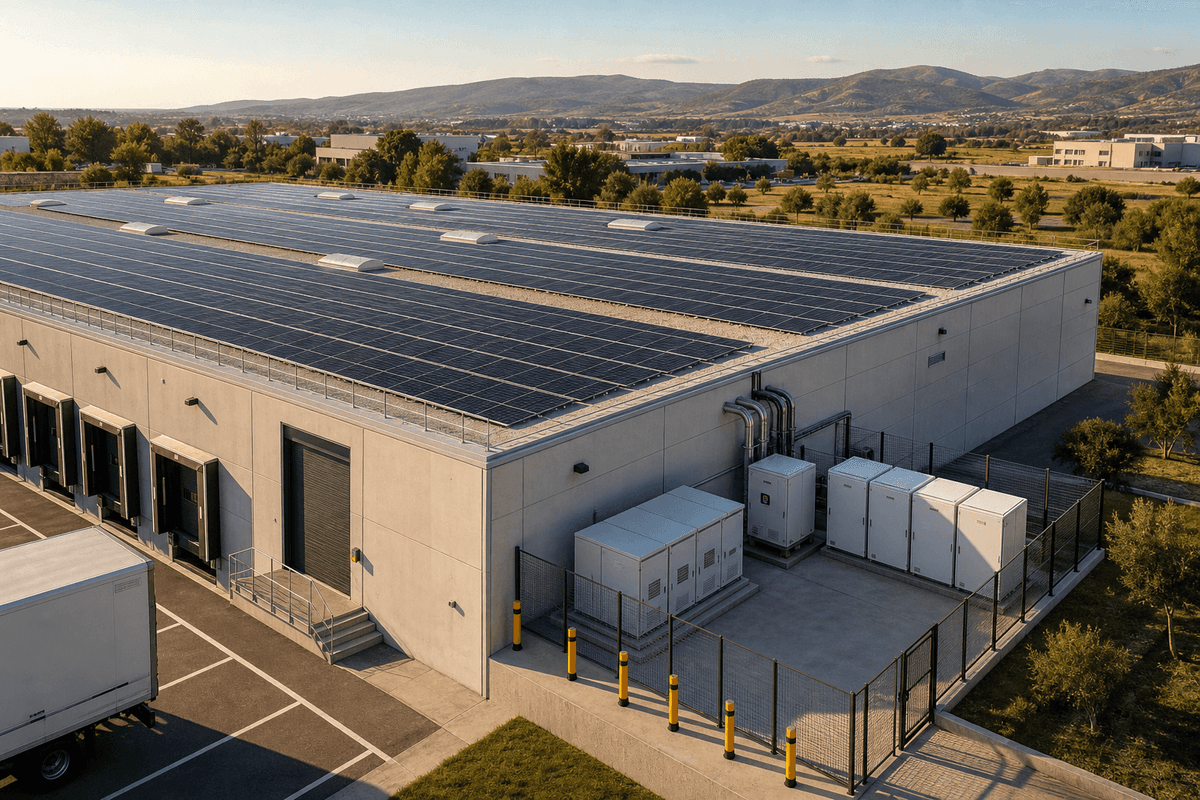
100kW + 200kWh Solar+Storage Commercial System - Peak Shaving & Energy Independence
Key Features
- 100kWp N-type TOPCon bifacial solar array generating 145 MWh annually with 22.5-24.5% module efficiency
- 200kWh LFP battery system with 6,000+ cycle life for peak shaving and 2-hour backup power
- 30-50% reduction in demand charges through intelligent energy management and load shifting
- 4-7 year payback period with LCOE below $0.05/kWh and 30-year performance warranty
- 103 tons CO₂ offset annually with IEC 61215, UL 9540A, and IEEE 1547 compliance
The SOLARTODO 100kW + 200kWh Solar+Storage Commercial system is designed for C&I applications, priced between $180,000 and $240,000. It features a high-efficiency solar array with 22.5%-24.5% efficiency and a robust battery storage system compliant with UL and IEC certifications. This solution enhances energy independence and operational resilience for businesses.
Description
The SOLARTODO 100kW + 200kWh Solar+Storage Commercial system represents the pinnacle of decentralized energy generation and management technology, engineered for businesses seeking to achieve energy independence, operational resilience, and significant long-term cost savings. This integrated solution combines a high-output 100-kilowatt (kWp) solar photovoltaic (PV) array with a robust 200-kilowatt-hour (kWh) battery energy storage system (BESS). It is specifically designed for commercial and industrial (C&I) applications, including manufacturing facilities, warehouses, office buildings, and retail centers, providing a reliable, clean, and economically advantageous alternative to conventional grid reliance.
At its core, the system leverages cutting-edge N-type Tunnel Oxide Passivated Contact (TOPCon) solar module technology, which has rapidly become the industry standard, projected to capture over 60% of the global PV market share by 2026. These modules, often in the 700W+ power class, deliver mass production efficiencies between 22.5% and 24.5%, a significant leap over older PERC technologies. The 100kWp array, comprising approximately 140 high-performance 720W modules, can generate an estimated 145 megawatt-hours (MWh) of clean energy annually, assuming an average solar irradiance of 4.5 kWh/m²/day. This output is sufficient to offset the electricity consumption of a medium-sized commercial operation, directly translating to reduced utility bills and a hedged position against volatile energy prices.
The integration of a 200kWh Lithium Iron Phosphate (LFP) battery system transforms the intermittent nature of solar power into a firm, dispatchable asset. LFP chemistry is renowned for its superior safety profile, long cycle life (typically exceeding 6,000 cycles at 80% depth of discharge), and thermal stability, making it the preferred choice for stationary energy storage in accordance with standards like UL 9540A. The BESS enables sophisticated energy management strategies, including peak shaving to reduce demand charges, load shifting to capitalize on time-of-use (TOU) rate arbitrage, and providing critical backup power during grid outages, ensuring business continuity. The system's intelligent inverter and energy management system (EMS) orchestrate the flow of energy, optimizing for either maximum self-consumption or grid services revenue, compliant with grid interconnection standards such as IEEE 1547.
The solar generation component of the system is built upon the latest advancements in crystalline silicon PV technology. The modules feature large-format 210mm N-type silicon wafers, which offer inherently lower degradation and higher efficiency potential compared to traditional P-type wafers. The TOPCon architecture involves creating an ultra-thin tunnel oxide layer and a layer of highly doped polysilicon on the rear surface of the cell. This passivated contact structure dramatically reduces surface recombination losses, a primary limiting factor in solar cell efficiency. This results in a higher open-circuit voltage (Voc) and fill factor, boosting the module's overall power output.
Furthermore, these modules are bifacial, capable of capturing reflected light (albedo) from the rear side, which can increase energy yield by an additional 10-20% depending on the installation surface (e.g., a white TPO roof or light-colored ground). The modules boast an exceptional 30-year linear performance warranty, guaranteeing no less than 87.4% of their nominal power output after three decades of operation. The first-year degradation is warranted to be less than 1%, with subsequent annual degradation capped at a mere 0.4%. This long-term performance assurance is critical for the financial modeling of commercial solar projects, ensuring a predictable and bankable return on investment. The entire assembly is certified to rigorous international standards, including IEC 61215 for design qualification and type approval, and IEC 61730 for safety.
The 100kWp array is mounted on a robust fixed-tilt structure, engineered from high-grade galvanized steel and aluminum to withstand diverse environmental conditions for over 25 years. While tracking systems can increase yield, the fixed-tilt design offers the lowest upfront cost, highest reliability, and minimal maintenance, making it the most cost-effective choice for many commercial rooftop and ground-mount applications. Power is converted from DC to AC by high-efficiency commercial string inverters (typically >98.5% peak efficiency), which comply with standards like IEC 62116 for anti-islanding protection, ensuring the safety of utility workers during grid maintenance.
The 200kWh BESS is the strategic heart of the SOLARTODO commercial solution, providing unparalleled control over energy consumption and supply. Housed in a climate-controlled, containerized unit, the system utilizes Lithium Iron Phosphate (LFP) cells, which are free of cobalt and offer a significantly lower risk of thermal runaway compared to other lithium-ion chemistries like Nickel Manganese Cobalt (NMC). This inherent safety is a paramount consideration for commercial installations. The BESS is sized to provide approximately two hours of backup power at the full rated output of the solar array (100kW), or can sustain a lower critical load for a much longer duration. Its primary economic function in a grid-tied scenario is demand charge management. Commercial electricity tariffs often include steep charges based on the highest peak power drawn from the grid during a billing cycle. The BESS can discharge rapidly to shave these peaks, keeping the grid draw below a predetermined threshold and slashing monthly demand charges by 30-50% or more.
Beyond peak shaving, the system's EMS enables sophisticated load shifting. The battery can be charged during off-peak hours when grid electricity is cheapest (or from free solar energy during midday) and discharged during peak hours when electricity is most expensive. This arbitrage creates a direct revenue stream or cost-saving mechanism. The 200kWh capacity provides ample storage to shift a significant portion of a facility's energy use. The system can also be configured to participate in grid services programs, such as frequency regulation or demand response, offering additional revenue opportunities where available. The entire storage solution is governed by a sophisticated Battery Management System (BMS) that monitors cell-level voltage, temperature, and state-of-charge, ensuring optimal performance and a lifespan of over a decade.
Investing in the SOLARTODO 100kW + 200kWh system is a strategic financial decision with compelling returns. With a price range of $180,000 to $240,000, the system's economics are underpinned by a low Levelized Cost of Energy (LCOE), often falling below $0.05/kWh over its lifetime, which is significantly cheaper than retail grid electricity in most markets. The combination of federal tax incentives (like the Investment Tax Credit in the U.S.), accelerated depreciation (MACRS), and local rebates can reduce the net capital outlay by 30-50%. A typical payback period for such a system ranges from 4 to 7 years, after which the generated electricity is virtually free. The system provides a powerful hedge against electricity price inflation, which has historically averaged 2-3% annually. By generating and storing its own power, a business can lock in its energy costs for the next 25-30 years. The estimated 145 MWh of annual generation displaces the equivalent of approximately 103 metric tons of carbon dioxide (CO₂) emissions each year, contributing significantly to corporate sustainability goals and enhancing brand image.
Technical Specifications
| System Capacity | 100kWp |
| Battery Storage Capacity | 200kWh |
| Module Type | N-type TOPCon Bifacial |
| Module Power Rating | 720W |
| Module Efficiency | 22.8% |
| Number of Modules | 140pcs |
| Array Configuration | Fixed-Tilt Ground/Roof Mount |
| Battery Chemistry | Lithium Iron Phosphate (LFP) |
| Battery Cycle Life | 6000cycles |
| Backup Power Duration | 2hours |
| Estimated Annual Generation | 145MWh |
| Capacity Factor | 16.5% |
| System Area Required | 550m² |
| CO₂ Offset (Annual) | 103tons |
| Payback Period | 4-7years |
| LCOE | 0.045$/kWh |
| Module Warranty | 30years |
| Inverter Warranty | 10years |
| Battery Warranty | 10years |
| Peak Demand Reduction | 30-50% |
Price Breakdown
| Item | Quantity | Unit Price | Subtotal |
|---|---|---|---|
| N-type TOPCon Bifacial Solar Modules (720W) | 140 pcs | $158 | $22,176 |
| Commercial String Inverters (100kW total) | 3 pcs | $1,667 | $5,000 |
| Fixed-Tilt Mounting System (galvanized steel) | 1 system | $8,000 | $8,000 |
| 200kWh LFP Battery Energy Storage System | 1 system | $80,000 | $80,000 |
| Battery Management System (BMS) | 1 system | $12,000 | $12,000 |
| Energy Management System (EMS) | 1 system | $8,000 | $8,000 |
| DC Cables & Combiner Box | 1 set | $2,000 | $2,000 |
| AC Infrastructure & Disconnect | 1 set | $3,000 | $3,000 |
| Monitoring System (cloud-based) | 1 system | $1,500 | $1,500 |
| Installation Labor & Commissioning | 1 project | $18,000 | $18,000 |
| Grid Connection & Utility Fees | 1 project | $3,500 | $3,500 |
| Engineering & Design | 1 project | $6,000 | $6,000 |
| Permits & Inspections | 1 project | $2,500 | $2,500 |
| Shipping & Logistics | 1 project | $4,000 | $4,000 |
| Warranty & Support (5 years) | 1 project | $5,324 | $5,324 |
| Total Price Range | $180,000 - $240,000 | ||
Frequently Asked Questions
What is the expected lifespan of the complete system?
How much physical space is required for the installation?
Can the system operate completely off-grid?
What are the primary maintenance requirements?
How does the system handle grid interconnection and compliance?
Certifications & Standards


Data Sources & References
- •PV-Tech 2023 TOPCon Market Analysis
- •NREL PVWatts Calculator 2025
- •IEC Standards Database
- •IEEE 1547-2018 Standard
- •UL 9540A Test Method
Interested in this solution?
Contact us for a customized quote based on your specific requirements.
Contact Us