Sky Hub Edge AI: On-Pole Drone Data Processing Pipeline |…

Cinn Song
Founder & Chief Solutions Architect
TL;DR
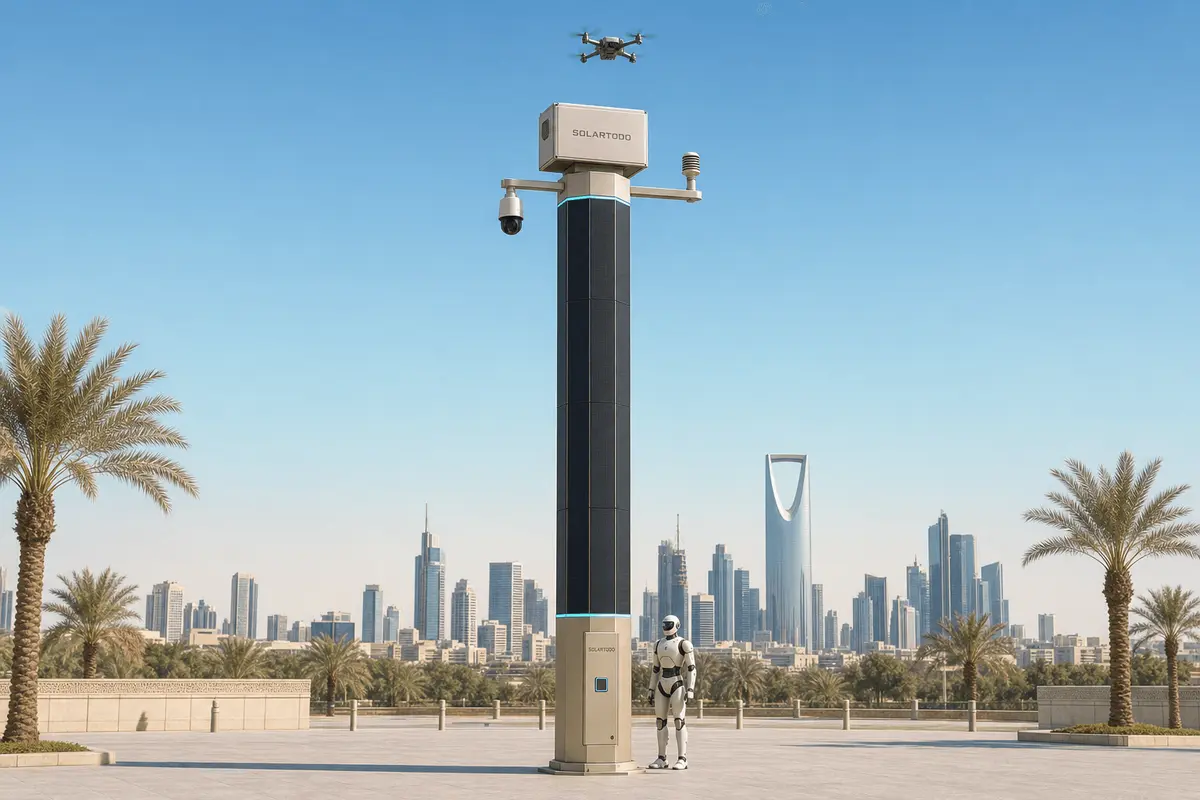
Sky Hub Edge AI is SOLARTODO's local-first drone data pipeline for a fully off-grid smart pole. It processes drone, sensor and robot events on-pole, keeps raw data local, sends only de-identified metadata, and schedules missions around 5-20 kWh storage plus about 7-10 kWh/day solar replenishment.
Sky Hub Edge AI explains how SOLARTODO processes drone, sensor and robot events on a fully off-grid smart pole using 5-20 kWh storage, 7-10 kWh/day solar replenishment and metadata-only reporting.
Summary
Sky Hub Edge AI explains how SOLARTODO processes drone, sensor and robot events on a fully off-grid smart pole using 5-20 kWh storage, 7-10 kWh/day solar replenishment and metadata-only reporting.
Key Takeaways
Sky Hub edge processing converts drone missions into local events across 4 workflow layers while keeping raw video and sensor records on the pole.
- Specify 5-20 kWh storage for high-power drone and robot operations, using on-pole solar as a 7-10 kWh/day replenishment layer rather than unlimited supply.
- Keep 100% of raw video and sensor streams on the pole, transmitting only de-identified event metadata, health status and mission summaries.
- Route drone inspection data through 4 stages: capture, local inference, event validation and authorized command response.
- Use 9 environmental inputs to decide whether a sortie, inspection pass or return-to-pole workflow should proceed.
- Separate hardware-ready, pilot-stage and leading-position capabilities into 3 procurement tiers to avoid overbuying immature automation.
- Plan EPC delivery in 3 commercial formats: FOB Supply, CIF Delivered and EPC Turnkey, with 5%, 10% and 15% volume guidance.
- Require human authorization for 100% of counter-UAS response actions, limited to detection, tracking, coordination and non-lethal demonstration workflows.
Sky Hub Edge AI Pipeline Overview
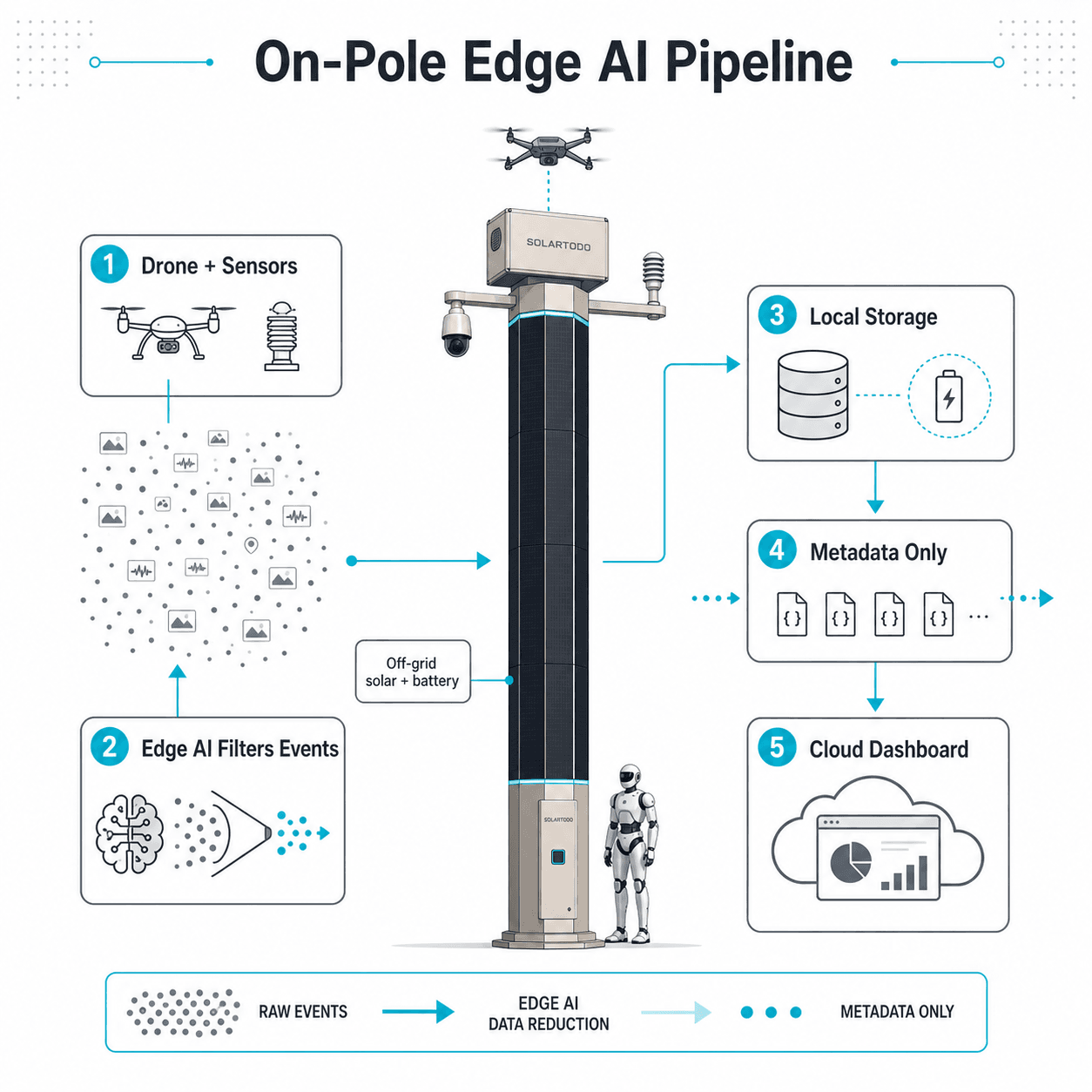
Sky Hub Edge AI is an on-pole processing architecture that turns drone data into local decisions within 4 steps: capture, inference, authorization and metadata reporting.
SOLARTODO Sky Hub should be understood as a pure smart pole for edge intelligence, drone operations and robot-ready field workflows. It is not a streetlight and does not include a lighting system. Advanced autonomy, robotic inspection and automated drone service are forward-looking concept capabilities at demonstration or pilot maturity unless verified deployment evidence is provided. The practical value for B2B buyers is simpler: move inspection data processing closer to where events occur, reduce upstream bandwidth and keep sensitive site data local.
The pipeline starts when the pole schedules a drone task, receives telemetry from a returning drone or correlates a fixed sensor event with a flight plan. Drone data can include mission status, position logs, still-image tags, inspection alarms and video-derived analytics. The edge node then runs local inference on a Jetson-class compute module and turns raw inputs into operational records such as intrusion alerts, asset-change flags, queue density, anonymous vehicle count or maintenance exceptions.
According to IEA (2024), data centres consumed about 460 TWh in 2022 and could exceed 1,000 TWh in 2026. The IEA states, "Electricity consumption from data centres, artificial intelligence (AI) and the cryptocurrency sector could double by 2026." For remote districts, ports, campuses and industrial perimeters, that trend supports edge-first design: not every video stream needs a cloud trip before it becomes useful.
SOLARTODO positions Sky Hub as a local common-operating-picture node rather than a cloud camera pole. The operating loop is sensing, authorized assessment, edge-compute scheduling and field maintenance coordination. The result is a compact workflow where drone sorties, environmental readings, pole health and robot status appear in one command view while raw data stays on the pole.
Technical Architecture and Data Flow
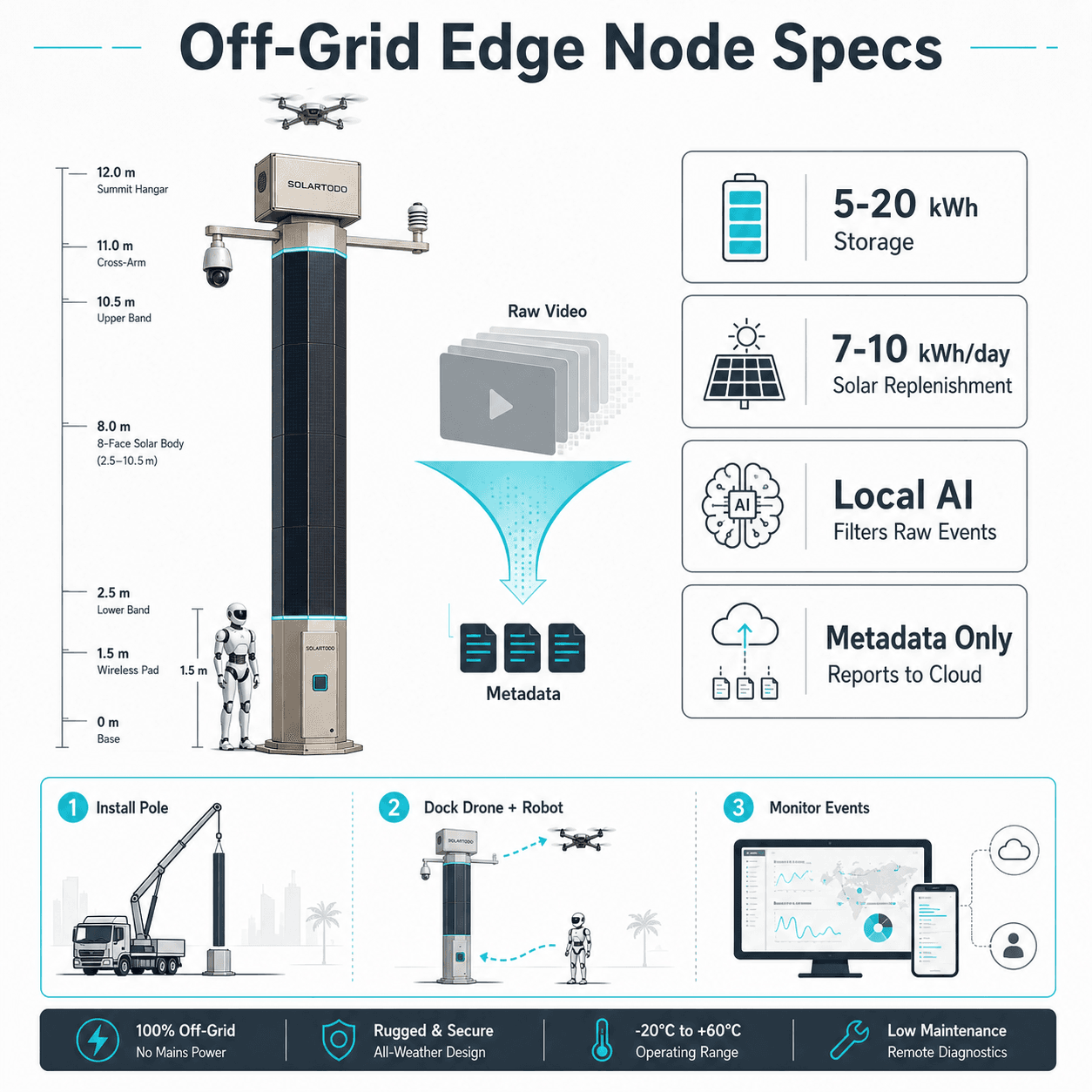
The Sky Hub processing stack uses 6 functional layers: sensing, mission control, inference, storage, policy authorization, and de-identified external reporting.
At the sensing layer, the pole accepts data from the drone, a PTZ perception device, a 9-parameter environmental package and service-robot interfaces. Environmental readings include wind speed, wind direction, temperature, humidity, pressure, noise, PM10, PM2.5 and illuminance. These signals are not decorative data; they determine whether a drone launch should be delayed, whether an inspection result needs weather context, and whether an alarm is probably environmental rather than operational.
At the mission layer, OTATODO acts as the edge workflow manager. It queues missions, tracks battery-swap or charge state, records route execution and monitors fleet health. A landed drone can enter a battery-service workflow, receive a charged pack from a multi-bay magazine and relaunch when the state machine confirms task priority, battery status, weather limits and authorization rules.
At the inference layer, Jetson-class compute runs local analytics. Suitable workloads include object detection, intrusion-zone events, equipment-state classification, crowd-density estimation and anonymous traffic counting. Face recognition and licence-plate recognition should not be specified as active capabilities for this concept. A procurement-ready configuration should define model type, frame sampling rate, retention policy, event taxonomy and expected false-alert handling before field acceptance testing.
At the data-governance layer, raw video and sensor data stay on the pole. Only de-identified event metadata, mission status, system health, alarms and maintenance logs may leave the site. That architecture is designed for local processing and PDPL/LGPD-oriented deployments, but it should not be described as certified unless a project has completed a documented third-party compliance review.
According to IEEE 1934-2018, fog and edge architectures place compute between field devices and centralized cloud systems. In Sky Hub terms, that means the pole can make short-cycle decisions locally while still escalating summaries to a command system. According to NREL PVWatts documentation, performance modelling can use hourly outputs, solar radiation, ambient temperature, wind speed and albedo, which is relevant when sizing solar replenishment and duty cycles for off-grid edge nodes.
| Pipeline Layer | Main Function | Data That Stays Local | Data That May Leave the Pole |
|---|---|---|---|
| Drone capture | Collect inspection and patrol evidence | Raw video, imagery and telemetry detail | Mission completion status |
| Edge inference | Classify events and anomalies | Model inputs and raw sensor frames | Event type, timestamp and confidence |
| Authorization | Confirm response rules | Review context and supporting evidence | Approved command state |
| Energy scheduler | Balance compute, flight and robot loads | Battery curves and local power logs | Health summary and service alert |
| Command view | Present common operating picture | Detailed source data | De-identified metadata and KPIs |
Off-Grid Energy and Compute Scheduling
Sky Hub is a battery-backed off-grid micro-station where 2.8-3.2 kWp on-pole PV can realistically replenish about 7-10 kWh/day in high-irradiance regions.
The energy architecture matters because edge AI, drone battery service and robot charging create short, high-power bursts. The on-pole solar surface is a supplemental replenishment layer, not a guarantee of unlimited self-sufficiency. In a high-irradiance region, realistic clear-sky output is roughly 1.0-1.3 kW DC peak across the day, with daily production around 7-10 kWh. High-load operations are therefore buffered by storage, typically in the 5-20 kWh class, and governed by duty cycle.
The scheduler should treat power as an operational constraint. A routine perimeter mission, a battery exchange, an environmental data upload and an AI model update should not all compete blindly. OTATODO can prioritize safety events, defer non-urgent analytics, throttle compute during low state of charge and schedule robot charging during lower mission demand.
According to IRENA (2025), solar added 452 GW of global capacity in 2024 and accounted for more than three quarters of renewable capacity expansion. IRENA states, "The share of renewables in total capacity expansion has increased significantly in 2024 and reached 92.5%." The same IRENA highlights show off-grid renewable capacity reached 14.3 GW in 2024, with solar accounting for 90.2% of that off-grid expansion. Those figures support the broader direction, but project sizing still requires local irradiation, dust, temperature and service-load modelling.
For EPC planning, engineers should produce an energy budget with at least 5 categories: base electronics, communications, edge compute, drone service and robot charging. A conservative acceptance test should include cloudy-day reserve, maximum mission count per day, peak battery-service load, communication outage mode and thermal derating. This is where a supplier's duty-cycle assumptions become more important than nameplate solar capacity.
Applications, Security and Human Authorization
Sky Hub is best suited to 6 controlled environments: campuses, industrial parks, ports, smart districts, energy assets and critical-infrastructure perimeters.
The strongest use cases are sites that need recurring inspection without installing several separate cabinets, towers and service points. A port can use the pole to coordinate perimeter events, weather-aware drone dispatch and asset inspection logs. An industrial park can use it for intrusion awareness, anonymous vehicle counts and equipment-zone checks. A campus can use it for emergency verification, crowd-density signals and maintenance-ticket evidence without exporting raw video streams.
Counter-UAS coordination must remain narrow and human-authorized. Sky Hub may detect and track an unauthorized drone and coordinate a friendly drone for a demonstration-mode aerial net-capture or close-approach deterrence workflow. It should not be specified as a weapon system, jammer or autonomous attack platform. Radar is not pole hardware; it may only be considered as an optional partner-sensor input or simulated data feed.
Cybersecurity should follow industrial control principles. IEC 62443-3-3 defines system security requirements and security levels for automation environments, while IEC 62443-4-2 addresses technical security requirements for components. For a Sky Hub project, the practical controls include signed updates, role-based access, encrypted communications, audit logs, separation of operator and maintainer roles, and hard limits on what data can leave the pole.
The maturity model should be explicit in tender documents. Hardware-ready items include the pole structure, energy architecture, sensor placement, battery-service architecture and compute integration. Pilot-stage items include drone-operations management, environmental monitoring, PTZ local analytics and OTATODO workflow orchestration. Leading-position items include full air-ground robot coordination, V2X integration, optional partner radar feeds and automated common-operating-picture workflows.
EPC Investment Analysis and Pricing Structure
EPC buyers should compare Sky Hub in 3 commercial scopes: FOB equipment supply, CIF delivered goods and full turnkey site delivery.
A turnkey EPC package normally includes site survey, foundation and civil interface design, pole installation, solar and storage commissioning, edge-compute configuration, drone-service workflow setup, communications testing, operator training and acceptance documentation. For controlled sites, the higher EPC cost may be justified because the integration risk sits in the interfaces: energy, autonomy, safety policy, data governance and maintenance access.
FOB Supply is suitable when the buyer or local integrator already controls import, civil works and commissioning. CIF Delivered adds international freight and insurance to the destination port, reducing logistics uncertainty but not solving site execution. EPC Turnkey adds design coordination, installation, commissioning and handover; it is the best fit for multi-site programs where uptime and repeatability matter more than the lowest initial purchase price.
Volume guidance can be presented as planning-level commercial logic, not a binding quote: 50+ units may support about 5% discount, 100+ units about 10%, and 250+ units about 15%, subject to configuration, country, warranty scope and logistics. Standard payment terms are 30% T/T deposit plus 70% against bill of lading, or 100% L/C at sight. Project financing may be available for large programs above $1,000K. Procurement teams can contact [email protected] for quotation coordination.
ROI should be modelled against conventional alternatives: separate pole or tower, camera cabinet, environmental station, drone charging point, storage cabinet, network cabinet and manual patrol vehicle time. The strongest savings usually come from avoided duplicate foundations, fewer site-power interfaces, lower recurring bandwidth and reduced field visits. A realistic payback model should include battery replacement reserves, service visits, software support, drone consumables and local permitting.
| Commercial Scope | Buyer Responsibility | Best Fit | Pricing Logic |
|---|---|---|---|
| FOB Supply | Import, freight, installation and commissioning | Experienced integrators | Lowest equipment-side price |
| CIF Delivered | Customs handling, installation and commissioning | Import-sensitive buyers | Adds freight and insurance |
| EPC Turnkey | Site access and acceptance coordination | Multi-site public or industrial programs | Highest scope, lowest integration risk |
FAQ
Sky Hub FAQ answers 10 procurement questions on architecture, energy, privacy, EPC pricing, counter-UAS limits, maintenance and deployment maturity.
Q: What is the Sky Hub Edge AI pipeline? A: The Sky Hub Edge AI pipeline is an on-pole workflow that collects drone, sensor and robot events, processes them locally, and sends only de-identified metadata outward. It has 4 practical stages: capture, local inference, authorization and reporting. Raw video and detailed sensor records remain on the pole.
Q: Is Sky Hub a smart streetlight? A: No. Sky Hub is a pure smart pole with no lighting system. It is designed to host edge compute, drone service, sensing, battery-backed off-grid energy and robot-ready workflows. Buyers should specify it for campuses, industrial parks, ports, smart districts and perimeter infrastructure rather than roadway lighting projects.
Q: How much solar energy can the pole realistically produce? A: In high-irradiance regions, the integrated on-pole PV layer is expected to provide about 1.0-1.3 kW DC clear-sky peak and roughly 7-10 kWh/day. That energy replenishes a battery-backed system; it does not mean unlimited solar operation under all weather, mission or maintenance conditions.
Q: What storage capacity should buyers plan for? A: A practical Sky Hub concept should be modelled around 5-20 kWh-class storage, depending on mission frequency, drone battery service, robot charging and communication uptime requirements. The battery absorbs high-power bursts while the solar surface replenishes energy over the day. EPC sizing should include cloudy-day reserve and peak mission loads.
Q: Does raw drone video leave the site? A: No. The intended architecture keeps raw video and sensor data on the pole for local processing. External systems receive de-identified metadata such as event type, timestamp, confidence score, mission status and maintenance alerts. This supports PDPL/LGPD-oriented design, although certification requires separate legal and technical verification.
Q: What AI workloads are appropriate for on-pole processing? A: Suitable workloads include intrusion detection, anonymous vehicle counts, crowd-density estimation, equipment-zone monitoring, environmental threshold alerts and mission health scoring. Face recognition and licence-plate recognition should not be treated as active capabilities for this concept. Workload sizing should define frame rate, model class, retention period and false-alert tolerance.
Q: How does Sky Hub handle counter-UAS events? A: Counter-UAS functions are limited to detection, tracking, command coordination and human-authorized non-lethal response demonstrations. A friendly drone may be coordinated for simulated net-capture or close-approach deterrence. The system should not be specified for jamming, destructive action, autonomous attack or any weaponized mitigation.
Q: What does EPC turnkey delivery include? A: EPC turnkey delivery can include survey, civil interface design, installation, solar and storage commissioning, edge workflow setup, communications testing, operator training and acceptance documentation. Pricing is usually compared across FOB Supply, CIF Delivered and EPC Turnkey scopes. Large projects above $1,000K may qualify for financing discussion.
Q: How should buyers evaluate ROI? A: ROI should compare Sky Hub against separate deployments for sensing, drone service, environmental monitoring, cabinets, network equipment and manual patrols. Benefits often come from fewer foundations, reduced cabling, lower bandwidth and fewer field visits. A credible model also includes software support, battery reserves, drone consumables and preventive maintenance.
Q: Which standards are relevant to procurement? A: Relevant references include IEC 62443 for industrial cybersecurity, IEC 61724-1 for PV performance monitoring, IEEE 1934-2018 for fog architecture, ISO/IEC 27001:2022 for information security management and UL 9540 for energy storage systems. These standards guide specifications, but they do not automatically certify a specific project.
References
The references below cite 7 authoritative sources for solar modelling, off-grid growth, edge architecture, cybersecurity and energy-storage safety.
- IEA (2024): Electricity 2024, documenting global electricity demand, data-centre growth from about 460 TWh in 2022 toward more than 1,000 TWh in 2026, and clean-power trends.
- IRENA (2025): Renewable Capacity Highlights 2025, reporting 585 GW of renewable additions in 2024, 452 GW of solar additions and 14.3 GW of off-grid renewable capacity.
- NREL PVWatts (2024): PVWatts V8 methodology and solar-resource modelling framework for estimating PV output using weather, irradiance, temperature, wind and albedo inputs.
- IEC 61724-1 (2021): Photovoltaic system performance monitoring standard defining measurement, data acquisition and monitoring quality expectations for PV systems.
- IEEE 1934-2018 (2018): Standard for Adoption of OpenFog Reference Architecture for Fog Computing, relevant to distributed edge and cloud-to-field system design.
- IEC 62443-4-2 (2019): Technical security requirements for industrial automation and control system components used in OT and edge infrastructure.
- ISO/IEC 27001 (2022): Information security management system requirements for risk management, security controls, audit discipline and continual improvement.
- UL 9540 (2023): Safety standard for energy storage systems and equipment used to frame battery-system safety expectations in stationary installations.
Conclusion
Sky Hub Edge AI is a local-first drone data pipeline that combines 4 processing stages, 5-20 kWh storage and metadata-only reporting for off-grid smart infrastructure.
The bottom line: SOLARTODO Sky Hub is strongest where buyers need local drone intelligence, controlled data handling and off-grid resilience from one smart pole. For serious procurement, specify duty-cycle assumptions, privacy rules, human authorization, 7-10 kWh/day replenishment expectations and EPC scope before requesting a final quotation.
About SOLARTODO
SOLARTODO is a global integrated solution provider specializing in solar power generation systems, energy-storage products, smart street-lighting and solar street-lighting, intelligent security & IoT linkage systems, power transmission towers, telecom communication towers, and smart-agriculture solutions for worldwide B2B customers.
About the Author

Cinn Song
Founder & Chief Solutions Architect
Cinn Song founded SOLARTODO LIMITED and leads its smart-city infrastructure engineering — from solar, storage and integrated smart poles to the company's push into physical-AI city edge nodes: pole-mounted edge computing, vertical LLMs for smart cities, drone-based O&M with autonomous battery swapping, robotic maintenance, and high-speed counter-UAS interception. Since 2010, he has directed turnkey EPC + BOT delivery across 50+ countries, including telecom monopole supply for national grid operators, off-grid solar street-lighting for African municipalities, and integrated smart-pole programs for Gulf smart cities.
Cite This Article
Cinn Song. (2026). Sky Hub Edge AI: On-Pole Drone Data Processing Pipeline |…. SOLARTODO. Retrieved from https://solartodo.com/knowledge/sky-hub-edge-ai-on-pole-drone-data-processing-pipeline-2
@article{solartodo_sky_hub_edge_ai_on_pole_drone_data_processing_pipeline_2,
  title = {Sky Hub Edge AI: On-Pole Drone Data Processing Pipeline |…},
  author = {Cinn Song},
  journal = {SOLARTODO Knowledge Base},
  year = {2026},
  url = {https://solartodo.com/knowledge/sky-hub-edge-ai-on-pole-drone-data-processing-pipeline-2},
  note = {Accessed: 2026-06-22}
}
Published: June 21, 2026 | Available at: https://solartodo.com/knowledge/sky-hub-edge-ai-on-pole-drone-data-processing-pipeline-2
Subscribe to Our Newsletter
Get the latest solar energy news and insights delivered to your inbox.
View All Articles