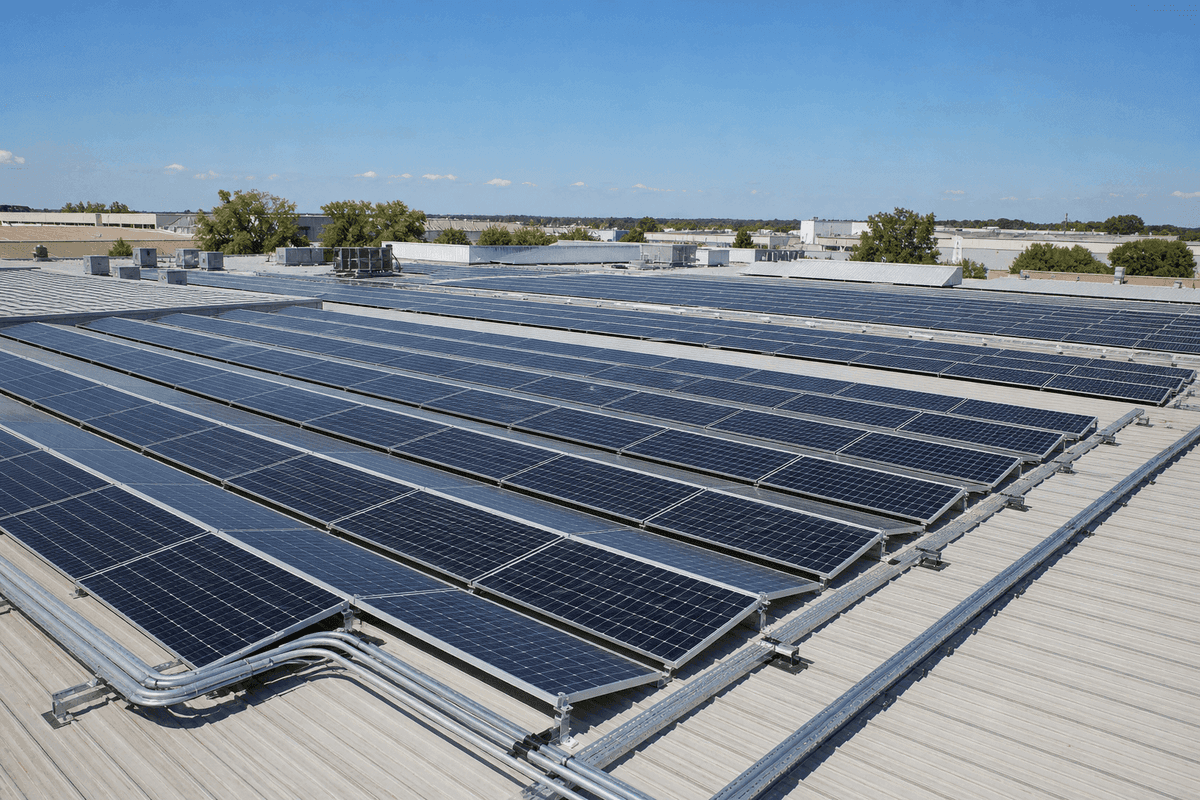
300kW Industrial Metal Roof PV System - TOPCon EPC Turnkey
Key Features
- 300.3kWp DC capacity using approximately 429 x 700W N-type TOPCon modules
- 24.5% module efficiency reduces roof area by about 12-16% versus 21% PERC modules
- 468MWh estimated annual generation at a 17.8% modeled capacity factor
- $129,600-$165,600 EPC turnkey price with engineering, installation, commissioning, and 1-year support
- 211 tons/year estimated CO2 offset using a 0.45tCO2/MWh grid-emission factor
The 300kW Industrial Metal Roof PV System is a fixed-array commercial solar package using N-type TOPCon modules up to 24.5% efficiency, 300.3kWp DC capacity, and string-inverter architecture. SOLARTODO supplies FOB, CIF, and EPC turnkey configurations from $80,352 to $165,600 for factories, warehouses, and logistics buildings.
Description
The 300kW Industrial Metal Roof Solar PV System is a 300.3kWp fixed-array rooftop power plant designed for factories, logistics centers, cold-storage buildings, and large metal-roof industrial assets. It uses N-type TOPCon mono modules with up to 24.5% efficiency, approximately 429 pieces of 700W-class panels, and an estimated annual output of 468MWh under a 17.8% modeled capacity factor.
For B2B procurement teams, the system is positioned between small commercial rooftop solar below 100kW and utility-scale PV above 1MW, with EPC turnkey pricing from $129,600 to $165,600. Buyers can View all Solar PV System products, Configure your system online, or Request a custom quotation for roof load, wind zone, grid-code, and metering requirements.
System Architecture
A 300kW metal-roof PV plant typically uses 6 string inverters rated around 50kW each, 12 to 18 DC input circuits per inverter group, and 1 AC distribution panel connected to the building low-voltage bus or a step-up transformer. The fixed array reduces moving parts by 100% compared with tracker systems, which is why rooftop systems usually prioritize ballast, clamps, standing-seam interfaces, and cable containment rather than motors or hydraulic drives.
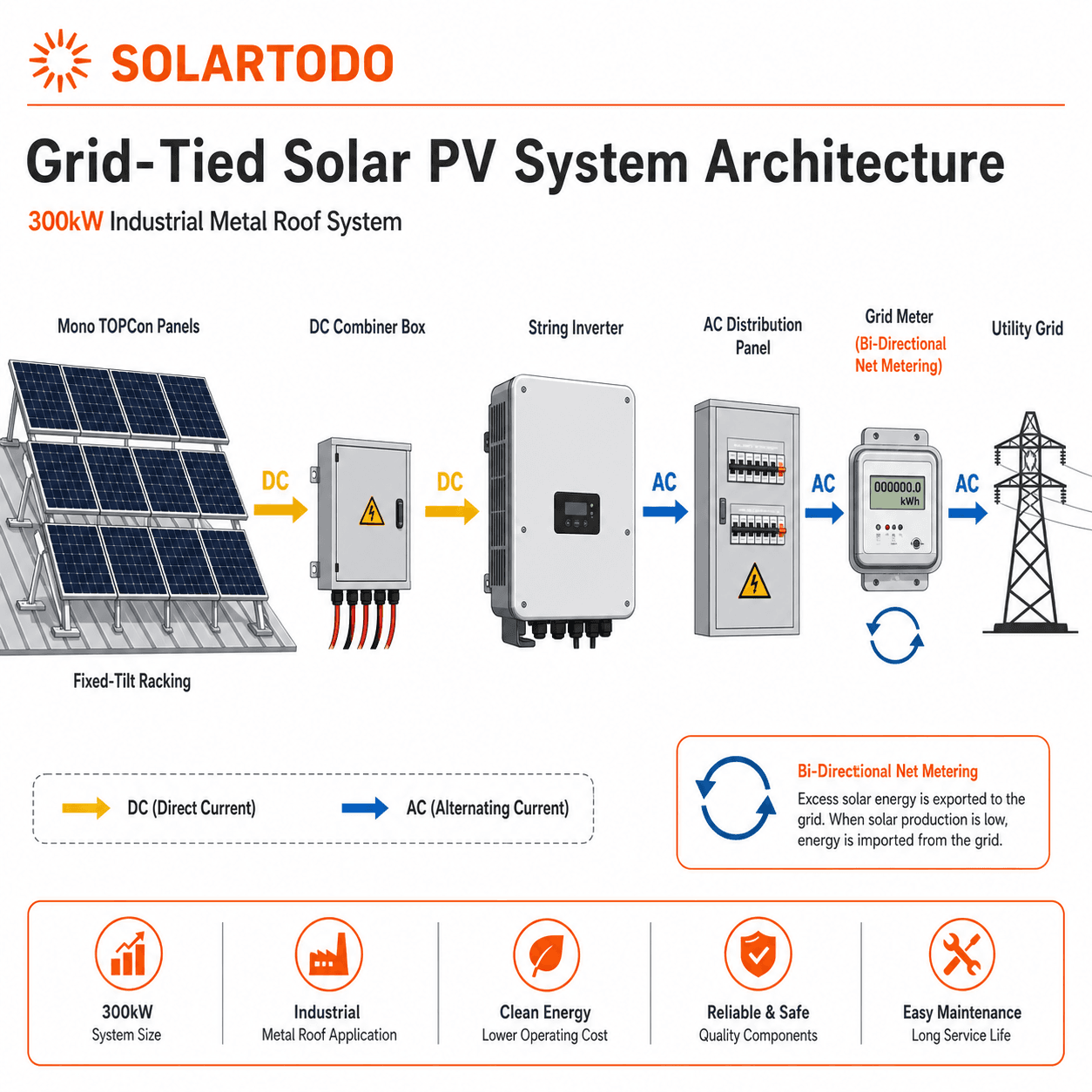
The DC side is built around N-type TOPCon modules using passivated-contact cell technology, 210mm wafer formats, and bifacial-capable glass configurations where roof reflectance supports a 5% to 10% rear-side gain. Compared with conventional p-type PERC modules at 20.5% to 21.5% efficiency, 24.5% TOPCon modules can reduce required module area by about 12% to 16% for the same 300kW nameplate capacity.
The AC side uses commercial string inverters rather than a central inverter because 300kW is below the 500kW threshold where central inverter economics commonly dominate. This distributed design limits a single inverter fault to roughly 16.7% of AC capacity, improves roof-zone MPPT granularity, and supports section-by-section shutdown for maintenance under IEC 62116 anti-islanding and local utility interconnection rules.
Technical Specifications
The standard design capacity is 300kWp DC, calculated as 429 modules x 700W = 300.3kWp before inverter clipping and site-specific derating. With 1,400m2 of planned roof area, the layout normally reserves 12% to 18% of available surface for walkways, fire setbacks, drainage paths, skylight clearance, and edge-zone wind loading.
| Parameter | Standard Value | Engineering Note |
|---|---|---|
| DC capacity | 300.3kWp | 429 x 700W TOPCon modules |
| Module efficiency | 24.5% | N-type mono TOPCon class |
| Array type | Fixed tilt | Metal roof clamps or rails |
| Annual generation | 468MWh/year | Modeled at 17.8% capacity factor |
| CO2 offset | 211t/year | Based on 0.45tCO2/MWh grid factor |
| EPC price | $129,600-$165,600 | Installed and commissioned |
The module package follows IEC 61215 design qualification, IEC 61730 safety qualification, and UL 1703 legacy module safety references where required by procurement specifications. For bankable industrial projects, SOLARTODO recommends factory flash-test reports for 100% of modules, electroluminescence inspection for sampled lots, and serial-number traceability covering all 429 panels.
Expected degradation is below 1.0% in year 1 and below 0.4% per year after year 2, leaving about 87.4% warranted output at year 30 for many N-type TOPCon warranties. This matters for industrial roofs because the steel roof asset may have a 25-year service plan, while the solar array can remain financially productive through 30 years if corrosion, grounding, and waterproofing are engineered correctly.
Industrial Metal Roof Application
A typical use case is a 24-hour packaging factory in the MENA region with 1,800m2 of trapezoidal metal roof, a 420kVA service transformer, and daytime loads between 180kW and 260kW. After installing a 300kW fixed rooftop array, the operator can self-consume about 70% to 85% of annual PV production when cooling, compressors, and conveyor loads operate during daylight hours.
Compared with buying all electricity from a diesel-backed grid at $0.14/kWh, the modeled 468MWh annual generation can reduce purchased electricity by about $65,520/year before O&M and demand-charge effects. Compared with a diesel generator consuming 0.27L/kWh, the same PV output can avoid roughly 126,000L of diesel per year and reduce fuel logistics exposure by more than 80 truck deliveries over 25 years.
The roof interface is selected after 3 checks: metal profile geometry, purlin spacing, and corrosion category. Standing-seam clamps can avoid roof penetrations in many cases, while trapezoidal roofs may use EPDM-sealed fasteners at 4 to 6 attachment points per module row depending on wind uplift calculations and local structural codes.
Cloud Monitoring
The monitoring system records inverter output, string current, daily yield, fault codes, and grid export at 5-minute to 15-minute intervals. A 300kW plant normally generates 1,200kWh to 1,600kWh on a strong irradiance day, so cloud analytics can identify a 5% underperformance event within 1 operating day instead of waiting for monthly utility bills.
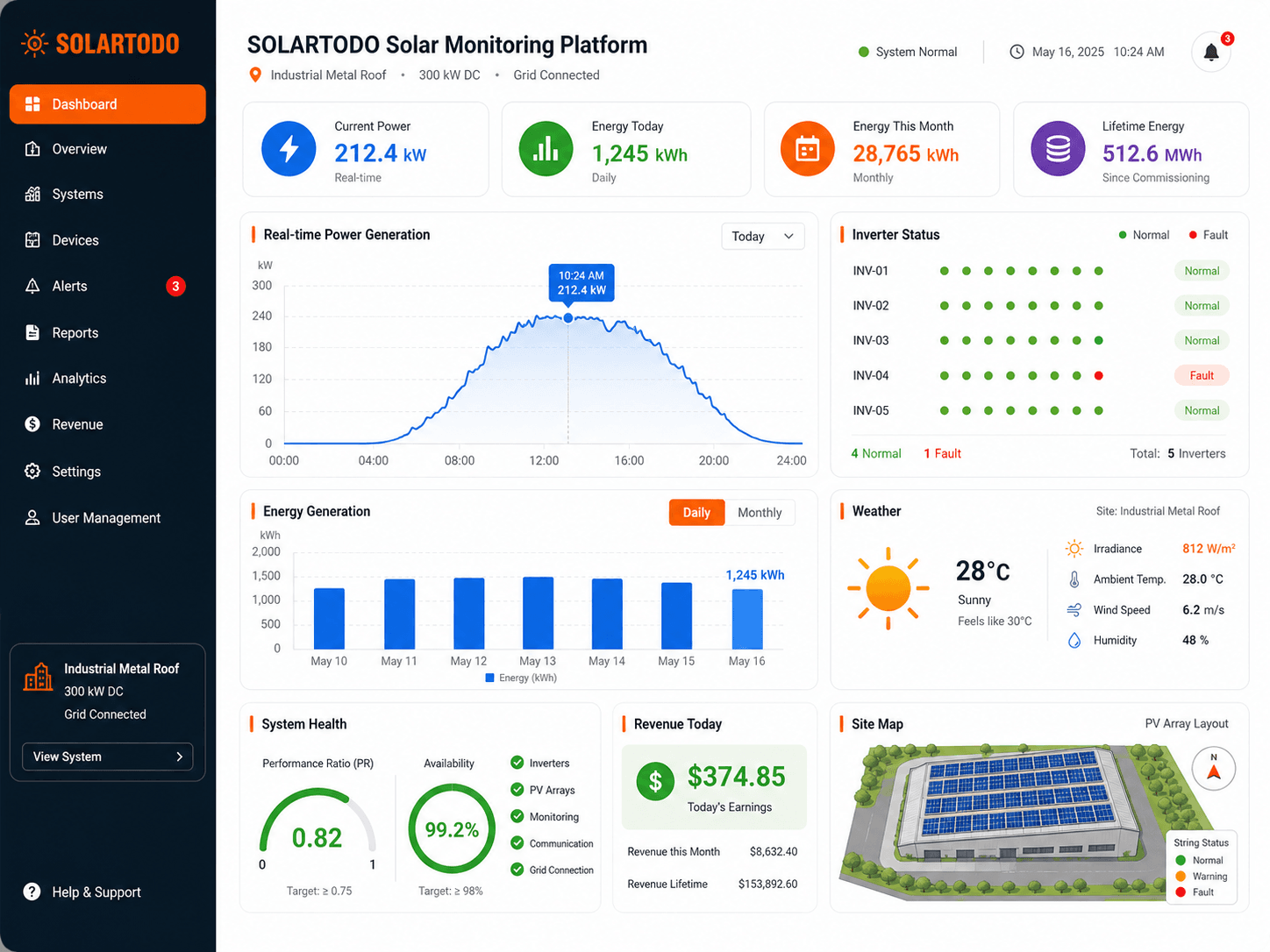
Remote O&M workflows include 3 practical alarms: inverter trip, string mismatch above 8%, and AC export limit violation. These alarms help asset managers dispatch technicians with exact inverter IDs, string numbers, and timestamped performance data, which can reduce diagnostic site visits by 1 to 2 trips per fault event.
For teams building internal energy dashboards, the monitoring layer can export kWh, kW, voltage, current, and fault status into an EMS or BMS using Modbus TCP, RS485, or API gateways. Buyers can Learn about topic for solar monitoring concepts and Learn about topic for commercial PV sizing, grid connection, and procurement checklists.
Standards, Bankability, and Market Context
NREL PVWatts is commonly used as an early-stage yield reference because it converts irradiance, temperature, array tilt, azimuth, and system losses into annual kWh estimates. For this 300kW package, SOLARTODO uses 468MWh/year as a preliminary planning value, while final EPC engineering should run site-specific simulations using 8760-hour weather data and roof-shading geometry.
IRENA reported continued reductions in solar PV generation costs through 2024, and many high-irradiance markets can now produce utility-scale PV electricity below $0.03/kWh under favorable financing. Industrial rooftop PV usually has a higher LCOE than desert utility PV because of roof access, safety systems, and smaller procurement volume, but a 300kW rooftop plant can still target about $0.032/kWh over a 25-year operating period.
IEA and IEA PVPS market data show solar PV as one of the fastest-growing electricity technologies, with global installed PV capacity exceeding 2TW by the mid-2020s. BloombergNEF and Wood Mackenzie have also identified N-type technologies, including TOPCon, as mainstream capacity additions during 2025 and 2026 because higher efficiency reduces BOS cost per watt on constrained roofs.
IEC 61215 and IEC 61730 remain the baseline module standards for qualification and safety, while IEC 62116 addresses inverter anti-islanding behavior. For North American or export-financed projects, procurement teams may also request UL 1703 references, UL 61730 alignment, IEEE 1547 interconnection compliance, and NEC rapid-shutdown review depending on the authority having jurisdiction.
EPC Investment Analysis and Pricing Structure
SOLARTODO’s EPC turnkey scope includes 5 work packages: engineering design, procurement, construction, commissioning, and 1-year warranty support. Engineering covers roof survey, layout, single-line diagram, string plan, grounding plan, wind-uplift review, and yield estimate; procurement covers modules, inverters, mounting, cable, AC panels, protection devices, and monitoring.
| Pricing Tier | Scope | Price Range |
|---|---|---|
| FOB Supply | Equipment only, ex-works China | $80,352-$112,608 |
| CIF Delivered | Equipment plus ocean freight and insurance | $88,652-$124,240 |
| EPC Turnkey | Installed, commissioned, and 1-year warranty | $129,600-$165,600 |
| Volume Tier | Discount | Typical Buyer |
|---|---|---|
| 50+ systems | 5% | Regional distributor or EPC integrator |
| 100+ systems | 10% | National rooftop rollout program |
| 250+ systems | 15% | Multi-country industrial portfolio |
At the EPC midpoint of $147,600 and annual output of 468MWh, a facility paying $0.12/kWh can offset about $56,160/year in gross electricity purchases. After allowing $1,500/year for inspection, cleaning, and monitoring, the simple payback is about 2.7 years, while a $0.09/kWh tariff gives a longer 3.7-year payback.
The cost comparison is strongest where diesel backup, high daytime tariffs, or carbon reporting obligations increase the value of each kWh. Against grid-only supply at $0.12/kWh, 25-year generation of about 11,700MWh represents $1.40 million of gross avoided electricity purchases before degradation, tariff escalation, inverter replacement, and tax treatment.
Standard payment terms are 30% T/T deposit plus 70% against B/L copy, or 100% L/C at sight for approved bank instruments. Project financing can be discussed for portfolios above $5,000K, and commercial buyers can contact [email protected] for country-specific EPC scope, Incoterms, warranty language, and commissioning documentation.
Procurement Notes
The recommended procurement package includes 7 document groups: datasheets, IEC certificates, inverter compliance reports, mounting structural calculations, cable and connector certificates, factory QA records, and commissioning checklists. A complete 300kW handover file should include insulation-resistance tests, polarity checks, torque records, inverter startup logs, and 30 days of monitoring validation.
For metal roofs older than 10 years, SOLARTODO recommends confirming roof coating life, fastener condition, drainage performance, and spare load capacity before signing EPC contracts. A 300kW array can add roughly 12kg/m2 to 18kg/m2 depending on module, rail, and ballast choices, so structural verification is a commercial requirement rather than an optional engineering exercise.
Technical Specifications
| System Capacity | 300kWp |
| Module Type | N-type mono TOPCon |
| Module Efficiency | 24.5% |
| Array Configuration | Fixed metal roof array |
| Estimated Annual Generation | 468MWh/year |
| Capacity Factor | 17.8% |
| System Area | 1400m2 |
| CO2 Offset | 211tons/year |
| Payback Period | 2.7years at $0.12/kWh midpoint EPC |
| LCOE | 0.032USD/kWh |
| Warranty | 25yr panels, 10yr inverter, 1yr EPC support |
Price Breakdown
| Item | Quantity | Unit Price | Subtotal |
|---|---|---|---|
| 700W N-type TOPCon solar module | 429 pcs | $154 | $66,066 |
| 50kW commercial string inverter | 6 pcs | $4,000 | $24,000 |
| Fixed metal roof mounting set | 300 pcs | $80 | $24,000 |
| DC cables, connectors, and combiner protection | 1 pcs | $6,000 | $6,000 |
| AC distribution and protection infrastructure | 1 pcs | $9,000 | $9,000 |
| Cloud monitoring gateway and meter | 1 pcs | $500 | $500 |
| Grid connection and commissioning interface | 1 pcs | $2,000 | $2,000 |
| Engineering design and quality control | 1 pcs | $6,500 | $6,500 |
| Installation and commissioning labor | 1 pcs | $18,000 | $18,000 |
| 1-year warranty and technical support | 1 pcs | $3,500 | $3,500 |
| Project logistics and site coordination | 1 pcs | $5,000 | $5,000 |
| Total Price Range | $129,600 - $165,600 | ||
Frequently Asked Questions
What is included in the EPC turnkey price for the 300kW Industrial Metal Roof system?
How much roof area is required for a 300kW industrial metal roof PV system?
What annual energy output should buyers expect from this system?
Which certifications and standards apply to the modules and inverters?
Why use N-type TOPCon modules instead of conventional PERC modules?
Certifications & Standards


Data Sources & References
- •NREL PVWatts Calculator and PV performance modeling: https://pvwatts.nrel.gov/
- •IEC 61215 photovoltaic module design qualification: https://webstore.iec.ch/
- •IEC 61730 photovoltaic module safety qualification: https://webstore.iec.ch/
- •IEC 62116 utility-interconnected PV inverter anti-islanding test procedure: https://webstore.iec.ch/
- •IRENA Renewable Power Generation Costs 2024: https://www.irena.org/Publications
- •IEA PVPS Trends in Photovoltaic Applications 2025: https://iea-pvps.org/
- •BloombergNEF and Wood Mackenzie solar technology market outlook references
Interested in this solution?
Contact us for a customized quote based on your specific requirements.
Contact Us