Beyond-Visual-Line-of-Sight Drone Operations from Smart…

Cinn Song
Founder & Chief Solutions Architect
TL;DR
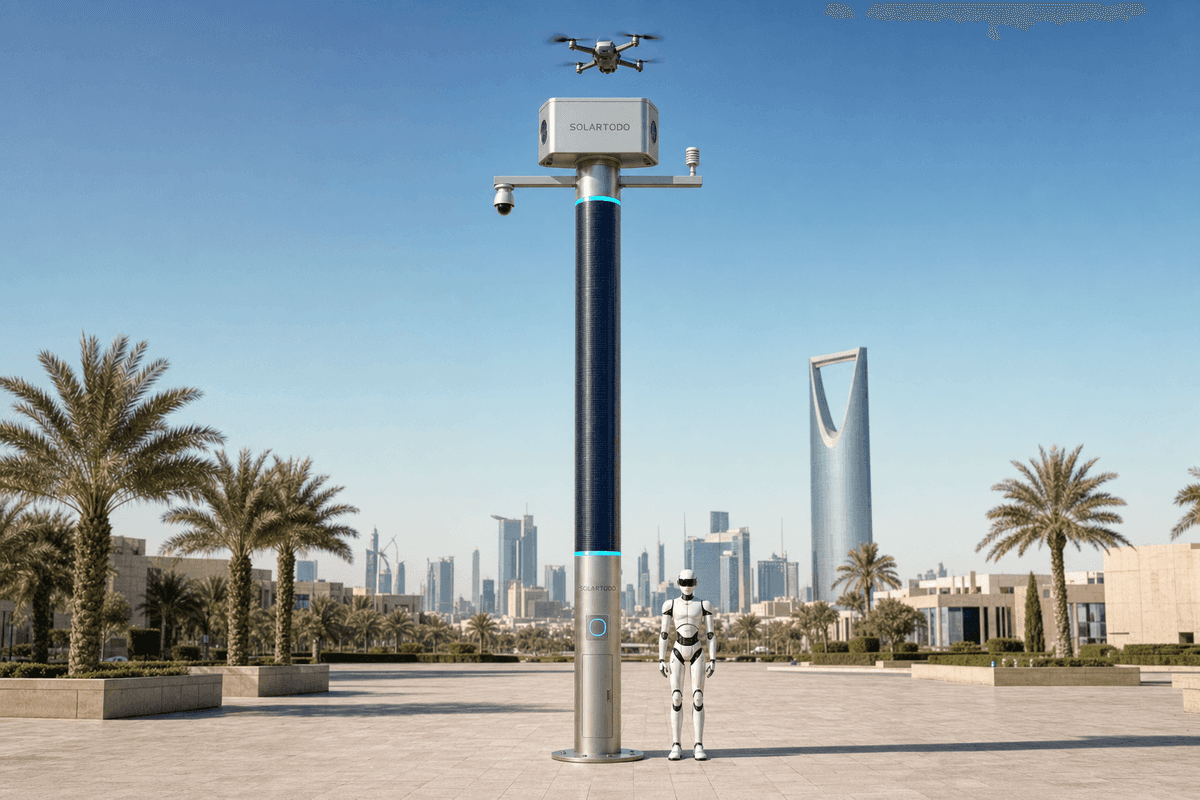
BVLOS drone operations from smart pole networks work best as approval-led pilots, not instant full rollouts. SOLARTODO Sky Hub combines fully off-grid 5-20 kWh storage, realistic 0.8-1.1 kW CIGS replenishment, local edge processing, drone battery service, and human-authorized mission control for controlled corridors such as ports, campuses, industrial parks, and critical-infrastructure perimeters.
BVLOS drone operations from SOLARTODO smart pole networks use 0.8-1.1 kW CIGS replenishment, 5-20 kWh storage, and 48,383 FAA BEYOND BVLOS flights as benchmarks for pilot-stage procurement and site planning.
Summary
BVLOS drone operations from SOLARTODO smart pole networks use 0.8-1.1 kW CIGS replenishment, 5-20 kWh storage, and 48,383 FAA BEYOND BVLOS flights as benchmarks for pilot-stage procurement and site planning.
Key Takeaways
These 8 procurement takeaways translate BVLOS smart pole networks into energy budgets, approval gates, EPC scope, ROI assumptions, and pilot-stage operating limits.
- Define BVLOS scope by corridor length, approval pathway, Remote ID status, and at least 1 human authorization gate before procurement.
- Model each SOLARTODO Sky Hub energy budget around 0.8-1.1 kW DC peak CIGS output and 6-9 kWh/day replenishment.
- Size battery storage at 5-20 kWh per pole to buffer drone swaps, edge compute, sensing, and robotic patrol duty cycles.
- Plan pilot operations around 3 maturity tiers: hardware-ready, pilot-stage workflows, and leading-position integrations requiring validation.
- Use edge processing to keep 100% of raw video and sensor feeds on the pole while sending only de-identified event metadata.
- Compare pole networks against crewed patrols by estimating 20-40% fewer routine site visits on large campuses after pilot validation.
- Specify C-UAS only as human-authorized, non-lethal detection, tracking, coordination, and simulated net-capture or close-approach deterrence.
- Request EPC pricing in 3 tiers, then apply 5%, 10%, or 15% volume guidance at 50, 100, or 250 units.
BVLOS Smart Pole Networks for Off-Grid Drone Operations
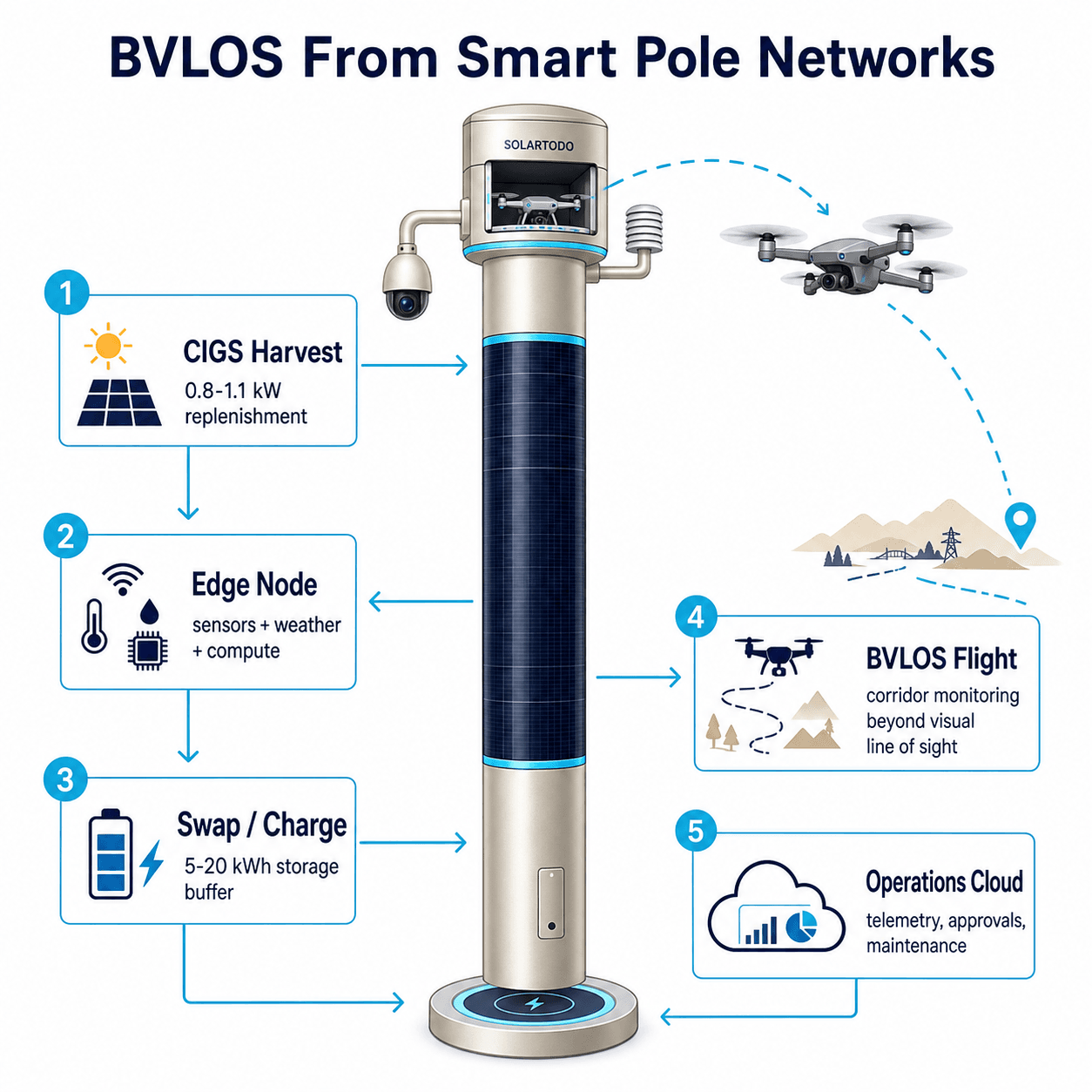
BVLOS smart pole networks move drone operations from single launch points to distributed, approval-controlled infrastructure using 5-20 kWh storage and 6-9 kWh/day solar replenishment. For SOLARTODO Sentinel / Sky Hub, autonomous drone service, robotic inspection, air-ground coordination, and C-UAS response are forward-looking concept capabilities at demonstration or pilot stage unless separately evidenced.
Beyond-visual-line-of-sight operations are not just a longer flight path. They require a system that can prove where the aircraft is, what it is doing, how risks are detected, and who is authorized to intervene. A smart pole network helps because each node becomes a fixed point for power buffering, local compute, environmental sensing, vehicle status, and command records.
The SOLARTODO Sky Hub concept should be understood as a pure smart pole with no lighting system. It is aimed at smart districts, industrial parks, ports, campuses, city perimeters, utility corridors, and critical-infrastructure zones where a buyer wants patrol, inspection, alarm verification, and on-site autonomy from a repeatable pole-form micro-station.
According to the FAA BEYOND program (2025), Phase 1 recorded 70,563 flights, including 48,383 BVLOS flights, before Phase 2 began in 2025. The FAA also states, "Remote ID lays the foundation" for more complex drone operations, so identification, telemetry, and control-station accountability belong in the procurement package.
For B2B buyers, the business problem is usually not the drone itself. The hard problem is repeatability: keeping aircraft charged, dispatching tasks, maintaining audit logs, and monitoring weather limits. A pole network gives the owner operational anchors that can be commissioned, inspected, and governed like other critical infrastructure.
Technical Architecture and Data Governance
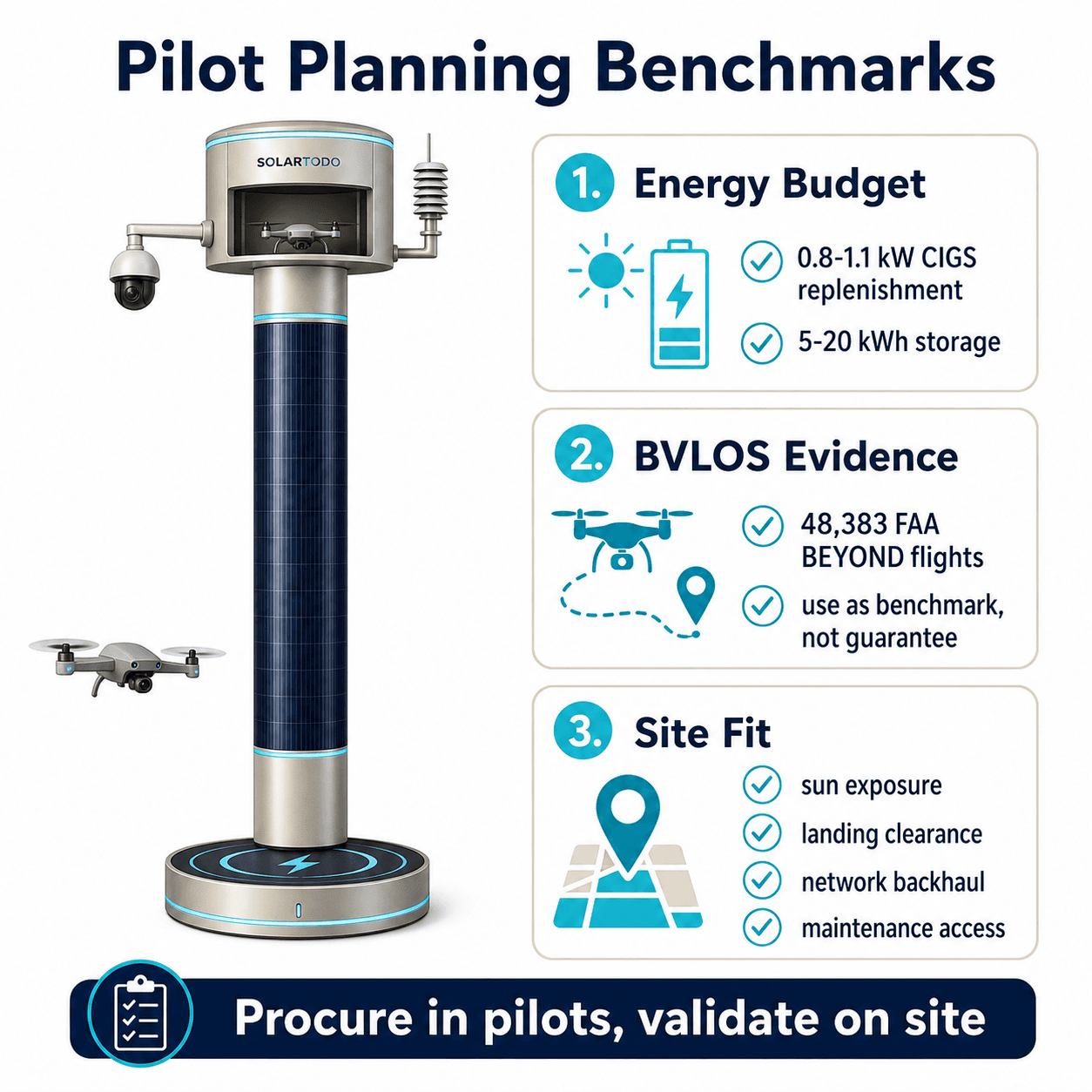
A BVLOS-ready Sky Hub node combines 9 functional domains: off-grid power, drone service, edge compute, sensing, environmental data, mission control, robot support, C-UAS coordination, and metadata exchange.
Energy and Duty-Cycle Architecture
The pole is designed as a fully off-grid, battery-backed micro-station. Its CIGS replenishment layer should be modeled at about 0.8-1.1 kW DC peak in strong solar regions, with about 6-9 kWh/day in clear-sky conditions and roughly 5-8 kWh/day annual average where solar resource is favorable. That is a replenishment budget, not unlimited self-sufficiency.
High-power tasks are scheduled against storage and duty cycle. Drone launch, return, automated battery exchange, edge inference, environmental sensing, communications, and ground-robot charging all draw from the same energy envelope. A 5-20 kWh-class battery allows the system to absorb short peaks while the CIGS layer restores state of charge.
According to NREL PVWatts V8 (2026), PV modeling can accept 0.05-500,000 kW system capacity inputs and hourly outputs; use it for site screening, not final CIGS yield guarantees. According to IRENA (2026), renewables added 692 GW in 2025 and represented 85.6% of global capacity expansion, with solar accounting for about 511 GW. IRENA Director-General Francesco La Camera states, "renewable energy remains consistent and steadfast in its expansion."
Edge Compute, Privacy, and Mission Workflow
The edge stack uses Jetson-class compute to run local inference, schedule workloads, and manage event routing. Raw video and sensor data stay on the pole. Only de-identified alerts, status metadata, mission logs, battery state, and equipment health records should leave the node.
This local-processing design supports PDPL/LGPD-oriented governance because the control room receives operational evidence without defaulting to continuous raw-data export. It also reduces bandwidth load where many events are low-value until a rule threshold is crossed. Local analytics should be limited to anonymous vehicle count, crowd density, intrusion, and perimeter awareness, not active face recognition or licence-plate recognition.
The operational loop is sensing, authorized assessment and response, edge-compute scheduling, and field operations and maintenance. In command-center terms, this becomes a common operating picture that shows node status, mission queue, weather limits, aircraft readiness, robot availability, event severity, and human authorization state.
Drone Service and C-UAS Boundaries
The drone workflow includes launch, patrol, inspection, return, battery exchange, and task redeployment. A multi-bay battery magazine can support several consecutive sorties by replacing the landed aircraft battery with a charged pack. Mission management should include route planning, swap state, task queueing, health telemetry, and logs.
C-UAS coordination must remain non-lethal and human-authorized. The pole can detect and track an unauthorized drone using onboard perception and optional partner-sensor input, then coordinate a friendly drone for simulated aerial net-capture or close-approach deterrence. Radar should be treated only as an optional or simulated external input, not as pole hardware. Any mitigation requires local legal review and explicit operator approval.
EPC Investment Analysis and Pricing Structure
EPC delivery should compare 3 commercial scopes: FOB equipment supply, CIF delivered logistics, and turnkey deployment with installation, commissioning, training, and acceptance testing.
For SOLARTODO, procurement normally follows inquiry, offline quotation, engineering review, delivery scope confirmation, and financing discussion for qualified large projects. EPC turnkey delivery should include site survey, civil works coordination, pole foundations, off-grid energy commissioning, drone-service setup, environmental sensor calibration, network integration, operator training, spare-parts planning, and acceptance testing.
Three-tier pricing helps avoid hidden assumptions. FOB Supply covers the factory equipment package and export documentation. CIF Delivered adds freight and insurance to the destination port. EPC Turnkey adds local installation management, commissioning, training, field acceptance, and project documentation. Buyers should ask SOLARTODO to separate equipment cost, logistics, civil works, installation, software configuration, warranty scope, and annual maintenance.
Volume pricing guidance can be modeled as 50+ units for a 5% discount, 100+ units for 10%, and 250+ units for 15%, subject to final configuration and country logistics. Standard payment terms may be 30% T/T plus 70% against B/L, or 100% L/C at sight. Project financing may be available for large programs above $1,000K; contact [email protected] for commercial qualification.
ROI should be treated as a pilot-calibrated model, not a guarantee. A defensible business case compares routine patrol labor, vehicle mileage, inspection frequency, response time, security incident verification, and the cost of separate cabinets, docks, sensor poles, and communication sites. For large campuses, a conservative planning case may target 20-40% fewer routine field visits after validation.
According to IEA (2024), the main case expects 5,500 GW of new renewable capacity by 2030, while at least 1,650 GW of advanced renewable projects were waiting for grid connection. That queue statistic strengthens the case for carefully scoped off-grid infrastructure in remote or power-constrained sites, but it does not remove the need for battery sizing and duty-cycle discipline.
Applications, Selection Guide, and Operating Limits
The best first BVLOS deployments are controlled 2-20 km corridors where inspection value, security urgency, communications coverage, and regulatory approval can be validated together.
Practical use cases include port perimeter patrol, solar park inspection, pipeline or fence-line monitoring, campus emergency verification, industrial yard inventory checks, road or bridge condition review, and critical-infrastructure perimeter awareness. Strong projects have repetitive routes, measurable response-time benefits, and a site owner who can control access, signage, privacy notices, and maintenance windows.
Selection should start with the operating concept. Buyers should define the route, altitude envelope, launch frequency, dwell time, emergency landing options, communications coverage, weather thresholds, and decision authority before choosing hardware options. According to FAA Part 107 waiver guidance (2024), applicants must describe operational risks and mitigation methods when seeking to operate outside standard rules.
| Selection Factor | Pilot-Ready Requirement | Procurement Risk If Ignored |
|---|---|---|
| Energy budget | 0.8-1.1 kW DC peak CIGS, 5-20 kWh storage | Underestimated battery depletion during consecutive sorties |
| Regulatory path | BVLOS waiver, COA, or local equivalent | Aircraft grounded after hardware delivery |
| Data governance | Raw data processed locally, metadata exported | Privacy objections and excessive bandwidth cost |
| Mission frequency | Defined sorties per day and swap cycles | Overbuilt dock or undersized storage |
| Communications | Redundant links and event logs | Lost command continuity or incomplete audit trail |
| C-UAS scope | Human-authorized, non-lethal demonstration only | Legal exposure from prohibited mitigation claims |
Maturity should be separated into 3 tiers. Hardware-ready items include pole structure, energy architecture, sensor placement, battery-service architecture, and edge-compute integration. Pilot-stage items include drone-operations management, environmental monitoring, PTZ local analytics, and OTATODO edge workflow. Leading-position items include C-UAS mitigation, air-ground robot coordination, V2X, optional partner radar inputs, and full common-operating-picture automation.
The major limitation is that a smart pole network cannot by itself authorize BVLOS flight. It can reduce infrastructure friction, improve evidence capture, and standardize operations, but approvals remain jurisdiction-specific. Weather, battery aging, communications gaps, payload limits, privacy law, and community acceptance must be included.
FAQ
These 10 FAQ answers cover BVLOS approvals, off-grid energy, maintenance, pricing, privacy, and C-UAS boundaries for procurement teams in 40-80 word answers.
Q: What does BVLOS mean for smart pole drone operations? A: BVLOS means the drone operates beyond the pilot's unaided direct view under an approved safety case. In a smart pole network, each node can support launch, recovery, energy buffering, local sensing, and command metadata, but the operator still needs jurisdiction-specific authorization, documented risk controls, and human oversight for mission approval.
Q: How does SOLARTODO Sky Hub support BVLOS workflows without grid power? A: SOLARTODO Sky Hub is designed as a fully off-grid smart pole using battery storage plus CIGS replenishment. The CIGS layer is realistic supplemental generation, roughly 0.8-1.1 kW DC peak and 6-9 kWh/day in strong solar regions, while 5-20 kWh-class storage buffers drone service, sensing, compute, and communications loads.
Q: Can raw video leave the pole for cloud analytics? A: The intended architecture keeps raw video and sensor feeds on the pole for local processing. Only de-identified event records, operating status, alarms, health telemetry, and mission logs should leave the site. This reduces bandwidth demand and supports PDPL/LGPD-oriented privacy design, although legal compliance still depends on local deployment review.
Q: What approvals are normally needed for BVLOS drone operations? A: Approvals depend on the country, airspace class, drone weight, operating altitude, population density, and detect-and-avoid concept. In the United States, FAA Part 107 operations outside visual-line-of-sight limitations require a waiver or other approved authority. Procurement teams should budget for safety-case preparation, trials, training, and regulator engagement.
Q: What is the difference between a drone dock and a smart pole network? A: A standalone dock typically serves one launch site, while a smart pole network distributes power, sensing, compute, and mission status across multiple nodes. For BVLOS corridors, that network can improve coverage, redundancy, and maintenance access. SOLARTODO positions Sky Hub as a pure smart pole, not as a lighting product.
Q: How should buyers estimate ROI for BVLOS smart pole networks? A: ROI should compare avoided patrol hours, fewer truck rolls, faster alarm verification, improved asset inspection frequency, and reduced standalone cabinet or foundation work. For early pilots, use conservative assumptions such as 20-40% fewer routine inspection visits after validation, then adjust against measured mission success rate, battery throughput, maintenance cost, and approval overhead.
Q: Does the system include counter-UAS mitigation? A: The concept allows C-UAS coordination only as non-lethal, human-authorized detection, tracking, and response coordination. Demonstration workflows may include simulated aerial net-capture or close-approach deterrence by a friendly drone. The pole is not described as radar hardware, and mitigation must avoid prohibited force, signal-denial methods, or automated hostile response.
Q: What maintenance is required for an off-grid BVLOS pole? A: Maintenance should cover battery health, CIGS surface condition, connectors, weather seals, drone battery magazine operation, charging interfaces, PTZ calibration, environmental sensors, and edge-compute logs. A typical plan includes remote health checks weekly, field inspection every 3-6 months, and post-event inspection after severe weather or abnormal docking faults.
Q: How is EPC pricing structured for large projects? A: SOLARTODO B2B projects should be requested as FOB Supply, CIF Delivered, or EPC Turnkey quotations. EPC adds site survey, foundations, installation, commissioning, training, and project management to equipment supply. Volume guidance can apply at 50, 100, and 250 units, while payment terms may use 30% T/T plus 70% against B/L or 100% L/C at sight.
Q: When should a buyer choose pilot deployment instead of full rollout? A: Choose a pilot when BVLOS approvals, local communications coverage, C-UAS rules, data-governance requirements, or drone duty cycles are unproven. A 3-6 month pilot can validate energy yield, mission completion rate, alarm workflow, privacy controls, and maintenance burden before committing to multi-site rollout or financing above $1,000K.
References
These 8 references anchor BVLOS approvals, renewable power assumptions, PV modeling, remote identification, and electrical-safety choices to recognized authorities for 2024-2026 planning.
- FAA UAS BEYOND Program (2025): Reports Phase 1 achievements of 70,563 total flights and 48,383 BVLOS flights, with Phase 2 running to 2029. https://www.faa.gov/uas/programs_partnerships/beyond
- FAA Part 107 Waivers (2024): Explains waiver requirements for operations outside Part 107 limits, including visual-line-of-sight constraints. https://www.faa.gov/uas/commercial_operators/part_107_waivers
- FAA Remote Identification of Drones (2025): Defines Remote ID as broadcast identification and location information for drones in flight. https://www.faa.gov/uas/getting_started/remote_id
- IEA Renewables 2024 (2024): Forecasts 5,500 GW of new renewable capacity by 2030 and identifies solar PV as 80% of renewable growth. https://www.iea.org/reports/renewables-2024
- IRENA Renewable Capacity Statistics 2026 (2026): Reports 692 GW of renewable additions in 2025, 85.6% share of capacity expansion, and 511 GW solar additions. https://www.irena.org/News/pressreleases/2026/Apr/Near-700-GW-Surge-in-2025-Proves-Renewable-Energy-Resilience
- NREL PVWatts V8 API (2026): Documents PVWatts V8 solar resource datasets, 0.05-500,000 kW capacity inputs, hourly outputs, and photovoltaic performance modeling. https://developer.nrel.gov/docs/solar/pvwatts/v8/
- IEEE 2030.5-2018 (2018): Smart Energy Profile application protocol for distributed energy resources and utility communications relevant to edge energy integration. https://standards.ieee.org/ieee/2030.5/5897/
- ASTM F3411-22a (2022): Standard specification for Remote ID and tracking of unmanned aircraft systems, relevant to interoperable drone identification workflows. https://www.astm.org/f3411-22a.html
Conclusion
BVLOS smart pole networks are strongest as pilot-validated infrastructure, combining 5-20 kWh storage, 6-9 kWh/day replenishment, and approval-led mission control.
The bottom line: SOLARTODO Sky Hub should be specified as a fully off-grid pure smart pole for controlled BVLOS corridors, not as a lighting asset or unlimited solar platform. For projects above 50 nodes, buyers should request a three-tier quotation, validate a 3-6 month pilot, and scale only after energy yield, mission logs, maintenance cost, and authorization workflow are proven.
About SOLARTODO
SOLARTODO is a global integrated solution provider specializing in solar power generation systems, energy-storage products, smart street-lighting and solar street-lighting, intelligent security & IoT linkage systems, power transmission towers, telecom communication towers, and smart-agriculture solutions for worldwide B2B customers.
About the Author

Cinn Song
Founder & Chief Solutions Architect
Cinn Song founded SOLARTODO LIMITED and leads its smart-city infrastructure engineering — from solar, storage and integrated smart poles to the company's push into physical-AI city edge nodes: pole-mounted edge computing, vertical LLMs for smart cities, drone-based O&M with autonomous battery swapping, robotic maintenance, and high-speed counter-UAS interception. Since 2010, he has directed turnkey EPC + BOT delivery across 50+ countries, including telecom monopole supply for national grid operators, off-grid solar street-lighting for African municipalities, and integrated smart-pole programs for Gulf smart cities.
Cite This Article
Cinn Song. (2026). Beyond-Visual-Line-of-Sight Drone Operations from Smart…. SOLARTODO. Retrieved from https://solartodo.com/knowledge/beyond-visual-line-of-sight-drone-operations-from-smart-pole-networks
@article{solartodo_beyond_visual_line_of_sight_drone_operations_from_smart_pole_networks,
  title = {Beyond-Visual-Line-of-Sight Drone Operations from Smart…},
  author = {Cinn Song},
  journal = {SOLARTODO Knowledge Base},
  year = {2026},
  url = {https://solartodo.com/knowledge/beyond-visual-line-of-sight-drone-operations-from-smart-pole-networks},
  note = {Accessed: 2026-10-22}
}
Published: June 21, 2026 | Available at: https://solartodo.com/knowledge/beyond-visual-line-of-sight-drone-operations-from-smart-pole-networks
Subscribe to Our Newsletter
Get the latest solar energy news and insights delivered to your inbox.
View All Articles