Smart Solar Streetlights, Carbon Credits & 5G Strategy

SOLARTODO Editorial Team
Solar Energy & Infrastructure Expert Team
Watch the video
TL;DR
For EV charging corridors, Smart Solar Streetlight Systems are usually justified by 50-70% lower lighting energy use, better site resilience, and 5G small cell lease potential rather than carbon credits alone. A typical corridor strategy combines 80-200W IP66 smart poles, 1-3 nights of solar-storage autonomy, and EPC delivery, while carbon value is added after baseline wattage, operating hours, and grid emission factors are documented.
Smart Solar Streetlight Systems can cut corridor lighting energy use by 60-70%, host 1 small cell per pole, and support EV corridor uptime with IP66 hardware. For carbon strategy, the strongest value usually comes from avoided grid kWh, lower maintenance trips, and telecom lease revenue rather than carbon credits alone.
Summary
Smart Solar Streetlight Systems can cut corridor lighting energy use by 60-70%, host 1 small cell per pole, and support EV corridor uptime with IP66 hardware. For carbon strategy, the strongest value usually comes from avoided grid kWh, lower maintenance trips, and telecom lease revenue rather than carbon credits alone.
Key Takeaways
- Quantify avoided electricity first: replace legacy 150-250W HID poles with 80-200W LED smart poles to reduce lighting energy by 50-70% and create the baseline for carbon accounting.
- Size solar-storage autonomy at 1-3 nights for corridor resilience, using battery capacity matched to local irradiance, EV stop density, and critical loads such as cameras, WiFi, and displays.
- Use telecom-ready poles with 6-10m mounting height and 150 km/h wind resistance when planning 5G small cell hosting along highways, service areas, and charging forecourts.
- Compare carbon revenue against lease revenue: in many projects, 1 hosted small cell can generate more annual cash flow than carbon credits tied to 1 pole’s avoided emissions.
- Specify IP66 luminaires, IEC 60598 compliance, and remote monitoring to cut outage response time by more than 20% versus non-connected lighting assets.
- Bundle corridor functions into 1 pole by combining 80-200W LED lighting, AI camera, environmental sensing, WiFi, public audio, or display modules to reduce field asset count by up to 60%.
- Model EPC economics with three tiers—FOB Supply, CIF Delivered, and EPC Turnkey—and apply volume guidance of 5% discount at 50+ units, 10% at 100+, and 15% at 250+.
- Prioritize corridors where grid emission factors exceed 0.4 tCO2/MWh and lighting run time is about 4,000 hours per year, because these conditions improve measurable avoided-emission value.
Why carbon credit value matters for smart solar streetlights in EV corridors
Smart Solar Streetlight Systems create the most bankable corridor value when 50-70% lighting energy savings, 1 hosted 5G small cell, and higher EV-site uptime are evaluated together instead of carbon credits in isolation.
For B2B buyers, the key question is not whether a smart pole can generate a carbon story, but whether that carbon story is measurable, auditable, and material compared with other cash flows. Along EV charging corridors, lighting poles run roughly 10-12 hours per night, often near service areas, toll approaches, and parking bays where telecom coverage and public safety are also required. That makes the pole a multi-revenue infrastructure asset rather than a single lighting asset.
According to the International Energy Agency, "digitalisation can improve the efficiency, resilience and sustainability of energy systems". That statement matters here because a connected pole can combine LED lighting, sensors, communications backhaul, and site visibility in 1 managed node. For corridor operators, this reduces truck rolls, shortens fault isolation time, and supports charger utilization with better security and connectivity.
Carbon credits, however, need careful treatment. A project only earns tradable credits when avoided emissions are additional, measurable, verified, and accepted under a recognized methodology. In many corridor projects, the practical financial stack is stronger when carbon value is treated as a secondary benefit, while primary returns come from lower electricity consumption, lower maintenance dispatch, and telecom lease income from 5G small cell hosting.
SOLAR TODO typically advises buyers to start with a baseline study covering existing wattage, annual operating hours, local grid emission factor, maintenance frequency, and telecom demand density per kilometer. Without that baseline, carbon estimates become too generic for investment committees. With it, procurement teams can compare a conventional passive pole against an integrated smart solar streetlight architecture on a total-cost-of-ownership basis over 10-15 years.
How Smart Solar Streetlight Systems create carbon and infrastructure value
Smart Solar Streetlight Systems create value through 3 measurable channels: avoided grid kWh, avoided maintenance travel, and shared infrastructure hosting that can place 3-6 functions on 1 pole.
The first channel is direct energy reduction. Replacing legacy HID fixtures in the 150-250W range with LED smart poles in the 80-200W range commonly cuts lighting consumption by 50-70%, especially when dimming schedules, occupancy logic, or adaptive controls are used. According to IEA (2022), LEDs are the most energy-efficient lighting technology and can greatly reduce electricity demand when paired with controls.
The second channel is solar self-generation and storage. Where the corridor uses off-grid or hybrid poles, the system can offset part or all of the lighting load with local PV and battery storage. NREL states, "Resilient distributed energy systems can maintain critical services during grid disruptions," which is relevant for EV corridors where lighting, cameras, and communications should remain active even during feeder outages. A 1-3 night autonomy target is common for corridor lighting nodes, depending on irradiance and criticality.
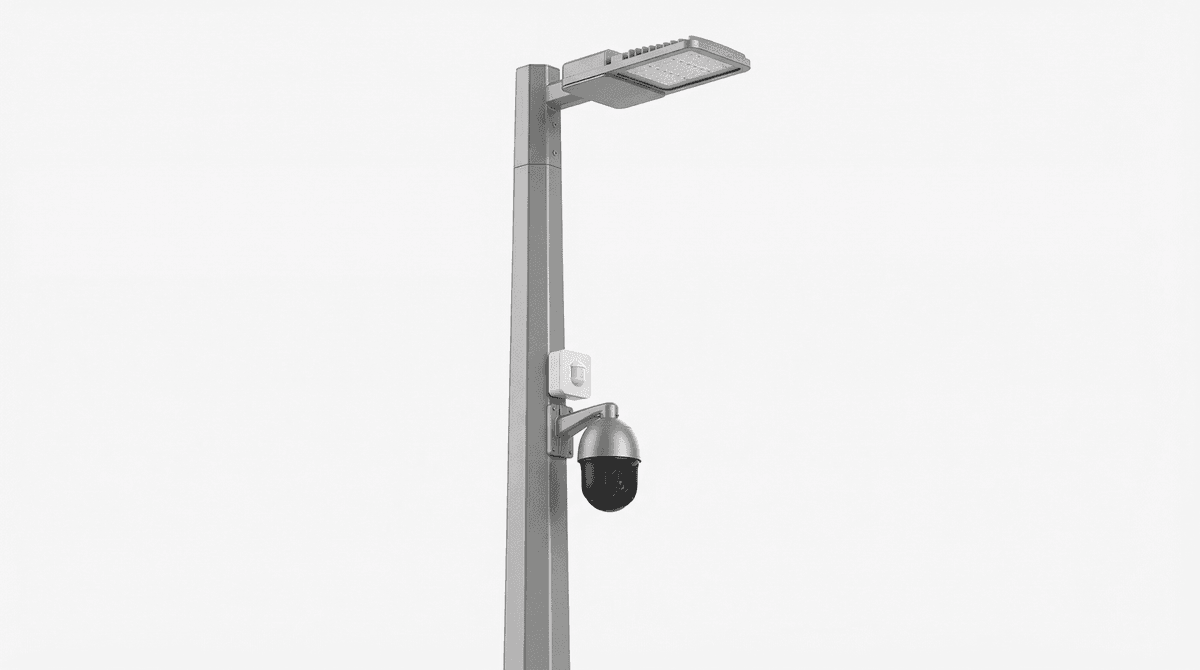
The third channel is infrastructure consolidation. A smart pole can support lighting, AI camera, environmental sensing, WiFi, public audio, display, and telecom brackets in 1 structure. That reduces foundations, trench interfaces, and maintenance points. In the SOLAR TODO product range, the 9m Commercial Street 6-in-1 with Display combines 120W LED lighting, 4K camera, environmental sensing, LED display, WiFi, and IP public audio on a 9m pole with IP66 protection and more than 150 km/h wind resistance.
Carbon accounting logic for corridor projects
Carbon value depends on the difference between the project scenario and the baseline scenario, expressed in tCO2e per year. A simple screening formula is annual avoided emissions = avoided electricity use in MWh × local grid emission factor in tCO2/MWh, with a smaller add-on for reduced maintenance travel if fleet fuel data is available. This screening does not replace formal verification, but it is a useful first filter for procurement teams.
Sample deployment scenario (illustrative): if a corridor replaces a 200W legacy fixture with a 120W LED smart pole and operates 4,000 hours per year, the direct avoided electricity is about 320 kWh per pole annually before control savings. If adaptive dimming adds another 20% reduction, avoided electricity rises to about 416 kWh. At a grid factor of 0.6 tCO2/MWh, that equals roughly 0.25 tCO2 per pole per year.
That number is useful, but it also shows why carbon credits alone rarely justify the project. If carbon is priced at USD 10-30/tCO2, the annual credit value per pole may be only USD 2.5-7.5 in this illustrative case. By contrast, telecom hosting or avoided maintenance dispatch can be materially larger, which is why SOLAR TODO frames carbon as one layer in a stacked business case.
Technical pole options relevant to EV corridors
Corridor applications usually need stronger visibility, communications support, and weather protection than a standard urban streetlight. The 10m Tunnel Entrance Smart Pole from SOLAR TODO uses 1 × 200W LED luminaire at 170 lm/W, about 34,000 lumens, plus 1 AI camera, 1 environmental sensor, and 1 LED display in a 10m octagonal galvanized steel pole with IP66 protection and a 25-year structural design life. That type of configuration is relevant for tunnel thresholds, ramps, and high-contrast approach zones.
For service areas, mixed-use forecourts, and charger parking zones, the 9m Commercial Street 6-in-1 with Display is often closer to the requirement set. Its 28m recommended spacing, 120W luminaire, and integrated public information modules support both lighting and site operations. For campuses, green rest stops, or lower-speed parking environments, the 8m Campus/Park Environmental Smart Streetlight combines an 80W LED luminaire, AI camera, environmental sensor, WiFi module, and USB charging interface in a 5-in-1 configuration with IP66 protection and a 25-year design life.
5G small cell hosting strategy for EV charging corridors
A 5G small cell hosting strategy works best when poles are spaced around 25-40m in activity zones, provide 6-10m mounting height, and reserve power, enclosure, and backhaul paths for 1 telecom tenant per pole.
EV charging corridors need more than illumination. Drivers expect payment reliability, app connectivity, CCTV visibility, and real-time occupancy data. Small cells improve local coverage where terrain, service plazas, tunnels, or roadside geometry weaken macro-network performance. Better connectivity can reduce failed charging sessions linked to payment or communications issues, although the exact gain depends on charger software and network design.
The infrastructure strategy should separate core and optional loads. Core loads are LED lighting, controller, battery management, and safety camera. Optional loads include LED display, WiFi, public audio, and telecom radio. This separation matters because 5G equipment may require additional power conditioning, thermal management, and utility coordination beyond the base lighting design.
A practical corridor hosting plan usually includes these design checkpoints:
- Pole structural reserve for antenna, bracket, and cable load, with wind checks aligned to local code and project wind speeds up to 150 km/h where required.
- Dedicated equipment compartment or external cabinet plan for radio, fiber termination, surge protection, and metering.
- Power architecture that distinguishes solar-powered lighting circuits from grid-fed telecom circuits when telecom uptime obligations exceed the solar autonomy window.
- Backhaul path selection using fiber, microwave, or carrier handoff, with latency and maintenance responsibilities defined in the lease.
- Access control and cybersecurity for pole controller, camera, and telecom interfaces.
According to IEEE (2018), interoperability and clear interface definitions are essential when distributed assets connect to wider power systems. While IEEE 1547 is not a streetlight standard, the principle is relevant: corridor assets need defined electrical and communications boundaries. For procurement teams, that means the telecom hosting scope should be written early, not added after the civil package is released.
EPC Investment Analysis and Pricing Structure
For EV corridors, the strongest investment case usually combines 5-8 year lighting payback, 10-15 year pole life-cycle planning, and secondary income from telecom hosting rather than relying on carbon credits alone.
EPC means Engineering, Procurement, and Construction delivered as one turnkey package. For smart solar streetlight corridors, that usually includes photometric design, pole and foundation design, solar-storage sizing where applicable, equipment supply, logistics, installation, commissioning, and remote monitoring setup. Depending on scope, it may also include trenching, feeder works, civil interfaces near chargers, and telecom-ready brackets or enclosures.
The standard commercial structure should be evaluated in 3 tiers:
| Pricing Tier | What it includes | Typical use case |
|---|---|---|
| FOB Supply | Pole, luminaire, controller, PV/battery if specified, accessories, factory testing | Buyer manages shipping, customs, and site works |
| CIF Delivered | FOB scope plus ocean freight and insurance to named port | Importers needing landed cost visibility |
| EPC Turnkey | CIF-equivalent supply plus civil works, installation, commissioning, testing, and handover | Highway authorities, EPCs, and charging-network developers |
Volume guidance for budgeting:
- 50+ units: about 5% discount
- 100+ units: about 10% discount
- 250+ units: about 15% discount
Payment terms commonly used in export projects are 30% T/T with 70% against B/L, or 100% L/C at sight. Financing is available for large projects above USD 1,000K, subject to project review, jurisdiction, and buyer credit profile. For quotation support, buyers can contact [email protected] or call +6585559114.
Illustrative ROI stack
Sample deployment scenario (illustrative): assume a corridor replaces 100 conventional 200W fixtures with 100 smart poles using 120W LED luminaires, 4,000 annual operating hours, and electricity at USD 0.12/kWh. Direct electricity savings are about 32,000 kWh per year, or roughly USD 3,840. If networked monitoring cuts maintenance dispatch by 20-30% and each avoided truck roll saves USD 80-150, O&M savings can become comparable to energy savings.
Now add telecom hosting. Even 1 tenant on selected poles can materially change project economics if lease revenue is contracted over 5-10 years. Carbon value may still be included, but in most screening models it remains the smallest line item unless the corridor is very large, the grid is carbon-intensive, or the project is aggregated under a formal crediting program.
Comparison and selection guide for corridor buyers
For EV charging corridors, the best pole choice depends on whether the priority is 200W threshold lighting, 120W commercial-zone connectivity, or 80W lower-speed environmental monitoring with WiFi.
The selection process should start with road class, charger density, target lux level, telecom interest, and autonomy requirement. A tunnel approach or ramp needs higher luminance and stronger visual guidance than a parking bay. A service plaza may value display, public audio, and WiFi more than a simple roadside segment.
| Model | Main use case | Core configuration | Key specs | Indicative installed price |
|---|---|---|---|---|
| 10m Tunnel Entrance Smart Pole | Tunnel entrance, ramps, threshold zones | 4-in-1: 200W LED + AI camera + environmental sensor + LED display | 10m pole, 170 lm/W, about 34,000 lm, IP66, 150 km/h wind, 25-year design life | USD 1,800-2,200/unit |
| 9m Commercial Street 6-in-1 with Display | EV forecourts, service roads, retail-adjacent charging zones | 120W LED + 4K camera + environmental sensing + LED display + WiFi + IP audio | 9m pole, 170 lm/W, 28m spacing, IP66, >150 km/h wind | Project quotation |
| 8m Campus/Park Environmental Smart Streetlight | Parking areas, green rest stops, lower-speed access roads | 80W LED + AI camera + environmental sensor + WiFi + USB | 8m pole, 170 lm/W, IP66, -40°C to +55°C, 25-year design life | USD 1,400-1,600/unit |
Buyers should also compare integrated poles against multi-asset layouts. A conventional design may use 1 passive lighting pole, 1 CCTV mast, 1 speaker, 1 environmental node, and 1 telecom support structure. The integrated alternative reduces visible street furniture and can cut trenching interfaces by 30-40%, based on product-level deployment assumptions in the SOLAR TODO range.
SOLAR TODO recommends a corridor selection matrix with 6 columns: lighting class, telecom demand, solar resource, maintenance access, charger criticality, and carbon accounting readiness. This matrix helps procurement teams avoid over-specifying every pole. In practice, only selected nodes may need telecom hosting, while all nodes need reliable lighting and remote fault monitoring.
FAQ
A corridor smart pole usually earns more from energy savings and telecom hosting than from carbon credits alone, although verified avoided emissions can still support ESG reporting and project finance documentation.
Q: What is the carbon credit value of a Smart Solar Streetlight System in an EV corridor? A: The carbon credit value is usually modest per pole because avoided emissions from one light are limited. A screening case may show about 0.1-0.3 tCO2 per pole per year, so revenue depends heavily on local carbon price and whether the project qualifies under a recognized verification method.
Q: Why are carbon credits often secondary to telecom hosting revenue? A: Carbon revenue from one lighting pole is often only a few dollars per year in many markets. By contrast, 1 telecom tenant can create a larger contracted cash flow over 5-10 years, which is easier for lenders and project managers to model in a corridor business case.
Q: How do Smart Solar Streetlight Systems support EV charging corridor reliability? A: They support reliability by keeping lighting, cameras, and local communications active during grid disturbances when solar-storage architecture is used. A 1-3 night autonomy target is common for critical nodes, while remote monitoring helps operators detect outages and battery issues before they affect the site.
Q: What technical features matter most for 5G small cell hosting on a smart pole? A: The main factors are pole height, structural reserve, power availability, enclosure space, and backhaul path. For corridor projects, 6-10m mounting height, IP66 outdoor protection, surge protection, and wind resistance up to 150 km/h are common specification checkpoints.
Q: Can one pole support both solar lighting and a 5G small cell? A: Yes, but the power architecture must be defined early. In many projects, the lighting load can be solar-battery based while the telecom load uses grid power or hybrid backup, because carrier uptime obligations may exceed the autonomy window designed for the lighting circuit.
Q: How should procurement teams calculate avoided emissions before formal verification? A: Start with baseline wattage, proposed wattage, annual operating hours, and the local grid emission factor in tCO2/MWh. Then add any control savings and, if data exists, reduced maintenance travel. This gives a screening estimate that is useful for budgeting but not a substitute for third-party carbon verification.
Q: What is included in EPC turnkey delivery for these corridor projects? A: EPC turnkey usually includes engineering design, equipment procurement, logistics, installation, testing, commissioning, and handover. It may also include foundations, trenching, feeder coordination, solar-storage sizing, and telecom-ready brackets or cabinets depending on the scope written into the contract.
Q: What are the usual pricing and payment terms from SOLAR TODO? A: Projects are typically quoted as FOB Supply, CIF Delivered, or EPC Turnkey. Volume guidance is about 5% discount at 50+ units, 10% at 100+, and 15% at 250+, with payment terms commonly set at 30% T/T plus 70% against B/L, or 100% L/C at sight.
Q: Which SOLAR TODO model fits an EV service area best? A: For many service areas, the 9m Commercial Street 6-in-1 with Display is a practical fit because it combines 120W lighting, 4K camera, sensing, WiFi, display, and public audio. Tunnel approaches or ramps may need the 10m 200W model, while lower-speed parking areas may fit the 8m 80W model.
Q: How much maintenance reduction can connected smart poles deliver? A: The exact result depends on network design and maintenance practice, but connected monitoring often reduces outage response time by more than 20% compared with non-connected assets. It also reduces site visits by consolidating several devices into 1 managed pole location.
Q: When does a corridor project become suitable for carbon-credit aggregation? A: Aggregation becomes more practical when the project includes a large number of poles, consistent metering data, and a jurisdiction or registry that accepts the methodology. Small projects with weak baseline data often use avoided-emission estimates for ESG reporting rather than for tradable credit issuance.
Q: What warranty and financing points should buyers ask about? A: Buyers should ask for luminaire, battery, controller, and structural warranty terms separately because each component has a different risk profile. For large projects above USD 1,000K, financing may be available subject to project review, and buyers should confirm spare parts scope, response terms, and remote monitoring support.
References
The carbon and infrastructure case for corridor smart poles is strongest when buyers combine IEC-compliant lighting, auditable energy savings, and telecom hosting economics in one procurement model.
- IEA (2022): Energy Efficiency 2022; LED lighting and digital controls reduce electricity demand and improve system efficiency.
- IEA (2023): Electricity 2023; electrification and digital infrastructure increase the importance of resilient power and communications assets.
- IRENA (2023): Renewable Power Generation Costs in 2022; renewable generation continues to improve cost competitiveness for distributed energy applications.
- NREL (2024): Distributed energy resilience research and performance modeling guidance relevant to critical roadside energy systems.
- IEC 60598 (various editions): Luminaires safety requirements for design, construction, and testing.
- IEC 62722 (various editions): Luminaire performance requirements relevant to LED street lighting evaluation.
- IEEE 1547-2018 (2018): Interconnection and interoperability principles for distributed energy resources with electric power systems.
- CIE (2014): Tunnel lighting practice and visual adaptation guidance for entrance zones and threshold lighting.
Conclusion
For EV charging corridors, Smart Solar Streetlight Systems deliver the best value when 50-70% lighting energy savings, 1 telecom hosting opportunity, and remote O&M gains are modeled together rather than treating carbon credits as the main return.
Bottom line: for most corridor projects, SOLAR TODO smart poles should be justified first on lighting, resilience, and telecom lease economics, with carbon value added as a verified secondary benefit once baseline data, operating hours, and grid emission factors are documented.
About SOLARTODO
SOLARTODO is a global integrated solution provider specializing in solar power generation systems, energy-storage products, smart street-lighting and solar street-lighting, intelligent security & IoT linkage systems, power transmission towers, telecom communication towers, and smart-agriculture solutions for worldwide B2B customers.
About the Author

SOLARTODO Editorial Team
Solar Energy & Infrastructure Expert Team
SOLAR TODO is a professional supplier of solar energy, energy storage, smart lighting, smart agriculture, security systems, communication towers, and power tower equipment.
Our technical team has over 15 years of experience in renewable energy and infrastructure, providing high-quality products and solutions to B2B customers worldwide.
Expertise: PV system design, energy storage optimization, smart lighting integration, smart agriculture monitoring, security system integration, communication and power tower supply.
Cite This Article
SOLARTODO Editorial Team. (2026). Smart Solar Streetlights, Carbon Credits & 5G Strategy. SOLARTODO. Retrieved from https://solartodo.com/knowledge/carbon-credit-value-with-smart-solar-streetlight-systems-5g-small-cell-hosting-strategy-for-ev-charging-corridors
@article{solartodo_carbon_credit_value_with_smart_solar_streetlight_systems_5g_small_cell_hosting_strategy_for_ev_charging_corridors,
  title = {Smart Solar Streetlights, Carbon Credits & 5G Strategy},
  author = {SOLARTODO Editorial Team},
  journal = {SOLARTODO Knowledge Base},
  year = {2026},
  url = {https://solartodo.com/knowledge/carbon-credit-value-with-smart-solar-streetlight-systems-5g-small-cell-hosting-strategy-for-ev-charging-corridors},
  note = {Accessed: 2026-08-29}
}
Published: April 26, 2026 | Available at: https://solartodo.com/knowledge/carbon-credit-value-with-smart-solar-streetlight-systems-5g-small-cell-hosting-strategy-for-ev-charging-corridors
Subscribe to Our Newsletter
Get the latest solar energy news and insights delivered to your inbox.
View All Articles