commercial and industrial energy storage C&I | SOLARTODO

Cinn Song
Founder & Chief Solutions Architect
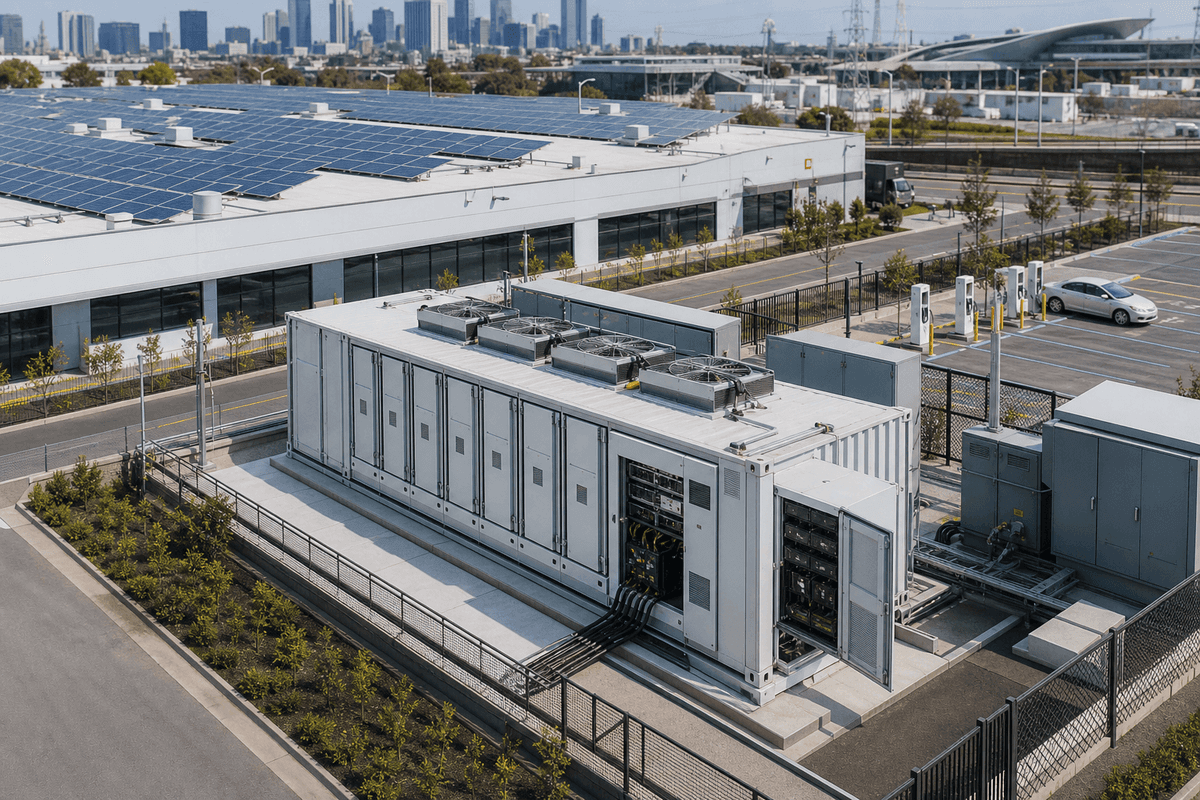
TL;DR
Commercial and industrial energy storage is a behind-the-meter battery system, usually 100kWh-5MWh, used to reduce peak demand, shift solar energy, and provide backup power. Strong projects combine 2-4 hour LFP batteries, 6,000+ cycle life, standards such as UL 9540 and IEEE 1547, and tariff-based ROI modeling for 3-7 year payback.
C&I energy storage uses 500kW-5MW LFP battery systems to cut peak demand, shift solar output, and add 2-4 hours of backup, with typical payback in 3-7 years for high-tariff facilities.
Summary
C&I energy storage uses 500kW-5MW LFP battery systems to cut peak demand, shift solar output, and add 2-4 hours of backup, with typical payback in 3-7 years for high-tariff facilities.
Key Takeaways
C&I battery storage decisions should convert 15-minute load data, tariff spreads, and 2-4 hour backup needs into a bankable power and energy specification.
- Reduce 15-40% of peak demand charges by dispatching a 500kW-1MW battery during utility billing intervals.
- Pair 100kW solar PV with 200kWh storage to improve daytime self-consumption and provide 1-3 hours of critical backup.
- Specify LFP chemistry with 6,000+ cycles and 80% depth of discharge for daily C&I peak shaving or arbitrage.
- Compare 0.5C and 1C battery designs because a 1MWh system can deliver either 500kW for 2 hours or 1MW for 1 hour.
- Require IEC 62933, UL 9540, UL 9540A, and IEEE 1547 alignment before procurement, interconnection, and insurance review.
- Model ROI over 10-15 years using demand charge savings, time-of-use spreads, avoided outage losses, and solar export reduction.
- Select EPC turnkey delivery for projects above 250kWh when civil works, protection settings, commissioning, and grid approval affect schedule.
- Use SOLARTODO project financing for large projects above $1,000K when CAPEX timing is the main barrier to deployment.
Commercial and Industrial Energy Storage in 2026
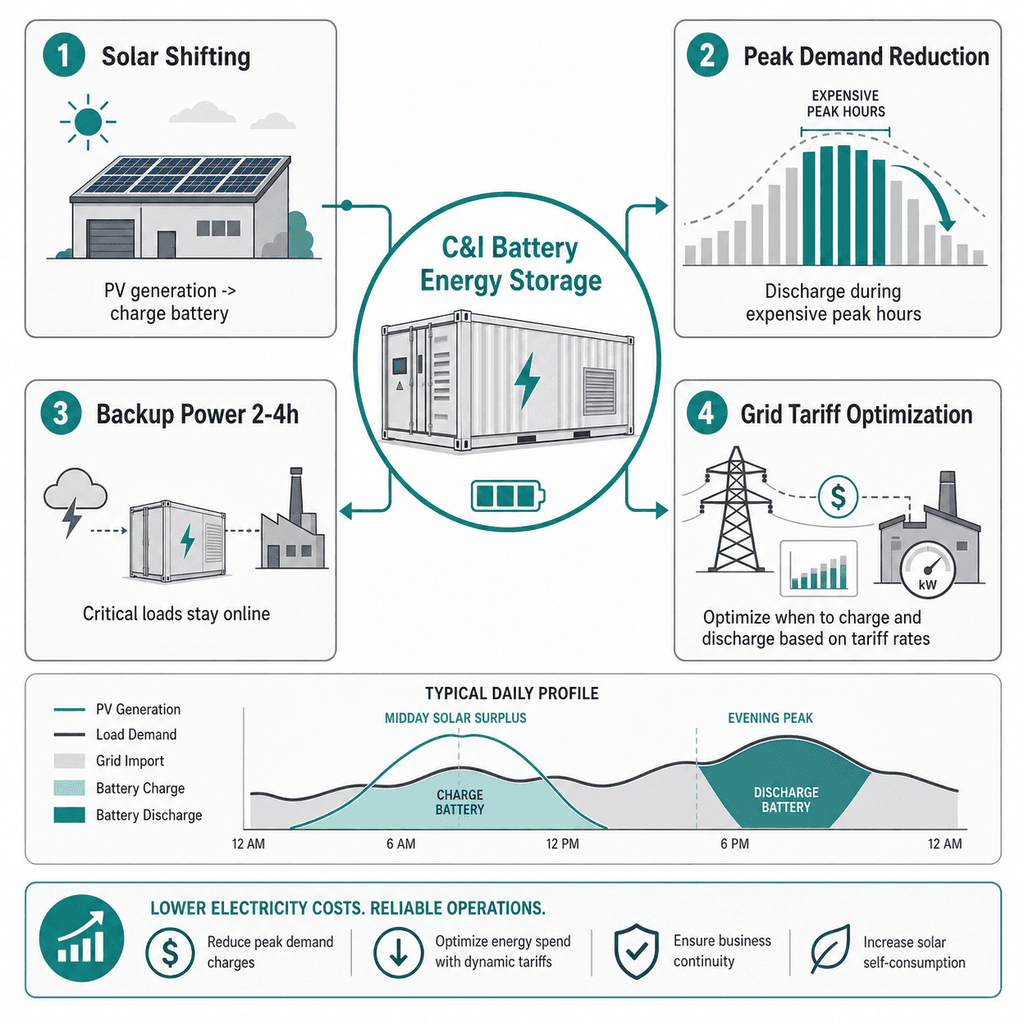
Commercial and industrial energy storage typically uses 100kWh-5MWh LFP battery systems to reduce peak demand, shift solar energy, and provide 2-4 hours of backup power.
For procurement managers and project engineers, C&I storage is no longer a pilot technology. It is a controllable energy asset that can lower demand charges, protect production uptime, and improve the economics of rooftop or ground-mounted solar PV. The right design starts with load data, not a catalog page: the battery must match the facility's peak profile, outage tolerance, transformer capacity, tariff structure, and future electrification plan.
According to the International Energy Agency (2024), battery deployment in the power sector more than doubled in 2023, reaching about 85GW of installed capacity globally. The IEA also states, 'Batteries are an essential part of the global energy system today.' For C&I buyers, that growth matters because supply chains, power conversion systems, safety standards, and bankability documentation have matured quickly.
The common business case has 4 value streams. Peak shaving reduces maximum demand during 15-minute or 30-minute utility billing windows. Load shifting charges the battery during low-price periods and discharges during expensive periods. Solar self-consumption stores midday PV output instead of exporting it at low compensation. Backup power keeps essential loads online during grid outages, usually through a microgrid controller and protected load panel.
SOLARTODO supplies C&I energy storage as part of an offline quotation model, not an online marketplace. Typical configurations include a 100kW + 200kWh solar-plus-storage system for commercial buildings and a 1MWh LFP container with 500kW continuous output for industrial peak shaving, arbitrage, and resilience.
Technical Architecture and Sizing Method
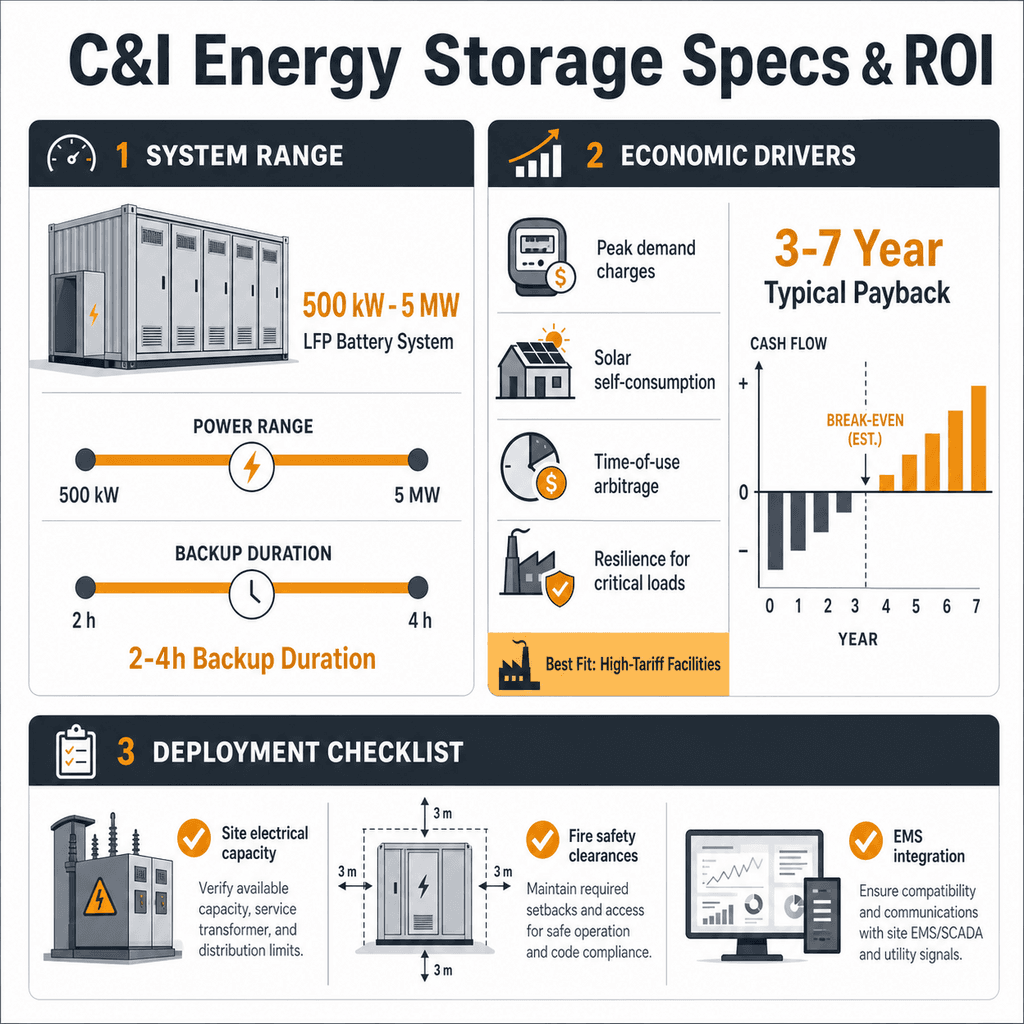
A bankable C&I battery design defines 4 parameters first: usable kWh, kW output, discharge duration, and cycle life under the site's actual tariff.
The battery energy storage system includes LFP cells, battery modules, racks, a battery management system, HVAC or liquid cooling, fire detection, power conversion system, energy management system, switchgear, and monitoring. In containerized systems, these components are factory-integrated to reduce site labor and commissioning risk. In indoor cabinet systems, fire separation, ventilation, and local code requirements can dominate design decisions.
A 1MWh system with 500kW continuous output is a 0.5C, 2-hour design. It is suitable for demand charge management, time-of-use arbitrage, and solar shifting. A 1MWh system with 1MW output is a 1C, 1-hour design, better for short peaks but usually more demanding on inverter sizing, thermal management, and cell stress. For most C&I facilities, 2-hour systems balance cost, operating flexibility, and cycle life.
According to NREL (2024), interval load data and site-specific solar resource modeling are essential for estimating PV and storage performance. Engineers should analyze at least 12 months of utility bills and, where available, 15-minute meter data. The sizing workflow should identify the facility's top 20 annual peak events, recurring time-of-use price windows, minimum critical load, and available PV generation.
Safety architecture is equally important. UL 9540 covers energy storage system safety, while UL 9540A evaluates thermal runaway fire propagation behavior. IEC 62933 provides international guidance for electrical energy storage systems, and IEEE 1547 governs interconnection behavior for distributed energy resources. These references are not paperwork only; they affect insurance review, fire authority approval, grid interconnection, and long-term bankability.
For SOLARTODO projects, the technical package can include single-line diagrams, datasheets, battery capacity assumptions, PCS ratings, monitoring architecture, container layout, and operating modes. Project teams should confirm ambient temperature range, altitude, seismic requirements, corrosion exposure, communication protocol, and grid code before placing the final purchase order.
Applications, Use Cases, and ROI Drivers
C&I storage generates value when 1 battery asset serves at least 2 operating modes, such as peak shaving plus solar shifting or backup plus arbitrage.
Manufacturing plants often use storage to reduce peak demand created by motors, compressors, chillers, and process equipment. Warehouses and cold-chain facilities use batteries to protect refrigeration and reduce evening peak costs. Hotels, campuses, hospitals, telecom sites, and water treatment plants value backup power because outage losses can exceed the battery's daily energy savings.
Solar-plus-storage is especially effective where export compensation is low or grid capacity is constrained. A 100kW PV array paired with 200kWh storage can store 2 hours of rated solar output and discharge it during evening demand periods. In regions with weak grids, this configuration also improves power continuity for lighting, IT loads, pumps, security systems, and critical production equipment.
According to IRENA (2025), 91% of new renewable power projects commissioned in 2024 were more cost-effective than fossil fuel alternatives. IRENA states, 'Renewables are the most competitive source of new electricity.' When low-cost PV is combined with dispatchable storage, C&I buyers can convert intermittent generation into a managed load-reduction asset.
ROI depends heavily on local tariffs. A facility paying high demand charges may recover investment in 3-5 years if the battery reliably clips monthly peaks. A site focused only on energy arbitrage may require wider peak/off-peak spreads and daily cycling to reach a 5-7 year payback. Backup value is site-specific: for a production line, avoided downtime can justify a larger battery even when tariff savings alone are moderate.
A practical financial model should include annual degradation, round-trip efficiency, cycling limits, O&M, insurance, inverter replacement assumptions, and residual value. For LFP systems, 6,000+ cycles at 80% depth of discharge supports 10 years or more of daily operation when thermal control and operating limits are properly managed.
Comparison and Selection Guide
A C&I buyer should compare at least 3 configurations by kW, kWh, duration, standards, installation model, and expected payback before procurement.
| Configuration | Typical Rating | Best Use Case | Key Advantage | Main Limitation |
|---|---|---|---|---|
| Solar-plus-storage commercial | 100kW PV + 200kWh BESS | Offices, schools, retail, farms | Improves PV self-consumption and backup | Limited duration for large industrial loads |
| Modular cabinet BESS | 100kWh-500kWh | Small factories, telecom, clinics | Flexible indoor or outdoor deployment | More site integration work at scale |
| Containerized LFP BESS | 1MWh + 500kW PCS | Industrial demand shaving and arbitrage | Factory-integrated, scalable, 2-hour duration | Requires civil pad and grid review |
| Microgrid storage | 500kWh-5MWh | Weak-grid or off-grid facilities | Supports backup, diesel reduction, PV smoothing | More complex controls and protection |
Selection should start with operating objective. If the problem is monthly demand charge exposure, specify power capacity first. If the problem is solar export or outage duration, specify energy capacity first. If the site needs both, model dispatch priorities so backup reserve does not eliminate peak shaving savings.
Procurement teams should request degradation curves, warranty conditions, usable energy definition, auxiliary consumption, HVAC rating, fire test documentation, and cybersecurity features. The difference between nominal and usable capacity matters: a 1MWh nameplate system may have lower guaranteed usable energy after depth-of-discharge limits, reserve settings, and degradation allowances.
SOLARTODO's 1MWh C&I Arbitrage LFP Container is designed around 1,000kWh usable capacity and 500kW continuous output. It supports two-cycle-per-day commercial strategies where tariff spreads justify high throughput. For buyers that need smaller systems, SOLARTODO can also configure solar-plus-storage packages around 100kW PV and 200kWh BESS capacity.
EPC Investment Analysis and Pricing Structure
EPC turnkey delivery can reduce C&I storage execution risk by bundling engineering, procurement, construction, commissioning, and grid coordination into 1 accountable scope.
A turnkey EPC package normally includes site survey, electrical design, civil foundation, trenching, battery and PCS supply, switchgear, protection coordination, installation, commissioning, owner training, and documentation. For C&I buyers without in-house power engineering teams, EPC delivery reduces interface risk between battery supplier, electrical contractor, utility, and authority having jurisdiction.
SOLARTODO quotations can be structured in 3 commercial tiers. FOB Supply covers factory supply for buyers managing freight and installation. CIF Delivered includes international freight and delivery to destination port or agreed location. EPC Turnkey includes equipment, engineering, installation, commissioning, and project handover where local execution conditions allow.
| Pricing Tier | Included Scope | Best Fit | Buyer Responsibility |
|---|---|---|---|
| FOB Supply | Equipment, factory documentation, export packing | Experienced EPCs and distributors | Freight, customs, installation, permits |
| CIF Delivered | Equipment plus international delivery | Importers needing logistics support | Local permits, civil works, installation |
| EPC Turnkey | Engineering, procurement, construction, commissioning | End users seeking single-scope delivery | Site access, approvals, utility coordination support |
Volume pricing should be discussed during quotation. As planning guidance, 50+ units may support a 5% discount, 100+ units may support a 10% discount, and 250+ units may support a 15% discount, subject to configuration, destination, warranty, and delivery schedule.
Payment terms are typically 30% T/T deposit plus 70% against bill of lading, or 100% L/C at sight for approved transactions. Project financing may be available for large projects above $1,000K, especially where the buyer can provide bankable offtake, utility bills, site ownership documentation, and project cash-flow assumptions. For EPC and pricing inquiries, contact [email protected] or +6585559114.
FAQ
C&I storage FAQs should answer 10 procurement questions on sizing, safety, payback, EPC scope, warranties, installation, maintenance, and solar integration.
Q: What is commercial and industrial energy storage? A: Commercial and industrial energy storage is a battery system, typically 100kWh-5MWh, installed behind the meter at a business facility. It stores electricity from the grid or solar PV and discharges it for peak shaving, time-of-use savings, backup power, or solar self-consumption.
Q: How do I size a C&I battery system? A: Size the system using 12 months of utility bills and 15-minute interval load data where available. Choose kW capacity to reduce peak demand and kWh capacity to cover the target discharge duration, commonly 2-4 hours for C&I sites.
Q: Why is LFP chemistry common for C&I storage? A: LFP is common because it offers strong thermal stability, long cycle life, and lower dependence on nickel and cobalt. Many C&I designs target 6,000+ cycles at 80% depth of discharge, making LFP suitable for daily peak shaving and arbitrage.
Q: What payback period should a facility expect? A: Payback is usually 3-7 years, depending on demand charges, time-of-use spreads, battery utilization, incentives, and outage value. Sites with high monthly peaks or large solar export losses normally achieve faster returns than sites with flat electricity tariffs.
Q: What does EPC turnkey delivery include? A: EPC turnkey delivery includes engineering, procurement, construction, commissioning, and handover under one project scope. For C&I storage, this can include civil pads, battery containers, PCS, switchgear, protection settings, monitoring, utility coordination, and operator training.
Q: What standards should buyers require? A: Buyers should require documentation aligned with IEC 62933, UL 9540, UL 9540A, and IEEE 1547 where applicable. These standards support safety review, interconnection approval, fire authority acceptance, and lender or insurer confidence in the project.
Q: Can C&I storage work with existing solar PV? A: Yes, storage can be AC-coupled to existing solar PV or integrated into a new solar-plus-storage design. AC coupling is often practical for retrofits, while new projects can optimize PV, inverter, and battery sizing together.
Q: How much maintenance does a C&I battery need? A: Maintenance usually includes remote monitoring, HVAC inspection, firmware updates, electrical torque checks, fire system inspection, and periodic capacity review. Most sites schedule preventive maintenance 1-2 times per year, with alarms monitored continuously through the energy management system.
Q: What warranty terms matter most? A: The most important warranty terms are usable energy, cycle count, calendar life, throughput limit, operating temperature, and response process. A 10-year warranty is only meaningful if the operating profile, depth of discharge, and ambient conditions match the project design.
Q: When should a company choose containerized storage? A: Containerized storage is usually best above 500kWh because factory integration reduces site assembly work and improves repeatability. A 1MWh, 500kW container is well suited for industrial demand shaving, solar shifting, and 2-hour backup applications.
Conclusion
For C&I facilities above 100kW peak load, a 100kWh-5MWh LFP storage system can reduce demand charges, improve solar ROI, and add 2-4 hours of resilience.
The bottom line: commercial and industrial energy storage is most bankable when tariff savings, solar shifting, and backup value are modeled together. SOLARTODO can support C&I buyers with 100kW + 200kWh solar-plus-storage systems, 1MWh LFP containers, EPC quotation structures, and financing options for projects above $1,000K.
References
Authoritative references for C&I storage should combine 5+ standards and market sources covering safety, interconnection, cost trends, and performance modeling.
- IEA (2024): Batteries and Secure Energy Transitions, covering battery deployment growth, cost reduction, and the role of storage in power systems.
- IRENA (2025): Renewable Power Generation Costs in 2024, reporting renewable cost competitiveness and global solar PV cost trends.
- NREL (2024): PVWatts Calculator and System Advisor Model resources for estimating solar production, storage dispatch, and project economics.
- IEC 62933 (2024): Electrical energy storage systems standards for terminology, planning, safety, and performance considerations.
- IEEE 1547-2018 (2018): Standard for interconnection and interoperability of distributed energy resources with electric power systems.
- UL 9540 (2023): Safety standard for energy storage systems and equipment used in stationary battery installations.
- UL 9540A (2019): Test method for evaluating thermal runaway fire propagation in battery energy storage systems.
- NFPA 855 (2023): Standard for the installation of stationary energy storage systems, including fire safety and location requirements.
About SOLARTODO
SOLARTODO is a global integrated solution provider specializing in solar power generation systems, energy-storage products, smart street-lighting and solar street-lighting, intelligent security & IoT linkage systems, power transmission towers, telecom communication towers, and smart-agriculture solutions for worldwide B2B customers.
About the Author

Cinn Song
Founder & Chief Solutions Architect
Cinn Song founded SOLARTODO LIMITED and leads its smart-city infrastructure engineering — from solar, storage and integrated smart poles to the company's push into physical-AI city edge nodes: pole-mounted edge computing, vertical LLMs for smart cities, drone-based O&M with autonomous battery swapping, robotic maintenance, and high-speed counter-UAS interception. Since 2010, he has directed turnkey EPC + BOT delivery across 50+ countries, including telecom monopole supply for national grid operators, off-grid solar street-lighting for African municipalities, and integrated smart-pole programs for Gulf smart cities.
Cite This Article
Cinn Song. (2026). commercial and industrial energy storage C&I | SOLARTODO. SOLARTODO. Retrieved from https://solartodo.com/knowledge/commercial-and-industrial-energy-storage-ci-2
@article{solartodo_commercial_and_industrial_energy_storage_ci_2,
  title = {commercial and industrial energy storage C&I | SOLARTODO},
  author = {Cinn Song},
  journal = {SOLARTODO Knowledge Base},
  year = {2026},
  url = {https://solartodo.com/knowledge/commercial-and-industrial-energy-storage-ci-2},
  note = {Accessed: 2026-08-15}
}
Published: July 1, 2026 | Available at: https://solartodo.com/knowledge/commercial-and-industrial-energy-storage-ci-2
Subscribe to Our Newsletter
Get the latest solar energy news and insights delivered to your inbox.
View All Articles