Electric Transmission Tower Structure Guide

Cinn Song
Founder & Chief Solutions Architect
TL;DR
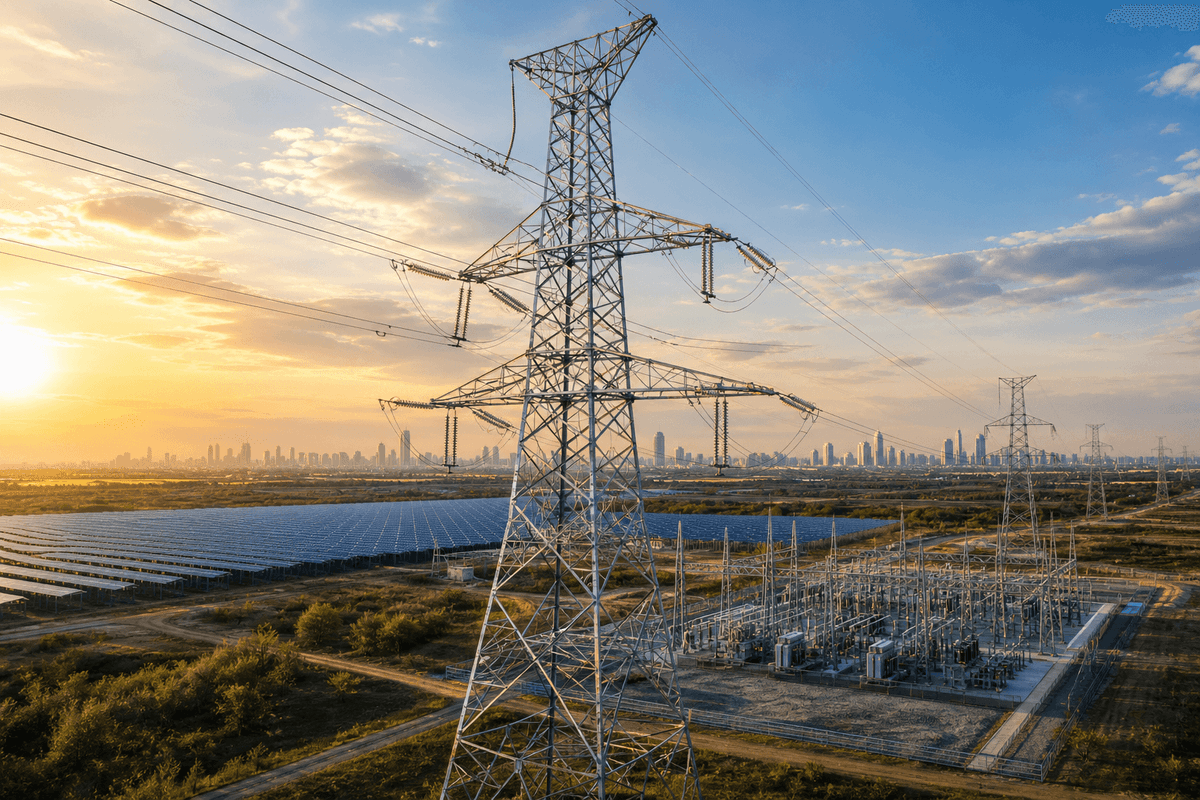
An electric transmission tower structure is the engineered support system that moves high-voltage power from renewable plants to substations. For B2B solar-grid projects, 45m-50m galvanized lattice towers rated 220kV-330kV, designed for 400m spans and 50-year service, are common procurement baselines. Buyers should compare FOB, CIF, and EPC Turnkey offers and verify IEC 60826, IEC 60652, and galvanizing standards.
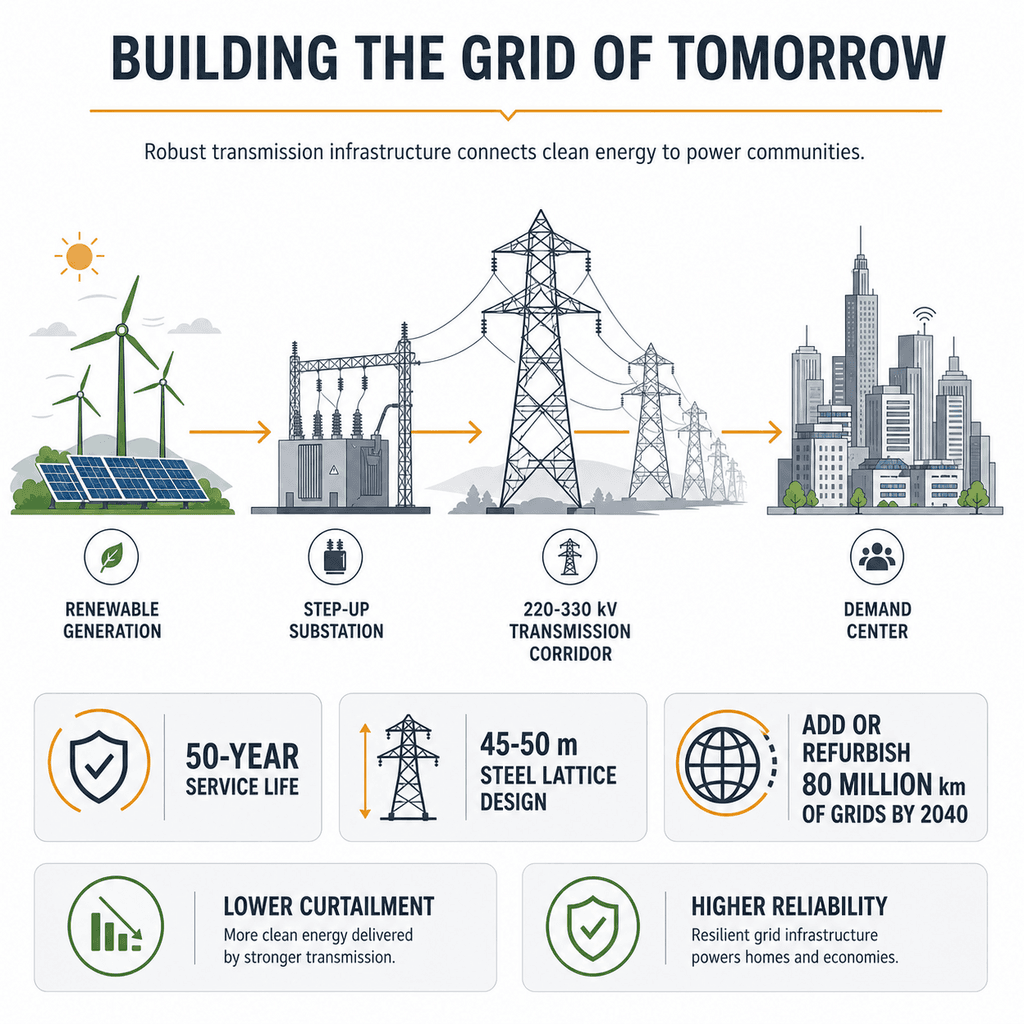
Electric transmission tower structure connects renewable plants to demand centers using 45m-50m galvanized steel lattice designs, 220kV-330kV ratings, and 50-year service life; IEA says 80 million km of grids must be added or refurbished by 2040.
Summary
Electric transmission tower structure connects renewable plants to demand centers using 45m-50m galvanized steel lattice designs, 220kV-330kV ratings, and 50-year service life; IEA says 80 million km of grids must be added or refurbished by 2040.
Key Takeaways
Electric transmission tower procurement should lock 220kV-330kV voltage class, 30-degree angle capacity, 400m spans, and 50-year corrosion design before quotation.
- Specify 220kV-330kV tower duty before tendering to avoid rework across conductor, insulator, foundation, and clearance packages.
- Select 45m-50m galvanized steel lattice designs when renewable corridors need 400m spans and 50-year service life.
- Use tangent towers for 70-80% of straight route sections and angle towers for deviations up to 30 degrees.
- Verify IEC 60826 load cases, IEC 60652 testing, and ASTM A123 or ISO 1461 galvanizing before factory acceptance.
- Model double-circuit 330kV structures to reduce duplicate route footprint by 15-25% versus two single-circuit corridors.
- Calculate 3-6 year payback from double-circuit routing, 2-5% annual O&M savings, and reduced curtailment versus duplicated lines.
- Plan schedules around 5-15 year grid permitting and 1-5 year renewable plant development timelines reported by IEA.
- Request FOB, CIF, and EPC Turnkey quotations with 30% T/T plus 70% against B/L or 100% L/C at sight.
Electric Transmission Tower Structure for Renewable Grids
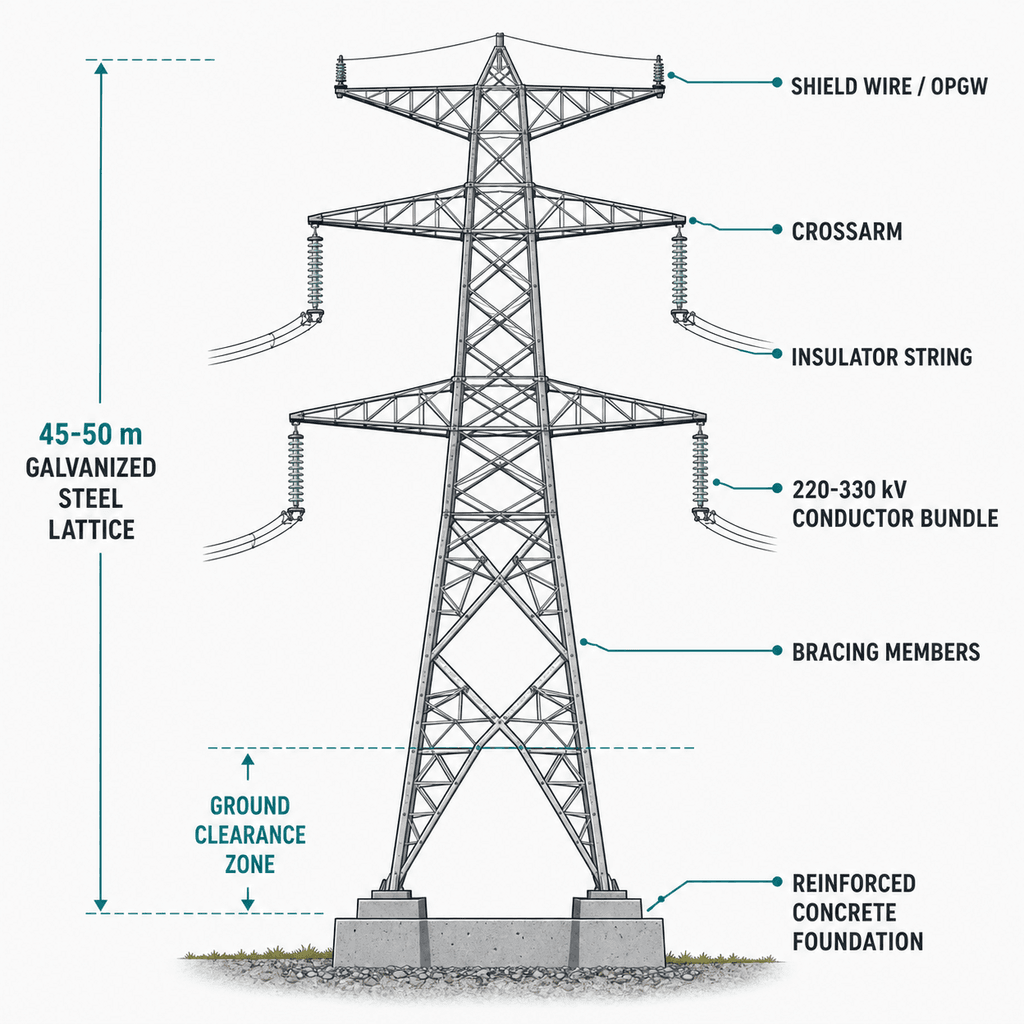
An electric transmission tower structure transfers 220kV-330kV power across 400m spans by resisting conductor tension, wind, ice, and foundation loads for 50 years. For solar and storage projects, the tower is the physical bridge between remote generation and substations, so underspecified steel, galvanizing, or load cases can delay energization and revenue.
Procurement managers should treat tower structure as an integrated system, not a steel commodity. It includes legs, bracing, crossarms, peaks, conductor attachment points, insulator strings, anti-climbing hardware, grounding, step bolts, nameplates, and foundation interfaces. For B2B solar-energy projects, the structure must also fit the route profile, substation bay, OPGW communications plan, and local permitting limits.
According to IEA (2023), electricity use must grow 20% faster in the next decade than in the previous one to meet national climate and energy targets. The same report says more than 80 million km of grids must be added or refurbished by 2040, roughly equivalent to today's global grid. That makes tower standardization, logistics, and quality inspection a direct schedule risk for utility-scale solar, wind, storage, and hybrid plants.
The International Energy Agency states, 'bigger, stronger and smarter grids' are necessary for net-zero pathways. In practice, that means specifying steel structures with clear load cases, documented galvanizing thickness, verified bolt grades, and route-specific accessories before commercial comparison.
Technical Deep Dive: Loads, Materials, and Standards
A 45m-50m lattice tower for 220kV-330kV lines must withstand vertical, transverse, longitudinal, seismic, thermal, and construction loads under IEC 60826 for 50-year service.
Transmission tower loads are not static. Tangent towers mainly carry vertical conductor weight and wind load, while angle and dead-end towers also resist the horizontal resultant tension created by route deviation. A SOLARTODO 45m 220kV Transmission Angle Tower is suited to 30-degree directional change, while a 50m 330kV double-circuit tangent tower fits straight sections with about 400m design span and 15mm ice assumptions.
Steel grade and corrosion protection determine long-term reliability. High-strength steel such as Q420, Q460, or project-equivalent material reduces member size while retaining load capacity. Hot-dip galvanizing is commonly specified at about 85 micrometers for harsh outdoor exposure, subject to final contract standard and coating class.
Core structural specifications
- Voltage class: 220kV and 330kV regional transmission corridors.
- Tower height: commonly 45m for 220kV angle duty and 50m for 330kV tangent duty.
- Circuit arrangement: single-circuit or double-circuit, with 2 conductors per phase where specified.
- Route geometry: 0-2 degrees for tangent structures and up to 30 degrees for angle towers.
- Design span: about 400m for many 330kV plateau or open-corridor sections.
- Design life: 50 years with scheduled inspection, bolt checks, and corrosion monitoring.
- Quality basis: IEC 60826 design criteria, IEC 60652 load testing, and ASTM or ISO galvanizing standards.
According to IEA (2023), at least 3,000 GW of renewable power projects are waiting in grid connection queues, including 1,500 GW in advanced stages. For engineers, that statistic turns tower design into an energy-transition bottleneck. A technically compliant tower package helps prevent preventable delays during route approval, foundation design, factory inspection, and conductor stringing.
Applications and Use Cases for Solar, Storage, and Utility Corridors
For renewable-grid projects, electric transmission tower structure selection can unlock 3,000 GW queue constraints by matching generation, route, and interconnection capacity.
Utility-scale solar plants in deserts, plateaus, and remote industrial zones often need transmission corridors that are longer than the generation site itself. A 220kV line may connect a solar-plus-storage plant to a regional substation, while a 330kV double-circuit line can move larger blocks of power with fewer parallel corridors. In Latin America, the Middle East, Africa, Southeast Asia, and Europe, this can reduce land acquisition complexity and grid-connection risk.
According to IRENA (2024), utility-scale solar PV LCOE fell 12% from 2022 to 2023, and battery storage project costs dropped 89% between 2010 and 2023. IRENA states, 'default source of least-cost new power generation' when describing renewable power. Lower generation costs increase pressure on transmission because cheap solar has limited value if grid export capacity is delayed.
SOLARTODO supplies B2B tower packages for renewable plants, utility corridors, telecom-linked infrastructure, and smart-energy projects. A typical scope may combine power transmission towers, telecom towers, solar streetlights, security systems, and smart monitoring equipment where the route supports multiple infrastructure functions. SOLARTODO works through inquiry, engineering review, and offline quotation rather than online marketplace checkout.
Comparison and Selection Guide
Tangent, angle, and dead-end tower choices can change steel weight by 10-30% and foundation cost by 15-25% across a route.
The best tower type depends on alignment, voltage, conductor bundle, terrain, wind, ice, foundation capacity, and access roads. A low unit price can become expensive if it increases the number of structures, adds special foundations, or creates clearance problems during utility review. Buyers should compare route-level cost, not only steel weight per tower.
| Structure type | Typical role | Common design range | Best use case | Procurement risk |
|---|---|---|---|---|
| Tangent lattice tower | Straight-line suspension | 0-2 degree deviation, often 70-80% of route | 50m 330kV double-circuit corridors | Underestimating wind swing and clearance |
| Angle lattice tower | Directional change support | 5-30 degree deviation | 45m 220kV route turns and substation approaches | Underestimating transverse conductor tension |
| Dead-end tower | Terminal or high-tension section | Up to 100% line tension | River crossings, substations, long-span endpoints | Higher steel and foundation demand |
| Steel monopole | Compact urban corridor | Often 69kV-220kV, project-specific | Roadsides, industrial zones, limited right-of-way | Higher fabrication and transport constraints |
| Guyed tower | Long rural span support | Site-specific span and guy layout | Open land with available anchor area | Land rights and anchor maintenance |
According to IEA (2023), new grid infrastructure often takes 5-15 years to plan, permit, and complete, compared with 1-5 years for new renewable projects. The same IEA report notes that grid investment has remained around USD 300 billion per year and needs to reach over USD 600 billion per year by 2030. Standard tower families reduce engineering repetition and help procurement teams place orders before renewable assets are ready to energize.
For SOLARTODO projects, the selection path usually starts with voltage class, route profile, conductor data, climate assumptions, foundation conditions, and destination port. Engineers then decide whether a 45m 220kV angle tower, 50m 330kV tangent tower, or mixed family is the right procurement baseline.
EPC Investment Analysis and Pricing Structure
EPC turnkey delivery for transmission towers bundles engineering, procurement, construction, testing, and commissioning into 1 accountable package with 3 commercial tiers.
EPC means Engineering, Procurement, and Construction. For transmission towers, turnkey EPC typically includes route survey coordination, tower spotting, structural design review, foundation design, steel procurement, galvanizing, packing, export documentation, inland logistics, civil works, erection, conductor-stringing support, QA records, and commissioning documentation. Utility approvals, land access, outage windows, and grid-operator witnessing should be assigned clearly in the contract matrix.
| Pricing tier | What is included | Buyer responsibility | Best fit |
|---|---|---|---|
| FOB Supply | Tower steel, bolts, galvanizing, packing, and export documents | Freight, insurance, import clearance, installation | EPCs with existing logistics teams |
| CIF Delivered | FOB scope plus sea freight and marine insurance to destination port | Inland transport, foundations, erection, permits | Importers and regional contractors |
| EPC Turnkey | Engineering, supply, logistics, foundations, erection, QA, and commissioning support | Owner permits, land access, utility interface | Large 220kV-330kV interconnection projects |
SOLARTODO is a B2B manufacturer and exporter, not an online marketplace, so final pricing is confirmed by inquiry and offline quotation. Volume guidance can be modeled as 50+ towers for about 5% discount, 100+ towers for about 10%, and 250+ towers for about 15%, subject to steel index, port, coating class, and delivery schedule. Standard payment terms are 30% T/T plus 70% against B/L, or 100% L/C at sight.
ROI should compare the selected tower family against conventional alternatives such as duplicated single-circuit routes, underspecified poles, or non-standard mixed designs. A 330kV double-circuit corridor can reduce route footprint by 15-25% versus 2 separate single-circuit corridors, depending on terrain and phase spacing. Large projects may model 3-6 year payback from fewer structures, lower patrol effort, reduced right-of-way exposure, and 2-5% annual O&M savings versus fragmented alternatives.
Project financing is available for large projects above USD 1,000K after credit review and scope validation. For commercial inquiry, send route length, voltage class, tower schedule, conductor type, wind and ice data, destination port, and delivery target to [email protected] or contact +6585559114.
FAQ
These 10 FAQ answers address tower basics, 220kV-330kV technical choices, EPC pricing, installation, maintenance, warranty, and SOLARTODO procurement workflow for buyers.
Q: What is an electric transmission tower structure? A: An electric transmission tower structure is the support system that holds high-voltage conductors at safe electrical clearance. For 220kV-330kV lines, B2B projects commonly use 45m-50m galvanized lattice towers with crossarms, bracing, insulators, grounding, and foundation interfaces designed for 50-year service.
Q: How does a lattice transmission tower carry 220kV or 330kV conductors? A: A lattice tower transfers conductor weight, wind pressure, ice load, and line tension through crossarms, bracing, legs, base plates, and foundations. In 220kV-330kV designs, engineers check vertical, transverse, and longitudinal loads so the structure remains stable during normal operation, maintenance, and contingency conditions.
Q: What is the difference between tangent, angle, and dead-end towers? A: Tangent towers support straight line sections, typically with 0-2 degree deviation and lower horizontal tension. Angle towers handle route turns, often up to 30 degrees for project-specific designs. Dead-end towers resist high longitudinal loads at terminals, crossings, or section endpoints where conductor tension must be anchored.
Q: Why is hot-dip galvanizing important for transmission towers? A: Hot-dip galvanizing protects steel members from corrosion by forming a zinc coating around exposed surfaces. For outdoor transmission towers with 50-year design life, galvanizing thickness, surface preparation, drainage holes, and post-galvanizing inspection are critical, especially in coastal, desert, industrial, or high-humidity environments.
Q: How should EPC teams choose tower height and design span? A: EPC teams should choose tower height and span from conductor clearance, terrain profile, voltage class, wind swing, ice loading, and foundation conditions. A 50m tower with a 400m design span may suit open 330kV routes, while shorter or stronger structures may be needed near substations, roads, rivers, or steep terrain.
Q: How much does an electric transmission tower package cost? A: Pricing depends on voltage, steel tonnage, route geometry, wind and ice assumptions, galvanizing, freight, and EPC scope. SOLARTODO quotes by offline inquiry, with FOB Supply, CIF Delivered, and EPC Turnkey options. Volume pricing guidance is 5% at 50+ towers, 10% at 100+, and 15% at 250+.
Q: What does EPC turnkey delivery include for transmission towers? A: EPC turnkey delivery normally includes engineering coordination, structural supply, foundations, logistics, erection, QA documentation, and commissioning support. For 220kV-330kV projects, the owner should still define land access, permits, grid-operator witnessing, outage windows, payment terms, and warranty obligations before contract award.
Q: How long does installation and commissioning take? A: Installation duration depends on route length, foundation type, access roads, weather, and conductor-stringing sequence. Individual tower erection may take days, but full line delivery can take months after foundations cure. IEA reports that major grid infrastructure often needs 5-15 years for planning, permitting, and completion.
Q: What maintenance is required for galvanized lattice towers? A: Maintenance usually includes annual or scheduled inspection of corrosion, missing bolts, bent members, foundation settlement, grounding continuity, signage, vegetation clearance, and access roads. Critical corridors may add drone inspection, thermography, and post-storm checks. Proper maintenance protects the 50-year design basis and reduces outage risk.
Q: Which standards should buyers specify in tower procurement? A: Buyers should specify IEC 60826 for overhead line design criteria, IEC 60652 for structure loading tests, IEEE 524 for conductor installation guidance, and ASTM A123 or ISO 1461 for hot-dip galvanizing. Local grid codes, seismic rules, and utility-specific clearance standards must also be included.
References
These 7 references anchor tower design, galvanizing, conductor installation, and renewable-grid investment decisions with standards from 2002-2024 for B2B procurement teams.
- IEA (2023): Electricity Grids and Secure Energy Transitions; grid expansion, investment, queue, and permitting data.
- IRENA (2024): Renewable Power Generation Costs in 2023; solar PV LCOE, battery cost, and renewable competitiveness data.
- IEC 60826 (2017): Design criteria of overhead transmission lines; load cases and reliability approach for transmission-line structures.
- IEC 60652 (2002): Loading tests on overhead line structures; test procedures for validating tower structural performance.
- IEEE 524 (2016): Guide to the Installation of Overhead Transmission Line Conductors and Ground Wires; conductor stringing and installation guidance.
- ASTM A123/A123M (2024): Standard specification for zinc hot-dip galvanized coatings on iron and steel products.
- ISO 1461 (2022): Hot dip galvanized coatings on fabricated iron and steel articles; coating requirements and inspection basis.
Conclusion
Electric transmission tower structure decisions should match 220kV-330kV duty, 400m span assumptions, IEC loading, and 50-year corrosion protection before award.
Bottom line: For solar and storage grid connections above 220kV, SOLARTODO's galvanized lattice tower packages provide a practical procurement baseline when projects need 45m-50m structures, 30-degree angle capability, and 50-year design life. Buyers should request FOB, CIF, and EPC Turnkey comparisons before final route approval.
About SOLARTODO
SOLARTODO is a global integrated solution provider specializing in solar power generation systems, energy-storage products, smart street-lighting and solar street-lighting, intelligent security & IoT linkage systems, power transmission towers, telecom communication towers, and smart-agriculture solutions for worldwide B2B customers.
Procurement paths
About the Author

Cinn Song
Founder & Chief Solutions Architect
Cinn Song founded SOLARTODO LIMITED and leads its smart-city infrastructure engineering — from solar, storage and integrated smart poles to the company's push into physical-AI city edge nodes: pole-mounted edge computing, vertical LLMs for smart cities, drone-based O&M with autonomous battery swapping, robotic maintenance, and high-speed counter-UAS interception. Since 2010, he has directed turnkey EPC + BOT delivery across 50+ countries, including telecom monopole supply for national grid operators, off-grid solar street-lighting for African municipalities, and integrated smart-pole programs for Gulf smart cities.
Cite This Article
Cinn Song. (2026). Electric Transmission Tower Structure Guide. SOLARTODO. Retrieved from https://solartodo.com/knowledge/electric-transmission-tower-structure
@article{solartodo_electric_transmission_tower_structure,
  title = {Electric Transmission Tower Structure Guide},
  author = {Cinn Song},
  journal = {SOLARTODO Knowledge Base},
  year = {2026},
  url = {https://solartodo.com/knowledge/electric-transmission-tower-structure},
  note = {Accessed: 2026-08-11}
}
Published: June 27, 2026 | Available at: https://solartodo.com/knowledge/electric-transmission-tower-structure
Subscribe to Our Newsletter
Get the latest solar energy news and insights delivered to your inbox.
View All Articles