Engineering Commercial Solar PV Systems for hospitals:…

Cinn Song
Founder & Chief Solutions Architect
Watch the video
TL;DR
A 200kW hospital rooftop solar PV system is a strong daytime cost-reduction asset when engineered around medical-load safety. With about 286 TOPCon modules, it can generate 320-360MWh/year, save roughly USD 38,400-72,000 annually at USD 0.12-0.20/kWh tariffs, and typically pay back in 3-7 years while meeting IEC, IEEE, UL, and fire-safety requirements.
Hospital rooftop solar PV systems around 200kW can generate 320-360MWh annually, cut daytime energy costs by 30-70%, and meet IEC and IEEE safety requirements when engineered with medical-load resilience.
Summary
Hospital rooftop solar PV systems around 200kW can generate 320-360MWh annually, cut daytime energy costs by 30-70%, and meet IEC and IEEE safety requirements when engineered with medical-load resilience.
Key Takeaways
Hospital PV procurement decisions should prioritize 200kW-class yield, IEC 61215/61730 compliance, IEEE 1547 interconnection, and 3-7 year payback before equipment selection.
- Specify a 200kW rooftop PV system with 286 700W-class TOPCon modules to produce about 320-360MWh/year on suitable hospital roofs.
- Verify IEC 61215, IEC 61730, IEC 62109, IEEE 1547, and UL 1741 compliance before approving modules, inverters, and grid interconnection.
- Separate PV-backed noncritical loads from life-safety circuits unless storage, ATS logic, and generator controls are engineered for 10-15 second transfer requirements.
- Model payback using USD 0.12-0.20/kWh avoided tariffs, where 320-360MWh/year can save roughly USD 38,400-72,000 annually.
- Reserve 900-1,100m2 of structurally approved roof area for a 200kW fixed-tilt array with safe fire access and maintenance walkways.
- Compare FOB Supply, CIF Delivered, and EPC Turnkey pricing because installed hospital costs can vary by 30-60% depending on civil works and protection systems.
- Include 24/7 monitoring, DC insulation checks, and 12-month preventive maintenance to protect 25+ year asset life and medical facility uptime.
- Request SOLARTODO project financing for portfolios above USD 1,000K and apply volume discounts of 5%, 10%, or 15% at 50+, 100+, or 250+ systems.
Engineering Hospital Solar PV Systems for Critical Loads
A hospital 200kW rooftop PV plant should be engineered as a daytime cost-reduction asset, producing 320-360MWh annually while protecting emergency circuits through IEEE 1547-compliant interconnection and selective load separation. The technical objective is not simply to place panels on a roof; it is to reduce utility imports without compromising operating theaters, intensive care, vaccine refrigeration, oxygen systems, elevators, fire pumps, or data networks.
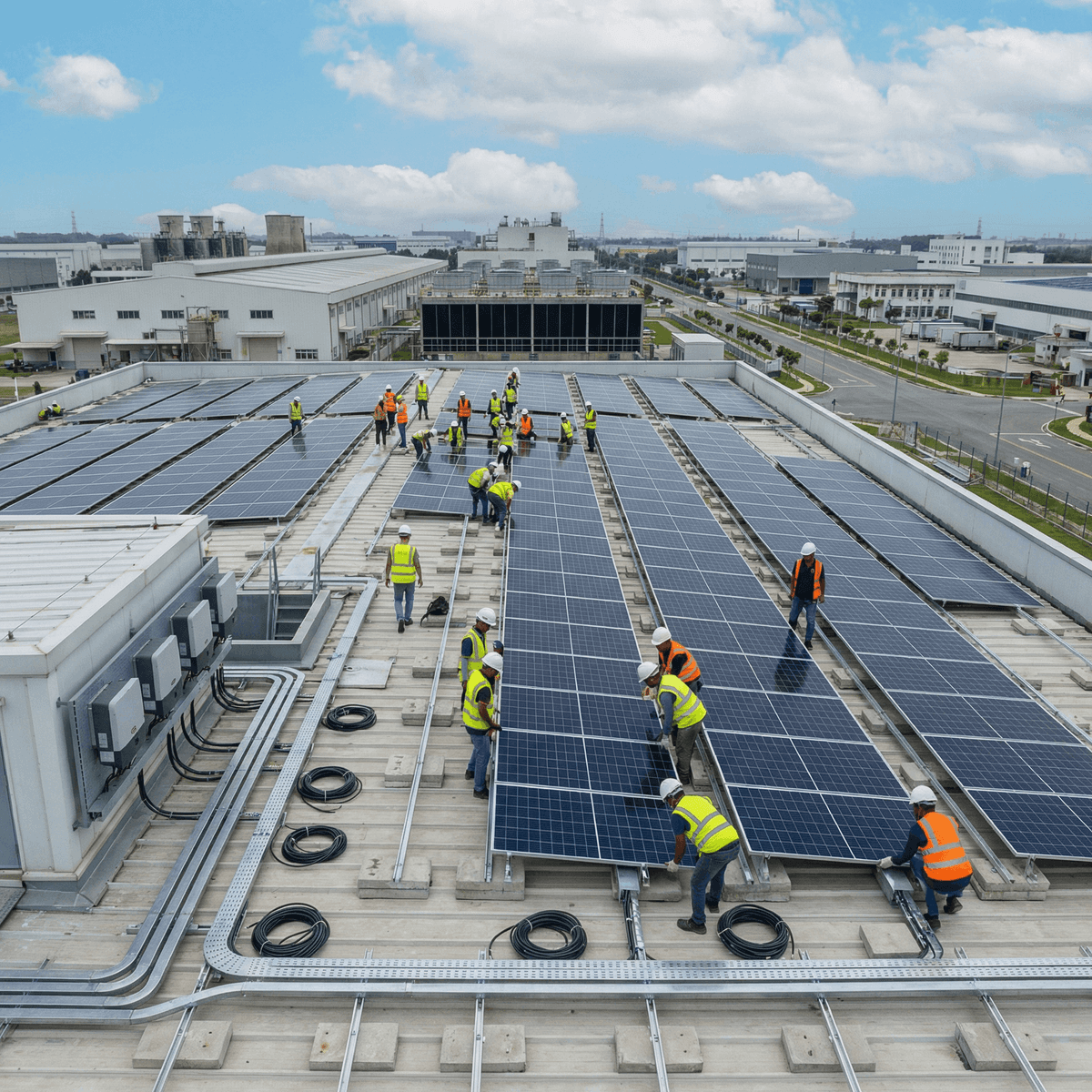
A SOLARTODO 200kW School Hospital Rooftop configuration uses N-type mono TOPCon modules with 22.5-24.5% mass-production efficiency and a fixed rooftop array. In practical layouts, the system uses about 286 modules in the 700W class for roughly 200.2kWp DC capacity, requiring about 900-1,100m2 of usable roof depending on spacing, parapets, skylights, access paths, and wind zones.
Hospital demand is usually favorable for solar because cooling, sterilization, labs, imaging, lighting, water pumping, and administrative loads peak between 08:00 and 18:00. That aligns with PV generation and improves self-consumption. For procurement teams, the key question is whether the proposed design reduces daytime purchases by 30-70% over 25+ years without creating electrical, fire, or operational risk.
According to IRENA (2025), 91% of newly commissioned utility-scale renewable capacity in 2024 delivered power below the cost of the cheapest fossil fuel alternative, and renewables helped avoid USD 467 billion in fossil fuel costs. IRENA states, "renewables continued to represent the most cost-competitive source of new electricity generation in 2024." That cost trend supports hospital PV investment, but hospital projects still need site-specific engineering.
SOLARTODO is a B2B manufacturer and exporter, not an online marketplace. Hospital buyers typically submit drawings, load data, grid information, and roof details, then receive an offline quotation for supply, delivery, or EPC delivery. Buyers can also review Solar PV System products or use the solar PV configurator before contacting SOLARTODO for project validation.
Technical Design and Safety Standards
Hospital PV safety design starts with IEC 61215/61730 modules, IEC 62109 inverters, IEEE 1547 controls, and NEC Article 690 or IEC 60364 wiring rules. These standards turn a commercial solar layout into a bankable electrical asset that can pass design review, utility interconnection, fire-safety inspection, and insurer due diligence.
Module and Inverter Requirements
Modules should be specified to IEC 61215 for design qualification and IEC 61730 for safety qualification. For hospital roofs, procurement teams should also request factory flash-test data, bill of materials traceability, connector compatibility, salt-mist or ammonia test data where relevant, and wind-load calculations. TOPCon modules are attractive because 22.5-24.5% efficiency reduces roof area per kW compared with older lower-efficiency panels.
Inverters should comply with IEC 62109 for safety and, where required, UL 1741 and IEEE 1547 for grid support and anti-islanding. IEEE 1547-2018 defines interconnection and interoperability requirements for distributed energy resources connected to electric power systems. In hospital projects, inverter settings should be coordinated with the utility, generator controls, protection relays, and building management system.
Medical Facility Load Segmentation
PV should not be treated as emergency power unless the system includes certified storage, transfer equipment, protection logic, and black-start design. Most 200kW hospital rooftop PV systems are grid-tied self-consumption systems that reduce daytime grid energy while diesel generators or UPS equipment continue to serve life-safety and critical branches.
The electrical single-line diagram should separate critical, essential, and noncritical loads. PV can safely offset HVAC chillers, laundry, kitchens, offices, pumps, and general lighting when reverse power, export limits, and generator interaction are correctly controlled. If the hospital wants PV to support backup loads, SOLARTODO normally recommends a hybrid design with LFP storage, bidirectional PCS, EMS controls, and selective load panels.
Fire, Roof, and Maintenance Access
Fire-safe design requires DC isolators, surge protection, arc-fault strategy where mandated, cable containment, rapid shutdown where required, and clear roof access routes. Structural design should verify roof live load, ballast or anchoring, uplift, drainage, waterproofing, and corrosion resistance. Hospitals often operate continuously, so installation sequencing must isolate work zones, reduce noise and dust, and avoid blocking emergency access.
According to IEA (2024), at least 1,650GW of renewable capacity was in advanced development and waiting for grid connection, which shows that interconnection is a major schedule risk. Hospitals should therefore start utility applications, protection studies, and export-limit discussions early, not after equipment procurement.
EPC Investment Analysis and Pricing Structure
A 200kW hospital EPC package typically compares FOB, CIF, and turnkey scopes, with annual savings of USD 38,400-72,000 at USD 0.12-0.20/kWh avoided tariffs. EPC means Engineering, Procurement, and Construction, but hospital buyers should define exactly where supplier responsibility starts and ends.
What EPC Turnkey Delivery Includes
A true EPC turnkey scope should include site survey, structural review, electrical design, module and inverter procurement, mounting supply, logistics, installation, AC/DC protection, testing, commissioning, documentation, grid-connection support, and operator training. For hospitals, it should also include outage planning, construction safety method statements, infection-control coordination where rooftop works affect air intakes, and handover documents for facility managers.
SOLARTODO can support three procurement structures:
| Pricing tier | Scope | Buyer responsibility | Typical use |
|---|---|---|---|
| FOB Supply | Modules, inverters, mounting, DC materials loaded at export port | Freight, insurance, customs, local installation | Experienced EPCs buying equipment |
| CIF Delivered | Equipment delivered to destination port with freight and insurance | Customs clearance, inland transport, installation | Public buyers and regional distributors |
| EPC Turnkey | Engineering, supply, delivery, installation, commissioning, documentation | Site access, permits, utility approvals, payment milestones | Hospitals seeking single-point delivery |
Budgetary pricing must be confirmed by quotation because roof structure, country duties, cable runs, protection panels, and labor rates can shift total cost materially. For early screening, many buyers compare FOB supply, CIF delivered, and EPC turnkey on a USD/W basis, then request a firm SOLARTODO quotation after drawings and load data are reviewed.
Volume pricing guidance is straightforward: 50+ systems can qualify for about 5% discount, 100+ systems for about 10%, and 250+ systems for about 15%, subject to final specification and delivery schedule. Standard payment terms are 30% T/T deposit plus 70% against B/L, or 100% L/C at sight. Financing is available for large projects above USD 1,000K; contact [email protected] or +6585559114 for project screening.
Payback Method
A 200kW hospital rooftop system generating 320-360MWh/year creates annual gross savings of USD 38,400 at USD 0.12/kWh and USD 72,000 at USD 0.20/kWh. If the installed EPC cost is modeled at USD 150,000-230,000, simple payback usually falls around 3-7 years before incentives, tax effects, degradation, and O&M are applied. Diesel-offset projects can pay back faster when fuel, transport, and generator maintenance are included.
According to NREL PVWatts methodology, yield modeling should use system size, array type, tilt, azimuth, DC-to-AC ratio, inverter efficiency, and system losses. NREL PVWatts states, "Estimates the energy production of grid-connected photovoltaic (PV) energy systems throughout the world." For hospital investment committees, the model should include monthly production, tariff escalation, self-consumption rate, export compensation, O&M, degradation below 0.4%/year for premium TOPCon modules, and inverter replacement allowances.
Hospital Applications and Payback Modeling
Hospitals usually receive the strongest PV value between 08:00 and 18:00, when HVAC, sterilization, refrigeration, imaging, lighting, and IT loads overlap with solar output. That overlap means a fixed-tilt rooftop system can offset high-value daytime consumption without relying on export revenue.
A 200kW PV system is commonly appropriate for mid-size hospitals, clinics with laboratories, medical campuses, and public health buildings with stable daytime loads above 120-180kW. If daytime load frequently drops below PV output, the design should use export limitation, battery charging, chilled-water pre-cooling, or a smaller DC array.
The financial case should compare PV against grid-only electricity, diesel-supported daytime operation, and hybrid PV-plus-storage. For a hospital paying USD 0.16/kWh, 340MWh/year of self-consumed PV offsets about USD 54,400/year. Over 25 years, before tariff escalation and major replacements, that creates about USD 1.36 million in avoided energy purchases.
According to IEA (2024), solar PV and wind together account for 95% of renewable capacity growth through 2030, while new solar capacity accounts for 80% of renewable power growth by the end of the decade. That matters to hospital buyers because module supply chains, inverter firmware, and O&M practices are mature, but grid approvals and quality control still decide project outcomes.
Comparison and Selection Guide
Hospital buyers should compare PV-only, PV-plus-storage, and diesel-only supply on 25-year cost, outage performance, roof area, and standards compliance. The right selection depends on load profile, outage frequency, utility tariff, diesel cost, and whether the hospital wants savings only or resilience as well.
| Option | Typical configuration | Strength | Limitation | Best-fit hospital use |
|---|---|---|---|---|
| PV-only rooftop | 200kW TOPCon, fixed tilt, grid-tied inverter | Lowest cost per kWh and 3-7 year payback | No backup during grid outage without grid-forming system | Stable daytime load with reliable grid |
| PV-plus-storage | 100-200kW PV with 200-400kWh LFP | Load shifting, peak reduction, selected backup | Higher capex and more control design | Frequent outages or high demand charges |
| Diesel-only backup | Existing genset and ATS | High surge capacity and familiar operation | Fuel cost, emissions, maintenance, noise | Emergency backup where PV is not feasible |
| Grid-only supply | Utility service with no onsite generation | Lowest complexity | Tariff exposure and limited resilience | Temporary facilities or shaded sites |
Selection should begin with 12 months of interval load data if available. Engineers should calculate daytime base load, peak demand, roof area, structural capacity, shading, utility export rules, and emergency power architecture. For a 200kW SOLARTODO rooftop project, the strongest business case appears when at least 75-90% of PV output is self-consumed on site.
Procurement managers should request a compliance matrix with each quotation. At minimum, it should list IEC 61215, IEC 61730, IEC 62109, IEEE 1547, UL 1741 where applicable, IEC 62446 testing documentation, surge protection standards, cable ratings, fire access clearances, and warranty terms. SOLARTODO should be evaluated on delivered scope, documentation quality, project references, financing support, and after-sales service, not only module price.
FAQ
Hospital PV FAQs should resolve 10 procurement questions covering 200kW sizing, payback, EPC pricing, standards, batteries, maintenance, warranty, and diesel integration.
Q: What size solar PV system is practical for a hospital rooftop? A: A 200kW rooftop PV system is practical for many mid-size hospitals with 900-1,100m2 of usable roof and daytime demand above 120-180kW. SOLARTODO's 200kW hospital configuration uses about 286 700W-class TOPCon modules and can generate roughly 320-360MWh/year depending on irradiation, temperature, tilt, shading, and roof orientation.
Q: Can a hospital use solar PV as emergency backup power? A: Solar PV alone should not be treated as emergency backup because grid-tied inverters normally disconnect during outages for safety. Backup operation requires LFP batteries, grid-forming inverters, transfer logic, protection coordination, and selective critical-load panels. Diesel generators and UPS systems usually remain responsible for life-safety circuits unless a hybrid system is specifically engineered.
Q: Which safety standards matter most for hospital solar PV? A: Hospital PV projects should require IEC 61215 and IEC 61730 for modules, IEC 62109 for inverters, and IEEE 1547 or local equivalent rules for grid interconnection. In the United States, UL 1741 and NEC Articles 690 and 705 are also common. IEC 62446 documentation improves inspection, commissioning, and O&M traceability.
Q: What payback period should a hospital expect from a 200kW system? A: A 200kW hospital PV system often models at a 3-7 year simple payback when it generates 320-360MWh/year and offsets USD 0.12-0.20/kWh electricity. Annual gross savings can reach about USD 38,400-72,000. Actual payback depends on installed cost, self-consumption, export rules, incentives, financing, O&M, and tariff escalation.
Q: What does EPC turnkey pricing include for a hospital PV project? A: EPC turnkey delivery should include engineering, procurement, construction, installation, commissioning, testing, documentation, grid-connection support, and operator training. Hospital scopes should also include roof structural review, shutdown planning, fire access, protection coordination, and safety method statements. SOLARTODO can quote FOB Supply, CIF Delivered, or EPC Turnkey after reviewing drawings and load data.
Q: How should PV be integrated with hospital diesel generators? A: PV integration with diesel generators requires reverse-power protection, export limiting, load control, and inverter settings coordinated with generator governors and voltage regulators. During grid outages, ordinary grid-tied PV shuts down unless a hybrid microgrid controller forms the electrical reference. Engineers should verify all operating modes before connecting PV to essential busbars.
Q: How much maintenance does a hospital rooftop PV system require? A: Hospital PV systems typically need remote monitoring, monthly performance review, annual electrical inspection, periodic module cleaning, thermal imaging, torque checks, insulation-resistance testing, and inverter log review. Dusty climates may need quarterly cleaning. Preventive maintenance is important because a 5-10% performance loss can materially reduce annual savings and extend payback.
Q: Should hospitals add battery storage to a 200kW PV system? A: Battery storage is justified when the hospital faces frequent outages, high demand charges, weak grids, or poor export compensation. A 200-400kWh LFP battery can shift solar energy into evening loads and support selected backup circuits. If the goal is only daytime energy savings under reliable grid service, PV-only usually gives the lowest payback.
Q: What warranty terms should procurement teams request? A: Buyers should request module product warranties, 25-30 year performance warranties, inverter warranties, mounting corrosion warranties, and workmanship coverage for EPC installation. For TOPCon modules, annual degradation below 0.4% and retained output around 87% after 30 years are common premium benchmarks. Warranty value depends on documentation, serial tracking, and local service access.
Q: How does SOLARTODO support hospital PV procurement? A: SOLARTODO supports hospital PV procurement through B2B equipment supply, export delivery, EPC coordination, offline quotation, and financing screening for projects above USD 1,000K. Buyers can submit roof drawings, load profiles, grid details, and target scope. SOLARTODO then prepares a technical and commercial proposal rather than processing the order as an online marketplace transaction.
References
These 8 references anchor hospital PV engineering to recognized 2018-2025 standards, cost reports, interconnection rules, and performance-modeling methods for bankable procurement decisions.
- IRENA (2025): Renewable Power Generation Costs in 2024, including 91% cost-competitive renewable capacity and USD 467 billion avoided fossil fuel costs.
- IEA (2024): Renewables 2024, including 5,500GW new renewable capacity forecast by 2030 and solar PV's role in 80% of growth.
- IEEE 1547-2018 (2018): Standard for interconnection and interoperability of distributed energy resources with electric power system interfaces.
- NREL PVWatts (2024): PVWatts Calculator methodology for estimating grid-connected PV energy production from system size, losses, tilt, azimuth, and inverter assumptions.
- IEC 61215-1 (2021): Terrestrial photovoltaic modules design qualification and type approval requirements for crystalline silicon module durability testing.
- IEC 61730-1 (2023): Photovoltaic module safety qualification requirements for construction, electrical safety, mechanical safety, and fire-related design review.
- UL 1741 (2021): Standard for inverters, converters, controllers, and interconnection system equipment for distributed energy resources.
- NFPA 70 NEC (2023): National Electrical Code requirements including Article 690 for solar photovoltaic systems and Article 705 for interconnected power production sources.
Conclusion
For hospitals above 100kW daytime load, a 200kW SOLARTODO rooftop PV system can deliver 320-360MWh/year and a modeled 3-7 year payback. The bottom line: hospital solar PV is financially compelling when self-consumption exceeds 75-90%, but it must be engineered around IEC, IEEE, UL, fire-safety, roof-structure, generator, and medical-load constraints. SOLARTODO can support B2B quotation, export supply, EPC coordination, and financing discussions for qualified hospital portfolios.
About SOLARTODO
SOLARTODO is a global integrated solution provider specializing in solar power generation systems, energy-storage products, smart street-lighting and solar street-lighting, intelligent security & IoT linkage systems, power transmission towers, telecom communication towers, and smart-agriculture solutions for worldwide B2B customers.
Procurement paths
About the Author

Cinn Song
Founder & Chief Solutions Architect
Cinn Song founded SOLARTODO LIMITED and leads its smart-city infrastructure engineering — from solar, storage and integrated smart poles to the company's push into physical-AI city edge nodes: pole-mounted edge computing, vertical LLMs for smart cities, drone-based O&M with autonomous battery swapping, robotic maintenance, and high-speed counter-UAS interception. Since 2010, he has directed turnkey EPC + BOT delivery across 50+ countries, including telecom monopole supply for national grid operators, off-grid solar street-lighting for African municipalities, and integrated smart-pole programs for Gulf smart cities.
Cite This Article
Cinn Song. (2026). Engineering Commercial Solar PV Systems for hospitals:…. SOLARTODO. Retrieved from https://solartodo.com/knowledge/engineering-commercial-solar-pv-systems-for-hospitals-safety-standards-and-payback-period-analysis
@article{solartodo_engineering_commercial_solar_pv_systems_for_hospitals_safety_standards_and_payback_period_analysis,
  title = {Engineering Commercial Solar PV Systems for hospitals:…},
  author = {Cinn Song},
  journal = {SOLARTODO Knowledge Base},
  year = {2026},
  url = {https://solartodo.com/knowledge/engineering-commercial-solar-pv-systems-for-hospitals-safety-standards-and-payback-period-analysis},
  note = {Accessed: 2026-08-07}
}
Published: June 16, 2026 | Available at: https://solartodo.com/knowledge/engineering-commercial-solar-pv-systems-for-hospitals-safety-standards-and-payback-period-analysis
Subscribe to Our Newsletter
Get the latest solar energy news and insights delivered to your inbox.
View All Articles