Smart Agriculture Monitoring Systems for Crop Fields

SOLARTODO Editorial Team
Solar Energy & Infrastructure Expert Team
Watch the video
TL;DR
For crop fields above 20 ha, the best labor-saving approach is a zone-based monitoring system with weather stations, soil sensors, solar-powered nodes, and LoRaWAN or 4G backhaul. These systems typically report every 10 minutes, cover 5-15 km in rural links, and can reduce routine scouting and inspection labor by 20-60%, with payback often achieved in 2-4 seasons when labor, water, and crop-protection savings are combined.
Smart agriculture monitoring systems cut manual field checks by 30-60%, transmit sensor data every 10 minutes across 5-15 km LoRaWAN links, and reduce irrigation-related labor hours by 20-40% when weather, soil, and control data are managed in one platform.
Summary
Smart agriculture monitoring systems cut manual field checks by 30-60%, transmit sensor data every 10 minutes across 5-15 km LoRaWAN links, and reduce irrigation-related labor hours by 20-40% when weather, soil, and control data are managed in one platform.
Key Takeaways
- Deploy LoRaWAN networks with 5-15 km rural coverage and 10-minute reporting intervals to reduce site visits by 30-60% across dispersed crop fields.
- Place 1 weather station plus 1 soil node per 3-5 ha management zone to improve irrigation decisions and detect microclimate variation within 10-500 m terrain changes.
- Size solar-powered field nodes with IP67-IP68 enclosures and LFP battery backup to support year-round operation with low maintenance in remote plots.
- Use automated alerts at crop-specific thresholds such as 0°C to -2.5°C frost risk or abnormal soil moisture bands to shorten response time from hours to minutes.
- Compare FOB Supply, CIF Delivered, and EPC Turnkey pricing early; orders above 50 units typically target 5% discounts, 100 units 10%, and 250 units 15%.
- Integrate weather, soil, water-quality, and valve-control data into one cloud platform to cut irrigation water use by up to 50% in data-driven desert or water-stressed projects.
- Verify IEC, IEEE, ISO 11783, and IP protection compliance so gateways, power systems, and field sensors remain interoperable and serviceable over 2-5 year asset cycles.
- Calculate labor ROI using baseline patrol frequency, fuel cost, and technician hours; many farms recover monitoring investment within 2-4 seasons when labor and input savings are combined.
Why Smart Agriculture Monitoring Systems Reduce Labor in Crop Fields
Smart agriculture monitoring systems reduce labor cost by 20-60% when 10-minute field data, 5-15 km wireless transmission, and automated alerts replace manual scouting across multiple hectares.
For crop-field operators, the core engineering question is not whether sensors are useful, but how to move reliable data from remote plots to a decision platform with low operating cost. A field team walking or driving 20-50 ha to inspect soil moisture, pump status, and weather conditions can spend 2-6 labor hours per day on observation alone. Once those measurements are automated, staff can shift from routine checking to exception-based intervention.
SOLAR TODO applies this approach in smart agriculture packages that combine weather monitoring, soil sensing, communications, solar power, and cloud analytics. In the product range, the Orchard Frost Early Warning 40ha covers 40 ha with 10 sensing points and default 10-minute intervals, while the Tea Garden Precision Monitoring 30ha uses 15 sensors/devices across 30 ha. For larger reclamation projects, the Desert Reclamation Solar+Agriculture 50ha combines 20 sensors, 4G LTE communications, and 500 kW solar PV support.
According to IRENA (2023), digitalization and smart control improve renewable-based energy system efficiency and operational visibility across distributed assets. According to the IEA (2024), data-driven electrification and automation are becoming central to productivity in energy-intensive sectors, including agriculture. In practical farm terms, that means fewer patrols, faster response, and more consistent records for irrigation, frost protection, and disease management.
The International Energy Agency states, "Digital technologies can make energy systems more connected, intelligent, efficient, reliable and sustainable." That statement fits agriculture monitoring directly because field operations depend on frequent measurements, distributed equipment, and time-sensitive actions. For procurement managers, the result is measurable labor reduction when data replaces routine inspection.
System Architecture: Sensors, Power, and Data Transmission Design
A practical crop-field architecture uses 1 gateway, 8-20 field nodes, solar power, and either LoRaWAN or 4G LTE to deliver 10-minute data intervals with low maintenance.
The engineering stack starts with sensing layers. A typical crop-field deployment includes one professional weather station for 8-10 atmospheric parameters, distributed soil probes for moisture and temperature, optional EC or pH sensors, and control I/O for pumps or valves. In orchards or tea gardens, microclimate can change over 10 m to 500 m elevation differences, so one sensor point is rarely enough for 20-50 ha.
Sensor layer and field placement
A good planning rule is to divide land into management zones of 3-5 ha when topography, irrigation layout, or soil texture varies. One weather station can often serve a 20-50 ha block, but soil nodes should be distributed by root-zone behavior, not by geometry alone. For drip-irrigated fields, probe placement near representative emitters and root depth is more useful than equal spacing.
The Orchard Frost Early Warning 40ha package uses 10 field sensing points across 40 ha, which is a practical reference for frost-sensitive orchards. The Tea Garden Precision Monitoring 30ha package includes 15 sensors/devices over 30 ha, reflecting the higher variability of slope, humidity, and disease pressure. In both cases, 10-minute intervals are frequent enough for operational control without creating unnecessary bandwidth load.
Data transmission options
LoRaWAN is usually the first choice for remote crop fields because it provides long range at low power. Rural links of 5-15 km are common under favorable terrain and antenna height conditions, though dense vegetation, hills, and metal structures reduce range. A single gateway can often cover one large block or several adjacent zones, which lowers communication cost compared with SIM-based devices on every node.
4G LTE becomes useful when projects need higher data volume, image transfer, or direct cloud backhaul from isolated sites. The Desert Reclamation Solar+Agriculture 50ha package uses 4G LTE because it combines 20 sensors, water-quality monitoring, and automated irrigation control across a utility-scale site. Where mobile coverage is weak, a hybrid design can use LoRaWAN in-field and 4G LTE or Ethernet at the gateway.
According to IEEE (2018), interoperability and stable interconnection are essential when distributed devices exchange operational data with control systems. In agriculture, that principle applies to gateways, cloud APIs, and pump or valve interfaces. ISO 11783 is also relevant because it supports agricultural data interoperability between field devices and management platforms.
Power system design for remote nodes
Most field nodes should use dedicated solar power with battery storage because trenching AC power across 30-50 ha usually costs more than the sensor hardware. A common design uses a small PV module, charge controller, and LFP battery sized for 3-5 days of autonomy. Outdoor enclosures should meet IP67 or IP68 protection, especially where irrigation spray, dust, and fertilizer exposure are frequent.
SOLAR TODO uses solar-powered outdoor nodes in orchard and tea configurations to reduce maintenance and avoid dependence on unstable grid supply. This matters in export markets across Africa, Latin America, and Southeast Asia where field electrification quality varies by region. For procurement teams, the engineering objective is simple: low-power electronics, sealed enclosures, and battery chemistry that tolerates daily cycling.
How Data Transmission Cuts Labor Cost and Improves Response Time
Labor savings come from replacing 2-6 daily inspection hours with threshold alerts, centralized dashboards, and remote control actions completed in 5-15 minutes.
Manual field inspection is expensive because labor cost includes travel time, fuel, supervision, and delayed decisions. A worker may need 20-40 minutes to reach a remote block, inspect 4-8 points, write notes, and report back. If the farm has 3-6 separate blocks, the daily observation burden scales quickly.
With a monitoring system, the workflow changes from route-based patrol to event-based intervention. Soil moisture below a defined threshold can trigger an app push, SMS, or email alert. Frost risk near 0°C to -2.5°C can trigger wind machine control or operator notification. Pump failure, abnormal pressure, or rainfall events can be seen on the dashboard without sending a technician first.
According to NREL (2024), data-driven performance monitoring improves operational visibility and supports more accurate system management across distributed energy assets. In agriculture, the same logic reduces labor because operators no longer collect routine measurements manually. They verify exceptions, not every normal condition.
The World Meteorological Organization states, "Observations are the foundation of weather, climate and water services." For farms, that means better decisions depend on continuous measurements, not occasional spot checks. A 10-minute reporting interval creates 144 records per day per node, far beyond what a manual team can gather economically.
Labor reduction mechanisms
There are four direct labor-saving mechanisms in field deployments:
- Fewer patrols: routine visits can drop from daily to exception-based schedules, often cutting scouting trips by 30-60%.
- Faster troubleshooting: operators identify which zone has a problem before dispatching staff, reducing diagnostic time by 20-50%.
- Remote control: irrigation valves, pumps, or frost devices can be activated without sending a worker to the field edge.
- Better records: automatic logs reduce manual reporting time and support seasonal audits, water-use review, and agronomic analysis.
Sample deployment scenario (illustrative): a 40 ha orchard previously inspected twice daily by 2 workers at 1.5 hours per round uses 6 labor hours/day for observation. If automated monitoring cuts routine rounds by 50%, the farm saves about 3 labor hours/day, or roughly 90 hours/month over a 30-day frost-risk period. That does not include avoided crop loss from earlier action.
Applications and Product Configuration for Different Crop Fields
Crop-field monitoring works best when system density matches agronomic risk, with 10 sensing points for 40 ha orchards, 15 devices for 30 ha tea gardens, and 20 sensors for 50 ha reclamation sites.
Different crops create different data priorities. Orchards need canopy-level frost awareness, wind, humidity, and root-zone moisture. Tea gardens need microclimate mapping, leaf wetness or disease indicators, and slope-sensitive irrigation data. Desert reclamation projects need weather, soil, water quality, and energy visibility because pumping and irrigation are tightly linked.
Example configuration comparison
| System | Coverage | Sensors/Devices | Communications | Power | Typical Use Case |
|---|---|---|---|---|---|
| Orchard Frost Early Warning 40ha | 40 ha | 10 sensing points | LoRaWAN | Solar-powered nodes | Apple and citrus frost protection |
| Tea Garden Precision Monitoring 30ha | 30 ha | 15 sensors/devices | LoRaWAN | Solar-powered outdoor operation | Tea irrigation and AI disease control |
| Desert Reclamation Solar+Agriculture 50ha | 50 ha | 20 sensors | 4G LTE | 500 kW PV + field solar kits | Water-energy-agriculture control |
The orchard package is designed for 1 large 40 ha block or 2-4 adjacent orchard zones. It combines weather monitoring and soil moisture-temperature monitoring with SMS, email, and app push alerts. Integrated wind machine control supports active frost mitigation, which is important when blossom damage can occur within 1-3 hours.
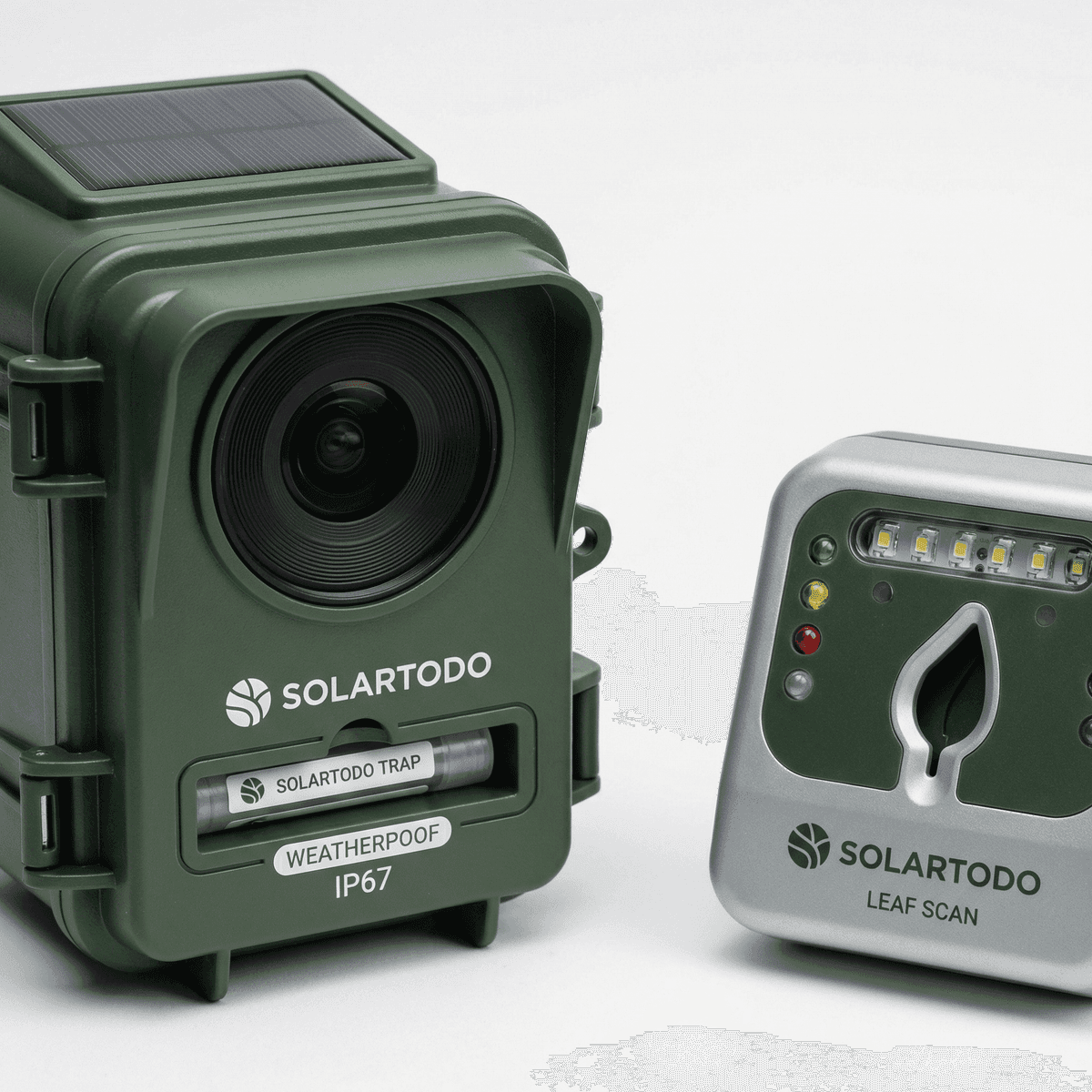
The tea package is designed for 30 ha where elevation changes and canopy moisture create disease pressure. It includes one multispectral leaf scanner and 10 core weather parameters, helping estates identify stress before visible symptoms appear. That reduces scouting burden and shortens disease response by several hours to several days.
The desert reclamation package is designed for 50 ha with 500 kW solar PV, 12 comprehensive soil probes, 4 water-quality monitoring points, and automated drip-irrigation control. Product knowledge indicates water use can be reduced by up to 50%, pesticide use by about 30%, and yield improved by 15-25% when agronomic response protocols are followed. For labor planning, those gains matter because fewer emergency interventions are needed.
SOLAR TODO can also support custom configurations where buyers need different hectare ranges, crop profiles, or communication methods. Buyers can review the broader portfolio at View all Smart Agriculture IoT Monitoring System products or assess options at Configure your system online. The commercial process remains B2B: inquiry, offline quotation, and financing support for qualified projects.
EPC Investment Analysis and Pricing Structure
EPC delivery combines engineering, procurement, installation planning, commissioning, and training into one scope, which reduces interface risk on 30-50 ha smart agriculture projects.
For B2B buyers, pricing should be evaluated in three layers because equipment cost alone does not show total project cost. A monitoring package may look competitive on hardware, but gateway mounting, solar power kits, civil works, sensor calibration, and software onboarding often determine the real budget. Procurement teams should compare supply scope, logistics scope, and full delivery scope side by side.
Three-tier pricing structure
| Pricing Model | What It Includes | Best For | Commercial Notes |
|---|---|---|---|
| FOB Supply | Equipment only, factory handover, packing list, manuals | Importers and local integrators | Lowest upfront price; buyer handles freight, customs, installation |
| CIF Delivered | Equipment, export handling, sea freight, insurance to destination port | Buyers wanting landed-cost clarity | Better budget predictability; local installation still separate |
| EPC Turnkey | Engineering, equipment, delivery, installation guidance or coordination, commissioning, training | Large farms, developers, public projects | Highest capex, lowest interface risk and faster startup |
Volume pricing guidance should be discussed early in tender planning. Standard commercial guidance is 5% discount for 50+ units, 10% for 100+, and 15% for 250+ when scope, configuration, and shipment schedule are aligned. For mixed projects with sensors, gateways, and control cabinets, discount treatment should be confirmed line by line.
Payment terms commonly used are 30% T/T in advance and 70% against B/L, or 100% L/C at sight for qualified orders. Financing is available for large projects above $1,000K, subject to project review, country risk, and buyer credentials. For EPC, warranty and service scope should define hardware period, cloud subscription term, spare parts, and remote support hours.
ROI and labor payback logic
A practical ROI model combines labor savings, water savings, reduced crop loss, and lower travel cost. If a farm saves 2-4 labor hours/day over a 180-day season, annual labor reduction alone can be material. If the same system also reduces irrigation water by 10-50% depending on crop and baseline practice, payback often falls within 2-4 seasons.
Sample deployment scenario (illustrative): a 50 ha irrigated field cuts 3 labor hours/day at $8/hour over 240 days, saving $5,760/year in labor. If improved irrigation saves an additional $4,000-$12,000/year in water and pumping energy, the annual operating benefit reaches $9,760-$17,760 before crop-protection gains. That is why monitoring projects should be evaluated as operations infrastructure, not only as sensor purchases.
For quotations, EPC scope review, and financing discussion, buyers can contact SOLAR TODO at [email protected] or call +6585559114. SOLAR TODO supports offline quotation rather than online checkout, which is normal for customized B2B agriculture projects.
FAQ
A concise FAQ with 10 answers helps procurement teams compare 10-minute data systems, 5-15 km communications, EPC scope, and maintenance obligations before issuing RFQs.
Q: What is a smart agriculture monitoring system for crop fields? A: A smart agriculture monitoring system is a field network of sensors, gateways, power units, and cloud software that measures weather, soil, water, and equipment status. Most B2B systems report every 10-30 minutes and cover 20-50 ha or more. The main purpose is to reduce manual inspection, improve response speed, and support data-based irrigation or crop protection.
Q: How does data transmission work in remote crop fields? A: Data transmission usually starts with field sensors sending readings to a gateway by LoRaWAN over 5-15 km in rural conditions. The gateway then forwards data to the cloud through 4G LTE, Ethernet, or Wi-Fi. This two-layer design lowers node power consumption and reduces SIM-card cost compared with cellular devices on every sensor.
Q: Why does LoRaWAN often make sense for agriculture projects? A: LoRaWAN is useful because it combines long range, low power, and low operating cost for distributed field nodes. A single gateway can often cover one large block or several nearby zones, depending on terrain and antenna height. That makes it suitable for soil probes, weather stations, and alarm devices that only need small data packets every 10 minutes.
Q: How much labor cost can a monitoring system reduce? A: Labor reduction depends on field size, patrol frequency, and automation level, but many farms cut routine scouting and inspection hours by 20-60%. Savings come from fewer site visits, faster fault isolation, and remote control of irrigation or frost equipment. The strongest results appear where farms manage multiple blocks and previously relied on manual note-taking.
Q: What sensors are typically included in a crop-field system? A: A standard system often includes one weather station, several soil moisture-temperature probes, gateway hardware, and solar-powered communication nodes. More advanced projects add EC, pH, water-quality, rainfall, solar radiation, atmospheric pressure, and valve-control inputs. Crop type matters: orchards prioritize frost and canopy conditions, while tea or vegetable fields may prioritize disease and irrigation zoning.
Q: How should buyers size a system for 30-50 hectares? A: Buyers should size by management zones rather than total area alone. A 30-50 ha site with uniform soil may need fewer nodes than a 30 ha site with 4 irrigation zones and 200 m elevation change. As a practical reference, 10 sensing points for 40 ha orchards and 15 devices for 30 ha tea gardens are reasonable starting configurations.
Q: What maintenance is required for field monitoring hardware? A: Most systems need routine inspection every 3-6 months, plus seasonal calibration checks for selected sensors. Maintenance usually includes cleaning radiation shields, checking solar charging status, verifying enclosure seals, and reviewing gateway connectivity. IP67 or IP68 hardware reduces failure risk, but battery health, cable strain relief, and probe placement still need periodic review.
Q: What is included in EPC turnkey delivery for smart agriculture? A: EPC turnkey delivery typically includes site engineering, bill of materials confirmation, communications design, supply of sensors and gateways, installation coordination, commissioning, and operator training. It may also include cloud onboarding and control logic setup for pumps or valves. Buyers should confirm whether civil works, local permits, and telecom subscriptions are included or excluded.
Q: How are pricing and payment terms usually structured? A: Pricing is commonly offered as FOB Supply, CIF Delivered, or EPC Turnkey depending on project scope. Standard payment terms are often 30% T/T in advance and 70% against B/L, or 100% L/C at sight. For larger projects above $1,000K, financing may be available after commercial and project-risk review.
Q: What warranty period should B2B buyers expect? A: Warranty depends on product category and project scope, but 1-2 years is common for electronics and cloud service is often quoted separately by annual tier. For example, the desert reclamation package references 2 years hardware warranty and 1 year professional cloud service. Buyers should also ask about spare parts, remote diagnostics, and replacement lead times.
References
- NREL (2024): PVWatts Calculator methodology and performance modeling approach for distributed solar-powered systems and remote asset energy estimation.
- IEEE 1547-2018 (2018): Standard for interconnection and interoperability of distributed energy resources with associated electric power systems interfaces.
- IEA (2024): Analysis on digitalization, electrification, and system efficiency trends relevant to distributed monitoring and control.
- IRENA (2023): Digitalization for the energy transition and operational efficiency across distributed renewable-based infrastructure.
- WMO (2023): Weather observation guidance showing that continuous observations are the basis for weather and water services.
- ISO 11783 (2024): Agricultural data communication framework supporting interoperability between field equipment and management systems.
- IEC 60529 (2013): IP code classification for enclosure protection, relevant to IP67 and IP68 outdoor sensor housings.
Conclusion
Smart agriculture monitoring systems reduce field labor by 20-60%, support 10-minute decision data, and extend communications 5-15 km with the right LoRaWAN or 4G architecture.
For crop fields above 20 ha, SOLAR TODO recommends a zone-based design with solar-powered nodes, one integrated cloud platform, and EPC scope review early in procurement. The bottom line is straightforward: if a farm still depends on manual patrols for weather, soil, and irrigation status, a properly sized monitoring system can lower labor cost within 2-4 seasons while improving response quality.
About SOLARTODO
SOLARTODO is a global integrated solution provider specializing in solar power generation systems, energy-storage products, smart street-lighting and solar street-lighting, intelligent security & IoT linkage systems, power transmission towers, telecom communication towers, and smart-agriculture solutions for worldwide B2B customers.
About the Author

SOLARTODO Editorial Team
Solar Energy & Infrastructure Expert Team
SOLAR TODO is a professional supplier of solar energy, energy storage, smart lighting, smart agriculture, security systems, communication towers, and power tower equipment.
Our technical team has over 15 years of experience in renewable energy and infrastructure, providing high-quality products and solutions to B2B customers worldwide.
Expertise: PV system design, energy storage optimization, smart lighting integration, smart agriculture monitoring, security system integration, communication and power tower supply.
Cite This Article
SOLARTODO Editorial Team. (2026). Smart Agriculture Monitoring Systems for Crop Fields. SOLARTODO. Retrieved from https://solartodo.com/knowledge/engineering-smart-agriculture-monitoring-systems-for-crop-fields-data-transmission-and-labor-cost-reduction
@article{solartodo_engineering_smart_agriculture_monitoring_systems_for_crop_fields_data_transmission_and_labor_cost_reduction,
  title = {Smart Agriculture Monitoring Systems for Crop Fields},
  author = {SOLARTODO Editorial Team},
  journal = {SOLARTODO Knowledge Base},
  year = {2026},
  url = {https://solartodo.com/knowledge/engineering-smart-agriculture-monitoring-systems-for-crop-fields-data-transmission-and-labor-cost-reduction},
  note = {Accessed: 2026-10-23}
}
Published: July 5, 2026 | Available at: https://solartodo.com/knowledge/engineering-smart-agriculture-monitoring-systems-for-crop-fields-data-transmission-and-labor-cost-reduction
Subscribe to Our Newsletter
Get the latest solar energy news and insights delivered to your inbox.
View All Articles