galvanized steel power line tower wholesale | SOLARTODO

Cinn Song
Founder & Chief Solutions Architect
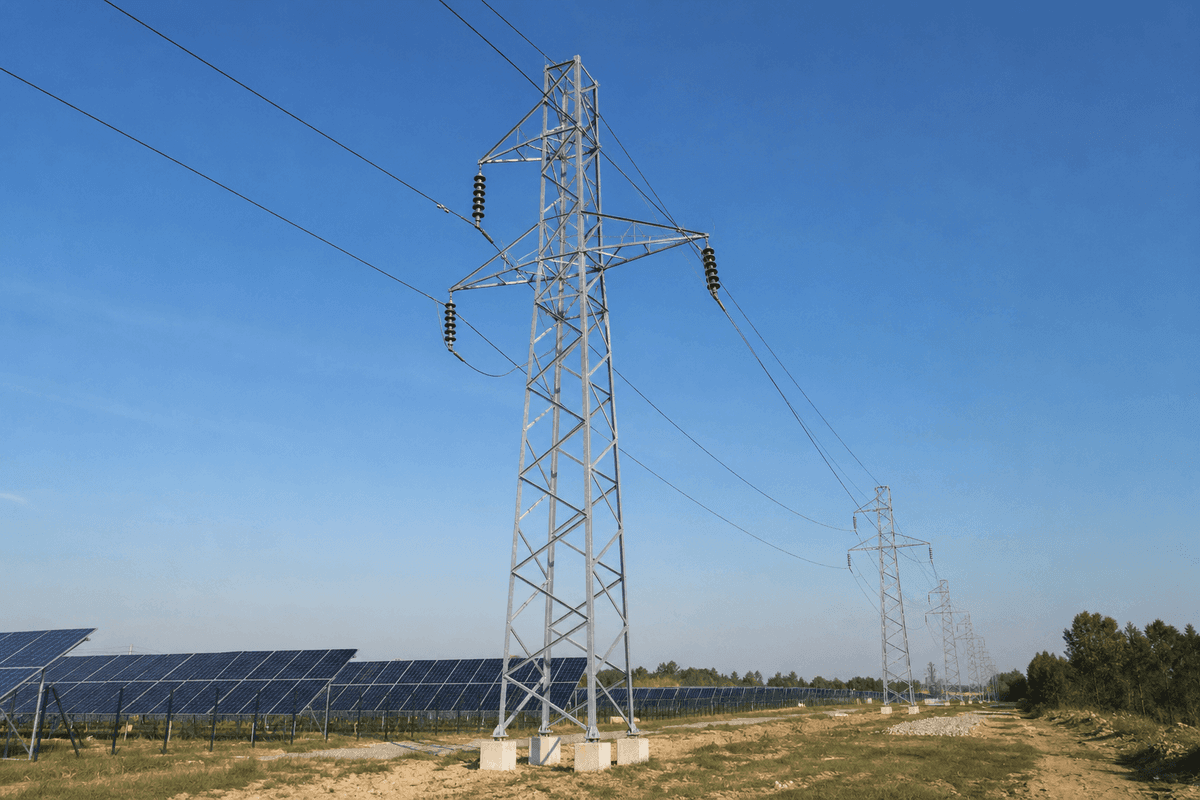
TL;DR
Galvanized steel power line tower wholesale procurement should start with engineering data, not price per ton. For 35kV distribution, SOLARTODO offers 22m Q420/Q460 double-circuit lattice towers with 120m nominal spans, ISO 1461 hot-dip galvanizing, and 50-year design targets, with FOB, CIF, or EPC turnkey pricing available for bulk infrastructure projects.
Wholesale galvanized steel power line towers for 35kV distribution use 22m Q420/Q460 lattice structures, 120m design spans, and ISO 1461 hot-dip galvanizing to target 50-year service life for utilities, EPCs, and renewable grid extensions.
Summary
Wholesale galvanized steel power line towers for 35kV distribution use 22m Q420/Q460 lattice structures, 120m design spans, and ISO 1461 hot-dip galvanizing to target 50-year service life for utilities, EPCs, and renewable grid extensions.
Key Takeaways
Procure galvanized steel power line towers in 50+ unit lots to secure engineered drawings, predictable logistics, and about 5% wholesale discount leverage.
- Specify 22m 35kV double-circuit tangent towers when suburban corridors require 6 conductors, 1 OPGW, and 120m nominal spans.
- Verify ISO 1461 hot-dip galvanizing with 85 micrometer typical coating targets for steel sections above 6mm in corrosive outdoor service.
- Compare Q420 and Q460 angle steel for projects needing 420MPa-plus yield strength, reduced tower weight, and 50-year design life.
- Reduce right-of-way pressure by using double-circuit steel lattice towers that carry 2 circuits on 1 structure and can cut land use up to 40%.
- Require IEC 60826 and ASCE 10-15 design checks for wind, ice, conductor tension, deflection, foundation reactions, and erection safety.
- Plan bulk shipments in 20ft or 40ft containers with bundled members, bolt kits, packing lists, and match-marked erection drawings.
- Budget EPC turnkey pricing separately from FOB supply because civil foundations, erection crews, testing, and commissioning can add 25-60%.
- Request SOLARTODO financing review for projects above $1,000K where phased delivery, grid revenue, or public infrastructure budgets affect cash flow.
Wholesale Market Context for Galvanized Steel Power Line Towers
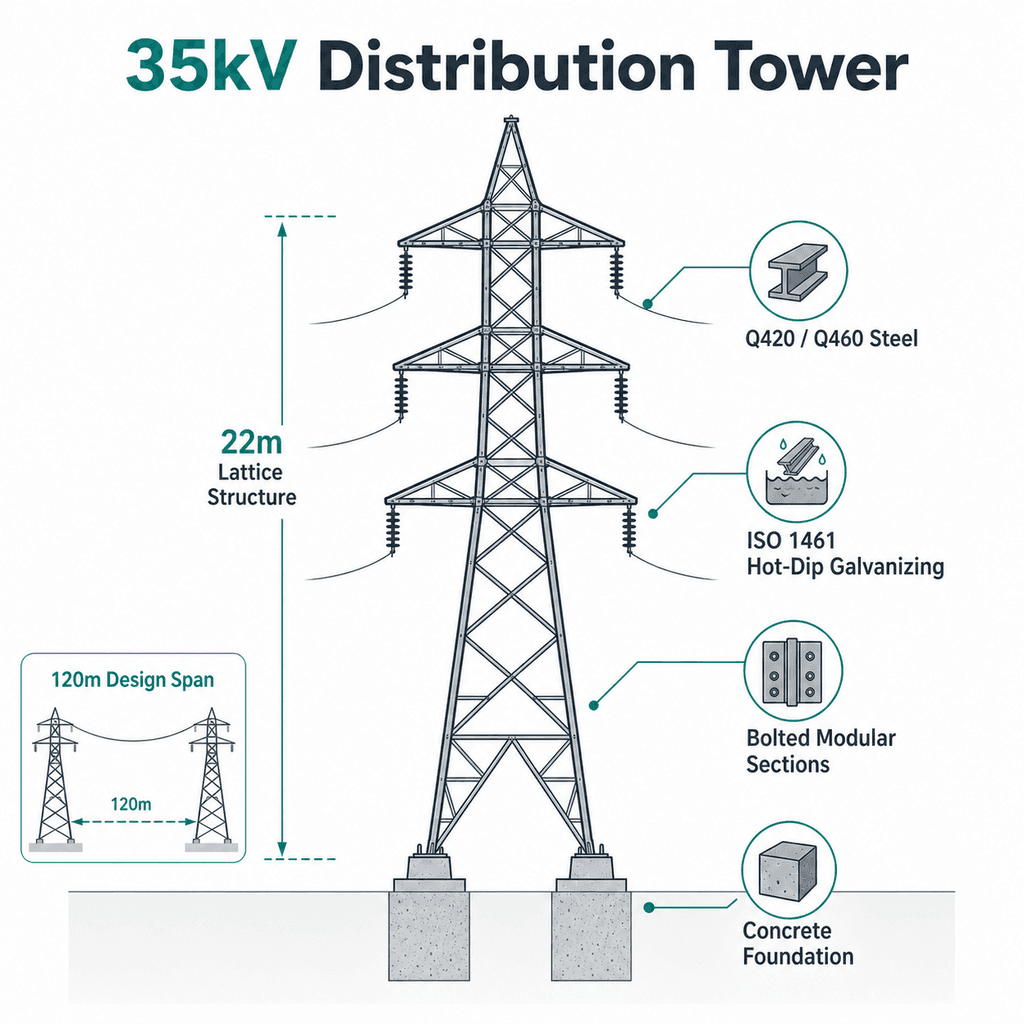
Galvanized steel power line tower wholesale procurement is driven by 35kV to 220kV grid expansion, 50-year asset life expectations, and standardized tower families.
Utilities, EPC contractors, renewable developers, and industrial power users buy power line towers differently from ordinary steel structures. The tower is not only a fabricated product; it is a regulated grid component that must match voltage class, conductor type, route geometry, soil conditions, wind zone, corrosion environment, and erection method. For B2B buyers, the commercial goal is to reduce delivered cost per installed span without weakening compliance, traceability, or long-term maintainability.
According to the International Energy Agency (2023), around 80 million kilometers of grids must be added or refurbished by 2040 to meet national energy and climate targets. The IEA also states, 'Electricity grids are the backbone of electricity systems,' which explains why transmission and distribution hardware has become a procurement bottleneck for renewable integration. For solar, wind, storage, mining, industrial parks, and rural electrification, galvanized steel towers remain a practical choice because they combine modular fabrication, high load capacity, corrosion protection, and field repairability.
SOLARTODO supplies galvanized steel power line tower wholesale packages for infrastructure buyers that need export documentation, project quotation, and technical coordination rather than online checkout. A typical 22m 35kV double-circuit distribution tower uses hot-dip galvanized Q420/Q460 angle steel, supports six ACSR conductor strings and one OPGW shield wire, and is configured for about 120m standard spans. The lattice structure is wider at the base, tapers upward, and distributes vertical conductor load, transverse wind load, and longitudinal imbalance through braced steel members.
According to IRENA (2025), 91% of renewable power projects commissioned in 2024 were more cost-effective than fossil fuel alternatives, while global renewable capacity additions reached 582GW. Those renewable projects require substations, collection lines, distribution upgrades, and transmission interconnections. Towers are therefore part of the renewable energy value chain even when the product itself is not a solar module or inverter.
For wholesale buyers, the key commercial distinction is scope. FOB supply covers fabricated and galvanized tower steel, bolts, nuts, washers, packing lists, and drawings. CIF delivered adds international freight and insurance. EPC turnkey delivery adds foundations, erection, stringing coordination, testing, commissioning, and project management. The correct buying model depends on whether the customer already has local civil crews and grid engineers or needs a single accountable delivery partner.
Technical Specifications and Engineering Requirements
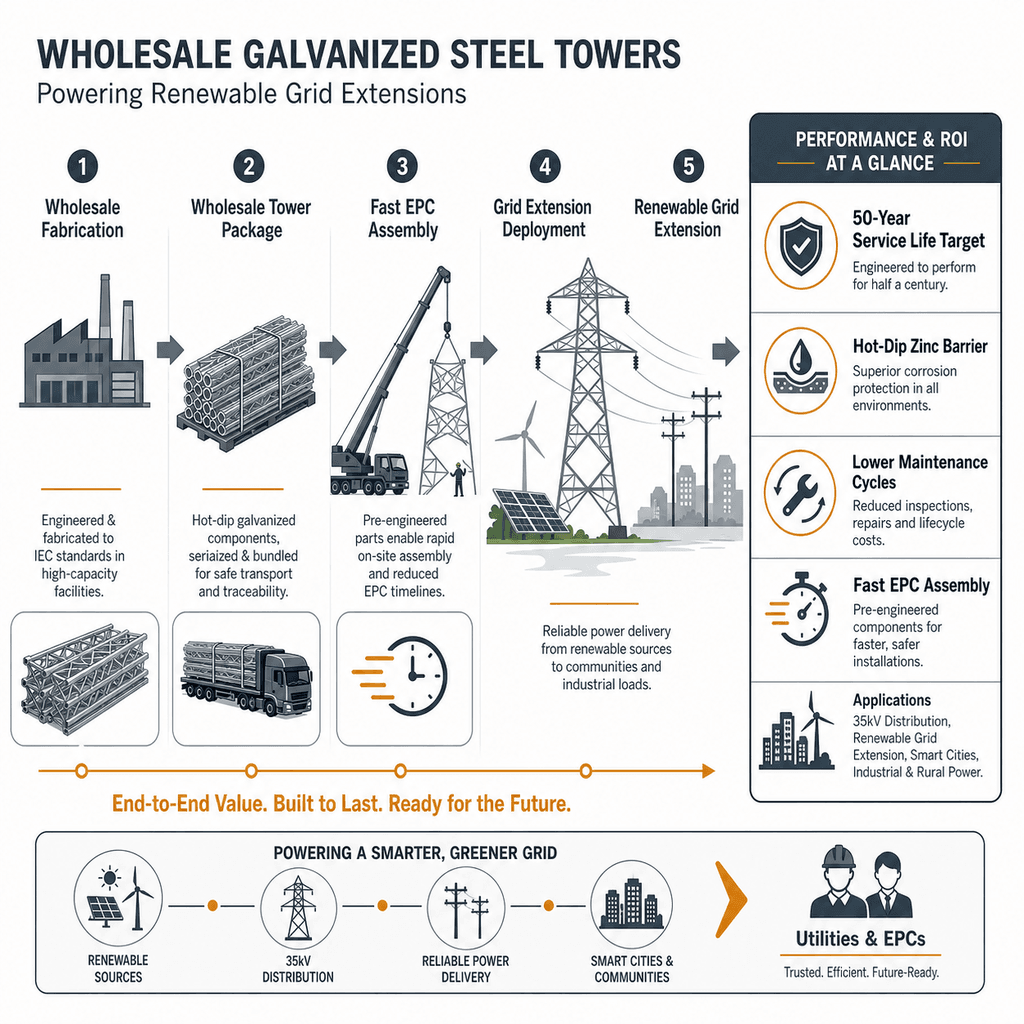
A 22m 35kV galvanized steel lattice tower typically combines Q420/Q460 steel, double-circuit cross-arms, OPGW grounding, and ISO 1461 corrosion protection.
The core specification begins with voltage class and tower function. For 35kV distribution and sub-transmission routes, common tower types include tangent suspension towers, angle towers, terminal towers, strain towers, and special crossing towers. A tangent tower usually carries vertical and transverse loads while allowing conductor swing through suspension insulator strings. Angle and terminal towers must resist higher longitudinal forces, so their member sizes, foundations, and hardware are heavier.
SOLARTODO's 22m 35kV double-circuit tangent tower is designed for two circuits on one steel lattice structure. It supports six phase conductors, usually three per circuit, and an OPGW ground wire at the peak for lightning protection and fiber-optic communication. Standard footing resistance is normally kept below 10 ohms, with below 4 ohms preferred in high-lightning regions. Insulator options include porcelain disc strings for proven long service life and composite polymer insulators for lower weight, improved pollution performance, and vandal resistance.
According to IEC 60826, overhead line design must evaluate climatic loads, conductor loads, reliability levels, and safety factors rather than treating the tower as a simple static frame. ASCE 10-15 provides design guidance for latticed steel transmission structures, including member strength, connection behavior, buckling, and detailing. For wholesale buyers, these standards should appear in the technical schedule, not only in marketing documents.
Hot-dip galvanizing is the primary corrosion protection system for power line towers because zinc provides both barrier protection and sacrificial protection. ISO 1461 specifies requirements and test methods for hot-dip galvanized coatings on fabricated iron and steel articles. For steel sections thicker than 6mm, an 85 micrometer minimum average coating is commonly referenced in ISO 1461-based specifications. ASTM A123/A123M is often requested for North American projects and covers zinc coatings on iron and steel products.
Quality documentation should include mill certificates, steel grade confirmation, galvanizing inspection records, bolt grade certificates, dimensional inspection reports, and trial assembly records for complex towers. Buyers should also require packing marks that match erection drawings because field crews lose time when bundled angles cannot be identified quickly. On large shipments, one missing bolt kit can delay a line section more than a delayed steel member.
Key Specification Checklist
Use a 12-point technical checklist before requesting a firm wholesale quotation because tower price depends on geometry, loads, steel grade, and route conditions.
- Voltage class: 35kV, 66kV, 110kV, 132kV, or project-specific rating.
- Tower function: tangent, angle, strain, terminal, river crossing, or substation gantry.
- Height and span: for example, 22m height and 120m nominal design span.
- Circuit configuration: single circuit, double circuit, or multi-circuit arrangement.
- Conductor and shield wire: ACSR size, OPGW requirement, sag-tension data, and insulator type.
- Design loads: basic wind speed, ice thickness, seismic assumptions, and broken-wire cases.
- Material: Q420/Q460 angle steel or approved equivalent with yield strength documentation.
- Corrosion protection: ISO 1461 or ASTM A123 hot-dip galvanizing with coating records.
- Foundations: stub angle, anchor bolt cage, grillage, or locally designed concrete footing.
- Packaging: member bundles, fastener cartons, part labels, and container loading plan.
- Compliance: IEC 60826, ASCE 10-15, GB 50545, local utility code, or national grid standard.
- Documentation: GA drawings, shop drawings, BOM, erection manual, QA dossier, and certificate package.
Applications, Use Cases, and Project Economics
Galvanized steel tower wholesale programs serve solar grid connections, utility distribution upgrades, telecom power corridors, and industrial loads from 35kV to 220kV.
The highest-value applications are routes where land, reliability, and schedule matter more than the lowest initial pole price. A double-circuit lattice tower can carry two medium-voltage circuits in one right-of-way, which may reduce land acquisition pressure by up to 40% compared with two separate single-circuit routes. Compared with concrete poles of equivalent height, a steel lattice design can reduce structural material volume by about 30% while improving maintainability and load adaptability.
Solar and storage projects often use 35kV collection systems to connect inverter stations, step-up transformers, and substations. In these projects, tower delivery must coordinate with module installation, inverter energization, substation testing, and grid interconnection windows. A late tower package can delay revenue recognition even when the solar plant itself is mechanically complete. This is why B2B buyers should evaluate suppliers by engineering response time, documentation accuracy, export experience, and capacity for repeatable production.
According to NREL (2024), solar resource and system performance modeling tools such as PVWatts are used to estimate annual energy yield from site-specific irradiance and system assumptions. That energy yield is only bankable when the grid connection is available. The practical lesson for EPC teams is simple: treat the power line tower package as part of the energy project critical path, not as a late-stage commodity purchase.
IRENA states, 'Renewables are the most cost-competitive source of new power generation,' and that trend increases pressure on distribution networks. New solar farms, battery storage plants, and industrial electrification loads frequently require 35kV to 132kV line extensions. Galvanized steel towers help EPCs standardize those extensions because members can be fabricated in batches, containerized for export, and assembled with bolted connections in remote locations.
A typical wholesale use case is a 15-tower 35kV double-circuit network serving a suburban load center, renewable mini-grid, or industrial park. With 120m design spans, that package may cover about 1.8km before route adjustments, angle structures, and terminal gantries are counted. In procurement terms, the buyer should request a route-based bill of materials rather than multiplying one tower type by the total tower count. Real lines include tangent structures, angle structures, terminals, grounding accessories, hardware, and spare parts.
Comparison and Selection Guide
Buyers should compare lattice towers, monopoles, and concrete poles across 8 engineering and commercial criteria before selecting a wholesale package.
| Option | Best-fit voltage and span | Strengths | Limitations | Procurement note |
|---|---|---|---|---|
| Galvanized steel lattice tower | 35kV-220kV, 100m-400m typical | High load capacity, modular shipping, easy inspection, 50-year design target | Larger footprint and more parts than monopoles | Best for bulk export, long routes, high wind, and double-circuit lines |
| Steel monopole | 35kV-132kV, urban constrained routes | Compact footprint, clean appearance, faster visual acceptance | Heavier single pieces, higher crane demand, costlier transport | Best where right-of-way width is limited and access roads support cranes |
| Concrete pole | 11kV-35kV, shorter distribution spans | Familiar installation, simple procurement, good stiffness | Heavy handling, cracking risk, limited adaptability | Best for short rural feeders with local production and simple loads |
| Wood pole | Low-voltage to medium-voltage distribution | Low upfront cost, fast installation in some markets | Shorter life, biological degradation, treatment restrictions | Best for temporary or low-load feeders where codes permit |
The wholesale decision should start with line reliability class. IEC 60826 uses reliability-based design principles, while utility specifications may define separate requirements for urban feeders, critical industrial routes, and renewable evacuation lines. If the route crosses highways, railways, rivers, dense settlements, or high-wind regions, the tower family may need special structures that cannot be priced accurately from a generic catalog.
Galvanized lattice towers are usually favored when the buyer needs strength-to-weight efficiency, high corrosion resistance, and flexible packaging. Individual members can fit into standard containers, and replacement angles can be fabricated if a member is damaged in transit or during erection. The trade-off is that assembly requires accurate drawings, trained crews, and disciplined bolt tightening procedures.
For procurement managers, the most common mistake is comparing only price per ton. A lower steel ton price can become more expensive if it produces higher freight cost, missing drawings, weak galvanizing documentation, or installation delays. A better metric is delivered and installed cost per compliant structure, including tower steel, hardware, logistics, foundation compatibility, erection labor, inspection, and schedule risk.
SOLARTODO supports wholesale buyers by aligning the inquiry, technical confirmation, offline quotation, and export delivery process. The company is not an online marketplace; procurement starts with drawings, route data, tower schedule, standards, and target delivery terms. For Latin America, the Middle East, Africa, Southeast Asia, and Europe, this offline quotation model is more realistic because grid hardware specifications vary by utility, climate, and local approval process.
EPC Investment Analysis and Pricing Structure
EPC pricing for galvanized steel power line towers separates FOB supply, CIF delivery, and turnkey construction to control 25-60% installation cost variation.
EPC means Engineering, Procurement, and Construction. For a tower line package, engineering includes route review, tower selection, structural checks, shop drawings, foundation interface, grounding design, and documentation. Procurement includes tower fabrication, galvanizing, bolts, insulators, conductor hardware, OPGW accessories, packing, freight coordination, and customs documents. Construction includes foundation works, tower erection, hardware installation, conductor stringing coordination, grounding, testing, as-built records, and commissioning support.
SOLARTODO typically structures commercial offers in three tiers. FOB Supply is the base export package: manufactured tower steel, galvanizing, bolts, packing, and documents delivered to the loading port. CIF Delivered adds ocean freight and insurance to the destination port, which helps buyers forecast landed cost. EPC Turnkey adds local or partner-managed civil works, erection, testing, and commissioning, subject to route access, soil conditions, permitting, and country-specific labor requirements.
Volume pricing should be negotiated by project size rather than by a single sample tower. As guidance, 50+ towers may qualify for about 5% discount, 100+ towers for about 10%, and 250+ towers for about 15%, depending on steel price, standardization, coating requirements, and shipping schedule. Custom angle towers, terminal towers, heavy river crossings, and urgent production slots may reduce discount levels because they require separate engineering and fabrication planning.
ROI for galvanized steel towers is measured differently from solar panels. Towers do not generate electricity, but they enable revenue by connecting generation and load. A 35kV line that energizes a solar farm, storage site, telecom corridor, or industrial park can protect thousands of dollars per day in avoided curtailment, diesel replacement, or delayed production. Against conventional alternatives, the economic benefit usually comes from longer service life, lower maintenance, fewer replacement cycles, and higher circuit capacity per corridor.
Payment terms are normally 30% T/T deposit plus 70% against bill of lading, or 100% irrevocable letter of credit at sight for qualified projects. Financing may be available for large projects above $1,000K, especially when the buyer can provide project documents, offtake visibility, public-sector budget approval, or credible EPC milestones. For quotation, send tower schedule, drawings, standards, delivery country, Incoterms preference, and financing needs to [email protected] or contact +6585559114.
FAQ
Wholesale galvanized steel power line tower projects usually require 8 core decisions: voltage, span, load, coating, standards, logistics, EPC scope, and payment terms.
Q: What is a galvanized steel power line tower? A: A galvanized steel power line tower is a bolted steel structure protected with zinc coating for overhead conductors. Typical wholesale projects specify 35kV to 220kV voltage classes, Q420/Q460 steel, hot-dip galvanizing, and a 30-50 year service target depending on environment, maintenance, and design standard.
Q: How is a lattice power tower different from a steel monopole? A: A lattice tower uses many bolted angle-steel members to distribute loads, while a monopole uses one large tubular shaft. Lattice towers are usually easier to containerize, inspect, and repair for 100m-plus spans, while monopoles suit narrow urban rights-of-way where footprint and appearance are more important.
Q: What information is needed for a wholesale quotation? A: A reliable quotation needs voltage class, tower schedule, route length, conductor type, span, wind speed, ice load, corrosion environment, applicable standards, destination port, and Incoterms. If drawings are unavailable, SOLARTODO can start from a reference 22m 35kV double-circuit tower and refine after engineering review.
Q: Why is hot-dip galvanizing used for power line towers? A: Hot-dip galvanizing protects steel by forming a zinc coating that provides barrier and sacrificial corrosion resistance. ISO 1461 and ASTM A123/A123M are common specifications, and 85 micrometers is a frequent minimum average coating target for fabricated steel sections above 6mm.
Q: What standards should buyers request for galvanized tower supply? A: Buyers should request IEC 60826 for overhead line design criteria, ASCE 10-15 for latticed steel transmission structures, ISO 1461 or ASTM A123 for galvanizing, and local utility requirements. For North American interconnection projects, IEEE 524 and IEEE 1547 may also affect construction and grid interface planning.
Q: How much does EPC turnkey delivery add compared with FOB supply? A: EPC turnkey delivery can add about 25-60% compared with FOB supply because it includes foundations, erection crews, equipment, grounding, stringing support, testing, and commissioning. The final premium depends on soil conditions, access roads, labor cost, permitting, tower count, and whether local subcontractors are already approved.
Q: What payment terms are common for bulk tower orders? A: Common payment terms are 30% T/T deposit and 70% against bill of lading, or 100% letter of credit at sight. For large projects above $1,000K, SOLARTODO may review financing options if the buyer provides project documents, delivery schedule, budget approval, and EPC milestone structure.
Q: How long does a galvanized steel tower last? A: A properly designed galvanized steel tower can target a 50-year design life, especially when coating thickness, drainage, grounding, and maintenance are specified correctly. Actual service life depends on corrosion category, coastal exposure, industrial pollution, mechanical damage, foundation stability, and whether periodic inspections identify loose bolts or coating defects.
Q: Can one tower carry two power circuits? A: Yes, a double-circuit tower can carry two three-phase circuits, normally six conductors plus one or more shield wires. For a 35kV route, this can double corridor capacity on one structure and may reduce right-of-way requirements by up to 40% compared with two separate single-circuit alignments.
Q: Are galvanized steel towers suitable for solar and storage projects? A: Yes, galvanized steel towers are suitable for solar farms, battery storage sites, and hybrid renewable projects that need 35kV or higher grid connection. They support collection lines, substation feeders, and export corridors where corrosion resistance, repeatable fabrication, and long service life are more important than lowest initial pole cost.
Q: How should buyers compare tower suppliers? A: Compare suppliers by engineering capability, standards compliance, galvanizing records, trial assembly process, export packing, delivery history, and documentation quality. Price per ton is incomplete because missing drawings, weak coating records, poor packaging, or delayed bolt kits can raise installed cost and delay energization.
Q: How does SOLARTODO handle wholesale tower inquiries? A: SOLARTODO handles wholesale tower inquiries through technical review and offline quotation, not online marketplace checkout. Buyers send project drawings, route data, standards, tower quantities, destination, Incoterms, and financing needs; SOLARTODO then confirms specifications, pricing tier, delivery scope, and export documentation.
References
The following 8 references define grid demand, overhead line design, galvanizing quality, renewable integration, and interconnection requirements for tower procurement.
- IEA (2023): Electricity Grids and Secure Energy Transitions; identifies the need to add or refurbish about 80 million kilometers of grids by 2040.
- IRENA (2025): Renewable Power Generation Costs in 2024; reports 582GW of renewable additions and 91% cost-competitive renewable projects in 2024.
- IEC 60826 (2017): Design criteria of overhead transmission lines; defines reliability-based loading and design criteria for overhead line structures.
- ASCE 10-15 (2015): Design of Latticed Steel Transmission Structures; covers structural design methods for steel lattice transmission towers.
- ISO 1461 (2022): Hot dip galvanized coatings on fabricated iron and steel articles; specifies galvanizing requirements and coating test methods.
- ASTM A123/A123M (2024): Standard specification for zinc hot-dip galvanized coatings on iron and steel products used in infrastructure.
- IEEE 524 (2016): Guide for the Installation of Overhead Transmission Line Conductors; supports construction planning for conductor stringing and installation.
- NREL (2024): PVWatts Calculator methodology; supports solar energy yield estimation that informs grid interconnection and line capacity planning.
Conclusion
Galvanized steel power line tower wholesale procurement works best when 35kV-220kV engineering data, ISO 1461 coating requirements, and EPC scope are defined before price negotiation.
For B2B buyers, the bottom line is that a SOLARTODO galvanized steel power line tower package can support 22m 35kV double-circuit routes, 120m nominal spans, and 50-year design targets when specified with IEC 60826, ASCE 10-15, and proper galvanizing documentation. Use FOB for controlled supply, CIF for landed-cost certainty, and EPC turnkey when schedule accountability matters more than minimum initial price.
About SOLARTODO
SOLARTODO is a global integrated solution provider specializing in solar power generation systems, energy-storage products, smart street-lighting and solar street-lighting, intelligent security & IoT linkage systems, power transmission towers, telecom communication towers, and smart-agriculture solutions for worldwide B2B customers.
Procurement paths
About the Author

Cinn Song
Founder & Chief Solutions Architect
Cinn Song founded SOLARTODO LIMITED and leads its smart-city infrastructure engineering — from solar, storage and integrated smart poles to the company's push into physical-AI city edge nodes: pole-mounted edge computing, vertical LLMs for smart cities, drone-based O&M with autonomous battery swapping, robotic maintenance, and high-speed counter-UAS interception. Since 2010, he has directed turnkey EPC + BOT delivery across 50+ countries, including telecom monopole supply for national grid operators, off-grid solar street-lighting for African municipalities, and integrated smart-pole programs for Gulf smart cities.
Cite This Article
Cinn Song. (2026). galvanized steel power line tower wholesale | SOLARTODO. SOLARTODO. Retrieved from https://solartodo.com/knowledge/galvanized-steel-power-line-tower-wholesale-2
@article{solartodo_galvanized_steel_power_line_tower_wholesale_2,
  title = {galvanized steel power line tower wholesale | SOLARTODO},
  author = {Cinn Song},
  journal = {SOLARTODO Knowledge Base},
  year = {2026},
  url = {https://solartodo.com/knowledge/galvanized-steel-power-line-tower-wholesale-2},
  note = {Accessed: 2026-10-13}
}
Published: June 30, 2026 | Available at: https://solartodo.com/knowledge/galvanized-steel-power-line-tower-wholesale-2
Subscribe to Our Newsletter
Get the latest solar energy news and insights delivered to your inbox.
View All Articles