Off-Grid Solar LED Street Light Price Guide

Cinn Song
Founder & Chief Solutions Architect
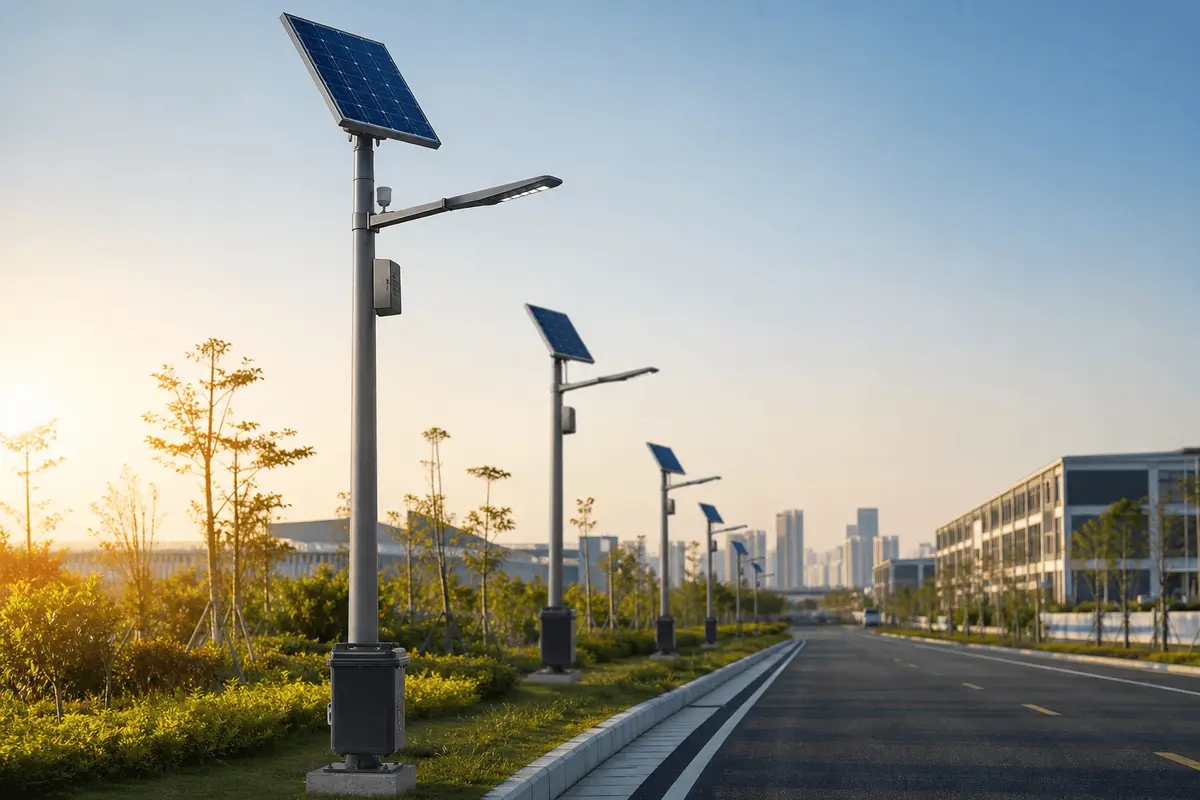
Watch the video
TL;DR
Off-grid solar LED street lights usually cost USD 280-1,900 per pole, with price driven by pole height, LED wattage, PV size, LiFePO4 battery Wh, autonomy, and EPC scope. For remote roads, ports, mines, and industrial sites, avoided trenching of USD 2,000-10,000 per pole can make solar lighting cheaper than grid-connected alternatives.
Off-grid solar LED street lights cost USD 280-1,900 per pole, typically use 30-300Wp PV, 100-1,200Wh LiFePO4 storage, deliver 3-8 cloudy-day autonomy, and avoid USD 2,000-10,000 trenching per grid-connected pole.
Summary
Off-grid solar LED street lights cost USD 280-1,900 per pole, typically use 30-300Wp PV, 100-1,200Wh LiFePO4 storage, deliver 3-8 cloudy-day autonomy, and avoid USD 2,000-10,000 trenching per grid-connected pole.
Key Takeaways
Use these 7 procurement actions to compare off-grid solar LED street light price, specifications, and ROI across 4m-12m project categories.
- Compare 4m-12m pole packages by wattage, because SOLARTODO systems range from 15W garden lights to 150W dual-head industrial lights.
- Specify 3-8 days of battery autonomy with 100-1,200Wh LiFePO4 storage to reduce outage risk during cloudy weather.
- Budget USD 280-1,900 per pole before freight and civil works, then compare against USD 2,000-10,000 trenching savings per pole.
- Request TOPCon PV modules of 180-300Wp and MPPT controllers above 98% efficiency for high-output security and roadway projects.
- Select 60W-120W systems for roads, logistics yards, ports, mines, and plant perimeters needing 8m-10m mounting heights.
- Use volume purchasing at 50, 100, and 250 units to target 5%, 10%, and 15% pricing reductions respectively.
- Validate IEC 60598, IEC 61215, IEC 61730, and UL 8750 compliance before approving any municipal or industrial tender.
Off-Grid Solar LED Street Light Price Overview
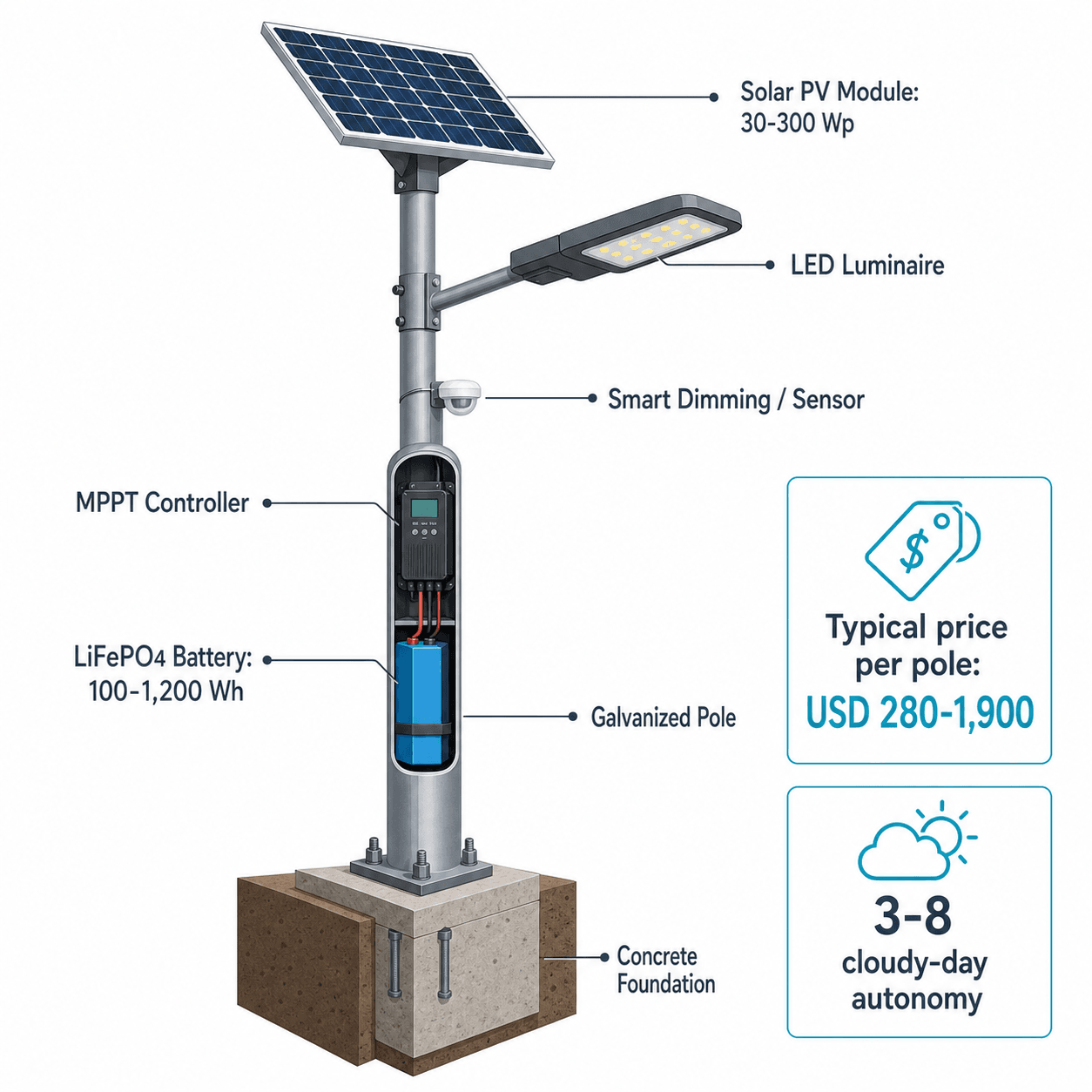
Off-grid solar LED street lights normally cost USD 280-1,900 per pole in 2026, with price driven by 15W-150W luminaires, 30-300Wp PV modules, and 100-1,200Wh LiFePO4 batteries.
For B2B buyers, the first pricing mistake is comparing lamp wattage alone. A 60W all-in-one security light with a 2MP 4G camera, 180Wp TOPCon module, and 720Wh battery can cost more than a basic 100W fixture because energy storage, communications, pole height, and optics define the real bill of materials. SOLARTODO positions off-grid lighting as a project system, not a retail lamp, because procurement teams need lighting performance, autonomy, logistics, installation, and warranty terms in one quotation.
According to IRENA (2024), utility-scale solar PV LCOE fell 12% year on year in 2023, and solar PV was 56% below weighted fossil fuel alternatives. That upstream cost trend supports lower solar component pricing, but street light pricing remains project-specific because poles, foundations, batteries, corrosion protection, and freight are local cost variables. IRENA states, 'solar PV leading the cost reductions,' which explains why PV module oversupply can help buyers negotiate, while battery and steel specifications still require discipline.
According to IEA (2025), solar PV accounts for almost 80% of expected global renewable capacity growth through 2030. The IEA states, 'Low costs, faster permitting and broad social acceptance' continue to drive solar adoption. For street lighting buyers in Latin America, the Middle East, Africa, Southeast Asia, and Europe, the implication is practical: solar components are mature, but tender documents must still define illumination class, autonomy, wind load, and service access.
Typical SOLARTODO reference configurations include a 4m classic European garden light at USD 280-400, an 8m 60W security all-in-one with camera at USD 980-1,350, a 10m 120W dual-arm split system at USD 1,200-1,650, and a 12m 150W dual-head industrial split system at USD 1,400-1,900. These are indicative B2B ranges for inquiry and offline quotation; SOLARTODO is a manufacturer and exporter, not an online marketplace.
Technical Cost Drivers and Specification Benchmarks
A credible 10m off-grid street light quotation should specify at least 120W LED output, 240Wp solar input, 960Wh LiFePO4 storage, MPPT control, pole steel grade, and autonomy days.
The largest cost drivers are the battery, pole, solar module, luminaire, controller, and logistics. LiFePO4 batteries normally cost more upfront than lead-acid alternatives, but they offer better cycle life, depth-of-discharge tolerance, and thermal stability. For industrial projects, SOLARTODO uses LiFePO4 chemistry with 2,000+ deep cycles and MPPT controllers above 98% efficiency on higher-grade systems.
Core Bill of Materials
A complete off-grid solar LED street light should include the luminaire, PV module, battery pack, charge controller, pole, bracket, cable set, foundation bolts, and packaging. Split systems separate the panel, battery, controller, and lamp heads, improving heat dissipation and service access. In many field installations, split architecture can improve panel angle optimization by 15-25% compared with compact integrated designs.
For lighting performance, evaluate delivered lumens rather than nominal watts. A 120W LED set at above 170 lm/W can theoretically produce about 20,400 lumens before optical and driver losses. A 150W dual-head industrial system can reach about 25,500 lumens, suitable for wider roads, plant perimeters, ports, and large logistics yards.
Standards and Durability
IEC 60598-2-3 defines particular safety requirements for road and street lighting luminaires, while IEC 61215 and IEC 61730 address PV module design qualification and safety. UL 8750 is relevant for LED equipment in lighting products, especially where buyers need North American compliance language. IEEE 1547 is more relevant to grid-connected distributed energy systems, but it helps procurement teams distinguish off-grid equipment from interconnection-dependent assets.
NREL PVWatts notes that PV performance estimates involve assumptions and uncertainty, including variation by weather and site conditions. For street lighting, use local peak sun hours, 30-year weather datasets where available, and a conservative battery reserve. A project in a coastal, dusty, or high-humidity area may need more battery reserve, higher IP rating, stronger anti-corrosion coating, and more frequent cleaning.
| Configuration | Typical pole | PV and battery | Output and autonomy | Indicative price |
|---|---|---|---|---|
| Classic garden light | 4m | 30Wp, 100Wh LiFePO4 | 15W, 3 days | USD 280-400 |
| Security all-in-one | 8m | 180Wp TOPCon, 720Wh LiFePO4 | 60W, 3-4 days, 2MP 4G camera | USD 980-1,350 |
| Industrial dual-arm split | 10m | 240Wp TOPCon, 960Wh LiFePO4 | 120W, up to 8 rainy days | USD 1,200-1,650 |
| Industrial dual-head split | 12m | 300Wp mono, 1,200Wh LiFePO4 | 150W, 25,500lm, 4 days | USD 1,400-1,900 |
EPC Investment Analysis and Pricing Structure
EPC turnkey pricing for solar street lights adds engineering, procurement, construction, testing, and commissioning to supply-only costs, often changing payback by 2-5 years.
EPC means Engineering, Procurement, and Construction. For an off-grid solar LED street light project, turnkey EPC delivery normally includes lighting layout, pole spacing recommendation, foundation design support, bill of materials, factory production, quality inspection, freight coordination, installation supervision or local installation, commissioning, and as-built documentation. This scope matters because a low FOB lamp price can become expensive if foundation bolts, pole strength, battery reserve, or local installation labor are missing.
SOLARTODO normally structures B2B quotations in three commercial tiers. FOB Supply covers factory supply and export-ready packaging. CIF Delivered adds international freight and insurance to the destination port. EPC Turnkey adds engineering support, site execution, commissioning, and project handover, with exact scope depending on country, terrain, civil works, and local subcontractor requirements.
| Pricing tier | What it includes | Best fit | Buyer control |
|---|---|---|---|
| FOB Supply | Product, pole, accessories, export packaging | Experienced importers and EPC contractors | Highest control over freight and installation |
| CIF Delivered | FOB scope plus freight and insurance to port | Distributors and public tenders needing landed cost | Balanced control and logistics visibility |
| EPC Turnkey | Engineering, procurement, installation, testing, commissioning | Municipal, industrial, mining, port, and campus projects | Lowest coordination burden |
Volume pricing should be requested explicitly. As guidance, SOLARTODO can structure target discounts of 5% for 50+ units, 10% for 100+ units, and 15% for 250+ units, subject to final specifications, delivery country, steel price, battery capacity, and project schedule. Payment terms are typically 30% T/T deposit plus 70% against bill of lading, or 100% L/C at sight for qualified transactions.
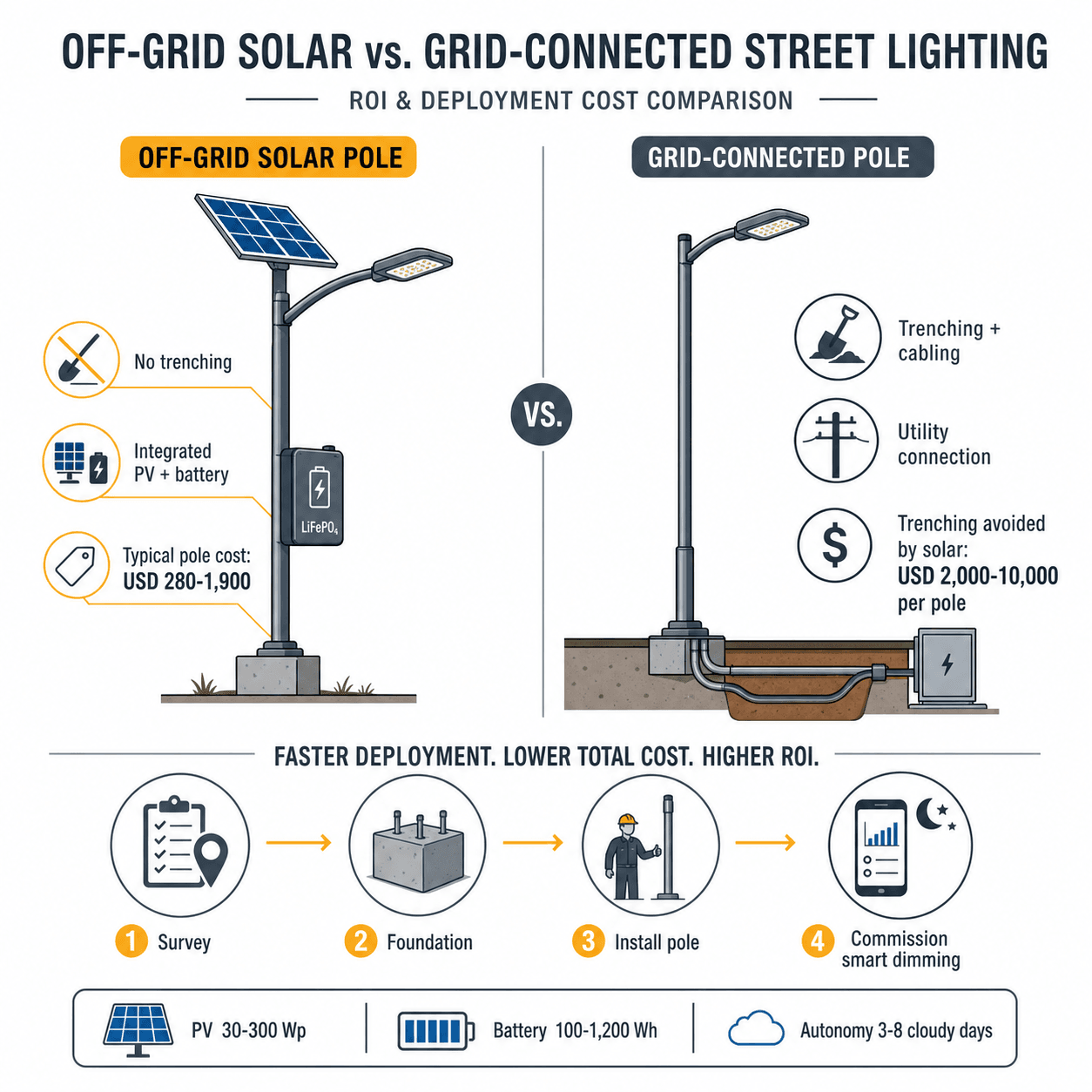
ROI depends on avoided grid extension, avoided trenching, electricity savings, and maintenance. In many road and perimeter projects, eliminating trenching and cabling can save USD 2,000-10,000 per pole before considering transformer, permitting, road closure, and grid connection delay. If a solar pole costs USD 1,200-1,650 and avoids USD 3,000 of civil electrical work, payback can be immediate at the project level. Financing is available for large projects above USD 1,000K; buyers can contact [email protected] for project discussion.
Applications and Selection Guide
Most B2B buyers should match 4m-12m solar street lights to illumination duty, road width, camera load, autonomy target, and installation environment.
Decorative garden lights are suitable for parks, resorts, walkways, and villa communities where visual design and moderate lighting matter more than roadway lux levels. A 4m 15W system with 30Wp PV and 100Wh storage fits lower mounting heights and shorter pole spacing. It is not a substitute for industrial perimeter lighting or municipal arterial roads.
Security and smart infrastructure projects often need higher battery capacity because cameras, 4G modules, sensors, and controllers consume energy beyond the LED load. An 8m 60W all-in-one system with a 2MP 4G camera, 180Wp TOPCon panel, and 720Wh battery gives procurement teams a compact package for remote gates, storage yards, rural roads, and temporary construction areas.
Industrial roads, mining camps, logistics yards, ports, and plant perimeters normally justify split systems. A 10m 120W dual-arm split solar street light with 240Wp TOPCon PV and 960Wh LiFePO4 storage supports wider coverage and easier maintenance. For broader or higher-risk areas, a 12m 150W dual-head system with 300Wp PV and 1,200Wh storage improves output and reserve.
Selection should start with site data: road width, pole spacing, average nightly operating hours, minimum autonomy, local solar irradiation, wind speed, corrosion exposure, and required lighting standard. For procurement, require a lighting simulation, datasheets, battery cycle specification, IP65 or IP66 enclosure rating, warranty terms, and spare parts list. SOLARTODO can configure pole height, battery reserve, and smart controls through offline engineering quotation.
Price Comparison and Procurement Checklist
A price comparison is valid only when every bid uses the same 6-12m pole class, battery Wh rating, PV Wp rating, lumen output, and warranty scope.
The cheapest bid often removes value where it is hardest to detect: battery capacity, pole wall thickness, galvanization, controller efficiency, LED driver quality, optical distribution, surge protection, and packaging. Procurement managers should ask bidders to disclose battery watt-hours, not just amp-hours, because battery voltage changes the real storage capacity. Engineers should also request luminaire photometric files, not only catalog lumen claims.
According to IEA (2025), solar PV prices in China were down over 60% since 2023 because of module oversupply and competition. Buyers should use this market context to negotiate PV pricing, but they should not assume the full reduction applies to street lights. Steel poles, lithium batteries, freight, local labor, and compliance testing can dominate the final delivered price.
Use this checklist before approving a purchase order:
- Confirm pole height, arm type, wind load, hot-dip galvanizing thickness, and foundation bolt dimensions.
- Verify LED wattage, delivered lumens, color temperature, optical distribution, dimming profile, and surge protection.
- Require PV module Wp, cell technology, mounting angle, cable rating, and IEC 61215 or IEC 61730 evidence.
- Compare LiFePO4 battery Wh, cycle life, BMS protection, operating temperature, enclosure IP rating, and replacement access.
- Define autonomy as 3, 4, or 8 rainy days based on local weather and criticality.
- Separate FOB, CIF, and EPC turnkey pricing so finance teams can compare true landed cost.
- Include warranty, commissioning support, spare parts, and response time in the commercial evaluation.
SOLARTODO supports inquiry-based quotation for solar streetlights, smart streetlights, telecom towers, power towers, smart traffic equipment, security systems, and smart agriculture monitoring equipment. For large public or industrial projects, the best procurement path is to send site drawings, pole spacing targets, lighting level requirements, and delivery country to [email protected] or call +6585559114.
FAQ
These 10 answers cover price, EPC scope, warranty, technical sizing, maintenance, and comparison issues in 40-80 words each.
Q: What is the average off-grid solar LED street light price in 2026? A: Off-grid solar LED street lights typically cost USD 280-1,900 per pole, depending on pole height, LED wattage, PV size, battery capacity, and smart features. A 4m decorative 15W light may cost USD 280-400, while 10m-12m industrial split systems normally range from USD 1,200-1,900 before final freight, installation, and taxes.
Q: Why do solar street light prices vary so much between suppliers? A: Prices vary because many quotations hide differences in battery Wh, pole steel thickness, galvanizing, controller efficiency, LED optics, and warranty scope. Two 60W lights can perform very differently if one uses a 720Wh LiFePO4 battery and 180Wp TOPCon panel while another uses smaller storage and lower-efficiency PV.
Q: What does EPC turnkey pricing include for solar street light projects? A: EPC turnkey pricing includes engineering, procurement, construction, testing, and commissioning, not just product supply. For solar street lights, that may cover lighting layout, foundation design support, poles, lamps, batteries, freight coordination, installation, commissioning reports, and handover documents. SOLARTODO quotes EPC scope offline because site conditions and local labor differ by country.
Q: How many days of autonomy should an off-grid street light have? A: Most commercial systems should specify 3-4 days of autonomy, while critical roads, ports, mines, and high-security sites may require up to 8 rainy days. Autonomy depends on nightly operating hours, dimming schedule, local solar resource, battery Wh capacity, and camera or communications load. Oversizing storage improves reliability but raises upfront cost.
Q: Is a split solar street light better than an all-in-one model? A: Split systems are usually better for 8m-12m industrial projects because the panel, battery, controller, and lamps can be positioned for cooling, service access, and solar angle optimization. All-in-one models are compact and faster to install, making them useful for 4m-8m garden, security, and rural applications with moderate lighting duty.
Q: How much can off-grid solar lighting save versus grid-connected lighting? A: The largest saving is often avoided trenching, cabling, and grid connection work, which can remove USD 2,000-10,000 per pole from remote or paved-road projects. Solar lights also reduce electricity bills and avoid outage exposure. ROI can be immediate when civil electrical work is expensive, but it should be modeled per site.
Q: What warranty and standards should procurement teams request? A: Buyers should request warranty terms for the LED luminaire, PV module, battery, controller, and pole coating separately. Standards evidence may include IEC 60598-2-3 for street luminaires, IEC 61215 and IEC 61730 for PV modules, and UL 8750 for LED equipment. Public tenders should also require datasheets, test reports, and spare parts commitments.
Q: What battery type is best for off-grid solar LED street lights? A: LiFePO4 is usually the best battery chemistry for B2B solar street lights because it supports deep cycling, thermal stability, and long service life. SOLARTODO industrial systems use LiFePO4 batteries with 2,000+ deep cycles. Lead-acid can reduce upfront cost, but it often increases replacement frequency and maintenance risk.
Q: How should I compare FOB, CIF, and EPC prices? A: Compare FOB, CIF, and EPC prices as separate commercial scopes. FOB covers factory supply and export packaging, CIF adds freight and insurance to the destination port, and EPC turnkey adds engineering, installation, testing, and commissioning. This separation helps finance teams avoid comparing a product-only quote against a full project-delivery quote.
Q: Who should request a SOLARTODO quotation? A: Procurement managers, EPC contractors, municipalities, developers, and industrial site owners should request a SOLARTODO quotation when they need 4m-12m off-grid lighting with defined autonomy and project support. Provide road width, pole spacing, location, lighting target, quantity, and preferred pricing tier. For large projects above USD 1,000K, financing may be available.
Conclusion
Off-grid solar LED street light price should be evaluated as a 10-25 year infrastructure cost, not a lamp-only purchase price.
For commercial projects, SOLARTODO systems from USD 280-1,900 per pole can eliminate USD 2,000-10,000 in trenching per pole while delivering 3-8 days of autonomy. The bottom line: specify PV Wp, battery Wh, pole class, standards, and EPC scope before selecting the lowest bid.
References
These 7 references provide current authority for solar cost trends, PV forecasting, lighting safety, LED equipment, PV module qualification, and interconnection context.
- IRENA (2024): Renewable Power Generation Costs in 2023; reports 12% solar PV LCOE reduction, 89% battery storage cost decline since 2010, and solar PV 56% below fossil alternatives.
- IEA (2025): Renewables 2025; forecasts 4,600GW of new renewable power capacity by 2030, with solar PV accounting for almost 80% of the increase.
- NREL PVWatts (2026): PVWatts Calculator; provides solar resource and PV performance modeling inputs while warning that estimates include assumptions and uncertainty.
- IEC 60598-2-3 (2011): Luminaires, Part 2-3; particular requirements for road and street lighting luminaires used in roadway applications.
- IEC 61215-1 (2021): Terrestrial photovoltaic modules; design qualification and type approval requirements for crystalline silicon PV modules.
- IEC 61730-1 (2023): Photovoltaic module safety qualification; construction and safety requirements for PV modules.
- UL 8750 (2021): Light Emitting Diode equipment for lighting products; safety requirements for LED equipment and components.
About SOLARTODO
SOLARTODO is a global integrated solution provider specializing in solar power generation systems, energy-storage products, smart street-lighting and solar street-lighting, intelligent security & IoT linkage systems, power transmission towers, telecom communication towers, and smart-agriculture solutions for worldwide B2B customers.
About the Author

Cinn Song
Founder & Chief Solutions Architect
Cinn Song founded SOLARTODO LIMITED and leads its smart-city infrastructure engineering — from solar, storage and integrated smart poles to the company's push into physical-AI city edge nodes: pole-mounted edge computing, vertical LLMs for smart cities, drone-based O&M with autonomous battery swapping, robotic maintenance, and high-speed counter-UAS interception. Since 2010, he has directed turnkey EPC + BOT delivery across 50+ countries, including telecom monopole supply for national grid operators, off-grid solar street-lighting for African municipalities, and integrated smart-pole programs for Gulf smart cities.
Cite This Article
Cinn Song. (2026). Off-Grid Solar LED Street Light Price Guide. SOLARTODO. Retrieved from https://solartodo.com/knowledge/off-grid-solar-led-street-light-price-2
@article{solartodo_off_grid_solar_led_street_light_price_2,
  title = {Off-Grid Solar LED Street Light Price Guide},
  author = {Cinn Song},
  journal = {SOLARTODO Knowledge Base},
  year = {2026},
  url = {https://solartodo.com/knowledge/off-grid-solar-led-street-light-price-2},
  note = {Accessed: 2026-10-13}
}
Published: July 2, 2026 | Available at: https://solartodo.com/knowledge/off-grid-solar-led-street-light-price-2
Subscribe to Our Newsletter
Get the latest solar energy news and insights delivered to your inbox.
View All Articles