Solar-Powered Security Systems for Remote Facilities

Cinn Song
Founder & Chief Solutions Architect
Watch the video
TL;DR
Remote facilities reduce vandalism and theft most effectively when security stays online during outages. A solar-powered system with 16 cameras, 32 active zones, 32 detector points, and 24/7 monitoring removes grid dependence and improves response quality. For medium sites, SOLARTODO EPC turnkey budgets of USD 7,100-9,200 can deliver faster payback than repeated theft losses or generator-backed surveillance.
Solar-powered security systems reduce remote-site theft risk by combining 32 alarm zones, 16 cameras, and 24/7 monitoring without grid dependence. For medium checkpoints, EPC turnkey budgets of USD 7,100-9,200 can protect 1 gate area, 2-4 lanes, and perimeter strips.
Summary
Solar-powered security systems reduce remote-site theft risk by combining 32 alarm zones, 16 cameras, and 24/7 monitoring without grid dependence. For medium checkpoints, EPC turnkey budgets of USD 7,100-9,200 can protect 1 gate area, 2-4 lanes, and perimeter strips.
Key Takeaways
- Deploy a 32-zone off-grid system with 16 cameras and 32 detectors to cover 1 gate, 2-4 vehicle lanes, and 1 perimeter strip at remote facilities.
- Size solar power and battery autonomy for 24/7 operation so cameras, NVR, detectors, and communications stay online during 0-grid or unstable-grid conditions.
- Separate indoor and outdoor detection by using 16 PIR detectors for sheltered spaces and 16 dual-technology detectors for wind-prone zones to cut nuisance alarms.
- Reserve 32 spare zones in a 64-zone hybrid panel for future fence loops, panic buttons, lane sensors, or thermal relay inputs without replacing the core controller.
- Compare supply models early: equipment-only, CIF delivered, or EPC turnkey at USD 7,100-9,200 to control logistics cost, commissioning scope, and project risk.
- Verify compliance targets such as EN 50131, IEC 62676, UL 681, and NFPA 72 before procurement to reduce redesign, inspection, and handover delays.
- Use layered video plus intrusion logic across 16 cameras, 8 beam sets, and 32 detector points to improve visual verification and speed response at isolated sites.
- Plan volume procurement with 5% discount at 50+ units, 10% at 100+, and 15% at 250+ units to lower portfolio security cost for multi-site operators.
Why Solar-Powered Security Systems Solve Remote Facility Vandalism and Theft
Solar-powered security systems reduce theft and vandalism at remote facilities by keeping 16 cameras, 32 detector points, and 24/7 monitoring active even where grid uptime is 0% or unreliable.
Remote assets are attacked for two simple reasons: isolation and delayed response. A fuel transfer point, border checkpoint, telecom compound, pump station, or storage yard may sit 5-50 km from the nearest staffed building, with no stable utility supply and limited night visibility. Conventional CCTV fails when power drops, and stand-alone alarms fail when no one can verify an event within 2-10 minutes.
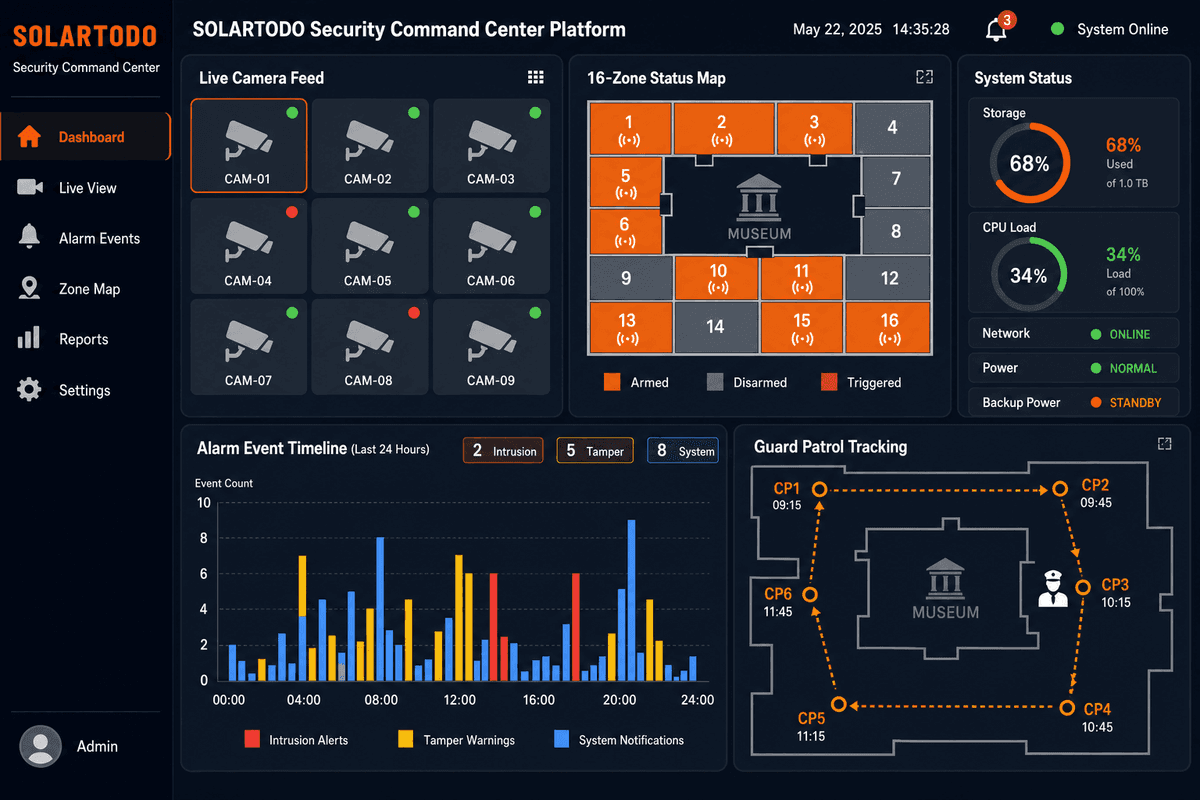
A solar-powered security architecture addresses the power problem and the response problem together. The off-grid package most relevant here is the SOLARTODO Border Checkpoint 32-Zone Off-Grid, which supports 12 fixed HD IP cameras, 4 PTZ cameras, 8 perimeter beam sets, 16 PIR detectors, 16 dual-technology detectors, a 32-channel NVR, and a 64-zone hybrid alarm panel configured for 32 active zones. That layout gives a medium remote site both perimeter detection and visual confirmation.
According to the International Energy Agency, “Solar PV is today the cheapest source of electricity in many regions.” That matters for security because remote operators no longer need to choose between diesel runtime and surveillance uptime. According to NREL (2024), off-grid solar-plus-storage modeling can be used to predict production and autonomy under site-specific irradiance conditions, which is essential when security loads must run 24 hours per day.
For B2B buyers, the main issue is not whether cameras can be installed. The issue is whether the system can sustain recording, detection, communications, and alarm logic through low-sun periods, dust, heat, and poor maintenance access. A proper design therefore combines solar generation, battery storage, communications redundancy, and layered detection under one commissioning plan.
SOLARTODO supplies this category as equipment-only, delivered cargo, or turnkey EPC, which is useful when procurement teams need one vendor for both off-grid power and security hardware. That reduces interface risk between solar contractors, CCTV installers, and alarm subcontractors across a 1-site or 100-site rollout.
Technical Architecture for Remote Solar-Powered Security
A remote solar-powered security system works when 4 subsystems are sized together: generation, storage, surveillance, and alarm signaling, with at least 24 hours of continuous security load support.
The core architecture starts with the control layer. In the SOLARTODO 32-zone off-grid package, a 64-zone hybrid panel runs 32 active zones and leaves 32 spare zones for expansion. Those spare inputs matter in real projects because remote sites often add fence vibration loops, thermal camera relay outputs, gate contacts, or guard panic buttons after the first security audit.
The surveillance layer combines 12 fixed IP cameras for constant views and 4 PTZ cameras for long-range tracking. A 32-channel NVR records and manages video, allowing future camera additions without immediate recorder replacement. For a remote checkpoint, the usual camera map includes 1 primary gate area, 2-4 vehicle lanes, 1 inspection building, 1 perimeter strip, and several controlled access points.
The intrusion layer uses detector diversity to reduce false alarms. The standard mix includes 16 PIR detectors for indoor rooms or sheltered corridors, plus 16 dual-technology detectors for thermally unstable or wind-prone areas. Dual-technology devices combine microwave and passive infrared logic, which helps reject nuisance triggers from heat shimmer, moving vegetation, or airflow changes that commonly affect open compounds.
Detection logic and zone planning
A 32-zone plan should divide the site by function, not only by geography, because response priorities differ between a fence breach and a records-room entry. Typical partitions include gatehouse, lane barriers, inspection building, fuel or evidence store, communications room, outer perimeter, and maintenance yard. That structure supports faster dispatch and cleaner event logs in the NVR and alarm software.
Perimeter beam sets are especially useful where fence lines are short to medium and line-of-sight can be maintained. In this package, 8 beam sets add an early-warning layer before intruders reach doors or windows. When tied to camera presets, a beam alarm can trigger PTZ repositioning within seconds, giving operators visual verification before dispatching guards.
Off-grid power design considerations
Security reliability depends on energy budgeting, not just panel wattage. Cameras, PoE switches, NVRs, radios, alarm panels, detectors, sirens, and lighting must be counted in watt-hours per day, then matched to solar production and battery autonomy. In remote projects, buyers should ask for a load list, worst-month irradiance assumptions, battery depth-of-discharge limits, and recharge time after 1-2 low-sun days.
According to IRENA (2024), solar and battery systems continue to improve project economics in off-grid and weak-grid applications. According to BloombergNEF (2024), battery-backed distributed systems are increasingly selected where diesel logistics and outage risk raise total operating cost. For security, the practical implication is simple: a system that stays online through outages prevents the blind periods during which theft usually occurs.
Standards and compliance framework
Remote security systems should be specified against recognized frameworks even when local enforcement is inconsistent. The relevant references here are EN 50131 for intrusion systems, IEC 62676 for video surveillance, UL 681 for installation practices, and NFPA 72 where supervisory signaling or fire interface is required. These standards help procurement teams compare bids on a common technical basis.
UL states that installation and classification rules improve burglary system reliability when field wiring, signaling paths, and equipment categories are defined clearly. IEC 62676 provides the video surveillance framework for image quality, system design, and operational performance, which matters when footage must support evidence review rather than only live viewing.
Use Cases, Risk Reduction, and Operational Benefits
Solar-powered security systems are most effective at remote facilities where theft windows last 10-60 minutes and utility outages would otherwise disable surveillance for several hours.
The first use case is border and checkpoint infrastructure. These sites combine public access, controlled lanes, inspection areas, and perimeter exposure. A 32-zone off-grid package fits a medium-security layout with 1 primary gate, 2-4 lanes, and multiple access points, giving operators both lane oversight and perimeter alerting without depending on unstable grid service.
The second use case is remote industrial compounds such as pump stations, telecom shelters, storage yards, and utility substations. These sites often contain copper, fuel, batteries, tools, and network equipment that can be removed quickly. With 16 cameras and 32 detector points, operators can assign separate alarm logic to fence lines, equipment rooms, tank areas, and service gates.
The third use case is temporary or semi-permanent project infrastructure. EPC camps, construction laydown yards, and remote road or pipeline sections may operate for 6-36 months, making permanent grid extension uneconomic. Off-grid security lets the owner protect material stock without waiting for utility connection, trenching, or generator fuel contracts.
According to IEA (2024), energy resilience is a growing requirement for critical infrastructure. According to NFPA, signaling pathways and supervisory functions must remain dependable under adverse conditions. In practical terms, a solar-powered system reduces the single-point failure of utility loss, which is one of the most common causes of surveillance downtime in isolated facilities.
For incident management, layered detection changes response quality. A perimeter beam trip can trigger a PTZ preset, start event tagging on the NVR, send an alarm to the monitoring team, and activate a local siren. That sequence is far stronger than a basic stand-alone camera because operators can verify whether the event is intrusion, animal movement, or environmental noise within 10-30 seconds.
SOLARTODO is relevant when buyers want one supplier that understands both off-grid energy and security hardware. That is useful for procurement managers comparing separate bids from solar EPC firms, CCTV integrators, and alarm installers, because interface gaps often appear in battery sizing, communications backup, and field commissioning responsibility.
Comparison and Selection Guide
A 32-zone solar-powered package offers a balanced fit for medium remote sites, while smaller cloud retail packages and larger 128-zone government systems serve different risk profiles and power assumptions.
The table below helps buyers compare the three relevant SOLARTODO security_system configurations by site type, scale, and delivery model.
| Configuration | Power Basis | Cameras | Detector/Zone Basis | Typical Site Scope | Pricing Guidance |
|---|---|---|---|---|---|
| Border Checkpoint 32-Zone Off-Grid | Off-grid solar + storage | 16 | 32 active zones on 64-zone panel | 1 gate, 2-4 lanes, 1 inspection building, perimeter strip | EPC turnkey USD 7,100-9,200 |
| Gas Station Chain 32-Zone Cloud | Grid-powered with 4G/Ethernet/WiFi | 16 | 32 protected zones | Single fuel station, multi-site cloud portfolio | Quote by site scope |
| Government Building 128-Zone Maximum | Grid-powered | 64 | 128 security zones | 4-12 floors, 20-60 controlled rooms, 2 perimeters | EPC turnkey USD 36,300-46,600 |
For remote anti-theft projects, the off-grid variant is usually the correct starting point because power resilience is the first design constraint. A cloud retail package may offer strong multi-site visibility, but it assumes stable grid service and a different hazard profile. A 128-zone government package is suitable when a site has many buildings, high occupancy, and multiple partitions, but it may be oversized for a compact remote checkpoint.
Selection checklist for procurement teams
Choose the final configuration by checking 6 items before RFQ release:
- Confirm protected footprint in meters, including fence length, lane count, and building count.
- Define required camera count, with fixed versus PTZ split, before NVR sizing.
- Specify communications path such as 4G, radio, satellite backhaul, or mixed links.
- Request battery autonomy assumptions for at least 24 hours of full operation.
- Reserve 20-50% spare alarm zones for future sensors and panic devices.
- Align bid documents to EN 50131, IEC 62676, UL 681, and NFPA 72 where applicable.
EPC Investment Analysis and Pricing Structure
For remote facilities, EPC turnkey security at USD 7,100-9,200 can be financially justified when one theft event, one cable loss, or one outage-driven blind period would cost more than 12 months of system ownership.
EPC means Engineering, Procurement, and Construction under one delivery scope. In practice, that includes site survey inputs, load calculation, bill of materials, solar and battery sizing, equipment supply, installation, testing, commissioning, and handover documents. For remote security, this bundled scope matters because under-sized batteries or poor detector placement can undermine the whole system.
A three-tier pricing structure is the clearest way to compare bids:
- FOB Supply: equipment only, ex-port shipment. Best when the buyer has its own installer and import process.
- CIF Delivered: equipment plus freight and insurance to destination port. Best when logistics risk is the main concern.
- EPC Turnkey: supply, installation, testing, and commissioning. Best when the buyer wants one accountable contractor.
For the SOLARTODO Border Checkpoint 32-Zone Off-Grid package, EPC turnkey guidance is USD 7,100-9,200 depending on site layout, communications method, mounting works, and local labor conditions. Equipment-only pricing is lower, but buyers must add civil works, solar mounting, wiring, commissioning tools, and field labor. In remote locations, those hidden costs can erase the apparent savings of split contracting.
Volume pricing is important for portfolios. Guidance is 5% discount for 50+ units, 10% for 100+, and 15% for 250+ units. For border agencies, utilities, or telecom operators standardizing remote site protection, this can materially reduce per-site capex while simplifying spare parts and training.
ROI should be measured against avoided loss, avoided diesel runtime, and reduced guard dispatch inefficiency. Sample deployment scenario (illustrative): if one remote site loses USD 3,000-5,000 per year to cable theft, fuel theft, or vandalism-related downtime, a USD 7,100-9,200 turnkey system may reach payback in roughly 1.5-3.0 years. The exact result depends on incident frequency, labor cost, and whether the system replaces generator-backed surveillance.
Payment terms are typically 30% T/T with 70% against B/L, or 100% L/C at sight for qualified transactions. Financing is available for larger projects above USD 1,000K, which is relevant for multi-site rollouts across utilities, border infrastructure, and industrial portfolios. For quotations and project support, buyers can contact [email protected] or SOLARTODO at +6585559114.
FAQ
A practical FAQ should answer sizing, cost, standards, maintenance, and deployment questions in 40-80 words so procurement teams can compare options quickly.
Q: What is a solar-powered security system for remote facilities? A: A solar-powered security system combines solar generation, battery storage, cameras, detectors, alarm panels, and communications so surveillance keeps running without stable grid power. In a medium remote deployment, it can support 16 cameras, 32 detector points, and 24/7 monitoring across gates, buildings, and perimeter lines.
Q: Why is solar power better than generator-only security at isolated sites? A: Solar power reduces dependence on fuel delivery, generator maintenance, and outage-related blind periods. Generator-only systems can fail when fuel runs low or servicing is delayed, while solar-plus-battery systems maintain routine daily operation with lower operating cost and less acoustic and logistics burden.
Q: How many zones and cameras does a typical remote anti-theft system need? A: A medium remote site often starts with 32 active alarm zones and 16 cameras. That scale usually covers 1 main gate, 2-4 vehicle lanes, 1 inspection or control building, and a perimeter strip while leaving spare capacity for future sensors and expansion.
Q: How do dual-technology detectors help reduce false alarms? A: Dual-technology detectors use two sensing methods, typically microwave and passive infrared, before generating an alarm. This is useful in outdoor or thermally unstable areas where wind, heat shimmer, or moving vegetation can trigger single-technology devices and waste response resources.
Q: What standards should buyers request in tender documents? A: Buyers should reference EN 50131 for intrusion systems, IEC 62676 for video surveillance, UL 681 for burglary installation practices, and NFPA 72 where supervisory signaling or fire interface is required. These references improve bid comparability and reduce disputes over performance expectations at handover.
Q: How much does an off-grid remote security system cost? A: For the SOLARTODO Border Checkpoint 32-Zone Off-Grid package, EPC turnkey guidance is USD 7,100-9,200. Final cost depends on communications path, mounting works, cable routes, local labor, and whether the buyer chooses equipment-only, CIF delivered, or full EPC scope.
Q: What does EPC turnkey delivery include for this type of project? A: EPC turnkey delivery usually includes engineering review, bill of materials, solar and battery sizing, equipment supply, installation, testing, commissioning, and handover documents. It is the lowest-risk option when the buyer wants one contractor responsible for both off-grid power performance and security system operation.
Q: How long is the payback period for solar-powered security? A: Payback commonly depends on avoided theft, avoided downtime, and reduced generator use rather than direct energy savings alone. In many remote assets, if annual losses from vandalism or theft reach USD 3,000-5,000, a turnkey system in the USD 7,100-9,200 range may pay back in about 1.5-3.0 years.
Q: What maintenance is required at remote sites? A: Maintenance includes camera lens cleaning, solar module cleaning, battery health checks, detector walk tests, event log review, and communications testing. Many operators schedule quarterly visual checks and a deeper technical inspection every 6-12 months, depending on dust, heat, and access conditions.
Q: Can the system expand after the first installation? A: Yes. The 64-zone hybrid panel in the 32-zone off-grid package leaves 32 spare zones for future devices such as fence loops, thermal relay outputs, gate contacts, or panic buttons. Expansion planning is one reason buyers should avoid controllers with no reserve capacity.
Q: When should a buyer choose off-grid instead of grid-powered cloud security? A: Off-grid is the better choice when utility power is unavailable, unstable, or too costly to extend to the protected area. Grid-powered cloud systems are suitable for retail or urban sites, but remote compounds usually need solar-plus-storage to maintain 24/7 security continuity.
Q: What are the payment terms and financing options? A: Standard payment terms are 30% T/T and 70% against B/L, or 100% L/C at sight. For larger programs above USD 1,000K, financing support may be available, which helps agencies and operators spread capex across multi-site security rollouts.
References
A strong procurement case for solar-powered remote security should cite at least 5 recognized standards and energy authorities with current technical relevance.
- NREL (2024): PVWatts and solar resource methodology used to estimate site-specific solar production and off-grid energy balance.
- IEC 62676 (2025): Video surveillance system standards covering system requirements, image quality, and operational performance.
- EN 50131 (2024): Intrusion and hold-up alarm system framework for detector grading, control equipment, and signaling logic.
- UL 681 (2024): Installation and classification standard for burglary and holdup alarm systems.
- NFPA 72 (2025): National Fire Alarm and Signaling Code, relevant where supervisory signaling and integrated notification paths are required.
- IEA (2024): Energy sector analysis supporting the cost and resilience value of distributed solar power in critical infrastructure applications.
- IRENA (2024): Renewable power cost and deployment analysis relevant to off-grid solar-plus-storage economics.
- BloombergNEF (2024): Market analysis on distributed energy storage and project economics for resilient remote power applications.
Conclusion
Solar-powered security systems are the most practical answer for remote facilities when 24/7 protection, 16-camera visibility, and 32-zone intrusion coverage must continue through grid outages or no-grid conditions.
For medium remote sites, the SOLARTODO Border Checkpoint 32-Zone Off-Grid package offers a clear starting point: 16 cameras, 32 detector points, spare expansion capacity, and EPC turnkey guidance of USD 7,100-9,200. The bottom line is simple: if a site can lose more than a few thousand dollars per year to theft, vandalism, or outage-driven blind periods, off-grid security is usually cheaper than repeated incidents and easier to scale across a portfolio.
About SOLARTODO
SOLARTODO is a global integrated solution provider specializing in solar power generation systems, energy-storage products, smart street-lighting and solar street-lighting, intelligent security & IoT linkage systems, power transmission towers, telecom communication towers, and smart-agriculture solutions for worldwide B2B customers.
Further Reading
About the Author

Cinn Song
Founder & Chief Solutions Architect
Cinn Song founded SOLARTODO LIMITED and leads its smart-city infrastructure engineering — from solar, storage and integrated smart poles to the company's push into physical-AI city edge nodes: pole-mounted edge computing, vertical LLMs for smart cities, drone-based O&M with autonomous battery swapping, robotic maintenance, and high-speed counter-UAS interception. Since 2010, he has directed turnkey EPC + BOT delivery across 50+ countries, including telecom monopole supply for national grid operators, off-grid solar street-lighting for African municipalities, and integrated smart-pole programs for Gulf smart cities.
Cite This Article
Cinn Song. (2026). Solar-Powered Security Systems for Remote Facilities. SOLARTODO. Retrieved from https://solartodo.com/knowledge/overcoming-vandalism-and-theft-in-remote-facilities-with-solar-powered-security-systems
@article{solartodo_overcoming_vandalism_and_theft_in_remote_facilities_with_solar_powered_security_systems,
  title = {Solar-Powered Security Systems for Remote Facilities},
  author = {Cinn Song},
  journal = {SOLARTODO Knowledge Base},
  year = {2026},
  url = {https://solartodo.com/knowledge/overcoming-vandalism-and-theft-in-remote-facilities-with-solar-powered-security-systems},
  note = {Accessed: 2026-09-14}
}
Published: July 12, 2026 | Available at: https://solartodo.com/knowledge/overcoming-vandalism-and-theft-in-remote-facilities-with-solar-powered-security-systems
Subscribe to Our Newsletter
Get the latest solar energy news and insights delivered to your inbox.
View All Articles