P1-2 Evidence Gate Run3: HTTPS Source Attribution for…

Cinn Song
Founder & Chief Solutions Architect
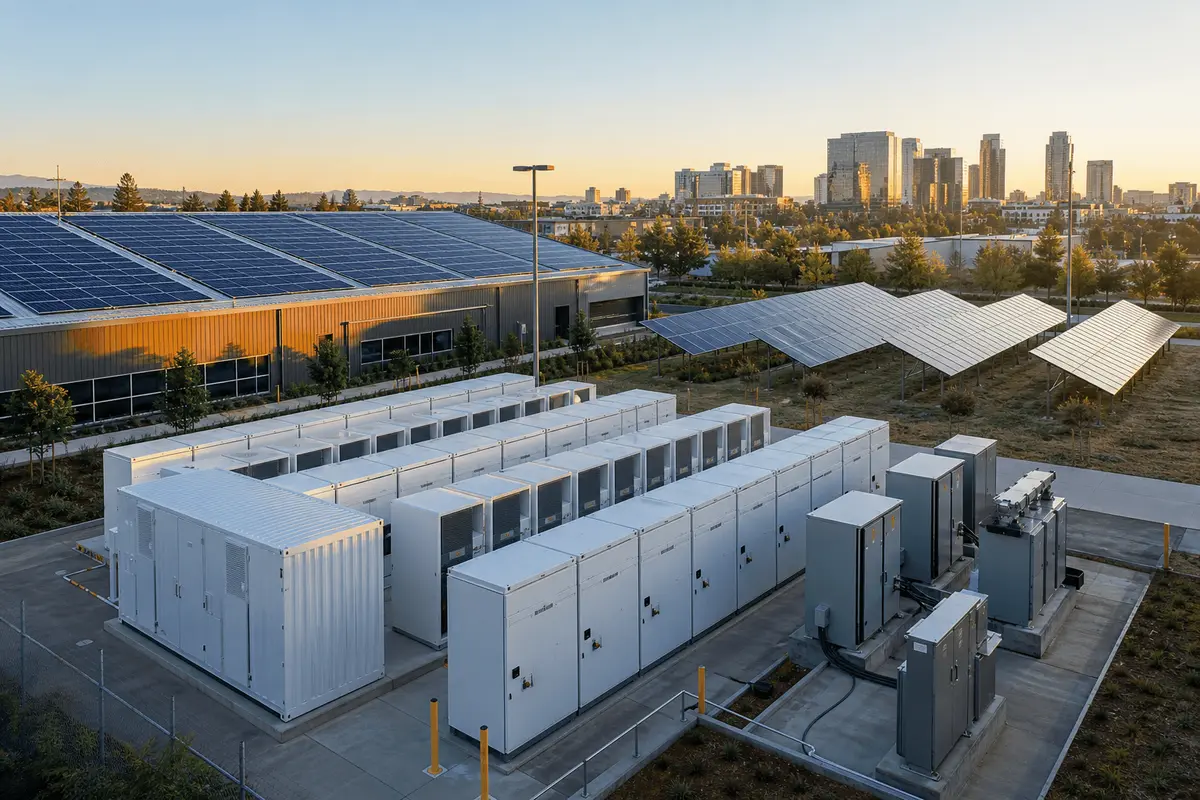
Watch the video
TL;DR
Solar storage EPC procurement should be evidence-gated before payment or shipment. Buyers should verify at least 5 authoritative HTTPS sources, model yield with NREL tools, confirm IEC/IEEE/UL compliance, and compare FOB, CIF, and turnkey scope. SOLARTODO supports 20kW-1MW+ PV and 50kWh-4MWh LFP storage quotations for B2B projects.
Evidence-gated solar storage EPC procurement links 20kW-1MW PV, 50kWh-4MWh LFP storage, and 5-8 verified HTTPS sources to reduce design risk, support bankability, and compare FOB, CIF, and turnkey pricing.
Summary
Evidence-gated solar storage EPC procurement links 20kW-1MW PV, 50kWh-4MWh LFP storage, and 5-8 verified HTTPS sources to reduce design risk, support bankability, and compare FOB, CIF, and turnkey pricing.
Key Takeaways
- Verify at least 5 HTTPS sources before approving EPC specifications, including IEC 61215, IEC 61730, IEEE 1547, UL 9540, and NREL PVWatts.
- Size hybrid PV-plus-storage from measured load data, using 20kW-1MW PV and 50kWh-4MWh LFP storage ranges for commercial B2B projects.
- Require IEC 61215 and IEC 61730 module compliance to reduce electrical, fire, and mechanical safety risk over a 25-30 year asset life.
- Model annual yield with NREL PVWatts V8 or SAM, then apply 12-16% system losses before final EPC pricing and ROI approval.
- Compare FOB Supply, CIF Delivered, and EPC Turnkey pricing to separate equipment cost, logistics risk, civil works, commissioning, and warranty scope.
- Apply volume discounts of 5% for 50+ units, 10% for 100+ units, and 15% for 250+ units during framework procurement.
- Calculate payback against diesel or peak-grid tariffs, where LFP storage can provide 90-95% round-trip efficiency and multi-hour backup.
- Document every specification with source URL, publication year, and acceptance evidence before releasing 30% T/T deposit or L/C instructions.
Evidence-Gated Solar Storage EPC Procurement
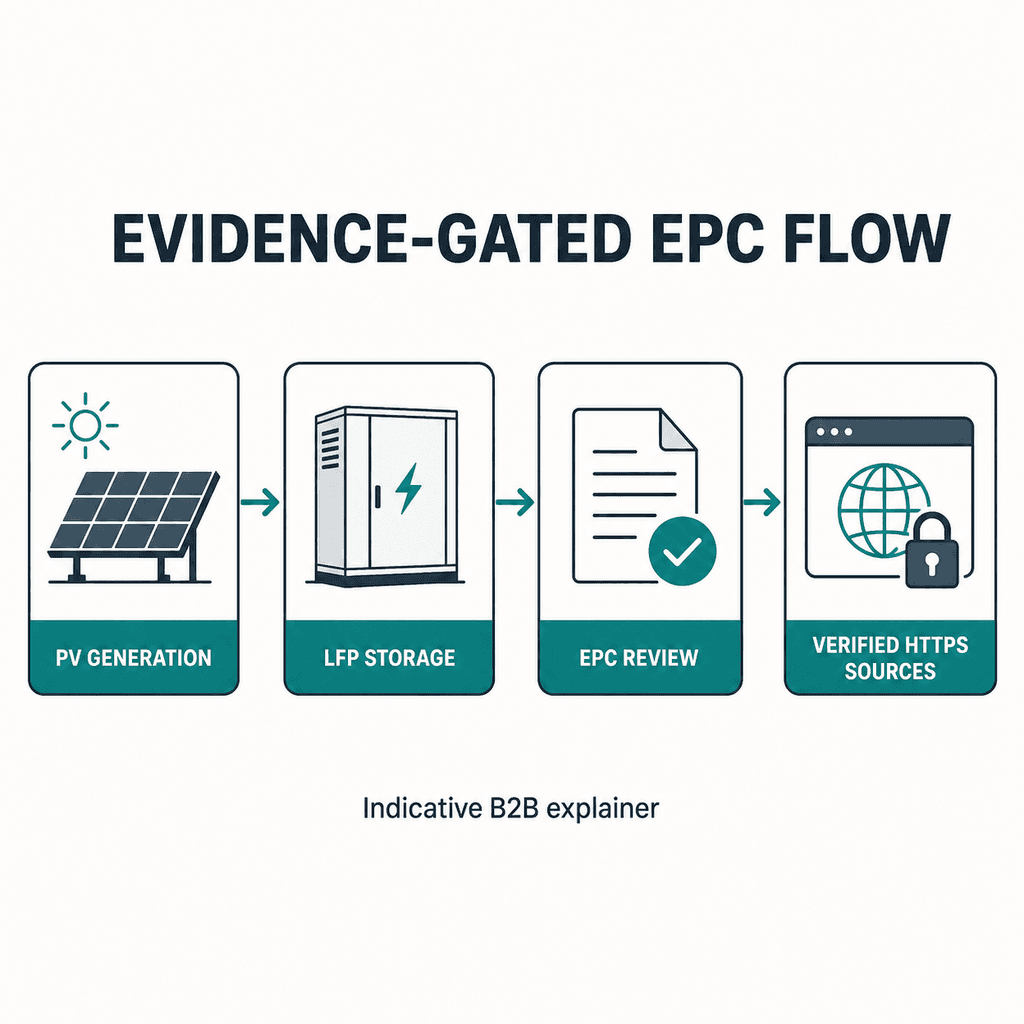
Evidence-gated solar storage EPC procurement uses 5-8 authoritative HTTPS sources, 20kW-1MW PV sizing, and 50kWh-4MWh LFP storage data to reduce procurement risk.
For B2B buyers, the phrase P1-2 Evidence Gate Run3 means a procurement workflow where every technical claim is checked before it reaches commercial quotation. Instead of accepting a generic solar storage proposal, procurement teams require traceable source attribution for standards, yield assumptions, battery safety, interconnection behavior, warranty scope, and EPC delivery boundaries. This is especially important for solar PV projects that combine generation, storage, smart controls, and backup power.
SOLARTODO positions solar storage EPC as an engineered export solution rather than an online checkout product. The buyer submits site load, tariff, roof or land area, backup requirement, grid condition, and logistics destination. SOLARTODO then prepares an offline quotation that may include FOB equipment supply, CIF delivery, or EPC turnkey execution with financing support for large projects.
According to IRENA (2025), utility-scale solar PV reached a global weighted average LCOE of USD 0.043/kWh in 2024, while battery storage installed costs fell 93% from 2010 to 2024. According to IEA (2024), solar PV and wind are expected to account for 95% of renewable capacity additions through 2030. These figures make solar storage commercially compelling, but only if the EPC specification is disciplined.
The International Energy Agency states, 'Solar PV and wind together account for 95% of all renewable capacity growth.' NREL states that PVWatts 'estimates the energy production of grid-connected photovoltaic systems.' These short statements explain why source-backed yield modeling and bankable equipment selection belong at the center of procurement.
Technical Architecture and Source Attribution
A bankable solar storage EPC design should connect PV modules, hybrid inverters, LFP batteries, EMS controls, and grid protection through at least 6 verified standards.
A typical SOLARTODO solar storage EPC package begins with mono TOPCon PV modules, selected because modern N-type modules commonly support 22.5-24.5% efficiency and lower long-term degradation than legacy PERC products. The PV array feeds MPPT inverter channels, while the battery energy storage system uses LFP chemistry for thermal stability, cycle life, and high dispatch efficiency. The energy management system then manages self-consumption, peak shaving, backup operation, generator coordination, and grid export limits.
HTTPS source attribution should be built into the bill of materials. PV modules should reference IEC 61215 for design qualification and IEC 61730 for safety qualification. Grid-connected inverter behavior should reference IEEE 1547-2018 for distributed energy resource interconnection and IEC 62116:2014 for islanding prevention testing. Stationary storage systems should reference UL 9540 and, where applicable, NFPA 855 for installation and fire safety context.
According to IEC (2023), IEC 61730-1 specifies construction requirements for PV modules to support safe electrical and mechanical operation. According to IEEE (2018), IEEE 1547 covers interconnection, operation, testing, safety, power quality, islanding, and maintenance requirements for distributed energy resources. According to UL Solutions (2025), UL 9540 covers energy storage systems intended to receive, store, and supply electrical energy.
| EPC Evidence Item | Required Source Type | Procurement Use | Acceptance Check |
|---|---|---|---|
| PV module reliability | IEC 61215 and IEC 61730 | Confirms design and safety qualification | Certificate, model match, datasheet match |
| Energy yield | NREL PVWatts V8 or SAM | Estimates annual kWh production | Location, tilt, azimuth, losses documented |
| Grid interconnection | IEEE 1547-2018 | Defines DER interface requirements | Utility approval and inverter certificate |
| Anti-islanding | IEC 62116:2014 | Confirms inverter islanding prevention test basis | Test report or certified inverter list |
| Battery system safety | UL 9540 | Evaluates complete ESS integration | UL listing, enclosure rating, BMS details |
| Installation safety | NFPA 855 or local code | Guides stationary ESS installation review | Fire setback and commissioning record |
For a 20kW+50kWh commercial or high-end residential system, a reasonable yield range is often 30-36MWh per year in good solar resource regions, before site-specific shading and soiling adjustments. For a 500kW+1MWh commercial facility, the same evidence process scales to transformer loading, demand-charge reduction, and battery dispatch strategy. The engineering principle remains consistent: quote only after measured load, solar resource, compliance scope, and logistics boundaries are clear.
EPC Investment Analysis and Pricing Structure
EPC investment analysis should compare 3 pricing tiers, 5-15% volume discounts, and project payback before any 30% deposit is released.
SOLARTODO uses a B2B inquiry-to-quotation model because solar storage systems depend on site conditions. EPC turnkey delivery normally includes engineering design, equipment procurement, logistics coordination, mounting, cabling, protection devices, civil works where required, installation supervision, commissioning, monitoring setup, documentation, training, and warranty handover. The exact scope must be written into the quotation, not assumed from product photos.
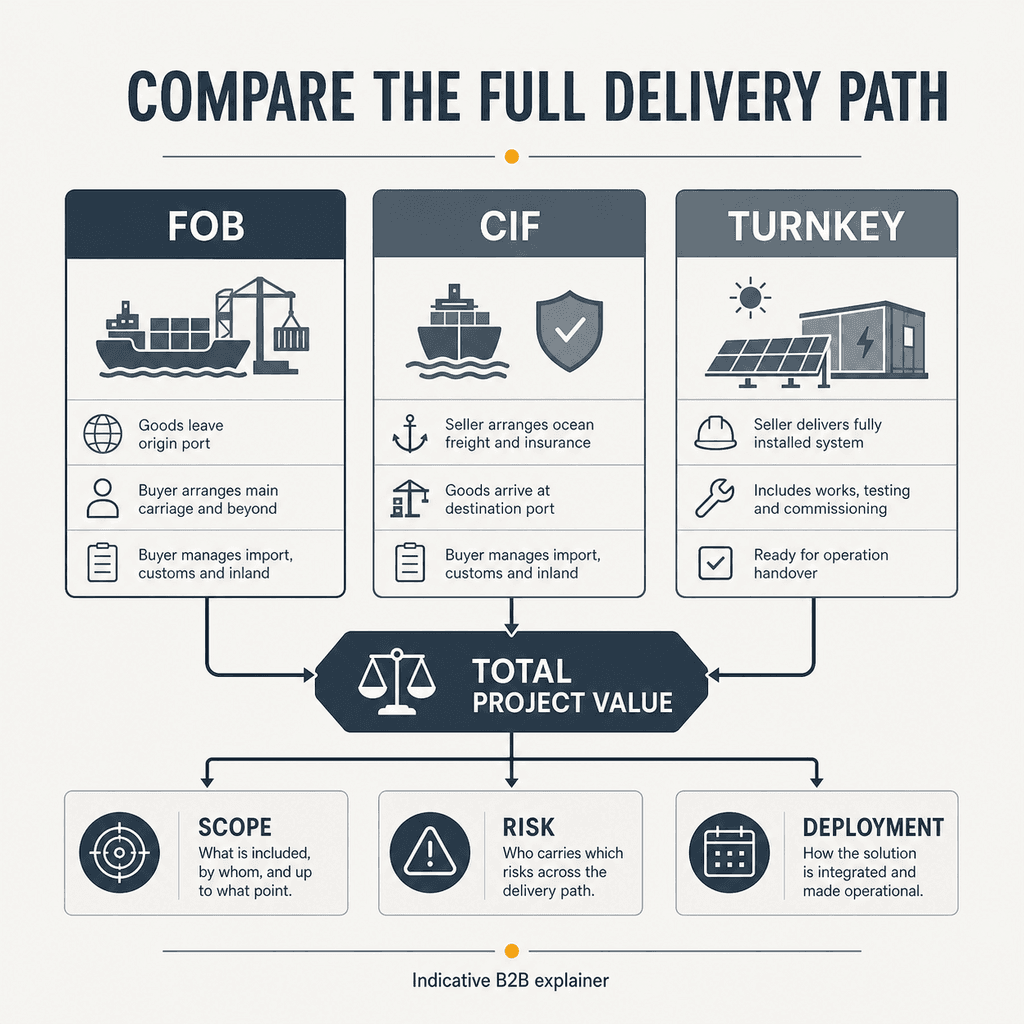
The three-tier pricing structure separates buyer responsibilities. FOB Supply covers factory supply at the export port and is suitable for experienced importers or local EPC contractors. CIF Delivered adds freight and insurance to the destination port, improving landed-cost visibility for distributors and government buyers. EPC Turnkey includes engineering, installation, commissioning, and acceptance testing, making it the most complete but also the most site-dependent option.
| Pricing Tier | Included Scope | Buyer Responsibility | Best Fit |
|---|---|---|---|
| FOB Supply | Equipment, factory documentation, export packing | Freight, import, local installation | Distributors and EPC partners |
| CIF Delivered | Equipment, export packing, ocean freight, insurance | Import clearance, inland delivery, installation | Importers needing landed-cost control |
| EPC Turnkey | Design, supply, installation, commissioning, handover | Site access, permits, utility interface support | Industrial, telecom, estate, and public projects |
Volume pricing should be explicit during framework procurement. SOLARTODO can structure guidance around 50+ units for a 5% discount, 100+ units for a 10% discount, and 250+ units for a 15% discount, subject to configuration, destination, and delivery schedule. For large projects above USD 1,000K, project financing may be available after credit review, technical due diligence, and commercial approval.
Payment terms are typically 30% T/T deposit and 70% against bill of lading, or 100% L/C at sight for qualified transactions. Procurement teams should link payment milestones to evidence gates: datasheet approval, compliance certificate review, production inspection, factory acceptance test, shipping documents, commissioning record, and final handover. This prevents ambiguity when EPC scope spans multiple suppliers and jurisdictions.
ROI depends on tariff, diesel displacement, battery cycling, demand charge, and backup value. In a facility paying USD 0.15/kWh, a 100kW PV system generating 150,000kWh per year can offset about USD 22,500 annually before storage benefits. A 200kWh LFP battery can add peak shaving and outage resilience, while modern LFP systems often support 90-95% round-trip efficiency under controlled operating conditions.
For quotation, contact [email protected] or +6585559114 with load curves, project country, grid voltage, roof or land dimensions, backup load list, and preferred pricing tier.
Comparison and Selection Guide
The best solar storage EPC option depends on 4 variables: load profile, backup duration, grid rules, and whether the buyer needs FOB, CIF, or turnkey delivery.
Procurement managers should begin with the business problem, not the product catalog. A telecom site may need 8-24 hours of backup with solar-assisted battery recharge. A factory may need peak shaving from 250kW to 1MW of PV and 500kWh to 4MWh of storage. A commercial building may need 50kW to 500kW of PV, load shifting, and a protected loads panel for IT, lighting, pumps, and security systems.
Engineers should validate whether the battery is sized for energy, power, or both. A 50kWh battery can run a 5kW critical load for roughly 9 hours at a 90% usable window, but it cannot support a 50kW process load for long. Conversely, a high-power battery inverter may handle motor starts but still require enough kWh capacity for the required backup duration.
According to NREL (2025), PVWatts Version 8.5.2 uses PVWatts API Version 8.0 and updated weather/model assumptions for preliminary PV performance estimates. According to NREL (2024), the Annual Technology Baseline provides technology-specific CAPEX, O&M, capacity factor, and LCOE parameters for PV, PV-plus-battery, and storage technologies. These tools help EPC teams separate realistic yield expectations from optimistic sales estimates.
| Project Type | Typical PV Range | Typical Storage Range | Primary Value | EPC Evidence Priority |
|---|---|---|---|---|
| High-load residence or villa | 20-50kW | 50-150kWh | Backup and self-consumption | Hybrid inverter, battery safety, load panel |
| Commercial rooftop | 50-500kW | 100kWh-1MWh | Bill reduction and peak shaving | Roof loading, yield model, grid approval |
| Industrial facility | 500kW-1MW+ | 1-4MWh | Demand control and resilience | Transformer study, EMS logic, protection |
| Telecom or remote site | 5-100kW | 20-500kWh | Diesel reduction and uptime | Autonomy hours, enclosure rating, monitoring |
| Public infrastructure | 20-300kW | 50kWh-1MWh | Reliability and sustainability | Standards, documentation, acceptance tests |
SOLARTODO can support these use cases as a manufacturer-exporter covering solar energy, energy storage, smart streetlights, telecom towers, power towers, smart traffic, security systems, and smart agriculture monitoring equipment. For mixed infrastructure projects, one evidence gate can cover PV modules, another can cover battery systems, and another can cover communications or monitoring integration.
Implementation Workflow and Risk Control
A practical EPC workflow uses 7 evidence gates from site data to commissioning, reducing rework before shipment, installation, and final acceptance.
Gate 1 is site and load evidence. Buyers should provide 12 months of utility bills, 15-minute load data where available, backup load schedules, roof or land drawings, local grid voltage, and outage history. Without these inputs, EPC teams can only issue budgetary estimates, not bankable designs.
Gate 2 is energy simulation. Use NREL PVWatts for early screening and SAM or engineering software for detailed modeling when shading, bifacial gain, storage dispatch, and tariff complexity matter. Apply loss assumptions for temperature, soiling, mismatch, wiring, inverter conversion, availability, and curtailment.
Gate 3 is equipment compliance. The approved equipment list should map each PV module, inverter, battery cabinet, BMS, switchgear item, and monitoring gateway to datasheets, certificates, serial traceability, and warranty terms. A procurement file without model-level certificate matching should not pass technical approval.
Gate 4 is commercial structure. FOB, CIF, and EPC turnkey proposals should be compared side by side. The buyer should know whether customs, inland transport, cranes, foundations, cable trenching, utility studies, fire systems, and local permits are included.
Gate 5 is factory and shipment evidence. FAT records, packing lists, shipping marks, bill of lading, insurance certificate, and photo documentation should be retained. Payment against B/L should reference the same equipment models and quantities approved during technical review.
Gate 6 is commissioning. The EPC team should verify insulation resistance, polarity, grounding, inverter startup, battery communication, EMS functions, grid protection settings, monitoring data, and emergency shutdown. For storage projects, battery state-of-charge strategy and reserve settings must match the backup requirement.
Gate 7 is O&M handover. According to NREL (2018), standardized O&M practices can reduce cost uncertainty and improve performance risk management for PV and PV-plus-storage assets. Handover should include inspection schedules, spare parts, warranty claim process, monitoring access, and escalation contacts.
FAQ
Solar storage EPC buyers should ask at least 10 evidence-based questions covering standards, yield, storage safety, pricing, installation, maintenance, and warranty risk.
Q: What does HTTPS source attribution mean in solar storage EPC procurement? A: HTTPS source attribution means each major technical claim links to a verifiable source from an organization such as NREL, IEC, IEEE, IEA, IRENA, UL, or NFPA. In practice, procurement teams attach 5-8 source URLs to yield assumptions, standards, safety requirements, and pricing decisions before approving an EPC quotation.
Q: Why is an evidence gate needed before buying solar storage equipment? A: An evidence gate prevents buyers from approving incomplete or unsupported specifications. For solar storage EPC, it checks module standards, inverter interconnection rules, battery safety, energy yield, and delivery scope before payment. This reduces disputes when projects include 20kW-1MW PV arrays, 50kWh-4MWh storage, and international logistics.
Q: What does SOLARTODO include in EPC turnkey delivery? A: EPC turnkey delivery can include engineering, procurement, construction, installation supervision, commissioning, monitoring setup, documentation, training, and warranty handover. Exact scope depends on project country, site access, permits, civil works, grid requirements, and battery size. SOLARTODO confirms this through offline quotation rather than online checkout.
Q: How should buyers compare FOB Supply, CIF Delivered, and EPC Turnkey pricing? A: Compare the tiers by responsibility, not only unit price. FOB Supply covers equipment at export port, CIF Delivered adds freight and insurance, and EPC Turnkey adds site engineering, installation, commissioning, and handover. A lower FOB price may still have higher total cost if local labor, cranes, permits, and inland transport are excluded.
Q: What payment terms are typical for SOLARTODO solar storage EPC projects? A: Typical payment terms are 30% T/T deposit and 70% against bill of lading, or 100% L/C at sight for qualified buyers. For projects above USD 1,000K, financing may be available after commercial review. Payment milestones should reference approved equipment lists, certificates, FAT evidence, and shipment documents.
Q: Which standards matter most for PV modules in a solar storage project? A: IEC 61215 and IEC 61730 are the core PV module standards buyers should verify. IEC 61215 supports design qualification and type approval, while IEC 61730 addresses PV module safety construction and testing. Procurement should match certificate model numbers to the exact module in the bill of materials.
Q: Which standards apply to inverters and grid interconnection? A: IEEE 1547-2018 is a key reference for DER interconnection and interoperability with electric power systems. IEC 62116:2014 is commonly used for testing islanding prevention measures in utility-interconnected PV inverters. Local utility codes may add country-specific requirements, so EPC teams must verify both international and local rules.
Q: How is battery storage safety verified? A: Battery storage safety is verified at system level, not just cell level. UL 9540 evaluates integrated energy storage systems, including battery, power conversion, protection, controls, and communication. NFPA 855 provides installation safety context for stationary ESS, including commissioning, operation, maintenance, and fire-code considerations.
Q: How should annual solar generation be estimated before EPC quotation? A: Early estimates should use NREL PVWatts V8 or equivalent solar modeling with location, tilt, azimuth, system size, and losses documented. For detailed EPC quotation, engineers should refine shading, soiling, inverter loading, bifacial gain, and curtailment. A practical design loss factor often falls around 12-16%.
Q: What ROI can a commercial solar storage project expect? A: ROI depends on electricity tariff, diesel use, demand charges, storage dispatch, and financing cost. For example, 100kW of PV generating 150,000kWh annually offsets about USD 22,500 per year at USD 0.15/kWh before storage value. Batteries can improve payback where outages, peak tariffs, or generator fuel costs are material.
Q: What maintenance is required after commissioning? A: Maintenance should include PV cleaning, thermal inspection, inverter checks, battery health review, firmware control, protection testing, and monitoring data review. Many commercial systems use quarterly remote checks and annual site inspections. Storage systems also need state-of-charge policy review and emergency response documentation.
Q: How can buyers request a SOLARTODO quotation? A: Buyers should send project country, load profile, utility tariff, roof or land area, grid voltage, backup load list, preferred pricing tier, and target delivery date. SOLARTODO reviews the data and prepares an offline B2B quotation. For large projects, contact [email protected] or +6585559114.
References
- IRENA Renewable Power Generation Costs in 2024 (2025): Reports utility-scale solar PV LCOE of USD 0.043/kWh, solar PV installed cost of USD 691/kW, and utility-scale BESS installed cost decline of 93% from 2010 to 2024. — https://www.irena.org/Data/View-data-by-topic/Capacity-and-Generation
- IEA Renewables 2024 (2024): Forecasts more than 5,500GW of new renewable capacity by 2030 and states that solar PV and wind account for 95% of renewable capacity growth. — https://www.iea.org/reports/world-energy-outlook-2024
- NREL PVWatts Calculator Version 8.5.2 (2025): Provides current PVWatts V8 modeling for preliminary grid-connected photovoltaic energy production estimates using updated weather and PV assumptions. — https://www.nrel.gov/research/data-tools.html
- NREL Annual Technology Baseline (2024): Provides CAPEX, O&M, capacity factor, and LCOE assumptions for photovoltaic, PV-plus-battery, and battery storage technologies. — https://www.nrel.gov/research/data-tools.html
- IEC 61730-1:2023 (2023): Defines PV module safety qualification construction requirements for safe electrical and mechanical operation in terrestrial PV modules. — https://webstore.iec.ch/
- IEC 62116:2014 (2014): Provides test procedures for islanding prevention measures in utility-interconnected photovoltaic inverters. — https://webstore.iec.ch/
- IEEE 1547-2018 (2018): Defines interconnection and interoperability requirements for distributed energy resources with electric power system interfaces. — https://standards.ieee.org/ieee/1547/7382/
- UL 9540 Energy Storage Systems and Equipment (2025): Covers complete energy storage system safety evaluation, including storage, power conversion, protection, controls, and communication. — https://www.ul.com/ This article uses 8 authoritative HTTPS references from 2018-2025 to support solar PV, storage, interconnection, safety, cost, and O&M claims.
- IRENA (2025): Renewable Power Generation Costs in 2024; reports utility-scale solar PV LCOE of USD 0.043/kWh and BESS cost declines from 2010-2024. https://www.irena.org/Digital-Report/Renewable-Power-Generation-Costs-in-2024
- IEA (2024): Renewables 2024; forecasts more than 5,500GW of new renewable capacity by 2030 and strong solar PV growth. https://www.iea.org/reports/renewables-2024
- NREL (2025): PVWatts Calculator Version 8.5.2; estimates grid-connected PV energy production using current PVWatts V8 modeling. https://pvwatts.nrel.gov/version_8.php
- NREL (2024): Annual Technology Baseline; provides CAPEX, O&M, capacity factor, and LCOE parameters for PV, PV-plus-battery, and storage technologies. https://atb.nrel.gov/electricity/2024/technologies
- IEC 61730-1:2023 (2023): Photovoltaic module safety qualification, Part 1; construction requirements for safe electrical and mechanical operation. https://webstore.iec.ch/en/publication/59803
- IEC 62116:2014 (2014): Utility-interconnected photovoltaic inverters; test procedure for islanding prevention measures. https://webstore.iec.ch/en/publication/6479
- IEEE 1547-2018 (2018): Standard for interconnection and interoperability of distributed energy resources with electric power systems interfaces. https://standards.ieee.org/ieee/1547/5915/
- UL Solutions (2025): UL 9540 energy storage system testing and certification; covers complete ESS safety evaluation. https://www.ul.com/services/energy-storage-system-testing-and-certification
Conclusion
Evidence-gated solar storage EPC procurement turns 5-8 authoritative sources, 3 pricing tiers, and project-specific load data into a bankable buying process.
The bottom line: SOLARTODO solar storage EPC is strongest when buyers verify standards, model yield, compare FOB/CIF/turnkey scope, and document payment gates before shipment. For projects from 20kW+50kWh to 1MW+4MWh, evidence discipline is the practical route to lower technical risk and clearer ROI.
About SOLARTODO
SOLARTODO is a global integrated solution provider specializing in solar power generation systems, energy-storage products, smart street-lighting and solar street-lighting, intelligent security & IoT linkage systems, power transmission towers, telecom communication towers, and smart-agriculture solutions for worldwide B2B customers.
About the Author

Cinn Song
Founder & Chief Solutions Architect
Cinn Song founded SOLARTODO LIMITED and leads its smart-city infrastructure engineering — from solar, storage and integrated smart poles to the company's push into physical-AI city edge nodes: pole-mounted edge computing, vertical LLMs for smart cities, drone-based O&M with autonomous battery swapping, robotic maintenance, and high-speed counter-UAS interception. Since 2010, he has directed turnkey EPC + BOT delivery across 50+ countries, including telecom monopole supply for national grid operators, off-grid solar street-lighting for African municipalities, and integrated smart-pole programs for Gulf smart cities.
Cite This Article
Cinn Song. (2026). P1-2 Evidence Gate Run3: HTTPS Source Attribution for…. SOLARTODO. Retrieved from https://solartodo.com/knowledge/p1-2-evidence-gate-run3-https-source-attribution-for-solar-storage-epc-20260809t130651z
@article{solartodo_p1_2_evidence_gate_run3_https_source_attribution_for_solar_storage_epc_20260809t130651z,
  title = {P1-2 Evidence Gate Run3: HTTPS Source Attribution for…},
  author = {Cinn Song},
  journal = {SOLARTODO Knowledge Base},
  year = {2026},
  url = {https://solartodo.com/knowledge/p1-2-evidence-gate-run3-https-source-attribution-for-solar-storage-epc-20260809t130651z},
  note = {Accessed: 2026-08-09}
}
Published: August 9, 2026 | Available at: https://solartodo.com/knowledge/p1-2-evidence-gate-run3-https-source-attribution-for-solar-storage-epc-20260809t130651z
Subscribe to Our Newsletter
Get the latest solar energy news and insights delivered to your inbox.
View All Articles