Public Address and Emergency Broadcast on Smart Poles |…

Cinn Song
Founder & Chief Solutions Architect
Watch the video
TL;DR
Public address smart poles combine outdoor speakers, LED lighting, SOS triggers, cameras, and 4G/5G connectivity to broadcast emergency instructions across 50m-150m zones. For B2B projects, specify IEC 60268-16 intelligibility testing, IP66 hardware, backup logic, and EPC pricing tiers before procurement.
Smart pole public address systems combine 180W LED lighting, IP66 speakers, 4G/5G backhaul, and one-key SOS workflows to broadcast evacuation, weather, security, and safety messages across outdoor B2B sites.
Summary
Smart pole public address systems combine 180W LED lighting, IP66 speakers, 4G/5G backhaul, and one-key SOS workflows to broadcast evacuation, weather, security, and public safety messages across campuses, roads, and smart city zones.
Key Takeaways
- Specify IP66 outdoor horn or column speakers with 15W-60W output per zone to keep voice messages intelligible above traffic and crowd noise.
- Integrate 4G/5G, Ethernet, or LoRaWAN control paths with 1 local fallback playlist so emergency broadcasts continue during network outages.
- Design broadcast zones at 50m-150m spacing so evacuation, weather, or security instructions reach targeted areas without over-alerting the whole site.
- Combine SOS buttons, 4K PTZ cameras, PA speakers, and dispatch software to reduce verification time from minutes to near real-time operator response.
- Compare FOB, CIF, and EPC turnkey pricing before procurement, with 50+ poles eligible for 5% guidance discounts and 250+ poles for 15%.
- Require IEC 60268-16 speech intelligibility testing, IEC 60529 IP ratings, and ASTM A123 galvanizing to reduce compliance and maintenance risk.
- Budget annual savings from adaptive LED dimming at up to 60% versus conventional lighting while adding emergency communication without separate poles.
- Use SOLARTODO smart poles for parks, campuses, highways, ports, industrial zones, and municipal corridors where 24/7 public warning is required.
Public Address on Smart Poles: What It Solves
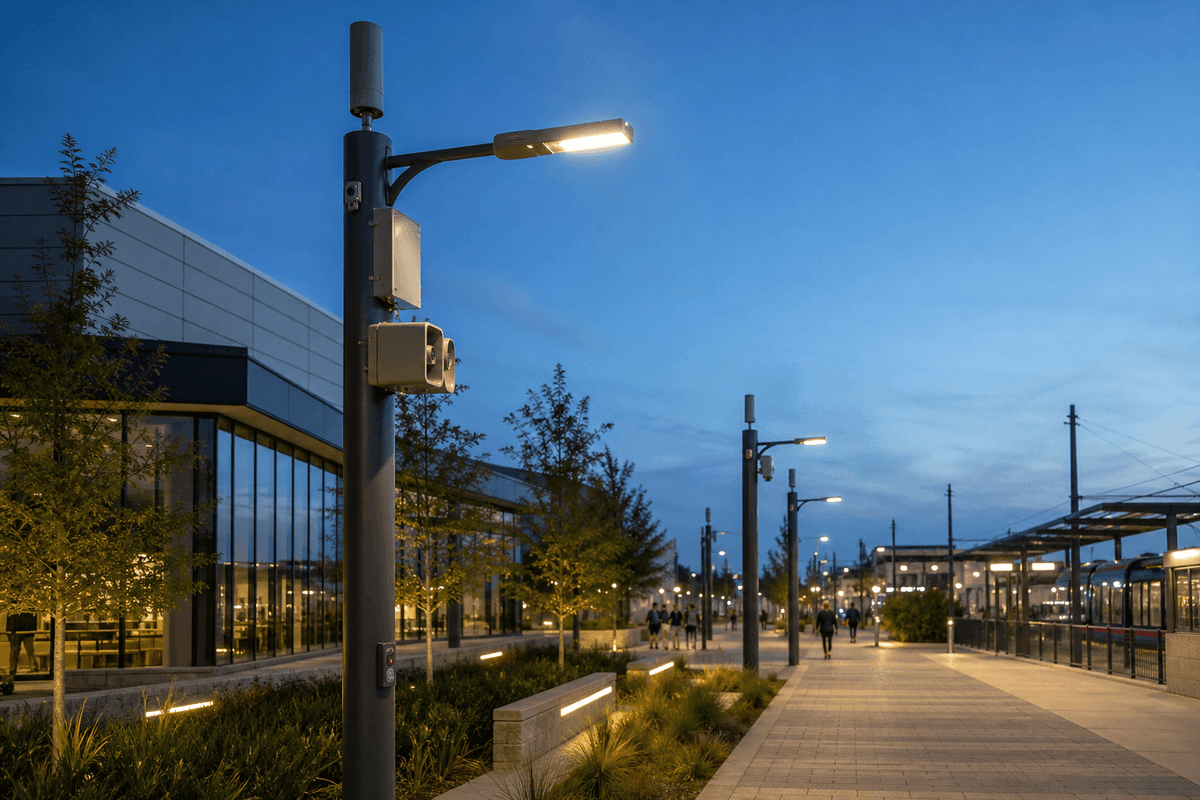
Smart pole public address systems turn 8m-12m lighting assets into emergency communication nodes with 15W-60W speakers, SOS input, and 4G/5G command connectivity.
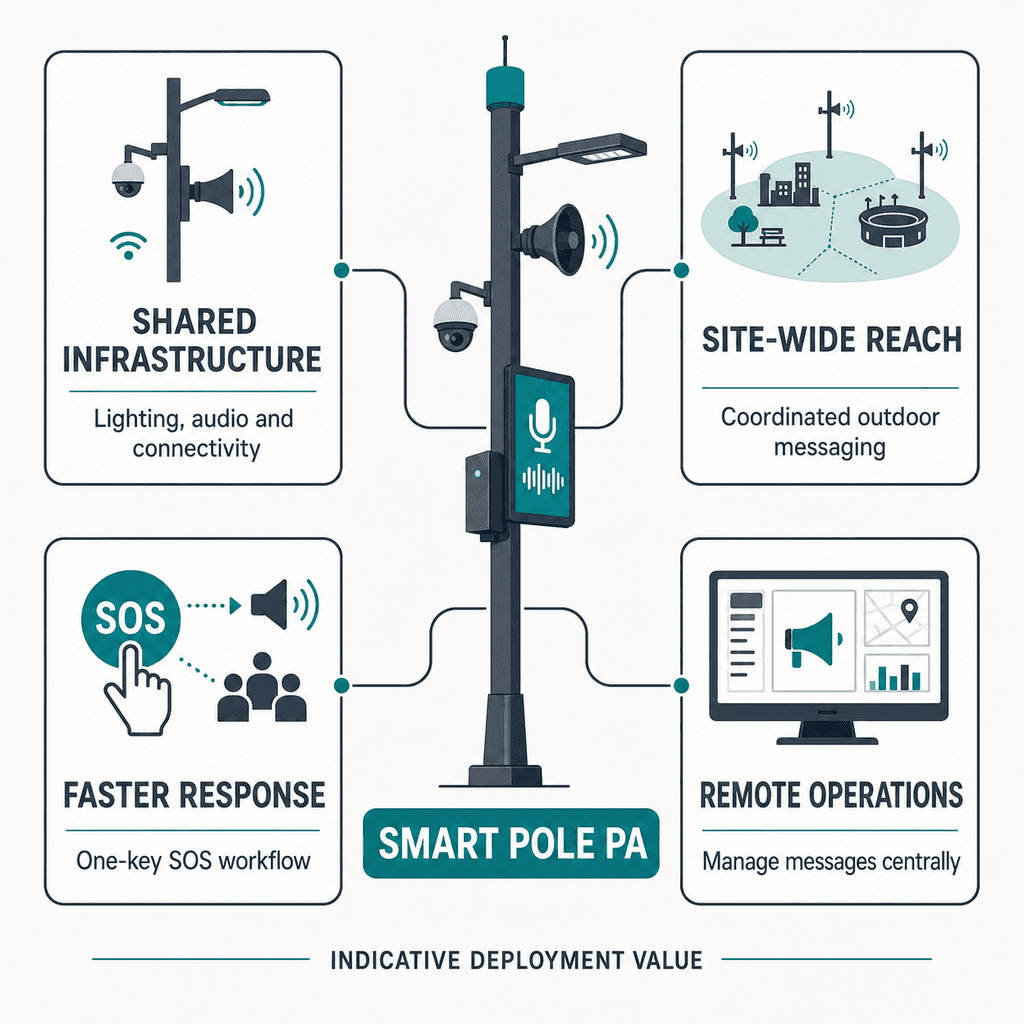
For B2B buyers, the value is not the speaker alone. The value is a single outdoor platform that can illuminate a site, detect incidents, verify video, broadcast instructions, and connect dispatch teams without installing separate towers, cabinets, and conduit for every subsystem.
A SOLARTODO emergency broadcast smart pole typically combines a hot-dip galvanized steel pole, LED luminaire, PA amplifier, weatherproof loudspeaker, SOS button, 4K PTZ camera, controller, and remote management software. The 12m Emergency Response Full configuration adds a 180W LED luminaire, WiFi 6 access point, environmental sensing, AED storage, and AI video analytics for public safety projects.
According to ISO 7240-16:2007, emergency sound systems are intended to broadcast information for life protection in specified areas. For outdoor smart poles, that translates into clear spoken instructions during security events, storms, evacuations, traffic accidents, crowd control, and medical emergencies.
The International Energy Agency states, 'ever-cheaper solar PV' is driving major electricity growth through 2030. That cost trend matters because smart poles can combine efficient LED lighting, solar-ready power options, and networked emergency systems in one procurement package.
Technical Architecture and Broadcast Workflow
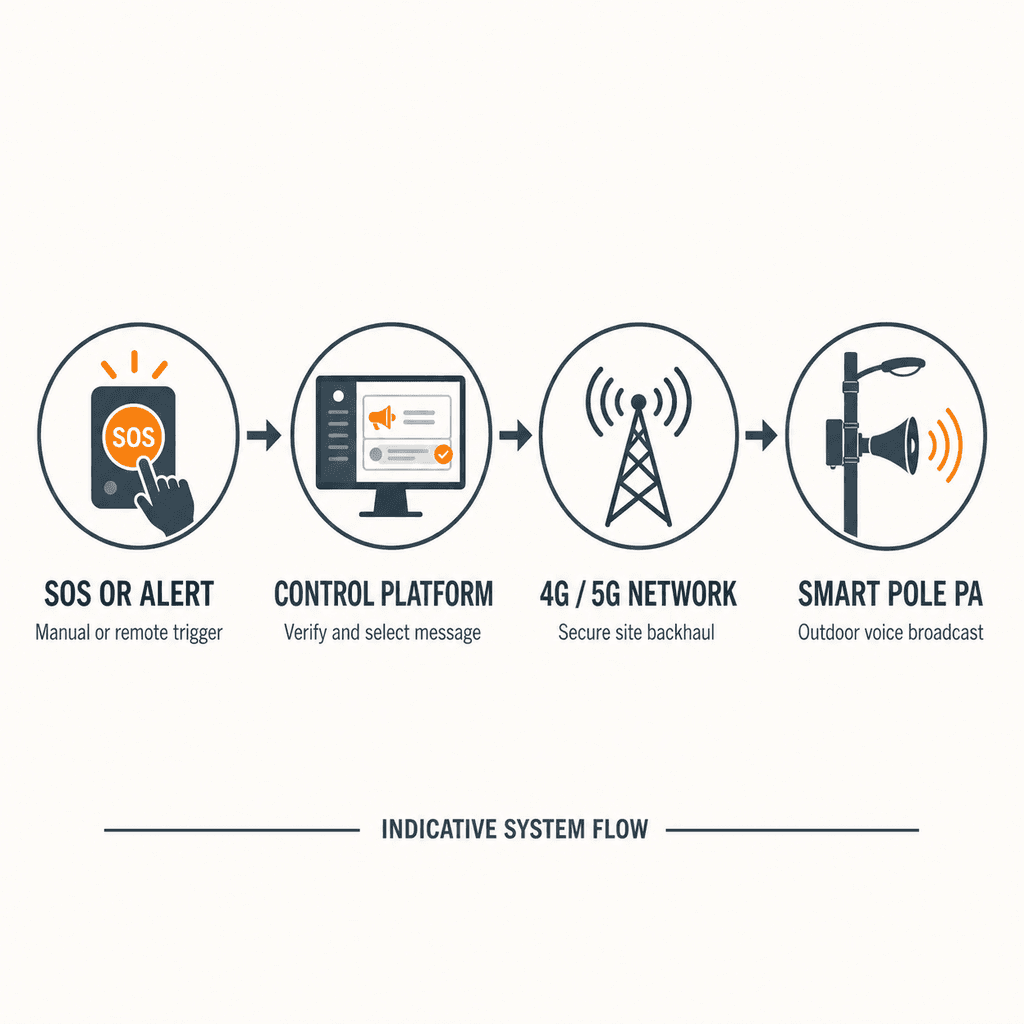
A reliable emergency broadcast smart pole uses 3 layers: field audio hardware, edge control logic, and command-center software with live or pre-recorded messages.
The field layer includes outdoor speakers, amplifier modules, microphones, SOS buttons, camera triggers, local storage, and surge-protected power distribution. Speaker output is normally selected by site noise level: 15W-30W can suit pedestrian paths, while 40W-60W is more appropriate for roads, plazas, ports, and industrial yards.
The edge layer decides what happens when an event occurs. For example, pressing a one-key SOS button can trigger a siren tone, play a pre-recorded safety message, rotate a 4K PTZ camera toward the incident, open a two-way intercom channel, and send GPS coordinates to a control room.
The command-center layer lets operators select zones, override automatic messages, start live paging, review logs, and monitor pole health. For mission-critical deployments, buyers should require role-based access, event audit trails, time-stamped broadcast logs, and remote diagnostics for amplifier, speaker, controller, and network status.
According to IEC 60268-16:2020, the Speech Transmission Index model supports objective measurement and prediction of speech intelligibility. Procurement specifications should therefore ask vendors to test intelligibility under expected ambient noise, not only quote amplifier wattage.
Core Components
A practical public address smart pole package includes:
- Weatherproof speaker: IP65 or IP66 horn, column, or array speaker rated for outdoor dust and water exposure.
- Amplifier and controller: 15W-60W per channel, local message storage, watchdog restart, and remote firmware management.
- Network module: Ethernet, fiber, 4G/5G, WiFi bridge, or LoRaWAN depending on bandwidth and site design.
- Trigger devices: SOS button, AI camera event, command-center command, weather alert input, or security system relay.
- Power system: AC220V grid supply, solar-hybrid option, smart PDU, surge protection, and backup battery where required.
- Compliance package: IEC 60268-16 testing, IEC 60529 ingress protection, ASTM A123 galvanizing, and local civil approvals.
Applications and Emergency Use Cases
Smart pole PA systems are most effective where 1 operator must reach hundreds of people across roads, parks, campuses, or industrial zones.
Municipal streets use emergency broadcast poles to warn pedestrians about road closures, flooding, civil defense alerts, missing-person searches, or evacuation routes. Because poles are already distributed along streets, the communication network can follow the public realm instead of depending on building-mounted speakers.
Campuses and parks use 8m environmental smart poles for security announcements, lost-child alerts, weather warnings, and event crowd management. SOLARTODO's 8m Campus/Park Environmental Smart Pole combines an 80W LED luminaire, 4K AI PTZ camera, WiFi 6 access point, environmental monitoring, and public communication capability for distributed outdoor coverage.
Industrial zones, ports, and logistics parks need stronger zoning discipline. A refinery, port gate, or container yard may need separate messages for emergency assembly areas, hazardous zones, entrances, and loading lanes. A segmented smart pole network can broadcast only to the affected 100m-300m corridor instead of interrupting the entire facility.
According to OSHA guidance on employee alarms, alarm systems must be perceived above ambient noise or light levels by affected employees. For outdoor B2B projects, this means site acceptance testing should include real operating conditions such as traffic, generators, machinery, rain, and crowd noise.
Selection Guide and Specification Comparison
Procurement teams should compare smart pole PA systems by intelligibility, zoning, resilience, integration, and lifecycle cost, not only by speaker wattage.
| Selection Factor | Basic PA Pole | Emergency Broadcast Smart Pole | SOLARTODO 7-in-1 Emergency Pole |
|---|---|---|---|
| Typical height | 6m-8m | 8m-12m | 12m |
| Speaker output | 10W-30W | 30W-60W | Configurable PA module |
| Lighting | 40W-100W LED | 80W-180W LED | 180W LED luminaire |
| Video verification | Optional fixed camera | 4K PTZ recommended | 4K AI PTZ with 20x zoom |
| Emergency trigger | Manual paging | SOS, VMS, command center | SOS video intercom plus dispatch |
| Connectivity | Ethernet or 4G | 4G/5G plus fallback | 4G/5G, WiFi 6, LoRaWAN options |
| Enclosure rating | IP54-IP65 | IP65-IP66 | IP66 module enclosures |
| Best use case | Announcements | Public safety zones | Smart city emergency response |
| Indicative price | Project-specific | Project-specific | $32,000-$42,000 reference range |
According to IRENA (2025), renewable power additions reached 582GW in 2024, with solar PV contributing 452.1GW. IRENA also states, 'renewables remained the most cost-competitive option' for new generation in 2024, which supports solar-ready smart infrastructure in markets with high grid costs.
Structural durability matters because PA, camera, and communications modules are only useful if the pole survives the environment. SOLARTODO specifies hot-dip galvanized steel structures, IP66 enclosures, and wind resistance above 150km/h for relevant smart pole models, with a 25-year design-life target when installed to local civil codes.
EPC Investment Analysis and Pricing Structure
EPC smart pole delivery converts a 50-250 pole emergency broadcast project into one engineered package covering design, supply, installation, testing, and handover.
Engineering, Procurement, and Construction delivery normally includes site survey, pole layout, acoustic zoning, civil foundation design, electrical design, communications design, factory acceptance testing, logistics, installation supervision, commissioning, operator training, and documentation. For municipalities and private developers, EPC reduces interface risk because the pole, PA, camera, software, and power system are treated as one deliverable.
SOLARTODO uses an inquiry-to-offline-quotation model rather than an online marketplace. Buyers can request three commercial scopes:
| Pricing Tier | Includes | Buyer Responsibility | Best Fit |
|---|---|---|---|
| FOB Supply | Factory supply, packed smart poles, module configuration | Ocean freight, customs, installation | Experienced importers and distributors |
| CIF Delivered | Product supply, freight, insurance to destination port | Import clearance, inland transport, installation | EPC contractors managing local works |
| EPC Turnkey | Engineering, supply, delivery coordination, installation support, testing | Permits and local authority approvals | Municipal and infrastructure owners |
Volume pricing guidance is typically 5% discount for 50+ poles, 10% for 100+ poles, and 15% for 250+ poles, subject to final configuration, destination, and financing structure. Standard payment terms are 30% T/T deposit plus 70% against bill of lading, or 100% L/C at sight for qualified transactions.
ROI comes from avoiding duplicate infrastructure and reducing operating cost. A smart pole can combine lighting, PA, camera, WiFi, sensing, and SOS functions in one foundation and electrical connection. Adaptive LED dimming can reduce lighting energy consumption by up to 60% versus conventional schedules, while integrated PA avoids separate loudspeaker poles, cabinets, trenching, and network runs.
Large projects above $1,000K may qualify for project financing support. Procurement teams should send drawings, deployment quantity, target country, communications preference, warranty expectations, and required certifications to [email protected] for a project quotation.
FAQ
A complete smart pole PA specification should answer at least 10 procurement questions covering audio coverage, standards, integration, pricing, maintenance, and warranty risk.
Q: What is a public address system on a smart pole? A: A public address system on a smart pole is an outdoor audio module that broadcasts live or recorded messages from a lighting pole. It normally includes a weatherproof speaker, amplifier, controller, network module, and command-center software. In emergency versions, it links with SOS buttons, 4K cameras, and dispatch workflows.
Q: How far can a smart pole emergency speaker cover? A: Coverage depends on speaker type, wattage, mounting height, ambient noise, and required intelligibility. Pedestrian paths may use 50m-80m spacing, while roads or plazas often require 80m-150m spacing with directional speakers. Final spacing should be confirmed by acoustic modeling and site acceptance testing.
Q: What standards apply to emergency broadcast smart poles? A: Important references include IEC 60268-16:2020 for speech intelligibility measurement, ISO 7240-16:2007 for emergency sound system control equipment, IEC 60529 for IP ratings, and ASTM A123/A123M-24 for hot-dip galvanizing. Local fire, telecom, data privacy, and civil engineering codes may also apply.
Q: Why is speech intelligibility more important than speaker wattage? A: Wattage only describes electrical power, not whether people can understand instructions during noise, echo, wind, or traffic. IEC 60268-16 uses Speech Transmission Index methods to evaluate intelligibility. A lower-wattage well-aimed speaker can outperform a louder system that creates distortion or overlapping sound fields.
Q: Can smart pole PA systems work during network outages? A: Yes, if the design includes local message storage, automatic triggers, and backup power. A resilient pole can play pre-recorded evacuation or warning messages even if the command-center link drops. For critical sites, specify 4G/5G plus wired backhaul, local fallback logic, and event logs.
Q: How does the PA system integrate with SOS buttons and cameras? A: When an SOS button is pressed, the controller can start a warning tone, play a safety message, open two-way intercom, and rotate a 4K PTZ camera toward the caller. The command center receives the pole ID, location, live video, and audio channel for faster verification.
Q: What is included in EPC turnkey delivery for PA smart poles? A: EPC turnkey delivery usually includes engineering design, acoustic zoning, pole supply, foundations, electrical works, communications setup, commissioning, testing, training, and handover documents. SOLARTODO can quote FOB Supply, CIF Delivered, or EPC Turnkey scopes depending on project country, quantity, and local contractor responsibilities.
Q: How much does an emergency broadcast smart pole cost? A: Cost depends on height, speaker power, camera, lighting wattage, network design, sensors, and civil works. As a reference, SOLARTODO's 12m 7-in-1 Emergency Response Full model is positioned around $32,000-$42,000 per pole before project-specific freight, duties, installation, and financing adjustments.
Q: What maintenance is required for outdoor PA smart poles? A: Maintenance should include quarterly remote diagnostics, annual physical inspection, speaker and amplifier testing, firmware updates, seal inspection, and cleaning of camera or sensor surfaces. Harsh coastal or industrial sites may need more frequent checks. Buyers should require spare speakers, surge protectors, and controller modules for fast replacement.
Q: Can the system broadcast different messages to different zones? A: Yes, a properly designed smart pole PA network can divide a site into zones by street, park area, campus block, gate, or emergency assembly point. Operators can broadcast to 1 zone, multiple zones, or all poles. Zoning prevents unnecessary disruption and improves emergency instructions.
Q: Are solar-powered PA smart poles practical? A: Solar-powered or solar-hybrid PA smart poles are practical when the load profile, battery capacity, and local irradiance support the required uptime. PA speakers draw significant power during broadcasts but low power at standby. Critical emergency poles often use grid power plus battery backup for higher reliability.
Q: What warranty and documentation should procurement require? A: Buyers should request a pole structural warranty, LED warranty, module warranty, IP test evidence, galvanizing standard, wiring diagrams, software manuals, and commissioning reports. For public safety use, require factory acceptance testing and site acceptance testing. Warranty terms should clearly separate structure, electronics, batteries, and software support.
Conclusion
Public address smart poles are best specified as 8m-12m integrated safety nodes with tested intelligibility, IP66 outdoor hardware, and multi-channel emergency workflows.
The bottom line: SOLARTODO public address and emergency broadcast smart poles combine lighting, PA, SOS, video, and connectivity in one infrastructure asset, making them strongest for 50+ pole municipal, campus, port, and industrial deployments where response speed and lifecycle cost matter.
References
These 8 references support smart pole PA specifications across speech intelligibility, emergency communication, outdoor protection, steel durability, energy cost, and interconnection practice.
- IEC 60268-16:2020 (2020): Sound system equipment standard defining objective speech intelligibility measurement by Speech Transmission Index.
- ISO 7240-16:2007 (2007, confirmed 2025): Fire detection and alarm systems standard for sound system control and indicating equipment.
- NFPA 72 (2025): National Fire Alarm and Signaling Code covering emergency communications systems and speech intelligibility guidance.
- IEC 60529 (1989+A2:2013): International ingress protection rating standard used for IP65 and IP66 outdoor electrical enclosures.
- ASTM A123/A123M-24 (2024): Standard specification for zinc hot-dip galvanized coatings on iron and steel products.
- IRENA (2025): Renewable Power Generation Costs in 2024, reporting 582GW renewable additions and USD 0.043/kWh solar PV LCOE.
- IEA (2026): Electricity 2026 supply analysis forecasting strong solar PV growth through 2030 in major economies.
- IEEE 802.11ax (2021): WiFi 6 standard for high-efficiency wireless LAN performance in dense user environments.
About SOLARTODO
SOLARTODO is a global integrated solution provider specializing in solar power generation systems, energy-storage products, smart street-lighting and solar street-lighting, intelligent security & IoT linkage systems, power transmission towers, telecom communication towers, and smart-agriculture solutions for worldwide B2B customers.
About the Author

Cinn Song
Founder & Chief Solutions Architect
Cinn Song founded SOLARTODO LIMITED and leads its smart-city infrastructure engineering — from solar, storage and integrated smart poles to the company's push into physical-AI city edge nodes: pole-mounted edge computing, vertical LLMs for smart cities, drone-based O&M with autonomous battery swapping, robotic maintenance, and high-speed counter-UAS interception. Since 2010, he has directed turnkey EPC + BOT delivery across 50+ countries, including telecom monopole supply for national grid operators, off-grid solar street-lighting for African municipalities, and integrated smart-pole programs for Gulf smart cities.
Cite This Article
Cinn Song. (2026). Public Address and Emergency Broadcast on Smart Poles |…. SOLARTODO. Retrieved from https://solartodo.com/knowledge/public-address-and-emergency-broadcast-on-smart-poles
@article{solartodo_public_address_and_emergency_broadcast_on_smart_poles,
  title = {Public Address and Emergency Broadcast on Smart Poles |…},
  author = {Cinn Song},
  journal = {SOLARTODO Knowledge Base},
  year = {2026},
  url = {https://solartodo.com/knowledge/public-address-and-emergency-broadcast-on-smart-poles},
  note = {Accessed: 2026-10-20}
}
Published: July 19, 2026 | Available at: https://solartodo.com/knowledge/public-address-and-emergency-broadcast-on-smart-poles
Subscribe to Our Newsletter
Get the latest solar energy news and insights delivered to your inbox.
View All Articles