Startup, Commissioning and Acceptance in Lighting Controls…

Cinn Song
Founder & Chief Solutions Architect
TL;DR
Use separate gates: startup for activation, commissioning for integrated cross-vendor verification, and acceptance for the buyer’s contractual sign-off. DOE supports the startup/commissioning split and multi-vendor bid structure; it does not prove project-specific savings or supplier claims.
Separate startup, commissioning, and acceptance so a multi-vendor street lighting controls tender can distinguish activation, integrated verification, and the buyer’s final contractual decision. DOE’s V2.0 model specification supports separating startup and commissioning and structuring bids around central management systems, backhaul communication networks, and field devices.
Key Takeaways
- DOE’s V2.0 model specification separated Start-Up and Commissioning and refined requirements for independent bids across CMS, backhaul networks, and field devices.
- Startup should confirm readiness, but exact startup tests are project-defined because the supplied DOE text does not provide a universal checklist.
- Commissioning should verify cross-vendor operation between the management system, communications network, and field devices.
- Acceptance should be a separate buyer decision supported by evidence; the supplied sources do not define a universal acceptance process.
- U.S. FEMP exterior lighting purchasing requirements apply to U.S. federal covered purchases and should not be generalized to other countries.
- Controls can be recommended, but project-specific savings, payback, certifications, deployments, prices, and supplier performance are unknown unless documented.
Summary
For a multi-vendor street lighting controls tender, startup, commissioning, and acceptance should be treated as separate project stages because the supplied DOE model specification describes networked outdoor lighting control systems as a market where user interests vary, true value can be difficult to assess, and V2.0 was refined to support independent bids for central management systems, backhaul communication networks, and field devices (https://www.energy.gov/cmei/ssl/model-specification-networked-outdoor-lighting-control-systems). The evidence supports a procurement structure that separates technical activation from system verification and from the buyer’s final acceptance decision. It does not prove any specific supplier performance, project savings, product stock, certification, price, or deployment result.
Why separation matters in a multi-vendor tender
The DOE Municipal Solid-State Street Lighting Consortium describes its Model Specification for Networked Outdoor Lighting Control Systems as a tool for cities, utilities, and local agencies considering systems that may reduce streetlight energy and maintenance costs (https://www.energy.gov/cmei/ssl/model-specification-networked-outdoor-lighting-control-systems). The same source says many monitoring and control capabilities raise questions for users about whether and how they should be implemented, and how their true value should be assessed. That is a strong reason to avoid treating “installed,” “configured,” and “accepted” as the same milestone.
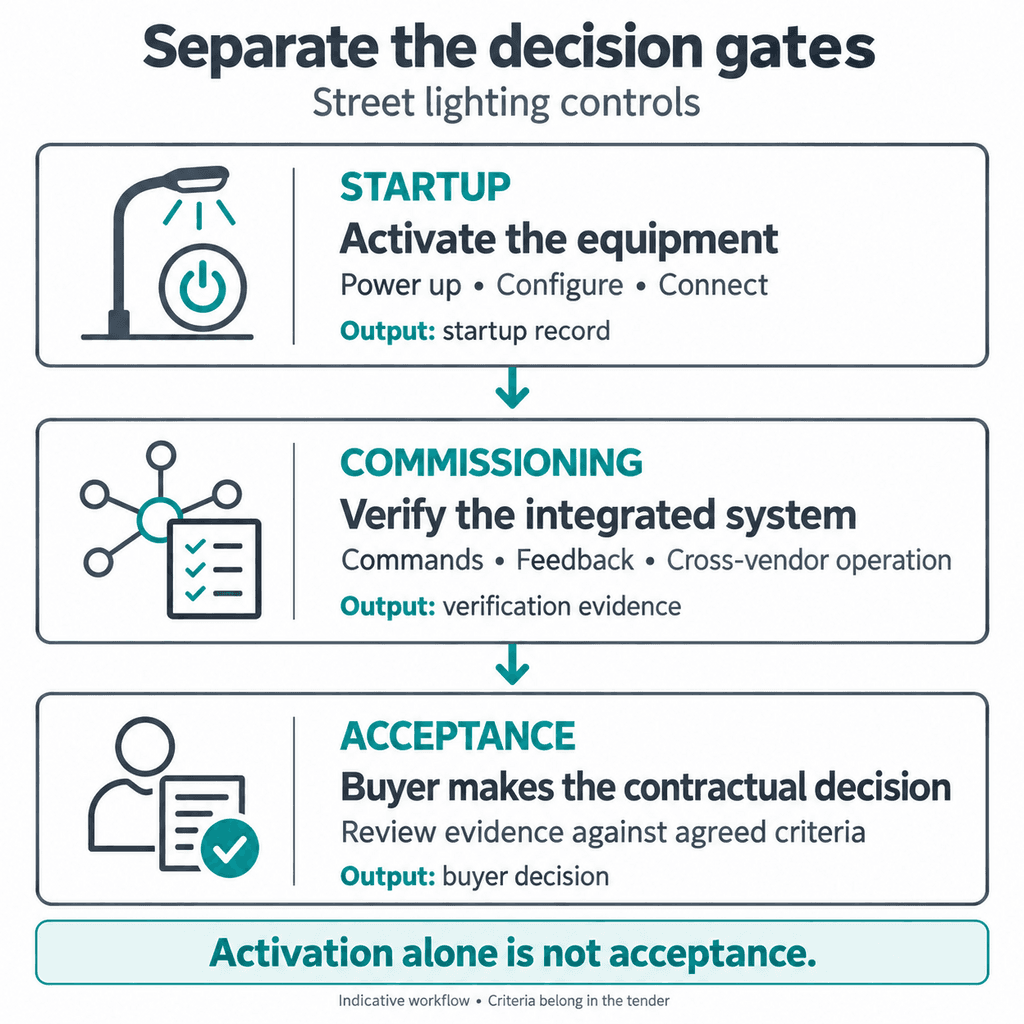
The DOE source also states that V2.0 separated the Start-Up and Commissioning sections and refined the specification to facilitate independent bids for Central Management Systems, Backhaul Communication Networks, and Field Devices (https://www.energy.gov/cmei/ssl/model-specification-networked-outdoor-lighting-control-systems). In a tender, this supports assigning different evidence requirements to each stage: startup evidence for whether components are powered and connected, commissioning evidence for whether integrated functions work as specified, and acceptance evidence for whether the buyer agrees that contractual requirements have been met. The source does not provide a universal acceptance checklist, so each buyer should define acceptance criteria in the tender.
Recommended tender structure
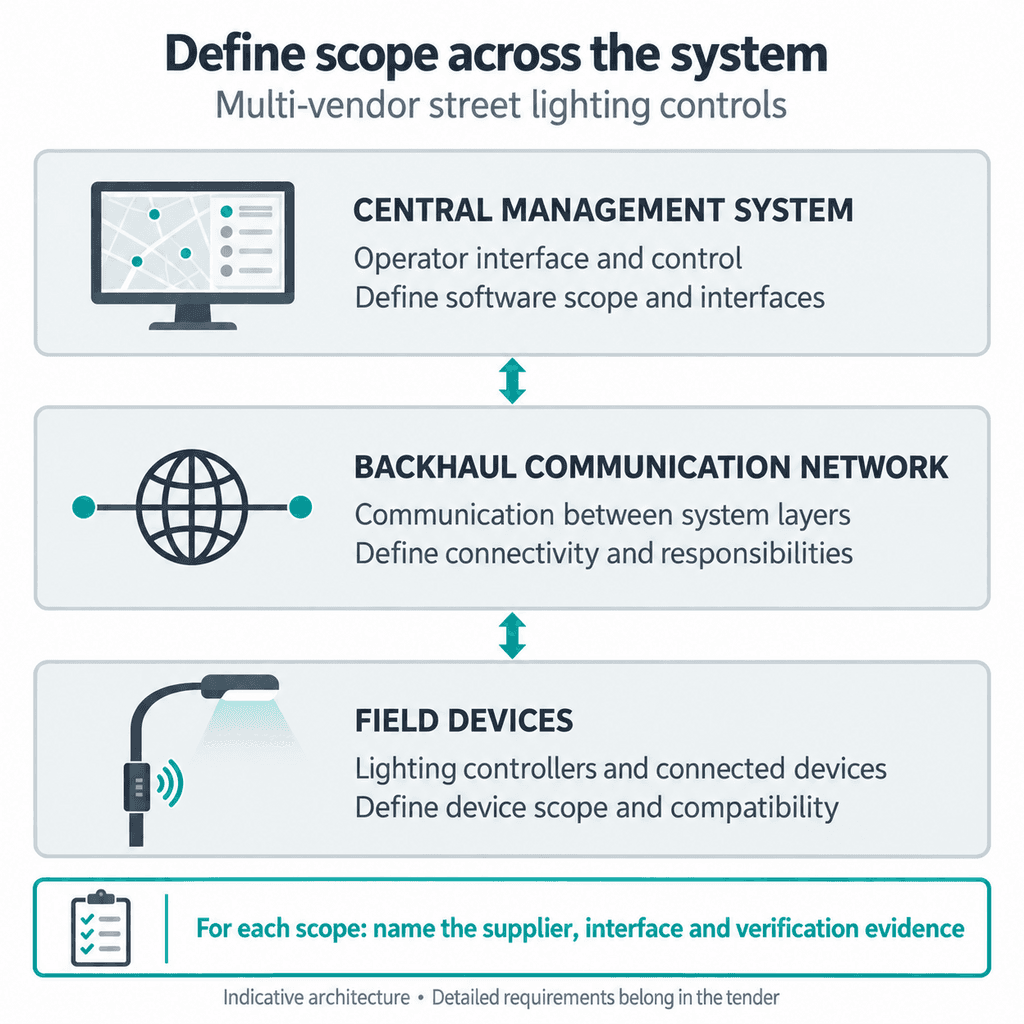
A practical tender can divide the controls package into three scopes aligned with the DOE V2.0 structure: Central Management System, Backhaul Communication Network, and Field Devices (https://www.energy.gov/cmei/ssl/model-specification-networked-outdoor-lighting-control-systems). This is a recommendation, not a DOE mandate for all projects. The reason is that the DOE source explicitly says V2.0 supports independent bids across those three parts, which is relevant when a city, utility, EPC contractor, or developer wants to compare vendors without blurring interface responsibilities.
Startup should be written as the vendor’s initial activation step. It can confirm that field devices, communications links, and management software have been installed and made ready for testing. The supplied source supports separating startup from commissioning, but it does not specify exact startup tests; therefore, test items such as device registration, network reachability, asset IDs, user roles, alarms, or dimming schedules must be defined by the buyer, engineer, or project specification.
Commissioning should be written as integrated verification. Because the DOE source highlights a backhaul communication network, central management system, and field devices as separable bid elements, commissioning should verify cross-vendor operation at the interfaces between those elements (https://www.energy.gov/cmei/ssl/model-specification-networked-outdoor-lighting-control-systems). The evidence does not support claiming that any networked system will automatically deliver a specific maintenance saving or response-time improvement.
Acceptance should be the buyer’s contractual decision after startup and commissioning evidence has been reviewed. The DOE text does not state a universal acceptance procedure, so acceptance requirements are unknown unless provided in the project documents. A cautious recommendation is to require a written acceptance package that identifies open defects, waived items, as-built configuration, training status, warranty start conditions, and any post-acceptance monitoring period.
Energy and procurement evidence that should not be overextended
DOE FEMP guidance for exterior lighting was updated in June 2023 and applies to U.S. federal acquisition guidance for covered exterior lighting categories, including outdoor wall-mounted luminaires, pole or arm-mounted area and roadway luminaires, decorative luminaires, fuel pump canopy luminaires, bollards, parking garage luminaires, and floodlight luminaires (https://www.energy.gov/cmei/femp/purchasing-energy-efficient-exterior-lighting). Those U.S. federal purchasing requirements should not be applied to non-U.S. buyers or private international tenders unless their own contract adopts them.
FEMP states that federal purchases in covered categories must meet or exceed minimum luminaire efficacy rating requirements, and it defines LER as light output divided by electrical input in lumens per watt (https://www.energy.gov/cmei/femp/purchasing-energy-efficient-exterior-lighting). That can help U.S. federal buyers specify eligible exterior lighting, but it does not prove the specifications of any SOLARTODO product or any other supplier product.
The same FEMP source says advanced controls can save additional energy and operating costs compared with improving luminaire efficiency alone, and it notes that networked controls can allow LED exterior luminaires to adapt to environmental conditions and real-time activity (https://www.energy.gov/cmei/femp/purchasing-energy-efficient-exterior-lighting). This supports including controls capability in tender discussions, but the supplied documents do not support a project-specific savings percentage, payback period, or guaranteed performance result.
Evidence package to request
For each bidder, request documents that map their responsibilities to the Central Management System, Backhaul Communication Network, and Field Devices, because those are the three bid areas specifically referenced in the DOE model specification update (https://www.energy.gov/cmei/ssl/model-specification-networked-outdoor-lighting-control-systems). Require interface assumptions to be stated clearly, especially where one vendor depends on another vendor’s network, field controller, luminaire driver, or software API.
For U.S. federal exterior lighting purchases, request evidence that covered luminaires meet the applicable FEMP or ENERGY STAR purchasing path, unless an allowed exception is documented. FEMP says agencies may claim an exception through a written finding that no qualifying product meets functional requirements or that no qualifying product is life cycle cost-effective for the specific application (https://www.energy.gov/cmei/femp/purchasing-energy-efficient-exterior-lighting). For non-U.S. projects, local law, utility standards, and contract requirements are unknown from the supplied documents.
Practical recommendation
Use the DOE V2.0 structure to keep commercial responsibility clean: startup proves readiness, commissioning proves integrated operation, and acceptance records the buyer’s decision. Keep energy-efficiency and controls claims evidence-based. Where the tender lacks local legal requirements, product certificates, savings models, or supplier test reports, mark those items as unknown instead of filling gaps with assumptions.
FAQ
Why separate startup from commissioning?
DOE’s V2.0 model specification specifically separated Start-Up and Commissioning, which supports treating activation and integrated verification as different tender stages.
What should startup mean in the tender?
Startup can be defined as initial activation and readiness for testing. Exact tests are unknown from the supplied sources and should be written into the project specification.
What should commissioning verify?
Commissioning should verify that the central management system, backhaul communication network, and field devices operate together as specified.
Is acceptance the same as commissioning?
It should not be treated as the same milestone. Acceptance is best framed as the buyer’s contractual decision after reviewing startup and commissioning evidence.
Does DOE provide a universal acceptance checklist?
No. The supplied DOE text does not provide a universal acceptance checklist, so the buyer must define acceptance criteria.
Can U.S. FEMP purchasing rules be applied to international tenders?
Not from these sources. FEMP requirements are U.S. federal purchasing guidance and should not be applied to other countries unless adopted by the contract or local rules.
Do networked controls guarantee savings?
The sources support that controls can further reduce energy and operating costs, but they do not support a guaranteed savings percentage for a specific project.
Can these sources prove SOLARTODO product specifications?
No. The supplied DOE sources do not prove SOLARTODO product specifications, certifications, stock, pricing, savings, or deployment performance.
Procurement paths
About the Author

Cinn Song
Founder & Chief Solutions Architect
Cinn Song founded SOLARTODO LIMITED and leads its smart-city infrastructure engineering — from solar, storage and integrated smart poles to the company's push into physical-AI city edge nodes: pole-mounted edge computing, vertical LLMs for smart cities, drone-based O&M with autonomous battery swapping, robotic maintenance, and high-speed counter-UAS interception. Since 2010, he has directed turnkey EPC + BOT delivery across 50+ countries, including telecom monopole supply for national grid operators, off-grid solar street-lighting for African municipalities, and integrated smart-pole programs for Gulf smart cities.
Cite This Article
Cinn Song. (2026). Startup, Commissioning and Acceptance in Lighting Controls…. SOLARTODO. Retrieved from https://solartodo.com/knowledge/separate-startup-commissioning-and-acceptance-in-a-multi-vendor-street-lighting-controls-tender
@article{solartodo_separate_startup_commissioning_and_acceptance_in_a_multi_vendor_street_lighting_controls_tender,
  title = {Startup, Commissioning and Acceptance in Lighting Controls…},
  author = {Cinn Song},
  journal = {SOLARTODO Knowledge Base},
  year = {2026},
  url = {https://solartodo.com/knowledge/separate-startup-commissioning-and-acceptance-in-a-multi-vendor-street-lighting-controls-tender},
  note = {Accessed: 2026-09-21}
}
Published: September 13, 2026 | Available at: https://solartodo.com/knowledge/separate-startup-commissioning-and-acceptance-in-a-multi-vendor-street-lighting-controls-tender
Subscribe to Our Newsletter
Get the latest solar energy news and insights delivered to your inbox.
View All Articles