Sky Hub Smart Poles: Integrated Drone Docking for…

Cinn Song
Founder & Chief Solutions Architect
TL;DR
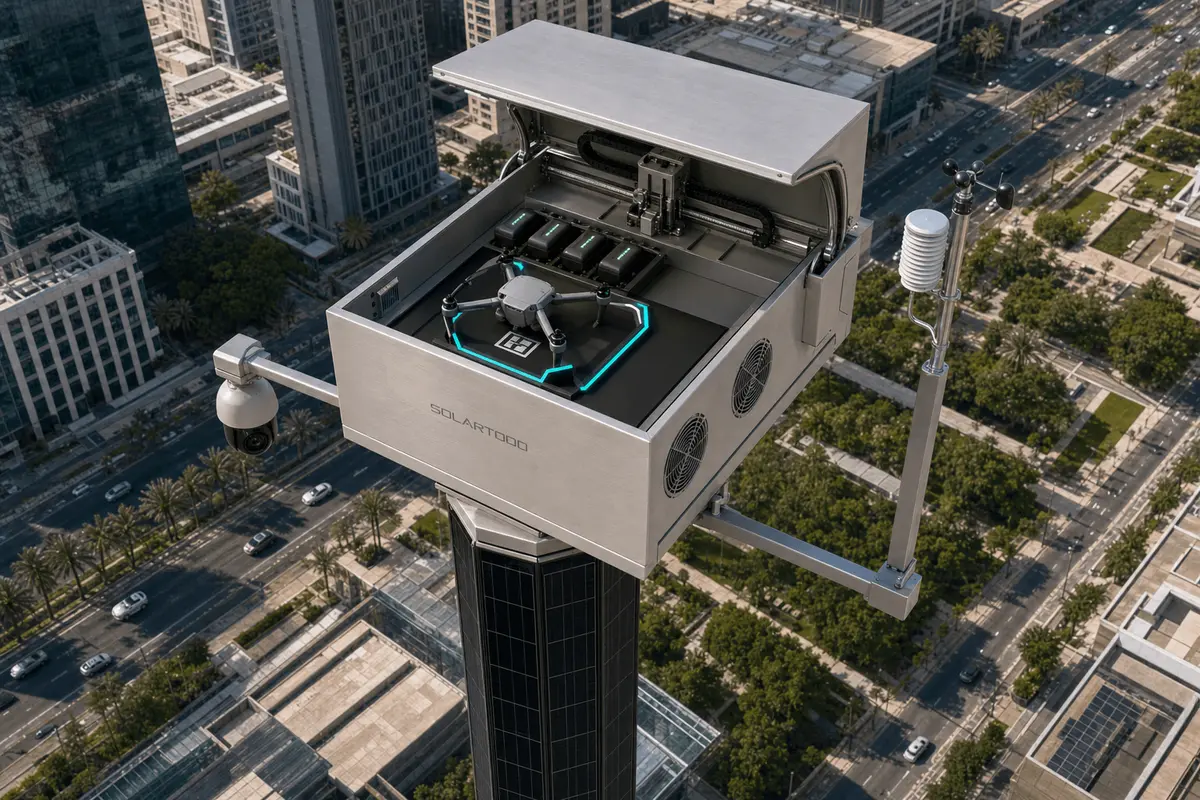
Sky Hub is a SOLARTODO pure off-grid smart pole for autonomous patrol, not a lighting product. It combines drone docking, local edge AI, 9 environmental sensors, 5-20 kWh storage and 7-10 kWh/day on-pole solar replenishment. Best-fit projects are campuses, ports, industrial parks and perimeters where local data processing, human authorization and EPC planning matter.
Sky Hub is a pure off-grid smart pole for autonomous patrol, combining drone docking, local edge AI, 9-sensor environmental monitoring, 5-20 kWh storage and 7-10 kWh/day on-pole solar replenishment for campuses and critical sites.
Summary
Sky Hub is a pure off-grid smart pole for autonomous patrol, combining drone docking, local edge AI, 9-sensor environmental monitoring, 5-20 kWh storage and 7-10 kWh/day on-pole solar replenishment for campuses and critical sites.
Key Takeaways
Procurement teams should evaluate Sky Hub across 8 controls: energy yield, storage, sorties, local analytics, data boundaries, maintenance, aviation approvals and EPC delivery.
- Specify 5-20 kWh battery storage so drone and robot tasks are buffered instead of depending on real-time solar production.
- Validate 7-10 kWh/day on-pole solar replenishment under local irradiance, shading, dust and seasonal operating assumptions.
- Require 9 environmental channels: wind speed, wind direction, temperature, humidity, pressure, noise, PM10, PM2.5 and illuminance.
- Keep raw video and sensor streams on the pole, sending only de-identified event metadata or status data to external systems.
- Separate 3 maturity tiers: hardware-ready assets, pilot-stage operations and leading-position workflows requiring project qualification.
- Plan drone missions around 1 queue, battery-swap state, launch permissions, weather gates and maintenance logs per node.
- Use human authorization for 100% of counter-UAS response actions, limited to detection, tracking, coordination and non-lethal mitigation.
- Compare FOB, CIF and EPC turnkey scopes before ordering 50, 100 or 250 units because volume discounts may reach 5%, 10% and 15%.
Sky Hub Smart Pole Concept and Patrol Problem
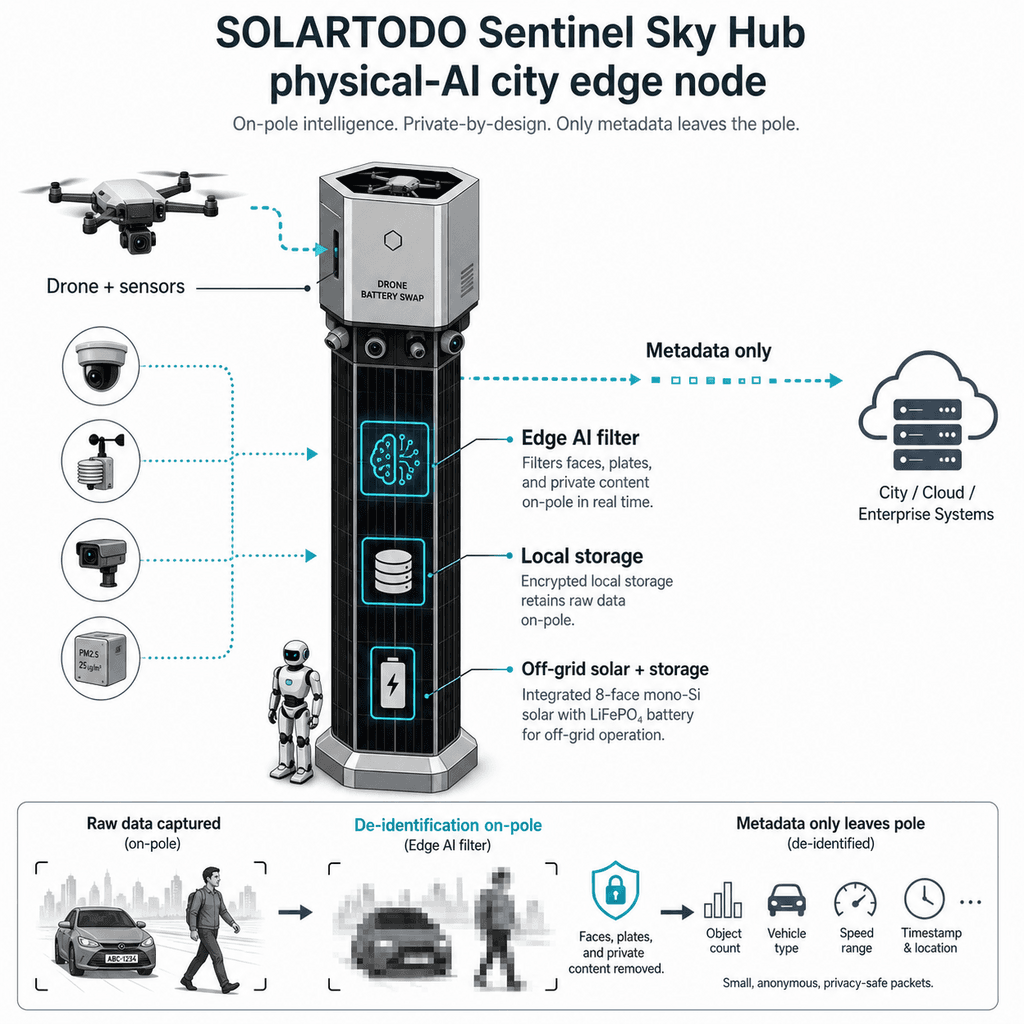
Sky Hub addresses autonomous patrol by placing drone service, edge compute and off-grid energy in 1 pole node, with 7-10 kWh/day replenishment. The advanced drone, robot and counter-UAS workflows described here are forward-looking demonstration capabilities unless a project-specific deployment record is verified.
For B2B buyers, the core problem is not simply adding a drone dock to a site. The real challenge is coordinating sensing, energy, mission approval, maintenance and data governance at locations where permanent staff may be limited. SOLARTODO positions Sky Hub as a pure smart pole: a non-lighting infrastructure node for districts, campuses, ports, industrial parks, perimeters and critical-infrastructure zones.
The operating model is an edge-first common operating picture. A pole detects an event, classifies it locally, queues an action, presents an operator with context, and then dispatches approved field activity. That loop can support regional patrol, perimeter inspection, environmental threshold alerts, service robot response and maintenance diagnostics without moving raw site data into a remote cloud workflow.
According to IRENA (2025), global renewable power capacity reached 4,448 GW at the end of 2024, and solar capacity reached 1,865 GW. IRENA states, 'renewable power capacity increased by 585 GW (+15.1%) in 2024'. This matters for Sky Hub procurement because solar and storage are now standard infrastructure planning inputs, but the pole still needs duty-cycle control rather than assumptions of unlimited solar autonomy.
According to IEA (2024), the main-case forecast expects 5,500 GW of new renewable capacity to become operational by 2030, with annual additions approaching 940 GW by 2030. The IEA states, 'renewables will account for almost half of global electricity generation by 2030'. For patrol infrastructure, that macro trend supports off-grid design, but local energy budgets remain the engineering constraint.
Technical Architecture for Drone Docking and Edge Autonomy
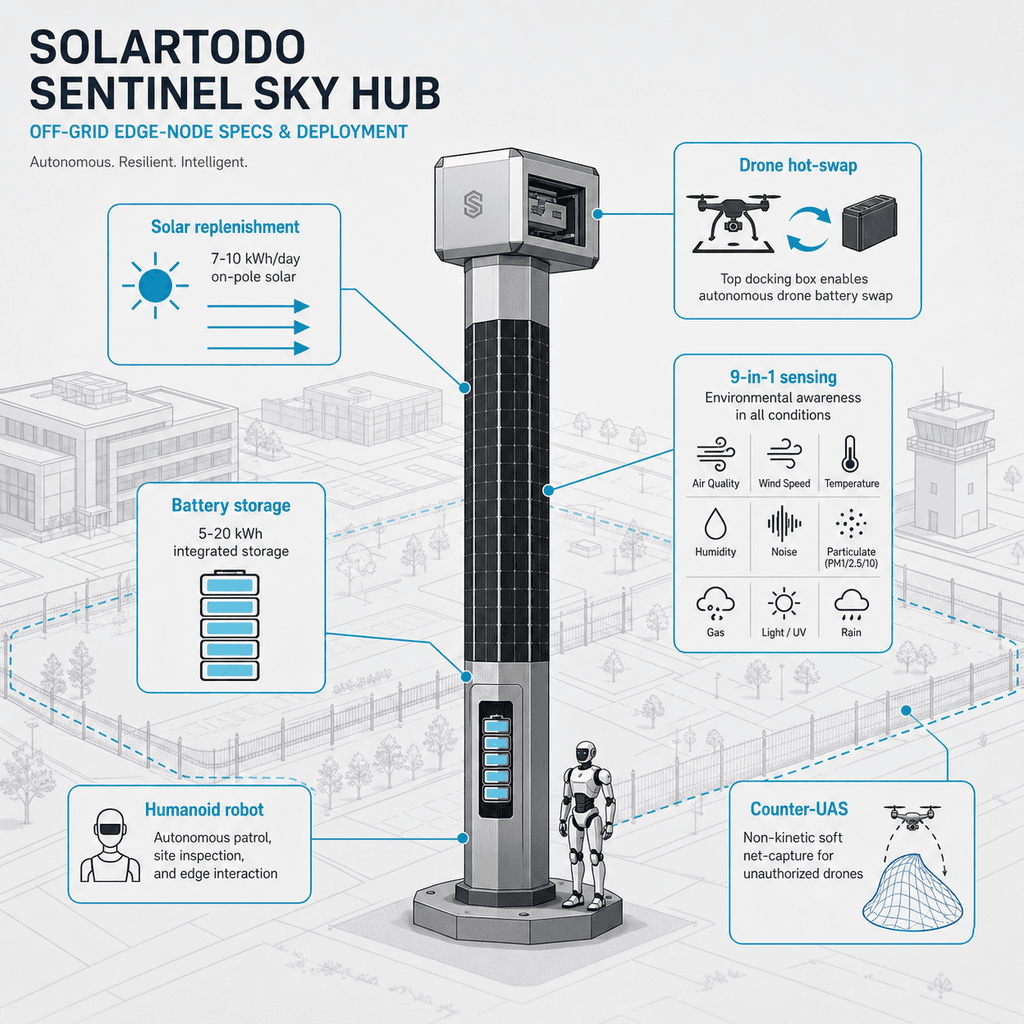
Sky Hub integrates 9 functional domains into 1 edge node: off-grid energy, drone service, robot support, sensing, compute, mission workflow, security analytics, environmental monitoring and operator authorization.
Drone Docking and Mission State
The drone operations layer is best understood as a state machine. A mission request enters the queue, the system checks battery state, weather, airspace permissions and maintenance status, then the operator authorizes launch. After the drone returns, the dock services the aircraft through automated battery exchange or charging workflow, updates the mission log and prepares the next sortie.
The multi-bay battery-service concept is important because patrol value depends on repeatability. One landed aircraft can receive a charged pack and redeploy while depleted packs recover inside the system. Multiple bays allow several consecutive sorties, but daily availability still depends on storage state, solar replenishment, thermal limits, cleaning schedules and aircraft maintenance intervals.
Local AI and OTATODO Workflow
OTATODO is the edge workflow layer that coordinates sensing, inference, task scheduling and event reporting. A Jetson-class module can run local models for anonymous vehicle count, crowd density, intrusion detection and perimeter awareness. SOLARTODO should present these as local analytics rather than identity systems; face recognition and licence-plate recognition should not be specified as active capabilities.
The edge-first assumption is strict: raw video and sensor data stay on the pole for local processing. External systems receive de-identified events, health status, alarms, audit records and operational metadata only. This architecture is designed for local processing and is PDPL-LGPD-oriented, but certification or full legal compliance should be confirmed separately for each jurisdiction and project.
Counter-UAS Coordination Limits
Counter-UAS workflow is a restricted coordination function, not a weapon function. The pole may detect and track an unauthorized drone, then coordinate a friendly drone for simulated aerial net-capture or close-approach deterrence after human approval. Radar, when used, should be specified only as an optional partner-sensor input and not as hardware built into the pole.
For procurement documents, use negative constraints explicitly. The system should not be described as autonomous attack, hard-kill, destructive interception, signal denial or jamming. Every mitigation step should be logged, human-authorized and bounded by local aviation, privacy and public-safety rules.
Off-Grid Energy, Data Governance and Safety Limits
Sky Hub is fully off-grid through battery storage plus on-pole PV replenishment, typically modeled at 1.0-1.3 kW DC clear-sky peak and 7-10 kWh/day.
The on-pole photovoltaic body is a supplemental replenishment layer, not a promise of unlimited self-sufficiency. Its multi-face monocrystalline design has about 2.8-3.2 kWp nameplate capacity, but realistic clear-sky production in a high-irradiance region is closer to 1.0-1.3 kW DC peak because only part of the surface receives strong direct sun at any moment. Storage covers the mismatch between generation and high-power drone or robot work.
According to NREL PVWatts documentation, PV performance estimates carry assumptions and uncertainty, including weather variation and site-specific characteristics. For Sky Hub, EPC teams should model local irradiance, dust, wind, temperature and albedo before sizing battery capacity. In most project discussions, 5-20 kWh storage is the practical buffer range for mixed sensing, compute and scheduled field operations.
According to IRENA (2025), off-grid electricity capacity expansion nearly tripled in 2024, rising by 1.7 GW to 14.3 GW, with solar accounting for 90.2% of the expansion. That supports the direction of the architecture, but off-grid operation still requires load shedding rules, mission priority levels, battery reserve thresholds and maintenance access planning.
A conservative energy workflow should define at least 4 operating modes: normal monitoring, drone-ready standby, active sortie support and reserve protection. When state of charge falls below a project-defined threshold, the system should defer non-critical sorties, lower compute workload, prioritize security events and notify operators. This is where edge scheduling creates value: it turns limited solar replenishment into planned operational availability.
Safety and data governance should be specified at the same level as energy. FAA 14 CFR Part 107 defines small unmanned aircraft as under 55 lb, and local equivalents should be checked for each export market. IEC 62443 provides a useful framework for segmented industrial control security, while UL 9540 and related battery standards help buyers define energy storage safety expectations.
EPC Investment Analysis and Pricing Structure
EPC procurement should compare 3 commercial scopes: FOB supply, CIF delivered and turnkey delivery with civil works, commissioning, training and maintenance planning.
A complete EPC scope for SOLARTODO Sky Hub projects normally starts with site survey, foundation design review, logistics planning, installation method statement, commissioning checklist, operator training and handover documentation. For autonomous patrol use cases, EPC should also include mission-zone mapping, aviation approval support, battery-service acceptance testing, data-retention settings, cybersecurity configuration and spare-parts planning.
Pricing should be structured in 3 tiers. FOB Supply covers factory supply and export packing, leaving international freight, import handling and installation to the buyer. CIF Delivered adds freight and insurance to the destination port. EPC Turnkey covers delivered equipment plus installation coordination, commissioning, acceptance testing and project documentation, with final scope adjusted for civil works and local permits.
Volume pricing should be modeled early. For planning purposes, buyers may use 50+ units for a 5% discount, 100+ units for a 10% discount and 250+ units for a 15% discount, subject to final quotation and configuration. Payment terms are typically 30% T/T + 70% against B/L, or 100% L/C at sight. Financing is available for large projects above $1,000K, and inquiries can be sent to [email protected].
ROI should be evaluated against the cost of deploying separate poles, cabinets, drone service equipment, environmental stations, security sensors, edge gateways and manual patrol workflows. A practical business case often targets 3-6 years when 1 node replaces 3-5 separate infrastructure points and reduces 2-4 routine patrol rounds per day, but buyers should validate labor rates, inspection frequency, downtime cost and energy autonomy requirements.
The strongest ROI cases are not generic public deployments. They are controlled-area projects where events have measurable cost: perimeter incidents, delayed inspections, asset downtime, safety exposure, dust or weather thresholds, and repeated patrol labor. Warranty coverage, spare batteries, sensor calibration, software support and aviation documentation should be priced in the quotation rather than assumed.
Comparison and Selection Guide
Buyers should compare Sky Hub against 4 deployment alternatives using energy autonomy, data locality, mission continuity, civil works and compliance readiness as selection criteria.
| Option | Best fit | Energy approach | Patrol capability | Data approach | Main limitation |
|---|---|---|---|---|---|
| Sky Hub pure smart pole | Campuses, ports, industrial parks, perimeters | Fully off-grid battery plus 7-10 kWh/day PV replenishment | Drone service, local analytics and robot coordination | Raw data processed on pole | Advanced workflows need pilot qualification |
| Fixed camera pole | Small entrances or narrow zones | Often wired power or small backup | Passive observation only | Often streams video outward | Limited mobile inspection reach |
| Separate drone dock | Sites with existing power and network | Usually depends on site infrastructure | Strong drone workflow | Depends on vendor architecture | Requires separate foundation, cabinets or integration |
| Manual patrol | Low-risk or temporary sites | Human-operated | Flexible but inconsistent | Manual reporting | Labor cost and delayed response |
Use 3 maturity tiers in specifications. Hardware-ready items include pole structure, battery architecture, sensor placement, battery-service architecture and edge-compute integration. Pilot-stage items include drone operations management, environmental monitoring, PTZ local analytics and OTATODO workflow. Leading-position items include counter-UAS mitigation, air-ground robot coordination, V2X, optional partner radar input and full common-operating-picture automation.
According to IEA (2024), global solar manufacturing capacity was expected to exceed 1,100 GW by the end of 2024, more than double projected PV demand, and module prices had more than halved since early 2023. Procurement teams can use that market context to negotiate solar hardware cost, but they should not reduce budgets for battery safety, field commissioning or long-term maintenance.
Selection should begin with the use case. A port perimeter may prioritize wind thresholds, intrusion alerts and rapid drone inspection. A campus may prioritize anonymous crowd density, incident verification and privacy controls. A solar park or industrial zone may prioritize recurring inspection routes, dust correlation and maintenance dispatch. SOLARTODO should be evaluated as a project platform, not a commodity pole.
FAQ
These 10 FAQs address procurement, EPC, maintenance, drone operations, privacy, C-UAS limits and off-grid energy sizing for Sky Hub smart pole projects.
Q: What is a Sky Hub smart pole? A: Sky Hub is a SOLARTODO pure smart pole for autonomous patrol, edge sensing, drone operations and off-grid energy storage. It is not a lighting product. The concept combines drone service, local analytics, environmental monitoring and operator workflow in 1 pole-form node for controlled infrastructure sites.
Q: How does the drone docking workflow operate? A: The workflow uses mission queueing, launch checks, route execution, return handling and battery service. A landed drone can enter a battery exchange or charging workflow, after which mission logs and health status update locally. Consecutive sorties depend on battery magazine capacity, weather, maintenance state and operator authorization.
Q: How much solar energy can the pole generate? A: The on-pole PV body has about 2.8-3.2 kWp nameplate capacity, but realistic clear-sky production is about 1.0-1.3 kW DC peak. In high-irradiance regions, daily replenishment is typically modeled at 7-10 kWh/day. Battery storage remains essential for high-power tasks.
Q: What battery capacity should buyers specify? A: Buyers should model 5-20 kWh storage depending on sortie frequency, sensor load, compute workload and reserve requirements. A small patrol site may need the lower end, while multi-sortie industrial operations need more buffer. EPC sizing should include seasonal irradiance, dust, temperature and emergency reserve assumptions.
Q: Does raw video leave the pole? A: No. The intended architecture keeps raw video and sensor data on the pole for local processing. Only de-identified event metadata, status records, alerts and health information should leave the node. This supports local-processing and PDPL-LGPD-oriented design, but legal certification must be verified separately.
Q: What analytics are appropriate for procurement specifications? A: Appropriate analytics include anonymous vehicle count, crowd density, intrusion detection, perimeter awareness and environmental threshold alerts. Buyers should not specify face recognition or licence-plate recognition as active capabilities. The safest specification defines local analytics, metadata output, retention limits and human review requirements.
Q: Can Sky Hub perform counter-UAS response? A: Sky Hub can be described as coordinating non-lethal, human-authorized counter-UAS demonstrations: detection, tracking and friendly-drone response such as simulated net-capture or close-approach deterrence. It should never be specified as destructive, autonomous attack, hard-kill or signal-denial equipment. Optional radar must be partner-sensor input.
Q: What does EPC turnkey delivery include? A: EPC turnkey delivery can include site survey, logistics, foundation review, installation coordination, commissioning, mission-zone setup, operator training and handover documentation. For Sky Hub, it should also include battery-service tests, local analytics configuration, cybersecurity settings and maintenance planning. Final scope depends on permits and site conditions.
Q: How is pricing structured for B2B buyers? A: Pricing is typically quoted as FOB Supply, CIF Delivered or EPC Turnkey. Planning discounts may be 5% for 50+ units, 10% for 100+ units and 15% for 250+ units, subject to configuration. Payment terms are 30% T/T + 70% against B/L, or 100% L/C at sight.
Q: What maintenance is required after commissioning? A: Maintenance should include PV surface cleaning, battery health checks, drone-service mechanism inspection, sensor calibration, firmware update control and mission-log review. Environmental sensors and moving service mechanisms need scheduled inspection. Buyers should define spare batteries, replacement intervals and response-time targets in the warranty and service agreement.
Conclusion
Sky Hub is best specified as a 1-node off-grid patrol platform, combining 7-10 kWh/day PV replenishment with local AI and controlled drone operations.
The bottom line: SOLARTODO Sky Hub can reduce integration complexity for controlled-area patrol when buyers treat it as an off-grid edge micro-station, not as a conventional pole accessory. Projects should begin with energy modeling, human authorization rules, local data processing, EPC scope and pilot-stage acceptance criteria.
References
The 7 references below anchor PV yield, renewable growth, aviation rules, edge architecture, cybersecurity and battery safety assumptions for specification work.
- IRENA (2025): Renewable Capacity Statistics 2025, reporting 4,448 GW global renewable capacity and 585 GW added in 2024.
- IEA (2024): Renewables 2024, forecasting 5,500 GW of new renewable capacity by 2030 in the main case.
- NREL PVWatts (2024): PV performance estimation methodology using solar resource data, weather assumptions and system-input modeling.
- eCFR 14 CFR Part 107 (2026): U.S. small unmanned aircraft operating and certification rules, including the under-55 lb small UAS definition.
- IEEE 1934-2018 (2018): Standard for Adoption of OpenFog Reference Architecture for Fog Computing, relevant to hierarchical edge and fog computing design.
- IEC 62443 series (2018-2024): Industrial automation and control system cybersecurity standards covering zones, conduits, secure development and system requirements.
- UL 9540 (2023): Energy Storage Systems and Equipment safety standard used for battery energy storage procurement and safety planning.
About SOLARTODO
SOLARTODO is a global integrated solution provider specializing in solar power generation systems, energy-storage products, smart street-lighting and solar street-lighting, intelligent security & IoT linkage systems, power transmission towers, telecom communication towers, and smart-agriculture solutions for worldwide B2B customers.
About the Author

Cinn Song
Founder & Chief Solutions Architect
Cinn Song founded SOLARTODO LIMITED and leads its smart-city infrastructure engineering — from solar, storage and integrated smart poles to the company's push into physical-AI city edge nodes: pole-mounted edge computing, vertical LLMs for smart cities, drone-based O&M with autonomous battery swapping, robotic maintenance, and high-speed counter-UAS interception. Since 2010, he has directed turnkey EPC + BOT delivery across 50+ countries, including telecom monopole supply for national grid operators, off-grid solar street-lighting for African municipalities, and integrated smart-pole programs for Gulf smart cities.
Cite This Article
Cinn Song. (2026). Sky Hub Smart Poles: Integrated Drone Docking for…. SOLARTODO. Retrieved from https://solartodo.com/knowledge/sky-hub-smart-poles-integrated-drone-docking-for-autonomous-city-patrol
@article{solartodo_sky_hub_smart_poles_integrated_drone_docking_for_autonomous_city_patrol,
  title = {Sky Hub Smart Poles: Integrated Drone Docking for…},
  author = {Cinn Song},
  journal = {SOLARTODO Knowledge Base},
  year = {2026},
  url = {https://solartodo.com/knowledge/sky-hub-smart-poles-integrated-drone-docking-for-autonomous-city-patrol},
  note = {Accessed: 2026-08-08}
}
Published: June 24, 2026 | Available at: https://solartodo.com/knowledge/sky-hub-smart-poles-integrated-drone-docking-for-autonomous-city-patrol
Subscribe to Our Newsletter
Get the latest solar energy news and insights delivered to your inbox.
View All Articles