Smart Pole Aesthetics and Urban Design: Blending…

Cinn Song
Founder & Chief Solutions Architect
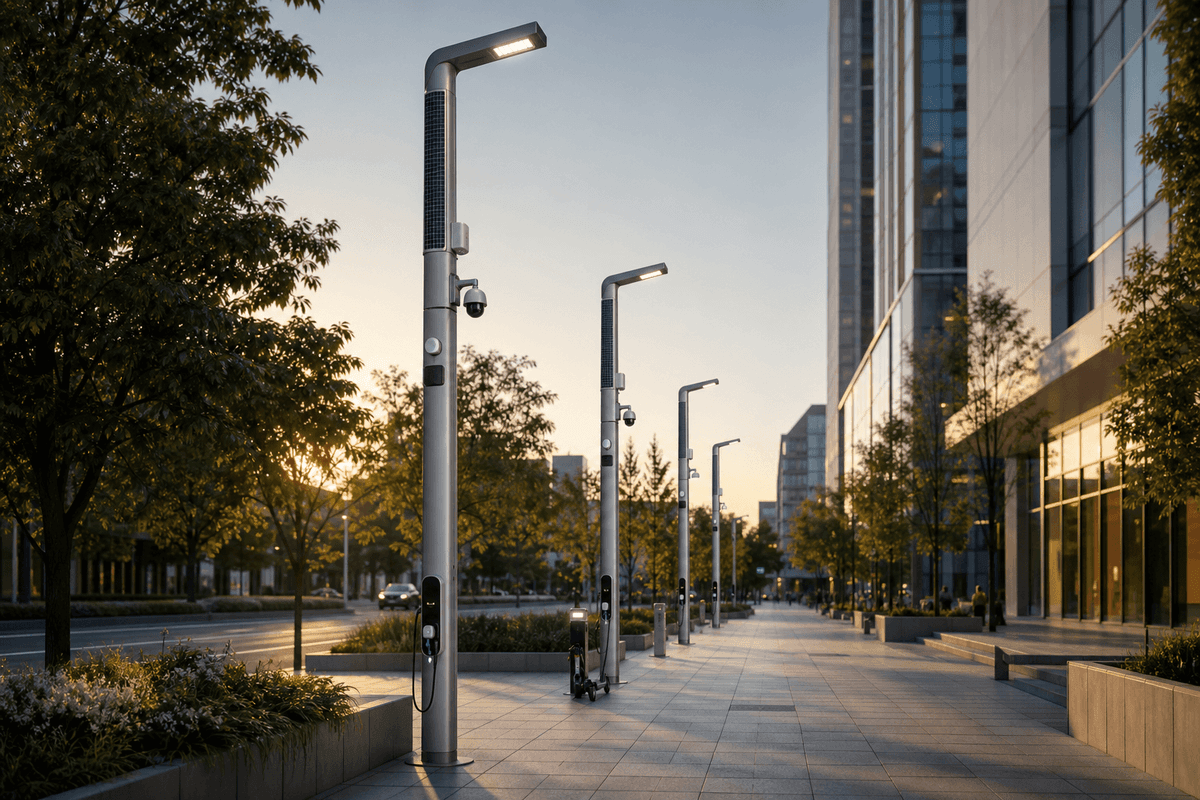
TL;DR
Smart pole aesthetics is a procurement and engineering issue: specify 7m-12m heights, 100W-200W LED lighting, 3000K-4000K color temperature, integrated solar, concealed devices, and EPC scope together. SOLARTODO smart poles can reduce footprint by 30-40%, consolidate 4-11 systems, and support 4-10 year ROI when civil works, energy savings, maintenance, EV charging, and connectivity value are included.
Smart pole urban design integrates 7m-12m steel columns, 100W-200W LEDs, CIGS or hybrid solar, cameras, WiFi 6, and 30-40% smaller footprints so cities can blend security, lighting, charging, and streetscape aesthetics.
Summary
Smart pole urban design integrates 7m-12m steel columns, 100W-200W LEDs, CIGS or hybrid solar, cameras, WiFi 6, and 30-40% smaller footprints so cities can blend security, lighting, charging, and streetscape aesthetics.
Key Takeaways
These 8 procurement takeaways show how to specify smart poles that improve urban appearance while meeting 25-year infrastructure, safety, energy, and ROI targets.
- Specify 7m-12m pole heights by district type so lighting, cameras, sensors, and signage align with road geometry and facade rhythm.
- Consolidate 4-11 subsystems into 1 engineered pole to reduce visible cabinets, exposed brackets, trenching points, and duplicated foundations.
- Select 3000K-4000K LED lighting with shielding, dimming, and uniform optics to balance safety, glare control, and nighttime identity.
- Use flush CIGS solar, welded charging bases, or symmetric A-frame panels to keep the visual envelope controlled within 400mm-600mm profiles where possible.
- Compare 28m-35m spacing plans against camera coverage, 100W-200W luminaire loads, battery autonomy, and smart city data requirements.
- Model solar output with NREL PVWatts V8 and local weather files before approving 256W CIGS or 400W-500W hybrid solar-wind designs.
- Price projects through FOB, CIF, and EPC turnkey tiers, applying 5% discounts at 50+ units, 10% at 100+, and 15% at 250+.
- Calculate ROI over 4-10 years using energy savings, avoided cabinets, reduced civil works, EV charging revenue, and lower maintenance visits.
Smart Pole Aesthetics in Urban Design
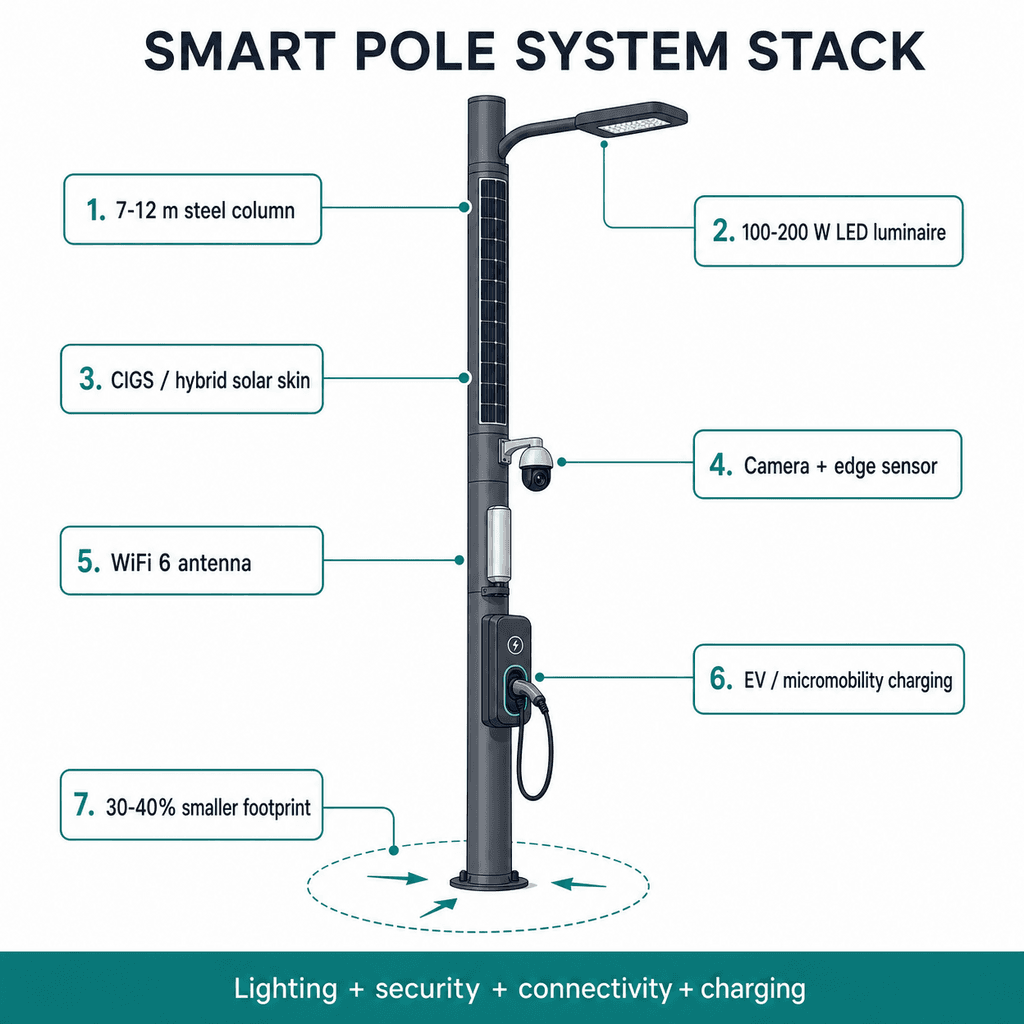
A city-ready smart pole should consolidate 4-11 functions into one 7m-12m vertical element while matching lighting class, color temperature, and facade rhythm. The design goal is not to hide technology completely; it is to make lighting, energy, communications, safety, and sensing read as one civic object rather than a cluster of afterthought devices.
Urban streets usually fail aesthetically when each department adds a separate asset: a lighting pole, CCTV mast, WiFi access point, loudspeaker, EV pedestal, telecom cabinet, traffic sensor, and junction box. Smart poles solve that problem only when procurement treats form factor, finish, night lighting, service access, and cable routing as technical requirements. For B2B buyers, aesthetics is therefore a lifecycle specification, not a decorative preference.
According to IRENA (2025), global renewable power capacity reached 4,448 GW at the end of 2024, including 1,865 GW of solar capacity and 452 GW of solar additions in one year. That scale matters for streetscape planning because cities are no longer adding isolated solar pilots; they are embedding distributed power into road corridors, checkpoints, campuses, ports, boulevards, and transit nodes.
DarkSky International states, 'Warm toned or filtered LEDs should be used' and recommends 3000K or lower where blue-rich light would increase glare and sky glow. For smart poles, that means residential plazas, heritage districts, and waterfront promenades often need 3000K, while checkpoints, tunnels, and logistics corridors may justify 4000K for identification and surveillance tasks.
SOLARTODO positions smart poles as engineered B2B infrastructure for offline quotation, not as an online marketplace product. That matters because a visually successful project depends on drawings, wind calculations, lighting simulation, battery sizing, finish samples, and mounting coordination before manufacturing begins.
Technical Design Principles for Integrated Smart Poles
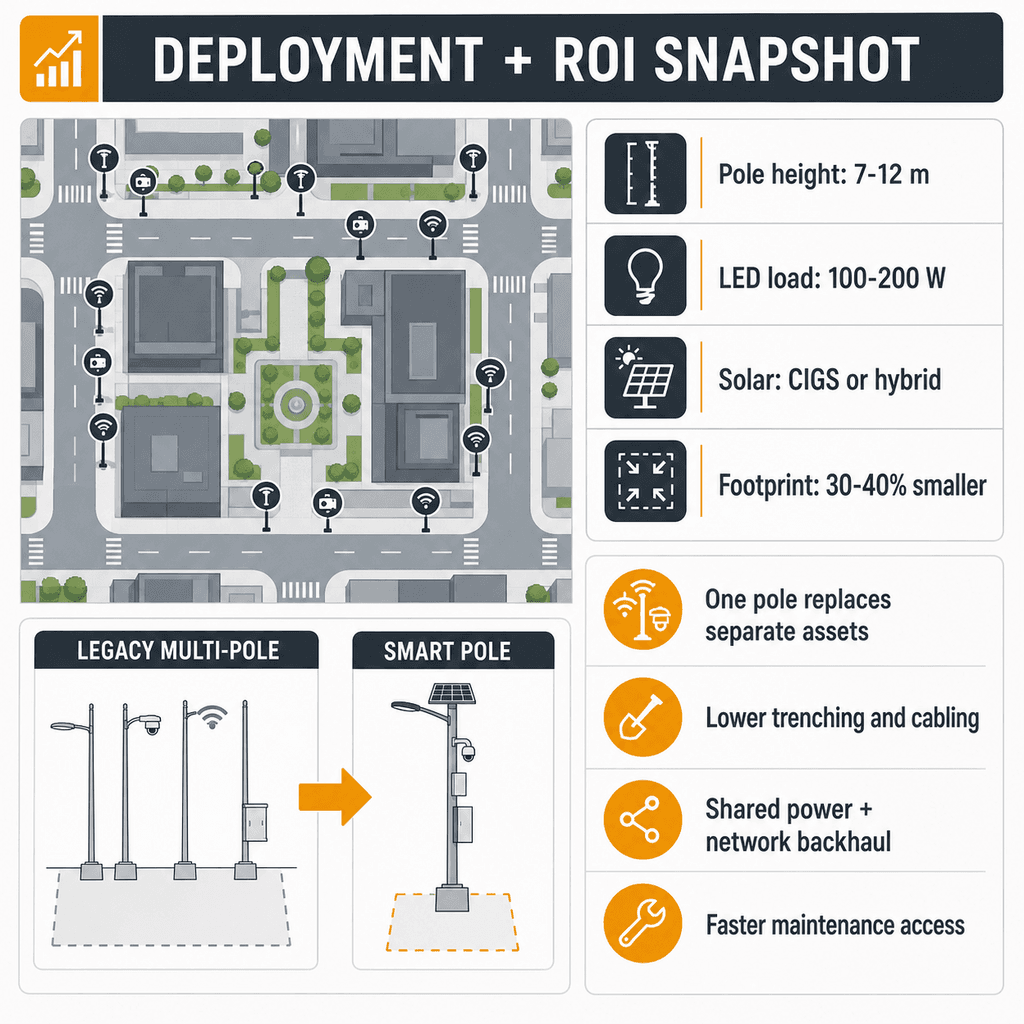
Well-designed smart poles hide power, battery, network, sensing, and lighting within IP66-rated structures while keeping a consistent 400mm-600mm visual envelope. Aesthetic success comes from disciplined integration: fewer protrusions, fewer visible boxes, predictable service panels, and a pole silhouette that fits the street hierarchy.
Form, Finish, and Nighttime Visual Comfort
The cleanest urban profiles use cylindrical, octagonal, or tapered steel columns with flush devices and controlled access seams. The SOLARTODO 7m Ø400 Cylindrical CIGS Smart Pole uses a seamless Ø400mm steel body, 5mm wall thickness, hot-dip galvanizing, black RAL9005 powder coating, 100W LED lighting, 15,000 lm output, about 256W CIGS solar generation, 3,000Wh LFP storage, 4MP IR video, WiFi 6, and 7kW AC charging in one monolithic profile.
For boulevards, the SOLARTODO 12m Wind-Solar Hybrid Smart Pole uses a taller octagonal structure, 160W LED luminaire, 400W-500W vertical-axis wind turbine, two monocrystalline solar panels, 5-15kWh LFP storage, and a 7kW or 11kW Type 2 AC EV charger. Its welded lower charging base can reduce footprint by about 30-40% compared with a pole-plus-bollard layout.
Lighting should be specified as a visual comfort system. Buyers should define mounting height, tilt, beam distribution, correlated color temperature, dimming profile, glare control, and maintenance lumen depreciation. For example, tunnel entrance applications may need 200W LED output around 34,000 lm and 300 lux in the approach zone, while pedestrian boulevards may prioritize lower glare and warmer color.
Systems Integration Controls
According to IEC 60529 (2013), IP ratings classify degrees of enclosure protection against solid objects and water ingress for electrical equipment up to 72.5 kV. For city poles, IP66 is a practical baseline for luminaires, cameras, access panels, charging controls, and sensor compartments exposed to rain, dust, cleaning, and roadside spray.
According to NREL PVWatts V8 documentation, the model accepts system capacities from 0.05 kW to 500,000 kW and uses weather datasets such as NSRDB TMY data for production estimates. For smart poles, this supports early-stage energy checks for 256W CIGS wraps, 200W-400W monocrystalline panels, or hybrid wind-solar systems before EPC pricing is finalized.
IEEE 802.11 standards define the MAC and PHY basis for wireless LAN systems, and IEEE 802.11-2024 incorporates amendments from 2021-2024. When buyers specify WiFi 6, WiFi 6E, or WiFi 7-ready smart poles, antenna placement must preserve coverage while avoiding visual clutter, blocked camera views, or exposed weatherproof boxes.
Applications, Cityscape Fit, and Selection Guide
Use-case selection should match 28m-35m spacing, 100W-200W lighting loads, solar exposure, camera height, and streetscape sensitivity before procurement. The right aesthetic strategy for a customs lane is different from the right strategy for a civic boulevard, tunnel entrance, airport road, or historic district.
According to ISO 37120 (2018), city indicators are intended to measure city service performance and quality of life in comparable ways. ISO 37122 (2019) extends that logic to smart city indicators. Smart poles fit both frameworks when they are planned as measurable infrastructure: lighting uptime, energy use, public safety coverage, EV utilization, wireless coverage, and maintenance response time.
| Urban setting | Recommended smart pole aesthetic | Core technical package | Design risk to control |
|---|---|---|---|
| Border checkpoint or customs lane | 7m Ø400 monolithic cylindrical pole with flush devices | 100W LED, 15,000 lm, 256W CIGS, 3,000Wh LFP, 4MP IR camera, WiFi 6, 7kW AC charging | Avoid exposed cameras, side arms, and cabinets that complicate inspection lanes |
| Urban boulevard or EV corridor | 12m hybrid pole with welded charging base and balanced top equipment | 160W LED, 400W-500W VAWT, 2 solar panels, 5-15kWh LFP, 7kW or 11kW Type 2 charger | Keep wind turbine, solar frame, and luminaire visually symmetrical at 30m-35m spacing |
| Tunnel entrance or underpass approach | 10m octagonal smart pole with minimal device stack | 200W LED, 34,000 lm, AI camera, environmental sensor, LED display, IP66 | Prioritize luminance transition, 300 lux target zones, and driver attention |
| Heritage street or civic plaza | Slim non-EV pole with warm lighting and concealed sensors | 3000K LED, shielded optics, small cameras, environmental sensors, optional WiFi | Avoid blue-rich light, large display screens, and oversized charging cabinets |
| Conventional multi-asset deployment | Separate pole, camera mast, cabinet, EV bollard, and WiFi mount | 4-8 visible devices with duplicated foundations and cable routes | Higher visual clutter, more permits, more maintenance points, and weaker brand control |
SOLARTODO typically recommends a corridor mock-up before full procurement for cities with strict architectural controls. A 3-pole pilot can validate finish, nighttime brightness, camera fields of view, network stability, solar exposure, pedestrian perception, and maintenance access before committing to 50, 100, or 250 units.
EPC Investment Analysis and Pricing Structure
EPC procurement should compare FOB, CIF, and turnkey pricing across 50, 100, and 250-pole quantities because logistics and civil works drive ROI. The lowest unit price is not always the lowest project cost if it creates extra foundations, exposed cabinets, separate EV pedestals, or additional maintenance contracts.
EPC turnkey delivery for smart poles normally includes site survey, photometric design, structural calculation, foundation drawings, single-line electrical design, communication architecture, manufacturing, factory acceptance testing, export packing, freight coordination, customs support, civil works, installation, commissioning, training, and handover documentation. For SOLARTODO projects, inquiry leads to an offline quotation because pole height, battery size, wind rating, finish, charger type, and certification scope materially affect the bill of materials.
| Pricing tier | What it includes | Best-fit buyer | Commercial note |
|---|---|---|---|
| FOB Supply | Manufactured poles, fixtures, integrated devices, factory test, export packing | EPC contractors with their own logistics and installation teams | Lowest factory-side price, but buyer owns freight, insurance, import, civil works, and commissioning |
| CIF Delivered | FOB scope plus international freight and insurance to destination port | Importers, distributors, municipal procurement teams | Improves landed-cost visibility but excludes local installation and grid/civil works |
| EPC Turnkey | Supply, delivery, foundations, cabling, installation, commissioning, training, and handover | Municipalities, airports, ports, logistics parks, campuses | Highest contract scope but usually best for schedule, warranty alignment, and single-party responsibility |
Volume pricing should be planned at the procurement stage. SOLARTODO can guide indicative discounts of 5% for 50+ units, 10% for 100+ units, and 15% for 250+ units, subject to final configuration and commodity conditions. Payment terms are typically 30% T/T deposit plus 70% against B/L, or 100% L/C at sight. Project financing is available for large projects above $1,000K, and commercial inquiries should be sent to [email protected].
For ROI, the most realistic analysis combines energy, civil works, O&M, and revenue. A 100W LED replacing a 250W legacy fixture for 12 hours per night saves about 657 kWh per year before dimming, or roughly $79 per year at $0.12/kWh. Larger value often comes from avoiding 3-4 separate assets, reducing footprint by 30-40%, cutting maintenance visits, and adding EV charging or telecom service revenue. In corridor projects, payback commonly falls in the 4-7 year range when avoided civil works and monetized services are included; aesthetics-only projects may require 7-10 years.
FAQ
These 10 FAQ answers cover aesthetics, cost, EPC, installation, maintenance, lighting, privacy, and use-case selection for 7m-12m smart pole projects.
Q: What makes a smart pole visually acceptable in urban design? A: A smart pole is visually acceptable when it looks like one planned streetscape element, not a stack of devices. Specify a consistent 7m-12m height range, concealed cabling, flush sensors, controlled access doors, matching finish, and 3000K-4000K lighting so the pole supports safety and identity without dominating the street.
Q: How do smart poles reduce street clutter compared with conventional assets? A: Smart poles reduce clutter by combining 4-11 functions in one structural column. Lighting, CCTV, WiFi, speakers, sensors, EV charging, solar generation, battery storage, and displays can share foundations, power routing, and maintenance access, reducing the need for separate cabinets, masts, brackets, and bollards.
Q: What color temperature should cities specify for smart pole lighting? A: Most urban streets should specify 3000K-4000K depending on the setting. Residential, waterfront, park, and heritage areas usually benefit from 3000K warm lighting, while checkpoints, logistics lanes, and tunnel entrances may justify 4000K for identification and video performance. Shielding and dimming are as important as color.
Q: How can solar panels be integrated without damaging the cityscape? A: Use flush CIGS wraps, symmetrical A-frame arrays, or upper-zone monocrystalline panels aligned with the pole geometry. The 7m Ø400 CIGS format hides about 256W of solar generation in the pole skin, while 12m hybrid boulevard poles can carry 200W-400W solar panels above pedestrian sightlines.
Q: What height should be selected for different urban smart pole projects? A: Select height by road type, lighting class, camera view, and district character. A 7m pole fits checkpoints, plazas, and lane nodes; a 10m pole suits tunnel entrances and approach zones; a 12m pole fits boulevards, EV corridors, wider roads, and hybrid wind-solar equipment.
Q: How much does a smart pole EPC project cost? A: Cost depends on height, battery capacity, charger rating, solar type, camera package, wind rating, and installation scope. The SOLARTODO 10m tunnel entrance smart pole has an EPC installed benchmark of USD 1,800-2,200 per unit, while 10-in-1 and 11-in-1 EV or hybrid poles require project-specific quotation.
Q: What does EPC turnkey delivery include for smart poles? A: EPC turnkey delivery includes engineering, procurement, and construction under one project scope. Typical deliverables include site survey, lighting simulation, structural and foundation drawings, manufacturing, FAT, freight, installation, cabling, commissioning, operator training, and handover documents. It is best for municipalities that want single-party accountability.
Q: What maintenance plan is required for integrated smart poles? A: Maintenance should include a 6-12 month inspection cycle for luminaires, seals, access panels, batteries, solar surfaces, fasteners, communications, and charger components. LED modules and LFP batteries reduce routine service needs, but integrated poles still require planned cleaning, firmware checks, electrical testing, and camera alignment verification.
Q: How should cities handle cameras, WiFi, and privacy concerns? A: Cities should define camera purpose, field of view, retention policy, signage, cybersecurity, and data ownership before installation. For aesthetics, cameras and WiFi antennas should be flush or compact, placed at consistent heights, and aligned with the pole axis so surveillance capability does not create a militarized streetscape.
Q: When should a city choose a wind-solar hybrid EV smart pole? A: Choose a wind-solar hybrid EV smart pole when the site has suitable wind exposure, good solar access, limited sidewalk space, and a need for AC charging. The SOLARTODO 12m model fits boulevards with 30m-35m spacing, 5-15kWh storage, 400W-500W VAWT, and 7kW or 11kW Type 2 charging.
References
These 8 references anchor smart pole specifications to solar growth, IP protection, WiFi standards, smart city indicators, and responsible outdoor lighting.
- IRENA (2025): Renewable Capacity Highlights 2025; reports 4,448 GW renewable capacity, 1,865 GW solar capacity, and 585 GW renewable additions in 2024.
- NREL PVWatts V8 (2024): PVWatts API documentation for photovoltaic production estimates using system capacity, tilt, azimuth, losses, and solar resource datasets.
- IEC 60529 (2013): Degrees of protection provided by enclosures, IP Code; applies to electrical equipment enclosure protection classification.
- IEC 60598-1 (2024): Luminaires - Part 1 general requirements and tests; baseline safety reference for LED roadway and area luminaires.
- IEEE 802.11-2024 (2024): Wireless LAN MAC and PHY specifications for WiFi connectivity used in smart city communications.
- ISO 37120 (2018): Sustainable cities and communities - indicators for city services and quality of life.
- ISO 37122 (2019): Sustainable cities and communities - indicators for smart cities, confirmed current in 2024.
- DarkSky International (2023): Responsible outdoor lighting guidance, including shielding, dimming, warm color temperature, and reduced blue emission.
Conclusion
Smart pole aesthetics should be specified as a 25-year urban infrastructure discipline combining 7m-12m forms, 100W-200W lighting, energy, data, and service access. Bottom line: for boulevards, checkpoints, tunnels, and civic corridors, SOLARTODO smart poles deliver the best value when buyers evaluate form, function, EPC scope, and ROI in one procurement model instead of treating technology and streetscape design separately.
About SOLARTODO
SOLARTODO is a global integrated solution provider specializing in solar power generation systems, energy-storage products, smart street-lighting and solar street-lighting, intelligent security & IoT linkage systems, power transmission towers, telecom communication towers, and smart-agriculture solutions for worldwide B2B customers.
About the Author

Cinn Song
Founder & Chief Solutions Architect
Cinn Song founded SOLARTODO LIMITED and leads its smart-city infrastructure engineering — from solar, storage and integrated smart poles to the company's push into physical-AI city edge nodes: pole-mounted edge computing, vertical LLMs for smart cities, drone-based O&M with autonomous battery swapping, robotic maintenance, and high-speed counter-UAS interception. Since 2010, he has directed turnkey EPC + BOT delivery across 50+ countries, including telecom monopole supply for national grid operators, off-grid solar street-lighting for African municipalities, and integrated smart-pole programs for Gulf smart cities.
Cite This Article
Cinn Song. (2026). Smart Pole Aesthetics and Urban Design: Blending…. SOLARTODO. Retrieved from https://solartodo.com/knowledge/smart-pole-aesthetics-and-urban-design-blending-technology-with-cityscape
@article{solartodo_smart_pole_aesthetics_and_urban_design_blending_technology_with_cityscape,
  title = {Smart Pole Aesthetics and Urban Design: Blending…},
  author = {Cinn Song},
  journal = {SOLARTODO Knowledge Base},
  year = {2026},
  url = {https://solartodo.com/knowledge/smart-pole-aesthetics-and-urban-design-blending-technology-with-cityscape},
  note = {Accessed: 2026-08-10}
}
Published: June 26, 2026 | Available at: https://solartodo.com/knowledge/smart-pole-aesthetics-and-urban-design-blending-technology-with-cityscape
Subscribe to Our Newsletter
Get the latest solar energy news and insights delivered to your inbox.
View All Articles