Smart Pole Drone Charging and Battery Swap Systems

Cinn Song
Founder & Chief Solutions Architect
Watch the video
TL;DR
Smart pole drone battery swap systems improve field availability when sites need 3+ autonomous sorties per day. SOLARTODO Sentinel / Sky Hub uses 5-20 kWh storage, 7-10 kWh/day solar replenishment, local AI processing and a multi-bay battery magazine, with raw video kept on-pole and EPC pricing structured as FOB, CIF or turnkey delivery.
Smart pole drone charging systems combine autonomous landing, battery swap, 5-20 kWh storage and 7-10 kWh/day solar replenishment to support repeated inspection, patrol and response missions without on-site operators.
Summary
Smart pole drone charging systems combine autonomous landing, battery swap, 5-20 kWh storage and 7-10 kWh/day solar replenishment to support repeated inspection, patrol and response missions without on-site operators.
Key Takeaways
Use these 7 decision points to specify a 5-20 kWh autonomous smart pole drone charging and battery swap system for B2B infrastructure projects.
- Specify 5-20 kWh battery storage to buffer drone swaps, robot charging and edge compute during low-solar periods.
- Model 7-10 kWh/day clear-sky PV replenishment before committing to mission frequency or 24-hour patrol intervals.
- Select automated battery swap when consecutive sorties above 3 missions/day are more important than low hardware cost.
- Require local AI processing for 100% of raw video and sensor data, exporting only de-identified event metadata.
- Plan EPC delivery in 3 levels: FOB supply, CIF delivered, and full turnkey installation with commissioning.
- Apply 50+, 100+ and 250+ unit volume tiers to target 5%, 10% and 15% supply-side price reductions.
- Maintain human authorization for 100% of counter-UAS response actions, limited to detection, tracking and non-lethal coordination.
Why Smart Pole Drone Charging Is Moving From Docking to Battery Swap
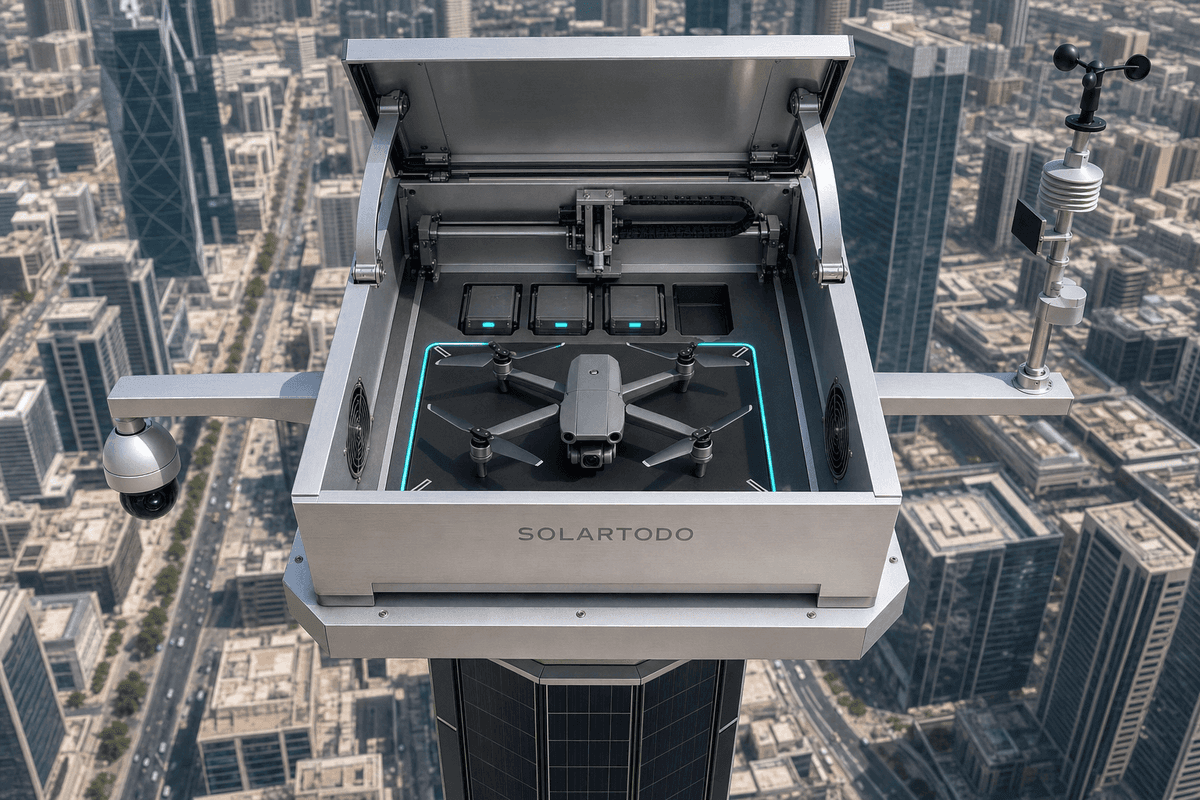
Autonomous battery swap changes drone infrastructure from a single-flight charger into a multi-sortie field station, typically pairing 5-20 kWh storage with automated task dispatch.
For procurement teams, the important difference is uptime. Contact charging is mechanically simpler, but it keeps the aircraft parked while the battery refills. A battery magazine changes the operational model: the drone lands, a charged pack is exchanged, mission logs are synchronized, health checks run locally, and the aircraft can be redeployed without an operator visiting the site.
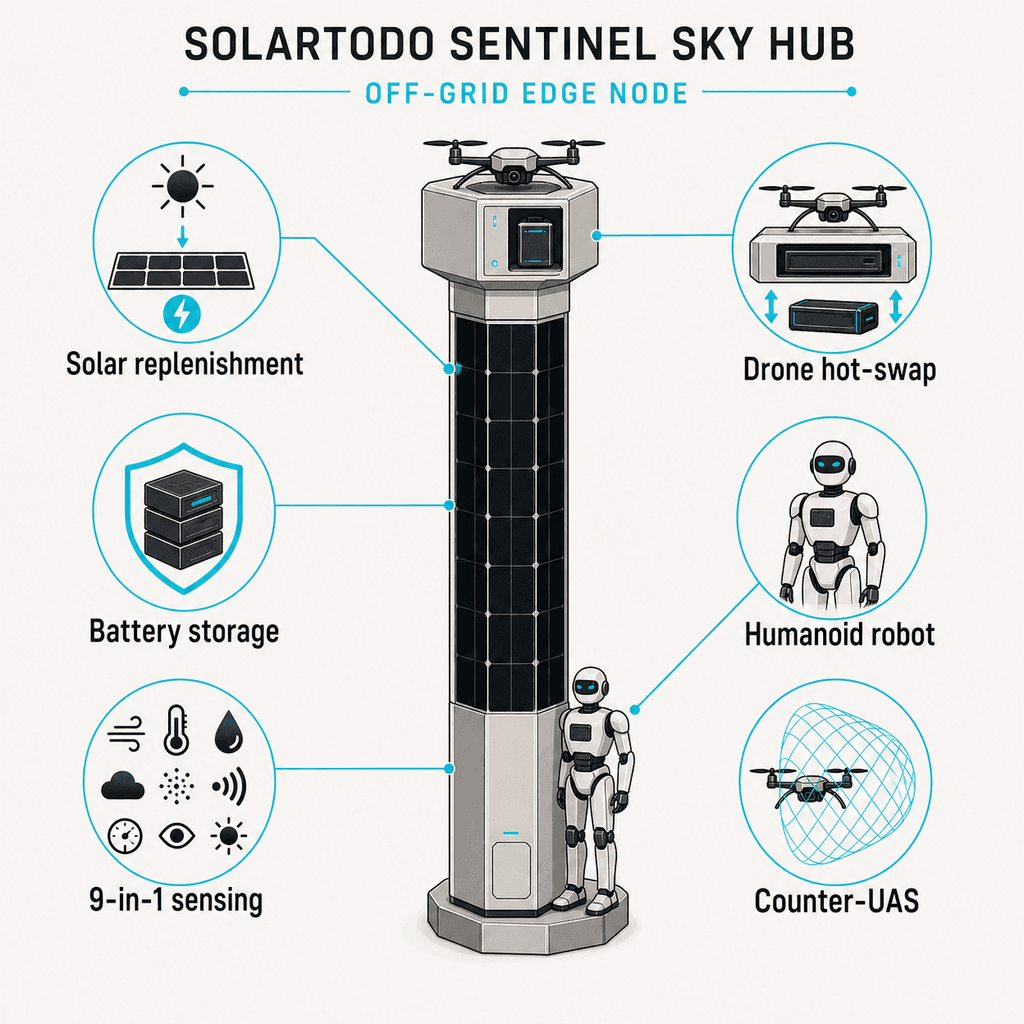
SOLARTODO Sentinel / Sky Hub is positioned as a pure smart pole, not a smart streetlight. It is a non-lighting urban edge node for sensing, local AI, autonomous drone service, ground robot charging, environmental monitoring and authorized response coordination. The pole is designed for districts, campuses, industrial parks, ports, perimeter corridors and critical-infrastructure zones where a fixed edge node can support repeated inspection workflows.
According to IEA (2025), global renewable power capacity is forecast to add 4,600 GW by 2030, with solar PV accounting for almost 80% of the increase. The IEA states, "Solar PV accounts for almost 80%" of global renewable capacity growth through 2030. That matters for smart pole energy design because distributed solar-plus-storage is now a mainstream planning assumption, not a niche accessory.
The core engineering issue is not whether the pole can run forever from a small solar surface. It cannot, and a serious specification should not claim that. The correct model is a fully off-grid, battery-backed micro-station where on-pole solar replenishes part of the daily load and the battery absorbs mission spikes from drone swapping, robot charging, sensing and compute.
System Architecture and Operating Workflow
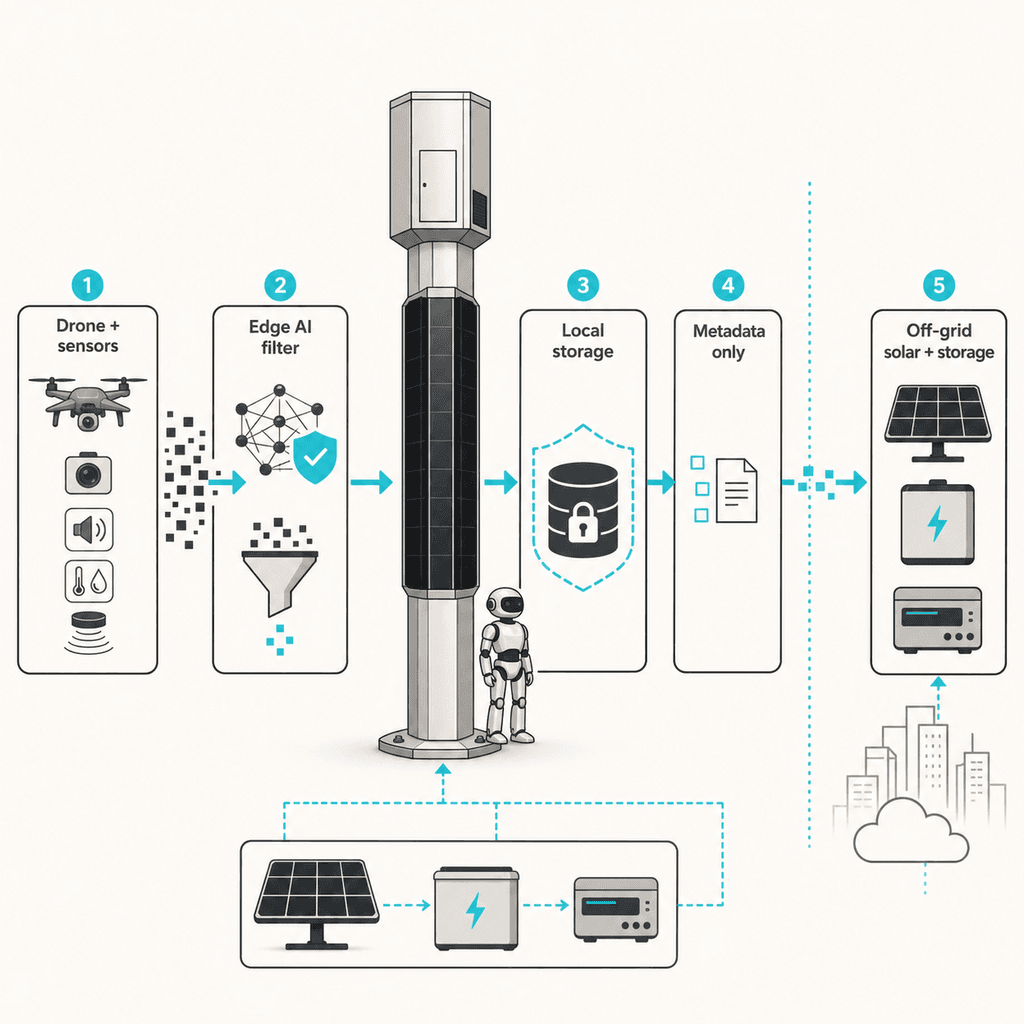
A battery-swap smart pole works as a 4-layer edge system: energy, aircraft service, local AI compute and human-authorized command operations.
At the energy layer, SOLARTODO uses on-pole photovoltaic replenishment and battery storage instead of grid, city or site power. A high-irradiance deployment can use roughly 2.8-3.2 kWp nameplate PV surfaces, with realistic clear-sky output around 1.0-1.3 kW DC peak and about 7-10 kWh/day. These figures should be treated as replenishment capacity, not unlimited energy autonomy.
At the aircraft service layer, the pole manages autonomous landing, battery inventory, swap sequencing, pack temperature checks, state-of-charge verification and relaunch permission. A multi-bay battery magazine supports several consecutive sorties before the station needs to recover energy through storage and solar replenishment. For operations managers, that reduces truck rolls and allows inspection teams to schedule repeated patrols around asset risk rather than around manual battery handling.
At the compute layer, a Jetson-class edge module runs inference, event filtering and mission scheduling locally. Raw video and sensor data stay on the pole. Only de-identified event records, alarms, status values and mission summaries leave the site. This architecture supports PDPL/LGPD-oriented data handling because the system is designed to reduce upstream data exposure at the source.
At the operations layer, the command loop follows sensing, authorized assessment, edge scheduling and field operations. The common operating picture gives operators mission queue status, drone health, robot status, battery state, environmental readings and alarm history in one control view. Human authorization remains mandatory for counter-UAS response.
NREL PVWatts states, "Estimates the energy production" of PV systems worldwide, and its public model notes that long-term output ranges rely on 30 years of weather data. For EPC planning, that supports a conservative approach: model irradiance, soiling, temperature and duty cycle before fixing patrol frequency.
| Subsystem | Engineering Role | Planning Number |
|---|---|---|
| On-pole PV replenishment | Daily energy recovery | 7-10 kWh/day in high-irradiance clear-sky conditions |
| DC peak output | Midday replenishment capacity | 1.0-1.3 kW DC realistic peak |
| Battery storage | Buffers drone, robot and compute loads | 5-20 kWh class |
| Battery swap | Reduces turnaround delay | Multi-bay magazine for consecutive sorties |
| Edge compute | Local inference and scheduling | Jetson-class module |
| Data handling | Local processing by default | Raw video and sensor data remain on-pole |
| Counter-UAS coordination | Non-lethal human-authorized workflow | Detection, tracking and soft response coordination |
Applications, Benefits and Limitations
Smart pole drone battery swap is strongest where 3 or more daily inspection sorties can replace vehicle dispatch, manual patrol or delayed incident verification.
Typical use cases include industrial fence-line patrol, port perimeter inspection, campus security response, solar farm inspection, logistics-yard monitoring, construction progress verification and critical-equipment checks. A drone can be dispatched from the pole after a local event trigger, while a ground robot can patrol nearby routes and return to the pole base for wireless charging.
Security sensing should be specified carefully. The system can support anonymous vehicle count, crowd density, intrusion detection and perimeter awareness. It should not be specified as an active face-recognition or licence-plate-recognition platform unless a separate, verified compliance and capability package is procured for a specific jurisdiction.
Environmental monitoring can include 9 practical channels: wind speed, wind direction, temperature, humidity, atmospheric pressure, noise, PM10, PM2.5 and illuminance. These readings improve mission safety, because sortie authorization can consider wind, visibility assumptions, particulate conditions and local operating thresholds.
Counter-UAS coordination is a controlled workflow, not a weapons system. The pole may detect and track an unauthorized drone and coordinate its own friendly drone for close-approach deterrence or soft aerial net-capture, but mitigation is non-lethal and human-authorized. Radar is not pole hardware; where radar is mentioned, treat it only as an optional partner-sensor input.
According to IEA (2025), variable renewables could generate almost 30% of global electricity by 2030, doubling today’s share. That reinforces the need for local storage and scheduling logic: high-power robotic activity should be dispatched by mission priority, state of charge, forecast replenishment and reserve margin.
The limitation is duty cycle. A fully off-grid pole can support valuable autonomous service, but daily sortie count depends on aircraft energy draw, payload, wind, route length, battery magazine size, storage capacity and solar resource. EPC teams should specify required missions per day, maximum response time, reserve hours and seasonal irradiance before finalizing hardware.
EPC Investment Analysis and Pricing Structure
EPC pricing should compare 3 delivery scopes, 3 volume tiers and a 5-8 year operational payback model against separate patrol and charging assets.
Turnkey EPC delivery includes engineering review, foundation design coordination, pole supply, battery system integration, drone-service commissioning, local AI configuration, communications setup, operator training, documentation and acceptance testing. For sensitive sites, EPC scope should also include cybersecurity settings, role-based access, data-retention policy and incident-response workflows.
SOLARTODO is a B2B manufacturer and exporter, so the commercial path is inquiry, engineering clarification, offline quotation and project financing review. It is not an online marketplace. Procurement teams should prepare site drawings, duty-cycle requirements, target number of poles, local code constraints, environmental conditions and whether a partner sensor network is required.
| Pricing Level | What It Includes | Best Fit |
|---|---|---|
| FOB Supply | Factory supply of pole system, packaged subsystems and documentation | Buyers with their own freight and local EPC contractor |
| CIF Delivered | FOB scope plus international freight and delivery to destination port | Importers and distributors managing local installation |
| EPC Turnkey | Engineering coordination, delivery, installation support, commissioning and training | Municipal, campus, port and industrial projects needing one accountable package |
Volume pricing should be treated as guidance until engineering scope is confirmed. For planning, 50+ units can target about 5% supply-side discount, 100+ units about 10%, and 250+ units about 15%. Final price depends on storage size, battery magazine configuration, communications, sensor package, certification requirements, logistics route and installation complexity.
ROI comes from replacing manual inspection visits, shortening alarm verification time and consolidating separate infrastructure into one off-grid edge station. A project that avoids 2 vehicle patrols per day, reduces emergency verification delays and cuts standalone cabinet count can often justify a 5-8 year payback, especially where labor, fuel, security risk or site access cost is high.
Standard payment terms are 30% T/T deposit and 70% against bill of lading, or 100% irrevocable L/C at sight. Financing is available for large projects above $1,000K, subject to buyer qualification, jurisdiction, project documentation and credit review. Commercial inquiries should be sent to [email protected].
Selection Guide for Procurement and Engineering Teams
Choose battery swap over simple charging when the site needs 3+ sorties/day, sub-hour redeployment or continuous patrol coverage from one off-grid node.
Procurement teams should begin with the mission profile, not with the aircraft. Define how many inspections are required per day, how fast the system must respond after an alarm, how long the drone must remain airborne, and how many consecutive missions must run before replenishment. This determines whether automated battery swap is necessary.
Engineering teams should then validate the energy model. On-pole PV may provide 7-10 kWh/day in favorable clear-sky conditions, but storage must cover night operations, poor weather, high-wind reroutes, compute load and ground robot charging. A 5 kWh battery may fit low-frequency inspection; a 20 kWh class configuration is more appropriate for heavier autonomous duty cycles.
IEC 62619:2022 is relevant because it covers safety requirements for industrial secondary lithium cells and batteries. IEEE 1547-2018 is relevant where distributed energy resources interface with electric power systems, although SOLARTODO Sentinel / Sky Hub is specified as fully off-grid. UL 9540A is useful for evaluating battery energy storage fire propagation test methods where local authorities request additional safety evidence.
| Requirement | Contact Charging | Automated Battery Swap |
|---|---|---|
| Hardware complexity | Lower | Higher |
| Turnaround time | Longer | Shorter |
| Consecutive sorties | Limited by charge time | Supported by battery inventory |
| Maintenance skill | Electrical and mechanical | Electrical, mechanical and robotic service |
| Best deployment | Low-frequency inspection | Repeated patrol and rapid response |
| Procurement focus | Charger reliability | Magazine, pack safety and swap state machine |
According to IRENA (2025), renewable capacity additions reached 582 GW in 2024, with solar PV contributing 452.1 GW. That market scale helps buyers source PV and storage components, but it does not remove the need for site-specific engineering.
FAQ
These 10 FAQs answer procurement, technical, installation, pricing and maintenance questions for 5-20 kWh smart pole drone swap deployments.
Q: What is a smart pole drone charging and battery swap system? A: It is an off-grid smart pole that supports autonomous drone landing, battery exchange, local AI processing and mission redeployment. Instead of waiting for a depleted pack to recharge, the pole uses a multi-bay magazine to install a charged pack, verify status and relaunch after authorization.
Q: How is SOLARTODO Sentinel / Sky Hub different from a smart streetlight? A: SOLARTODO Sentinel / Sky Hub is a pure smart pole with no lighting system. Its role is edge computing, sensing, drone operations, ground robot service, environmental monitoring and authorized response coordination, not road illumination. This distinction is important for procurement, permitting and technical specification.
Q: How much solar energy can the pole generate each day? A: In high-irradiance clear-sky conditions, the on-pole PV layer can realistically replenish about 7-10 kWh/day, with roughly 1.0-1.3 kW DC peak output. This is a supplemental replenishment layer for a battery-backed micro-station, not an unlimited energy source.
Q: Why use battery swap instead of charging the drone directly? A: Battery swap reduces aircraft downtime when a site needs repeated patrols or rapid redeployment. Contact charging can be suitable for low-frequency missions, but a swap magazine lets the drone exchange packs, complete checks and return to service while depleted batteries recharge inside the station.
Q: What battery storage size should an EPC team specify? A: A 5-20 kWh class battery is the practical planning range, depending on sortie count, robot charging, compute load and reserve requirements. Low-frequency inspection may fit the lower end, while multi-sortie perimeter patrols and night operations usually require higher storage and stricter scheduling.
Q: Does raw video leave the smart pole? A: No. Raw video and sensor data are processed locally on the pole. The system is designed so only de-identified event metadata, status data, alerts and mission summaries leave the site, supporting PDPL/LGPD-oriented data handling without claiming formal certification.
Q: Can the system perform counter-UAS missions? A: The system can support detection, tracking and human-authorized coordination against unauthorized drones. Allowed responses are non-lethal, such as close-approach deterrence or soft aerial net-capture by a friendly drone. It must not be specified for jamming, hard-kill actions or autonomous attack.
Q: What does EPC turnkey delivery include? A: EPC turnkey delivery normally includes engineering coordination, supply, logistics, installation support, commissioning, operator training, documentation and acceptance testing. For larger sites, it should also cover battery safety review, cybersecurity settings, user permissions, mission workflow setup and maintenance planning.
Q: How should buyers compare FOB, CIF and EPC pricing? A: FOB covers factory supply, CIF adds international freight to destination port, and EPC turnkey adds installation and commissioning responsibility. For planning, 50+ units may target 5% discount, 100+ units 10%, and 250+ units 15%, subject to final engineering scope.
Q: What maintenance is required for an autonomous battery swap pole? A: Maintenance should cover battery health, magazine mechanics, landing interface, weather seals, communications, local compute, sensors and PV cleaning. Most operators should plan scheduled inspections every 6-12 months, plus condition-based service when battery state, swap cycle count or mission logs show abnormal behavior.
Conclusion
For sites needing 3+ autonomous drone sorties per day, battery-swap smart poles provide higher field availability than simple charging when paired with 5-20 kWh storage.
The bottom line: SOLARTODO Sentinel / Sky Hub is a fully off-grid, non-lighting smart pole for autonomous drone service, robotic inspection and local AI operations, using 7-10 kWh/day solar replenishment as part of a battery-backed operating model. Buyers should specify mission duty cycle first, then size storage, swap inventory and EPC scope around verified site conditions.
References
These 7 references support PV modeling, renewable market context, battery safety and distributed-energy engineering for smart pole drone charging projects.
- [IEA] (2025): Renewables 2025, forecasting 4,600 GW renewable capacity growth by 2030 and solar PV contributing almost 80% of the increase. https://www.iea.org/reports/renewables-2025
- [IEA] (2020): World Energy Outlook 2020, noting solar PV cost reductions and the growing need for storage and grid flexibility. https://www.iea.org/reports/world-energy-outlook-2020
- [NREL PVWatts] (2026): PVWatts Calculator v8.7.3 / API v8.5, used for estimating PV energy production and long-term weather variability. https://pvwatts.nrel.gov/
- [IRENA] (2025): Renewable Capacity Statistics 2025, reporting 582 GW renewable additions in 2024 and 452.1 GW from solar PV. https://www.irena.org/Publications
- [IEC 62619] (2022): Safety requirements for secondary lithium cells and batteries used in industrial applications.
- [IEEE 1547] (2018): Standard for interconnection and interoperability of distributed energy resources with electric power systems interfaces. https://standards.ieee.org/standard/1547-2018.html
- [UL 9540A] (2019): Test method for evaluating thermal runaway fire propagation in battery energy storage systems. https://www.ul.com/services/ul-9540a-test-method
About SOLARTODO
SOLARTODO is a global integrated solution provider specializing in solar power generation systems, energy-storage products, smart street-lighting and solar street-lighting, intelligent security & IoT linkage systems, power transmission towers, telecom communication towers, and smart-agriculture solutions for worldwide B2B customers.
About the Author

Cinn Song
Founder & Chief Solutions Architect
Cinn Song founded SOLARTODO LIMITED and leads its smart-city infrastructure engineering — from solar, storage and integrated smart poles to the company's push into physical-AI city edge nodes: pole-mounted edge computing, vertical LLMs for smart cities, drone-based O&M with autonomous battery swapping, robotic maintenance, and high-speed counter-UAS interception. Since 2010, he has directed turnkey EPC + BOT delivery across 50+ countries, including telecom monopole supply for national grid operators, off-grid solar street-lighting for African municipalities, and integrated smart-pole programs for Gulf smart cities.
Cite This Article
Cinn Song. (2026). Smart Pole Drone Charging and Battery Swap Systems. SOLARTODO. Retrieved from https://solartodo.com/knowledge/smart-pole-drone-charging-and-autonomous-battery-swap-systems
@article{solartodo_smart_pole_drone_charging_and_autonomous_battery_swap_systems,
  title = {Smart Pole Drone Charging and Battery Swap Systems},
  author = {Cinn Song},
  journal = {SOLARTODO Knowledge Base},
  year = {2026},
  url = {https://solartodo.com/knowledge/smart-pole-drone-charging-and-autonomous-battery-swap-systems},
  note = {Accessed: 2026-10-16}
}
Published: July 16, 2026 | Available at: https://solartodo.com/knowledge/smart-pole-drone-charging-and-autonomous-battery-swap-systems
Subscribe to Our Newsletter
Get the latest solar energy news and insights delivered to your inbox.
View All Articles