Smart Pole Structural Design: Wind Load and Multi-Device…

Cinn Song
Founder & Chief Solutions Architect
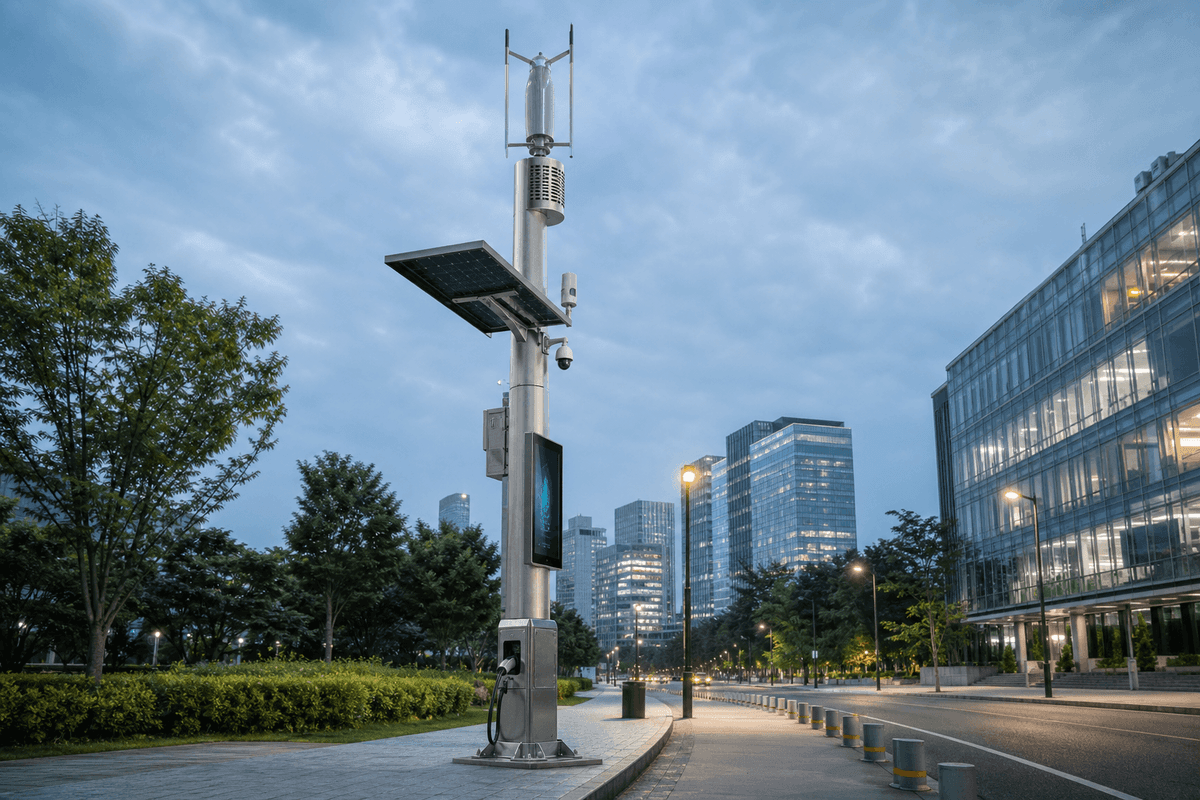
Watch the video
TL;DR
Smart poles should be engineered as complete multi-device structures, not lighting poles with accessories. For 10-12 m deployments, verify 150-180 km/h wind loads, low-mounted 5-15 kWh battery mass, bracket eccentricity, corrosion protection, and foundation reactions before ordering. SOLARTODO supports FOB, CIF, and EPC turnkey quotations for 50+ pole B2B projects.
Smart pole structural design must verify 150-180 km/h wind loads, 12 m pole geometry, and 5-15 kWh battery mass before adding cameras, 5G radios, displays, EV chargers, or VAWT modules.
Summary
Smart pole structural design must verify 150-180 km/h wind loads, 12 m pole geometry, and 5-15 kWh battery mass before adding cameras, 5G radios, displays, EV chargers, or VAWT modules.
Key Takeaways
These 8 actions help procurement and engineering teams reduce structural risk across 50-250 smart pole deployments in coastal, urban, and industrial sites.
- Verify 150-180 km/h design wind speed before selecting a 10 m or 12 m smart pole with cameras, displays, or wind turbines.
- Model 6-11 mounted subsystems as one structural assembly, including luminaire arms, PTZ camera, 5G radio, LED display, sensors, and battery mass.
- Specify Q235 or Q355 steel with hot-dip galvanizing to ASTM A123 for 25-year corrosion resistance in coastal or industrial corridors.
- Check anchor cage, base plate, and foundation reactions for 30 m, 32 m, or 35 m pole spacing before civil procurement.
- Reserve 8.7 m mounting height for communication equipment where RF clearance and maintenance access are both required.
- Compare integrated welded EV charging bases against separate bollards to reduce footprint by 30-40% and exposed cable length by 2-5 m.
- Budget 5%, 10%, or 15% volume discounts at 50+, 100+, or 250+ poles when evaluating FOB, CIF, and EPC turnkey quotations.
- Require factory drawings, load schedules, and third-party standard alignment before approving 100+ pole smart city rollouts.
Structural Design for Wind-Rated Smart Poles
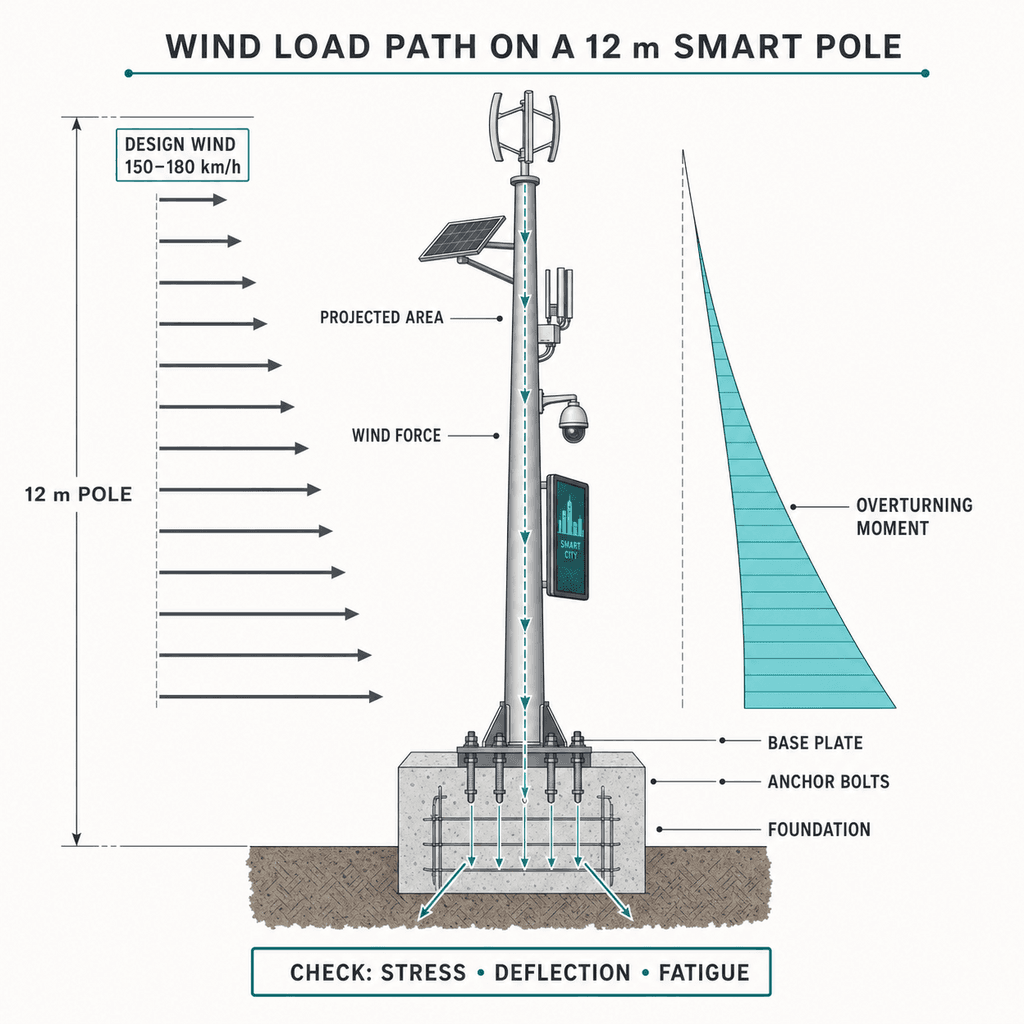
A wind-rated smart pole should be engineered as a 10-12 m multi-device structure, not as a lighting pole with accessories attached later.
For B2B buyers, the main structural question is simple: can the pole, base, anchor cage, and foundation resist combined wind pressure, equipment weight, vibration, and maintenance loads over the intended service life? A 12 m hybrid smart pole may carry a 160 W luminaire, 400-500 W VAWT, two 100-200 W monocrystalline modules, PTZ camera, environmental sensor, IP audio column, WiFi 6 or 5G equipment, LED display, 5-15 kWh LFP battery, and 7 kW or 11 kW Type 2 AC EV charger.
The SOLARTODO 12m Wind-Solar Hybrid Smart Pole uses an octagonal tapered steel body rated for 180 km/h wind conditions, while the 10m 5G Small Cell Integrated Smart Street Light Pole is positioned around wind load capacity above 150 km/h. These values are procurement starting points, not substitutes for local engineering. Final approval should consider terrain category, gust factor, exposure, topography, corrosion class, and national code requirements.
According to IRENA (2025), 582 GW of renewable power capacity was added globally in 2024, with solar PV accounting for about 452.1 GW. That market growth matters because cities are now adding energy generation, communications, and public safety devices to poles that were historically designed only for lighting.
The International Energy Agency states, 'Grid investment is essential' for scaling renewables and electrified infrastructure. For smart pole design, that principle translates into practical hardware discipline: every device changes the structural load path and must be considered before tender release, not after installation begins.
Core Structural Variables
The first review should quantify pole height, shaft geometry, material grade, bracket length, device area, device weight, cable routing, door openings, battery position, and foundation interface. A tapered octagonal steel shaft usually performs better than a thin decorative cylindrical tube because it provides predictable bending stiffness, clear weld surfaces, and practical internal cable space.
For SOLARTODO smart streetlight projects, common configuration checks include:
- 10 m or 12 m overall pole height
- 150-180 km/h stated wind rating, subject to local code verification
- Q235 or Q355 steel shaft selection
- Hot-dip galvanizing and architectural coating
- 120 W or 160 W LED luminaire load
- 5-15 kWh LFP battery mass inside the pole base
- Camera, sensor, speaker, display, 5G, WiFi, PV, VAWT, or EV charging modules
Multi-Device Mounting and Load Path Engineering
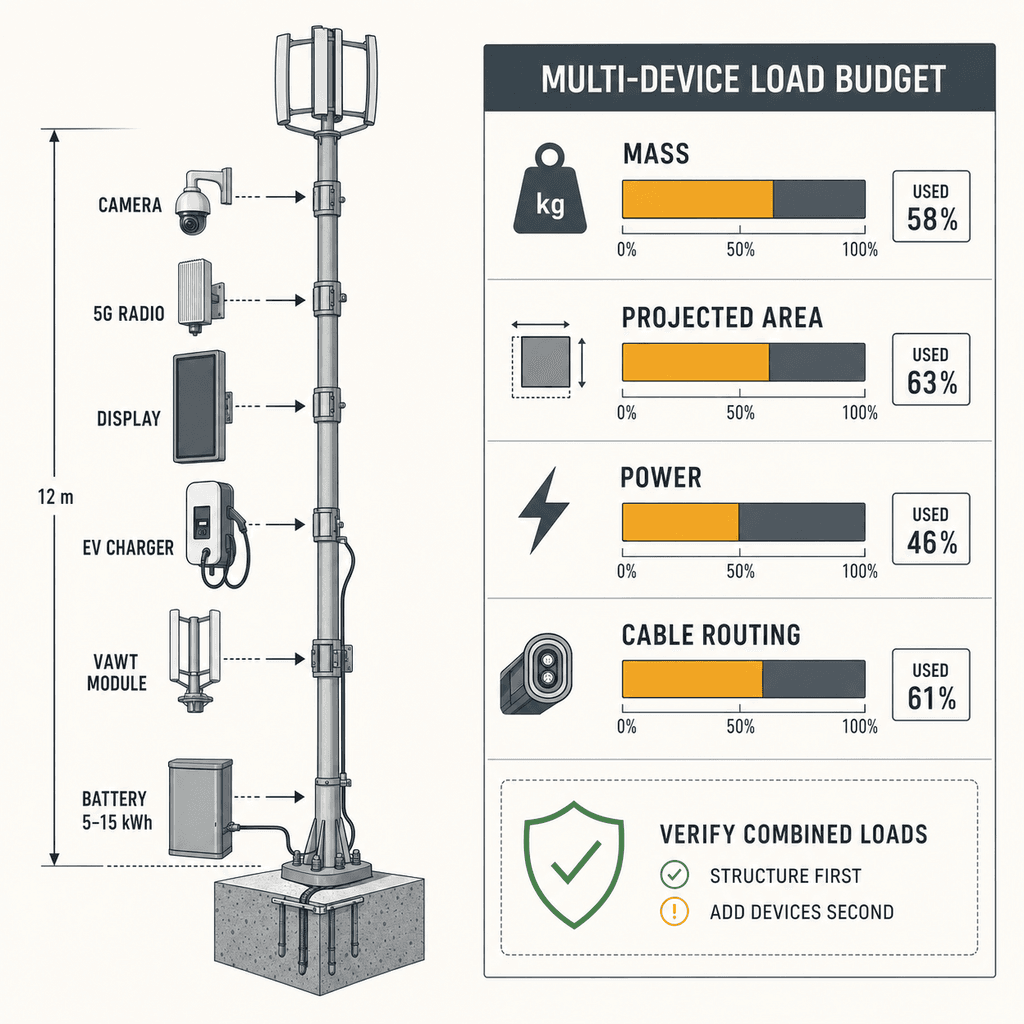
Each mounted device adds wind area, eccentricity, weight, and service access requirements that can increase bending moments by 2-5 times locally.
A multi-device smart pole is a vertical equipment platform. The luminaire arm creates cantilever force, the PTZ camera adds vibration sensitivity, the LED display increases projected wind area, the solar frame adds uplift and torsion, and the VAWT introduces dynamic loading. If the lower base also includes a 7 kW or 11 kW charger, engineers must protect service doors, cable bends, and heat dissipation while maintaining structural continuity.
Device elevation is a key design decision. SOLARTODO places the VAWT at about 11.8-12.0 m and the solar array around 10.2-11.2 m on the 12 m hybrid model. The communications unit is mounted at 8.7 m rather than under the luminaire arm, improving RF separation and reducing crowded maintenance zones. This type of mounting hierarchy is important when a buyer plans 50, 100, or 250+ poles, because small access problems become recurring field costs.
According to NREL PVWatts methodology, solar output depends strongly on local irradiance, tilt, orientation, and system losses. For structural teams, the point is not only energy yield; panel tilt and frame size also define projected area and wind reaction. A 400 W PV array on a 15 degree east-west A-frame should be reviewed differently from a single flat equipment plate.
IEEE states that distributed energy resources need defined interconnection and interoperability requirements under IEEE 1547-2018. On a smart pole, that same systems mindset applies mechanically: PV, battery, charger, lighting, surveillance, and telecom equipment must be integrated as one engineered node.
Mounting Zone Discipline
Good smart pole design separates high-wind-area devices, RF devices, power electronics, and pedestrian-access equipment. Heavy batteries should stay low. Communication equipment should avoid metal shadowing where possible. Cameras require clear sightlines and low vibration. Displays need wind review and service access. EV charging interfaces require impact protection, user access, and electrical isolation.
A practical hierarchy is:
- Top zone: VAWT or antenna equipment where wind exposure is high
- Upper shaft: PV frame, luminaire arms, and selected sensors
- Mid shaft: PTZ camera, WiFi, 5G, environmental monitoring, and audio
- Lower base: LFP battery, charger cabinet, protection devices, and service doors
- Foundation: anchor cage, conduits, grounding, drainage, and inspection access
EPC Investment Analysis and Pricing Structure
EPC procurement should compare FOB, CIF, and turnkey pricing for at least 50 poles, because civil works can exceed device cost variance.
For smart pole projects, EPC means Engineering, Procurement, and Construction. Engineering includes wind-load review, foundation drawings, load schedules, electrical single-line diagrams, grounding, cable routing, device layout, and site adaptation. Procurement includes pole fabrication, coating, luminaires, cameras, sensors, battery packs, EV charger modules, display units, communication equipment, controllers, packing, and export documentation. Construction includes foundation work, installation, lifting, wiring, commissioning, testing, and handover.
SOLARTODO is a B2B manufacturer and exporter, not an online marketplace. The normal business flow is inquiry, technical clarification, offline quotation, commercial terms, production, inspection, shipping, installation support, and project financing where applicable. For technical-commercial requests, contact [email protected].
Typical pricing structures should be separated clearly:
| Pricing tier | What it includes | Buyer responsibility | Best for |
|---|---|---|---|
| FOB Supply | Factory price, export packing, agreed China port handover | Ocean freight, insurance, import, local installation | Experienced importers and distributors |
| CIF Delivered | Product supply plus freight and insurance to destination port | Customs clearance, inland logistics, civil works | EPC firms controlling local construction |
| EPC Turnkey | Engineering, supply, logistics, installation support, commissioning scope | Site access, permits, grid approvals, local authority coordination | Municipal and industrial projects needing one delivery package |
Volume pricing should be discussed early. For budget planning, use 50+ poles for about 5% discount potential, 100+ poles for about 10%, and 250+ poles for about 15%, subject to configuration, destination, installation scope, and commodity cost. Standard payment terms are 30% T/T deposit and 70% against bill of lading, or 100% L/C at sight. Financing may be available for large projects above $1,000K.
ROI depends on what the pole replaces. An integrated smart pole can reduce separate cabinet, bollard, trenching, and cable interfaces. The SOLARTODO welded EV charging base reduces footprint by approximately 30-40% versus pole-plus-bollard layouts and can reduce exposed cable lengths by 2-5 m. LED lighting can reduce lighting electricity demand by about 36-45% versus older 250 W high-pressure sodium alternatives, depending on optics, operating hours, and tariff.
According to IEA (2024), the world added about 560 GW of renewable capacity in 2023, a record annual increase. According to IRENA (2025), 91% of new renewable power projects commissioned in 2024 were more cost-effective than fossil fuel alternatives. These macro trends support smart infrastructure investments, but project ROI still requires site-specific tariff, maintenance, civil cost, and utilization assumptions.
Selection Guide for B2B Smart Pole Projects
Procurement teams should compare wind rating, device count, corrosion protection, foundation design, and serviceability before comparing unit price alone.
The lowest pole price can become the highest project cost if it causes redesign, installation delay, vibration complaints, corrosion claims, or replacement foundations. A well-structured RFQ should ask each supplier for a device load table, shaft drawing, base plate drawing, anchor bolt layout, coating specification, electrical cabinet layout, maintenance access plan, and applicable standards list.
| Design factor | 10m 5G smart pole | 12m wind-solar hybrid smart pole | Procurement implication |
|---|---|---|---|
| Typical height | 10 m | 12 m | Taller poles need stronger wind and foundation review |
| Wind rating basis | Above 150 km/h | 180 km/h | Verify against local gust and exposure code |
| LED luminaire | 120 W | 160 W | Confirm road class, spacing, and optics |
| Energy modules | Grid-fed with telecom load | 200-400 W PV plus 300-500 W VAWT | Hybrid poles need dynamic and projected-area checks |
| Battery | Optional by project | 5-15 kWh LFP | Low-mounted mass helps stability but affects base design |
| Communications | 5G small cell, WiFi 6 | WiFi 6 or 5G communications | Confirm backhaul, RF clearance, and access height |
| EV charging | Optional | 7 kW or 11 kW Type 2 AC | Check user access, protection, metering, and thermal design |
| Best use case | Dense urban telecom and lighting | Boulevard, campus, marina, industrial park | Match structure to revenue and resilience objectives |
According to IEC 60598, luminaires must meet safety and construction requirements appropriate to their application. For smart poles, luminaire compliance is only one layer. The full assembly also needs mechanical, electrical, battery, communications, and site safety review.
UL notes that energy storage safety depends on system-level evaluation, not just cell chemistry. For smart pole batteries, buyers should request LFP pack documentation, BMS protections, enclosure details, ventilation assumptions, and applicable IEC 62619 or UL 1973 alignment where required by the destination market.
FAQ
These 10 FAQ answers give procurement teams concise 40-80 word guidance on wind load, mounting, cost, installation, and maintenance decisions.
Q: What wind load rating should a smart pole have? A: A smart pole should normally be specified around 150-180 km/h wind resistance for demanding urban, coastal, or industrial deployments. The final value must be checked against local code, terrain exposure, gust factor, pole height, and mounted equipment area. A 12 m pole with PV, VAWT, display, and camera needs a more detailed review than a simple 10 m lighting pole.
Q: Why is multi-device mounting structurally difficult? A: Multi-device mounting is difficult because each accessory adds weight, wind area, eccentricity, and vibration sensitivity. A PTZ camera, LED display, luminaire arm, 5G radio, and solar frame do not act independently once bolted to one shaft. Engineers should model the complete assembly, including brackets and cable openings, before approving fabrication drawings.
Q: How does pole height affect wind-load design? A: Pole height increases bending moment because wind force acts farther from the foundation. A 12 m smart pole can experience significantly higher base reactions than a 6 m or 8 m pole carrying similar devices. Height also changes maintenance planning, lifting equipment, camera stability, RF coverage, and foundation depth requirements.
Q: What materials are normally used for smart pole shafts? A: Smart pole shafts commonly use Q235 or Q355 steel with tapered octagonal geometry for strength, manufacturability, and internal cable routing. Hot-dip galvanizing to ASTM A123 plus exterior coating improves corrosion resistance. For coastal or industrial projects, buyers should confirm coating thickness, drainage, fastener material, and expected service life.
Q: Where should heavy batteries be located inside a smart pole? A: Heavy LFP batteries should be located low in the pole base to reduce overturning impact and simplify maintenance access. SOLARTODO hybrid poles use 5 kWh, 10 kWh, or 15 kWh internal LFP battery options. Designers still need to review ventilation, water ingress protection, cable separation, BMS access, and service door reinforcement.
Q: Is an integrated EV charging base better than a separate bollard? A: An integrated EV charging base can be better when the project values compact layout, fewer cabinets, and cleaner cable routing. SOLARTODO's welded base design can reduce footprint by about 30-40% and exposed cable length by 2-5 m. A separate bollard may still suit projects needing independent charger replacement or different user positioning.
Q: What should an EPC turnkey package include? A: An EPC turnkey package should include engineering drawings, pole supply, device procurement, logistics, foundation guidance, installation support, commissioning, and handover documentation. For 50+ pole projects, procurement teams should separate FOB Supply, CIF Delivered, and EPC Turnkey pricing. This prevents civil works, freight, and commissioning assumptions from being hidden in the unit price.
Q: How should buyers estimate ROI for smart pole projects? A: ROI should compare the smart pole against separate lighting, camera, telecom, EV charger, cabinet, trenching, and maintenance costs. LED replacement can reduce lighting electricity demand by about 36-45% versus older HPS fixtures. Projects may also gain value from 5G leasing, reduced trenching, lower outage risk, and consolidated maintenance routes.
Q: What documents should be requested before production? A: Buyers should request a general arrangement drawing, shaft and base plate drawing, anchor cage layout, device load table, electrical diagram, coating specification, packing plan, and standards declaration. For 100+ pole projects, also request sample inspection criteria and installation method statements. These documents reduce disputes before manufacturing and civil works begin.
Q: Which standards are most relevant to smart pole structural design? A: Relevant standards include TIA-222-H for antenna-supporting structures, ASTM A123 for hot-dip galvanizing, IEC 60598 for luminaires, IEC 62619 for industrial lithium batteries, IEEE 1547 for distributed energy interconnection, and IEC 62196-2 for Type 2 EV connectors. Local building and electrical codes still control final approval.
References
These 8 references support wind-aware smart pole specifications using 2018-2025 standards, renewable-energy data, and infrastructure safety guidance.
- IRENA (2025): Renewable Power Generation Costs in 2024; reports 582 GW renewable additions and broad cost competitiveness of new renewables. https://www.irena.org/
- IEA (2024): Renewables 2024; documents record renewable capacity growth and grid investment requirements for electrified infrastructure. https://www.iea.org/
- NREL (2024): PVWatts Calculator methodology; estimates PV generation using solar resource, tilt, orientation, and loss assumptions. https://pvwatts.nrel.gov/
- IEEE 1547-2018 (2018): Standard for interconnection and interoperability of distributed energy resources with electric power systems. https://standards.ieee.org/
- IEC 60598 (2024): Luminaire safety and construction requirements for lighting equipment used in public infrastructure. https://www.iec.ch/
- IEC 62619 (2022): Safety requirements for secondary lithium cells and batteries used in industrial applications. https://www.iec.ch/
- ASTM A123/A123M (2024): Standard specification for zinc hot-dip galvanized coatings on iron and steel products. https://www.astm.org/
- TIA-222-H (2017): Structural standard for antenna-supporting structures, antennas, small wind turbine support structures, and related infrastructure. https://www.tiaonline.org/
Conclusion
Smart pole structural design succeeds when 150-180 km/h wind loads, 6-11 device modules, and foundation reactions are engineered as one system.
The bottom line: for 50+ unit smart streetlight projects, SOLARTODO recommends validating wind load, mounting hierarchy, corrosion protection, battery placement, and EPC scope before price negotiation. A structurally disciplined 10 m or 12 m smart pole reduces redesign risk and improves lifecycle value across lighting, surveillance, telecom, energy storage, and EV charging use cases.
About SOLARTODO
SOLARTODO is a global integrated solution provider specializing in solar power generation systems, energy-storage products, smart street-lighting and solar street-lighting, intelligent security & IoT linkage systems, power transmission towers, telecom communication towers, and smart-agriculture solutions for worldwide B2B customers.
About the Author

Cinn Song
Founder & Chief Solutions Architect
Cinn Song founded SOLARTODO LIMITED and leads its smart-city infrastructure engineering — from solar, storage and integrated smart poles to the company's push into physical-AI city edge nodes: pole-mounted edge computing, vertical LLMs for smart cities, drone-based O&M with autonomous battery swapping, robotic maintenance, and high-speed counter-UAS interception. Since 2010, he has directed turnkey EPC + BOT delivery across 50+ countries, including telecom monopole supply for national grid operators, off-grid solar street-lighting for African municipalities, and integrated smart-pole programs for Gulf smart cities.
Cite This Article
Cinn Song. (2026). Smart Pole Structural Design: Wind Load and Multi-Device…. SOLARTODO. Retrieved from https://solartodo.com/knowledge/smart-pole-structural-design-wind-load-and-multi-device-mounting
@article{solartodo_smart_pole_structural_design_wind_load_and_multi_device_mounting,
  title = {Smart Pole Structural Design: Wind Load and Multi-Device…},
  author = {Cinn Song},
  journal = {SOLARTODO Knowledge Base},
  year = {2026},
  url = {https://solartodo.com/knowledge/smart-pole-structural-design-wind-load-and-multi-device-mounting},
  note = {Accessed: 2026-10-13}
}
Published: July 13, 2026 | Available at: https://solartodo.com/knowledge/smart-pole-structural-design-wind-load-and-multi-device-mounting
Subscribe to Our Newsletter
Get the latest solar energy news and insights delivered to your inbox.
View All Articles