Smart Streetlight Total Cost of Ownership: A 10-Year…

Cinn Song
Founder & Chief Solutions Architect
TL;DR
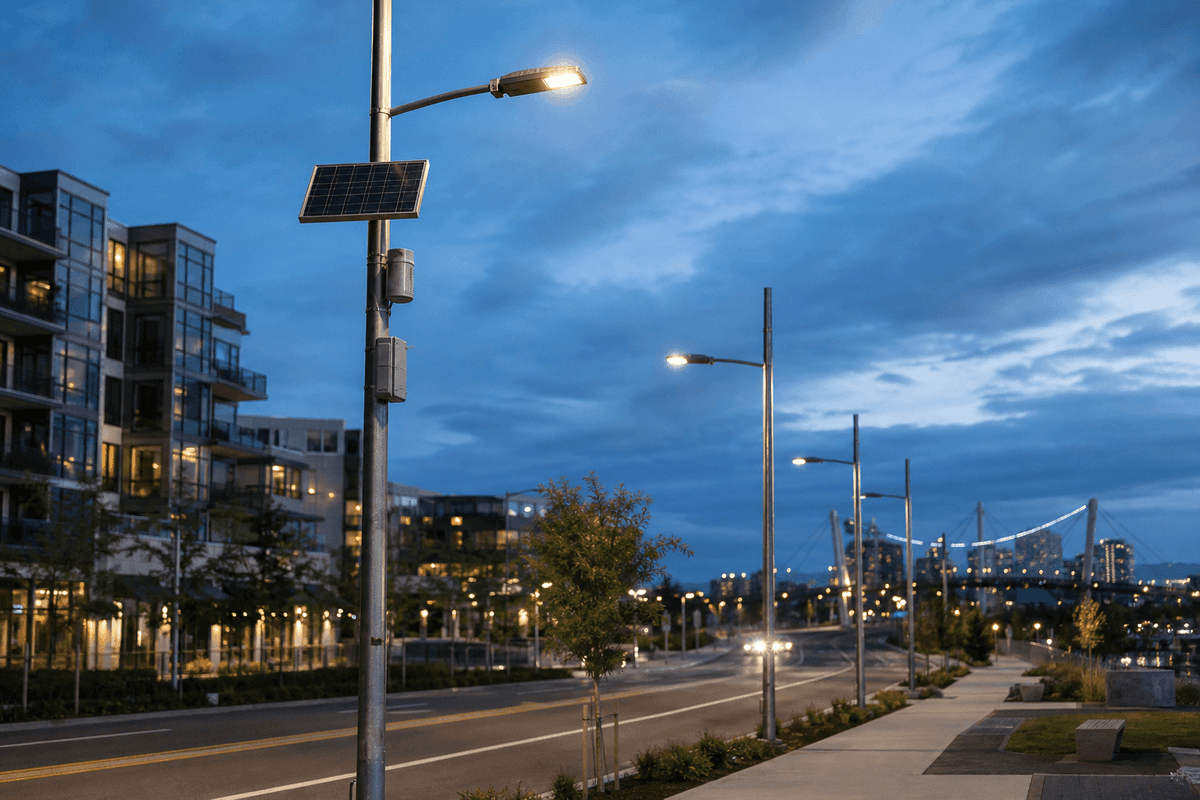
Smart streetlight TCO is not just pole price. A 10-year model should compare $1,600-$2,300 equipment cost, 120W-150W LED loads, 40-60% lighting energy savings, reduced maintenance from 3-4 devices consolidated into 1 pole, and EPC pricing tiers. For SOLARTODO projects, the strongest payback is typically 5-8 years where lighting, surveillance, sensors, and communications are combined.
A 10-year smart streetlight TCO model should compare $1,600-$2,300 pole CAPEX, 40-60% lighting energy reduction, 25-year pole life, and 5-8 year payback for security, bridge, campus, and municipal EPC projects.
Summary
A 10-year smart streetlight TCO model should compare $1,600-$2,300 pole CAPEX, 40-60% lighting energy reduction, 25-year pole life, and 5-8 year payback for security, bridge, campus, and municipal EPC projects.
Key Takeaways
A 10-year TCO model should separate 8 cost pools: pole CAPEX, installation, energy, connectivity, software, maintenance, spares, and end-of-life reserves.
- Benchmark 10m smart streetlight CAPEX at $1,600-$2,300 per pole before freight, civil works, taxes, and project-specific software integration.
- Compare LED power loads of 120W-150W against 250W-400W HID baselines to estimate 40-60% annual lighting energy savings.
- Model operating hours at 4,000-4,380 hours per year because a 150W LED consumes about 657 kWh annually at full output.
- Reduce maintenance visits by consolidating 3-4 devices into 1 pole, cutting truck rolls, foundations, and asset codes by roughly 25-40%.
- Require IP66 enclosures, -40°C to +55°C operation, 150-180 km/h wind design, and IEC 60598/IEC 62722 compliance in procurement documents.
- Use FOB, CIF, and EPC Turnkey pricing tiers to expose hidden freight, foundation, commissioning, and system-integration costs before award.
- Apply 50+, 100+, and 250+ volume bands to target 5%, 10%, and 15% supply discounts for municipal or campus rollouts.
- Plan payback over 5-8 years where energy savings, avoided CCTV masts, lower maintenance, and security value justify the higher upfront cost.
Why Smart Streetlight TCO Matters for B2B Buyers
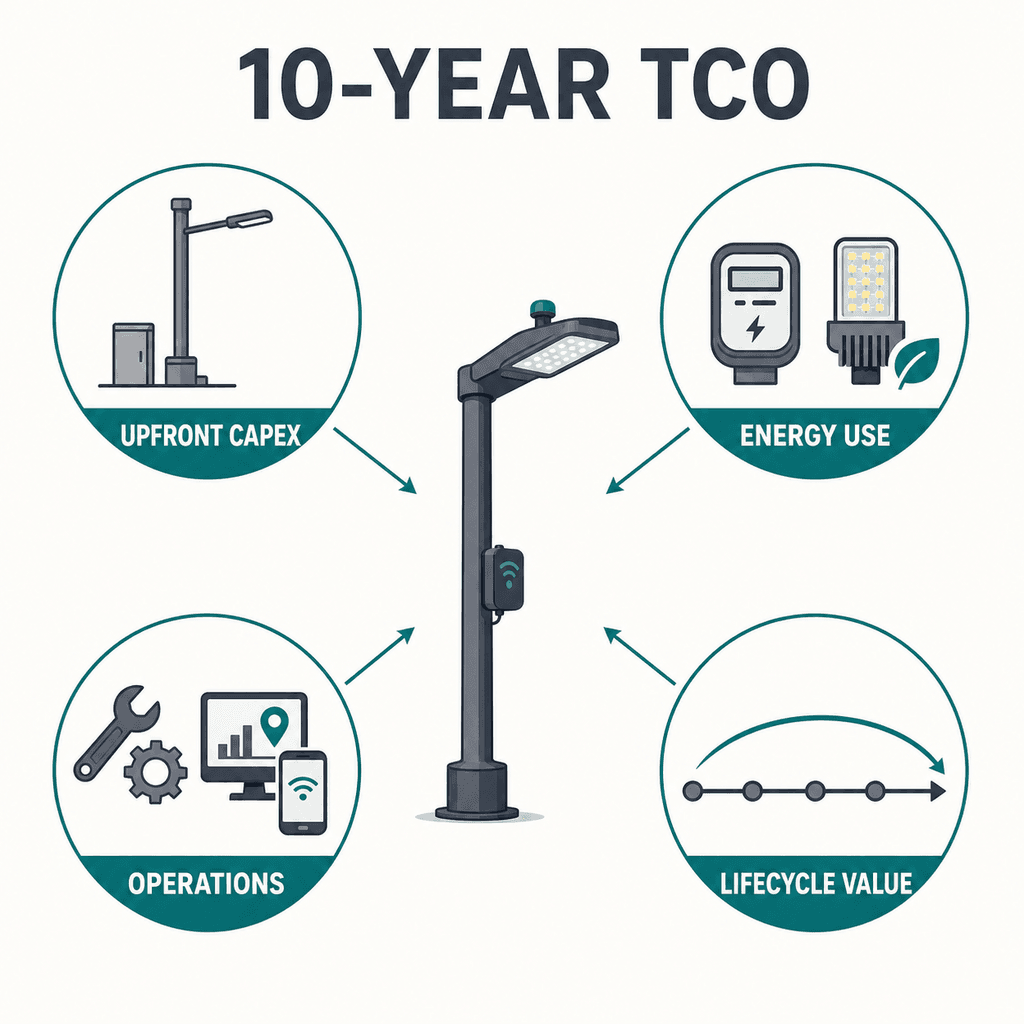
Smart streetlight TCO is a 10-year financial model comparing $1,600-$2,300 integrated poles against separate lighting, CCTV, sensor, and communications assets.
For procurement managers, the purchase price is only the first line of the financial model. A conventional project may buy one lighting pole, one CCTV mast, one sensor cabinet, one emergency call point, and separate cabling for each system. The integrated SOLARTODO approach puts lighting, surveillance, connectivity, and optional emergency communication onto one engineered pole platform, which changes the cost structure from fragmented equipment purchasing to lifecycle infrastructure planning.
The strongest TCO case appears where smart poles replace 3 or 4 roadside devices per location. In community gates, bridge corridors, campuses, ports, industrial parks, and mixed-use developments, the reduction in foundations, cable pulls, junction boxes, and maintenance interfaces can be more important than the LED energy saving alone. SOLARTODO smart streetlight variants typically use 120W or 150W LED luminaires at 170 lm/W, with IP66 protection, -40°C to +55°C operating range, and a 25-year structural design life.
According to IRENA (2025), 91% of new renewable power projects commissioned in 2024 were more cost-effective than fossil-fuel alternatives, which reinforces the broader business case for electrified and efficient infrastructure. For smart streetlights, the same logic applies at asset level: reduce wasted energy, reduce repeated civil works, and consolidate digital services into fewer outdoor assets.
The International Energy Agency states, 'Energy efficiency is the first fuel,' a useful framing for municipal and private infrastructure owners. A smart streetlight project should therefore be evaluated not as a decorative technology upgrade, but as an efficiency, safety, and operations investment with measurable 10-year cash flows.
10-Year Cost Model Assumptions
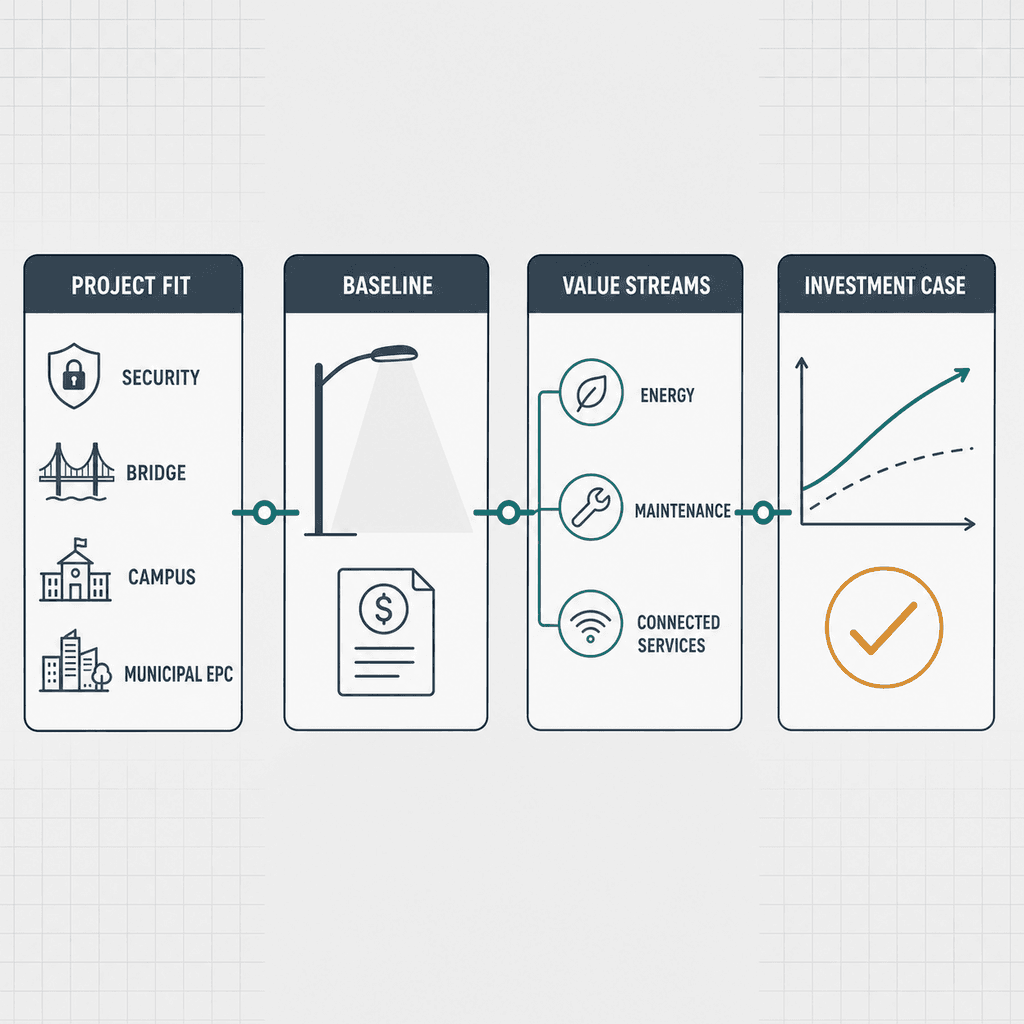
A practical 10-year model for 100 smart streetlights should test CAPEX, energy, maintenance, connectivity, and software assumptions under at least 3 scenarios.
The base case below uses a 100-pole project with 10m smart streetlights. Each pole includes one 150W LED luminaire, one AI PTZ camera or fixed AI camera, one environmental sensor or emergency module depending on site type, and one communications interface. For a bridge or municipal roadway variant, a typical EPC buyer can budget $1,800-$2,300 per pole for the integrated product before site-specific civil works. For a community entrance variant, $1,600-$2,000 per pole is a reasonable equipment budget.
For energy calculations, assume 4,380 annual operating hours, equal to 12 hours per night. A 150W LED consumes about 657 kWh per year before dimming. A 300W legacy HID or sodium fixture consumes about 1,314 kWh per year before ballast losses, so the lighting-only saving is roughly 657 kWh per pole per year. At $0.12/kWh, that is $78.84 per pole per year, or $78,840 over 10 years for 100 poles before tariff escalation.
Maintenance is the second major lever. Separate lighting, CCTV, and sensor assets create separate inspections, spare parts, and fault diagnosis. An integrated pole still needs planned maintenance, but field teams service one coordinated asset. For the 100-pole model, assume conventional maintenance at $120 per device per year across 3 devices, or $36,000 annually. Assume smart-pole maintenance at $180 per integrated pole per year, or $18,000 annually. That saves $180,000 over 10 years before inflation.
According to the Tucson LED conversion study (2018), the city moved from roughly 445 million fully shielded HPS/LPS lumens to 142 million LED lumens after converting about 95% of 18,000 luminaires. That case is relevant because it shows why lumen targeting, shielding, and controls matter as much as nominal wattage. A smart pole should not simply add more hardware; it should use controlled, measurable infrastructure.
| Cost Driver | Conventional Separate Assets | SOLARTODO Smart Streetlight | 10-Year TCO Effect |
|---|---|---|---|
| Roadside devices per point | 3-4 units | 1 integrated pole | 25-40% fewer interfaces |
| Typical LED load | Not applicable | 120W-150W | 657 kWh/year at 150W |
| Legacy lighting baseline | 250W-400W HID | Replaced by 170 lm/W LED | 40-60% energy reduction |
| Foundations per point | 2-3 typical | 1 typical | Lower civil works risk |
| Enclosure target | Mixed ratings | IP66 | Lower weather failure exposure |
| Design life | Varies by device | 25-year pole structure | Better residual value |
| Maintenance asset codes | 3-4 records | 1 coordinated record | Lower admin and truck-roll cost |
Technical Architecture and Lifecycle Risks
Smart streetlight lifecycle cost depends on 6 technical variables: structure, luminaire efficacy, enclosure class, communications, cybersecurity, and maintainable module design.
The pole structure carries the longest-life portion of the investment. SOLARTODO smart streetlights use tapered steel structures, including square-tube continuous-tapered designs for community security poles and octagonal marine-grade designs for bridge roadway variants. Wind resistance targets are typically around 150 km/h for community and campus projects, and up to 180 km/h for exposed bridge corridors or coastal viaducts. A 25-year design life is only meaningful when foundation design, anchoring, coating, and local wind assumptions are aligned.
The luminaire drives direct energy cost. A 120W unit at 170 lm/W produces about 20,400 lumens, while a 150W unit produces about 25,500 lumens. According to IEC 62722-2-1 (2014), LED luminaire performance must be evaluated through defined performance requirements, which helps buyers avoid comparing only headline wattage. IEC 60598-2-3 also matters because it addresses particular requirements for road and street lighting luminaires.
The digital layer creates new operating costs. A pole with 4K video, 20x optical zoom, 50m IR night vision, WiFi, LoRaWAN, or 4G/5G backhaul needs bandwidth planning, cybersecurity controls, user permissions, and software updates. These costs should be explicit in the TCO model instead of buried under general IT overhead. IEEE 802.11 standards are relevant for WiFi design, while IEEE 1547 applies where distributed energy resources or grid-interactive systems are connected.
IRENA states, 'Renewable power generation has become the default source of least-cost new power generation,' and this cost trend supports solar-assisted infrastructure where grid tariffs are high. However, buyers should not assume every smart streetlight must be solar-powered. Grid-powered smart poles are usually better for high-load camera, WiFi, display, or EV charging use cases, while solar streetlights fit lower-load roads and remote sites.
The highest lifecycle risks are usually integration risks: incompatible video platforms, weak access control, under-specified foundations, non-standard spare modules, and unclear maintenance ownership. SOLARTODO reduces these risks by treating the smart streetlight as a configurable B2B infrastructure product, not an online marketplace item. The inquiry-to-offline-quotation process allows project engineers to lock down modules, pole height, wind rating, communication topology, and after-sales scope before production.
EPC Investment Analysis and Pricing Structure
EPC turnkey delivery should price 3 tiers - FOB Supply, CIF Delivered, and EPC Turnkey - before calculating 5-8 year payback.
FOB Supply covers manufacturing, factory inspection, export packing, and loading at the origin port. This tier is useful when the buyer already controls freight forwarding, customs clearance, installation crews, and local commissioning. For a 10m smart streetlight, FOB equipment may sit around $1,600-$2,300 per pole depending on modules, steel specification, camera package, and coating system.
CIF Delivered adds international freight and insurance to the destination port. This tier improves landed-cost visibility for distributors and EPC contractors but still excludes inland transport, foundations, cranes, trenching, permits, local taxes, network subscriptions, software licenses, and on-site commissioning. CIF is often the cleanest comparison point for importers in Latin America, the Middle East, Africa, Southeast Asia, and Europe.
EPC Turnkey includes engineering coordination, procurement, pole supply, civil works, installation, cabling, commissioning, documentation, training, and project handover. It is the only tier that should be used for final 10-year owner-side TCO because it captures the real installed asset. SOLARTODO can support EPC packaging through inquiry, offline quotation, and project financing review for large projects above $1,000K. For commercial terms, typical payment options are 30% T/T deposit plus 70% against bill of lading, or 100% L/C at sight.
Volume pricing should be modeled as a procurement lever. For 50+ poles, use a 5% supply discount assumption. For 100+ poles, use 10%. For 250+ poles, use 15%, subject to module mix, steel price, shipping route, and project schedule. Buyers can request a quotation at [email protected] and should include location, pole quantity, height, wind speed, module list, grid voltage, camera requirements, and preferred Incoterms.
A simplified 100-pole model may show smart-pole installed CAPEX that is 15-30% higher than basic LED lighting. The payback comes from avoided CCTV masts, avoided sensor cabinets, reduced foundations, lower maintenance, fewer site visits, and improved security coverage. If conventional separate assets cost $3,200 per location installed and the smart pole costs $3,600 installed, the $400 premium can be recovered quickly when annual energy and maintenance savings exceed $250 per location.
| Pricing Tier | Included Scope | Excluded Scope | Best Buyer Type |
|---|---|---|---|
| FOB Supply | Pole, LED, modules, packing, factory documents | Freight, duty, installation, commissioning | Importers with local EPC teams |
| CIF Delivered | FOB scope plus sea freight and insurance | Inland logistics, civil works, taxes, software operations | Distributors and project traders |
| EPC Turnkey | Engineering, supply, installation, cabling, commissioning, training | Long-term network fees unless contracted | Municipal, campus, bridge, and industrial owners |
Selection Guide for Procurement and Engineering Teams
Select smart streetlights by matching 5 site variables: road class, security need, wind zone, corrosion exposure, and communication backhaul.
For community entrances, prioritize face recognition, emergency call modules, 120W lighting, WiFi coverage, and privacy controls. A 10m community entrance pole can replace four separate devices: LED luminaire, AI camera, emergency call point, and WiFi access point. This is suitable for gated communities, schools, worker housing, residential parks, and mixed-use compounds.
For bridge roadway projects, prioritize structural stiffness, 180 km/h wind design, marine corrosion resistance, 150W lighting, 4K PTZ surveillance, and environmental sensors. A bridge owner should also model lane-closure cost because fewer maintenance interventions can be financially valuable even when energy prices are moderate. Environmental sensors for PM2.5, PM10, temperature, humidity, noise, O3, NO2, and wind speed can support operations and compliance datasets.
For municipal streets, use a phased procurement model. Start with 20-50 poles for pilot validation, then scale to 100-250+ poles after confirming illuminance, camera coverage, network reliability, and maintenance workflows. According to IEA (2024), efficiency progress remains central to meeting energy and emissions goals, and public lighting is a visible place for cities to demonstrate measurable action.
Buyers should avoid lowest-price comparisons that omit lifecycle responsibilities. A low-cost pole with weak coating, non-standard camera firmware, poor access control, or unclear spare-part supply can lose the 10-year TCO case after the first major failure cycle. Procurement documents should require drawings, foundation recommendations, wiring diagrams, IP ratings, wind-load assumptions, luminaire test data, cybersecurity responsibilities, warranty boundaries, and spare module availability.
FAQ
These 10 FAQ answers summarize costs, specifications, installation, maintenance, warranty, and ROI for 10-year smart streetlight procurement decisions.
Q: What is smart streetlight total cost of ownership? A: Smart streetlight TCO is the full 10-year cost of buying, installing, powering, connecting, maintaining, and eventually upgrading each pole. It includes CAPEX, civil works, electricity, SIM or fiber fees, software, truck rolls, spare parts, and warranty risk. For B2B buyers, TCO is more reliable than unit price because integrated poles replace 3-4 separate assets.
Q: How much does a SOLARTODO smart streetlight cost per pole? A: Typical equipment pricing is $1,600-$2,000 for a 10m community security pole and $1,800-$2,300 for a 10m bridge roadway pole. Final pricing depends on LED wattage, camera type, sensors, steel thickness, coating, wind rating, freight, installation, and commissioning. EPC Turnkey pricing must be quoted project by project.
Q: What is included in EPC turnkey smart streetlight delivery? A: EPC Turnkey delivery normally includes engineering coordination, procurement, pole manufacturing, civil works, foundation installation, cabling, mounting, commissioning, documentation, and training. It may also include software setup and network configuration if specified. Buyers should define warranty, spare parts, response time, and post-handover maintenance before contract award.
Q: What payback period should buyers expect over 10 years? A: Many projects can target 5-8 year payback when smart poles replace separate lighting, CCTV, sensor, and communications assets. The payback comes from 40-60% lighting energy reduction, fewer foundations, reduced maintenance visits, and avoided standalone masts. Sites with high energy tariffs or expensive lane closures can recover the premium faster.
Q: How much energy does a 150W smart streetlight use annually? A: A 150W LED running 12 hours per night uses about 657 kWh per year before dimming. Replacing a 300W legacy fixture saves about 657 kWh per pole annually, excluding ballast losses. At $0.12/kWh, that equals about $78.84 per pole per year in lighting energy savings.
Q: Which standards should be required in procurement documents? A: Buyers should require IEC 60598 for luminaire safety, IEC 60598-2-3 for road and street lighting luminaires, IEC 62722 for LED luminaire performance, and IP66 enclosure protection. Projects with grid interaction, WiFi, or public networks should also reference relevant IEEE, cybersecurity, and local electrical standards.
Q: What maintenance is required for smart streetlights? A: Maintenance usually includes visual inspection, lens cleaning, fastener checks, electrical testing, firmware review, camera alignment, network diagnostics, and spare module replacement when needed. A practical schedule is 1-2 planned inspections per year, with remote monitoring for alarms. Integrated poles reduce field complexity because technicians service one coordinated asset.
Q: When should a buyer choose grid-powered instead of solar-powered smart streetlights? A: Choose grid-powered smart streetlights when the pole carries high-load devices such as 4K PTZ cameras, WiFi, displays, EV charging, or continuous environmental sensing. Solar-powered systems are better for lower-load remote roads where trenching is expensive. Hybrid designs can work, but battery sizing must match real night load and autonomy requirements.
Q: How do volume discounts affect a 100-pole project? A: A 100-pole order can use a 10% supply discount assumption in early budgeting, while 50+ poles may receive 5% and 250+ poles may receive 15%. Discounts depend on module standardization, steel pricing, payment terms, and delivery schedule. Standardizing one or two configurations usually improves procurement leverage.
Q: What information is needed to request a quotation? A: Buyers should provide pole quantity, height, installation country, road type, wind speed, grid voltage, module list, camera requirements, communication method, corrosion environment, and preferred Incoterms. For EPC requests, include drawings, soil data if available, installation schedule, warranty expectations, and financing requirements. Contact [email protected] for SOLARTODO project quotation support.
References
These 8 references support smart streetlight financial modeling, lighting performance, grid integration, and outdoor infrastructure procurement decisions.
- IRENA (2025): Renewable Power Generation Costs in 2024, reporting that 91% of new renewable power projects commissioned in 2024 were more cost-effective than fossil-fuel alternatives.
- IEA (2024): Energy Efficiency policy and market analysis, describing energy efficiency as a central lever for reducing operating energy demand and emissions.
- IEC 60598-1 (2020): Luminaires - General requirements and tests, the core safety framework for luminaires used in outdoor lighting systems.
- IEC 60598-2-3 (2002+A1:2011): Particular requirements for road and street lighting luminaires, relevant to roadway smart pole procurement.
- IEC 62722-2-1 (2014): LED luminaire performance requirements, used to evaluate LED fixture performance beyond nominal wattage.
- IEEE 1547 (2018): Standard for interconnection and interoperability of distributed energy resources with electric power systems interfaces.
- U.S. DOE Better Buildings (2016): Outdoor Lighting Accelerator resources and municipal lighting guidance for LED retrofit planning and energy savings.
- Barentine et al. (2018): Tucson LED street lighting conversion study covering about 18,000 luminaires and changes from 445 million to 142 million fully shielded lumens.
Conclusion
A 10-year smart streetlight TCO model should treat each pole as a $1,600-$2,300 digital infrastructure asset with measurable energy, maintenance, and civil-works savings.
The bottom line: SOLARTODO smart streetlights are strongest where one 10m integrated pole can replace 3-4 separate roadside systems, reduce lighting energy by 40-60%, and support a 5-8 year payback in EPC-scale deployments. For serious procurement, request FOB, CIF, and EPC Turnkey comparisons before finalizing the financial model.
About SOLARTODO
SOLARTODO is a global integrated solution provider specializing in solar power generation systems, energy-storage products, smart street-lighting and solar street-lighting, intelligent security & IoT linkage systems, power transmission towers, telecom communication towers, and smart-agriculture solutions for worldwide B2B customers.
About the Author

Cinn Song
Founder & Chief Solutions Architect
Cinn Song founded SOLARTODO LIMITED and leads its smart-city infrastructure engineering — from solar, storage and integrated smart poles to the company's push into physical-AI city edge nodes: pole-mounted edge computing, vertical LLMs for smart cities, drone-based O&M with autonomous battery swapping, robotic maintenance, and high-speed counter-UAS interception. Since 2010, he has directed turnkey EPC + BOT delivery across 50+ countries, including telecom monopole supply for national grid operators, off-grid solar street-lighting for African municipalities, and integrated smart-pole programs for Gulf smart cities.
Cite This Article
Cinn Song. (2026). Smart Streetlight Total Cost of Ownership: A 10-Year…. SOLARTODO. Retrieved from https://solartodo.com/knowledge/smart-streetlight-total-cost-of-ownership-a-10-year-financial-model
@article{solartodo_smart_streetlight_total_cost_of_ownership_a_10_year_financial_model,
  title = {Smart Streetlight Total Cost of Ownership: A 10-Year…},
  author = {Cinn Song},
  journal = {SOLARTODO Knowledge Base},
  year = {2026},
  url = {https://solartodo.com/knowledge/smart-streetlight-total-cost-of-ownership-a-10-year-financial-model},
  note = {Accessed: 2026-10-14}
}
Published: July 15, 2026 | Available at: https://solartodo.com/knowledge/smart-streetlight-total-cost-of-ownership-a-10-year-financial-model
Subscribe to Our Newsletter
Get the latest solar energy news and insights delivered to your inbox.
View All Articles