Solar-Powered Security Systems Case Study: borders and…

Cinn Song
Founder & Chief Solutions Architect
Watch the video
TL;DR
SOLARTODO's solar-powered border security package combines 16 cameras, 32 intrusion detectors, a 64-zone alarm panel, and 48-72 hours of battery backup. It is designed for off-grid checkpoints, 2-4 vehicle lanes, and 1-3 km fence segments, with EPC pricing typically at USD 7,100-9,200 and potential diesel runtime reduction of 40-60%.
This SOLARTODO case study explains a 16-camera, 32-detector border security system with 48-72 hours of battery backup for off-grid fences, reducing diesel runtime 40-60% and supporting 24/7 monitoring.
Summary
This SOLARTODO case study explains a 16-camera, 32-detector border security system with 48-72 hours of battery backup for off-grid fences, reducing diesel runtime 40-60% and supporting 24/7 monitoring.
Key Takeaways
For procurement teams, 8 takeaways define how solar power, 32 alarm zones, and battery backup change border fence security economics.
- Specify 16 IP cameras and 32 intrusion detectors to cover 1 checkpoint, 2-4 lanes, and 1-3 km of fence line.
- Size battery backup for 48-72 hours so surveillance, alarms, and communications continue during storms or grid failures.
- Use a 64-zone hybrid alarm panel with 32 active zones and 32 spare zones for future fence, gate, or tower expansion.
- Reduce diesel generator runtime by 40-60% by moving cameras, detectors, NVR, and radios to solar-battery primary power.
- Integrate 4 PTZ cameras, 12 fixed cameras, and 8 perimeter beam sets to verify alarms before dispatching guards.
- Compare FOB, CIF, and EPC pricing before award; EPC turnkey delivery for this package is typically USD 7,100-9,200.
- Require IEC 62676, EN 50131, UL 681, NFPA 72 interface review, and UN 38.3 battery documentation in tender files.
- Plan 2 preventive maintenance visits per year to inspect panels, batteries, grounding, camera aim, and detector alignment.
Solar-Powered Border Security Case Study
A solar-powered border security system can run 16 IP cameras, 32 detectors, and 24/7 monitoring without relying on unstable grid lines.
The case study is based on SOLARTODO's Border Checkpoint 32-Zone Off-Grid configuration for borders, fences, customs posts, construction camps, and utility corridors. The reference site includes 1 primary gate, 2-4 vehicle lanes, 1 inspection building, and a monitored fence perimeter where grid extension is slow, expensive, or operationally fragile.
The operating problem is not only intrusion detection. Border and fence owners need video evidence, alarm location, guard dispatch priority, power resilience, and remote diagnostics in one package. A diesel-only system can keep cameras online, but it also creates fuel logistics, theft risk, noise, maintenance visits, and outage windows during refueling.
According to IEA (2024), 5,500 GW of new renewable capacity is expected to become operational by 2030 under current policies. The same IEA report states, 'Solar PV and wind together account for 95% of all renewable capacity growth.' For remote security infrastructure, this cost and supply-chain trend makes solar-battery power a practical design baseline, not an environmental accessory.
SOLARTODO uses the case study to show how a security and surveillance system can be procured as equipment-only, delivered cargo, or turnkey EPC. The goal is a repeatable border package that reduces unauthorized crossings, improves event traceability, and keeps evidence capture online during grid loss.
Technical Architecture and Battery Backup Design
The recommended SOLARTODO architecture combines a 64-zone panel, 32 active zones, 16 cameras, and battery autonomy sized for 48-72 hours.
The security layer starts with a 64-zone hybrid alarm control panel configured for 32 active zones. This leaves 32 spare zones for future fence vibration cable, gate contacts, tower panic buttons, microwave links, or extra lane sensors. Zone mapping should follow the physical fence plan, with no zone so long that a guard cannot identify the likely intrusion point within 2-3 minutes.
Video verification uses 12 HD fixed IP cameras for fence, building, and lane coverage, plus 4 PTZ cameras for long-range event assessment. A 32-channel NVR provides spare capacity for thermal cameras or additional gate cameras. For projects requiring evidence retention, SOLARTODO recommends 30 days of 4K storage, with lower frame-rate recording on low-risk views and higher frame-rate capture at choke points.
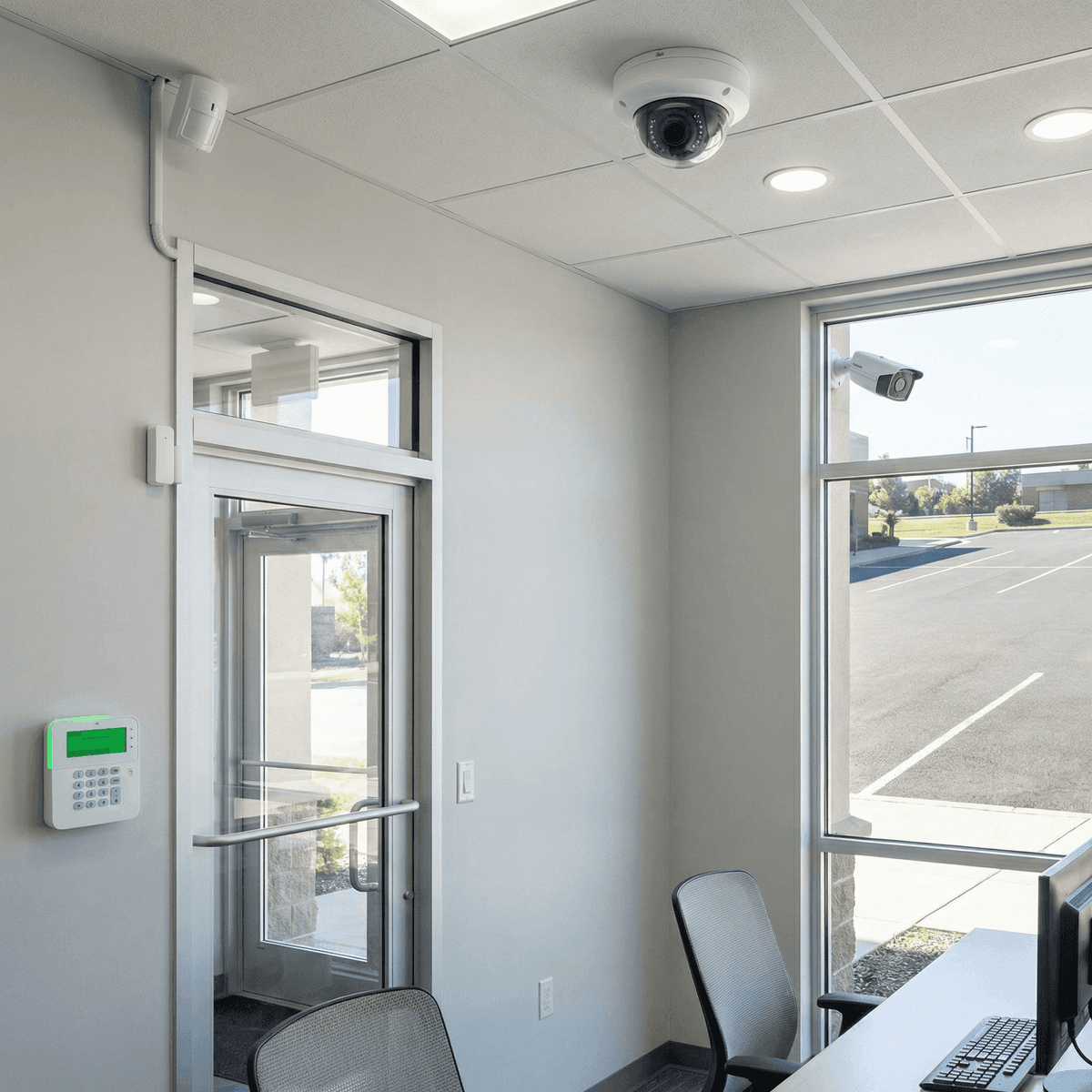
Detection combines 8 perimeter beam sets, 16 PIR detectors, and 16 dual-technology detectors. PIR devices fit sheltered interiors and building approaches, while dual-technology detectors are better for wind-prone or thermally unstable outdoor zones. Beam sets work well along straight fence segments, but they require careful alignment and periodic cleaning in dust-heavy environments.
Power design starts with the load schedule. A typical remote checkpoint package may run 350-700 W continuous load depending on camera count, radio backhaul, heater use, and NVR storage configuration. The battery bank is then sized for 48-72 hours of autonomy, with PV array capacity selected from local irradiance and seasonal worst-month production.
NREL PVWatts states, 'Estimates the energy production of grid-connected photovoltaic systems throughout the world.' Although PVWatts is primarily grid-connected, its 30-year weather-data basis is useful for early solar yield screening. According to NREL PVWatts documentation (2026), expected output ranges are based on 30 years of historical weather data, which helps engineers avoid undersizing remote systems on average-month assumptions.
Battery backup should include low-voltage disconnect, surge protection, correct enclosure ventilation, temperature compensation, and remote state-of-charge monitoring. For lithium systems, require UN 38.3 transport documentation and IEC 62619 or equivalent industrial battery safety review. For lead-acid systems, include ventilation, spill containment, and replacement planning.
Border and Fence Implementation Results
The case site model protects 1 checkpoint, 2-4 lanes, and 1-3 km of fence using layered detection and video verification.
Implementation begins with a risk survey. Engineers mark gate areas, blind corners, likely breach points, lighting gaps, cable routes, radio paths, and solar array locations. Procurement teams should require a zone schedule, camera schedule, power budget, cable schedule, and acceptance test plan before releasing production.
The strongest layout uses layers rather than relying on one sensor type. Fence beams detect perimeter events first, fixed cameras record context, PTZ cameras verify and track movement, and PIR or dual-technology sensors protect buildings and equipment compounds. This reduces false dispatches because the monitoring team can compare alarm zone, video image, and time-of-day rules before sending guards.
According to IEA (2024), solar PV will account for 80% of global renewable power growth through 2030. According to IRENA (2025), solar PV represented about 452.1 GW of renewable capacity additions in 2024, or 77.8% of total renewable additions. These data points matter for B2B buyers because stronger PV supply chains improve replacement availability, reduce lifecycle cost risk, and simplify multi-country maintenance planning.
For a border operator, the measurable gains are practical. Solar-battery power can reduce diesel runtime by 40-60% when the generator is retained only for emergency recharge. Video verification can reduce unnecessary patrol dispatches when analytics and alarm zoning distinguish people, vehicles, animals, weather movement, and authorized gate operations.
SOLARTODO recommends a staged acceptance process. First, test every alarm zone locally. Second, verify camera views during day, night, rain, and dust conditions. Third, disconnect grid or generator input and prove that the system carries the full security load for the specified backup period. Fourth, test remote monitoring escalation with at least 10 simulated events.
Comparison and Selection Guide
For remote borders, solar hybrid security usually beats grid extension and diesel-only power when distances exceed 500 meters or outages exceed 8 hours.
The right architecture depends on terrain, threat level, communications availability, and maintenance access. A simple grid-tied CCTV site may be adequate for urban parking or warehouses, but border fences need power independence and long-range alarm localization. Diesel remains useful as backup, but it should not be the only energy source for 24/7 surveillance.
| Option | Typical Configuration | Strength | Limitation | Best Fit |
|---|---|---|---|---|
| Analog DVR with grid power | 8-16 cameras, limited alarms | Lowest upfront cost | Weak expansion and outage resilience | Small staffed gates |
| Diesel-only CCTV | 16 cameras, generator, NVR | Familiar operation | Fuel theft, noise, maintenance, outage risk | Temporary worksites |
| Solar-battery security | 16 cameras, 32 detectors, 48-72 h backup | Low fuel dependency and remote uptime | Requires solar sizing discipline | Remote fences and checkpoints |
| SOLARTODO off-grid package | 16 cameras, 32 detectors, 64-zone panel, 32CH NVR | Integrated monitoring and expansion | Needs engineered commissioning | Borders, utilities, and high-risk perimeters |
According to IEC 62676 (2013-2014 series), video surveillance systems for security applications should be specified around system requirements, transmission, and application guidance rather than camera count alone. That is why the bill of materials must connect each camera to an operational purpose: detection, recognition, identification, evidence, or overview.
According to UL 681 (ANSI approval 2020), burglar and holdup alarm installations are classified by installation method and protective signaling practice. For border projects, this supports disciplined documentation of control units, circuits, devices, communications, and inspection responsibility.
According to NFPA 72 (2025), supervisory signaling and inspection practices are central where fire alarm interfaces or emergency communication functions are connected. Even when a border project is primarily security-focused, fire interface rules can affect power supplies, annunciation, cable pathways, and maintenance records.
EPC Investment Analysis and Pricing Structure
SOLARTODO structures border security procurement into 3 commercial tiers, with turnkey EPC typically priced at USD 7,100-9,200 per checkpoint package.
EPC means Engineering, Procurement, and Construction. For a border security project, turnkey EPC delivery includes site survey, zone design, solar and battery sizing, mounting plan, device supply, cabling, installation supervision, commissioning, operator training, as-built documentation, and remote monitoring handover. It is the best fit when the buyer needs one accountable package instead of separate solar, CCTV, and alarm contractors.
SOLARTODO supports 3 buying models. FOB Supply covers factory supply for buyers with their own freight forwarder and installation team. CIF Delivered adds international freight and destination-port delivery planning. EPC Turnkey adds field implementation, commissioning, and acceptance testing through a local or regional project team.
| Commercial Tier | Scope Included | Indicative Budget | Buyer Responsibility |
|---|---|---|---|
| FOB Supply | Equipment, factory QA, packing list | USD 5,600-6,800 | Freight, customs, installation |
| CIF Delivered | Equipment plus sea or air delivery support | USD 6,200-7,800 | Import clearance and site works |
| EPC Turnkey | Engineering, procurement, construction, commissioning | USD 7,100-9,200 | Site access and approvals |
Volume pricing can materially change the award decision. For repeat border posts or utility fence programs, SOLARTODO applies indicative discounts of 5% for 50+ units, 10% for 100+ units, and 15% for 250+ units, subject to final configuration, delivery country, battery chemistry, and installation scope.
ROI is usually driven by diesel reduction, fewer unnecessary patrols, and faster incident resolution. A remote site that avoids USD 3,000-5,500 per year in generator fuel, refueling trips, and avoidable guard dispatches can reach payback in 18-36 months compared with diesel-only CCTV. Where grid extension requires trenching, poles, permits, and transformers, avoided civil works can shorten payback further.
Standard payment terms are 30% T/T deposit and 70% against bill of lading, or 100% L/C at sight for qualified institutional buyers. Project financing is available for large programs above >$1,000K. Procurement teams can request configuration, warranty, and EPC quotation support from [email protected] or by contacting SOLARTODO at +6585559114.
FAQ
These 10 answers cover sizing, cost, EPC delivery, warranty, maintenance, and standards for solar-powered border security systems with battery backup.
Q: What is a solar-powered security system for borders and fences? A: A solar-powered border security system uses PV panels, batteries, cameras, intrusion detectors, and communications equipment to protect remote fence lines. The SOLARTODO case configuration uses 16 cameras, 32 detectors, a 64-zone alarm panel, and 48-72 hours of battery backup for continuous monitoring.
Q: How many cameras are needed for a typical border checkpoint? A: A medium checkpoint usually needs 12 fixed IP cameras and 4 PTZ cameras, giving 16 total channels for lanes, gates, buildings, and fence approaches. The 32-channel NVR leaves 16 spare channels for thermal cameras, added gates, or future perimeter expansion.
Q: How much battery backup should a remote fence security system include? A: Most remote border sites should specify 48-72 hours of battery autonomy, calculated from the actual camera, detector, NVR, radio, and lighting load. Critical sites may require a generator input or larger battery bank for extended storms, dust events, or poor winter irradiance.
Q: What does SOLARTODO include in EPC turnkey delivery? A: SOLARTODO EPC delivery includes engineering, procurement, construction support, solar sizing, security zoning, installation supervision, commissioning, training, and as-built documentation. This model is recommended when the buyer wants one accountable supplier for solar power, alarms, CCTV, battery backup, and monitoring handover.
Q: How much does the border and fence package cost? A: The reference Border Checkpoint 32-Zone Off-Grid package is typically USD 5,600-6,800 for FOB supply, USD 6,200-7,800 for CIF delivered, and USD 7,100-9,200 for EPC turnkey. Final pricing depends on battery chemistry, mounting structure, freight route, installation scope, and monitoring requirements.
Q: Which standards should procurement teams request? A: Procurement teams should request IEC 62676 alignment for video surveillance, EN 50131 principles for intrusion systems, UL 681 installation practice, and NFPA 72 review where fire or supervisory signaling is integrated. Battery documentation should include UN 38.3 transport testing and applicable industrial battery safety certification.
Q: How does solar-battery power compare with diesel-only CCTV? A: Solar-battery power reduces diesel runtime, refueling trips, acoustic signature, and fuel theft exposure while keeping 24/7 cameras online. Diesel-only CCTV can work for temporary projects, but remote permanent borders usually benefit from hybrid solar with generator backup retained only for emergency recharge.
Q: What maintenance is required after installation? A: SOLARTODO recommends 2 preventive maintenance visits per year for remote border systems. Technicians should clean PV modules, inspect battery state of health, test alarms, verify camera focus, check grounding, update firmware, clean detector lenses, and confirm monitoring center escalation rules.
Q: Can the system support ANPR or thermal cameras later? A: Yes, the 32-channel NVR and 64-zone alarm panel provide expansion room for ANPR cameras, thermal cameras, extra beam detectors, and gate contacts. Buyers should reserve bandwidth, storage, power capacity, and mounting locations during the first design to avoid rework later.
Q: When is project financing available? A: SOLARTODO can support financing discussions for large projects above >$1,000K, especially multi-site border, utility, telecom, or infrastructure programs. Buyers should prepare a site list, bill of quantities, delivery schedule, payment terms preference, and expected EPC scope before requesting financing review.
Conclusion
For border and fence projects, a 16-camera, 32-detector solar security package with 48-72 hours backup gives the strongest off-grid TCO.
The bottom line: SOLARTODO's solar-powered security and surveillance system is best suited for remote perimeters where grid power is unreliable, diesel logistics are expensive, and incident evidence must be available 24/7. For procurement teams, the recommended next step is a site-specific quotation covering zone design, PV sizing, battery autonomy, communications, and EPC scope.
References
These 7 references anchor the design assumptions in solar resource modeling, CCTV practice, alarm installation, battery safety, and renewable deployment data.
- IEA Renewables 2024 (2024): Forecasts 5,500 GW of renewable additions by 2030 and identifies solar PV as the main growth driver.
- NREL PVWatts Calculator (2026): Provides PV production estimates using long-term weather data for preliminary solar energy modeling.
- IRENA Renewable Power Generation Costs in 2024 (2025): Reports renewable cost competitiveness and 2024 solar PV deployment trends used for investment assumptions.
- IEC 62676 series (2013-2014): Defines video surveillance system requirements, transmission guidance, and application practices for security use.
- EN 50131 series (2006-2020): Provides intrusion and hold-up alarm system principles for detector grading, control equipment, and installation planning.
- UL 681 (2020): Covers installation and classification practices for burglar and holdup alarm systems in commercial security environments.
- NFPA 72 (2025): Defines fire alarm, supervisory signaling, emergency communication, inspection, testing, and maintenance practices where interfaces apply.
About SOLARTODO
SOLARTODO is a global integrated solution provider specializing in solar power generation systems, energy-storage products, smart street-lighting and solar street-lighting, intelligent security & IoT linkage systems, power transmission towers, telecom communication towers, and smart-agriculture solutions for worldwide B2B customers.
Further Reading
About the Author

Cinn Song
Founder & Chief Solutions Architect
Cinn Song founded SOLARTODO LIMITED and leads its smart-city infrastructure engineering — from solar, storage and integrated smart poles to the company's push into physical-AI city edge nodes: pole-mounted edge computing, vertical LLMs for smart cities, drone-based O&M with autonomous battery swapping, robotic maintenance, and high-speed counter-UAS interception. Since 2010, he has directed turnkey EPC + BOT delivery across 50+ countries, including telecom monopole supply for national grid operators, off-grid solar street-lighting for African municipalities, and integrated smart-pole programs for Gulf smart cities.
Cite This Article
Cinn Song. (2026). Solar-Powered Security Systems Case Study: borders and…. SOLARTODO. Retrieved from https://solartodo.com/knowledge/solar-powered-security-systems-case-study-borders-and-fences-implementation-with-battery-backup
@article{solartodo_solar_powered_security_systems_case_study_borders_and_fences_implementation_with_battery_backup,
  title = {Solar-Powered Security Systems Case Study: borders and…},
  author = {Cinn Song},
  journal = {SOLARTODO Knowledge Base},
  year = {2026},
  url = {https://solartodo.com/knowledge/solar-powered-security-systems-case-study-borders-and-fences-implementation-with-battery-backup},
  note = {Accessed: 2026-09-21}
}
Published: July 12, 2026 | Available at: https://solartodo.com/knowledge/solar-powered-security-systems-case-study-borders-and-fences-implementation-with-battery-backup
Subscribe to Our Newsletter
Get the latest solar energy news and insights delivered to your inbox.
View All Articles