Solar-Powered Security Systems Technical Guide: recording sy

SOLARTODO Editorial Team
Solar Energy & Infrastructure Expert Team
Watch the video
TL;DR
For remote and perimeter-heavy sites, solar-powered security systems work best when power sizing, local recording, and on-device AI are engineered together. Most B2B deployments target 4-16 cameras, 15-30 days of retention, and 2-5 days of battery autonomy, with realistic guard labor savings of 30-60% when AI reduces nuisance alarms and supports remote monitoring.
Solar-powered security systems combine 24/7 video, local AI analytics, and battery-backed recording to cut guard labor by 30-60% while sustaining 2-5 days of autonomy. Typical designs use 4-16 cameras, 30-day retention, and 4G plus Ethernet communications.
Summary
Solar-powered security systems combine 24/7 video, local AI analytics, and battery-backed recording to cut guard labor by 30-60% while sustaining 2-5 days of autonomy. Typical designs use 4-16 cameras, 30-day retention, and 4G plus Ethernet communications.
Key Takeaways
- Size solar generation to cover 1.2-1.4x average daily load, with 2-5 days of battery autonomy for remote security sites.
- Use on-device AI models on 4-16 cameras to reduce nuisance alarms by up to 90% versus motion-only legacy CCTV in comparable deployments.
- Specify recording retention at 15-30 days, with H.265 compression and edge plus NVR redundancy for evidentiary continuity.
- Replace static guard-only coverage with AI-assisted monitoring to reduce guard labor costs by 30-60% on repetitive perimeter and after-hours patrol tasks.
- Select communications with 4G, Ethernet, and WiFi failover to maintain alarm transmission above 99% pathway availability in mixed site conditions.
- Segment intrusion architecture into 32, 96, or 128 zones so operators can isolate forecourt, perimeter, office, and storage alarms without merging events.
- Verify compliance with EN 50131, IEC 62676, UL 681, and NFPA 72 principles to improve procurement acceptance and integration quality.
- Compare FOB, CIF, and EPC turnkey pricing early; projects above 50 units typically target 5% discounts, 100 units 10%, and 250 units 15%.
Solar-Powered Security Systems Overview
Solar-powered security systems can deliver 24/7 surveillance, 2-5 days of battery autonomy, and 30-60% guard labor savings when recording, AI analytics, and power design are engineered as one integrated platform.
For B2B buyers, the core question is not whether cameras can run on solar, but whether the full security stack can maintain evidentiary recording, analytics accuracy, and alarm continuity under real operating conditions. A technically sound system combines solar generation, battery storage, edge computing, communications redundancy, and intrusion logic into one design rather than treating power as an afterthought. This matters most at remote assets, logistics yards, telecom sites, fuel stations, temporary worksites, and perimeter-heavy facilities where trenching grid power is expensive or unreliable.
According to the International Energy Agency, "Solar PV is expected to account for the largest share of capacity expansion in power generation," reinforcing its role in distributed infrastructure design. For security applications, distributed solar power reduces dependence on unstable feeders and allows cameras, NVRs, sensors, and wireless backhaul to remain operational during outages. SOLAR TODO positions these systems for project-based B2B procurement, not e-commerce transactions, with quotation, engineering review, and financing support for qualified projects.
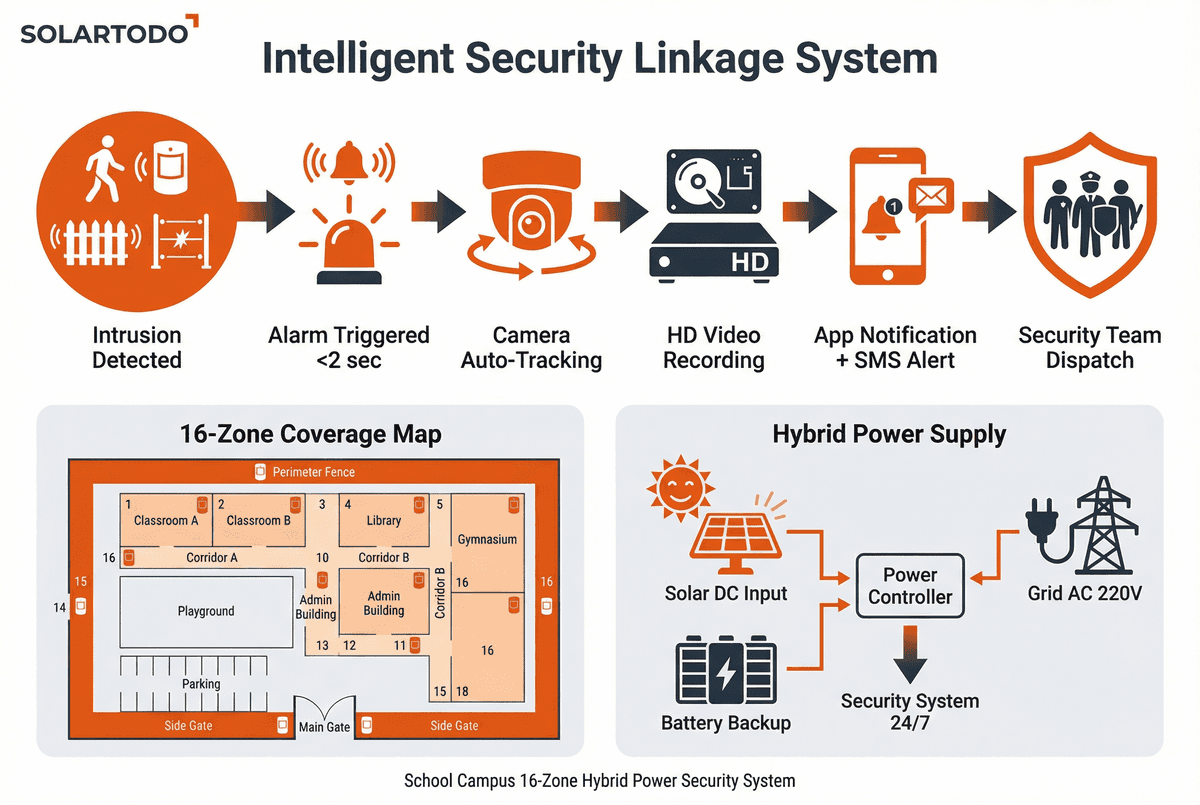
A practical architecture usually includes solar modules, MPPT charge control, lithium battery storage, PoE switching, IP cameras, local recording, and cloud or VMS access. Depending on site risk, the system may also integrate PIR detectors, door contacts, beam sensors, gas detection, sirens, and control panels. In higher-risk deployments, SOLAR TODO can align standalone solar nodes with larger integrated solutions such as 32-zone gas station, 96-zone port terminal, or 128-zone government building platforms.
Recording Systems and Evidence Retention
Recording system design determines whether a solar-powered security deployment captures usable evidence for 15-30 days while balancing bandwidth, storage, and battery load across 4-16 cameras or larger multi-site portfolios.
The recording layer should be planned around evidentiary objectives, not just camera count. A site that only needs live viewing can operate with lower storage and power demand, but most commercial and industrial buyers require searchable playback, event bookmarks, and retention policies for claims, theft, safety incidents, and compliance. That means storage sizing must account for resolution, frame rate, codec, scene complexity, and event density.
Edge recording vs NVR vs cloud
A robust solar-powered security system usually combines at least two recording paths. Edge recording on SD cards inside the camera protects footage during network interruptions. A local NVR centralizes retention, simplifies export, and supports synchronized playback. Cloud backup adds resilience for critical events, but continuous cloud recording can be bandwidth-intensive and expensive in remote deployments.
For many B2B sites, the best balance is event-prioritized hybrid recording. Cameras record continuously at lower bitrates to local storage while AI-tagged events are uploaded or mirrored to a central VMS. This reduces cellular data consumption while preserving incident evidence. SOLAR TODO typically recommends this architecture where 4G is the primary uplink and site visits are infrequent.
Storage sizing fundamentals
Storage demand rises quickly with resolution and retention targets. A 4MP or 8MP camera recording continuously at efficient H.265 settings may still require substantial capacity over 30 days, especially in high-motion scenes such as gates, forecourts, or loading areas. Procurement teams should request storage calculations based on actual scene assumptions rather than generic camera multipliers.
Typical design variables include:
- Resolution: 1080p, 4MP, 8MP, or 4K
- Frame rate: 8-15 fps for overview, 20-25 fps for transaction or gate evidence
- Codec: H.265 or H.265+
- Retention target: 15, 30, or 60 days
- Recording mode: continuous, event-only, or hybrid
- Redundancy: edge SD, RAID NVR, or cloud event archive
According to IEC 62676 guidance frameworks, video surveillance performance should be matched to operational purpose such as monitoring, detection, observation, recognition, or identification. That distinction matters because identification-grade video at entrances or cash points requires higher pixel density than general perimeter monitoring, which directly affects storage and solar energy budgets.
On-Device AI Models and Detection Accuracy
On-device AI models improve solar-powered security performance by filtering people, vehicles, and intrusion events locally, reducing nuisance alarms by up to 90% and lowering bandwidth versus cloud-only analytics.
On-device AI means inference happens inside the camera, edge box, or NVR instead of sending all video to the cloud for analysis. This architecture is especially valuable in solar-powered deployments because it reduces upstream data traffic, shortens response time, and allows analytics to continue even when backhaul quality drops. It also lowers recurring cloud compute costs for sites with dozens of cameras.
What AI models do at the edge
Modern edge analytics commonly support:
- Human and vehicle classification
- Line crossing and intrusion detection
- Loitering and object abandonment alerts
- License plate capture in controlled lanes
- PPE or safety rule detection in selected industrial use cases
- Queue, occupancy, or after-hours presence alerts
The technical objective is not just detection, but actionable detection. A perimeter camera that triggers on rain, insects, shadows, or vegetation creates alarm fatigue and increases guard workload. By contrast, an on-device model can classify a person crossing a fence line at 02:00 and ignore irrelevant motion. In practice, this means operators review fewer false events and dispatch faster to real incidents.
According to NIST evaluations on video and AI system reliability principles, performance depends heavily on training data, scene conditions, camera angle, and operational thresholds. Buyers should therefore ask for test conditions, confidence thresholds, and nighttime performance data rather than accepting generic "AI-enabled" claims. SOLAR TODO should be evaluated on use-case fit: perimeter analytics, gate control, fuel forecourt oversight, and remote asset protection all require different model tuning.
AI design constraints in solar deployments
Edge AI is not free from power and thermal constraints. Running advanced analytics on every stream increases processor load and energy consumption, which can shorten battery runtime if the power system is undersized. Designers should prioritize analytics by risk zone, using full AI on critical cameras and simpler motion or schedule logic on low-risk views.
According to NREL (2024), off-grid system reliability improves when component loading, storage depth of discharge, and seasonal variability are modeled together rather than independently. In security terms, that means AI compute load must be included in the energy budget alongside cameras, IR illumination, switches, radios, and recorders. A system that works in summer but fails after three cloudy days is not a security system; it is a pilot.
System Architecture, Power Design, and Communications
A dependable solar-powered security architecture pairs 1.2-1.4x daily energy generation with lithium storage sized for 2-5 autonomy days and dual-path communications such as 4G plus Ethernet or WiFi.
The engineering sequence should start with load analysis, then solar resource, then storage, then communications. Many failed projects reverse this order by selecting cameras first and only later estimating battery runtime. For remote or outage-prone sites, the power subsystem is as critical as the camera specification because every watt affects autonomy and lifecycle cost.
Core architecture blocks
A typical B2B solar-powered security deployment includes:
- Solar PV modules sized to seasonal irradiance and daily load
- MPPT charge controller for charging efficiency
- LiFePO4 battery bank for cycle life and thermal stability
- DC distribution or inverter depending on AC/DC loads
- IP cameras and PoE switch
- Edge AI appliance or AI-capable cameras
- NVR or industrial recorder
- 4G router with VPN, Ethernet, or wireless bridge
- Intrusion panel, sirens, and sensors where required
According to IRENA (2024), solar plus storage continues to gain competitiveness in distributed energy applications where diesel logistics or grid extension costs are high. That matters for security projects because trenching power to a perimeter pole or remote gate can exceed the cost of a self-powered surveillance node. In many cases, the economic comparison is not solar versus grid electricity, but solar versus civil works, downtime risk, and guard labor.
Communications and cybersecurity
Security systems need resilient signaling, not just internet access. Best practice is to separate video transport from alarm signaling priorities where possible, using QoS, VPN tunnels, and local failover logic. If the uplink fails, the site should continue recording locally and queue events for later synchronization.
According to the U.S. Cybersecurity and Infrastructure Security Agency, organizations should apply network segmentation, strong authentication, and patch management to connected physical security devices. SOLAR TODO buyers should request device hardening baselines, password policies, firmware management procedures, and remote-access controls as part of the technical submittal.
Guard Labor Savings, Use Cases, and ROI
Guard labor savings of 30-60% are realistic when solar-powered security systems automate repetitive observation across 4-16 cameras, while keeping human guards focused on response, escalation, and high-value patrol tasks.
The strongest ROI case appears where guards spend large amounts of time on low-value visual monitoring, perimeter rounds, or after-hours presence checks. AI-assisted surveillance does not eliminate all labor, but it changes the labor mix. One remote operator can supervise multiple low-traffic sites while local guards are redeployed to incident response, access control, or mobile patrols.
Typical use cases
Common B2B applications include:
- Remote telecom compounds and power infrastructure
- Construction sites without permanent utility service
- Fuel stations and forecourts with hazardous zones
- Ports, logistics yards, and bonded storage areas
- Farms, irrigation assets, and smart agriculture perimeters
- Municipal assets, pumping stations, and substations
For example, a chain operator with 20 small remote sites may replace overnight static guard presence at selected low-risk locations with AI-triggered remote monitoring, local sirens, and event-based dispatch. A higher-risk port or government site may instead use solar-powered nodes to extend perimeter coverage while keeping manned control rooms and central recording. SOLAR TODO can support both distributed standalone nodes and larger integrated systems.
BloombergNEF and multiple integrator benchmarks consistently show that labor and OPEX dominate lifecycle costs in surveillance-heavy operations. If one guard post costs materially more per year than a solar-powered multi-camera node, the payback can be short even before accounting for theft reduction, outage resilience, and incident documentation. The International Energy Agency states, "Digitalization can improve system efficiency, reliability and resilience," which is directly relevant to AI-assisted security operations.
Comparison table: architecture choices
| Configuration | Typical Cameras | Power Source | Recording | AI Location | Best Use Case | Main Trade-Off |
|---|---|---|---|---|---|---|
| Basic solar node | 2-4 | Solar + battery | Edge SD | In-camera | Remote gate, pump, fence corner | Lower retention and expansion |
| Standard remote site | 4-8 | Solar + battery | Edge + local NVR | In-camera/NVR | Telecom, farm, small depot | Higher battery and enclosure size |
| Advanced multi-zone site | 8-16 | Solar hybrid or grid-backed solar | NVR + cloud events | Camera + edge box | Fuel station, yard, branch facility | More integration complexity |
| Enterprise integrated site | 16+ | Grid with solar backup or distributed solar nodes | Central VMS + NVR | Multi-layer AI | Port, campus, critical infrastructure | Highest capex and commissioning scope |
EPC Investment Analysis and Pricing Structure
EPC turnkey delivery for solar-powered security systems typically includes engineering, procurement, installation, commissioning, and training, with pricing structured as FOB supply, CIF delivered, or full EPC depending on project scope.
For B2B procurement, pricing should be compared on scope parity. A low supply-only number may exclude poles, foundations, batteries, cabinets, networking, installation, testing, and operator training. A proper commercial comparison should define exactly what is included in each tier.
Three-tier pricing model
- FOB Supply: equipment only, ex-factory or port basis; suitable for local integrators with installation capability
- CIF Delivered: equipment plus freight and insurance to destination port; useful where buyers manage customs and local works
- EPC Turnkey: full engineering, procurement, construction, installation, testing, commissioning, and handover
Indicative project economics vary by camera count, autonomy days, pole works, and AI requirements. As a planning range, small 4-camera solar sites may start in the low five figures for turnkey delivery, while 8-16 camera multi-zone systems with batteries, analytics, and communications redundancy can move into mid five-figure or higher territory. Portfolio projects usually improve unit economics through shared engineering and standardized BOMs.
Volume discounts, payment terms, and financing
Standard volume pricing guidance is:
- 50+ units: 5% discount
- 100+ units: 10% discount
- 250+ units: 15% discount
Typical payment terms are 30% T/T in advance and 70% against B/L, or 100% L/C at sight for qualified transactions. Financing may be available for large projects above $1,000K, subject to project review, jurisdiction, and buyer credit profile. For quotations and EPC discussions, buyers can contact [email protected].
ROI logic
ROI should compare the system against guard labor, trenching cost, diesel backup, outage losses, and theft exposure rather than equipment cost alone. If a site avoids one full-time night guard post or reduces patrol frequency across multiple low-risk locations, payback may fall within 12-36 months depending on wage levels and incident history. Additional value comes from better evidence quality, faster response, and lower uninsured losses.
FAQ
A concise FAQ with 10 direct answers helps buyers compare recording, AI, power autonomy, EPC scope, and maintenance requirements for solar-powered security systems.
Q: What is a solar-powered security system? A: A solar-powered security system uses PV modules, batteries, cameras, recording devices, and communications equipment to deliver surveillance without depending entirely on grid power. Most B2B designs support 24/7 operation, local recording, and 2-5 days of battery autonomy for outages or remote sites.
Q: How many cameras can a typical solar-powered security system support? A: A typical standalone solar system supports 2-8 cameras comfortably, while larger engineered systems can support 8-16 cameras or more with expanded PV and battery capacity. The real limit depends on camera wattage, IR use, AI processing load, recorder power draw, and required autonomy days.
Q: What recording retention should commercial buyers specify? A: Most commercial buyers specify 15-30 days of retention because it balances evidentiary needs with storage and power cost. High-risk sites such as fuel stations, ports, or public facilities may require 30 days or longer, especially when incident review, insurance claims, or regulatory investigations are common.
Q: Why is on-device AI better than cloud-only analytics for remote sites? A: On-device AI reduces bandwidth, improves response speed, and keeps analytics running during network degradation. It is especially effective on solar-powered sites because local inference lowers upstream data traffic and can reduce nuisance alarms by up to 90% compared with motion-only legacy CCTV workflows.
Q: How much guard labor can AI-assisted surveillance realistically save? A: Many projects target 30-60% guard labor savings by reducing repetitive observation and low-value patrol tasks, not by removing all personnel. Savings are highest where remote operators can supervise multiple low-traffic sites and local guards are reserved for dispatch, intervention, and high-risk access control.
Q: What battery autonomy is recommended for solar-powered security systems? A: Most professional designs target 2-5 days of autonomy, depending on weather risk, criticality, and service response time. Sites in cloudy regions, cyclone-prone areas, or hard-to-access locations should lean toward the higher end, especially if they run NVRs, radios, and IR-heavy cameras overnight.
Q: What standards should buyers require in procurement documents? A: Buyers should typically reference EN 50131 for intrusion systems, IEC 62676 for video surveillance, UL 681 for installation practices, and NFPA 72 principles for alarm signaling interfaces. For power components, battery, solar, and electrical safety requirements should also be aligned with local code and project jurisdiction.
Q: How do solar-powered systems compare with grid-powered CCTV? A: Solar-powered systems usually cost more upfront per node but can lower total project cost where trenching, utility extension, or outage mitigation is expensive. They are often the better option for remote perimeters, temporary sites, and distributed assets where resilience and deployment speed matter more than lowest initial hardware cost.
Q: What maintenance do these systems require? A: Routine maintenance includes cleaning solar modules, checking battery health, verifying charging performance, updating firmware, testing communications, and confirming recording integrity. Most operators should schedule inspections every 3-6 months, with additional checks after storms, dust events, or major security incidents.
Q: What is included in EPC turnkey delivery from SOLAR TODO? A: EPC turnkey delivery generally includes engineering, bill of materials, procurement, installation, commissioning, testing, training, and handover documentation. Depending on contract scope, SOLAR TODO may also include poles, cabinets, foundations, networking, integration to a central platform, and post-commissioning support.
Q: What are the usual pricing and payment terms for B2B projects? A: Pricing is usually offered as FOB Supply, CIF Delivered, or EPC Turnkey so buyers can compare scope accurately. Standard payment terms are 30% T/T plus 70% against B/L, or 100% L/C at sight, with financing potentially available for projects above $1,000K.
Q: When should a buyer choose a hybrid solar-plus-grid architecture? A: A hybrid architecture is best when the site has grid access but suffers frequent outages or needs lower battery size than a fully off-grid system. It is also useful for 8-16 camera sites with NVRs and AI workloads where resilience is critical but full off-grid sizing would raise capex significantly.
References
A strong procurement decision should rely on recognized standards and energy-system sources that define surveillance performance, alarm integration, distributed power design, and connected-device resilience.
- NREL (2024): PV system performance modeling guidance and distributed energy analysis relevant to off-grid and hybrid solar sizing.
- IEC 62676 (2024): Video surveillance systems for use in security applications, including operational and performance guidance.
- EN 50131 (2024): Intrusion and hold-up alarm system framework for zone-based security design and system grading.
- UL 681 (2023): Installation and classification practices for burglary and holdup alarm systems.
- NFPA 72 (2022): National Fire Alarm and Signaling Code principles relevant to alarm transmission pathways and integration.
- IEA (2024): Energy technology and solar deployment outlooks supporting distributed PV use in resilient infrastructure.
- IRENA (2024): Renewable power and distributed energy economics relevant to solar-plus-storage applications.
- CISA (2023): Cybersecurity guidance for network-connected operational and physical security devices.
Conclusion
Solar-powered security systems deliver the best value when 24/7 recording, on-device AI, and 2-5 days of battery autonomy are designed together, enabling 30-60% guard labor savings with stronger outage resilience.
For remote and perimeter-heavy B2B sites, SOLAR TODO should be evaluated as an engineered security platform rather than a camera kit: the bottom line is that properly sized solar, local AI, and hybrid recording can cut OPEX fast while improving evidentiary performance across 4-16 cameras and beyond.
About SOLARTODO
SOLARTODO is a global integrated solution provider specializing in solar power generation systems, energy-storage products, smart street-lighting and solar street-lighting, intelligent security & IoT linkage systems, power transmission towers, telecom communication towers, and smart-agriculture solutions for worldwide B2B customers.
About the Author

SOLARTODO Editorial Team
Solar Energy & Infrastructure Expert Team
SOLAR TODO is a professional supplier of solar energy, energy storage, smart lighting, smart agriculture, security systems, communication towers, and power tower equipment.
Our technical team has over 15 years of experience in renewable energy and infrastructure, providing high-quality products and solutions to B2B customers worldwide.
Expertise: PV system design, energy storage optimization, smart lighting integration, smart agriculture monitoring, security system integration, communication and power tower supply.
Cite This Article
SOLARTODO Editorial Team. (2026). Solar-Powered Security Systems Technical Guide: recording sy. SOLARTODO. Retrieved from https://solartodo.com/knowledge/solar-powered-security-systems-technical-guide-recording-systems-on-device-ai-models-and-guard-labor-savings
@article{solartodo_solar_powered_security_systems_technical_guide_recording_systems_on_device_ai_models_and_guard_labor_savings,
  title = {Solar-Powered Security Systems Technical Guide: recording sy},
  author = {SOLARTODO Editorial Team},
  journal = {SOLARTODO Knowledge Base},
  year = {2026},
  url = {https://solartodo.com/knowledge/solar-powered-security-systems-technical-guide-recording-systems-on-device-ai-models-and-guard-labor-savings},
  note = {Accessed: 2026-09-01}
}
Published: April 22, 2026 | Available at: https://solartodo.com/knowledge/solar-powered-security-systems-technical-guide-recording-systems-on-device-ai-models-and-guard-labor-savings
Subscribe to Our Newsletter
Get the latest solar energy news and insights delivered to your inbox.
View All Articles