solar water pumping for agricultural irrigation systems |…

Cinn Song
Founder & Chief Solutions Architect
TL;DR
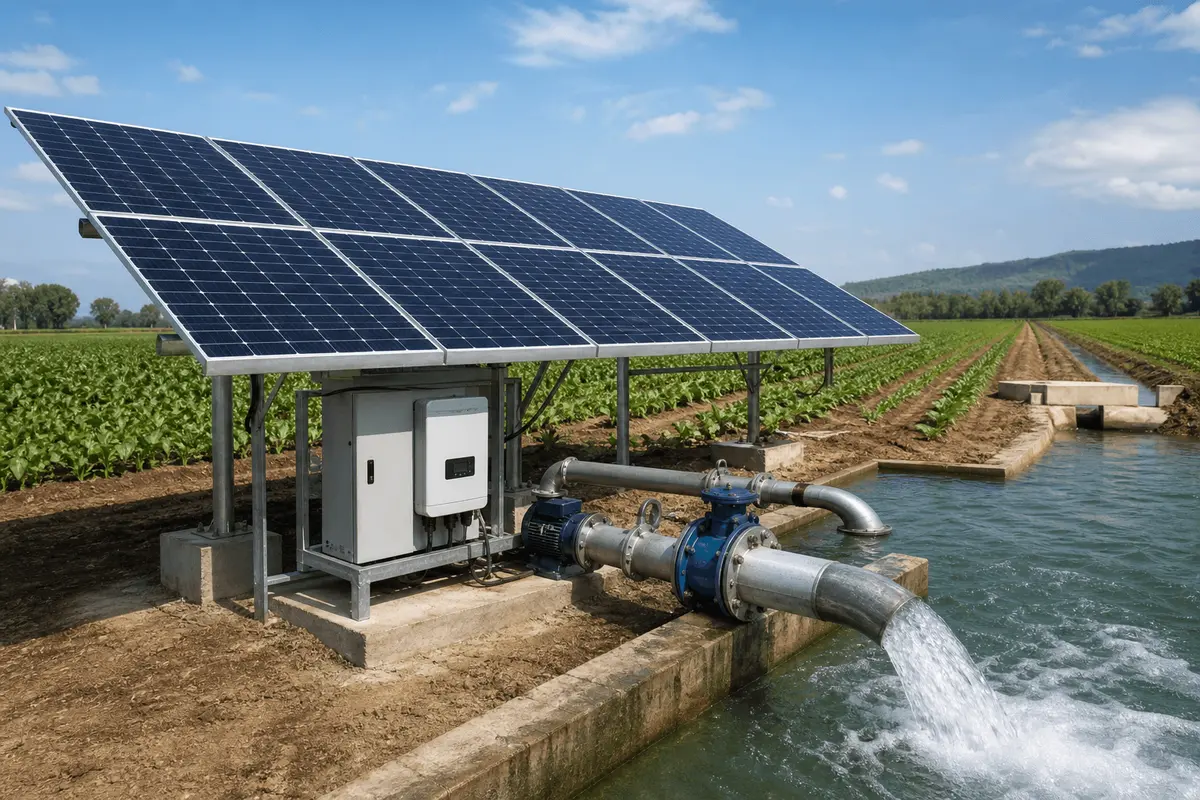
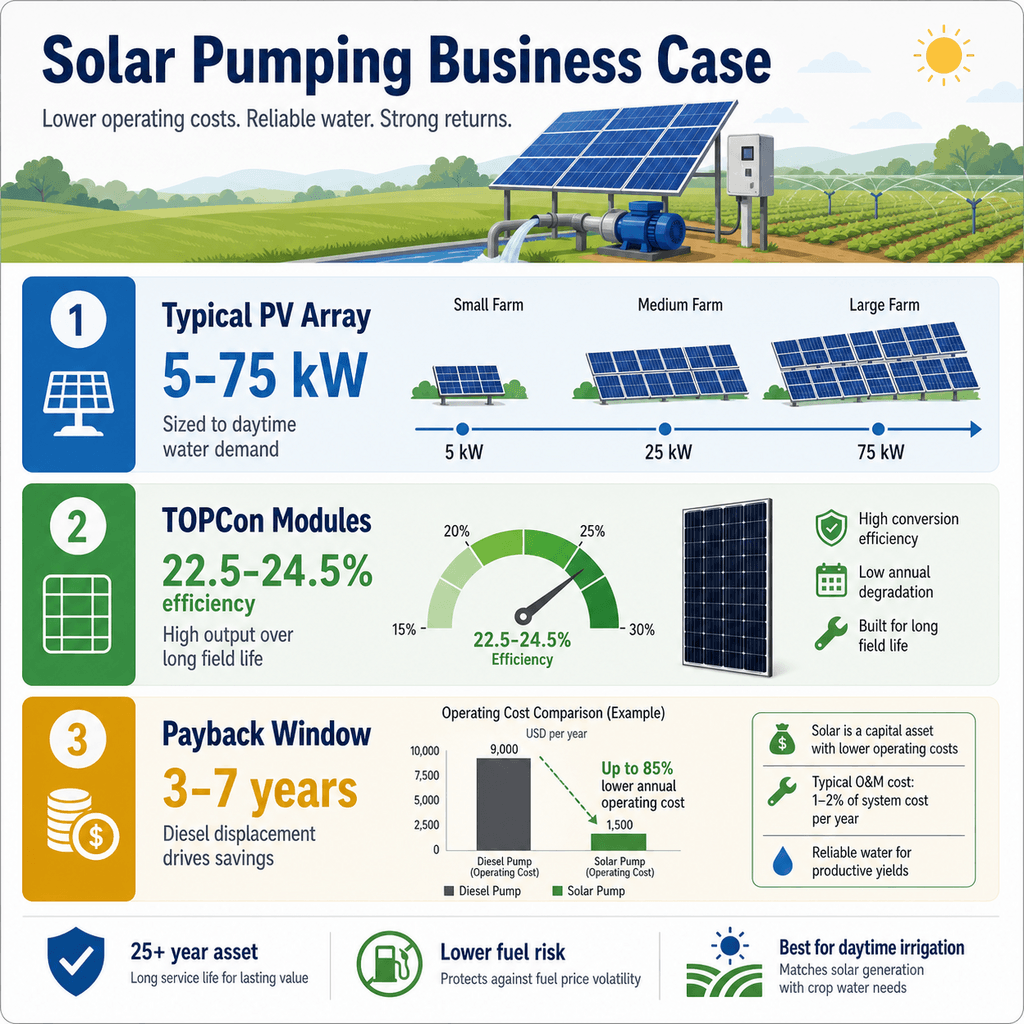
Solar water pumping is best for farms that need reliable daytime irrigation and want to reduce diesel or weak-grid dependence. A properly sized 5-75kW PV pump system uses verified m3/day demand, total dynamic head, pump curves, and 1-3 days of water storage. With 22.5-24.5% TOPCon modules, many projects reach 3-7 year payback.
Solar water pumping for irrigation replaces diesel or weak-grid pumping with 5-75kW PV arrays, 22.5-24.5% TOPCon modules, and 3-7 year payback for farms needing daytime water, lower fuel risk, and 25+ year assets.
Summary
Solar water pumping for irrigation replaces diesel or weak-grid pumping with 5-75kW PV arrays, 22.5-24.5% TOPCon modules, and 3-7 year payback for farms needing daytime water, lower fuel risk, and 25+ year assets.
Key Takeaways
A bankable solar irrigation project should match 1 daily water target, 1 total dynamic head figure, and 1 crop calendar before procurement.
- Calculate daily irrigation demand in m3/day before sizing a 5kW, 30kW, or 75kW solar pump package.
- Specify total dynamic head within 10% accuracy because every 10m of lift materially changes pump power and PV array size.
- Select 22.5-24.5% N-type TOPCon modules for limited land areas and 25+ year service life.
- Replace 50-85 liters/day of diesel use in a typical 30kW irrigation duty cycle to improve 3-5 year payback.
- Store water in elevated or lined reservoirs sized for 1-3 days instead of batteries for most daytime irrigation systems.
- Protect pumps with dry-run, overvoltage, surge, and tank-full controls to maintain 95%+ seasonal availability.
- Compare FOB, CIF, and EPC turnkey offers because civil works can add 35-60% beyond equipment supply.
- Request SOLARTODO project financing for irrigation programs above $1,000K and volume discounts of 5-15%.
Solar Water Pumping for Agricultural Irrigation Systems
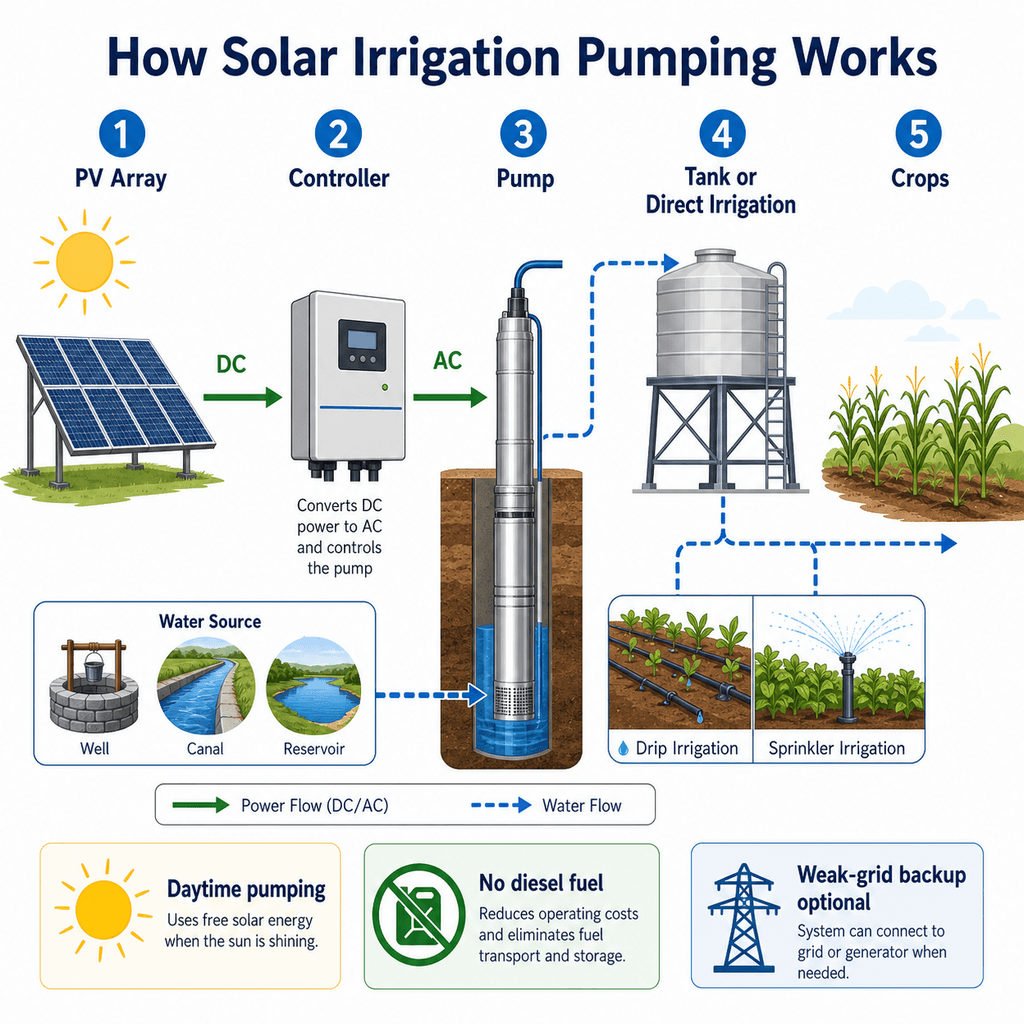
Solar water pumping for irrigation uses 5-75kW PV arrays, variable-speed drives, and borehole or surface pumps to move water during high-sun hours. For farms using diesel or unreliable grid power, the strongest business case is a 3-7 year payback and 25+ year PV asset life.
The core problem is not only energy cost; it is water timing. Farmers need predictable flow during crop stress windows, while diesel logistics, voltage drops, and fuel theft create operating risk during the same weeks when yield is most exposed. Solar pumping aligns well with irrigation because solar production usually peaks when evapotranspiration and daytime pumping demand are highest.
According to FAO AQUASTAT (2024), agriculture accounts for roughly 70% of global freshwater withdrawals, making efficient irrigation energy a strategic procurement issue rather than a small equipment purchase. According to IRENA (2025), renewable capacity increased by 585GW in 2024, with solar adding 452GW and reaching 1,865GW of global capacity. This scale is why solar pump procurement now benefits from mature PV supply chains, standardized controls, and lower module cost.
SOLARTODO positions solar water pumping as a B2B project solution, not an online marketplace item. Buyers submit site data, water demand, borehole depth, crop schedule, and delivery terms; SOLARTODO then prepares an offline quotation covering equipment supply, CIF delivery, or EPC turnkey implementation.
Technical Architecture and Sizing Method
A reliable solar irrigation system needs 4 inputs: m3/day demand, total dynamic head, pump curve, and site irradiation before selecting PV capacity.
A typical system includes N-type mono TOPCon PV modules, a mounting structure, DC combiner and protection, a solar pump inverter or variable frequency drive, submersible or surface pump, level sensors, flow meter, pressure protection, and remote monitoring. For compact commercial farms, module efficiency of 22.5-24.5% reduces land use and wiring runs compared with lower-efficiency panels. SOLARTODO normally sizes fixed-tilt arrays for low mechanical complexity and long field life.
Sizing starts with water, not watts. Daily water volume depends on crop evapotranspiration, irrigated area, soil water holding capacity, irrigation efficiency, and growth stage. Total dynamic head includes static water level, drawdown, elevation to tank or field, pipe friction, filter loss, and pressure required by sprinklers or drip emitters. A 30m error in head can shift the selected pump class, cable size, inverter rating, and PV capacity.
The simplified hydraulic relationship is useful for procurement screening: hydraulic power in kW equals flow in m3/s multiplied by head in meters, water density, and gravity, divided by pump efficiency. In practical tenders, engineers should use manufacturer pump curves and apply seasonal derating for high temperature, dusty modules, and low-water-level periods.
NREL states, 'Estimates the energy production of grid-connected photovoltaic systems throughout the world.' Although PVWatts is designed for grid-connected PV, its solar resource approach helps engineers validate site irradiation and monthly production assumptions before final pump simulation. According to NREL (2026), PVWatts uses long-term weather data to estimate interannual energy variation, which is important for irrigation risk analysis.
Pump and Control Options
Submersible borehole pumps are preferred for wells, deep aquifers, and livestock-water points where suction lift is impractical. Surface centrifugal pumps fit canals, ponds, rivers, and reservoirs where water is accessible and filtration is manageable. Helical rotor pumps often suit low-flow, high-head duties, while multistage centrifugal pumps suit higher daily volumes.
Controllers should include maximum power point tracking, soft start, dry-run protection, tank-full shutdown, overcurrent protection, surge protection, and optional grid or generator input. Where irrigation cannot stop during cloudy periods, hybrid AC input or a water reservoir is usually more economical than battery storage. Batteries make sense only when night pumping is mandatory or when the same PV plant supports cold rooms, sensors, or farm buildings.
Applications, Use Cases, and Operating Benefits
Solar pumping performs best when irrigation demand is 4-8 sun-hours/day and water storage can buffer 1-3 cloudy days.
Common B2B applications include drip irrigation for vegetables, orchard irrigation, pivot support for medium farms, livestock water distribution, aquaculture circulation, greenhouse fertigation, and community irrigation schemes. In Latin America, Africa, the Middle East, and Southeast Asia, the strongest use cases often involve remote farms where diesel supply is expensive and grid extension is slow.
According to IEA (2024), solar PV is forecast to provide 80% of global renewable capacity growth through 2030. IEA Executive Director Fatih Birol states, 'renewables today offer the cheapest option to add new power plants.' For irrigation buyers, that matters because pumping is an energy-intensive process with a clear avoided-cost benchmark: diesel, grid tariffs, or generator rental.
A 30kW solar pump replacing a diesel generator for 6 hours/day can avoid about 180kWh/day of diesel-generated energy. At 0.28 liters/kWh, that equals about 50 liters/day. Over a 180-day irrigation season at $1.00/liter, fuel savings approach $9,000/year before maintenance, oil, transport, and downtime benefits. In high-fuel-cost regions, payback can compress to 3-5 years.
Water storage changes system economics. A raised tank or lined pond stores hydraulic output directly, avoids battery conversion losses, and lets farmers irrigate early morning or evening. For drip systems, reservoir sizing of 1-3 days of crop demand is common where land and civil works budget allow it. Smart controls can also stop pumping when tanks are full, reducing overflow and aquifer over-extraction.
EPC Investment Analysis and Pricing Structure
EPC turnkey delivery combines engineering, procurement, construction, testing, and training into 1 accountable scope for irrigation projects above 10kW.
EPC means the supplier or project partner owns the full delivery chain: site survey, hydraulic design, electrical design, structural layout, procurement, logistics, installation, trenching, pump installation, piping interfaces, commissioning, and operator training. For procurement teams, the value is fewer interface disputes and clearer responsibility for flow, head, safety, and performance acceptance.
SOLARTODO supports three commercial models. FOB Supply is suitable when the buyer or local EPC already manages shipping and installation. CIF Delivered adds international freight and delivery documentation to the destination port. EPC Turnkey adds engineering, local civil works, electrical installation, pump commissioning, monitoring setup, and performance handover.
| Package type | Typical scope | Indicative budget logic | Buyer profile |
|---|---|---|---|
| FOB Supply | PV modules, pump, inverter, controls, protection | Lowest equipment-only price, excluding freight and site works | Distributors, EPCs, government procurement |
| CIF Delivered | FOB scope plus ocean freight, insurance, export documents | Adds logistics cost and delivery risk control | Importers and regional contractors |
| EPC Turnkey | Design, supply, installation, testing, training | Often 35-60% above supply due to civil and labor scope | Farms, NGOs, utilities, irrigation authorities |
For multi-site programs, SOLARTODO can structure volume pricing guidance at 50+ systems for a 5% discount, 100+ systems for a 10% discount, and 250+ systems for a 15% discount, subject to final specification, delivery country, and payment risk. Standard payment terms are 30% T/T deposit plus 70% against B/L, or 100% L/C at sight. Project financing is available for large programs above $1,000K; contact [email protected] for commercial review.
Warranty and acceptance criteria should be written into the purchase order. PV modules should reference IEC 61215 and IEC 61730, inverters should include local grid or generator compatibility where applicable, pumps should include curve documentation, and commissioning should verify measured flow at operating head. SOLARTODO can prepare a project-specific quotation through the inquiry-to-offline-quotation process.
Selection Guide and Specification Table
Buyers should compare solar pump proposals by delivered m3/day, head, controls, standards, and 25-year lifecycle cost, not by panel wattage alone.
The most common procurement mistake is treating PV array size as the main specification. A 20kW array on the wrong pump curve can underperform a 15kW package with better hydraulic matching. The second mistake is ignoring source-water variability; borehole drawdown during dry season can raise total head and reduce flow when crops need water most.
| Selection factor | Recommended specification | Why it matters |
|---|---|---|
| PV modules | N-type mono TOPCon, 22.5-24.5% efficiency | Reduces land area and supports 25+ year life |
| Pump sizing | Verified at design flow and total dynamic head | Prevents under-delivery during dry season |
| Storage | 1-3 days of water where feasible | Buffers clouds without batteries |
| Controls | MPPT, VFD, dry-run, tank-full, surge protection | Protects motor and improves availability |
| Monitoring | Flow, runtime, alarms, optional remote dashboard | Supports O&M and warranty claims |
| Standards | IEC 61215, IEC 61730, IEEE 1547 where grid-interactive | Improves safety, bankability, and compliance |
| Commercial model | FOB, CIF, or EPC turnkey | Aligns responsibility with buyer capability |
According to IEA (2024), global solar manufacturing capacity was expected to exceed 1,100GW by the end of 2024, more than double projected demand, and module prices more than halved since early 2023. That improves equipment affordability, but procurement teams should still assess bankability, warranty execution, spare parts, and country-specific certification.
For technical due diligence, request a datasheet package with module certificates, pump curve, inverter manual, wiring diagram, bill of materials, mounting load assumptions, and commissioning procedure. For agricultural programs, require a seasonal water-output table, not only peak flow. A good proposal should state expected m3/day for low, average, and high irradiation months.
FAQ
Solar irrigation FAQs should resolve 10 procurement questions covering sizing, cost, installation, maintenance, standards, and EPC warranty responsibility.
Q: What is a solar water pumping system for irrigation? A: A solar water pumping system uses PV modules, a pump inverter, and a submersible or surface pump to move water for crops. Typical farm systems range from 5kW to 75kW, depending on daily water demand and total dynamic head. Most systems pump during sunlight hours and store water in tanks or reservoirs.
Q: How do I size a solar pump for a farm? A: Start with daily water demand in m3/day, total dynamic head in meters, and peak irrigation months. Engineers then match the required flow and head to a pump curve and size the PV array for local irradiation. A 10% head error can materially change pump output and investment cost.
Q: Is solar pumping cheaper than diesel pumping? A: Solar pumping is usually cheaper over the lifecycle where diesel fuel, transport, and maintenance are significant. A 30kW system replacing about 50 liters/day of diesel over a 180-day season can save roughly $9,000/year at $1.00/liter. Typical payback is 3-7 years, depending on site conditions.
Q: Do solar irrigation pumps need batteries? A: Most agricultural solar pumps do not need batteries because water storage is cheaper and more durable. A 1-3 day tank or lined reservoir stores pumped water directly and avoids battery conversion losses. Batteries are mainly justified for night pumping, shared farm loads, or critical greenhouse operations.
Q: What pump type is best for boreholes? A: Submersible borehole pumps are usually best for wells because they avoid suction-lift limits and operate below the water level. The correct choice depends on casing diameter, static water level, drawdown, flow target, and total dynamic head. Always request a pump curve for the exact model offered.
Q: What does EPC turnkey delivery include? A: EPC turnkey delivery includes engineering, procurement, construction, commissioning, and operator training under one delivery responsibility. For solar irrigation, this normally covers hydraulic design, PV layout, mounting, cabling, pump installation, pipe interfaces, controls, testing, and handover. It costs more than FOB supply but reduces interface risk.
Q: What warranties should buyers require? A: Buyers should require PV module product and performance warranties, pump and inverter warranties, and a commissioning acceptance test. Modules should reference IEC 61215 and IEC 61730, while inverters and controls should meet local electrical rules. For EPC projects, measured flow at design head should be part of acceptance.
Q: How much maintenance does a solar pump need? A: Maintenance is modest but not zero. Operators should clean modules when soiling reduces output, inspect cables and earthing, check filters, confirm dry-run sensors, and record flow meter data. A professional inspection every 6-12 months helps maintain 95%+ seasonal availability and supports warranty documentation.
Q: Can solar pumping be connected to the grid or a generator? A: Yes, many solar pump inverters support hybrid input from PV plus grid or generator power. This is useful when crops require irrigation during cloudy weather or outside daylight hours. Grid-interactive designs may require compliance with IEEE 1547-2018 or local interconnection standards.
Q: How should procurement compare FOB, CIF, and EPC prices? A: Compare FOB, CIF, and EPC prices by scope, not headline price. FOB supply excludes freight and installation, CIF adds delivered logistics, and EPC turnkey adds civil, electrical, hydraulic, commissioning, and training work. For 50+ systems, ask SOLARTODO about 5% volume pricing guidance and standardized documentation.
References
These 8 references support solar irrigation design with PV performance methods, water-use context, safety standards, and renewable market data from 2018-2026.
- IRENA (2025): Renewable Capacity Highlights 2025, reporting 585GW renewable additions in 2024 and 452GW from solar; https://www.irena.org/Publications/2025/Mar/Renewable-capacity-statistics-2025
- IEA (2024): Renewables 2024, forecasting solar PV to provide 80% of global renewable capacity growth to 2030; https://www.iea.org/reports/renewables-2024
- NREL (2026): PVWatts Calculator v8.7.3 and API v8.5 for estimating photovoltaic energy production from long-term solar resource data; https://pvwatts.nrel.gov/
- FAO AQUASTAT (2024): Global water withdrawal data showing agriculture as the dominant freshwater user, commonly around 70% of withdrawals; https://www.fao.org/aquastat/
- IEC 61215-1:2021 (2021): Terrestrial photovoltaic module design qualification and type approval requirements for crystalline silicon PV modules.
- IEC 61730-1:2023 (2023): Photovoltaic module safety qualification requirements covering construction, electrical safety, and mechanical safety.
- IEEE 1547-2018 (2018): Standard for interconnection and interoperability of distributed energy resources with electric power systems.
- UL 1741 (2021): Inverters, converters, controllers, and interconnection equipment safety standard relevant to PV power conversion equipment.
Conclusion
Solar water pumping is most bankable when a 5-75kW PV system is specified around verified water demand, total dynamic head, and 25-year lifecycle cost.
The bottom line: for agricultural irrigation above 10kW, SOLARTODO solar pumping systems using 22.5-24.5% TOPCon modules can reduce diesel exposure, support 3-7 year payback, and create a more predictable water-energy platform for farms, EPCs, and public irrigation programs.
About SOLARTODO
SOLARTODO is a global integrated solution provider specializing in solar power generation systems, energy-storage products, smart street-lighting and solar street-lighting, intelligent security & IoT linkage systems, power transmission towers, telecom communication towers, and smart-agriculture solutions for worldwide B2B customers.
Procurement paths
About the Author

Cinn Song
Founder & Chief Solutions Architect
Cinn Song founded SOLARTODO LIMITED and leads its smart-city infrastructure engineering — from solar, storage and integrated smart poles to the company's push into physical-AI city edge nodes: pole-mounted edge computing, vertical LLMs for smart cities, drone-based O&M with autonomous battery swapping, robotic maintenance, and high-speed counter-UAS interception. Since 2010, he has directed turnkey EPC + BOT delivery across 50+ countries, including telecom monopole supply for national grid operators, off-grid solar street-lighting for African municipalities, and integrated smart-pole programs for Gulf smart cities.
Cite This Article
Cinn Song. (2026). solar water pumping for agricultural irrigation systems |…. SOLARTODO. Retrieved from https://solartodo.com/knowledge/solar-water-pumping-for-agricultural-irrigation-systems
@article{solartodo_solar_water_pumping_for_agricultural_irrigation_systems,
  title = {solar water pumping for agricultural irrigation systems |…},
  author = {Cinn Song},
  journal = {SOLARTODO Knowledge Base},
  year = {2026},
  url = {https://solartodo.com/knowledge/solar-water-pumping-for-agricultural-irrigation-systems},
  note = {Accessed: 2026-09-18}
}
Published: June 16, 2026 | Available at: https://solartodo.com/knowledge/solar-water-pumping-for-agricultural-irrigation-systems
Subscribe to Our Newsletter
Get the latest solar energy news and insights delivered to your inbox.
View All Articles