Storage Financial Model Assumptions for BTM vs FOM

Cinn Song
Founder & Chief Solutions Architect
TL;DR
Document the SAM financial model first: Residential, Commercial, and Third Party Ownership mean BTM bill reduction; PPA and Merchant Plant mean FOM revenue generation.
State the SAM financial model as a primary assumption. SAM classifies Residential, Commercial, and Third Party Ownership as behind-the-meter bill-reduction cases, while PPA and Merchant Plant are front-of-meter revenue-generation cases.
Key Takeaways
- The financial model, not only the battery hardware, determines whether SAM treats storage as BTM or FOM.
- Residential, Commercial, and Third Party Ownership are SAM distributed models for behind-the-meter bill reduction.
- PPA and Merchant Plant are SAM front-of-meter models where power is sold to generate revenue.
- Technical configuration should be documented separately from financial classification.
- Dispatch assumptions should state whether the battery uses peak shaving, price response, manual schedules, or custom time-series instructions.
- Unknown country rules, tariffs, contracts, product specifications, savings, or certifications should remain unknown unless the supplied documents support them.
Summary
For a storage analysis in SAM, the input assumptions should explicitly state the financial model because SAM uses that choice to classify the storage case as either behind-the-meter bill reduction or front-of-meter revenue generation. Distributed financial models, named by SAM as Residential, Commercial, and Third Party Ownership, are for behind-the-meter storage where system power is used to reduce a residential or commercial customer electricity bill. PPA and Merchant Plant financial models are for front-of-meter storage where system power is sold to generate revenue. Source: https://samrepo.nlr.gov/help/battery_storage.html
State the Financial Model First
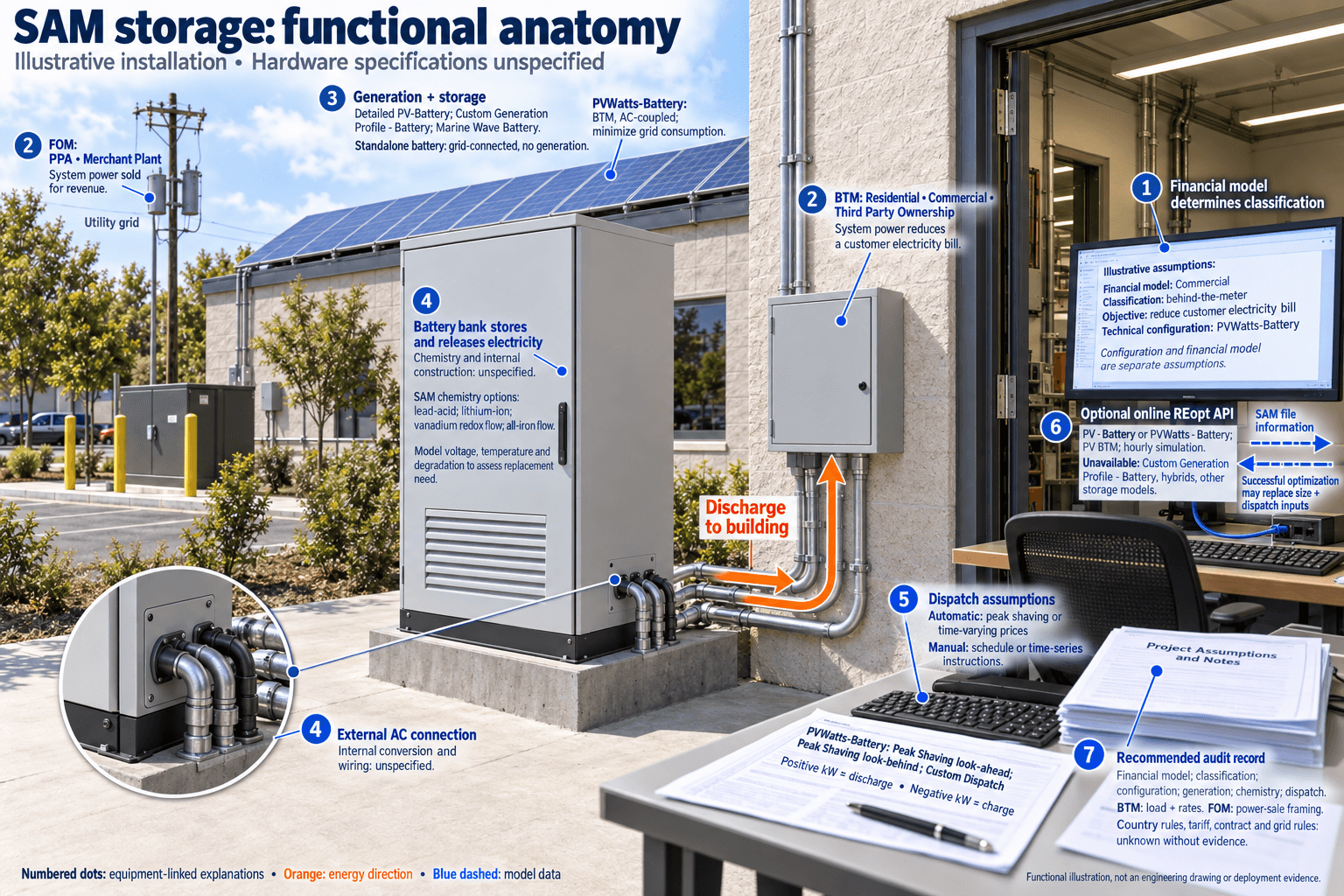
The assumptions sheet should name the exact SAM financial model before describing battery size, dispatch, tariff logic, or revenue logic. This is necessary because SAM says the storage application is determined by the financial model: distributed models are behind-the-meter, while PPA and Merchant Plant models are front-of-meter. Source: https://samrepo.nlr.gov/help/battery_storage.html
A useful assumption format is: “Financial model: Commercial; storage classification: behind-the-meter; economic objective: reduce a commercial customer’s electricity bill.” That statement is supported when the case uses SAM’s Commercial financial model. For a PPA or Merchant Plant case, the assumption should instead state that the storage case is front-of-meter and that power from the system is sold to generate revenue. Source: https://samrepo.nlr.gov/help/battery_storage.html
If the source documents do not identify the actual customer tariff, contract form, market rules, or country-specific interconnection requirement, those items should be marked unknown. The supplied SAM source defines the model classes and their BTM/FOM purpose, but it does not provide purchasing rules for any country. Source: https://samrepo.nlr.gov/help/battery_storage.html
Separate BTM Bill Reduction From FOM Revenue
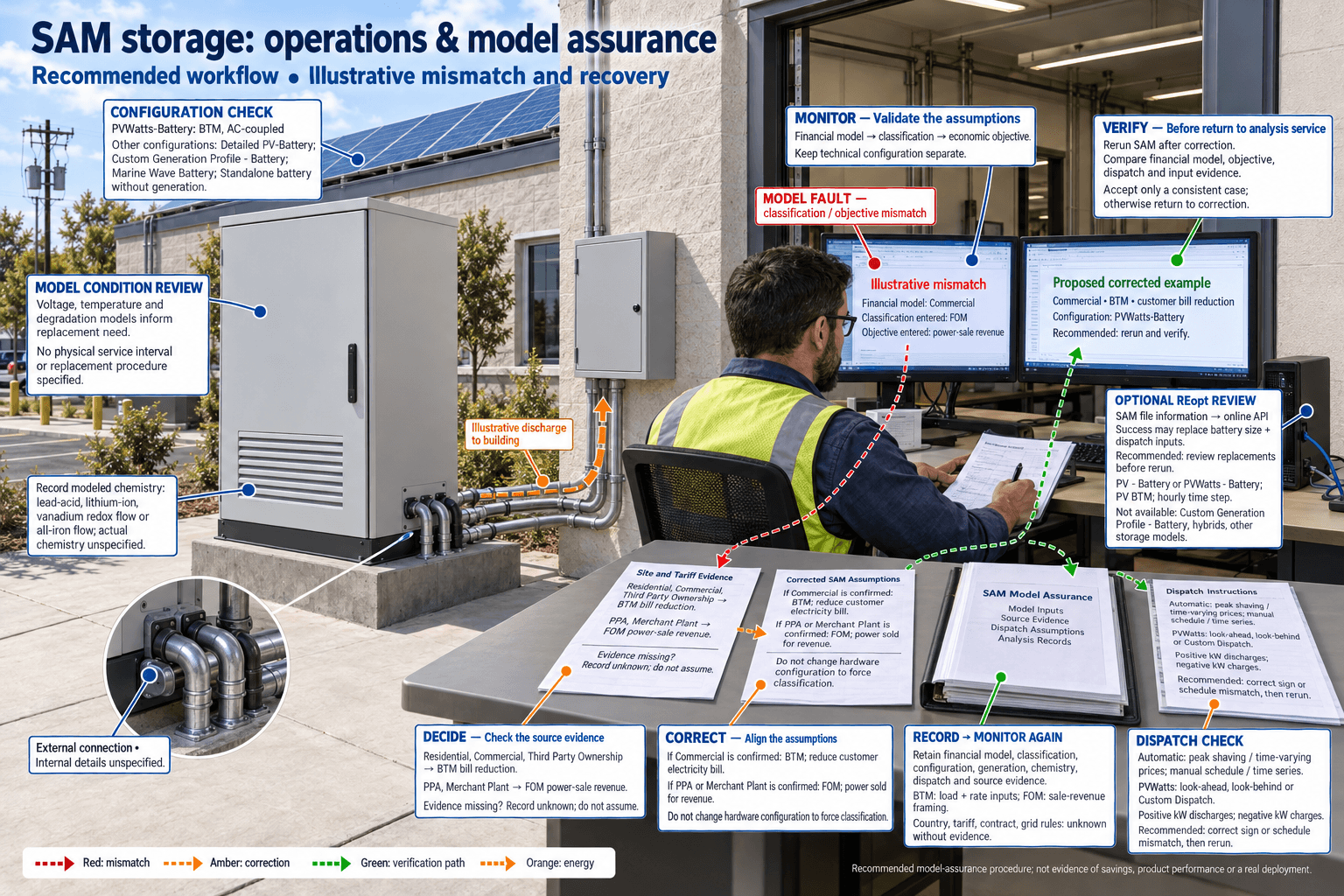
For behind-the-meter assumptions, the key condition is that system power is used to reduce a residential or commercial customer’s electricity bill under distributed financial models. SAM identifies Residential, Commercial, and Third Party Ownership as distributed financial models for this purpose. Source: https://samrepo.nlr.gov/help/battery_storage.html
For front-of-meter assumptions, the key condition is different: under PPA and Merchant Plant financial models, power from the system is sold to generate revenue. The assumptions should not mix customer-bill language with PPA or Merchant Plant logic unless another supplied source explains how that specific case is structured. Source: https://samrepo.nlr.gov/help/battery_storage.html
Describe the Storage Configuration Without Changing the Classification
SAM can analyze batteries combined with generation, including Detailed PV-Battery, Custom Generation Profile - Battery, and Marine Wave Battery. It can also analyze a Standalone battery for a grid-connected battery with no power generation equipment. These configuration choices describe the physical or modeling setup, but the BTM or FOM application is classified by the financial model. Source: https://samrepo.nlr.gov/help/battery_storage.html
For PVWatts-Battery, SAM describes a behind-the-meter AC-coupled battery bank designed to reduce a residential or commercial building’s electricity bill by minimizing grid power consumption. Source: https://samrepo.nlr.gov/help/pvwatts_system_design.html
The assumptions should therefore keep two fields separate: one for the technical configuration, such as PVWatts-Battery or Detailed PV-Battery, and one for the financial model, such as Commercial, PPA, or Merchant Plant. This avoids incorrectly treating a PV-plus-battery design as BTM or FOM without the financial model evidence.
Include Dispatch and Data Inputs as Assumptions
The source documents support documenting dispatch because SAM includes automatic dispatch controller options for peak shaving or time-varying power prices, plus manual dispatch options where the user provides a schedule or time-series instructions for battery charging and discharging. Source: https://samrepo.nlr.gov/help/battery_storage.html
For PVWatts-Battery, SAM lists Peak Shaving look-ahead, Peak Shaving look-behind, and Custom Dispatch. Custom Dispatch uses time-series values where positive kW discharges the battery and negative kW charges it. Source: https://samrepo.nlr.gov/help/pvwatts_system_design.html
If REopt is used for photovoltaic behind-the-meter systems with battery storage, the assumptions should disclose that SAM sends information from the SAM file to the online REopt API and can replace battery size and dispatch inputs if the optimization succeeds. The source says this option applies to PV - Battery or PVWatts - Battery, requires hourly simulation time step, and is not available for Custom Generation Profile - Battery, hybrid systems, or other models with storage. Source: https://samrepo.nlr.gov/help/pvwatts_system_design.html
Recommended Assumption Checklist
Recommended fields are: SAM financial model; resulting classification as BTM bill reduction or FOM revenue generation; storage configuration; whether generation is included; battery chemistry if modeled; dispatch method; electricity load and rate inputs for BTM cases; revenue-sale framing for PPA or Merchant Plant cases; and any unknown country, tariff, contract, or grid-rule evidence.
SAM supports lead-acid, lithium-ion, vanadium redox flow, and all-iron flow batteries in the battery storage model. Source: https://samrepo.nlr.gov/help/battery_storage.html
SAM’s detailed voltage, temperature, and degradation models account for operating conditions and battery degradation over time to determine when replacements are required. Source: https://samrepo.nlr.gov/help/battery_storage.html
These fields do not prove savings, product performance, stock, certification, or project feasibility. They simply make the model boundary auditable: which SAM financial model was selected, what that model means for BTM or FOM classification, and which technical and dispatch assumptions were entered.
FAQ
Which SAM input determines BTM or FOM classification?
The selected financial model determines the storage application classification in SAM.
Which SAM models are behind-the-meter?
SAM identifies Residential, Commercial, and Third Party Ownership financial models as behind-the-meter storage models.
What is the BTM purpose in the SAM source?
BTM storage is described as using system power to reduce a residential or commercial customer’s electricity bill.
Which SAM models are front-of-meter?
SAM identifies PPA and Merchant Plant financial models as front-of-meter storage models.
What is the FOM purpose in the SAM source?
FOM storage is described as selling system power to generate revenue.
Can PVWatts-Battery be used for BTM bill reduction?
Yes. The source describes PVWatts-Battery as a behind-the-meter AC-coupled battery bank designed to reduce a residential or commercial building’s electricity bill.
Should country-specific purchasing rules be applied?
No. The supplied sources do not provide country-specific purchasing requirements, so those requirements should be marked unknown.
Can these sources prove a product’s savings or performance?
No. They support SAM modeling classifications and inputs, not SOLARTODO product specifications, savings, deployments, certifications, price, stock, or performance.
Procurement paths
About the Author

Cinn Song
Founder & Chief Solutions Architect
Cinn Song founded SOLARTODO LIMITED and leads its smart-city infrastructure engineering — from solar, storage and integrated smart poles to the company's push into physical-AI city edge nodes: pole-mounted edge computing, vertical LLMs for smart cities, drone-based O&M with autonomous battery swapping, robotic maintenance, and high-speed counter-UAS interception. Since 2010, he has directed turnkey EPC + BOT delivery across 50+ countries, including telecom monopole supply for national grid operators, off-grid solar street-lighting for African municipalities, and integrated smart-pole programs for Gulf smart cities.
Cite This Article
Cinn Song. (2026). Storage Financial Model Assumptions for BTM vs FOM. SOLARTODO. Retrieved from https://solartodo.com/knowledge/what-input-assumptions-should-state-which-financial-model-classifies-the-storage-case-as-behind-the-meter-bill
@article{solartodo_what_input_assumptions_should_state_which_financial_model_classifies_the_storage_case_as_behind_the_meter_bill,
  title = {Storage Financial Model Assumptions for BTM vs FOM},
  author = {Cinn Song},
  journal = {SOLARTODO Knowledge Base},
  year = {2026},
  url = {https://solartodo.com/knowledge/what-input-assumptions-should-state-which-financial-model-classifies-the-storage-case-as-behind-the-meter-bill},
  note = {Accessed: 2026-10-04}
}
Published: October 4, 2026 | Available at: https://solartodo.com/knowledge/what-input-assumptions-should-state-which-financial-model-classifies-the-storage-case-as-behind-the-meter-bill
Subscribe to Our Newsletter
Get the latest solar energy news and insights delivered to your inbox.
View All Articles