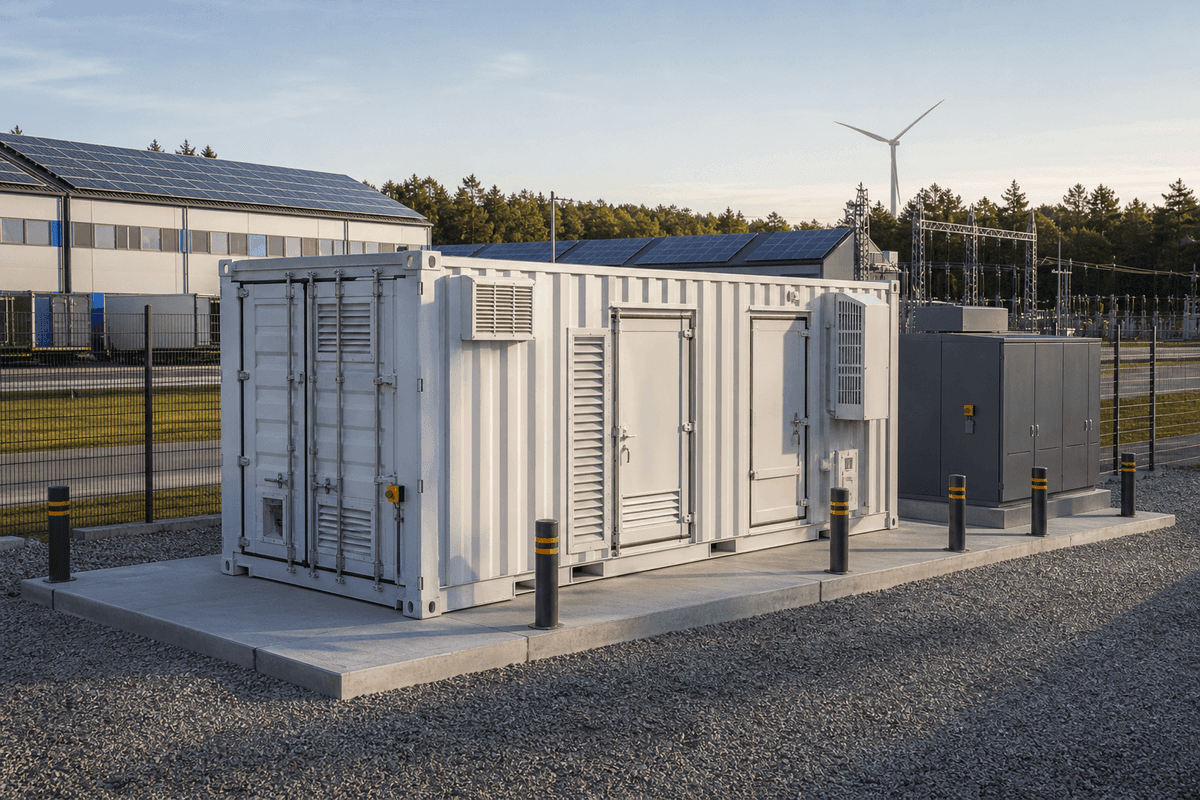
1MWh C&I Arbitrage LFP Container - High-Frequency Energy Trading System
Key Features
- 1,000 kWh usable energy capacity for multiple hours of peak shaving or energy arbitrage
- 6,000+ cycle life with LFP chemistry ensures over 15 years of reliable operation under two-cycle-per-day profile
- 96%+ round-trip efficiency with 500 kW bidirectional PCS minimizes energy losses and maximizes revenue
- UL 9540A tested three-tier fire suppression system provides highest level of safety against thermal events
- 2 cycles per day design for high-frequency energy trading accelerates ROI in volatile energy markets
The SOLARTODO 1MWh C&I Arbitrage LFP Container is a turnkey Battery Energy Storage System designed for commercial and industrial applications, featuring a capacity of 1,000 kWh and a continuous power output of 500 kW. Priced between $230,000 and $320,000, it meets UL 9540 and IEC 62619 certifications, ensuring safety and reliability for energy arbitrage strategies.
Description
SOLARTODO 1MWh C&I Arbitrage LFP Container: A Technical Deep Dive
Introduction: Redefining Commercial Energy Arbitrage
The SOLARTODO 1MWh C&I Arbitrage LFP Container is a fully integrated, turnkey Battery Energy Storage System (BESS) engineered for commercial and industrial (C&I) applications. Housed within a standard 20-foot container, this system delivers 1,000 kWh of energy capacity and a continuous power rating of 500 kW, designed specifically to capitalize on 2026 energy market dynamics, including wider Time-of-Use tariff adoption, rising renewable penetration, and growing demand for behind-the-meter flexibility. By leveraging the proven safety and longevity of Lithium Iron Phosphate (LFP) battery chemistry, this solution enables businesses to execute sophisticated energy arbitrage strategies, purchasing electricity during low-cost off-peak hours and selling it back to the grid or using it on-site during expensive peak periods. With a design focused on high-frequency cycling, robust safety, and seamless grid integration, the 1MWh container is built to deliver a rapid return on investment and over a decade of reliable service, fully compliant with stringent international standards such as UL 9540 and IEC 62619.
Core Technology: The LFP Advantage
At the heart of the system are advanced prismatic LFP (LiFePO4) battery cells, renowned for their exceptional safety profile and operational lifespan. Unlike nickel-based chemistries, LFP is inherently resistant to thermal runaway, a critical safety feature for large-scale energy storage. The system is rated for over 6,000 full depth-of-discharge cycles while retaining at least 80% of its original capacity, ensuring a project lifespan exceeding 15 years under a typical two-cycle-per-day arbitrage regime. Each cell is encased in a rugged aluminum housing, providing structural integrity and efficient heat dissipation. These cells are assembled into modules and racks, creating a dense energy system that achieves a total capacity of 1,000 kWh within the compact footprint of a 20-foot container. The underlying cell technology, with 2026 market prices continuing to approach $40-55/kWh in low-cost LFP procurement channels, allows for a system-level installed cost of approximately $125-180/kWh, making large-scale energy storage economically viable.
Performance and Application: Mastering Energy Arbitrage
The primary application for this BESS is energy arbitrage, a strategy that requires a system capable of performing multiple, reliable cycles each day. The SOLARTODO 1MWh container is designed for exactly this, supporting two full charge/discharge cycles daily. This allows operators to exploit daily price fluctuations in markets with Time-of-Use (ToU) tariffs. For profitable arbitrage, a tariff spread of at least $0.10/kWh between off-peak and peak prices is recommended. Under such conditions, a single daily cycle can generate approximately $100 in revenue or savings (1,000 kWh * $0.10/kWh). With two cycles per day, the potential gross annual revenue reaches $73,000 (2 cycles * 1,000 kWh * $0.10/kWh * 365 days), creating a compelling business case with a payback period of just 3-5 years, depending on the final installed cost and local tariff structure.
Power Conversion System (PCS): The Grid Interface
Grid interaction is managed by a state-of-the-art 500 kW bidirectional inverter, which serves as the brain and muscle of the power conversion system (PCS). This high-performance unit achieves a round-trip efficiency exceeding 96%, minimizing energy losses during the charge and discharge cycles. The PCS is fully compliant with grid codes like IEEE 1547, ensuring seamless and safe interconnection with the local utility. It supports both grid-tied mode, where it operates in parallel with the grid, and island mode, allowing it to provide backup power to the facility during a grid outage. This dual-mode capability not only enables arbitrage but also enhances on-site energy resilience, providing a critical power supply for essential loads when the grid fails.
System Intelligence: Advanced Battery Management (BMS)
Overseeing the health and performance
Technical Specifications
| Energy Capacity | 1000kWh |
| Power Rating (Continuous) | 500kW |
| Battery Chemistry | LFP (LiFePO4) |
| Round-trip Efficiency | 96% |
| Depth of Discharge (DoD) | 90% |
| Cycle Life (80% Retention) | 6000cycles |
| Calendar Life | 15years |
| Operating Temperature Range | -20 to 50°C |
| Daily Cycles | 2cycles/day |
| Annual Energy Throughput | 730MWh |
| Estimated Annual Savings | 73000USD |
| Payback Period | 3-5years |
| Container Dimensions | 20ft ISO (6.06m x 2.44m x 2.59m) |
| System Weight | ~12000kg |
| Thermal Management | Liquid Cooling |
| Fire Suppression | Three-Tier (Gas Detection + Module + Container) |
| Grid Connection | 480V AC (3-phase) |
| Communication Protocol | Modbus TCP/IP, CAN |
| Warranty | 10 years / 70% capacity retention |
Price Breakdown
| Item | Quantity | Unit Price | Subtotal |
|---|---|---|---|
| LFP Battery Cells (1000 kWh) | 1000 pcs | $55 | $55,000 |
| Battery Management System (BMS) | 1000 kWh | $15 | $15,000 |
| PCS - Bidirectional Inverter (500 kW) | 500 kW | $80 | $40,000 |
| Liquid Cooling System | 1000 kWh | $25 | $25,000 |
| 20ft Container Enclosure | 1 pcs | $8,000 | $8,000 |
| Three-Tier Fire Suppression System | 1 pcs | $5,000 | $5,000 |
| EMS Software & Controls | 1 pcs | $3,000 | $3,000 |
| Installation & Integration | 1000 kWh | $20 | $20,000 |
| Commissioning & Testing | 1 pcs | $5,000 | $5,000 |
| Total Price Range | $230,000 - $320,000 | ||
Frequently Asked Questions
What is the primary financial benefit of this system?
How does the liquid cooling system improve performance?
Is the system difficult to install?
What happens in the event of a grid outage?
How are safety and compliance ensured?
Certifications & Standards

Data Sources & References
- •UL 9540 - Standard for Energy Storage Systems and Equipment
- •UL 9540A - Test Method for Evaluating Thermal Runaway Fire Propagation
- •IEC 62619 - Safety requirements for secondary lithium cells and batteries
- •NFPA 855 - Standard for the Installation of Stationary Energy Storage Systems
- •IEEE 1547 - Standard for Interconnection and Interoperability of DER
- •Industry data: 2025 LFP cell pricing ($40-55/kWh)
- •Industry data: System-level installed costs ($125-180/kWh)
Interested in this solution?
Contact us for a customized quote based on your specific requirements.
Contact Us