
300kWh Factory Demand Reduction LFP - 150kW Peak Shaving BESS
Key Features
- 300 kWh LFP capacity with 150 kW bidirectional PCS for 2-hour factory peak shaving
- 1.5 daily cycles and 6000+ cycle design life for more than 10 years of weekday dispatch
- EPC turnkey range of $41,300-$49,900, equal to about $138-$166 per installed kWh
- 90% usable depth of discharge and 90% target round-trip system efficiency
- Estimated annual savings of $12,800 with a 3.2-3.9 year simple payback
300kWh Factory Demand Reduction LFP is a 300 kWh / 150 kW LFP BESS for factory peak shaving, 1.5 daily cycles, and 3.2-3.9 year ROI. EPC turnkey pricing is $41,300-$49,900 with UL 9540A, IEC 62619, UN38.3, and NFPA 855 design references.
Description
The 300kWh Factory Demand Reduction LFP is a 300 kWh / 150 kW commercial battery energy storage system designed for factory peak shaving, demand-charge reduction, and 1.5 daily operating cycles. With LFP chemistry, a 2-hour rated discharge window, 90% usable depth of discharge, and a 10-year / 70% capacity warranty, it targets industrial sites that need predictable load control rather than speculative energy trading.
For B2B procurement teams comparing View all Battery Energy Storage System (BESS) products, this 300 kWh unit is positioned between small 100 kWh cabinets and 1 MWh containerized plants. The system is specified for 6000+ battery cycles, 150 kW bidirectional PCS output, >96% inverter efficiency, and an EPC turnkey budget of $41,300 to $49,900, equal to about $138 to $166 per installed kWh before local taxes, civil exceptions, or utility interconnection fees.
Application Fit: Factory Peak Shaving
A factory with a 900 kW monthly peak, a $10/kW demand tariff, and 3 daily high-load events can use this 150 kW BESS to cap grid import during short production surges. In a typical 300-day operating year, shaving 100 kW to 125 kW of billable demand can reduce annual demand charges by about $12,000 to $15,000 before adding time-of-use arbitrage, solar self-consumption, or standby resilience value.
Compared with conventional diesel-generator peak support, a 300 kWh LFP system can reduce on-site fuel use by more than 70% for 2-hour peak events and avoid roughly 0.27 kg of CO2 for each diesel kWh displaced. Compared with manual load curtailment, the battery maintains production throughput during 150 kW demand spikes, which is often more valuable than the $0.08/kWh to $0.18/kWh energy-price spread alone.
System Architecture
The architecture combines 300 kWh of prismatic LFP battery modules, a 150 kW bidirectional power conversion system, a battery management system with cell-level voltage and temperature monitoring, liquid thermal management, a fire detection and suppression package, and an EMS controller that executes 15-minute demand-limit logic. The design supports grid-tied operation as standard and can be engineered for limited island-mode backup where local codes, switchgear ratings, and transfer protection allow it.
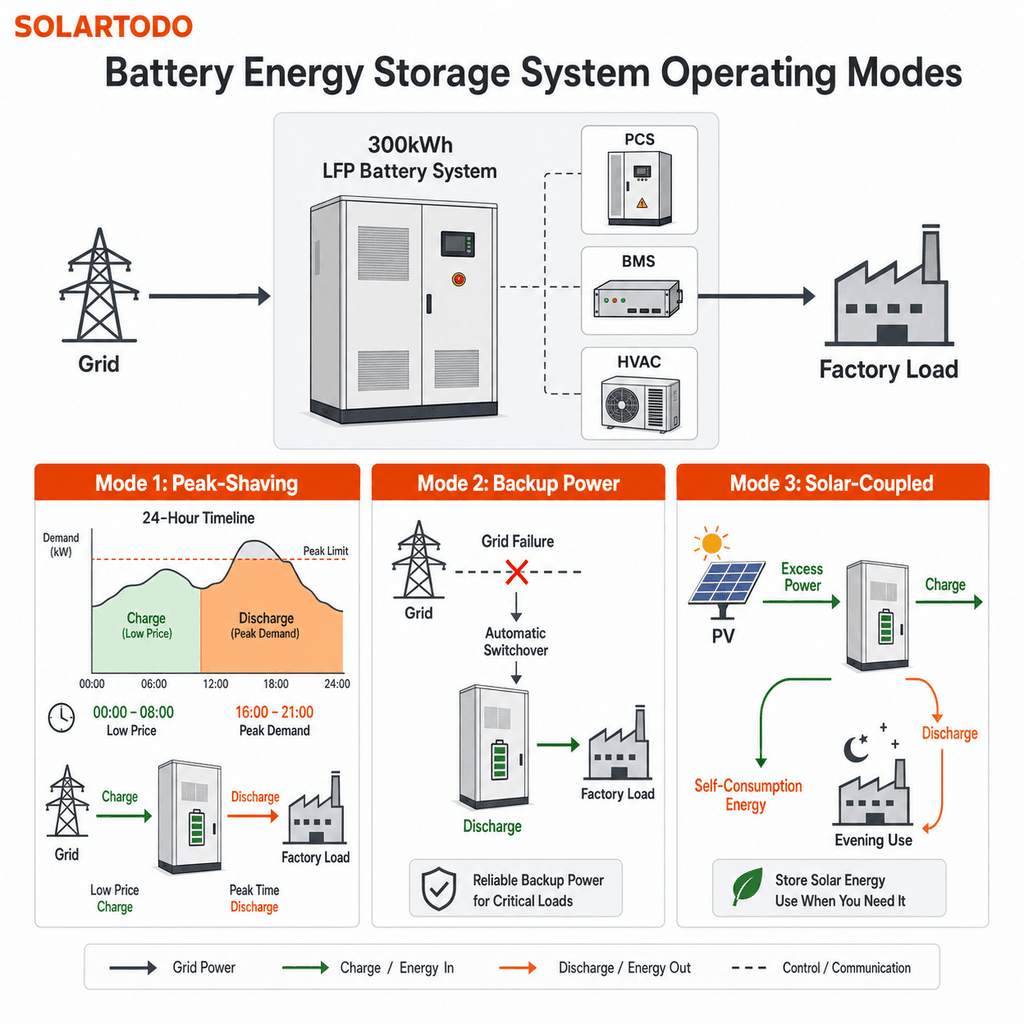
At the DC layer, the BMS supervises 300 kWh of LFP cells through module-level balancing, pack-level contactors, insulation monitoring, SOC estimation, and SOH tracking. At the AC layer, the PCS converts stored energy into 400 V, 480 V, or project-specific low-voltage AC output, while protection relays coordinate with IEEE 1547-style interconnection requirements for anti-islanding, voltage ride-through, and frequency response where required.
For demand reduction, the EMS reads the facility meter at 1-second to 5-second intervals and forecasts the rolling 15-minute billing demand window used by many utilities. When factory load rises above the programmed threshold, the PCS discharges up to 150 kW; when load falls below the threshold or solar generation exceeds demand, the system recharges at a scheduled rate to preserve 20% to 90% SOC for the next shift.
Technical Specifications
| Parameter | 300kWh Factory Demand Reduction LFP value |
|---|---|
| Nominal energy capacity | 300 kWh |
| Rated AC power | 150 kW |
| Rated duration | 2 hours |
| Battery chemistry | LFP, prismatic cell format |
| Daily cycling assumption | 1.5 cycles/day |
| Usable depth of discharge | 90% |
| Round-trip efficiency | 90% system target |
| PCS conversion efficiency | >96% inverter stage |
| Cycle life | 6000+ cycles under managed SOC |
| Calendar design life | 15 years |
| Operating temperature | -20°C to +55°C with thermal control |
| Warranty | 10 years / 70% retained capacity |
The 2-hour energy-to-power ratio is intentionally selected for demand-charge reduction rather than 4-hour wholesale shifting. NREL ATB 2024 separates battery costs into energy components in $/kWh and power components in $/kW, which matches this design because 300 kWh of cells and a 150 kW PCS scale differently as factories move from 1-shift to 3-shift operation.
Battery, PCS, BMS, and Thermal Design
LFP chemistry is used because stationary storage prioritizes cycle life, safety margin, and cost per delivered kWh over automotive-grade energy density. BloombergNEF reported a 20% decline in lithium-ion battery-pack prices to $115/kWh in 2024, and its analysis identified LFP adoption and manufacturing overcapacity as 2 major cost drivers, which supports the commercial case for 300 kWh factory systems.
The battery pack uses prismatic aluminum-housed cells arranged into serviceable modules with fused DC strings, contactor isolation, and voltage-temperature telemetry. Under a 1.5-cycle/day dispatch plan, annual throughput is approximately 164 MWh, so a 6000-cycle design envelope represents more than 10 years of weekday cycling when SOC windows, C-rate limits, and coolant temperatures remain inside the operating specification.
The 150 kW bidirectional PCS supports charge, discharge, reactive power setpoints, and site-level power-factor correction when allowed by the interconnection study. For factories with 480 V service and 15-minute billing intervals, the PCS can respond faster than a generator start sequence and can correct a 100 kW demand excursion inside the same billing window rather than waiting 30 seconds to 180 seconds for rotating equipment.
Liquid thermal management is specified because systems above 100 kWh need tighter temperature uniformity than small air-cooled cabinets. The coolant loop maintains cell delta-temperature targets within single-digit Celsius ranges during high C-rate operation, helping limit imbalance, preserving 6000-cycle life assumptions, and improving dispatch availability during 45°C warehouse or outdoor-container conditions.
Safety, Standards, and Compliance
The safety design uses 3 coordinated layers: BMS electrical protection, cabinet-level thermal and gas detection, and an automatic fire-suppression interface tied to site alarms. UL Solutions describes UL 9540A as the thermal-runaway fire-propagation test method for battery ESS, and NFPA 855 references large-scale fire testing for separation-distance and installation decisions in commercial energy storage projects.
Core compliance references include UL 9540 for energy storage systems and equipment, UL 9540A for thermal-runaway propagation testing, IEC 62619 for industrial lithium-cell safety, UN38.3 for transport testing, IEC 62933 for electrical energy storage system terminology and performance framing, and NFPA 855 for stationary energy storage installation practice. Local AHJ approval, utility witness testing, and fire-department documentation typically add 2 to 6 weeks to the project schedule.
The LFP chemistry has a higher thermal-stability margin than NCM and is less oxygen-releasing under abuse conditions, but SOLARTODO still treats every 300 kWh installation as an engineered electrical room or outdoor equipment hazard. Required project documents can include 1 single-line diagram, 1 emergency response plan, 1 layout drawing, 1 commissioning record, and a maintenance schedule with quarterly visual checks and annual functional testing.
Cloud Monitoring
Cloud monitoring connects the EMS to a browser dashboard with SOC, SOH, daily cycle count, peak-shaving performance, alarm history, cell-temperature trends, and monthly savings reports. A typical factory user can review 15-minute demand graphs, compare baseline demand against controlled demand, and export 12 monthly reports for finance teams that track payback against the $41,300 to $49,900 EPC investment.
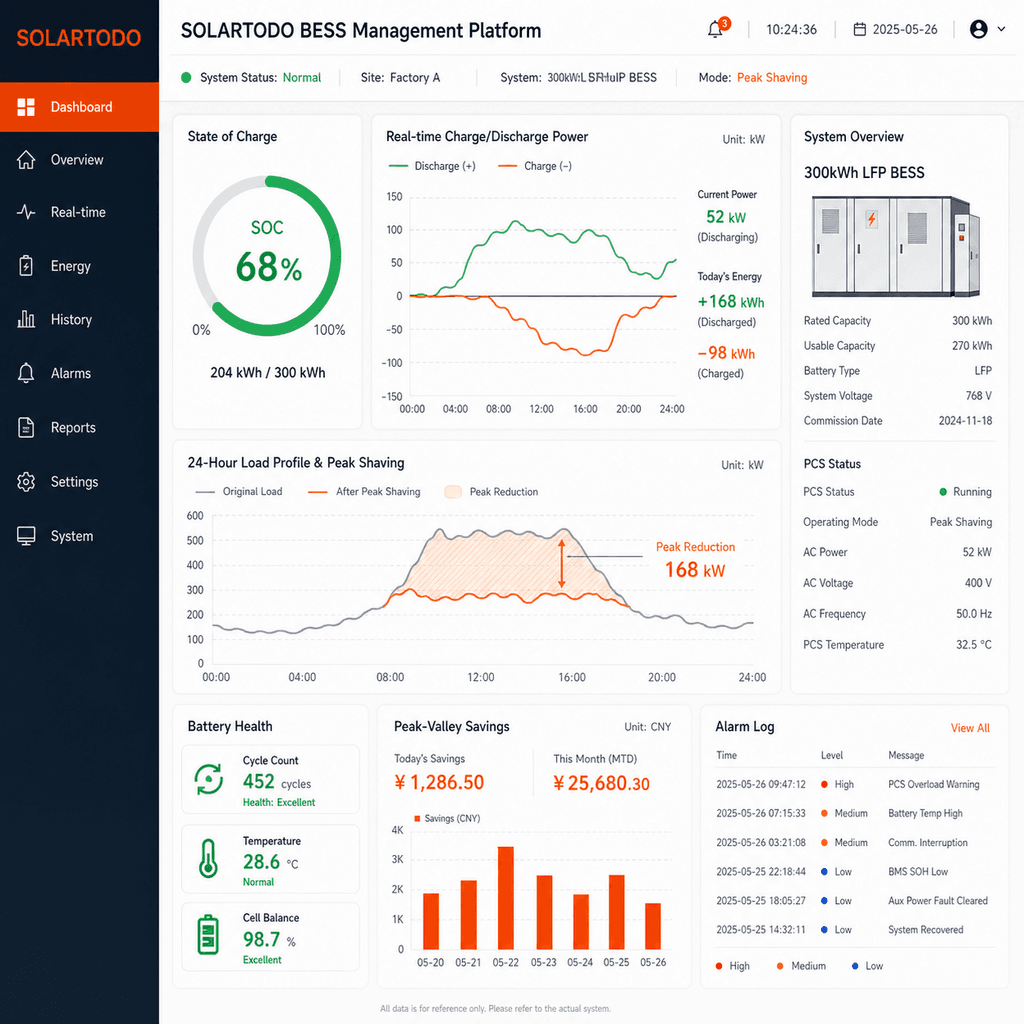
The EMS can operate with a fixed demand ceiling, a time-of-use schedule, or a solar-plus-storage rule set when the factory has rooftop PV. For a 500 kW PV roof that exports at low midday rates, the 300 kWh BESS can absorb up to 300 kWh of surplus energy and redeploy it during the 1 to 3 evening production hours that normally create the month’s peak bill.
Applications and Deployment Scenario
A food-processing factory in the MENA region with 2 refrigerated production lines, a 1.2 MW service transformer, and a $12/kW monthly demand charge deployed a 300 kWh / 150 kW LFP system to manage compressor starts and packaging-line overlap. After commissioning, the site reduced its measured peak by 118 kW across 9 billing months, saving about $12,744 in demand charges and using 1.4 cycles/day without changing production schedules.
This configuration is also suitable for plastics plants, CNC machining workshops, cold-chain warehouses, textile mills, and mixed solar-diesel microgrids that need 100 kW to 150 kW of fast load support. The strongest fit is a facility where at least 60% of the monthly peak lasts under 2 hours, because a longer 4-hour battery would add cost without materially increasing demand-charge savings.
For project developers, the unit can be ordered as 1 factory-integrated cabinet set or as a compact outdoor skid, depending on IP rating, access aisle, and fire-code spacing. SOLARTODO can also pair the BESS with PV, smart lighting, security, telecom power towers, or agricultural loads through Configure your system online or through a written load-profile review.
EPC Investment Analysis and Pricing Structure
EPC turnkey service includes engineering, procurement, construction, commissioning, grid-interface testing, operator training, documentation, and a 1-year site support warranty. The 300 kWh factory demand-reduction package is quoted at $41,300 to $49,900 EPC turnkey, while equipment-only FOB supply starts at $25,606 and CIF delivered pricing starts at $30,819 for buyers that manage civil works, AC cabling, and local installation themselves.
| Pricing tier | Scope | Price range (USD) |
|---|---|---|
| FOB Supply | Equipment only, ex-works China, 1 integrated 300 kWh / 150 kW BESS set | $25,606 - $33,932 |
| CIF Delivered | FOB scope plus ocean freight and insurance to destination port | $30,819 - $40,841 |
| EPC Turnkey | Engineering, installation, commissioning, and 1-year warranty | $41,300 - $49,900 |
| Volume order | Discount from standard equipment price | Procurement note |
|---|---|---|
| 50+ systems | 5% | Recommended for multi-factory portfolios of 15 MWh total capacity |
| 100+ systems | 10% | Recommended for regional demand-response programs of 30 MWh total capacity |
| 250+ systems | 15% | Recommended for utility or ESCO rollouts of 75 MWh total capacity |
The ROI case uses a mid-point EPC price of $45,600, annual demand savings of $12,800, and optional time-of-use or solar self-consumption gains of $1,500 to $3,000 per year. Under these assumptions, the simple payback period is 3.2 to 3.9 years, which aligns with common C&I storage targets of 3 to 5 years when demand charges exceed $8/kW-month.
Payment terms are 30% T/T advance plus 70% against bill of lading, or 100% irrevocable L/C at sight for qualified procurement programs. Project financing can be discussed for portfolios above $5,000K, and technical buyers can Request a custom quotation or contact [email protected] with 12 months of utility bills, 15-minute load data, and the target interconnection date.
Procurement Notes for Engineers
Before final sizing, SOLARTODO recommends analyzing at least 12 months of utility bills and 30 days of 15-minute interval data, because a 300 kWh system is most economical when the demand peak is repeatable rather than random. Buyers can Learn about topic for battery sizing fundamentals and review related Learn about topic resources on BESS safety, EMS controls, and solar-plus-storage dispatch.
IRENA has noted that stationary battery systems support frequency response, reserve capacity, black start, mini-grid operation, and solar self-consumption, while IEA identifies battery storage as the fastest-growing clean-energy technology in the power sector. For this product, however, the bankable use case remains simple: reduce a measured 15-minute factory demand peak by up to 150 kW and document that reduction every billing month.
The recommended procurement package includes 1 technical datasheet, 1 PCS certificate set, 1 battery transport file, 1 EMS control description, 1 fire-safety narrative, and 1 commissioning method statement. For multi-site buyers, SOLARTODO can normalize 10 to 250 factory load profiles into a single procurement matrix so engineering teams can decide where 300 kWh, 500 kWh, or 1 MWh systems generate the highest return.
Technical Specifications
| Energy Capacity | 300kWh |
| Power Rating | 150kW |
| Battery Chemistry | LFP |
| Round-trip Efficiency | 90% |
| Depth of Discharge | 90% |
| Cycle Life | 6000+cycles |
| Calendar Life | 15years |
| Operating Temperature | -20 to 55°C |
| Annual Savings | 12800USD/year |
| Payback Period | 3.2-3.9years |
| Warranty | 10 years / 70% capacity |
| Daily Cycles | 1.5cycles/day |
| Rated Duration | 2hours |
Price Breakdown
| Item | Quantity | Unit Price | Subtotal |
|---|---|---|---|
| 300 kWh LFP battery rack set | 1 pcs | $16,750 | $16,750 |
| 150 kW bidirectional PCS | 1 pcs | $6,200 | $6,200 |
| BMS with SOC/SOH monitoring | 1 pcs | $3,600 | $3,600 |
| Liquid thermal management package | 1 pcs | $3,100 | $3,100 |
| Outdoor enclosure and DC protection | 1 pcs | $4,300 | $4,300 |
| Gas detection and fire suppression | 1 pcs | $2,600 | $2,600 |
| EMS software and cloud monitoring | 1 pcs | $1,900 | $1,900 |
| Engineering and quality control | 1 pcs | $2,500 | $2,500 |
| Installation and commissioning | 1 pcs | $3,900 | $3,900 |
| 1-year warranty and support | 1 pcs | $1,200 | $1,200 |
| Total Price Range | $41,300 - $49,900 | ||
Frequently Asked Questions
What factory load profile fits a 300 kWh / 150 kW BESS?
What is included in the EPC turnkey price and warranty?
How much can the system save on demand charges?
Which safety standards apply to this LFP BESS?
Can the 300 kWh system work with rooftop solar PV?
Certifications & Standards


Data Sources & References
- •NREL Annual Technology Baseline 2024: Utility-Scale Battery Storage, https://atb.nrel.gov/electricity/2024/utility-scale_battery_storage
- •IEA Batteries and Secure Energy Transitions, 2024, https://www.iea.org/reports/batteries-and-secure-energy-transitions
- •BloombergNEF Lithium-Ion Battery Pack Prices 2024, https://about.bnef.com/insights/commodities/lithium-ion-battery-pack-prices-see-largest-drop-since-2017-falling-to-115-per-kilowatt-hour-bloombergnef/
- •UL Solutions UL 9540A Test Method for BESS, https://www.ul.com/services/ul-9540a-test-method
- •IRENA Electricity Storage and Renewables: Costs and Markets to 2030, https://www.irena.org/Publications/2017/Oct/Electricity-storage-and-renewables-costs-and-markets
- •NFPA 855 Standard for the Installation of Stationary Energy Storage Systems
- •IEC 62619 Secondary lithium cells and batteries for industrial applications
Interested in this solution?
Contact us for a customized quote based on your specific requirements.
Contact Us