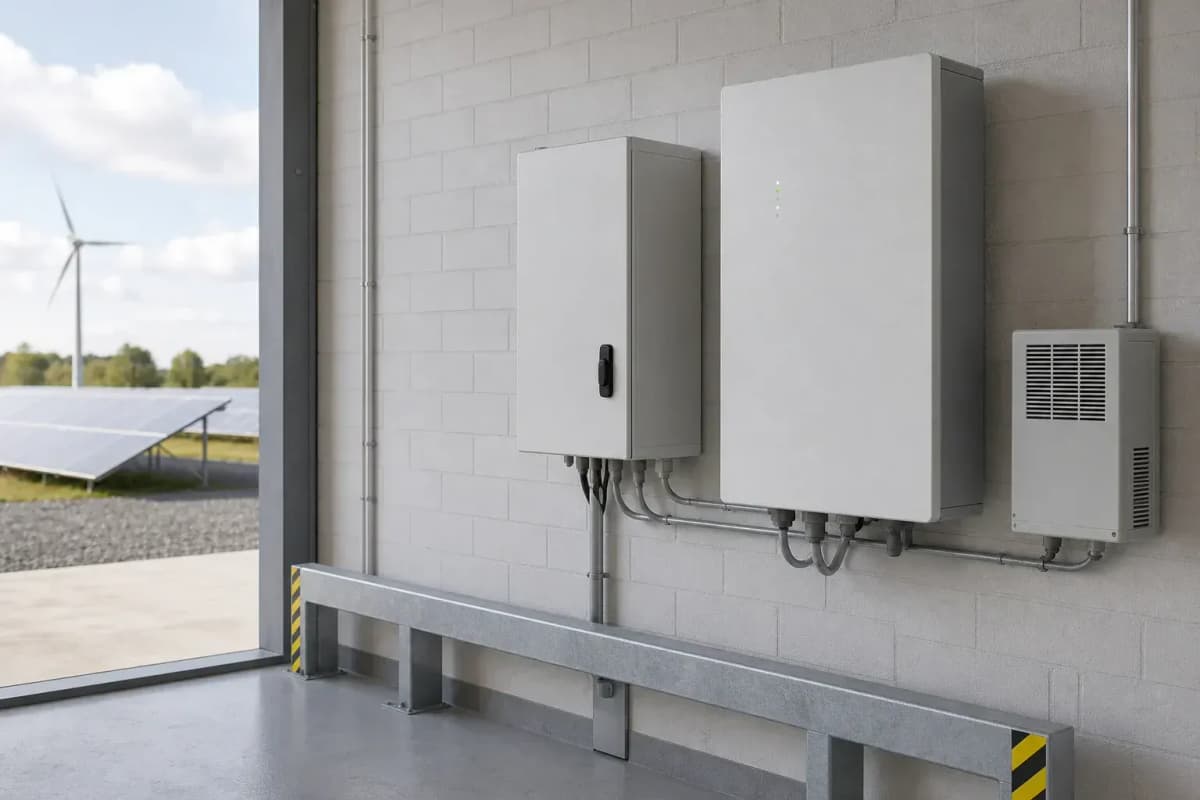
30kWh Backup Power LFP - 30kW Wall-Mount BESS
Key Features
- 30kWh nominal LFP capacity with 27kWh usable energy at 90% DoD
- 30kW bidirectional PCS supports 1C backup discharge and island mode
- Sub-10ms grid-to-island transfer target for UPS replacement loads
- 6,000+ cycle LFP design with 10-year or 70% capacity warranty basis
- EPC turnkey budget from $5,267 to $6,667, equal to about $176-$222/kWh nominal
The 30kWh Backup Power LFP is a 30kW wall-mount battery energy storage system using lithium iron phosphate chemistry, 90% depth of discharge, 1 daily cycle, and sub-10ms backup transfer logic. It is specified for small commercial backup, telecom rooms, villas, clinics, retail sites, and UPS replacement projects requiring 27kWh usable energy and EPC turnkey pricing from $5,267 to $6,667.
Description
The 30kWh Backup Power LFP is a 30kW wall-mount battery energy storage system for backup power applications requiring 30kWh nominal capacity, 27kWh usable capacity at 90% depth of discharge, and seamless grid-to-island operation in less than 10ms. SOLARTODO positions this 1C LFP BESS for 1 daily cycle, 6,000+ cycle battery life, 96%+ PCS conversion efficiency, and EPC turnkey budgets from $5,267 to $6,667 for qualified project sites.
Product Definition
This 30kWh backup BESS is designed as a compact wall-mount system for B2B buyers who need 1 to 8 hours of autonomy rather than diesel runtime, oversize lead-acid UPS rooms, or manually switched emergency generators. The configuration pairs a 30kWh lithium iron phosphate battery pack with a 30kW bidirectional inverter, an integrated BMS, DC protection, AC islanding logic, and a compact enclosure suitable for small commercial buildings, telecom shelters, security rooms, and critical-load subpanels. For broader capacity planning, buyers can View all Battery Energy Storage System (BESS) products or Configure your system online with 1 project load profile.
The system uses LFP chemistry because stationary backup systems normally prioritize safety, cycle life, and predictable cost over the highest possible gravimetric energy density. IEA analysis in Batteries and Secure Energy Transitions, 2024 states that batteries account for about 90% of the storage expansion in its 2030 net-zero pathway, while IRENA reports that installed battery storage project costs declined by 93% from 2010 to 2024. In this 30kWh class, the result is a practical backup platform with 27kWh usable energy, 30kW peak power, and a wall-mounted footprint that can replace many 10kVA to 30kVA short-runtime UPS configurations.
System Architecture
The architecture has 5 functional layers: prismatic LFP cells, module-level sensing, pack-level BMS, bidirectional PCS, and site-level EMS or gateway communication. The battery layer supplies 30kWh nominal DC energy, the inverter layer delivers 30kW AC power, and the control layer manages SOC, SOH, temperature, current, voltage, isolation, charge limits, discharge limits, and protective shutdown. For a 1C backup discharge, a fully charged system can deliver 30kW for about 1 hour, 15kW for about 2 hours, or 5kW for about 5.4 hours when calculated at 90% DoD before inverter and wiring losses.
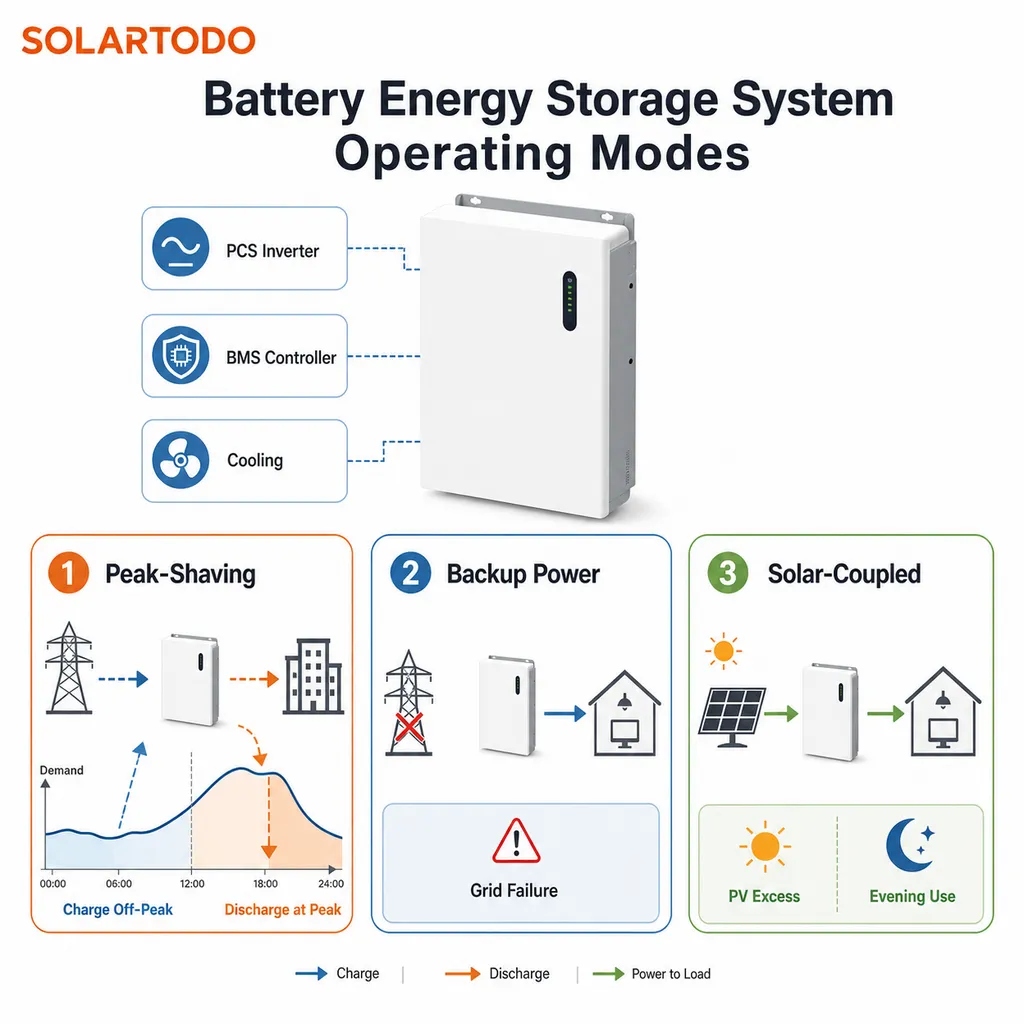
The PCS is specified as a bidirectional inverter with greater than 96% conversion efficiency, grid-tied operation, and island-mode support. In normal operation, the inverter can charge the battery from PV, grid, or a hybrid AC bus according to the site EMS setting; during an outage, it isolates the protected load panel and energizes the backup circuit within a target transfer time below 10ms. This switching class is suitable for many IT racks, POS systems, access-control panels, surveillance networks, refrigeration controls, and medical support loads, although life-safety circuits should always be reviewed against 1 local electrical code and 1 authority having jurisdiction.
The BMS continuously measures cell voltage, pack voltage, current, temperature, SOC, SOH, and fault state across the 30kWh battery stack. Passive or active balancing keeps cell groups aligned over thousands of cycles, while over-voltage, under-voltage, over-current, short-circuit, over-temperature, low-temperature charge inhibit, and insulation monitoring protect the pack in at least 7 common fault categories. For procurement teams, the most important BMS requirement is not a single sensor count but the verified ability to stop charge, stop discharge, open contactors, and report fault codes before a cell-level abnormality becomes a system-level outage.
Technical Specifications
| Parameter | Value |
|---|---|
| Nominal energy capacity | 30kWh |
| Usable energy at 90% DoD | 27kWh |
| Rated AC power | 30kW |
| Battery chemistry | LFP lithium iron phosphate |
| Application | Backup power and UPS replacement |
| Form factor | Wall-mount cabinet |
| Daily cycling basis | 1 cycle per day |
| Transfer target | Less than 10ms |
| PCS efficiency | Greater than 96% |
| Cycle life basis | 6,000+ cycles |
| Warranty basis | 10 years or 70% retained capacity |
The 30kWh rating should be interpreted as nominal battery capacity, while the practical dispatchable capacity is 27kWh at the specified 90% DoD. With 1 cycle per day, 6,000 cycles corresponds to more than 16 years of theoretical cycling, although warranty terms, calendar aging, temperature exposure, and site duty cycle normally define the commercial service envelope. NREL battery cost benchmarking and the NREL Annual Technology Baseline 2025 are useful references for evaluating storage assumptions, because capacity cost, inverter cost, installed cost, and augmentation assumptions can differ by more than 2 times between residential, commercial, and utility-scale systems.
The thermal design is air-cooled because a 30kWh wall-mounted backup cabinet normally stays below the thermal density where liquid cooling is justified. Large C&I and utility systems above 100kWh often use liquid cooling to improve module temperature uniformity, but a 30kWh backup BESS can maintain practical performance with forced-air cooling, cabinet ventilation, temperature sensors, and BMS derating. The recommended operating range is -10°C to 50°C, with charge power reduced at low temperature and discharge power reduced at elevated cabinet temperature to protect 6,000+ cycle life.
Safety, Codes, and Compliance
Relevant safety references include UL 9540 for energy storage systems and equipment, UL 9540A for thermal runaway fire-propagation testing, IEC 62619 for industrial lithium battery safety, IEC 63056:2020 for lithium batteries in electrical energy storage systems up to 1,500V DC, UN38.3 for transport testing, and NFPA 855 for stationary energy storage installation. UL Solutions notes that the 2026 edition of UL 9540A expands large-scale fire-test treatment for BESS, while NFPA 855 uses UL 9540A data to support installation spacing, fire protection, and code review.
LFP chemistry has a stronger thermal stability profile than nickel-rich NCM alternatives, but no engineered BESS should be described as risk-free. SOLARTODO specifies layered controls including cell-level monitoring, pack contactors, inverter fault isolation, cabinet thermal sensors, gas or smoke detection where required, and site-level emergency shutdown planning. Compared with conventional lead-acid UPS batteries, an LFP BESS can reduce replacement frequency by about 60% to 75% over a 10-year horizon because many lead-acid strings are replaced every 3 to 5 years, while the LFP design target is 6,000+ cycles and 10-year warranty coverage.
Applications
This 30kWh backup power system is suitable for small commercial facilities with 5kW to 30kW critical-load panels, including telecom equipment rooms, security command rooms, pharmacy cold-chain cabinets, bank branch IT closets, retail POS networks, gate-control systems, and residential villas with business continuity requirements. It is not intended to carry all building loads without load shedding; a 30kW inverter can be overloaded quickly by HVAC compressors, lifts, pumps, or simultaneous motor starts. Correct engineering normally begins with a 15-minute load audit, a 24-hour energy profile, and a single-line diagram showing protected and non-protected circuits.
For a representative MENA telecom-room scenario, assume a protected load of 7.5kW, an ambient design temperature of 45°C, 1 daily grid interruption, and a diesel generator previously used for short outages. The 30kWh LFP system provides about 3.6 hours of usable backup at 27kWh before losses, or about 3.4 hours after a conservative 6% conversion and wiring allowance. If the site avoids 2.5 liters of diesel per hour for 300 outage hours per year, the project can displace about 750 liters of diesel annually before maintenance and generator wear are counted.
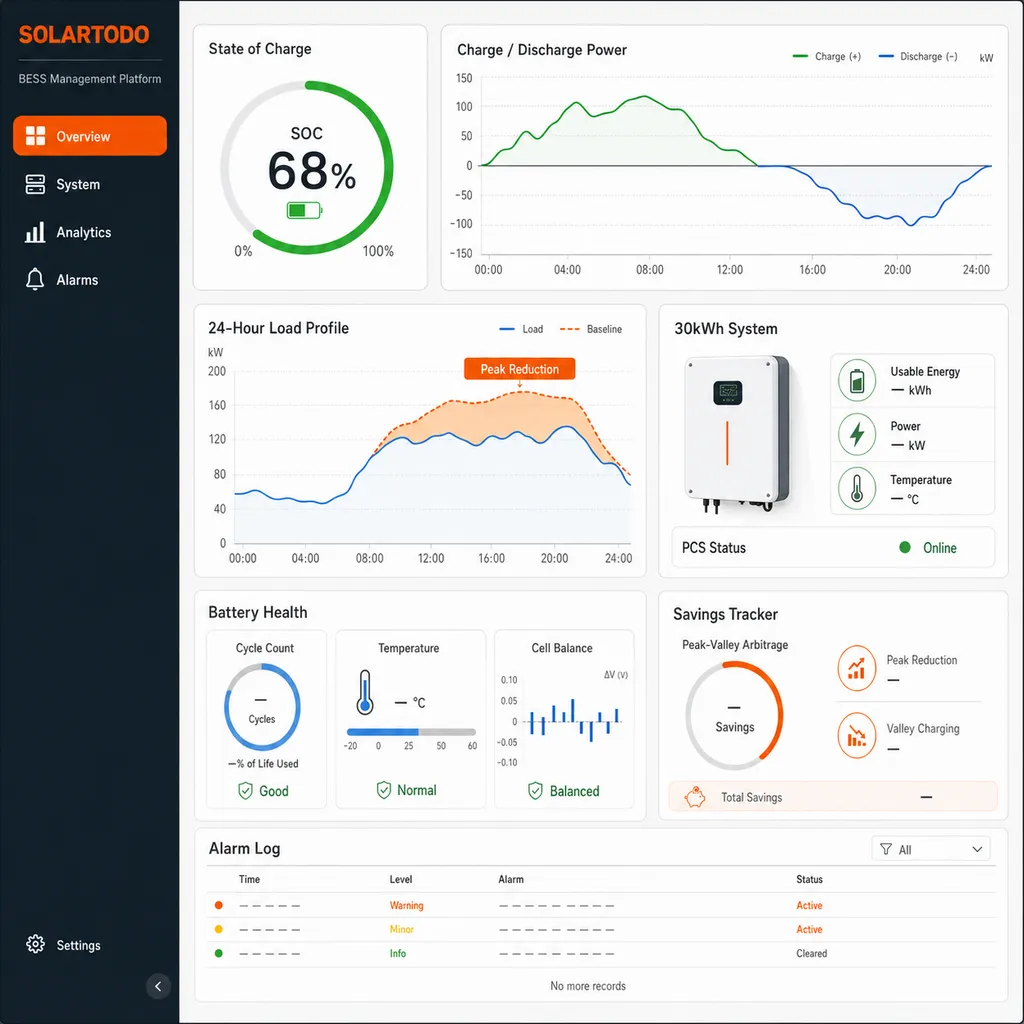
Cloud Monitoring
The optional cloud platform records SOC, SOH, charge energy, discharge energy, inverter status, alarm codes, grid availability, and daily cycle count with 5-minute or 15-minute reporting intervals depending on gateway configuration. For fleet buyers managing 10, 50, or 250 sites, remote monitoring reduces truck rolls by identifying weak grid input, overload behavior, high cabinet temperature, or battery imbalance before a field visit is scheduled. Data can be exported to the buyer's EMS, maintenance dashboard, or asset-management workflow using Modbus, RS485, Ethernet, 4G, or API integration where supported.
Cloud monitoring also improves warranty administration because fault history, cycle count, and temperature logs create a traceable record of actual use. A 30kWh battery operated at 1 daily cycle and kept within -10°C to 50°C is materially different from a cabinet exposed to 55°C rooftop heat or repeated 2C overload attempts. SOLARTODO recommends at least 12 months of monitoring for EPC warranty projects, with monthly review of alarm rate, round-trip efficiency, SOC drift, and outage response time.
EPC Investment Analysis and Pricing Structure
EPC turnkey delivery includes 5 commercial work packages: engineering, procurement, construction, commissioning, and 1-year warranty support. Engineering covers load assessment, single-line diagram review, cabinet placement, cable sizing, protection coordination, and local code assumptions; procurement covers the 30kWh LFP battery, 30kW PCS, BMS, enclosure, DC protection, AC breakers, monitoring gateway, and shipping documents; construction covers wall mounting, wiring, labeling, grounding, and protected-load panel integration; commissioning verifies charge, discharge, islanding, alarms, and handover records. For site-specific scope, Request a custom quotation or email [email protected] with 1 load profile and 1 installation address.
| Pricing tier | Scope basis | Price range |
|---|---|---|
| FOB Supply | Equipment only, ex-works China | $3,266 - $4,534 |
| CIF Delivered | Equipment plus ocean freight and insurance | $3,931 - $5,457 |
| EPC Turnkey | Installed, commissioned, and 1-year warranty | $5,267 - $6,667 |
| Volume quantity | Discount from applicable tier |
|---|---|
| 50+ systems | 5% |
| 100+ systems | 10% |
| 250+ systems | 15% |
The representative EPC midpoint is about $5,990, equal to roughly $200/kWh on a 30kWh nominal basis or $222/kWh on a 27kWh usable basis. IRENA's 2024 renewable cost report cites global commissioned battery storage project costs near $192/kWh, while turnkey costs vary by duration, market, EPC boundary, and local electrical work. SOLARTODO's listed EPC range is therefore consistent with a compact 30kWh system where the inverter, enclosure, installation mobilization, and commissioning are distributed across a smaller capacity than a 200kWh C&I cabinet.
ROI depends on 3 quantifiable value streams: avoided diesel fuel, avoided downtime, and avoided battery replacement versus lead-acid UPS. In the representative MENA case with 750 liters of diesel displaced at $1.10 per liter, annual fuel savings are about $825; if 10 hours of avoided downtime protects $100 per hour of transaction or monitoring value, the annual operational benefit adds $1,000. With combined annual savings of about $1,800, a $5,990 EPC midpoint produces a simple payback of about 3.3 years before tax, financing, or local maintenance effects.
Payment terms are 30% T/T advance plus 70% against bill of lading, or 100% L/C at sight for approved buyers. Project financing can be discussed for portfolios above $5,000K, especially when 50+ or 100+ identical sites provide repeatable drawings, standardized installation kits, and a lower commissioning cost per system. For procurement evaluation, buyers should compare not only the $/kWh price but also the inverter rating, 90% DoD, warranty basis, BMS logging, UL 9540A evidence, IEC 62619 cell or module documentation, and local electrical installation scope.
Engineering Notes for Buyers
The system should be connected to a defined critical-load panel rather than a whole building unless the verified load is below 30kW under all operating conditions. A 30kW inverter can sustain computers, network equipment, lights, cameras, access control, refrigeration controls, and small pumps, but large motors may require soft starters, interlocks, or load priority logic. SOLARTODO recommends sizing the protected panel at 70% to 85% of inverter rating for normal operation, leaving 4.5kW to 9kW of margin for transient loads and thermal derating.
Battery sizing should be based on measured kWh demand rather than nameplate watts alone. A 12kW critical load running for 2 hours requires 24kWh before losses, which fits within the 27kWh usable envelope; the same load for 3 hours requires 36kWh and should move to a 40kWh or 50kWh class. Buyers can use Learn about topic for storage sizing fundamentals and compare future variants through the SOLARTODO configurator.
Installation quality has at least 6 measurable checkpoints: wall strength, cabinet clearance, cable ampacity, grounding resistance, breaker coordination, and communication signal quality. The final commissioning record should include open-circuit voltage, insulation reading, AC output test, islanding response, alarm simulation, firmware version, and a 30-minute load test. For local permitting, the installer should verify 1 applicable electrical code, 1 fire code, and 1 utility interconnection rule before energizing the system.
Procurement Summary
The 30kWh Backup Power LFP is best specified when the buyer needs a compact, high-cycle backup asset with 30kW output, 27kWh usable energy, and 10-year battery warranty logic. It is smaller and cleaner than a diesel generator, longer-lived than many lead-acid UPS strings, and more controllable than a passive battery bank because the BMS, PCS, and monitoring layer provide real-time operating data. For technical comparison, Learn about topic and then Configure your system online using measured 15-minute load intervals, target backup hours, and local utility outage data.
Technical Specifications
| Energy Capacity | 30kWh |
| Usable Energy at 90% DoD | 27kWh |
| Power Rating | 30kW |
| Battery Chemistry | LFP lithium iron phosphate |
| Application | Backup power / UPS replacement |
| Form Factor | Wall-mount cabinet |
| Round-trip Efficiency | 96% |
| Depth of Discharge | 90% |
| Cycle Life | 6000+cycles |
| Calendar Life | 15years |
| Operating Temperature | -10 to 50°C |
| Daily Cycling Basis | 1cycle/day |
| Transfer Time | <10ms |
| Annual Savings | 1800USD/year |
| Payback Period | 3.3years |
| Warranty | 10 years / 70% capacity |
Price Breakdown
| Item | Quantity | Unit Price | Subtotal |
|---|---|---|---|
| LFP battery cells and modules | 30 kWh | $55 | $1,650 |
| Battery Management System | 30 kWh | $15 | $450 |
| 30kW bidirectional PCS inverter | 30 kW | $80 | $2,400 |
| Air thermal management | 30 kWh | $10 | $300 |
| Wall-mount enclosure and wiring kit | 1 pcs | $420 | $420 |
| DC protection and AC breaker set | 1 pcs | $280 | $280 |
| Factory integration and functional testing | 1 pcs | $360 | $360 |
| Installation and commissioning labor | 1 pcs | $300 | $300 |
| Engineering, drawings, and QC documentation | 1 pcs | $90 | $90 |
| 1-Year Warranty and remote support | 1 pcs | $37 | $37 |
| Total Price Range | $5,267 - $6,667 | ||
Frequently Asked Questions
What loads can a 30kWh Backup Power LFP system support?
How does LFP compare with lead-acid UPS batteries?
What is included in the EPC turnkey price?
Which standards are relevant for this BESS?
Can this 30kWh BESS work with solar PV?
Certifications & Standards


Data Sources & References
- •NREL Annual Technology Baseline 2025 and battery storage cost benchmark references
- •IEA Batteries and Secure Energy Transitions 2024, https://www.iea.org/reports/batteries-and-secure-energy-transitions
- •IRENA Renewable Power Generation Costs in 2024, https://www.irena.org/Digital-Report/Renewable-Power-Generation-Costs-in-2024
- •IRENA 24/7 Renewables: The Economics of Firm Solar and Wind 2026, https://www.irena.org/Publications/2026/May/24-7-renewables-The-economics-of-firm-solar-and-wind
- •UL Solutions UL 9540A and NFPA 855 ESS guidance, https://www.ul.com/resources/installation-codes-and-requirements-energy-storage-systems-ess-faqs
- •IEC 63056:2020 energy storage battery safety scope, https://webstore.iec.ch/en/publication/29224
- •BloombergNEF battery storage cost references cited by IRENA 2024
Interested in this solution?
Contact us for a customized quote based on your specific requirements.
Contact Us