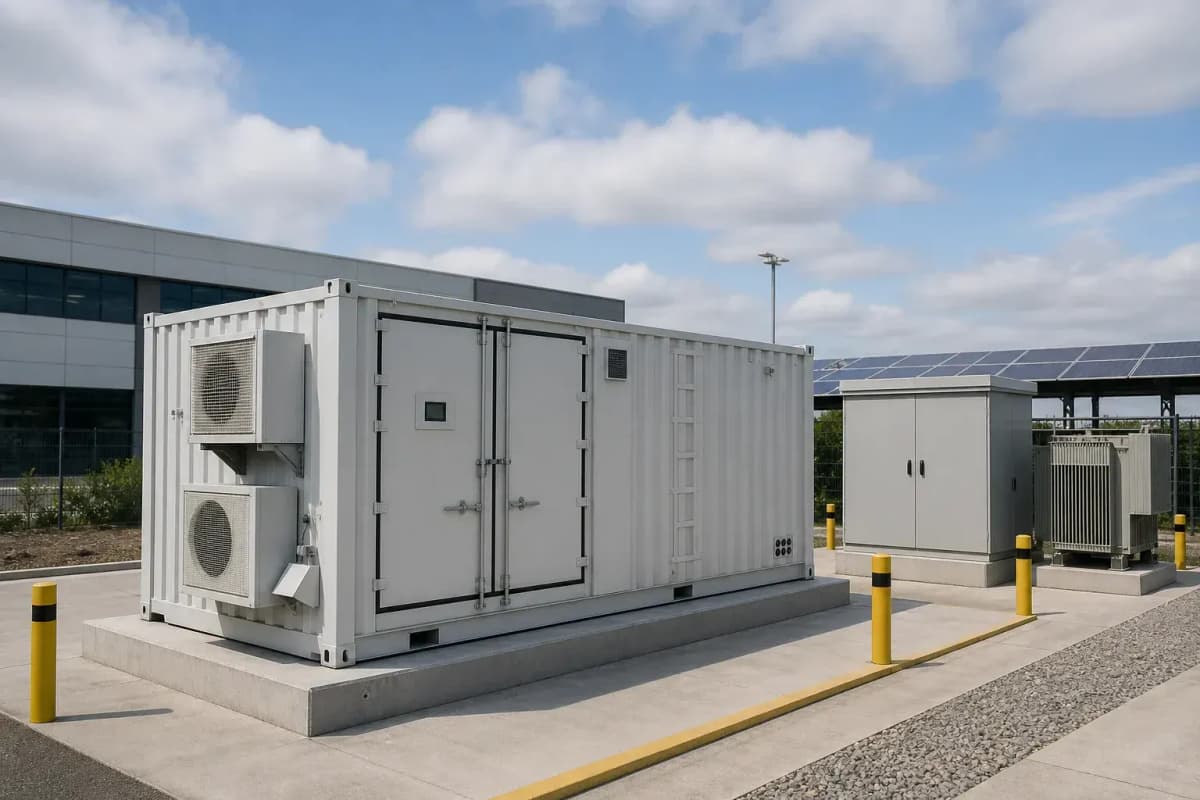
800kWh Commercial Complex LFP BESS - 800kW 20ft System
Key Features
- 800kW / 800kWh LFP BESS with 760kWh usable energy at 95% DoD
- 20ft containerized commercial system with liquid cooling, HVAC, fire suppression, and EMS
- 1.5 daily cycles support about 416,100kWh/year of usable energy shifting in the representative scenario
- EPC turnkey price range of $101,480-$127,520, equal to about $127-$159/kWh nominal
- 6,000+ cycle design target with 10-year / 70% capacity warranty reference
The 800kWh Commercial Complex LFP is an 800kW/800kWh containerized BESS for commercial complexes needing 1-hour peak shaving, solar self-consumption, and backup-ready power control. It uses LFP cells, liquid cooling, 95% DoD, and EPC turnkey pricing of $101,480-$127,520.
Description
The 800kWh Commercial Complex LFP is an 800kW / 800kWh battery energy storage system designed for commercial complexes that need 1.0-hour high-power discharge, 760kWh usable energy at 95% depth of discharge, and approximately 1.5 daily operating cycles. SOLARTODO supplies this 20ft containerized LFP BESS as an EPC-ready package for solar self-consumption, demand-charge reduction, power quality support, and backup-capable operation under IEC 62619, UL 9540, UL 9540A, UN38.3, and NFPA 855 design references.
For B2B buyers comparing 2026 energy storage projects, this product sits in the commercial and industrial class between 200kWh cabinet systems and multi-MWh utility containers. The 800kWh capacity is large enough to shift 760kWh of usable energy per cycle, while the 800kW PCS rating supports a 1C charge/discharge profile for facilities with short 15-minute to 60-minute peak events. View all Battery Energy Storage System (BESS) products to compare 200kWh, 500kWh, 1MWh, and 2MWh configurations.
Commercial Complex Use Case
Commercial complexes often combine 3 to 8 load types, including retail HVAC, elevators, refrigeration, EV chargers, office lighting, security systems, and data/network rooms. An 800kW / 800kWh BESS can absorb midday PV output, discharge during evening tariffs, and provide controlled power for 1 critical-load block instead of exporting low-value solar energy at midday. According to the International Energy Agency, global battery storage deployment is a core flexibility resource for power systems with higher renewable penetration, and commercial sites increasingly use batteries to move energy across 2 to 6 tariff periods per day (IEA, Batteries and Secure Energy Transitions, 2024).
For a representative MENA commercial complex scenario, assume a 1.2MW rooftop or carport PV plant, an 800kW evening peak, 1.5 cycles per day, 95% DoD, and a blended tariff spread of $0.10/kWh between solar export value and peak import cost. The BESS can process about 1,140kWh of usable energy per day, equal to 416,100kWh per year before degradation assumptions, and that energy shift can produce about $41,610/year in gross arbitrage or self-consumption value. This is a representative engineering scenario only; it is not a verified customer deployment or guaranteed savings claim.
System Architecture
The system architecture uses LFP prismatic cells in aluminum housings, rack-level battery modules, a centralized BMS, liquid thermal management, a bidirectional PCS, an EMS controller, fire detection, gas detection, and container-level auxiliary power. The 800kWh nominal pack is configured to deliver 800kW AC power through a PCS with greater than 96% conversion efficiency, while the overall round-trip efficiency is specified at approximately 88% to 92% depending on site temperature, auxiliary HVAC load, transformer losses, and operating profile. Learn about BESS sizing and safety for technical background on solar-storage dispatch.
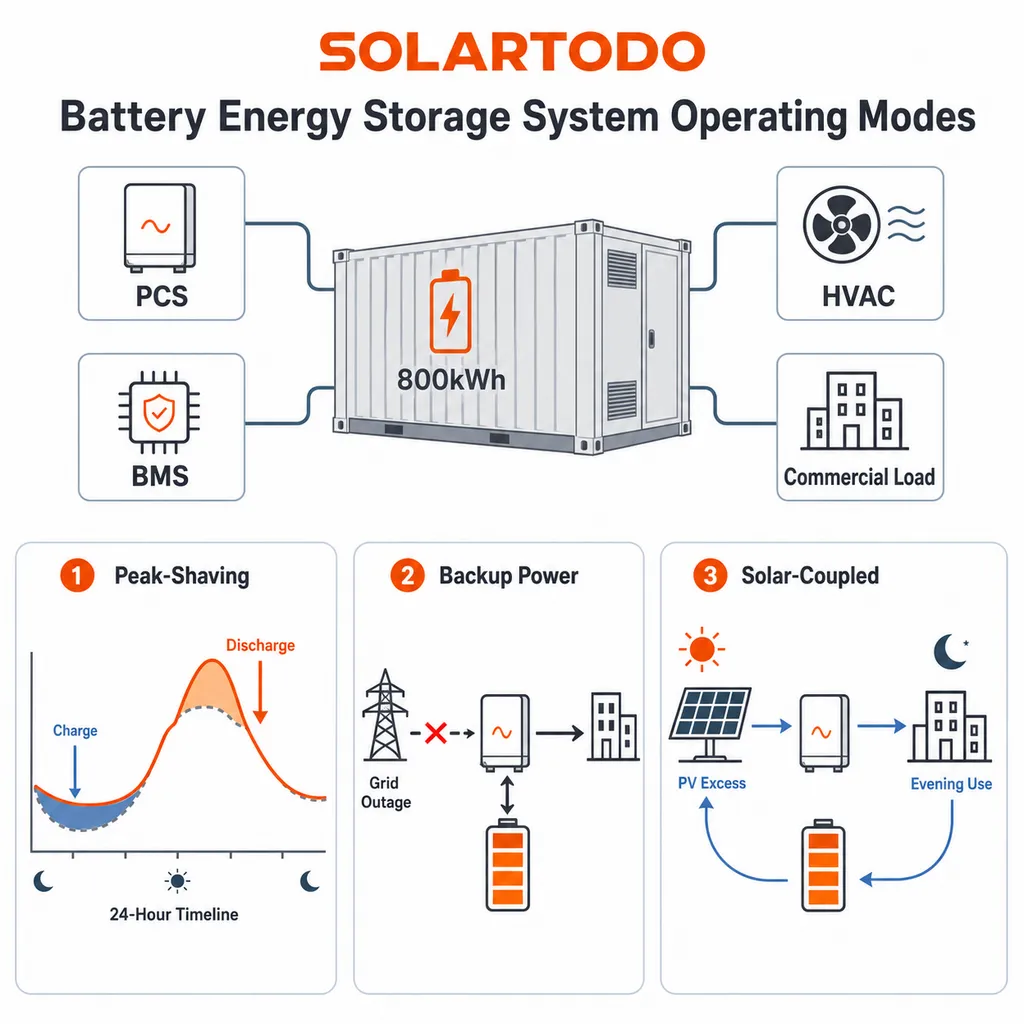
A 20ft container form factor reduces civil works compared with multiple indoor battery rooms because the enclosure integrates structural mounting, cable routing, HVAC, fire suppression, access control, and factory-tested wiring. Compared with a conventional diesel-generator-only backup design, an 800kWh LFP BESS can reduce on-site combustion during short outages by up to 100% for the covered load period, and it can reduce peak-grid import by up to 800kW when the PCS is scheduled for demand management. Diesel generators may still be retained for multi-hour emergency supply, but the battery handles sub-second response and daily cycling without fuel delivery logistics.
Battery Chemistry and Safety
LFP chemistry is selected for commercial-complex duty because it offers high thermal stability, long cycle life, and a lower cobalt/nickel exposure than NCM chemistries. The design target is 6,000+ cycles at controlled temperature and appropriate C-rate, which corresponds to about 10.9 years at 1.5 cycles per day before considering calendar aging and site-specific operating windows. IEC 62619 defines safety requirements for industrial lithium cells and batteries, while UL 9540 and UL 9540A are widely referenced in North American energy storage certification and fire propagation evaluation.
The safety concept uses 3 coordinated layers: cell/module monitoring through the BMS, rack/container electrical protection, and fire/gas detection with automatic shutdown logic. NFPA 855 is the common U.S. installation standard for stationary energy storage systems, including spacing, ventilation, fire detection, emergency planning, and maximum energy limits by location. For procurement teams, these 3 layers should be evaluated together with local authority-having-jurisdiction requirements, because a 20ft 800kWh container may need clearance distances, emergency-stop access, and signage defined by local code.
Technical Specifications
| Parameter | Value |
|---|---|
| Nominal energy capacity | 800kWh |
| AC power rating | 800kW |
| Usable energy at 95% DoD | 760kWh |
| Duration at rated power | 1.0 hour nominal |
| Battery chemistry | LFP, prismatic cells |
| Cooling method | Liquid cooling |
| PCS efficiency | >96% |
| Estimated round-trip efficiency | 90% typical |
| Daily operating profile | 1.5 cycles/day |
| Cycle-life target | 6,000+ cycles |
| Calendar-life target | 10-15 years |
| Operating temperature | -20°C to +55°C, derating by site design |
| Container format | 20ft integrated BESS |
| Warranty reference | 10 years / 70% capacity, project terms apply |
The 800kW / 800kWh ratio is useful where commercial tariffs penalize 15-minute, 30-minute, or 60-minute peaks, because the PCS can discharge at full rating without oversizing the battery to 2MWh or 4MWh. For buildings where the peak window lasts 2 to 3 hours, SOLARTODO can reconfigure the system to a 0.5C design, such as 800kW / 1.6MWh, or pair 2 containers in parallel. Configure your system online to compare rated power, usable energy, battery duration, and EPC scope.
PCS, EMS, and Grid Functions
The bidirectional PCS converts DC battery power into AC facility power and supports grid-tied operation, peak shaving, PV smoothing, power factor correction, and island-mode strategies when site switchgear allows it. The PCS is specified above 96% efficiency, but the delivered site-level efficiency must include transformer losses, cable losses, auxiliary pumps, HVAC, and standby consumption. IEEE 1547 is a key interconnection reference for distributed energy resources in many U.S.-influenced grid codes, and commercial buyers should confirm voltage ride-through, frequency ride-through, anti-islanding, and utility protection requirements before procurement.
The EMS schedules charge and discharge against PV generation, facility load, time-of-use prices, demand-charge thresholds, and backup reserve rules. A typical control plan can reserve 15% to 30% state of charge for backup service, leaving 70% to 85% of the 760kWh usable window for daily economic dispatch. NREL guidance on distributed energy storage emphasizes that financial value depends on tariff structure, load shape, demand charges, and interconnection limits, so ROI should be modeled with at least 12 months of interval data rather than monthly utility bills alone.
Cloud Monitoring
SOLARTODO can integrate the EMS with cloud monitoring for SOC, SOH, battery rack temperature, PCS operating state, alarms, event logs, revenue calculations, and maintenance reporting. A commercial complex manager can track 1-minute or 5-minute operating data, compare PV production against load, and export performance reports for energy managers or financing partners. The cloud platform is designed for asset fleets from 1 site to 250+ sites, with role-based access for owner, EPC, O&M contractor, and procurement teams.
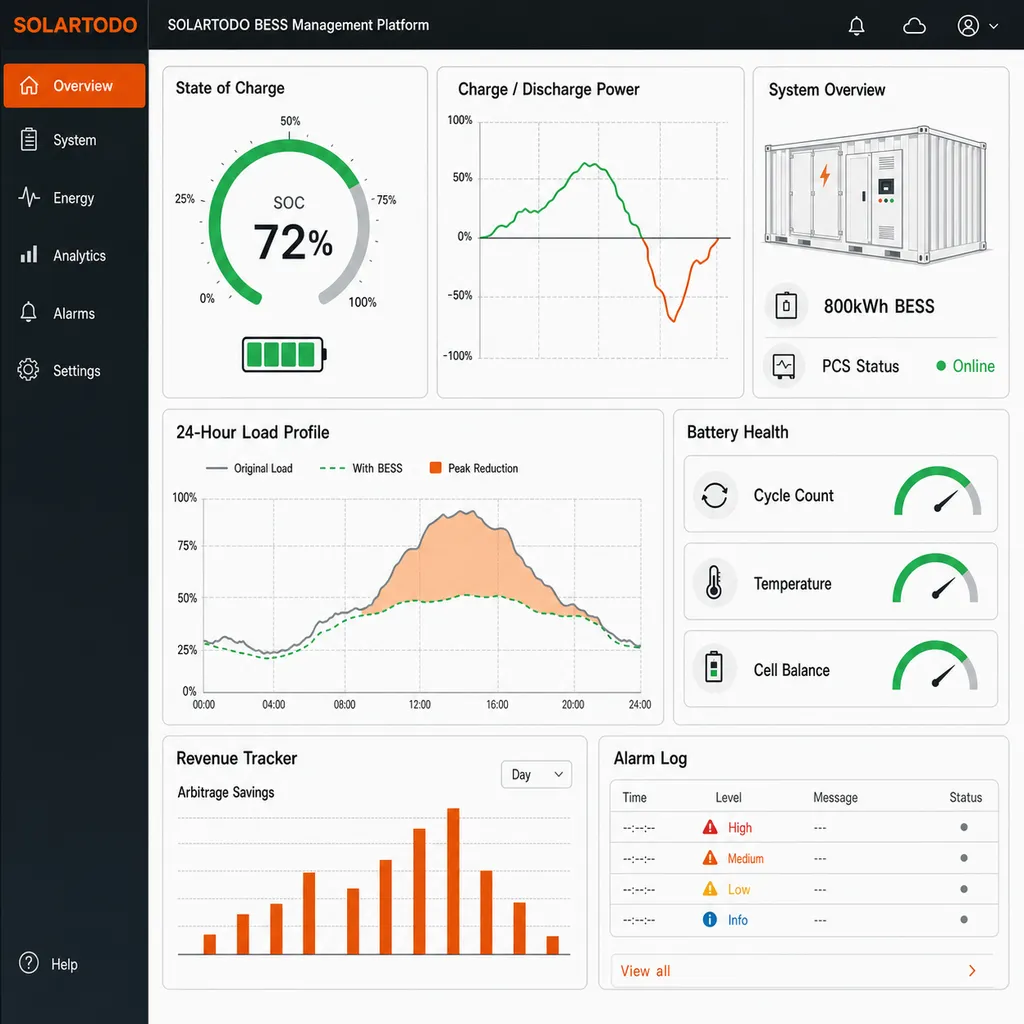
Cloud monitoring is not a substitute for electrical protection, but it reduces troubleshooting time by giving engineers fault codes, temperature trends, contactor status, PCS output, and battery balance metrics before a site visit. For 800kWh systems, a 1% state-of-charge error equals 8kWh, so SOC calibration, metering class, and commissioning tests materially affect revenue reporting. Request a custom quotation if the project requires SCADA, Modbus TCP, IEC 61850 mapping, or integration with an existing building management system.
Applications
The primary applications are solar self-consumption, demand-charge reduction, backup power support, EV-charging buffering, microgrid operation, and power quality management. In a commercial complex with 500kW to 1.5MW of rooftop or carport PV, the BESS can absorb excess midday generation and discharge into evening cooling, retail, or parking-load peaks. IRENA reports that storage is a major flexibility technology for higher renewable shares, and BESS projects are increasingly specified as modular assets that can be replicated across 10, 50, or 100 facilities.
For EV-charging plazas inside a commercial complex, an 800kW PCS can buffer multiple chargers and reduce transformer stress when 4 to 8 vehicles charge simultaneously. A site with 6 chargers at 120kW each can create a 720kW step load, which is close to the full PCS rating of this BESS. The battery can supply part of that peak for 30 to 60 minutes, reducing grid upgrade pressure while maintaining a controlled import limit.
EPC Investment Analysis and Pricing Structure
EPC turnkey scope includes engineering, procurement, construction, commissioning, and 1-year site support warranty for the installed 800kW / 800kWh BESS. Engineering covers single-line diagrams, equipment layout, cable schedules, protection settings, communication architecture, and utility-interconnection review. Procurement covers LFP battery racks, PCS, EMS, container, liquid cooling, fire suppression, switchgear interfaces, factory acceptance testing, and export packaging. Construction and commissioning cover foundations or skid placement, cable installation, grounding, insulation tests, functional tests, EMS setup, alarm verification, operator training, and handover documentation.
| Pricing tier | Scope | Price range (USD) |
|---|---|---|
| FOB Supply | Equipment only, ex-works China | $62,918-$86,714 |
| CIF Delivered | Equipment, ocean freight, and insurance | $75,728-$104,369 |
| EPC Turnkey | Fully installed, commissioned, and 1-year warranty | $101,480-$127,520 |
| Volume order | Discount from applicable tier | Typical buyer profile |
|---|---|---|
| 50+ systems | 5% | Regional EPC roll-out across 50 commercial sites |
| 100+ systems | 10% | Utility or chain-retail procurement program |
| 250+ systems | 15% | Multi-country framework supply agreement |
The EPC turnkey range of $101,480-$127,520 equals about $127/kWh to $159/kWh on nominal capacity, or about $134/kWh to $168/kWh on 760kWh usable capacity. This is consistent with the broad 2025-2026 C&I BESS market direction in which cell prices fell toward roughly $40-$55/kWh and integrated installed systems moved toward lower $/kWh bands as supply scaled. BloombergNEF has tracked rapid lithium-ion battery price declines across EV and stationary markets, while Wood Mackenzie has reported accelerating storage deployments as grid flexibility and renewable integration needs increase.
ROI should be calculated from 3 value streams: energy arbitrage or solar self-consumption, demand-charge reduction, and backup or resilience value. In the representative MENA scenario above, $41,610/year of energy-shifting value from 416,100kWh/year produces a simple payback of about 2.4 to 3.1 years against the EPC range, before O&M, degradation, taxes, financing, and tariff escalation. If demand-charge management avoids an additional 300kW at $10/kW-month, that adds $36,000/year and can reduce the simple payback to about 1.3 to 1.7 years.
Compared with upgrading a 1MVA transformer and medium-voltage service for a new EV-charging or HVAC peak, the BESS can defer part of the grid upgrade when the overload is limited to 30 to 60 minutes per day. A conventional infrastructure upgrade may deliver 24/7 capacity but no daily energy-shifting value, while an 800kWh BESS can cycle about 547.5 times/year at 1.5 cycles/day and provide both peak reduction and PV utilization. Final cost comparison should include transformer capacity, switchgear, trenching, utility fees, standby losses, and outage-resilience requirements.
Payment terms are 30% T/T deposit plus 70% against bill of lading, or 100% irrevocable L/C at sight for qualified buyers. Project financing can be discussed for projects above $5,000K, subject to buyer credit, country risk, EPC contract structure, and bank documentation. For budgetary BOQ review, tariff modeling, or site-specific EPC pricing, contact [email protected] with 12 months of interval load data, PV capacity, grid voltage, installation country, and target commissioning date.
Procurement and Compliance Notes
Procurement should verify 7 items before purchase: certified cell and module documentation, PCS grid-code certificate, UL 9540A test summary, UN38.3 transport documentation, container fire strategy, warranty terms, and site-specific installation approval. UL 9540 is commonly used for listed energy storage systems, IEC 62619 covers industrial lithium battery safety, UN38.3 covers transport testing, and NFPA 855 covers stationary ESS installation safeguards. For international projects, CE, EMC, low-voltage directive, and local grid-code requirements may also apply depending on destination country.
Quality control should include factory acceptance testing at 3 levels: cell/module inspection, rack/container electrical testing, and system-level PCS/EMS testing. A typical FAT checks insulation resistance, BMS communication, temperature sensors, liquid-cooling circulation, emergency stop, fire-alarm interface, PCS charge/discharge commands, and SOC reporting. For a 20ft 800kWh container, even a 0.5% metering deviation equals 4kWh per full cycle, which can materially affect performance guarantees over 6,000 cycles.
Lifecycle and O&M
The operating plan should keep cell temperature within the recommended band, limit unnecessary high-C-rate operation, and maintain SOC windows aligned with warranty terms. At 1.5 daily cycles and 95% DoD, the battery processes about 1.2MWh of nominal throughput per day, so warranty documentation should define throughput limits, capacity-retention testing, and allowed operating temperature. The standard warranty reference is 10 years / 70% capacity, with project-specific extensions available through negotiated O&M packages.
Routine O&M normally includes monthly remote alarm review, quarterly visual inspection, annual thermal-system inspection, annual protection checks, and firmware review when approved by the supplier. Spare parts planning should include fans or pumps, filters, fuses, contactors, sensors, and communication modules sized for 1 to 5 years of site operation. For sites with 10 or more BESS units, fleet analytics can compare degradation, fault rates, and dispatch revenue across all assets, which helps procurement teams refine future specifications.
Buyer Fit
The 800kWh Commercial Complex LFP is best suited to commercial complexes with peak loads from 600kW to 2MW, PV systems from 500kW to 1.5MW, and tariff structures where peak demand or time-of-use spreads justify daily cycling. It is less suitable for sites that need 6 to 12 hours of full-load backup unless the project adds additional containers or reduces the protected critical load. For most C&I buyers, the 800kW / 800kWh rating provides a practical balance between high-power response, 20ft footprint, and EPC cost discipline.
As a SOLARTODO BESS product, the system is specified for procurement clarity rather than vague capacity claims: 800kWh nominal capacity, 760kWh usable capacity, 800kW AC power, LFP chemistry, liquid cooling, 20ft enclosure, and EPC turnkey pricing from $101,480 to $127,520. Buyers can use this page as a preliminary technical specification, then request a site-level proposal with interconnection drawings, civil assumptions, tariff model, and delivery schedule.
Technical Specifications
| Energy Capacity | 800kWh |
| Power Rating | 800kW |
| Battery Chemistry | LFP |
| Round-trip Efficiency | 90% |
| Depth of Discharge | 95% |
| Cycle Life | 6000+cycles |
| Calendar Life | 10-15years |
| Operating Temperature | -20 to 55°C |
| Annual Savings | 41610USD/year |
| Payback Period | 2.4-3.1years |
| Warranty | 10 years / 70% capacity |
| Form Factor | 20ft containerized BESS |
| Daily Cycles | 1.5cycles/day |
| Usable Energy | 760kWh |
Price Breakdown
| Item | Quantity | Unit Price | Subtotal |
|---|---|---|---|
| LFP Battery Cells | 800 kWh | $40 | $32,000 |
| Battery Management System | 800 kWh | $8 | $6,400 |
| PCS Bidirectional Inverter | 800 kW | $35 | $28,000 |
| Liquid Thermal Management | 800 kWh | $12 | $9,600 |
| 20ft Container Enclosure | 1 pcs | $8,000 | $8,000 |
| Fire Suppression and Gas Detection | 1 pcs | $5,000 | $5,000 |
| EMS Software and Cloud Gateway | 1 pcs | $3,000 | $3,000 |
| Engineering and Quality Control | 1 pcs | $7,500 | $7,500 |
| Installation and Commissioning | 800 kWh | $22 | $17,600 |
| 1-Year Warranty and Support | 1 pcs | $5,000 | $5,000 |
| Total Price Range | $101,480 - $127,520 | ||
Frequently Asked Questions
What is included in the EPC turnkey price for the 800kWh Commercial Complex LFP?
How much usable energy does this 800kWh BESS provide?
Which standards are relevant for commercial BESS procurement?
What annual savings can a commercial complex expect?
Can the 800kWh system operate as backup power?
Certifications & Standards


Data Sources & References
- •NREL distributed energy storage and tariff modeling guidance
- •IEA Batteries and Secure Energy Transitions 2024
- •IRENA electricity storage and renewable flexibility analysis
- •IEC 62619 industrial lithium battery safety standard
- •UL 9540 and UL 9540A energy storage safety standards
- •NFPA 855 stationary energy storage installation standard
- •BloombergNEF and Wood Mackenzie battery storage market cost tracking
Interested in this solution?
Contact us for a customized quote based on your specific requirements.
Contact Us