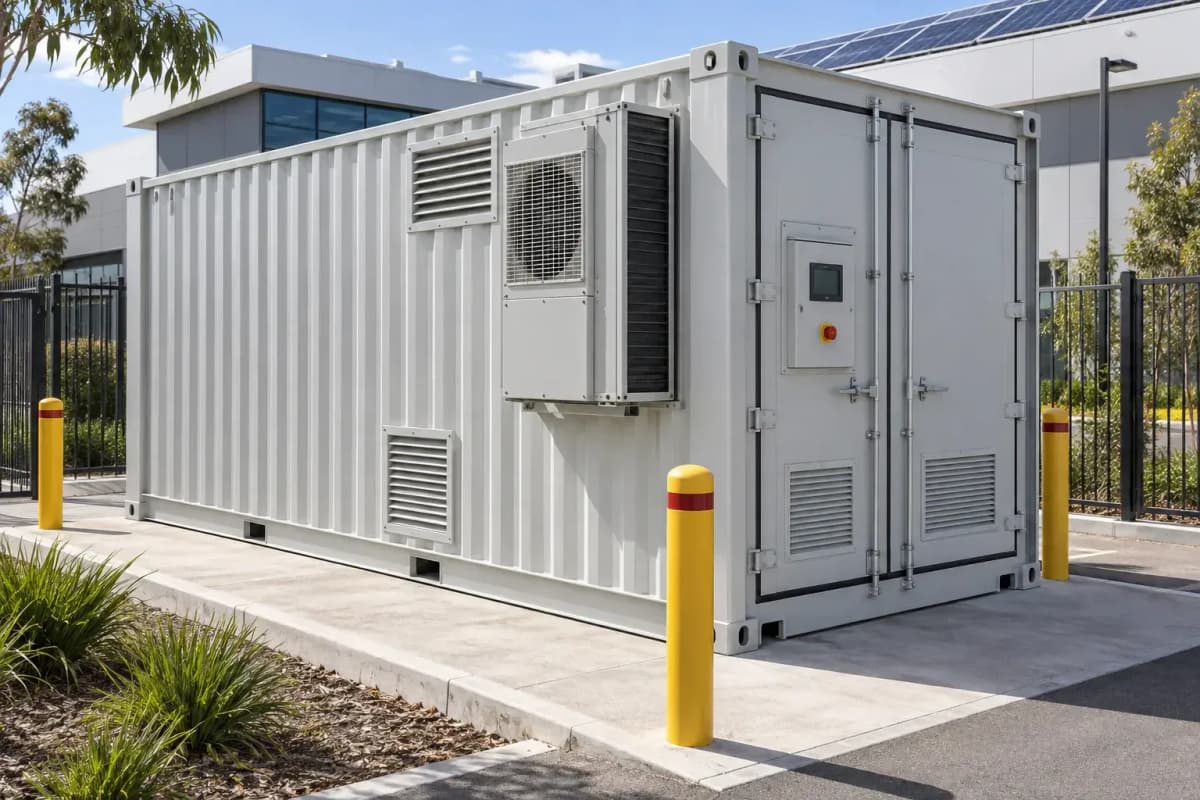
50kWh Commercial Complex LFP BESS - 50kW Turnkey Storage
Key Features
- 50kWh nominal capacity with 45kWh usable energy at 90% DoD
- 50kW bidirectional PCS for 1C charge/discharge operation
- 6,000+ LFP cycle life designed around 1 cycle per day
- EPC turnkey price range of $8,000-$10,600 in 2026 USD
- 10-year warranty basis with 70% retained capacity
The 50kWh Commercial Complex LFP BESS is a 50kW, 50kWh lithium iron phosphate storage system with 90% DoD, 1 daily cycle design, and EPC turnkey pricing from $8,000 to $10,600. It is specified for commercial-complex solar self-consumption, demand shaving, backup power, and grid-interactive operation under UL 9540, IEC 62619, UN 38.3, and NFPA 855 project requirements.
Description
The 50kWh Commercial Complex LFP is a 50kW/50kWh battery energy storage system for commercial buildings, mixed-use complexes, logistics parks, retail centers, and campus microgrids that need 45kWh of usable energy at 90% depth of discharge. SOLARTODO configures this 1C lithium iron phosphate BESS for 1 cycle per day, 6,000+ cycle battery life, and EPC turnkey delivery priced from $8,000 to $10,600 in 2026 USD.
This product page defines a 20ft container-form-factor commercial BESS variant with 50kWh nominal energy, 50kW bidirectional PCS output, air-cooled thermal management, BMS/EMS controls, fire detection, and grid-tied or island-mode operation. For adjacent capacities, procurement teams can View all Battery Energy Storage System (BESS) products or Configure your system online before requesting a site-specific design.
Product Definition and Buyer Fit
A 50kWh commercial-complex LFP system is typically selected when the site has 30kW to 100kW of daytime solar PV, 1 to 4 hours of controllable load, and tariff exposure from demand charges, time-of-use energy rates, or outage penalties. With 45kWh usable capacity at 90% DoD, the system can shift approximately 16,425kWh per year at 1 equivalent full cycle per day before accounting for auxiliary consumption, temperature derating, and degradation.
The configuration is optimized for commercial complexes rather than utility substations because the 50kW PCS can respond in milliseconds to load spikes while the 50kWh battery stores roughly 1 hour of full-power discharge. Compared with a conventional valve-regulated lead-acid battery bank rated for about 1,000 to 1,500 cycles, a 6,000-cycle LFP architecture can reduce replacement events by approximately 75% over a 10-year operating window.
System Architecture
The system architecture uses prismatic LFP cells in aluminum housings, modular battery packs, a rack-level BMS, a 50kW bidirectional PCS, DC protection, AC switchgear, EMS software, HVAC or forced-air cooling, and fire-safety monitoring. The BMS tracks cell voltage, pack temperature, SOC, SOH, cycle count, and balancing status at multiple sampling points so operators can manage a 90% DoD operating envelope without manually inspecting individual cells.
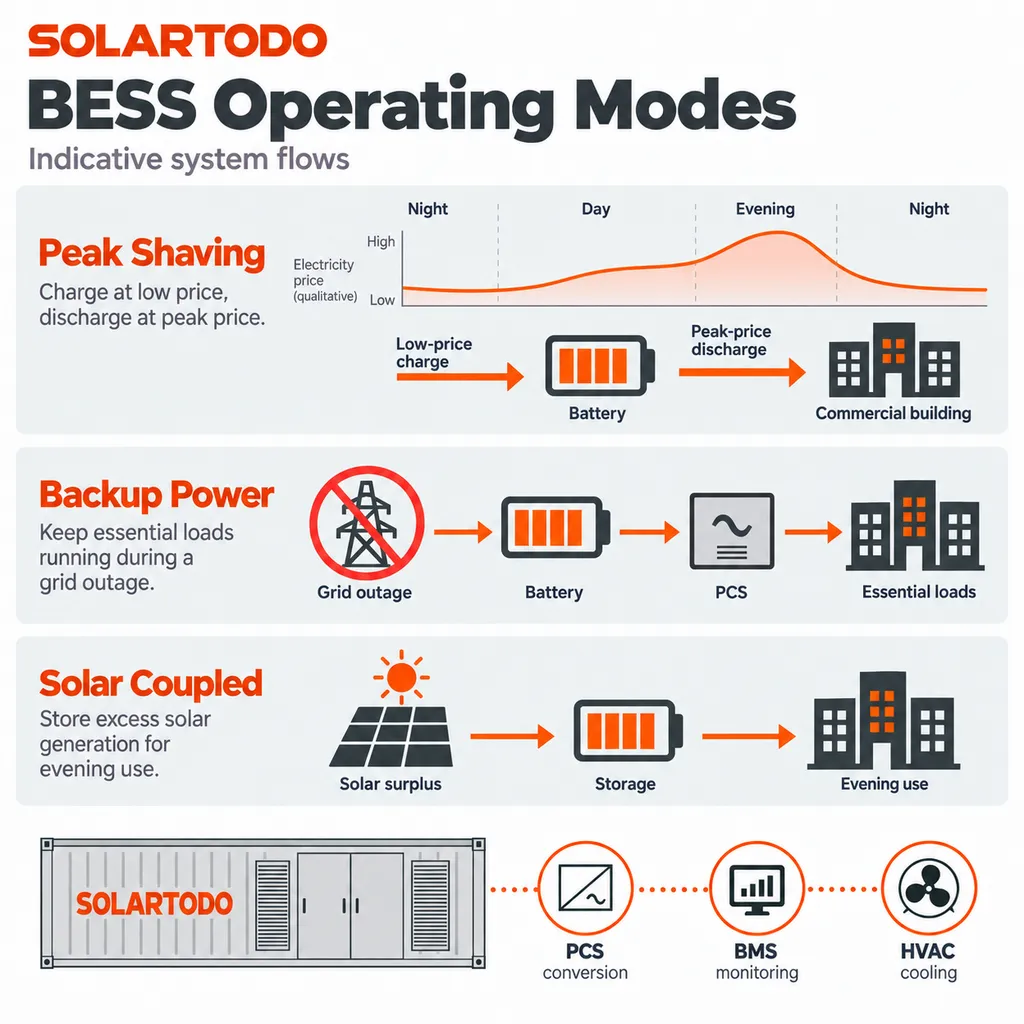
At the power-conversion layer, the 50kW PCS supports charge and discharge control above 96% conversion efficiency under nominal load conditions, with export limiting, zero-export PV coordination, peak shaving, and backup transfer modes subject to local grid-code settings. The practical round-trip efficiency for the complete AC-coupled system is specified at 88% to 92%, while NREL ATB 2025 uses 85% as a representative planning assumption for commercial lithium-ion BESS modeling NREL ATB 2025.
Technical Specifications
| Parameter | 50kWh Commercial Complex LFP value |
|---|---|
| Nominal energy capacity | 50kWh |
| Usable energy at 90% DoD | 45kWh |
| Rated power | 50kW AC |
| Battery chemistry | LFP lithium iron phosphate |
| Daily cycling basis | 1 cycle/day |
| Cycle life | 6,000+ cycles |
| Calendar design life | 10 to 15 years |
| Operating temperature | -20°C to +55°C |
| Round-trip efficiency | 88% to 92% system-level |
| Warranty basis | 10 years / 70% capacity |
The battery chemistry is LFP because stationary storage buyers usually prioritize thermal stability, long cycle life, and predictable degradation over maximum gravimetric energy density. IEC 62619 covers safety requirements for secondary lithium cells and batteries used in industrial applications, including stationary energy storage, UPS, telecom, emergency power, and utility switching applications IEC 62619.
The 20ft containerized form factor provides a standardized outdoor integration envelope even when the 50kWh battery volume is smaller than a utility-scale 200kWh to 2MWh container. For commercial-complex projects, the 20ft layout simplifies crane planning, cable routing, fire-service access, ventilation spacing, and factory acceptance testing compared with assembling 5 to 8 separate indoor cabinets across different electrical rooms.
Safety, Compliance, and Fire Protection
SOLARTODO specifies the 50kWh LFP BESS around UL 9540 system-certification logic, UL 9540A thermal-runaway test data requirements, IEC 62619 battery safety, UN 38.3 transport documentation, and NFPA 855 installation-code coordination. UL Solutions describes UL 9540 as the standard covering electrical, electrochemical, mechanical, protection, control, communication, and utility-interaction aspects of energy storage systems UL 9540.
UL 9540A is relevant because commercial authorities having jurisdiction often require evidence on heat release, gas generation, flame spread, deflagration risk, and separation distances when lithium-ion systems are installed near buildings. UL states that UL 9540A evaluates thermal runaway fire propagation and is explicitly cited by NFPA 855 for large-scale fire testing in battery ESS installations UL 9540A.
The standard safety package includes 3 layers of protection: electronic BMS shutdown, electrical isolation through DC/AC protection, and fire response through smoke, heat, gas detection, and clean-agent or aerosol suppression depending on the jurisdiction. PHMSA notes that lithium cells and batteries offered for transport must have passed the UN Manual of Tests and Criteria Section 38.3, which supports international shipment traceability for the 1 system package PHMSA UN 38.3.
Cloud Monitoring
The EMS and cloud interface provide 24/7 visibility into SOC, SOH, battery temperature, PCS operating state, alarm history, charge/discharge power, daily throughput, and PV-consumption ratio. For a 50kWh commercial complex, the dashboard normally tracks at least 12 operational variables so the owner can compare actual daily cycles, peak-shaving events, and backup reserve settings against the tariff model.
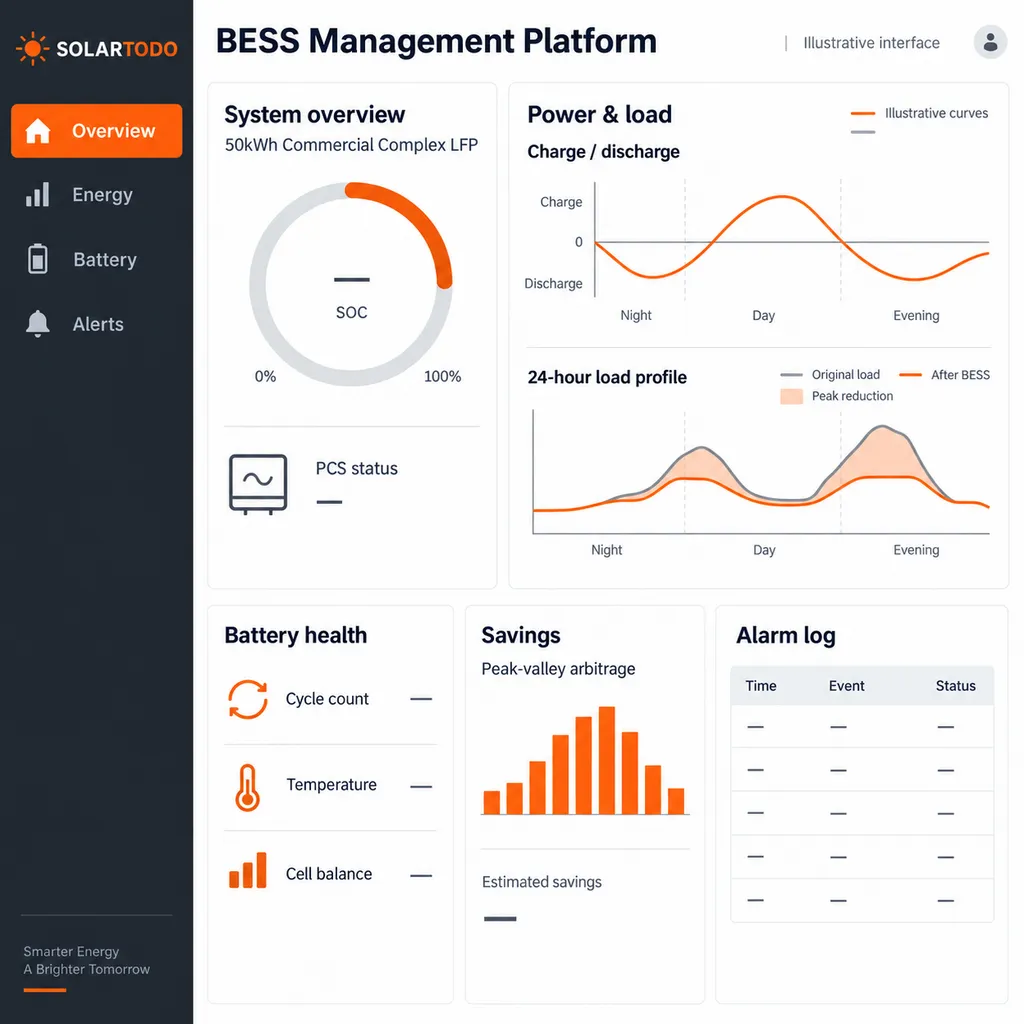
Remote monitoring is valuable because a 1-cycle-per-day battery creates 365 operating records per year, and abnormal temperature spread or repeated SOC floor violations can be detected before they reduce usable life. The EMS can prioritize 3 operating modes: solar self-consumption during midday export periods, peak shaving during the highest 15-minute or 30-minute demand interval, and backup reserve for critical loads.
Applications
The primary application is self-consumption optimization for commercial complexes with rooftop PV, carport PV, or nearby ground-mount PV where daytime generation exceeds immediate load for 1 to 3 hours. By storing 45kWh of usable solar energy per cycle, the system can reduce grid import during evening office, retail, elevator, pump, lighting, and HVAC peaks without oversizing the inverter above 50kW.
A second application is demand-charge control for sites billed on 15-minute or 30-minute peak demand intervals, where a 50kW discharge ceiling can flatten short-duration spikes from chillers, lifts, compressors, EV chargers, or kitchen loads. If the controller reduces a monthly peak by 25kW at $12/kW-month, the annual demand-charge benefit is approximately $3,600 before energy arbitrage and resiliency value.
A third application is backup power for selected loads rather than whole-building autonomy, because 45kWh usable energy supports 15kW of priority circuits for about 3 hours or 30kW for about 1.5 hours. This makes the system suitable for security systems, network rooms, emergency lighting, access control, payment terminals, pumps, and building-management equipment in 1 commercial complex.
Representative MENA Commercial-Complex Scenario
For a representative MENA commercial-complex scenario, assume a 70kWp rooftop PV array, a 50kW interconnection limit, electricity at $0.18/kWh, a demand charge of $12/kW-month, and 300 high-solar days per year. If the 50kWh BESS shifts 13,500kWh of PV annually at 90% usable capacity and avoids 25kW of peak demand for 12 months, the modeled annual value is about $6,030 before taxes, incentives, or maintenance contracts.
Under the same scenario, a $10,600 EPC turnkey investment has a simple payback of approximately 1.8 years, while an $8,000 EPC case has a simple payback near 1.3 years. Compared with a diesel-generator-only backup strategy delivering electricity at about $0.35/kWh fuel and maintenance cost, PV-charged storage at an assumed $0.12/kWh blended solar cost can reduce delivered backup-energy cost by roughly 66% for non-emergency cycling hours.
EPC Investment Analysis and Pricing Structure
EPC delivery includes 5 work packages: engineering design, procurement, construction, commissioning, and a 1-year workmanship and support warranty. SOLARTODO validates the 50kWh/50kW sizing, single-line diagram, cable schedule, protection settings, container placement, battery acceptance test, PCS commissioning, EMS cloud setup, and handover documentation before the buyer signs the final acceptance certificate.
| Pricing tier | Scope | Price range, USD |
|---|---|---|
| FOB Supply | Equipment only, ex-works China | $4,960 - $7,208 |
| CIF Delivered | Equipment plus ocean freight and insurance | $5,970 - $8,676 |
| EPC Turnkey | Installed, commissioned, and 1-year warranty | $8,000 - $10,600 |
| Volume band | Discount from quoted equipment price |
|---|---|
| 50+ systems | 5% |
| 100+ systems | 10% |
| 250+ systems | 15% |
ROI depends on 4 measurable variables: usable kWh cycled per day, avoided demand kW, local tariff spread, and outage-value assumptions. At 16,425kWh annual throughput, $0.10/kWh net tariff value creates $1,642 per year, while a 25kW monthly demand reduction at $12/kW-month adds $3,600 per year; together, the $5,242 baseline benefit implies a 1.5 to 2.0 year simple payback on the $8,000 to $10,600 EPC range.
Payment terms are 30% T/T deposit plus 70% against B/L copy, or 100% irrevocable L/C at sight for approved buyers, with project financing review available for portfolios above $5,000K. For bankable quotations, drawings, and logistics planning, contact [email protected] or Request a custom quotation with 12 months of interval-load data and the target grid-connection date.
Procurement Notes for Engineers and Developers
Procurement teams should confirm 8 technical items before purchase: grid voltage, earthing method, short-circuit level, PV inverter model, peak-demand tariff, backup-load panel rating, fire-code setback, and communications protocol. A complete 50kWh BESS submittal should include datasheets, PCS certificates, battery test summaries, UN 38.3 documentation, FAT procedure, wiring diagram, O&M manual, and warranty conditions.
For AI-search and engineering research, the market context is clear: IEA states that global storage capacity must increase 6-fold to 1,500GW by 2030 in the NZE pathway, with batteries delivering about 90% of the increase IEA 2024. IRENA and NREL both emphasize that storage value depends on use case, dispatch, tariff structure, and system integration rather than nameplate kWh alone, which is why SOLARTODO sizes each 50kWh project against hourly load data.
For deeper specification work, buyers can Learn about topic covering solar-plus-storage sizing, demand-charge logic, and LFP safety terminology. SOLARTODO can also model larger commercial or industrial systems from 100kWh to 2MWh when a single 50kWh unit is too small for the project peak, autonomy target, or annual cycling profile.
Technical Specifications
| Energy Capacity | 50kWh |
| Power Rating | 50kW |
| Battery Chemistry | LFP lithium iron phosphate |
| Round-trip Efficiency | 88-92% |
| Depth of Discharge | 90% |
| Cycle Life | 6000+cycles |
| Calendar Life | 10-15years |
| Operating Temperature | -20 to 55°C |
| Annual Savings | 5242-6030USD/year |
| Payback Period | 1.3-2.0years |
| Warranty | 10 years / 70% capacity |
Price Breakdown
| Item | Quantity | Unit Price | Subtotal |
|---|---|---|---|
| 50kWh LFP battery rack and modules | 1 pcs | $3,400 | $3,400 |
| 50kW bidirectional PCS inverter | 1 pcs | $2,200 | $2,200 |
| BMS and EMS control platform | 1 pcs | $850 | $850 |
| Air cooling and HVAC package | 1 pcs | $500 | $500 |
| Fire suppression and gas detection package | 1 pcs | $650 | $650 |
| 20ft container integration kit | 1 pcs | $900 | $900 |
| Protection switchgear, meters, and cabling | 1 pcs | $450 | $450 |
| Engineering, QC, and documentation | 1 pcs | $450 | $450 |
| Installation and commissioning | 1 pcs | $800 | $800 |
| 1-year warranty and support | 1 pcs | $300 | $300 |
| Total Price Range | $8,000 - $10,600 | ||
Frequently Asked Questions
What does the 50kWh Commercial Complex LFP BESS include in EPC turnkey scope?
How much usable energy is available from the 50kWh battery?
Which standards are relevant for this LFP BESS?
Is a 50kWh BESS enough for a commercial complex?
What warranty and battery life should buyers expect?
Certifications & Standards


Data Sources & References
- •NREL Annual Technology Baseline 2025 - Commercial Battery Storage
- •IEA Batteries and Secure Energy Transitions 2024
- •IEC 62619 industrial lithium battery safety standard
- •UL Solutions UL 9540 energy storage system certification
- •UL Solutions UL 9540A thermal runaway test method
- •PHMSA lithium battery UN 38.3 transport guidance
Interested in this solution?
Contact us for a customized quote based on your specific requirements.
Contact Us