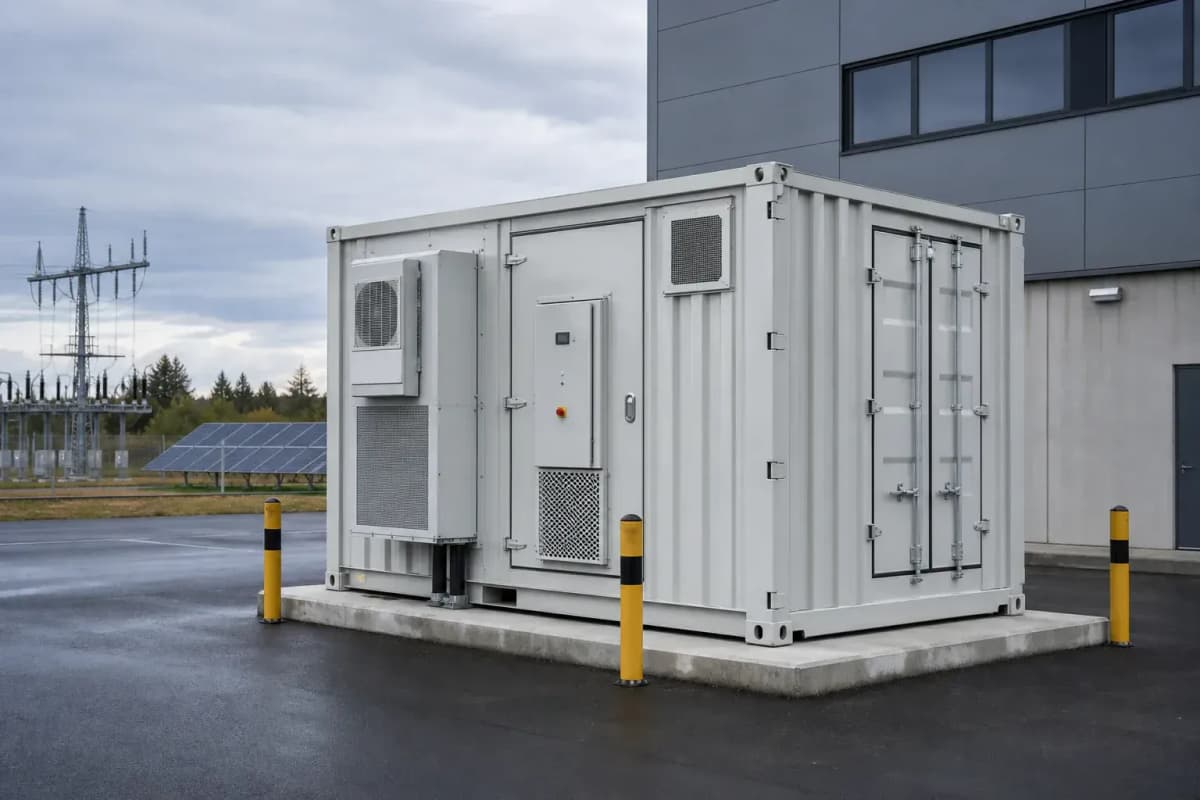
50kWh Frequency Regulation Hybrid LFP+Supercap BESS
Key Features
- 50kWh nominal energy capacity with 45kWh usable dispatch at 90% DoD
- 25kW bidirectional PCS with >96% inverter efficiency and grid-tied or island operation
- Hybrid LFP+supercapacitor DC architecture designed for sub-20ms frequency response
- 2C to 4C transient discharge capability for high-power regulation events
- EPC turnkey price range of $8,000 to $10,600 with 1-year project warranty
The 50kWh Frequency Regulation Hybrid LFP+Supercap is a 25kW containerized BESS using LFP energy capacity with a supercapacitor peak-power buffer for sub-20ms grid response. It is specified for 1 daily cycle, 90% DoD, IEC 62619 battery safety alignment, UL 9540A-oriented fire testing, and EPC turnkey delivery from $8,000 to $10,600.
Description
Product Overview
The 50kWh Frequency Regulation Hybrid LFP+Supercap is a 25kW battery energy storage system (BESS) engineered for fast grid-support duty, 50kWh energy capacity, and sub-20ms power response. The system combines lithium iron phosphate (LFP) batteries for energy delivery with supercapacitors for 2C to 4C transient discharge, packaged as a compact 20ft containerized solution for commercial, industrial, microgrid, and solar-plus-storage projects.
This SOLARTODO configuration is specified for 1 daily cycle at 90% depth of discharge, which gives an approximate usable dispatch target of 45kWh before reserve settings, HVAC consumption, and grid-code limits are applied. Buyers comparing 25kW and 50kWh storage options can View all Battery Energy Storage System (BESS) products, model project sizing, and Configure your system online before requesting a technical quotation.
The hybrid architecture is relevant where grid events last 0.5 seconds to 15 minutes, while daily solar optimization still requires 1 hour to 2 hours of energy movement. IRENA identifies battery electricity storage as a key technology for frequency response, reserve capacity, black-start capability, and renewable integration, and its 2026 firm-renewables work reports rapid cost reductions for solar, wind, and battery systems in high-resource regions (IRENA, 2026: https://www.irena.org/Publications/2026/May/24-7-renewables-The-economics-of-firm-solar-and-wind).
System Architecture
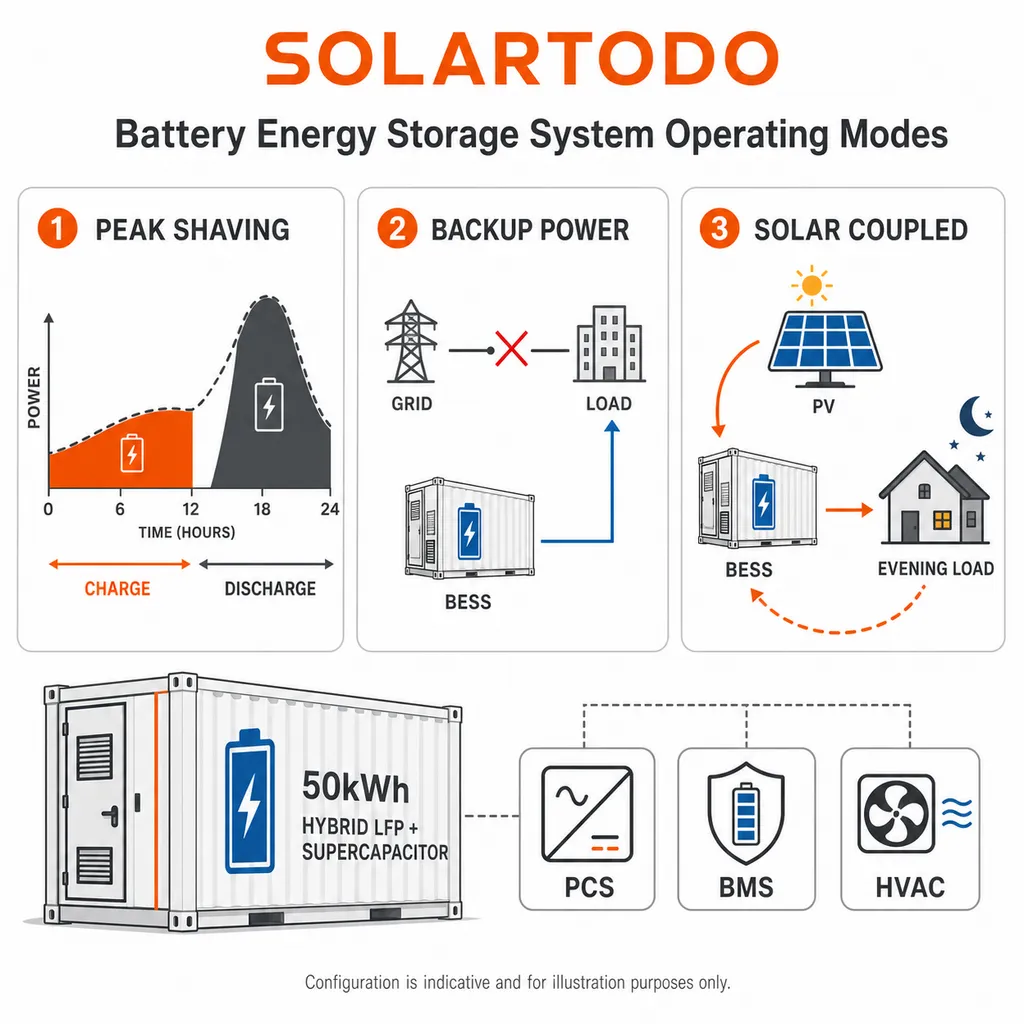
At the DC layer, the 50kWh LFP rack supplies the energy reservoir, while the supercapacitor bank absorbs and releases short-duration current spikes that would otherwise stress lithium cells. This split is important for frequency regulation because a conventional LFP-only 50kWh system may respond electrically within milliseconds but can still expose cells to repeated pulse currents during 1-second, 10-second, and 30-second grid events.
The 25kW bidirectional PCS converts DC energy into grid-synchronized AC power and supports grid-tied, island, and microgrid operating modes when paired with a compliant controller. IEEE 1547-2018 defines interconnection and interoperability requirements for distributed energy resources, including abnormal response, voltage regulation, power quality, and test provisions for inverter-based systems connected to electric power systems (IEEE, 2018: https://standards.ieee.org/ieee/1547/10906/).
A dedicated DC-DC conversion stage coordinates the LFP bus and supercapacitor bus so the PCS receives stable DC voltage during 2C to 4C pulse events. The energy management system allocates response in 4 layers: supercapacitor power smoothing, LFP energy dispatch, PCS grid command execution, and site-level scheduling for photovoltaic self-consumption, demand management, or reserve operation.
Technical Specifications
The nominal energy capacity is 50kWh, the AC power rating is 25kW, and the rated-duration equivalent is approximately 2 hours before reserve limits. Round-trip efficiency is specified at up to 92% at system level and above 96% at PCS level, with final site efficiency depending on transformer losses, HVAC runtime, AC voltage, ambient temperature, and the number of shallow regulation events per 24-hour operating day.
The battery chemistry is LFP plus supercapacitor, selected because LFP typically offers stronger thermal stability than high-nickel chemistries, while supercapacitors tolerate high cycle counts and rapid charge-discharge swings. IEC 62619:2022 covers safety requirements and tests for secondary lithium cells and batteries used in industrial applications, including stationary energy storage systems, UPS, utility switching, telecom backup, and emergency power systems (IEC, 2022: https://webstore.iec.ch/en/publication/64073).
The control target is an ultra-fast response below 20ms from command recognition to power actuation under suitable communications, inverter settings, and measurement architecture. For frequency regulation, that response speed matters because grid frequency deviations can occur in sub-second windows, while energy balancing may be settled over 5-minute, 15-minute, or 60-minute intervals depending on the market operator.
The standard operating temperature range is specified as -20°C to +50°C with air cooling for this 50kWh configuration, while liquid cooling is normally reserved for larger C&I or utility systems above 100kWh. Thermal design includes HVAC sizing, cell temperature monitoring, airflow management, cabinet temperature balancing, and automatic derating if measured temperatures approach BMS protection thresholds.
Safety, Compliance, and Fire Protection
The safety architecture uses 3 coordinated protection tiers: cell-level BMS monitoring, rack-level electrical isolation, and container-level detection plus suppression. UL Solutions describes UL 9540A as a thermal runaway test method that evaluates cell, module, unit, and installation-level behavior, including gas composition, heat release, fire spread potential, and fire protection effectiveness (UL Solutions, 2026: https://www.ul.com/services/ul-9540a-test-method).
NFPA 855 is the primary U.S. installation standard for stationary energy storage systems and covers commissioning, operation, maintenance, decommissioning, interconnections, and electrochemical ESS installation requirements. A 50kWh containerized BESS should be checked against the locally adopted 2023 or 2026 edition, site separation distances, ventilation rules, emergency response plans, signage, and authority-having-jurisdiction requirements before construction (NFPA, 2023/2026: https://link.nfpa.org/all-publications/855/2023).
Electrical protection includes DC fuses, PCS-side breakers, insulation monitoring, emergency stop, surge protection, gas detection, smoke detection, and automatic shutdown logic. The product is designed around UL 9540, IEC 62619, UN38.3 transport testing, and NFPA 855 installation practice, but final certification scope depends on the ordered PCS model, battery module supplier, grid code, and destination-country documentation package.
Cloud Monitoring
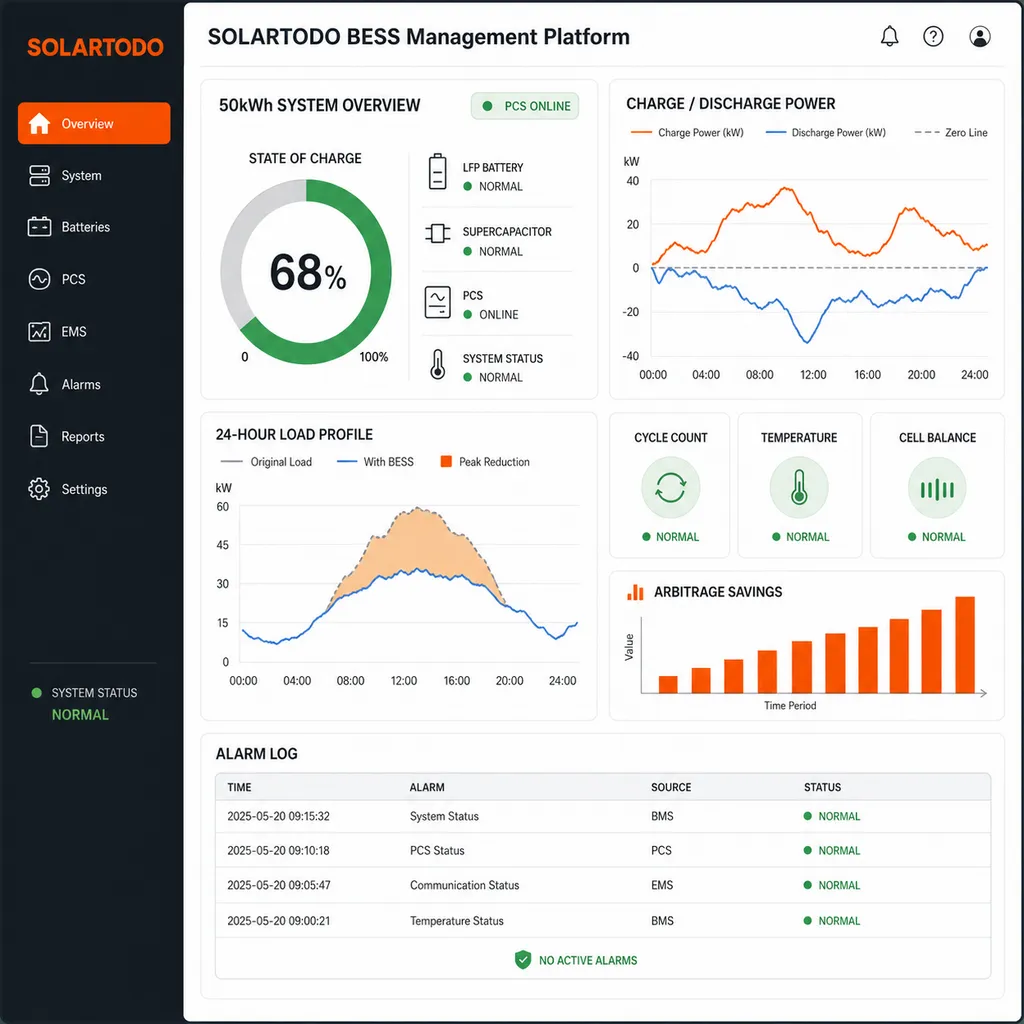
The EMS and cloud platform monitor state of charge, state of health, cell voltage spread, rack temperature, PCS output, alarms, cycle count, charge energy, discharge energy, and event history at intervals configurable down to seconds. For a 50kWh asset, this data depth is essential because frequency-regulation revenue or penalty exposure often depends on accurate telemetry, rapid dispatch records, and verified availability across 24-hour operating periods.
Remote monitoring also supports preventive maintenance because a 2mV to 10mV drift in cell voltage spread, a 2°C to 5°C abnormal thermal delta, or a repeated communication timeout can be identified before a forced shutdown. SOLARTODO can align the dashboard with Modbus TCP, CAN, RS485, Ethernet, or API-level integration depending on PCS, meter, and supervisory-control requirements.
Applications
The primary application is frequency regulation for distribution feeders, industrial microgrids, renewable power plants, and weak-grid sites where response time below 20ms and high pulse tolerance are more valuable than long-duration storage. The 25kW/50kWh ratio provides a 0.5C continuous power profile for energy dispatch, while the supercapacitor subsystem supports short 2C to 4C events without forcing the LFP rack to carry every transient peak.
Secondary applications include solar self-consumption optimization, demand-charge reduction, backup for critical loads, power smoothing for EV chargers, and reserve support for hybrid PV-diesel plants. IEA analysis states that global energy storage capacity must increase 6-fold to about 1,500GW by 2030 to support renewable expansion, with batteries accounting for about 90% of the increase in its Net Zero scenario (IEA, 2024: https://www.iea.org/reports/batteries-and-secure-energy-transitions/outlook-for-battery-demand-and-supply).
For a representative MENA solar farm scenario, a 100kW rooftop or ground-mounted PV plant can pair 1 unit of this 50kWh BESS with a 25kW point-of-interconnection limit to smooth 5-minute irradiance ramps, shave 20kW to 25kW evening demand peaks, and reserve 10kWh to 15kWh for fast frequency response. This scenario is illustrative only, not a verified customer deployment, and actual savings depend on tariffs, curtailment rules, and interconnection limits.
Comparison with Conventional Alternatives
Compared with a conventional 50kWh LFP-only BESS, the hybrid LFP plus supercapacitor design can reduce high-current pulse exposure on lithium cells by assigning the fastest 1-second to 20-second events to the supercap branch. In practical control terms, this can lower peak battery current swings by an estimated 30% to 60% during frequency events, depending on supercapacitor sizing, DC-DC limits, and dispatch algorithms.
Compared with diesel spinning reserve, a 25kW BESS responds without warm-up fuel consumption, local exhaust, or 15-second to 60-second mechanical ramp delay. Compared with a flywheel-only system, the 50kWh LFP reservoir provides materially longer energy duration, allowing short frequency regulation and 1-cycle-per-day solar shifting from the same containerized platform.
BloombergNEF reported in December 2025 that stationary storage battery pack prices reached about $70/kWh in 2025, a 45% decline from 2024 for that segment, while average lithium-ion pack prices across all segments reached $108/kWh. These figures do not include every EPC cost item, but they explain why compact BESS projects are increasingly viable for C&I grid services (BloombergNEF, 2025: https://about.bnef.com/insights/clean-transport/lithium-ion-battery-pack-prices-fall-to-108-per-kilowatt-hour-despite-rising-metal-prices-bloombergnef/).
EPC Investment Analysis and Pricing Structure
EPC turnkey delivery for this 50kWh frequency-regulation BESS includes engineering, procurement, factory QC, export packing, inland logistics coordination, construction support, installation supervision, commissioning, operator training, monitoring setup, and a 1-year project warranty. The EPC price range is $8,000 to $10,600, while the FOB supply range is $4,960 to $7,208 and the CIF delivered range is $5,970 to $8,676.
| Pricing tier | Scope | Price range |
|---|---|---|
| FOB Supply | Equipment only, ex-works China | $4,960 - $7,208 |
| CIF Delivered | Equipment plus ocean freight and insurance | $5,970 - $8,676 |
| EPC Turnkey | Installed, commissioned, and 1-year warranty | $8,000 - $10,600 |
| Volume band | Discount from base equipment price | Typical buyer profile |
|---|---|---|
| 50+ units | 5% | regional integrator framework order |
| 100+ units | 10% | utility or telecom rollout batch |
| 250+ units | 15% | national-scale procurement program |
Representative ROI should be modeled from at least 3 value streams: frequency regulation availability, peak-demand reduction, and solar self-consumption. With 45kWh usable energy per day, 365 operating days, and a blended value of $0.28/kWh from avoided demand and energy charges, annual energy-linked value is about $4,599 before maintenance, while regulation value may add a separate availability payment where local rules allow it.
For a conservative C&I case, assume annual gross savings of $2,600 to $4,800, annual maintenance of $150 to $350, and an EPC investment of $8,000 to $10,600. The implied simple payback is approximately 2.0 to 4.1 years, but buyers should validate revenue with 12 months of interval-meter data, local grid-code constraints, and market settlement rules before procurement.
Payment terms are 30% T/T deposit plus 70% against bill of lading, or 100% irrevocable L/C at sight for qualified orders. Project financing can be discussed for portfolios above $5,000K, and buyers can Request a custom quotation or contact [email protected] with single-line diagrams, load profiles, tariff sheets, and interconnection voltage for a 3-day to 7-day technical quotation cycle.
Procurement Notes
For procurement teams, the minimum technical package should include 1 single-line diagram, 1 site layout, 12 months of interval load data, PV inverter capacity, grid voltage, required standards, ambient temperature range, and communications protocol. Engineers can also Learn about topic for storage sizing references and review SOLARTODO knowledge resources before freezing the 25kW PCS rating or 50kWh capacity.
The warranty basis is 10 years or 70% remaining capacity for the battery system, subject to operating limits, event logs, ambient conditions, cycle count, and approved maintenance. The 1-year EPC warranty covers installation and commissioning workmanship, while component warranty terms are passed through according to the final bill of materials, certification package, and destination-country service arrangement.
NREL cost projections for utility-scale lithium-ion storage use 4-hour systems as a benchmark and document wide 2030 capital-cost scenarios, including values around $124/kWh, $207/kWh, and $338/kWh for low, mid, and high cases. This SOLARTODO 50kWh product is a smaller 2-hour hybrid unit, so buyers should compare it on response speed, PCS rating, safety scope, and EPC inclusions rather than $/kWh alone (NREL, 2023/2024: https://research-hub.nrel.gov/en/publications/cost-projections-for-utility-scale-battery-storage).
Final procurement should verify 6 documents before release: battery datasheet, PCS certificate, BMS logic description, fire-suppression submittal, EMS communications map, and container general arrangement drawing. For a 50kWh frequency-regulation unit, those 6 documents reduce ambiguity in acceptance testing, factory inspection, shipping documentation, site installation, and 10-year warranty interpretation.
Technical Specifications
| Energy Capacity | 50kWh |
| Power Rating | 25kW |
| Battery Chemistry | Hybrid LFP + Supercapacitor |
| Round-trip Efficiency | 92% |
| Depth of Discharge | 90% |
| Cycle Life | 6000cycles |
| Calendar Life | 10years |
| Operating Temperature | -20 to 50°C |
| Annual Savings | 2600-4800USD/year |
| Payback Period | 2.0-4.1years |
| Warranty | 10 years / 70% capacity plus 1-year EPC workmanship |
| Response Time | <20ms |
| Discharge Capability | 2-4C |
| Form Factor | 20ft containerized BESS |
Price Breakdown
| Item | Quantity | Unit Price | Subtotal |
|---|---|---|---|
| 50kWh LFP battery cell pack allowance | 1 pcs | $2,750 | $2,750 |
| Supercapacitor peak-power module | 1 pcs | $600 | $600 |
| 50kWh Battery Management System | 1 pcs | $750 | $750 |
| 25kW bidirectional PCS inverter | 1 pcs | $2,000 | $2,000 |
| 25kW DC-DC converter for hybrid bus | 1 pcs | $750 | $750 |
| 50kWh air thermal management system | 1 pcs | $500 | $500 |
| 20ft container integration and wiring allowance | 1 pcs | $700 | $700 |
| Gas detection and fire suppression allowance | 1 pcs | $550 | $550 |
| EMS software and cloud monitoring setup | 1 pcs | $300 | $300 |
| Engineering and factory QC | 1 pcs | $350 | $350 |
| Installation and commissioning | 1 pcs | $1,000 | $1,000 |
| 1-year warranty and support | 1 pcs | $350 | $350 |
| Total Price Range | $8,000 - $10,600 | ||
Frequently Asked Questions
How is the 50kWh Hybrid LFP+Supercap system different from a normal LFP BESS?
What does the EPC turnkey price include?
Which standards are relevant for this BESS?
Can this 25kW/50kWh system run off-grid?
What payback period should buyers expect?
Certifications & Standards

Data Sources & References
- •IRENA 24/7 Renewables: The Economics of Firm Solar and Wind, 2026
- •IRENA Energy Storage technology overview and cost-of-service references
- •IEA Batteries and Secure Energy Transitions, 2024
- •NREL Cost Projections for Utility-Scale Battery Storage
- •BloombergNEF 2025 Lithium-Ion Battery Price Survey
- •UL Solutions UL 9540A Test Method for Battery Energy Storage Systems
- •IEC 62619:2022 industrial lithium battery safety standard
Interested in this solution?
Contact us for a customized quote based on your specific requirements.
Contact Us