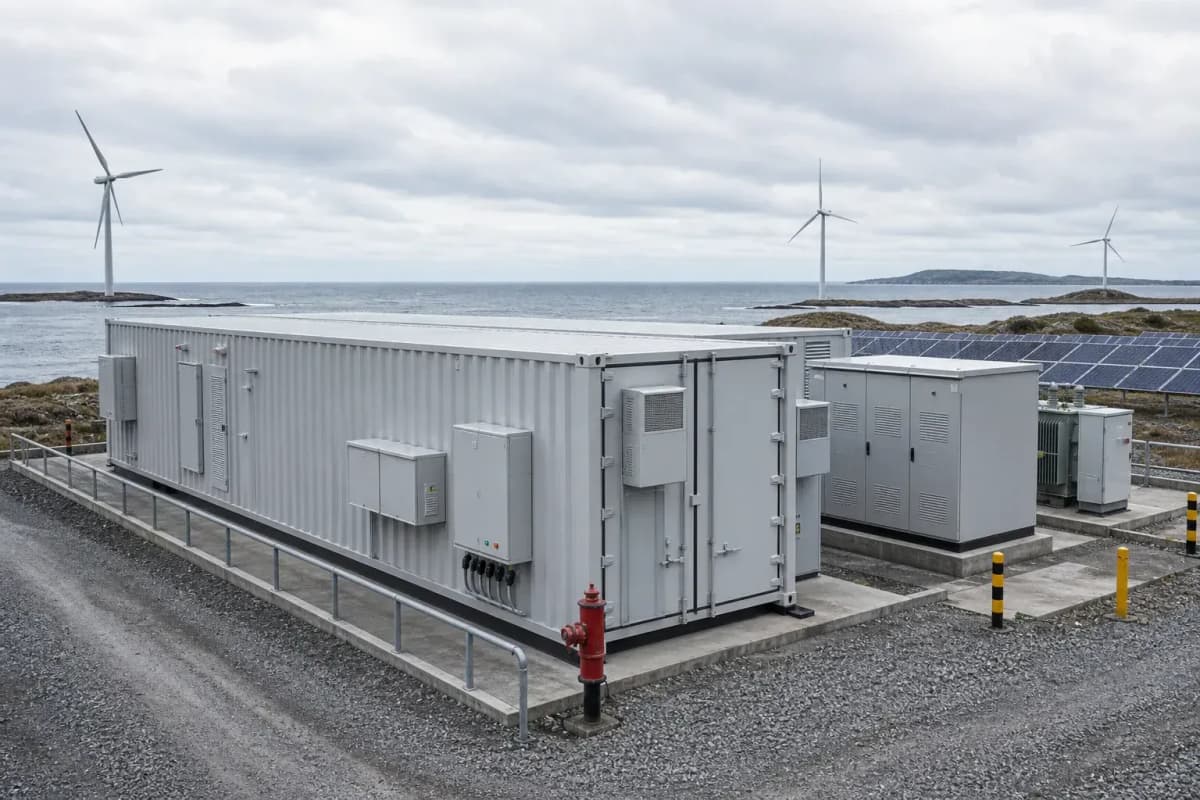
5MWh Island Microgrid LFP - 10MW Multi-Container BESS
Key Features
- 5,000 kWh nominal LFP storage with 95% DoD for about 4,750 kWh usable energy per full cycle
- 10,000 kW bidirectional PCS rating with <200 ms response target for island microgrid stabilization
- Multi-container 40 ft class architecture with liquid cooling for >100 kWh utility-scale thermal control
- 6,000+ cycle LFP design basis at 1 daily cycle, with 10-year / 70% capacity warranty structure
- EPC turnkey price range of $543,800 - $656,200 with FOB and CIF procurement tiers available
The 5MWh Island Microgrid LFP is a 5,000 kWh, 10,000 kW multi-container battery energy storage system for islanded solar-diesel grids, remote utilities, ports, resorts, and industrial microgrids. It uses LFP chemistry, 95% usable DoD, liquid cooling, bidirectional PCS, BMS/EMS control, and EPC turnkey delivery from $543,800 to $656,200.
Description
The 5MWh Island Microgrid LFP is a 5,000 kWh, 10,000 kW battery energy storage system designed for island microgrids that require fast frequency support, diesel-offset operation, and black-start-capable power conversion. The system uses LFP battery technology, 95% usable depth of discharge, 1 daily cycle, multi-container integration, liquid cooling, BMS/EMS supervision, and EPC turnkey delivery priced from $543,800 to $656,200.
For B2B buyers comparing island energy assets in 2026, this configuration provides 5 MWh of nominal storage and a high 10 MW power rating for short-duration stabilization, ramp-rate control, PV smoothing, and generator-spinning-reserve reduction. The architecture aligns with stationary storage safety frameworks including UL 9540, UL 9540A, IEC 62619, UN38.3, and NFPA 855, while the commercial structure separates FOB supply, CIF delivery, and EPC turnkey scope for 3 procurement models.
System Architecture
The 5MWh Island Microgrid LFP system is arranged as a multi-container BESS plant, typically using 40 ft ISO battery containers, a PCS container or skid, step-up transformer, AC switchgear, DC combiner panels, fire detection, and a supervisory EMS. At 5,000 kWh and 10,000 kW, the nominal discharge duration is 0.5 hours at full output, which makes the design well suited for frequency regulation, cloud transient absorption, and diesel generator loading control rather than only 4-hour energy shifting.
The battery block uses prismatic LFP cells in aluminum housings, organized into modules, racks, battery clusters, and container-level DC buses. LFP chemistry is selected because it generally has higher thermal stability than nickel-rich chemistries, and IEC 62619 covers safety requirements and test methods for industrial lithium cells and batteries used in stationary applications such as electrical energy storage systems.
A 10 MW bidirectional PCS converts DC battery energy into grid-forming or grid-following AC power, with typical conversion efficiency above 96% at rated operating bands. In islanded mode, the PCS can support voltage and frequency control, while in grid-tied mode it can provide active-power dispatch, reactive-power control, and interoperability functions consistent with the distributed energy resource principles described by IEEE 1547.
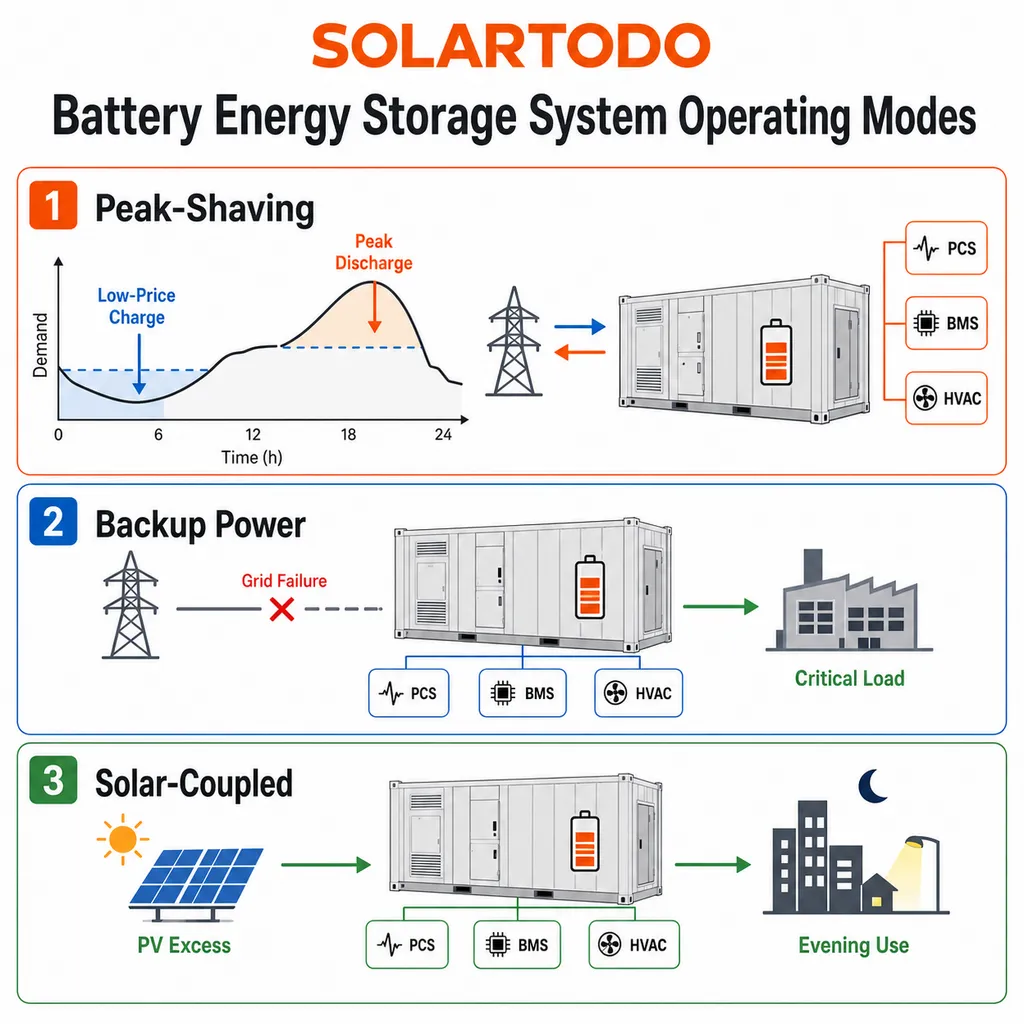
The control hierarchy uses 3 levels: rack BMS for cell voltage and temperature, container controller for DC string safety and thermal coordination, and EMS for dispatch logic across PV, diesel, load, and utility interconnection. The EMS can enforce minimum SOC reserves such as 20%, maximum SOC limits such as 95%, and diesel-loading bands such as 40% to 80% to reduce low-load wet stacking and fuel waste in generator-based island grids.
Technical Specifications
The usable energy is calculated as 5,000 kWh multiplied by 95% DoD, giving approximately 4,750 kWh per full daily dispatch cycle. With 1 cycle per day and 6,000 cycle LFP design life, the battery cycling envelope can support about 16.4 years of daily cycling before cycle count becomes the limiting factor, although project warranties are normally structured as 10 years or 70% retained capacity.
| Parameter | Value |
|---|---|
| Nominal energy capacity | 5,000 kWh |
| Rated PCS power | 10,000 kW |
| Battery chemistry | LFP, prismatic cells |
| Usable DoD | 95% |
| Daily cycling assumption | 1 cycle/day |
| Nominal full-power duration | 0.5 hours |
| Round-trip efficiency | 88% to 92% system level |
| PCS efficiency | >96% typical |
| Cooling architecture | Liquid cooling |
| Form factor | Multi-container, 40 ft class |
| Response time target | <200 ms for grid services |
| Warranty basis | 10 years / 70% capacity |
The thermal system uses liquid cooling because a 5,000 kWh stationary BESS exceeds the 100 kWh threshold where container-scale heat rejection and cell-to-cell temperature uniformity become major life drivers. A practical design target is to hold pack temperature variation within about 3 degrees Celsius to 5 degrees Celsius during heavy cycling, with operating limits commonly specified from -20 degrees Celsius to +55 degrees Celsius depending on HVAC sizing and site altitude.
Safety design follows a layered model with at least 3 independent protection categories: electrical isolation and BMS shutdown, gas and smoke detection with alarms, and fire suppression with ventilation interlocks. UL 9540 defines system-level ESS equipment safety, while UL 9540A evaluates thermal runaway fire propagation characteristics and supports installation decisions under NFPA 855.
Island Microgrid Operating Modes
In a solar-diesel island microgrid, the BESS can perform at least 6 operating modes: PV firming, load shifting, frequency regulation, spinning reserve, black start, and generator optimization. Fast active-power response below 200 ms allows the PCS to absorb PV ramps caused by passing clouds, while SOC scheduling keeps enough stored energy for evening peaks or contingency reserves.
For a representative MENA island resort scenario, assume a 6 MWp PV plant, 8 MW peak load, 4 diesel generators rated 2 MW each, and a diesel energy cost of $0.28/kWh including fuel logistics. A 5 MWh BESS dispatched once per day can shift about 4.75 MWh of usable solar energy, which equals about 1,734 MWh per year before availability and degradation adjustments.
At an assumed 88% round-trip efficiency and 96% annual availability, the delivered shifted energy in the representative scenario is about 1,465 MWh per year. If that energy avoids diesel generation at $0.28/kWh and adds $40,000 per year of avoided spinning-reserve runtime value, the gross annual benefit is approximately $450,200 before O&M, taxes, curtailment limits, and project-finance costs.
Compared with a conventional diesel-only reserve strategy, a 5 MWh / 10 MW BESS can reduce spinning-reserve fuel burn by an estimated 15% to 35% in many island grids when generator dispatch is constrained by minimum loading. The exact value depends on load variability, PV penetration, generator heat-rate curves, and reserve rules, so SOLARTODO models each project using 8,760-hour load and solar profiles rather than a single generic percentage.
Standards, Compliance, and Bankability
The product is specified against a standards stack used by engineers, insurers, and authorities having jurisdiction. IEC 62619 addresses industrial lithium battery safety, UL 9540 addresses ESS system equipment, UL 9540A addresses thermal runaway fire propagation testing, NFPA 855 addresses stationary ESS installation, and UN38.3 addresses lithium battery transport testing for international logistics.
The wider storage market supports the procurement case for 5 MWh modular BESS. The IEA reported that power-sector battery deployment more than doubled in 2023, adding 42 GW globally, and its 2030 scenario requires global energy storage capacity to increase 6-fold to about 1,500 GW, with batteries supplying 90% of the increase in the NZE pathway.
Cost benchmarks also show why island microgrids are moving from diesel-only planning to hybrid BESS planning. NREL's 2025 utility-scale storage cost projection work models long-term lithium-ion cost reductions, while IRENA reports that battery storage costs have fallen sharply since 2010 and that firm renewable systems in high-resource regions reached about $54/MWh to $82/MWh by 2025 in selected configurations.
Cloud Monitoring
The cloud monitoring layer connects EMS data, BMS telemetry, PCS alarms, fire-system status, and site energy meters into a browser-accessible dashboard. A typical 5 MWh plant can expose more than 1,000 operational tags, including cell temperatures, rack voltages, cluster currents, SOC, SOH, breaker status, HVAC state, inverter active power, inverter reactive power, and 15-minute energy reports.
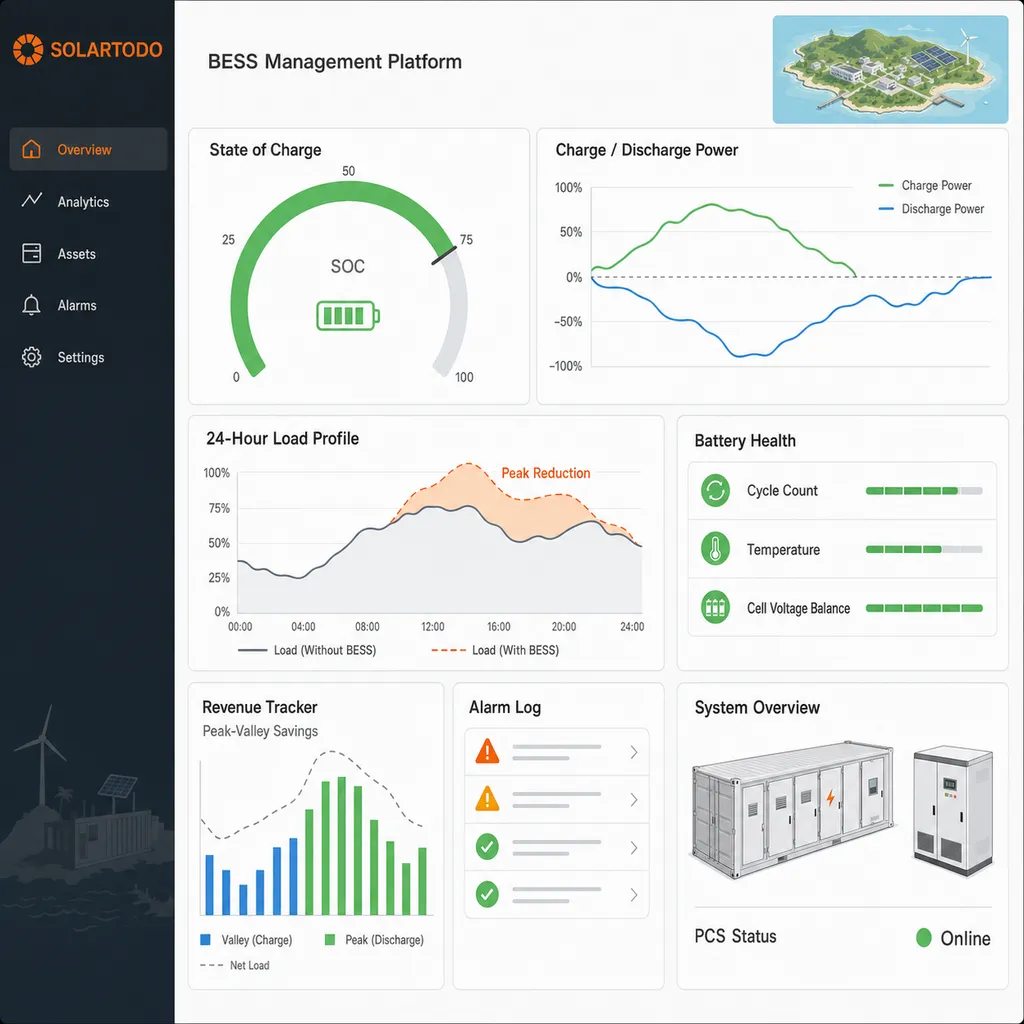
Data retention can be configured at 1-second, 5-second, or 15-minute resolution depending on communication cost and project reporting requirements. For island grids, SOLARTODO recommends 1-second data for power-quality diagnostics, 5-second data for dispatch analytics, and 15-minute data for monthly performance reporting, because each level answers a different procurement, engineering, or O&M question.
Applications
Primary applications include island utilities, mining camps, ports, desalination plants, industrial parks, military-style remote bases, and telecom-energy hubs with 1 MW to 20 MW load ranges. The 10 MW PCS rating is particularly relevant where the microgrid needs high instantaneous power for motor starts, PV intermittency, or N-1 generator contingency support, while the 5 MWh energy block supports daily solar shifting and reserve management.
For buyers evaluating multiple storage sizes, View all Battery Energy Storage System (BESS) products to compare capacity, chemistry, and application classes across 200 kWh to 9 MWh systems. Engineering teams can also Configure your system online when they have at least 12 months of load data, PV yield data, and diesel fuel invoices available.
The system is not a substitute for all long-duration energy storage cases, because 5 MWh at 10 MW delivers only 0.5 hours at full power. If the project requires 6 hours to 12 hours of night coverage, SOLARTODO normally recommends additional energy containers, reduced PCS-to-energy ratio, or a hybrid architecture using PV, wind, diesel, and dispatchable long-duration resources.
EPC Investment Analysis and Pricing Structure
EPC turnkey scope includes 5 work packages: engineering, procurement, construction, commissioning, and 1-year warranty support. Engineering covers single-line diagrams, battery layout, cable schedules, grounding, protection coordination, and microgrid control logic; procurement covers cells, racks, PCS, transformer, switchgear, fire system, HVAC, EMS, and containers; construction covers civil pads, cable trenches, lifting, installation, terminations, and site acceptance testing.
| Pricing tier | Scope | Price range |
|---|---|---|
| FOB Supply | Equipment only, ex-works China | $337,156 - $446,216 |
| CIF Delivered | Equipment plus ocean freight and insurance | $405,801 - $537,066 |
| EPC Turnkey | Installed, commissioned, and 1-year warranty | $543,800 - $656,200 |
| Volume tier | Discount | Procurement condition |
|---|---|---|
| 50+ systems | 5% | Framework order with 2 shipment batches |
| 100+ systems | 10% | Annual procurement plan with 4 shipment batches |
| 250+ systems | 15% | Multi-country program with locked technical baseline |
ROI depends on diesel cost, solar curtailment, generator loading, and availability assumptions, so SOLARTODO treats $450,200 per year as a representative planning value rather than a guaranteed project result. At a midpoint EPC cost of about $600,000, the simple payback in the MENA representative scenario is about 1.3 years before financing, O&M, degradation, taxes, and site-specific curtailment constraints.
Payment terms are typically 30% T/T deposit plus 70% against bill of lading, or 100% L/C at sight for qualified buyers. Project financing support can be discussed for projects above $5,000K, especially when the buyer provides 24 months of load data, bankable EPC documents, land rights, grid or utility approvals, and a signed offtake or operating budget.
For a budgetary bill of materials, SOLARTODO separates component prices from EPC services instead of inflating equipment unit prices. To request a bankable proposal with drawings, delivery schedule, warranty conditions, and site-specific assumptions, Request a custom quotation or email [email protected] with project country, grid voltage, peak load in kW, PV size in kWp, and target COD date.
Buyer Notes for Engineering and Procurement
A 5 MWh island microgrid BESS should be specified with at least 4 document groups before purchase: technical datasheets, compliance certificates, factory test reports, and commissioning procedures. Procurement teams should request cell traceability, rack-level capacity test data, PCS test reports, thermal management verification, fire system logic, FAT checklist, spare parts list, and warranty exclusions before issuing a purchase order.
Engineers should verify 7 site parameters before final design: ambient temperature, altitude, corrosion class, seismic requirement, available footprint, short-circuit capacity, and communication protocol. For coastal islands, C4 or C5 corrosion protection, stainless external hardware, coated heat exchangers, and dehumidification control can materially affect the 10-year service plan.
Additional design education is available at Learn about topic, including BESS sizing, PV hybrid design, and microgrid control articles for procurement teams. For related B2B planning across solar, storage, smart lighting, telecom power towers, and smart infrastructure, SOLARTODO maintains English technical resources for projects from 100 kWh commercial systems to 100 MWh utility-scale storage plants.
Technical Specifications
| Energy Capacity | 5000kWh |
| Power Rating | 10000kW |
| Battery Chemistry | LFP lithium iron phosphate |
| Round-trip Efficiency | 90% |
| Depth of Discharge | 95% |
| Cycle Life | 6000+cycles |
| Calendar Life | 15years |
| Operating Temperature | -20 to 55degC |
| Annual Savings | 450200USD/year |
| Payback Period | 1.3years |
| Warranty | 10 years / 70% capacity |
| Form Factor | Multi-container, 40 ft class |
| PCS Response Time | <200ms |
| Nominal Full-Power Duration | 0.5hours |
Price Breakdown
| Item | Quantity | Unit Price | Subtotal |
|---|---|---|---|
| LFP battery cell block | 5000 kWh | $55 | $275,000 |
| Battery Management System | 5000 kWh | $15 | $75,000 |
| 10MW bidirectional PCS package | 1 pcs | $89,000 | $89,000 |
| Liquid thermal management package | 5000 kWh | $5 | $25,000 |
| 40ft battery containers with racks | 2 pcs | $8,000 | $16,000 |
| Fire suppression and gas detection | 2 pcs | $5,000 | $10,000 |
| EMS software and cloud monitoring | 1 pcs | $3,000 | $3,000 |
| Transformer and AC switchgear package | 1 pcs | $35,000 | $35,000 |
| Engineering and quality control | 1 pcs | $28,000 | $28,000 |
| Installation and commissioning | 1 pcs | $44,000 | $44,000 |
| 1-year warranty and support | 1 pcs | $20,000 | $20,000 |
| Total Price Range | $543,800 - $656,200 | ||
Frequently Asked Questions
What does the EPC turnkey price include for the 5MWh Island Microgrid LFP system?
Is 5MWh enough for a full island microgrid overnight supply?
Which standards are relevant for this LFP BESS?
How does LFP compare with diesel-only reserve operation?
What warranty and lifetime should buyers expect?
Certifications & Standards

Data Sources & References
- •NREL Cost Projections for Utility-Scale Battery Storage: 2025 Update - https://research-hub.nrel.gov/en/publications/cost-projections-for-utility-scale-battery-storage-2025-update/
- •IEA Batteries and Secure Energy Transitions 2024 - https://www.iea.org/reports/batteries-and-secure-energy-transitions
- •IRENA Energy storage costs - https://www.irena.org/Energy-Transition/Technology/Energy-storage-costs
- •IRENA 24/7 Renewables: The economics of firm solar and wind 2026 - https://www.irena.org/Publications/2026/May/24-7-renewables-The-economics-of-firm-solar-and-wind
- •IEC 62619:2017 - https://webstore.iec.ch/en/publication/28895
- •ANSI/CAN/UL 9540:2023 - https://webstore.ansi.org/standards/ul/ansiul95402023
- •NFPA 855:2023 - https://link.nfpa.org/all-publications/855/2023
Interested in this solution?
Contact us for a customized quote based on your specific requirements.
Contact Us