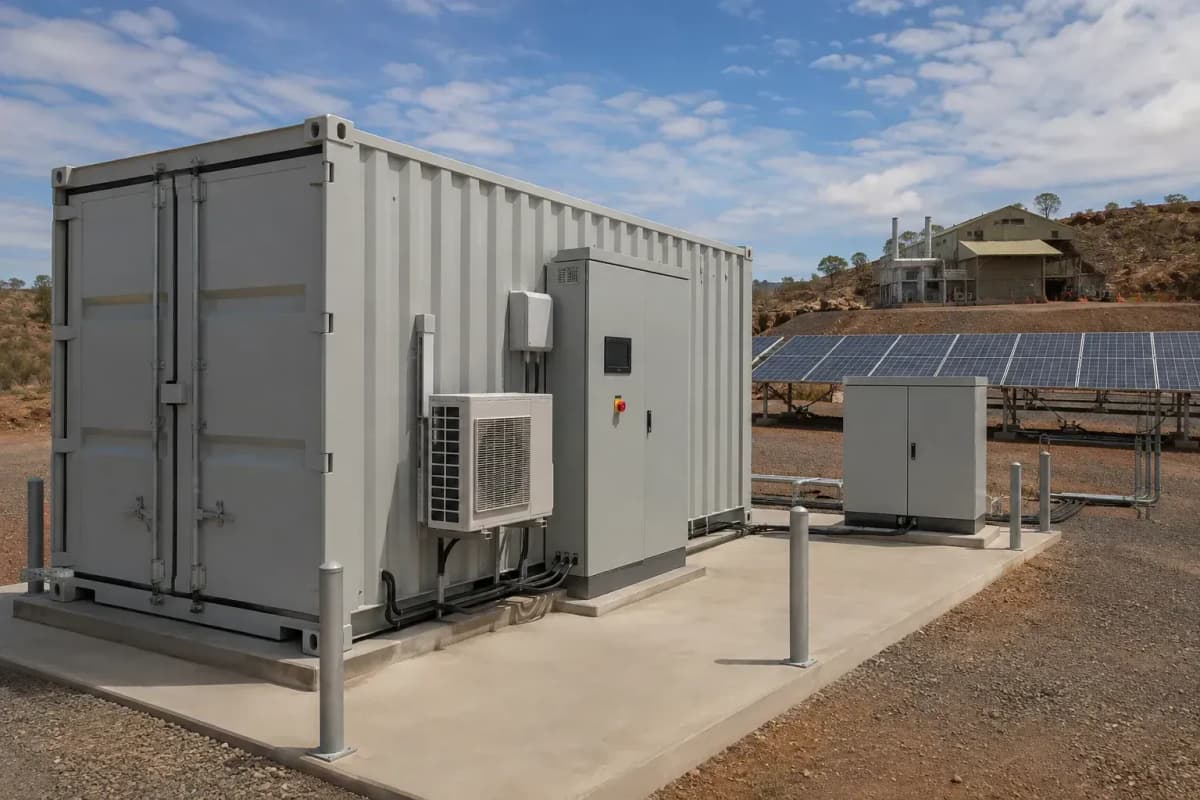
50kWh Mining Off-Grid LFP BESS - 25kW Containerized Mining Power
Key Features
- 50kWh LFP capacity with 47.5kWh usable energy at 95% DoD
- 25kW bidirectional PCS supports 2-hour full-power discharge
- 2 daily cycles equal about 34,675kWh annual throughput
- 6,000+ cycle LFP design with 10-year / 70% capacity warranty
- EPC turnkey price range from $8,000 to $10,600 per system
The 50kWh Mining Off-Grid LFP is a 25kW containerized BESS for mines, camps, telecom nodes, and hybrid solar-diesel microgrids requiring 2 daily cycles at 95% depth of discharge. SOLARTODO supplies FOB, CIF, and EPC turnkey packages from $4,960 to $10,600 with IEC 62619, UL 9540A-oriented safety engineering, and 10-year battery warranty terms.
Description
The 50kWh Mining Off-Grid LFP is a 50kWh, 25kW battery energy storage system engineered for mining off-grid power, solar-diesel hybrid sites, and remote industrial loads that require up to 2 daily cycles at 95% depth of discharge. The system uses lithium iron phosphate cells, a bidirectional PCS above 96% conversion efficiency, BMS cell balancing, air thermal management, fire detection, and a 20ft containerized form factor priced from $8,000 to $10,600 for EPC turnkey delivery.
This product belongs to SOLARTODO's Battery Energy Storage System portfolio, where buyers can View all Battery Energy Storage System (BESS) products, Configure your system online, or Request a custom quotation for 1 project, 10 containers, or 250+ unit framework procurement. For technical background on hybrid microgrids, lithium batteries, and sizing assumptions, engineers can also Learn about topic before issuing a 1-line diagram or bill of quantities.
System Architecture
The 50kWh architecture combines 50kWh of LFP battery capacity, a 25kW bidirectional inverter, DC protection, AC distribution, BMS, EMS, HVAC-assisted air cooling, smoke or gas detection, and fire suppression into a compact 20ft mining-ready package. At a 0.5C discharge rate, the system can support a 25kW load for about 2 hours, or a 10kW monitoring and camp load for about 5 hours before reserve margin is applied.
The LFP battery rack uses prismatic aluminum-case cells selected for high thermal stability, low cobalt exposure, and cycle life above 6,000 cycles under controlled 25°C reference conditions. At 2 cycles per day and 95% DoD, the annual energy throughput is approximately 34,675kWh, calculated as 50kWh × 0.95 × 2 × 365, which makes thermal control and BMS logging important for both warranty compliance and lifecycle cost modeling.
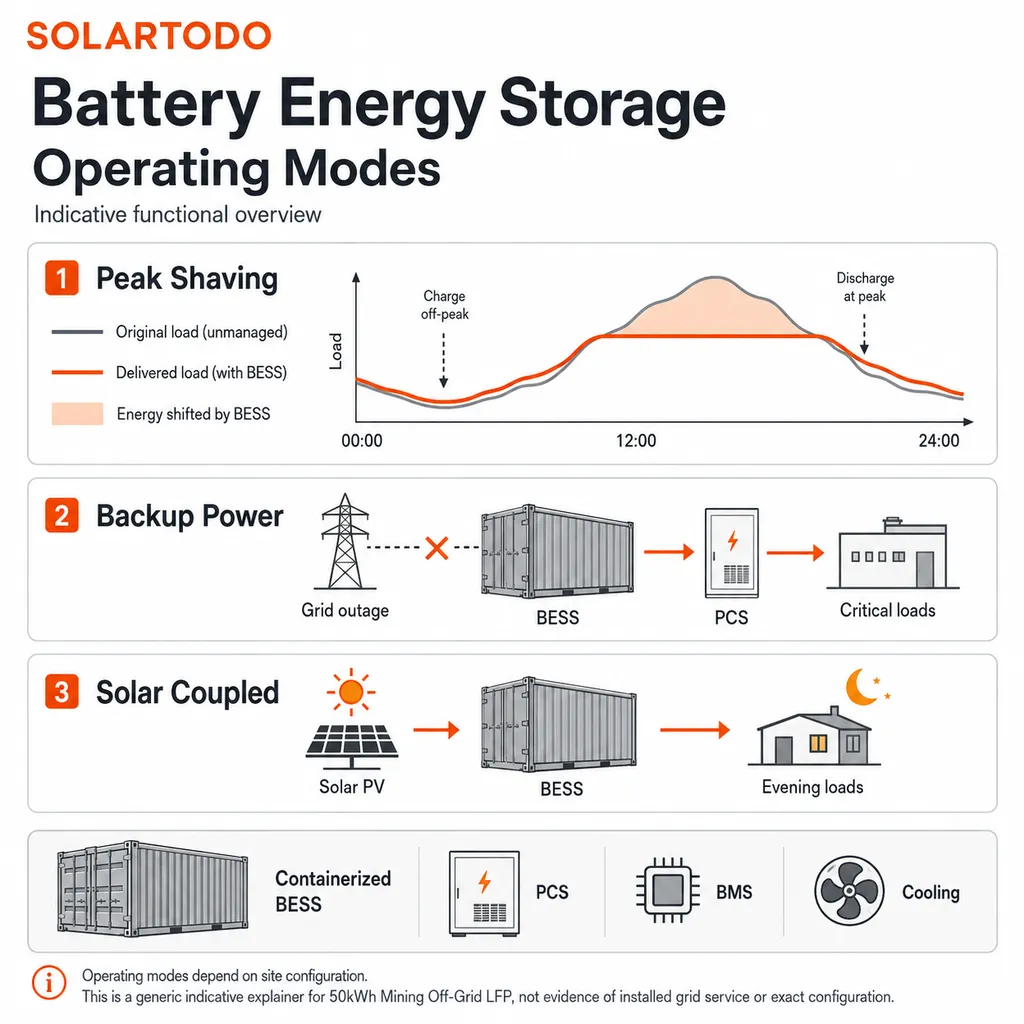
The PCS is rated at 25kW and supports bidirectional charging or discharging, grid-forming island mode, generator coordination, PV-coupled charging, and black-start sequencing where the final site design permits it. For mining off-grid use, the inverter can regulate voltage and frequency within the project-specific protection study, while the EMS prioritizes solar energy, then battery discharge, then diesel generator runtime for 24-hour operations.
Technical Specifications
The nominal energy capacity is 50kWh and the rated output power is 25kW, giving a 2-hour nameplate duration at full continuous power. Recommended usable energy is 47.5kWh at 95% DoD, and system round-trip efficiency is specified at 90% to 92% depending on AC wiring length, ambient temperature, auxiliary loads, and charge/discharge profile.
The recommended operating temperature window is -20°C to +50°C, with derating or preheating required at low-temperature charge conditions and ventilation planning required above 40°C ambient. Because mining sites can combine dust, vibration, generator exhaust, and high daily cycling, SOLARTODO specifies enclosure sealing, filtered ventilation, grounding, surge protection, and scheduled inspection intervals of 3 months for remote deployments.
The battery management system monitors voltage, current, state of charge, state of health, cell temperature, rack insulation, contactor status, balancing state, and alarm history across every operating cycle. The BMS also coordinates with the PCS and EMS to trigger current limitation, staged shutdown, or lockout events when measured voltage, temperature, insulation resistance, or communication signals move outside programmed thresholds.
Safety design follows the intent of IEC 62619:2022 for industrial lithium battery safety, UL 9540A:2026 thermal runaway fire-propagation evaluation, UL 9540 energy storage system equipment requirements, UN 38.3 transport testing, and NFPA 855:2026 installation practice for stationary energy storage. These standards matter because a 50kWh BESS stores enough energy to require documented separation, ventilation, emergency response, and commissioning controls rather than only consumer-device battery rules.
Mining Off-Grid Application Fit
Mining off-grid loads often include 5kW to 15kW of communications, lighting, network cabinets, pumping controls, security cameras, battery tools, and accommodation loads, while crushers, hoists, mills, and compressors may have much higher transient demand. The 50kWh Mining Off-Grid LFP unit is best applied to auxiliary power, exploration camps, edge monitoring stations, and solar-diesel hybrid sites where 25kW continuous output is sufficient or where multiple units are paralleled.
Compared with a conventional diesel-only operating pattern, a 50kWh BESS can reduce low-load generator runtime by 30% to 60% in a properly sized hybrid microgrid because the generator runs closer to efficient loading while the battery covers nighttime, transient, and low-demand periods. If diesel generation costs $0.45 to $0.80 per kWh delivered at a remote site, shifting 20,000kWh per year from low-load diesel to solar-charged battery energy can avoid $9,000 to $16,000 in fuel and maintenance exposure before site-specific logistics are counted.
For a representative MENA mining exploration scenario, assume a 25kWp to 35kWp solar array, a 30kVA diesel generator, 50kWh of storage, 2 cycles per day, and a remote delivered diesel cost of $0.60 per kWh. If the BESS shifts 27,000kWh per year from diesel runtime to solar-battery service, annual savings are about $16,200, and the simple payback against a $10,600 EPC package is about 0.65 years before taxes, financing, and generator service savings.
The same 50kWh system can also support security and telecom infrastructure such as 4G/5G relay sites, perimeter radar nodes, CCTV towers, weighbridge offices, and SCADA panels where outages above 2 hours create production or safety risk. For a 6kW critical load, 47.5kWh usable capacity provides about 7.9 hours of autonomy, while a 3kW communications node can run for about 15.8 hours before reserve and temperature derating.
Standards, Bankability, and Market Context
The International Energy Agency states that global storage capacity must grow to about 1,500GW by 2030 in a net-zero pathway, with batteries delivering roughly 90% of that increase; see the IEA Batteries and Secure Energy Transitions report. This matters for procurement because 2026 buyers increasingly ask for documented battery chemistry, safety testing, warranty terms, and recycling pathways even on 50kWh commercial systems.
The NREL 2025 utility-scale battery storage cost update shows continuing long-term cost reductions for lithium-ion storage, while BloombergNEF reported an average lithium-ion battery pack price of $115/kWh in 2024 and noted strong LFP adoption in stationary markets. SOLARTODO's 50kWh EPC price of $8,000 to $10,600 equals $160 to $212 per installed kWh, which includes enclosure integration, inverter, controls, installation, commissioning, and 1-year support rather than cells alone.
The IEC 62619:2022 standard covers safety requirements for secondary lithium cells and batteries in industrial applications, including stationary energy storage. The UL 9540A test method evaluates thermal runaway characteristics from cell level to installation level, and NFPA 855 addresses installation controls for stationary ESS, including commissioning, operation, maintenance, and decommissioning requirements.
IRENA's Electricity Storage Valuation Framework emphasizes that storage value comes from stacked services rather than 1 single revenue stream. For a mine, those services may include 4 functions: diesel optimization, solar shifting, power quality support, and backup autonomy, all of which should be quantified in the energy model before purchase order approval.
Cloud Monitoring
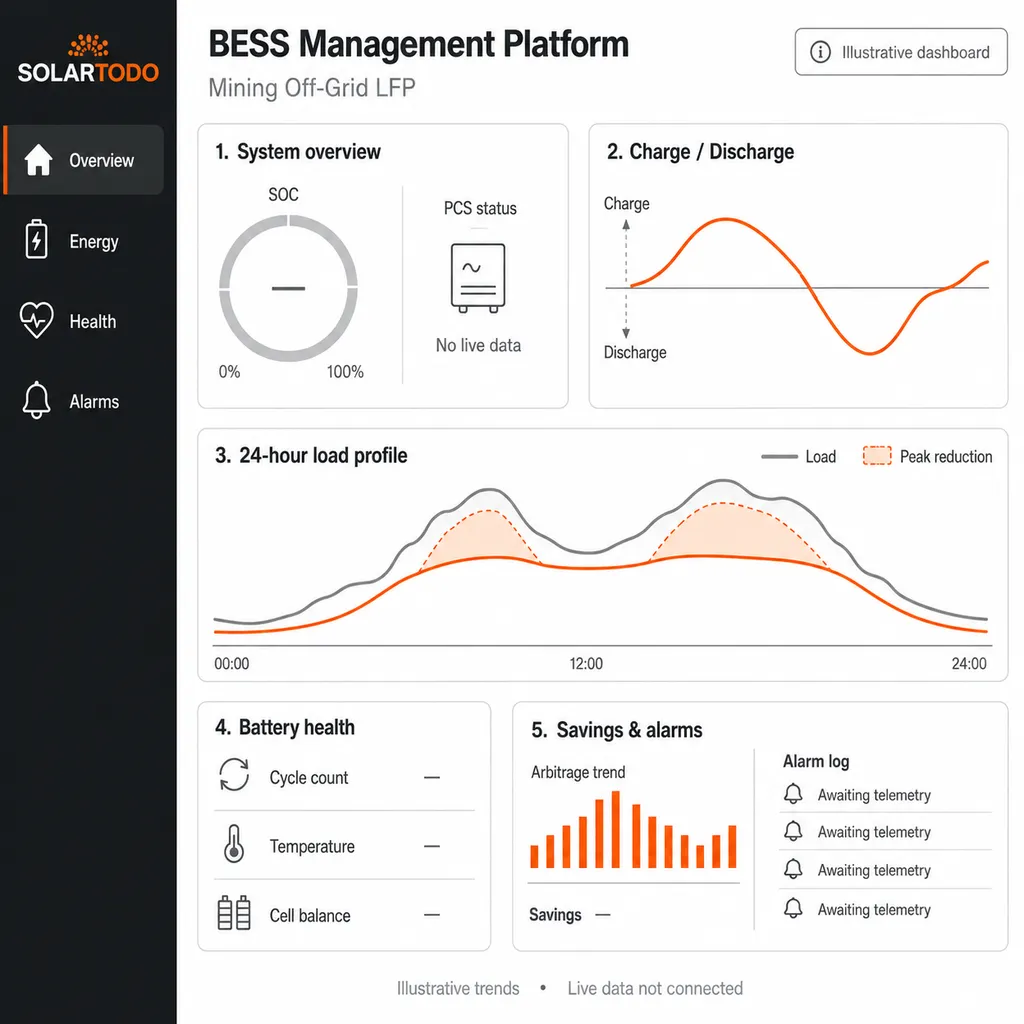
The EMS can connect to a cloud monitoring platform through Ethernet, 4G router, or site SCADA gateway, with 1-minute to 15-minute data intervals selected according to bandwidth and cybersecurity policy. Typical monitored variables include SOC, SOH, active power, reactive power, rack temperature, DC voltage, AC voltage, frequency, alarm state, cycle count, and daily energy charged or discharged.
Cloud monitoring is useful for mining sites because 1 remote engineer can review 10 to 100 distributed BESS assets without traveling to each container for routine checks. The platform can support downloadable CSV records, alarm notifications, maintenance scheduling, and trend analysis, while project cybersecurity requirements may require VPN access, role-based accounts, IP allowlisting, and data retention rules.
EPC Investment Analysis and Pricing Structure
EPC turnkey delivery includes 5 core work scopes: engineering, procurement, construction, commissioning, and 1-year warranty support. For a 50kWh mining BESS, engineering includes load review, single-line diagram coordination, cable sizing, grounding review, protection settings, layout confirmation, logistics planning, and a commissioning procedure covering at least 10 functional checks.
| Pricing tier | Scope | Price range (USD) | Typical buyer use |
|---|---|---|---|
| FOB Supply | Equipment only, ex-works China | $4,960 - $7,208 | 1 integrator with local installer |
| CIF Delivered | Ocean freight and insurance included | $5,970 - $8,676 | 1 importer managing local works |
| EPC Turnkey | Installed, commissioned, and 1-year warranty | $8,000 - $10,600 | 1 mine, EPC, or developer needing delivery risk control |
| Order volume | Discount | Example effect on $10,600 EPC list price |
|---|---|---|
| 50+ units | 5% | $10,070 per unit |
| 100+ units | 10% | $9,540 per unit |
| 250+ units | 15% | $9,010 per unit |
ROI depends on diesel price, solar resource, generator loading, duty cycle, logistics, and O&M cost, but a representative 27,000kWh annual diesel displacement at $0.60 per kWh creates about $16,200 annual savings. Against a $10,600 EPC turnkey price, the simple payback is about 0.65 years; against a more conservative $0.35 per kWh avoided cost and 18,000kWh annual displacement, annual savings are $6,300 and payback is about 1.7 years.
The standard payment structure is 30% T/T deposit and 70% against bill of lading, or 100% irrevocable L/C at sight for approved trade finance cases. Project financing can be discussed for portfolios above $5,000K, and technical or commercial requests should be sent to [email protected] with 12 months of load data, diesel cost, site coordinates, target autonomy, and import destination.
Procurement Notes
Procurement teams should specify 50kWh usable and nominal values separately because 95% DoD changes usable energy, lifetime throughput, and warranty assumptions. A complete RFQ should include at least 8 inputs: AC voltage, phase count, frequency, maximum continuous load, surge load, daily kWh, ambient temperature range, and required backup duration.
Engineering teams should not size the 25kW PCS only from average daily consumption because mining loads often have 2 to 5 starting surges from pumps, motors, compressors, or tools. Where surge current exceeds inverter limits, SOLARTODO can propose soft-start equipment, load sequencing, larger PCS capacity, or multiple 50kWh units in parallel after reviewing the electrical schedule.
Logistics planning should confirm container access, crane or forklift availability, pad bearing capacity, earthing electrode layout, drainage, shade, and cable trench distance before shipment. A 20ft form factor simplifies transport compared with site-built battery rooms, but the final installed footprint still requires clearance for doors, HVAC airflow, emergency access, and fire response procedures.
Lifecycle, Warranty, and Maintenance
The design target is 6,000+ cycles for LFP cells, 10 years of battery warranty coverage, and 70% retained capacity at end-of-warranty under approved operating conditions. Because 2 daily cycles can reach about 730 cycles per year, heavy-use mining applications should budget annual inspection, filter replacement, firmware review, insulation testing, torque checks, and alarm log review.
Recommended maintenance includes 4 quarterly visual inspections per year, 1 annual electrical inspection, and continuous remote data review for abnormal temperature spread, SOC drift, capacity fade, or communication faults. Battery replacement planning should consider calendar aging, throughput aging, ambient temperature, and spare-parts lead time, with 1 documented maintenance log required for warranty claim support.
For buyers comparing systems, the strongest technical comparison is levelized energy cost over 10 years rather than only the 1-time FOB price. A lower-cost battery without certified cells, BMS coordination, fire detection, documented commissioning, or remote monitoring may save $500 to $1,500 upfront but can add 5% to 15% lifecycle risk through downtime, derating, or warranty disputes.
Ordering Path
The fastest procurement path is to submit 1 site profile, 1 load table, and 1 target delivery port through Request a custom quotation. SOLARTODO can then return a 50kWh mining off-grid BESS configuration, EPC scope, shipping estimate, standards checklist, and commercial terms aligned to the selected FOB, CIF, or EPC tier.
Buyers who are still comparing alternatives can Configure your system online to test 25kW, 50kWh, 100kWh, and multi-container scenarios. For broader system selection, View all Battery Energy Storage System (BESS) products and Learn about topic to compare LFP BESS, PV generation, smart poles, telecom power towers, and remote-site security infrastructure from 1 supplier.
Technical Specifications
| Energy Capacity | 50kWh |
| Power Rating | 25kW |
| Battery Chemistry | LFP (Lithium Iron Phosphate) |
| Round-trip Efficiency | 90-92% |
| Depth of Discharge | 95% |
| Cycle Life | 6000+cycles |
| Calendar Life | 10years |
| Operating Temperature | -20 to 50°C |
| Annual Savings | 6300-16200USD/year |
| Payback Period | 0.65-1.7years |
| Warranty | 10 years / 70% capacity |
| Form Factor | 20ft containerized mining-ready BESS |
| Daily Cycling Design | 2cycles/day |
Price Breakdown
| Item | Quantity | Unit Price | Subtotal |
|---|---|---|---|
| LFP battery cells | 50 kWh | $55 | $2,750 |
| Battery Management System | 50 kWh | $15 | $750 |
| 25kW bidirectional PCS | 25 kW | $80 | $2,000 |
| DC protection and cabling kit | 1 pcs | $350 | $350 |
| Air thermal management | 50 kWh | $10 | $500 |
| Compact fire detection and suppression kit | 1 pcs | $900 | $900 |
| EMS monitoring software gateway | 1 pcs | $600 | $600 |
| 20ft mining-ready enclosure integration | 1 pcs | $1,100 | $1,100 |
| Engineering, QC, and documentation | 1 pcs | $600 | $600 |
| Installation and commissioning | 1 pcs | $700 | $700 |
| 1-year warranty and support | 1 pcs | $200 | $200 |
| Total Price Range | $8,000 - $10,600 | ||
Frequently Asked Questions
What is included in the $8,000 to $10,600 EPC turnkey price?
How long can the 50kWh system power a mining site?
Is LFP suitable for remote mining off-grid environments?
Can this BESS reduce diesel generator fuel consumption?
Which standards should buyers request for compliance review?
Certifications & Standards

Data Sources & References
- •NREL Cost Projections for Utility-Scale Battery Storage: 2025 Update
- •IEA Batteries and Secure Energy Transitions 2024
- •IEC 62619:2022 industrial lithium battery safety standard
- •UL Solutions UL 9540A Test Method 2025/2026 guidance
- •NFPA 855 Stationary Energy Storage Systems 2026 edition
- •IRENA Electricity Storage Valuation Framework 2020
- •BloombergNEF Lithium-Ion Battery Pack Price Survey 2024
Interested in this solution?
Contact us for a customized quote based on your specific requirements.
Contact Us