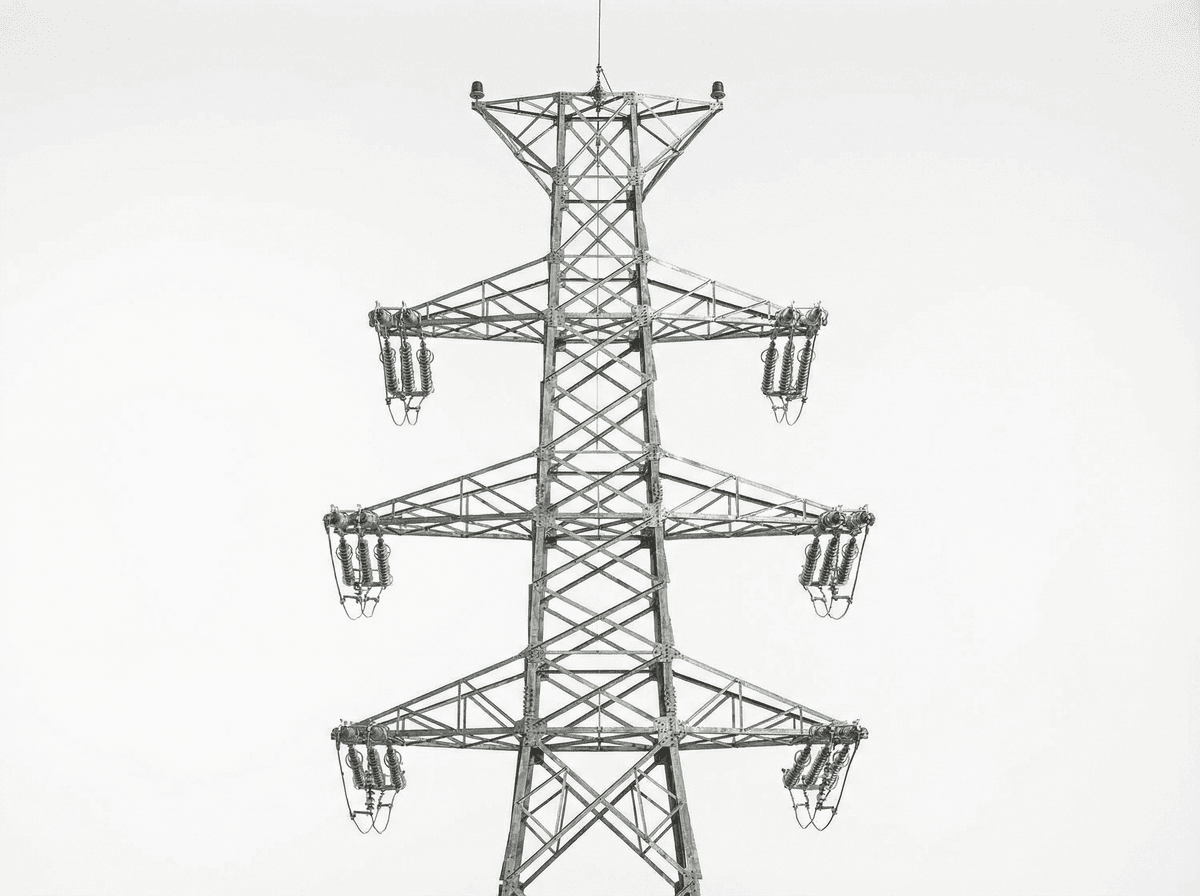
40m River Crossing Tower - 110kV Heavy Lattice Double-Circuit Transmission Structure
Key Features
- 40-meter heavy steel lattice structure engineered for 110kV double-circuit transmission across spans up to 1500 meters
- 25-meter minimum catenary clearance maintained above navigable waterways, compliant with international maritime safety regulations
- ACSR-240 conductors with single-bundle-per-phase configuration, minimizing corona discharge and line losses over long spans
- Integrated OPGW (Optical Ground Wire) providing simultaneous lightning protection and fiber optic communication backbone
- Grounding system achieving footing resistance below 10 ohms (standard) and below 4 ohms in high-lightning-risk zones
- Wide-base Q420/Q460 steel lattice design withstands wind loads and up to 15mm ice accumulation per IEC 60826 Class B
- 50-year design life with hot-dip galvanized finish, navigation light markings, and anti-galloping hardware included
The SOLARTODO 40m River Crossing Tower is a heavy-duty lattice structure designed for 110kV power transmission, priced between $85,000 and $120,000. It supports spans of 500 to 1500 meters with a 25-meter catenary clearance, adhering to IEC 60826 standards. Ideal for regional grid applications, it ensures reliable power delivery and communication integrity.
Description
The SOLARTODO 40m River Crossing Tower is a heavy-duty steel lattice transmission structure engineered specifically for long-span 110kV power transmission across rivers, valleys, and navigable waterways. Featuring a robust wide-base design, this tower supports spans of 500 to 1500 meters while maintaining a critical 25-meter catenary clearance above water surfaces. Designed in compliance with IEC 60826 and GB 50545 standards, it integrates advanced ACSR-240 conductors and OPGW ground wires to ensure reliable power delivery and communication backbone integrity for regional grids.
The architectural foundation of the 40m River Crossing Tower relies on a heavy steel lattice configuration, utilizing high-strength Q420 steel angles and Q460 steel tubes. This material selection provides exceptional structural rigidity, allowing the tower to withstand extreme environmental loads, including high wind speeds and significant ice accumulation up to 15 millimeters. The wide-base geometry is specifically calculated to distribute the immense tension forces generated by long conductor spans, ensuring stability even under broken wire conditions.
In terms of electrical performance, the tower is optimized for 110kV double-circuit configurations. It employs ACSR (Aluminum Conductor Steel Reinforced) cables, specifically the ACSR-240 variant, which offers an ideal balance of conductivity and tensile strength. The conductors are arranged in a single bundle per phase, minimizing corona discharge and line losses over extended distances. The integration of composite polymer insulators further enhances reliability; these lightweight components are highly resistant to vandalism and environmental degradation, contributing to the tower's impressive 50-year design life.
Safety and operational visibility are paramount in river crossing applications. The 40m River Crossing Tower is equipped with specialized navigation light markings on its upper sections, ensuring compliance with aviation and maritime safety regulations. These high-visibility markers alert low-flying aircraft and tall vessels to the presence of the transmission lines, significantly reducing the risk of accidental collisions in navigable waterways.
Furthermore, the tower incorporates an OPGW (Optical Ground Wire) system at its apex. This dual-purpose component serves as a robust lightning protection mechanism while simultaneously providing a high-capacity fiber optic communication link. The grounding system is meticulously designed to achieve a footing resistance of less than 10 ohms under standard conditions, and less than 4 ohms in areas prone to high lightning activity, safeguarding both the infrastructure and the connected grid network.
The practical efficacy of the SOLARTODO 40m River Crossing Tower is demonstrated in diverse global deployments. For instance, a major regional grid operator in Southeast Asia recently deployed a series of these towers to span a 1200-meter wide navigable river. The installation successfully maintained the required 25-meter clearance for commercial shipping while establishing a critical 110kV interconnection between two previously isolated industrial zones. The robust design proved resilient against the region's seasonal typhoons, maintaining uninterrupted power transmission during extreme weather events.
When compared to conventional standard-span transmission towers, the 40m River Crossing Tower offers significant advantages in challenging terrains. By enabling spans of up to 1500 meters, it reduces the total number of required tower foundations by approximately 60% compared to standard 300-meter span designs. This reduction not only minimizes the environmental footprint in sensitive riparian ecosystems but also substantially lowers overall project installation costs and timeline, making it a highly efficient solution for complex geographical crossings.
Frequently Asked Questions:
Q: What is the maximum span this tower can support? A: The 40m River Crossing Tower is engineered to support long spans ranging from 500 meters up to 1500 meters or more, depending on specific environmental loads and conductor configurations. This makes it ideal for crossing wide rivers, deep valleys, and other challenging topographical features where intermediate tower placement is impractical or impossible.
Q: How does the tower maintain clearance over navigable waterways? A: The tower's 40-meter height, combined with high-tension ACSR-240 conductors, is specifically calculated to maintain a minimum catenary clearance of 25 meters above the water surface at maximum sag conditions. This ensures safe passage for commercial vessels and complies with international maritime navigation standards, including ICAO and local waterway authority requirements.
Q: What type of insulators are used on this tower? A: We utilize advanced composite polymer suspension insulators. These insulators are significantly lighter than traditional porcelain, highly resistant to environmental pollution and salt spray, and virtually immune to vandalism, thereby reducing maintenance requirements and extending the operational lifespan of the transmission line by decades.
Q: Is the tower equipped for lightning protection? A: Yes, the tower features an integrated OPGW (Optical Ground Wire) system at the peak, which provides excellent lightning shielding for the phase conductors. Additionally, the tower's grounding system is designed to achieve a footing resistance of less than 10 ohms, ensuring effective dissipation of lightning strikes and protecting both the structure and the broader grid network.
Q: What international standards does the tower comply with? A: The structural and electrical design of the 40m River Crossing Tower strictly adheres to major international standards, including IEC 60826 for transmission line loading, GB 50545 for structural design, ASCE 10-15 for steel lattice tower design, and IEEE 738 for conductor thermal rating, ensuring global applicability and regulatory compliance across multiple jurisdictions.
Technical Specifications
| Tower Height | 40m |
| Voltage Rating | 110kV |
| Tower Type | River / Valley Crossing |
| Material | Heavy Steel Lattice (Q420/Q460) |
| Number of Circuits | 2 |
| Conductor Bundle | 1 × ACSR-240per phase |
| Design Span | 800m |
| Maximum Span Capability | 1500m |
| Catenary Clearance | 25m |
| Wind / Ice Load Class | Class B / 15mm ice |
| Foundation Type | Pile Foundation (concrete) |
| Grounding Resistance | <10 (standard) / <4 (high lightning)Ω |
| Ground Wire | OPGW (Optical Ground Wire) |
| Insulator Type | Composite Polymer Suspension |
| Navigation Lighting | ICAO-compliant aviation warning lights |
| Design Life | 50years |
| Surface Treatment | Hot-Dip Galvanized (ISO 1461) |
| Standards | IEC 60826 / GB 50545 / ASCE 10-15 / IEEE 738 |
Price Breakdown
| Item | Quantity | Unit Price | Subtotal |
|---|---|---|---|
| Q420 Steel Angle Structure (approx. 28 tons) | 1 set | $56,000 | $56,000 |
| Hot-Dip Galvanizing (28 tons) | 1 set | $12,600 | $12,600 |
| Composite Polymer Insulators (110kV, 12 strings) | 12 pcs | $150 | $1,800 |
| ACSR-240 Conductor (per km, 2 circuits x 3 phases) | 1 km | $8,000 | $8,000 |
| OPGW Fiber Optic Ground Wire (per km) | 1 km | $15,000 | $15,000 |
| Grounding System | 1 set | $2,500 | $2,500 |
| Pile Foundation (concrete, 15m depth x 4 piles) | 60 m | $800 | $48,000 |
| Navigation Lights & Marking Hardware | 1 set | $3,500 | $3,500 |
| Anti-Galloping Dampers | 12 pcs | $250 | $3,000 |
| Installation Labor (28 tons) | 1 set | $16,800 | $16,800 |
| Total Price Range | $85,000 - $120,000 | ||
Frequently Asked Questions
What is the maximum span this tower can support?
How does the tower maintain clearance over navigable waterways?
What type of insulators are used on this tower?
Is the tower equipped for lightning protection?
What international standards does the tower comply with?
Certifications & Standards


Data Sources & References
- •IEC 60826:2017 - Design criteria of overhead transmission lines
- •GB 50545-2010 - Code for design of 110kV-750kV overhead transmission line
- •ASCE 10-15 - Design of Latticed Steel Transmission Structures
- •IEEE Std 738-2012 - IEEE Standard for Calculating the Current-Temperature Relationship of Bare Overhead Conductors
- •CIGRE TB 207 - Thermal behaviour of overhead conductors
- •SOLARTODO Power Tower Engineering Specifications v3.2 (2025)
Interested in this solution?
Contact us for a customized quote based on your specific requirements.
Contact Us