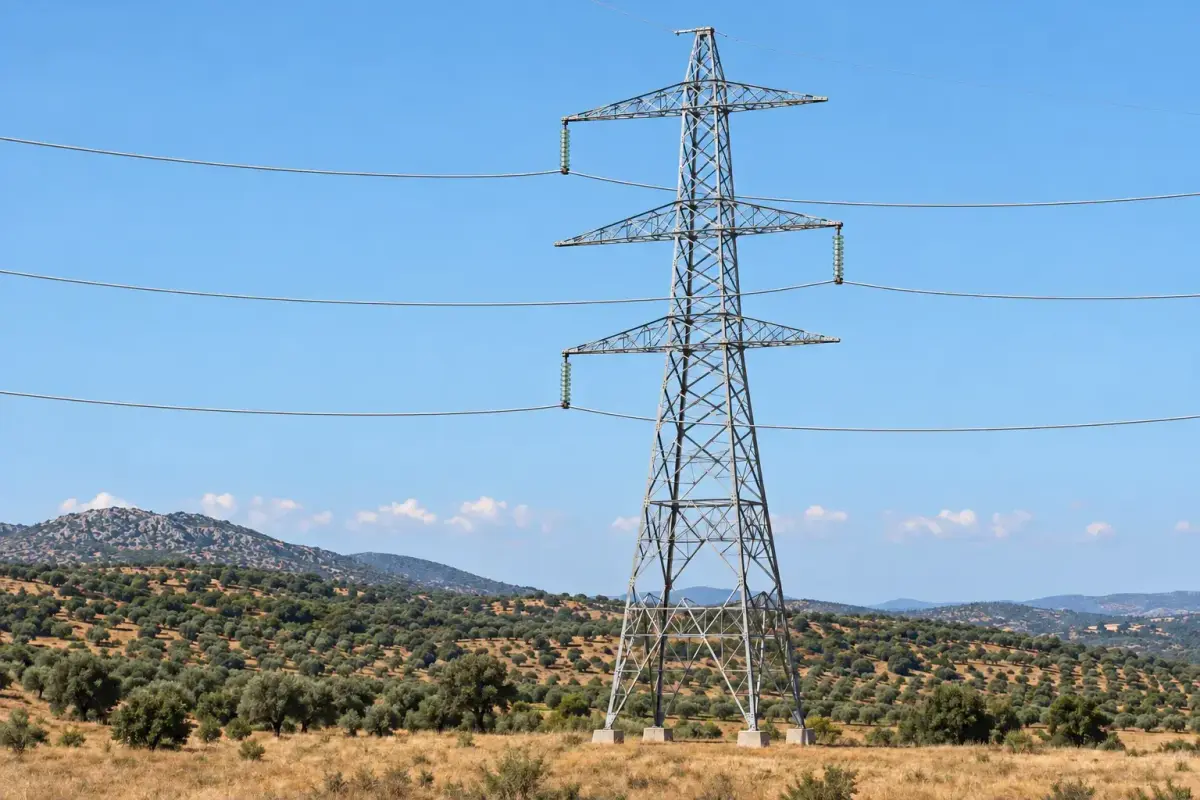
78m 500kV Heavy Lattice Tangent Tower Slip-Joint
Key Features
- 78m heavy galvanized steel lattice structure for 500kV UHV AC tangent suspension lines
- 468m design span with 1 circuit and 4 bundled ACSR conductors per phase
- Class B wind basis with 15mm ice load and 50-year design-life target
- EPC turnkey price range of $141,960 to $194,350 per installed tower
- Grounding target below 10 ohms standard or below 4 ohms in high-lightning corridors
The 78m 500kV Heavy Lattice Tangent Tower Slip-Joint is a single-circuit UHV transmission support for 4-bundle ACSR conductors, 468m design spans, Class B wind loading, and 15mm ice service. SOLARTODO supplies it in FOB, CIF, or EPC turnkey scope from $141,960 to $194,350 per installed tower.
Description
The 78m 500kV Heavy Lattice Tangent Tower Slip-Joint is a single-circuit steel suspension tower engineered for straight-line UHV transmission corridors carrying 4 conductors per phase across a 468m design span. It uses a heavy galvanized lattice body, slip-joint field assembly, I-string suspension insulators, and 50-year design-life assumptions aligned with IEC 60826:2017 and ASCE/SEI 10-15.
View all Power Transmission Tower/Pole products for the full 45kV to 500kV+ range, or Configure your system online with height, voltage, span, foundation, wind, and ice parameters. This 78m tangent tower is positioned for 500kV UHV AC transmission, renewable-energy export corridors, industrial grid extensions, and utility interconnections where 1 circuit can transmit approximately 1,000MW to 1,500MW depending on conductor rating, ambient conditions, and system stability limits.
System Architecture
A tangent, or suspension, tower normally represents 70% to 80% of the structures on a long overhead transmission line because it supports conductors on straight sections rather than making large angle turns. The 78m height supports electrical clearance, conductor sag control, and terrain clearance for a 468m nominal span, while the 4-conductor-per-phase bundle reduces corona, audible noise, and electric-field stress compared with a single large conductor at 500kV.
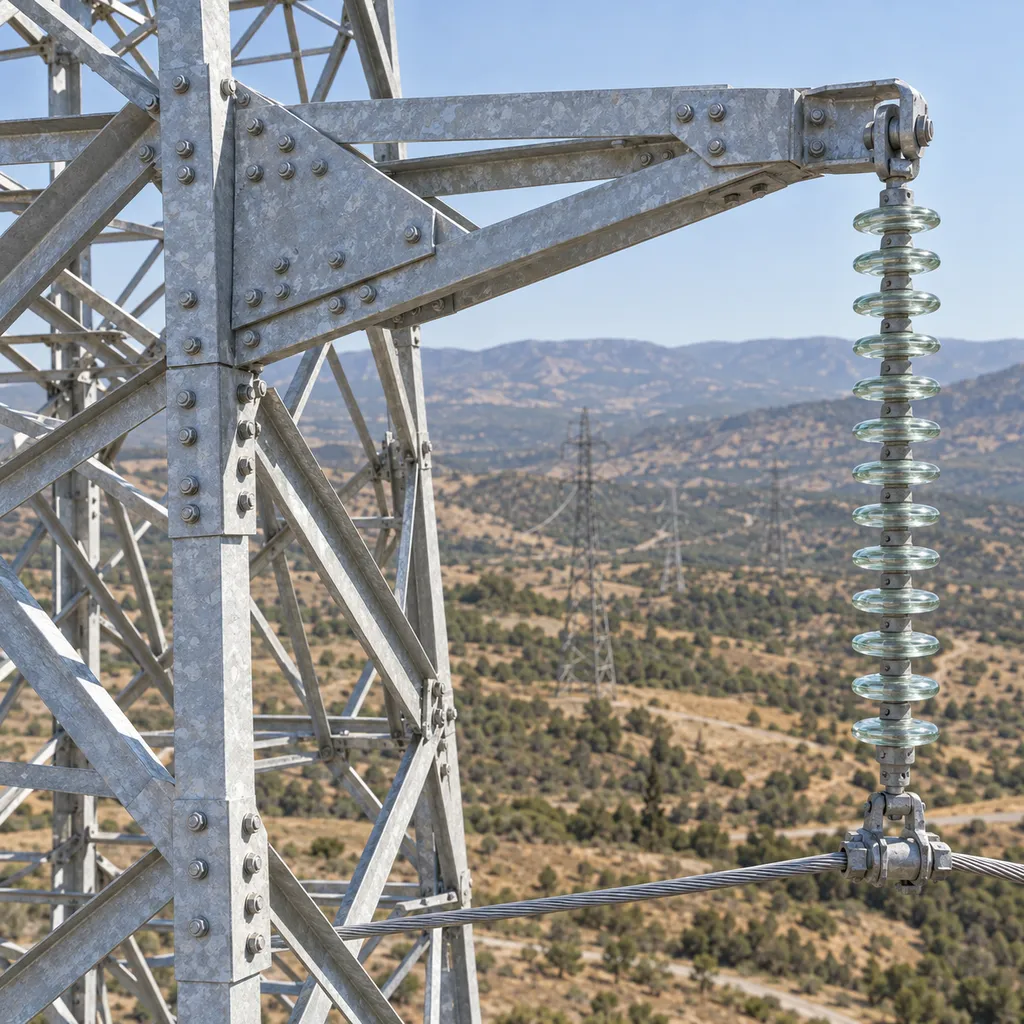
The structural system uses a heavy steel lattice shaft with bolted panels, crossarms, bracing members, conductor attachment points, earth-wire peaks, and slip-joint connection zones for faster field erection. ACSR phase conductors are normally suspended from 500kV I-string assemblies, while OPGW provides 2 functions in 1 component: lightning shielding and optical-fiber communications for line protection, SCADA, and grid telemetry.
Technical Specifications
The baseline configuration is 78m height, 500kV voltage class, 1 circuit, 4 conductors per phase, 468m span, Class B wind, and 15mm ice. The steel package is specified as heavy galvanized lattice steel, commonly Q420-grade equivalent for main angle members where the project code permits, with hot-dip galvanizing selected for 50-year service when inspection and maintenance intervals are observed.
Electrical design follows the logic of IEC 60826:2017, which applies reliability-based loading and strength principles to overhead lines of 45kV and above (IEC 60826). Conductor temperature and rating studies should reference IEEE 738-2023 for steady-state, transient, and dynamic current-temperature calculations of bare overhead conductors (IEEE 738-2023).
Structural design, fabrication, and full-scale testing should reference ASCE/SEI 10-15 for latticed steel electrical transmission structures, especially member slenderness, bolted joints, tower testing, and fabrication quality control (ASCE/SEI 10-15). For China-origin engineering deliverables, GB 50545 can be used as the national overhead transmission-line design framework beside the project owner’s local code.
| Parameter | Baseline Value |
|---|---|
| Tower height | 78m |
| Nominal voltage | 500kV |
| Tower function | Tangent suspension |
| Circuit count | 1 circuit |
| Bundle configuration | 4 conductors per phase |
| Design span | 468m |
| Ice load | 15mm |
| Design life | 50 years |
Loading, Clearance, and Foundation Basis
For a 500kV tangent tower, the dominant service loads are vertical conductor weight, transverse wind on conductors and tower steel, longitudinal residual load from uneven spans, and exceptional broken-wire cases. The suspension string allows conductor swing under wind, so the insulation swing angle, live-metal clearance, and tower-window geometry must be checked at at least 3 states: still air, design wind, and combined wind-plus-ice.
The representative foundation scope uses approximately 72m3 of reinforced concrete plus grounding, but final sizing depends on geotechnical bearing capacity, uplift, overturning moment, groundwater level, and seismic category. Standard grounding targets are below 10 ohms for ordinary corridors and below 4 ohms in high-lightning-density areas, with counterpoise length adjusted after soil-resistivity testing.
Compared with a conventional lower-voltage 220kV or 330kV corridor carrying the same bulk power across long distances, a 500kV line can reduce current for the same megawatt transfer and therefore reduce I2R losses by a meaningful percentage when conductor area and loading are comparable. In practical planning, a single 500kV circuit rated around 1,000MW to 1,500MW can replace multiple lower-voltage circuits, reducing right-of-way pressure by 20% to 40% in many corridor studies.
EPC Investment Analysis and Pricing Structure
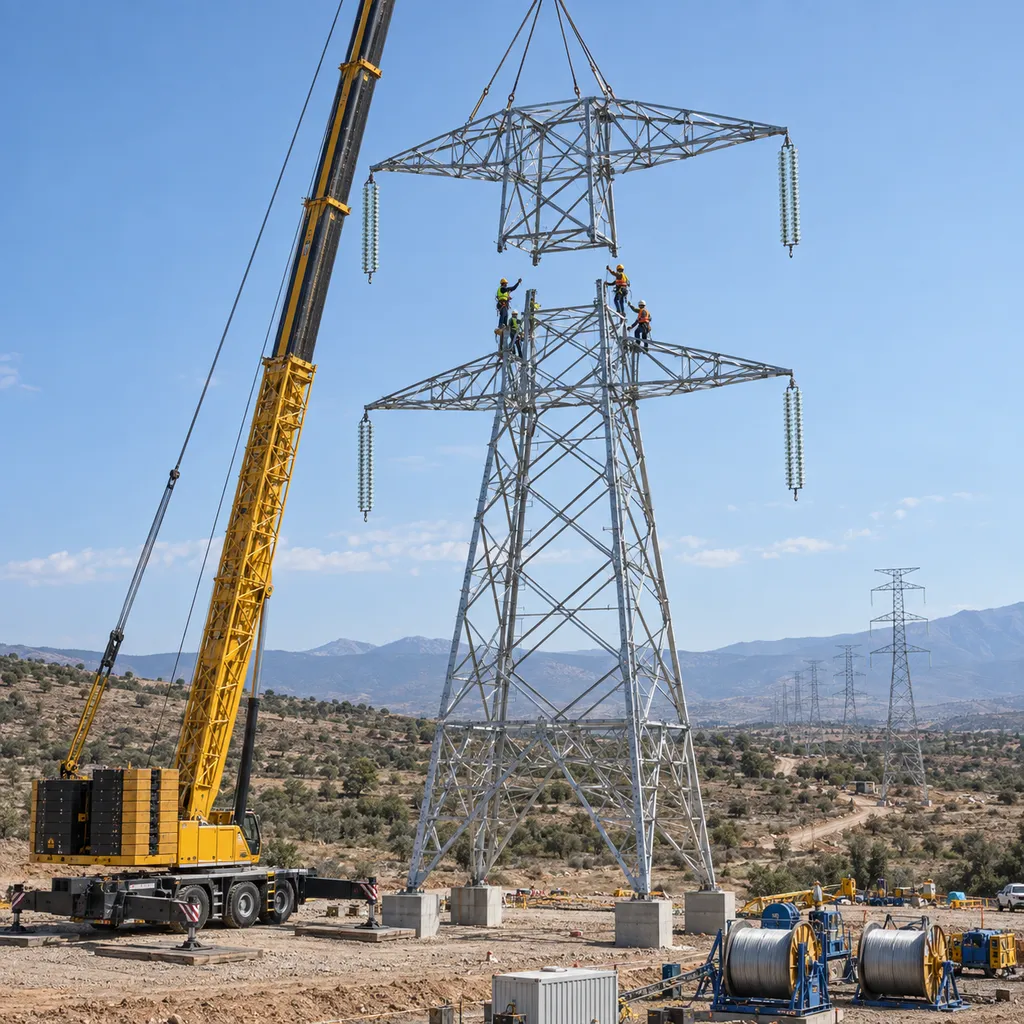
SOLARTODO’s EPC turnkey scope includes 5 work packages: engineering, procurement, construction, commissioning, and 1-year warranty support. Engineering covers tower spotting inputs, structural calculations, shop drawings, material take-off, galvanizing specification, inspection and test plan, packing list, and foundation coordination; procurement covers steel, bolts, insulators, grounding, OPGW hardware, and logistics; construction covers foundation works, assembly, erection, stringing interface, grounding, and handover tests.
| Pricing tier | Scope | Price range |
|---|---|---|
| FOB Supply | Equipment only, ex-works China | $88,015 - $132,158 |
| CIF Delivered | Equipment, ocean freight, and insurance | $112,556 - $169,007 |
| EPC Turnkey | Installed, commissioned, and 1-year warranty | $141,960 - $194,350 |
| Order quantity | Discount | Commercial note |
|---|---|---|
| 50+ towers | 5% | Suitable for 23km+ line sections at 468m average span |
| 100+ towers | 10% | Suitable for 46km+ bulk-transmission packages |
| 250+ towers | 15% | Suitable for 117km+ corridor procurement programs |
For ROI modeling, the tower is usually evaluated as part of a transmission corridor rather than as a standalone revenue asset. A 100-tower package at 468m average span supports roughly 46.8km of line; if the corridor avoids only 0.5% annual curtailment on a 1,000MW renewable plant operating at 30% capacity factor, recovered energy is about 13,140MWh per year, and at $45/MWh the annual value is about $591,300 before grid-loss effects.
For a representative MENA solar farm scenario, assume a 1,200MW desert PV cluster needs a 500kV export corridor of 70km with 150 tangent towers, 8 angle/dead-end structures, and 2 terminal gantries. At a midpoint EPC price of $168,155 per tangent tower, the tangent-tower portion is about $25.22 million before substations, protection, land, and owner costs; payback can be below 6 years if annual curtailment reduction exceeds 1.2% at $50/MWh.
Payment terms are 30% T/T deposit plus 70% against B/L copy, or 100% irrevocable L/C at sight for qualified buyers. Project financing discussions are available for packages above $1,000,000, subject to buyer credit, country risk, export documentation, and EPC boundary definition; procurement teams can Request a custom quotation or contact [email protected] with span tables, route profile, soil report, wind map, and voltage schedule.
Applications
Primary applications include 500kV UHV AC renewable export lines, utility backbone grid extensions, mining and industrial power corridors, cross-regional interconnectors, and transmission links connecting 200MW to 1,500MW generation clusters. The 78m height is especially relevant where electrical clearance, river crossings, road crossings, rolling terrain, or conductor-sag margins require a taller tangent support than a standard 45m to 60m lattice tower.
The International Energy Agency notes that modern grids are becoming a bottleneck for clean-energy deployment, and its 2025 transmission-grid analysis emphasizes expanding and modernizing transmission as electricity demand rises (IEA 2025). BloombergNEF reported that annual grid investment may need to reach $811 billion by 2030 under its Net Zero Scenario, with conventional wires, towers, cables, and substations still receiving most of the spend (BloombergNEF 2024).
IRENA’s 1.5 degrees Celsius pathway estimates cumulative power-sector investment of $61 trillion through 2050, including $22 trillion for grids and flexibility infrastructure (IRENA 2023). NREL transmission planning research also identifies transmission as a key enabler for safe, efficient, and cost-effective integration of renewable generation into the bulk-power system (NREL Transmission Planning).
Procurement and Quality Control
Quality control for a 78m 500kV lattice tower should include material certificates, bolt grade verification, weld inspection where welded assemblies are used, galvanizing thickness checks, trial assembly for critical sections, packing inspection, and dimensional control of crossarm and insulator attachment interfaces. For a 62-ton-equivalent heavy lattice package, even a 1% mass variance can represent more than 620kg of steel, so weight reconciliation and member marking are important before container loading.
A recommended inspection and test plan includes at least 6 checkpoints: steel mill certificate review, cutting and punching inspection, fabrication dimensional inspection, galvanizing inspection, trial fit-up, and pre-shipment packing verification. For severe coastal or desert projects, the owner may add salt-spray reference requirements, zinc-thickness acceptance thresholds, UV-resistant polymer insulators, and stainless or high-grade fastener options for selected exposed assemblies.
Digital Engineering and Monitoring Interface
Although a tangent tower is a passive structure, project owners increasingly require digital asset data for operation and maintenance. SOLARTODO can structure the supply package with tower ID, GPS coordinates, member bill of materials, foundation record, bolt torque record, grounding resistance value, inspection photos, and OPGW route data so that each installed structure has at least 8 traceable data fields for asset management.
For cloud monitoring, the tower can be integrated with line sensors, weather stations, OPGW communications, inspection drones, and SCADA data feeds where the EPC scope includes grid-automation interfaces. IEEE 738-2023 is relevant when utilities use ambient-adjusted or dynamic line-rating studies, because conductor current, conductor temperature, wind speed, solar heating, and ambient temperature are linked in the thermal model.
Buyer Guidance
Procurement teams should specify at least 10 inputs before final pricing: route length, tower schedule, span table, wind speed, ice thickness, conductor type, bundle spacing, insulator material, foundation type, soil report, grounding target, and applicable national code. Early definition reduces redesign cycles, because a 10m height change, 1 wind-class change, or 5mm ice-load change can materially alter steel tonnage and foundation volume.
For related technical background, Learn about topic covers transmission-tower selection, grounding, renewable grid integration, and overhead-line design inputs. SOLARTODO can quote FOB supply, CIF delivered, or EPC turnkey packages for 500kV tangent towers, angle towers, terminal towers, OPGW hardware, foundations, and smart-grid monitoring interfaces within one procurement file.
Technical Specifications
| Tower Height | 78m |
| Voltage Rating | 500kV |
| Tower Type | tangent suspension |
| Material | heavy galvanized steel lattice |
| Number of Circuits | 1circuit |
| Conductor Bundle | 4 x ACSR per phase |
| Design Span | 468m |
| Wind/Ice Load | Class B / 15mm ice |
| Connection Type | slip-joint bolted lattice assembly |
| Application | 500kV UHV transmission corridor |
| Foundation | reinforced concrete or pile foundation by soil report |
| Grounding Target | <10 standard; <4 high-lightning areasohm |
| Design Life | 50years |
| Standards | IEC 60826 / GB 50545 / ASCE 10-15 / IEEE 738 |
Price Breakdown
| Item | Quantity | Unit Price | Subtotal |
|---|---|---|---|
| Q420 galvanized heavy lattice steel ton-equivalent | 62 pcs | $1,400 | $86,800 |
| Slip-joint splice plates, bolts, and templates | 1 pcs | $6,200 | $6,200 |
| 500kV composite suspension insulator units | 12 pcs | $150 | $1,800 |
| OPGW shield-wire fittings and earth-wire hardware | 1 pcs | $4,800 | $4,800 |
| Tower grounding system | 1 pcs | $500 | $500 |
| Reinforced concrete foundation cubic-meter equivalent | 72 pcs | $350 | $25,200 |
| Pile or anchor reinforcement meter-equivalent | 12 pcs | $800 | $9,600 |
| Installation labor ton-equivalent | 62 pcs | $200 | $12,400 |
| Engineering, detailing, and QC documentation | 1 pcs | $7,800 | $7,800 |
| Commissioning and line-interface checks | 1 pcs | $3,400 | $3,400 |
| 1-year warranty and technical support | 1 pcs | $2,860 | $2,860 |
| Total Price Range | $141,960 - $194,350 | ||
Frequently Asked Questions
What is included in the EPC turnkey price for this 78m 500kV tower?
Why use a tangent tower instead of an angle or dead-end tower?
Can the tower support 4-bundle conductors for a 500kV UHV line?
Which standards are normally referenced for design and inspection?
What information is needed for a custom quotation?
Certifications & Standards



Data Sources & References
- •IEC 60826:2017 Design criteria of overhead transmission lines
- •IEEE 738-2023 Current-temperature relationship of bare overhead conductors
- •ASCE/SEI 10-15 Design of Latticed Steel Transmission Structures
- •IEA 2025 Building the Future Transmission Grid
- •IRENA 2023 World Energy Transitions Outlook
- •BloombergNEF 2024 New Energy Outlook: Grids
- •NREL Transmission Planning and Grid Modernization
Interested in this solution?
Contact us for a customized quote based on your specific requirements.
Contact Us