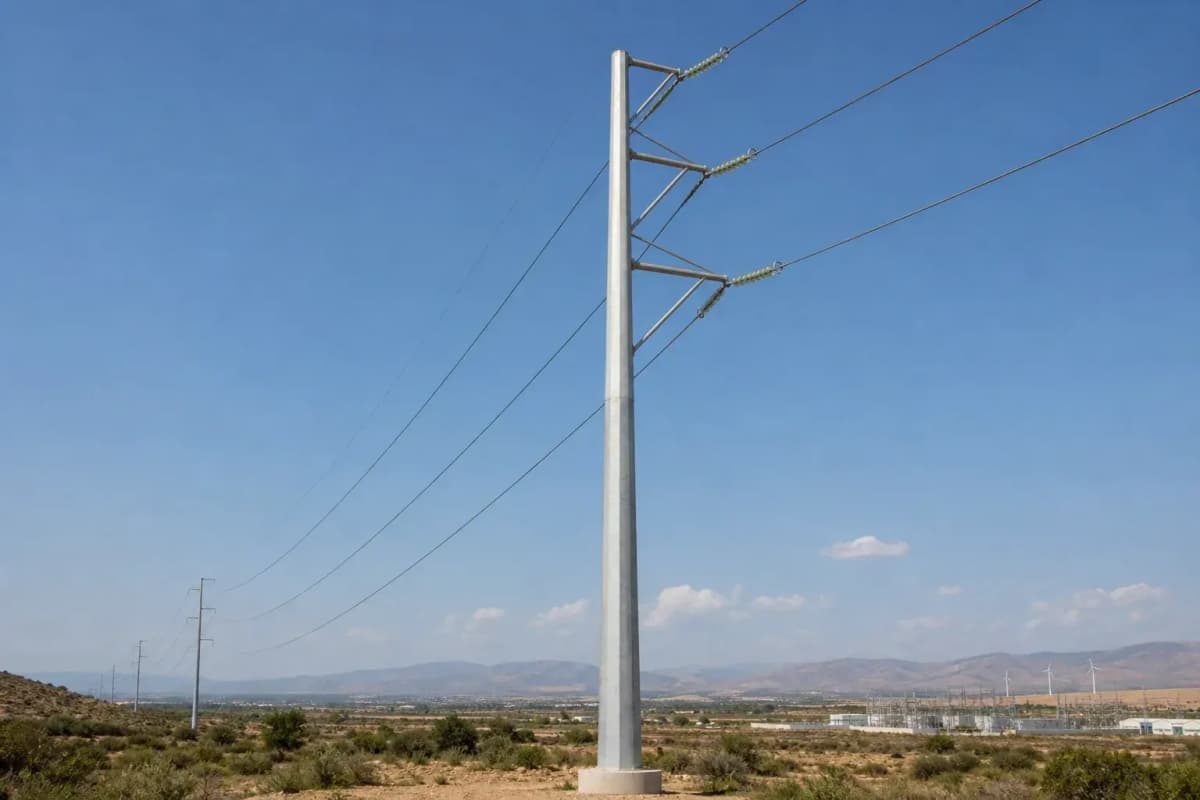
35m 66kV Octagonal Tangent Tower Slip-Joint - Single-Circuit Transmission Pole
Key Features
- 35m galvanized octagonal steel tangent tower for 66kV single-circuit overhead transmission lines
- 280m nominal design span with 1 conductor per phase and 3 suspension insulator strings
- Slip-joint shaft design can reduce site bolting work by about 20-35% versus flanged tubular joints
- Class B wind and 15mm ice baseline with 50-year design-life target under maintenance
- EPC turnkey price range of USD 16,800-25,200 with 5%, 10%, and 15% volume discounts
The 35m 66kV Octagonal Tangent Tower Slip-Joint is a galvanized steel transmission pole for 1-circuit, 1-conductor-per-phase overhead lines with a 280m design span. It is specified for tangent suspension duty, Class B wind loading, 15mm ice, and EPC turnkey pricing of USD 16,800-25,200 per installed tower.
Description
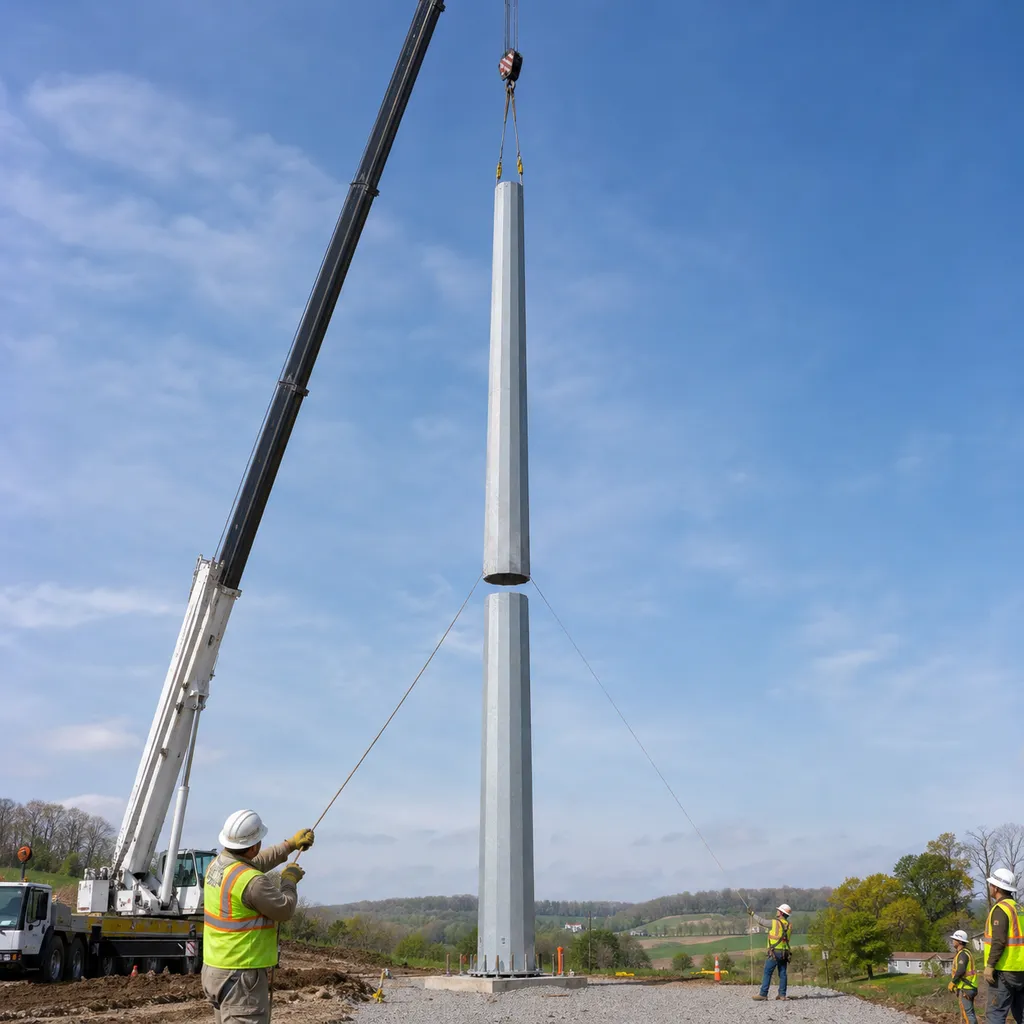
The 35m 66kV Octagonal Tangent Tower Slip-Joint is a single-circuit galvanized steel transmission pole designed for straight-line 66kV overhead power corridors with a 35m structure height, 280m nominal span, and 1 conductor per phase. The slip-joint octagonal shaft reduces bolted flange interfaces by 1-2 major joints, supports compact transport in 2-3 nested sections, and is suitable for solar, storage, industrial, utility, and smart-infrastructure interconnection projects.
SOLARTODO supplies this 66kV tangent pole as part of its Power Transmission Tower/Pole line for B2B buyers that need repeatable steel structures across 50, 100, or 250+ tower procurement packages. A tangent tower normally represents 70-80% of positions on a conventional transmission route, so the installed cost, galvanizing life, foundation size, and erection time of each 35m unit strongly influence total line economics across 10km, 50km, or 100km projects.
Product Definition and Use Case
This product is a tangent suspension tower, meaning it is intended for straight or near-straight line sections where the horizontal line angle is typically limited to a small engineering value such as 0-2 degrees, depending on the utility specification. Its primary structural demand is vertical loading from conductor, insulator, hardware, and self-weight, plus transverse wind load on the conductor and pole body, rather than the larger longitudinal loads assigned to 30-degree angle towers, dead-end towers, or terminal gantries.
The 35m pole height is selected for 66kV corridors where electrical clearance, conductor sag, road crossings, terrain undulation, and equipment access require more headroom than a 24-30m distribution pole. With a 280m design span and 1 conductor per phase, the structure can support common regional grid and renewable interconnection layouts while leaving project engineers to finalize conductor type, sag-tension tables, soil class, and grounding design during the 2-4 week detailed engineering phase.
Buyers can review adjacent tower models through View all Power Transmission Tower/Pole products, then use Configure your system online to adapt height, span, wind speed, ice thickness, circuit count, and conductor arrangement. For procurement packages above 50 towers, SOLARTODO normally recommends a route-level tower schedule with tangent, angle, terminal, river-crossing, and substation-interface quantities separated into at least 5 structure families.
Technical Specifications
| Parameter | Specification |
|---|---|
| Tower height | 35 m |
| Nominal voltage | 66 kV |
| Structure type | Tangent / suspension |
| Shaft form | Octagonal tapered steel pole |
| Connection type | Slip-joint, nested shaft sections |
| Circuits | 1 circuit |
| Conductors per phase | 1 x ACSR or equivalent conductor |
| Design span | 280 m nominal |
| Wind and ice load basis | Class B / 15 mm ice |
| Insulator arrangement | 3 suspension I-strings, project-specific creepage |
| Grounding target | Less than 10 ohm standard, less than 4 ohm in high-lightning zones |
| Design life | 50 years with inspection and maintenance |
| Reference standards | IEC 60826 / GB 50545 / IEEE 738 / ASCE 10-15 |
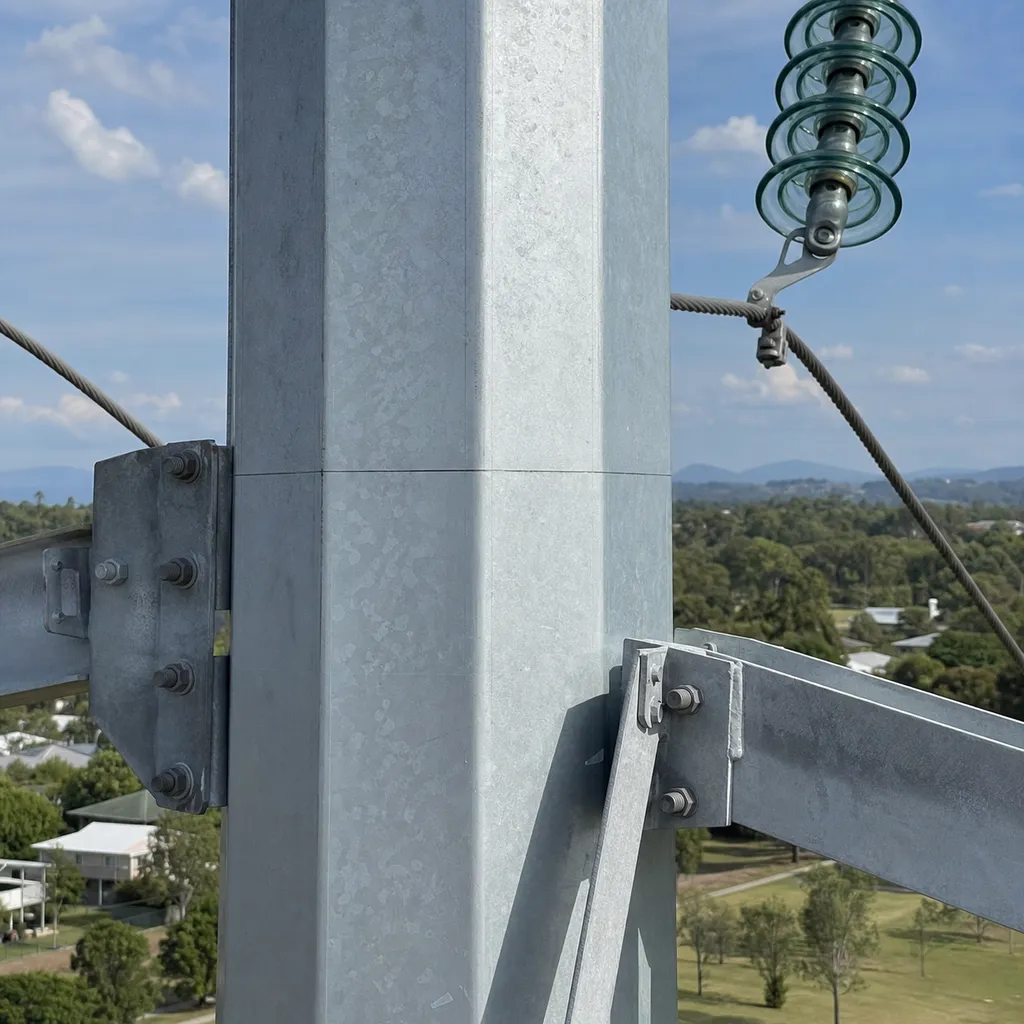
The octagonal steel shaft uses tapered segments that overlap by a controlled slip length, commonly engineered around 1.5-2.0 times the local pole diameter subject to final load calculations. Compared with a flanged tubular alternative with 2-3 heavy bolted joints, the slip-joint configuration can reduce site bolt installation work by about 20-35% and remove flange plate projections that complicate container loading, crane rigging, and anti-corrosion detailing.
Material selection is based on galvanized structural steel suitable for hot-dip zinc coating, with Q345, Q420, or Q460 grades evaluated according to tower loading, segment diameter, and wall thickness. For a 35m 66kV tangent pole, the installed steel mass often falls in the 6-9 ton class after crossarms, base plate, climbing attachments, grounding lugs, and accessories are included, although final weight depends on wind speed, terrain category, conductor tension, and foundation fixity.
Standards, Loading, and Electrical Design Basis
IEC 60826:2017 defines reliability-based design criteria for overhead lines at 45kV and above, which makes it directly relevant to a 66kV transmission structure with a 50-year service target. The standard requires climatic inputs such as wind and ice to be converted into loading cases, and this product page uses Class B wind with 15mm ice as the commercial baseline, while final engineering must use the project country and utility loading code.
IEEE 738-2023 is the reference method for calculating current-temperature relationships of bare overhead conductors, so conductor ampacity should be verified using ambient temperature, solar radiation, wind speed, emissivity, absorptivity, and maximum conductor temperature. For a 1-conductor-per-phase 66kV line, ampacity is not determined by the tower alone; it is determined by the selected ACSR or AAAC conductor, sag clearance, thermal limit, and emergency rating policy.
ASCE/SEI 10-15 is primarily written for latticed steel transmission structures, but its treatment of loading, connections, detailing, fabrication, and quality assurance remains useful for utility engineers comparing tubular steel poles against lattice alternatives. For tubular octagonal poles, SOLARTODO aligns fabrication control with equivalent structural principles, including weld inspection, dimensional tolerances, galvanizing quality, and full material traceability for 100% of main shaft plates.
GB 50545 is often used in China-origin engineering packages for overhead transmission line design, while IEC 60826 and IEEE 738 improve international review compatibility across Africa, the Middle East, Latin America, and Southeast Asia. A practical 66kV procurement specification usually names at least 3 standard families: mechanical loading, conductor thermal rating, and hot-dip galvanizing inspection, so bid comparison is not reduced to steel tonnage alone.
System Architecture
A complete 66kV tangent tower position includes 1 octagonal pole shaft, 1 base plate and anchor bolt cage, 3 phase crossarm attachment points, 3 suspension insulator strings, conductor clamps, vibration dampers, armor rods, grounding down-lead, earthing electrode set, and concrete foundation. Optional OPGW can be added as 1 overhead shield wire for lightning protection and fiber communication where the route requires SCADA, protection signaling, or telecom backhaul.
For grid-connected solar and storage projects, the tower is only 1 component in a broader interconnection architecture that may include 66kV collector switching, step-up transformers, protection relays, revenue metering, OPGW communications, and utility dispatch interfaces. IEA notes that electricity grids have operated for more than 100 years and now require major expansion for clean energy integration, making 66kV transmission hardware a practical bottleneck item in many renewable interconnection schedules.
The structural load path starts at the conductor clamp, transfers through the suspension string and crossarm bracket, enters the tapered steel shaft, and is resisted by base plate, anchor bolts, reinforcement cage, and soil-bearing foundation. Under normal tangent operation, conductor longitudinal forces are balanced across adjacent spans, but broken-wire and construction cases still need checking because a single abnormal case can govern 1 or more shaft sections.
Applications
This 35m 66kV pole is suitable for utility sub-transmission lines, renewable plant export lines, industrial park feeders, mining power corridors, port electrification systems, and regional smart-infrastructure backbones. It is especially relevant where a 280m span reduces right-of-way tower count compared with a shorter 180-220m distribution-style pole layout, while maintaining the clearance and mechanical strength expected of a 66kV transmission asset.
For a representative MENA solar farm scenario, assume a 20km 66kV export line from a 100MW solar plant to a grid substation with a 280m average span and 72 tower positions. If 75% of positions are tangent structures, approximately 54 units would use this 35m octagonal pole, while the remaining 18 positions would be angle, terminal, or special structures requiring higher longitudinal and torsional capacity.
In that 20km scenario, using a compact octagonal slip-joint pole may reduce visual bulk by roughly 30-45% compared with a conventional 66kV lattice tower envelope, depending on crossarm geometry and conductor spacing. The comparison is not a universal performance claim, because lattice towers can be cheaper in very high-load terrain, but tubular poles often reduce footprint, erection complexity, and right-of-way objection risk in peri-urban or industrial corridors.
EPC Investment Analysis and Pricing Structure
SOLARTODO EPC pricing includes 5 work packages: engineering, procurement, construction, commissioning, and 1-year warranty support. For this 35m 66kV octagonal tangent tower, the published EPC turnkey range is USD 16,800-25,200 per installed tower, while FOB supply and CIF delivered prices separate equipment, freight, insurance, civil works, lifting, testing, and local installation risk.
| Pricing tier | Scope | Unit price range |
|---|---|---|
| FOB Supply | Equipment only, ex-works China | USD 10,416-17,136 |
| CIF Delivered | Equipment plus ocean freight and insurance | USD 13,320-21,914 |
| EPC Turnkey | Installed, commissioned, and 1-year warranty | USD 16,800-25,200 |
| Order volume | Discount logic | Commercial effect |
|---|---|---|
| 50+ towers | 5% discount | Useful for 10-15km line sections with mostly tangent structures |
| 100+ towers | 10% discount | Useful for 25-35km export corridors with repeated 66kV geometry |
| 250+ towers | 15% discount | Useful for regional programs above 70km with standardized tower families |
ROI depends on the avoided alternative cost, not on power generation revenue from the tower itself. If a slip-joint pole saves USD 800 in erection labor and USD 400 in transport handling versus a flanged tubular alternative, a 100-tower package can reduce direct project cost by USD 120,000 before financing; at a 10% volume discount on a USD 21,000 representative EPC price, procurement savings add another USD 210,000.
For payback framing, a 66kV export line that prevents 0.5% annual curtailment on a 100MW solar plant with 1,800 full-load-equivalent hours protects about 900MWh per year. At USD 45/MWh, that protected energy has a value of USD 40,500 per year; therefore, a 20km route with 72 installed towers at USD 21,000 each has a tower-only installed cost near USD 1.512 million and a simple protected-energy payback contribution of about 37.3 years, before counting transformer, conductor, protection, land, and utility interconnection costs.
Payment terms are 30% T/T deposit plus 70% against bill of lading, or 100% irrevocable L/C at sight for qualified buyers. Project financing can be discussed for EPC packages above USD 1,000,000, and engineering buyers can Request a custom quotation or contact [email protected] with 6 inputs: route length, voltage, conductor type, wind speed, ice thickness, and soil report.
Engineering Notes for Procurement Teams
A procurement-ready datasheet should include at least 12 parameters: voltage, height, circuit count, conductor type, earth wire or OPGW, span, wind speed, ice thickness, seismic zone, terrain category, foundation type, and corrosion category. Without these 12 inputs, two 35m 66kV towers with the same name can differ by more than 15-25% in steel weight and foundation cost.
Inspection and quality control should cover 100% material certificates, 100% dimensional checks for slip-fit sections, welding procedure qualification, magnetic particle or ultrasonic inspection where specified, and hot-dip galvanizing thickness reports. For coastal, desert, or industrial atmospheres, engineers should define a zinc coating target, drainage-hole plan, and maintenance interval because corrosion exposure can dominate lifecycle cost over 50 years.
Grounding is a performance-critical item because a tower footing resistance below 10 ohm is a common utility target, while high-lightning areas often specify below 4 ohm with deeper rods, counterpoise, or soil treatment. When OPGW is installed, lightning performance, fiber splice-box location, and bonding details should be coordinated across every 280m span and every terminal structure.
For conductor procurement, common ACSR-240 class pricing is often benchmarked near USD 1,500 per km in budget-stage estimates, while OPGW can be closer to USD 8,000 per km depending on fiber count and mechanical rating. These line-material costs are separate from the tower EPC price, so bidders should avoid comparing a pole-only quotation against a full line package without normalizing at least 8 cost categories.
Industry Context and Source Basis
NREL solar cost and grid-integration research emphasizes that interconnection costs depend on hardware, utility studies, hosting capacity, and system upgrades, not only generation equipment. For a 66kV export line, that means the tower specification should be evaluated together with conductor ampacity, protection design, and substation scope, because a low-cost tower cannot compensate for an undersized thermal rating or delayed interconnection study.
IRENA's World Energy Transitions Outlook estimates that grids and system flexibility need large-scale investment through 2050, including USD 22.4 trillion in networks and flexibility in its 1.5 degree scenario. That macro figure does not price a single 35m pole, but it explains why standardized 66kV transmission structures are increasingly relevant to renewable, industrial, and smart-city infrastructure procurement.
IEA's grid analysis states that expanded and modernized grids are essential as electrification, heat pumps, electric vehicles, and renewable generation increase load on networks. In practical terms, a 35m 66kV tangent tower is a mid-voltage transmission building block that can connect generation and load centers across 10-100km corridors when the design complies with national utility criteria.
Buying Guidance
For early budgeting, use USD 16,800-25,200 per installed tower and multiply by the expected number of tangent positions, then add separate allowances for angle towers, terminal towers, conductor, OPGW, foundations outside the baseline, access roads, permitting, and substation works. A 50-tower order can receive 5% discount, a 100-tower order can receive 10%, and a 250-tower framework can receive 15% when drawings, steel grade, and delivery batches are standardized.
For technical background beyond this product page, buyers can Learn about topic on transmission structures, grounding, and renewable interconnection planning. SOLARTODO can also prepare a route-level bill of materials with 3-5 tower families, preliminary foundation assumptions, packing list, shipping cube, and EPC schedule after receiving route profile, soil data, and utility standard drawings.
Technical Specifications
| Tower Height | 35m |
| Voltage Rating | 66kV |
| Tower Type | Tangent suspension tower |
| Material | Galvanized octagonal steel |
| Number of Circuits | 1circuit |
| Conductor Bundle | 1 x ACSR or equivalent conductor |
| Design Span | 280m |
| Wind/Ice Load | Class B / 15mm ice |
| Foundation | Reinforced concrete foundation with anchor bolt cage |
| Connection Type | Slip-joint shaft sections |
| Grounding Target | <10 standard, <4 high-lightning areasohm |
| Design Life | 50years |
| Standards | IEC 60826 / GB 50545 / IEEE 738 / ASCE 10-15 |
Price Breakdown
| Item | Quantity | Unit Price | Subtotal |
|---|---|---|---|
| Galvanized octagonal steel pole shaft | 1 pcs | $11,250 | $11,250 |
| Crossarm, base plate, and connection hardware | 1 pcs | $1,450 | $1,450 |
| Composite suspension insulator strings | 3 pcs | $150 | $450 |
| Conductor clamps, dampers, and line fittings | 3 pcs | $120 | $360 |
| Tower grounding system | 1 pcs | $500 | $500 |
| Concrete foundation and anchor cage package | 1 pcs | $4,200 | $4,200 |
| Transport handling and lifting equipment allowance | 1 pcs | $1,300 | $1,300 |
| Installation and commissioning | 1 pcs | $900 | $900 |
| Engineering, drawings, and QC documentation | 1 pcs | $950 | $950 |
| 1-Year warranty and technical support | 1 pcs | $450 | $450 |
| Total Price Range | $16,800 - $25,200 | ||
Frequently Asked Questions
What is included in the EPC turnkey price for this 35m 66kV tangent tower?
How is a tangent tower different from an angle or terminal tower?
Can this 66kV pole use OPGW for communication and lightning protection?
Which standards should engineers use to review the design?
What information is needed for a custom quotation?
Certifications & Standards


Data Sources & References
- •IEC 60826:2017 Design criteria of overhead transmission lines: https://webstore.iec.ch/en/publication/33148
- •IEEE 738-2023 Standard for Calculating the Current-Temperature Relationship of Bare Overhead Conductors: https://standards.ieee.org/ieee/738/10207/
- •IEA Electricity Grids and Secure Energy Transitions, 2023: https://www.iea.org/reports/electricity-grids-and-secure-energy-transitions
- •IRENA World Energy Transitions Outlook 2023: https://www.irena.org/Digital-Report/World-Energy-Transitions-Outlook-2023
- •NREL Solar Technology Cost Analysis: https://www.nrel.gov/solar/market-research-analysis/solar-cost-analysis.html
- •NREL Distribution Grid Integration Unit Cost Database: https://www.nrel.gov/solar/market-research-analysis/distribution-grid-integration-unit-cost-database
- •ASCE/SEI 10-15 Design of Latticed Steel Transmission Structures: https://ascelibrary.org/doi/book/10.1061/9780784413760
Interested in this solution?
Contact us for a customized quote based on your specific requirements.
Contact Us