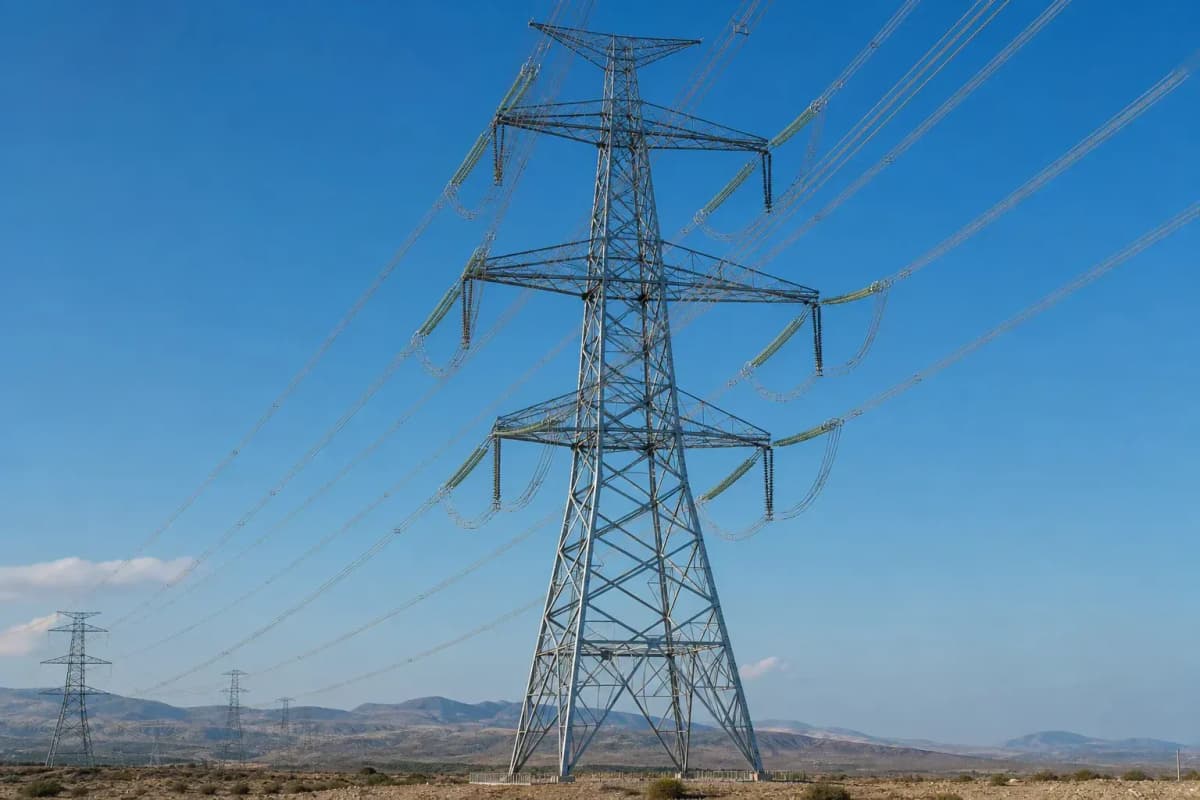
91m 750kV Heavy Lattice Tangent Tower Flanged - UHV Transmission Support
Key Features
- 91 m heavy galvanized steel lattice tangent tower for 750 kV UHV overhead transmission corridors
- 2-circuit configuration with 6 bundled conductors per phase and 546 m nominal design span
- Designed around IEC 60826 loading, ASCE 10-15 lattice structure practice, and IEEE 738 conductor rating methods
- EPC turnkey price range of $318,500-$436,800 with 1-year warranty and commissioning scope
- Standard grounding target below 10 ohms, with below 4 ohms recommended for high-lightning areas
The 91m 750kV Heavy Lattice Tangent Tower Flanged is a 2-circuit UHV suspension structure for straight-line transmission corridors with 6 bundled conductors per phase and a 546 m design span. It is specified for IEC 60826 reliability-based loading, ASCE 10-15 lattice-steel structural design, Class B wind, 15 mm ice, and EPC turnkey delivery from $318,500 to $436,800 per installed tower.
Description
The 91m 750kV Heavy Lattice Tangent Tower Flanged is a 91 m, 750 kV, 2-circuit ultra-high-voltage transmission tower engineered for tangent, or suspension, positions on straight-line overhead corridors. With 6 conductors per phase, a 546 m design span, flanged steel-lattice interfaces, and EPC turnkey pricing from $318,500 to $436,800, the structure is intended for UHV transmission projects where 1 circuit can carry approximately 1,000-1,500 MW depending on conductor selection and thermal rating methodology.
SOLARTODO supplies this tower as part of its Power Transmission Tower/Pole portfolio for utility-scale grid reinforcement, renewable-energy export lines, industrial power corridors, and smart-infrastructure backbones operating at 500 kV and above. Buyers can View all Power Transmission Tower/Pole products, Configure your system online, or Request a custom quotation when project drawings, soil data, route maps, or conductor schedules are available for a 1-line or 100+ tower package.
Technical Specifications
| Parameter | Specification |
|---|---|
| Tower height | 91 m |
| Nominal voltage | 750 kV |
| Tower type | Tangent / suspension |
| Structural material | Heavy galvanized steel lattice |
| Circuit count | 2 circuits |
| Conductor bundle | 6 x ACSR or project-specified equivalent per phase |
| Design span | 546 m |
| Connection type | Flanged joints and bolted lattice members |
| Wind / ice basis | Class B wind / 15 mm ice |
| Foundation basis | Reinforced concrete pad, pier, or pile foundation by geotechnical report |
| Design life | 50 years with inspection and galvanizing maintenance |
| Reference standards | IEC 60826 / GB 50545 / ASCE 10-15 / IEEE 738 |
This 91 m lattice tower is specified as a tangent structure, meaning it supports the vertical conductor weight and transverse wind loads on a straight transmission alignment rather than carrying large longitudinal dead-end loads. In many 220 kV to 750 kV overhead-line projects, tangent and suspension towers can represent 70-80% of the total tower count, which makes their steel weight, erection speed, foundation geometry, and repeatable fabrication tolerances central to total corridor economics.
System Architecture
The 750 kV architecture uses 2 independent circuits, each arranged with 3 phases and 6 bundled conductors per phase, producing 36 phase conductors across the tower envelope before shield wires, OPGW, spacers, dampers, and suspension strings are counted. The 546 m nominal span is coordinated with sag-tension calculations, conductor temperature limits, and tower-top clearances so that live-line clearances remain compliant at high operating temperatures.
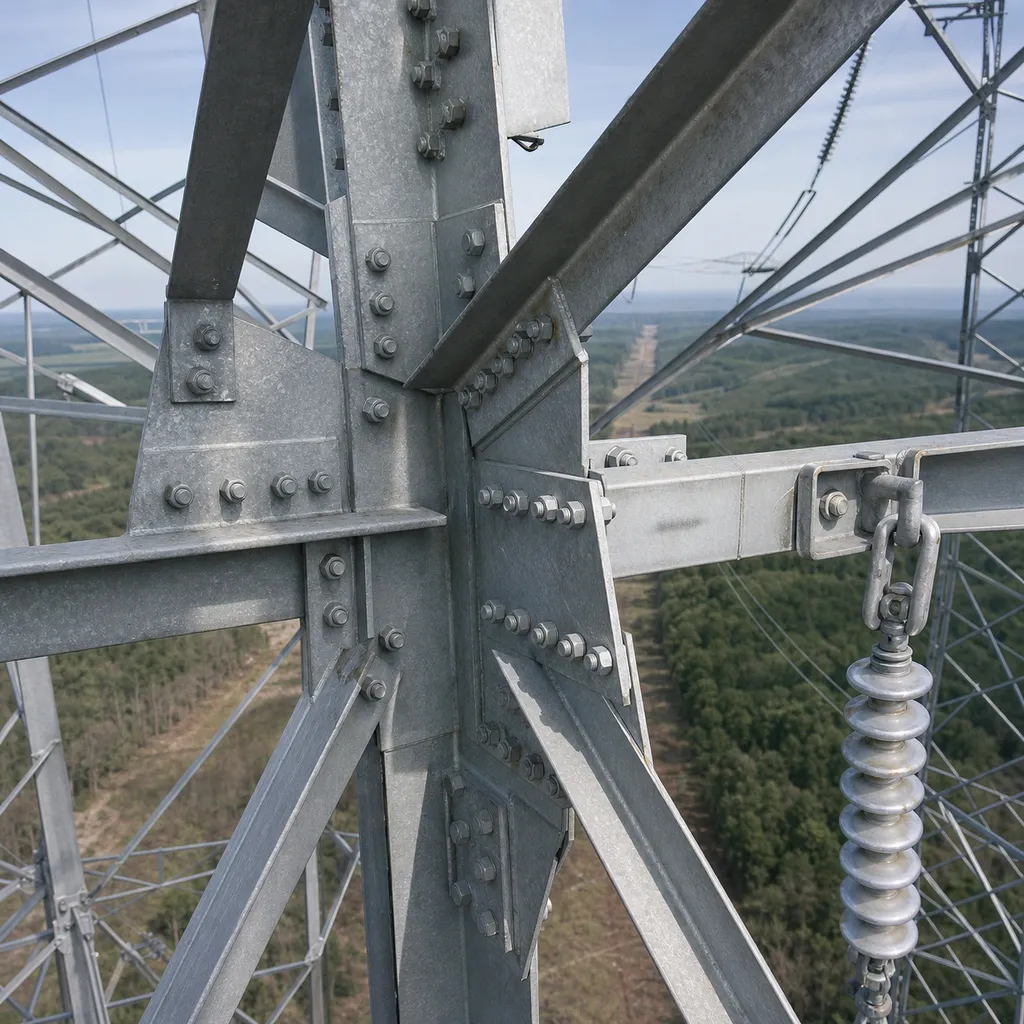
The tower body is a heavy steel-lattice system using galvanized angle members, bracing panels, crossarms, earth-wire peaks, and flanged or bolted interfaces to simplify transport and staged erection. Compared with a tubular monopole alternative at similar 750 kV clearance envelopes, a heavy lattice structure can reduce individual member transport constraints by approximately 20-35% because major assemblies can be shipped as smaller galvanized components rather than as oversize pole shafts.
Conductor support is based on suspension insulator strings, commonly I-string or V-string arrangements depending on wind swing, phase spacing, and corona-control requirements. For a 750 kV line with 6 subconductors per phase, bundle spacing, spacer-damper layout, and corona rings must be coordinated with electrical-clearance studies because audible noise, radio interference, and corona loss increase materially at EHV and UHV voltage classes above 500 kV.
The tower can integrate 2 OPGW shield wires or project-specific earth-wire combinations to provide lightning interception and fiber-optic communication on the same overhead corridor. A standard grounding target is tower footing resistance below 10 ohms, while high-lightning or high-soil-resistivity areas often specify below 4 ohms with radial counterpoise, deep electrodes, chemical grounding, or extended ring grounding.
Standards and Engineering Basis
IEC 60826:2017 defines reliability-based design criteria for overhead transmission lines of 45 kV and above, including loading and strength concepts that national standards adapt to local wind, ice, and terrain data. For this 750 kV tower, IEC 60826 is used as the loading framework, while local annexes or project specifications define the statistical wind speed, ice accretion, temperature range, terrain exposure, and broken-wire assumptions.
ASCE/SEI 10-15 is the principal reference for design, fabrication, and full-scale testing of latticed steel transmission structures, and it is especially relevant to a 91 m self-supporting tower with many bolted compression and tension members. For conductor thermal rating, IEEE 738-2023 provides a numerical method for calculating the current-temperature relationship of bare overhead conductors under steady-state or time-varying weather conditions.
The International Energy Agency reported in 2023 that power grids are becoming a bottleneck for electrification and renewable-energy integration, with physical infrastructure and planning processes both requiring expansion. IRENA's renewable-energy transition analysis similarly indicates that grid reinforcement is a core enabler for high-renewable systems, while NREL transmission studies show that long-distance high-voltage lines can reduce congestion when renewable resources are located hundreds of kilometers from load centers.
The engineering package should normally include plan and profile drawings, tower spotting tables, loading trees, foundation reactions, bill of materials, galvanizing thickness requirements, bolt grades, assembly drawings, and packing lists. For a 100-tower procurement package, even a 1% steel-weight deviation can materially change freight cost, foundation volumes, and installation labor, so SOLARTODO treats tower mass, member schedules, and packing density as commercial variables rather than secondary details.
Applications
This product is intended for UHV transmission corridors connecting utility-scale solar, wind, hydro, thermal, or interregional grid nodes at 750 kV. Typical use cases include renewable-energy export lines longer than 50 km, industrial grid reinforcements above 500 kV, desert transmission corridors with 15 mm ice design allowances in elevated sections, and smart-infrastructure routes requiring integrated fiber communication through OPGW.
For a representative MENA solar farm scenario, a 2 GW generation zone located 180 km from a 750 kV grid injection point may require a double-circuit UHV corridor with tangent towers forming roughly 75% of the route count. In that scenario, the 91 m tangent tower supports long-span straight sections, while angle, strain, and terminal towers are inserted only where route deviation, substation entry, or river and road crossings require higher longitudinal capacity.
Compared with a conventional 500 kV 4-bundle tangent alternative, a 750 kV 6-bundle double-circuit corridor can carry more power per right-of-way when conductor rating, phase spacing, and substation equipment are designed as a complete system. The trade-off is that tower height, crossarm width, insulation length, and electromagnetic-clearance studies all increase, so EPC assessment must compare $/MW-km, not only $/tower.
Cloud Monitoring and Smart Grid Integration
The tower can be supplied with provisions for OPGW splice boxes, aviation warning lights, tilt sensors, conductor-temperature sensors, weather stations, or line-monitoring hardware when the project requires digital inspection. A typical smart-corridor package may use 1 sensor node per 5-10 towers, with higher density at river crossings, high-wind zones, mountain passes, or urban-interface spans.
IEEE 738-2023 is relevant to dynamic line-rating workflows because it defines the conductor current-temperature calculation method rather than a fixed ampacity table. When field weather stations measure wind speed, ambient temperature, solar radiation, and conductor temperature at 5-15 minute intervals, operators can compare real thermal headroom with conservative static ratings and improve dispatch decisions without changing tower steel.
For procurement teams comparing tower packages, SOLARTODO recommends separating structural steel, insulators, OPGW hardware, foundations, installation, commissioning, and warranty into distinct commercial lines. This structure makes the difference between FOB, CIF, and EPC pricing visible and prevents a 1-year warranty or site-mobilization cost from being hidden inside the unit price of galvanized steel.
EPC Investment Analysis and Pricing Structure
EPC turnkey delivery includes 5 major scopes: engineering, procurement, construction, commissioning, and a 1-year warranty. Engineering covers tower calculations, drawings, foundation reactions, and QA documentation; procurement covers galvanized steel, bolts, insulators, grounding, fittings, and packing; construction covers foundations, erection, stringing support, grounding, and site QA; commissioning covers inspection records, torque checks, grounding measurements, as-built documents, and handover.
| Pricing tier | Scope | Price range per tower |
|---|---|---|
| FOB Supply | Equipment only, ex-works China | $197,470 - $297,024 |
| CIF Delivered | FOB supply plus ocean freight and insurance | $252,530 - $379,842 |
| EPC Turnkey | Installed, commissioned, and 1-year warranty | $318,500 - $436,800 |
| Order volume | Discount from listed tier | Procurement note |
|---|---|---|
| 50+ towers | 5% | Applies when drawings and loading trees are frozen for batch fabrication |
| 100+ towers | 10% | Applies to repeatable tower families with consolidated packing |
| 250+ towers | 15% | Applies to corridor-scale procurement with staged delivery lots |
A representative ROI comparison should evaluate total installed cost per MW-km rather than the isolated 1-tower purchase price. If a 750 kV double-circuit line avoids building a parallel lower-voltage corridor, the savings can come from reduced right-of-way acquisition, fewer foundations, lower corridor losses, and fewer access-road interventions; for large projects above 1,000 MW, these avoided costs can create a payback period of 3-7 years depending on land, congestion, curtailment, and financing assumptions.
Payment terms are normally 30% T/T deposit plus 70% against bill of lading, or 100% irrevocable L/C at sight for qualified buyers and approved banks. Project financing can be discussed for integrated EPC packages above $1,000,000, and commercial requests should be sent to [email protected] with route length, tower count, voltage class, conductor type, foundation assumptions, and required Incoterms.
Procurement, Quality, and Delivery
Quality control for a 91 m heavy lattice tower should include steel mill certificates, galvanizing inspection, trial assembly for representative panels, bolt and nut traceability, member marking checks, packing verification, and dimensional inspection. For a 100-tower batch, SOLARTODO recommends at least 1 pre-shipment inspection lot per fabrication phase, with sampling increased when multiple factories, steel grades, or galvanizing lines are used.
Hot-dip galvanizing is normally specified for a 50-year service life with maintenance, but coating thickness and corrosion allowance must reflect site category, salt exposure, industrial pollution, and abrasion risk during transport. In coastal or desert environments with high chloride or sand abrasion, procurement teams should request the coating standard, measured zinc thickness, repair method, and storage procedure before approving a 1,000-ton production lot.
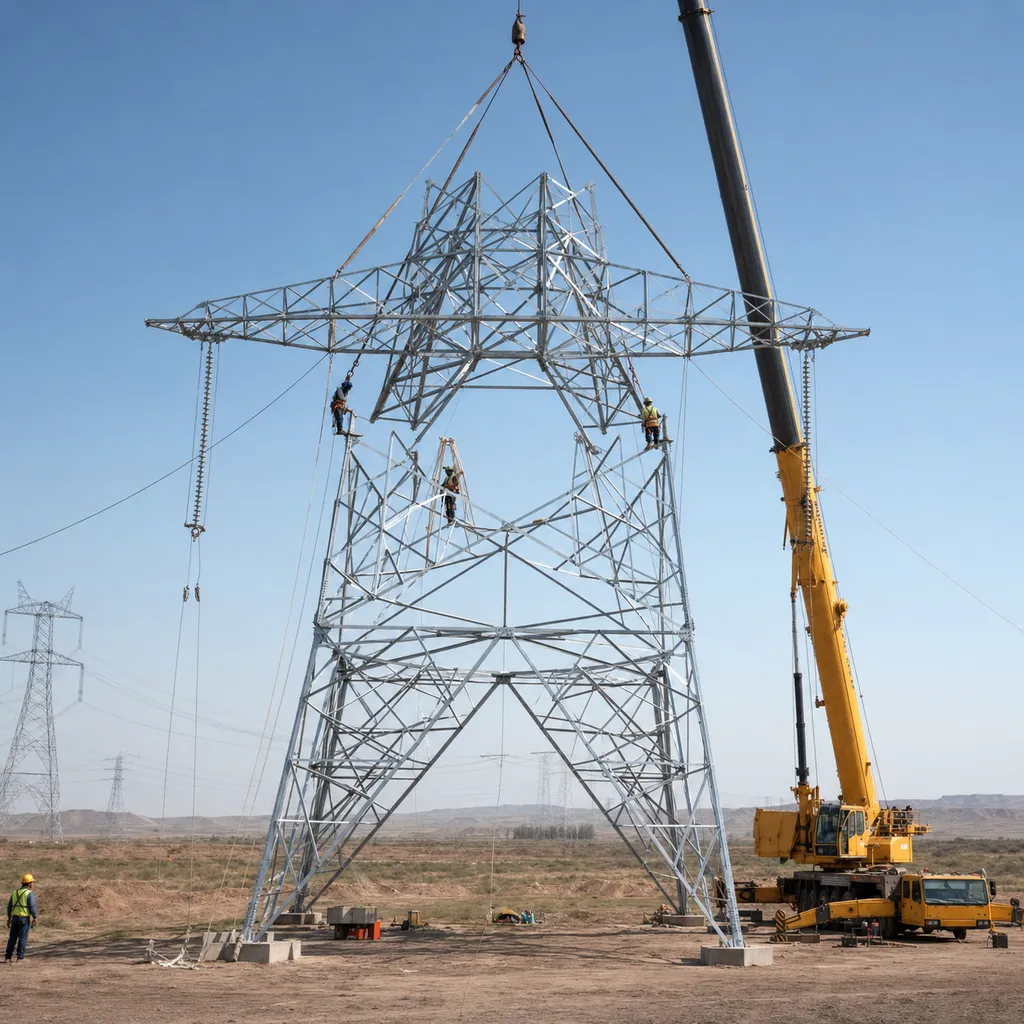
Packing and logistics are material for a 91 m tower because member count, bundle length, container utilization, and port handling can change the delivered cost by 5-12%. A flanged and bolted lattice design improves erection sequencing because foundation stubs, lower body panels, crossarms, and peak assemblies can be staged in predictable lifts rather than requiring a single oversize shaft delivery.
Buyer Guidance
Before quotation, engineers should provide voltage class, line angle range, ruling span, wind speed, ice thickness, conductor type, ground-wire type, insulation creepage distance, terrain category, seismic requirement, and geotechnical parameters. A minimum RFQ package for 1 tower family should include 10-15 project variables, because a 750 kV tower cannot be priced accurately from height and voltage alone.
Procurement managers should compare offers using a matrix that includes steel grade, estimated tower weight, galvanizing standard, bolt grade, foundation scope, delivery term, inspection plan, warranty period, and commissioning responsibility. SOLARTODO can align this tower with related solar, storage, lighting, security, telecom, and smart-agriculture infrastructure, and buyers can Learn about topic or review additional grid-infrastructure notes at Learn about topic before submitting a 50+ unit package.
Standards Summary
This product page references 6 authoritative technical sources: IEC 60826:2017 for overhead-line loading criteria, ASCE/SEI 10-15 for latticed steel transmission structures, IEEE 738-2023 for bare overhead conductor thermal calculations, IEA 2023 grid-transition analysis, IRENA renewable grid-integration guidance, and NREL transmission planning research. Final project approval must always use the governing national code, utility specification, and stamped engineering calculations for the specific 750 kV route.
Technical Specifications
| Tower Height | 91m |
| Voltage Rating | 750kV |
| Tower Type | Tangent / suspension |
| Material | Heavy galvanized steel lattice |
| Number of Circuits | 2circuits |
| Conductor Bundle | 6 x ACSR per phase |
| Design Span | 546m |
| Connection Type | Flanged and bolted lattice connection |
| Wind/Ice Load | Class B / 15 mm ice |
| Foundation | Reinforced concrete pad, pier, or pile foundation by soil report |
| Design Life | 50years |
| Standards | IEC 60826 / GB 50545 / ASCE 10-15 / IEEE 738 |
| Grounding Target | <10 standard; <4 high-lightning areasohm |
| Application | UHV transmission |
Price Breakdown
| Item | Quantity | Unit Price | Subtotal |
|---|---|---|---|
| Heavy galvanized lattice tower steel package | 1 pcs | $226,800 | $226,800 |
| Flanged connection hardware and high-strength bolt set | 1 pcs | $22,500 | $22,500 |
| 750kV suspension insulator and corona fitting assemblies | 12 pcs | $1,750 | $21,000 |
| Tower grounding system package | 1 pcs | $500 | $500 |
| Reinforced concrete foundation works | 1 pcs | $48,500 | $48,500 |
| OPGW shield-wire attachment and lightning protection fittings | 1 pcs | $7,000 | $7,000 |
| Engineering, structural calculation, QA and documentation | 1 pcs | $28,500 | $28,500 |
| Installation and commissioning | 1 pcs | $44,500 | $44,500 |
| 1-year warranty and support | 1 pcs | $6,700 | $6,700 |
| Total Price Range | $318,500 - $436,800 | ||
Frequently Asked Questions
What does tangent tower mean for a 750 kV transmission line?
What is included in the EPC turnkey price of $318,500-$436,800?
Which standards are used for this tower design?
Can this tower support OPGW and smart monitoring devices?
What project data is required for an accurate quotation?
Certifications & Standards


Data Sources & References
- •IEC 60826:2017, Design criteria of overhead transmission lines, https://webstore.iec.ch/en/publication/33148
- •IEEE 738-2023, IEEE Standard for Calculating the Current-Temperature Relationship of Bare Overhead Conductors, https://standards.ieee.org/ieee/738/10207/
- •ASCE/SEI 10-15, Design of Latticed Steel Transmission Structures, https://ascelibrary.org/doi/book/10.1061/asce10
- •IEA, Electricity Grids and Secure Energy Transitions, 2023, https://www.iea.org/reports/electricity-grids-and-secure-energy-transitions
- •IRENA renewable power and grid integration publications, https://www.irena.org/
- •NREL transmission and grid integration research, https://www.nrel.gov/grid/
Interested in this solution?
Contact us for a customized quote based on your specific requirements.
Contact Us