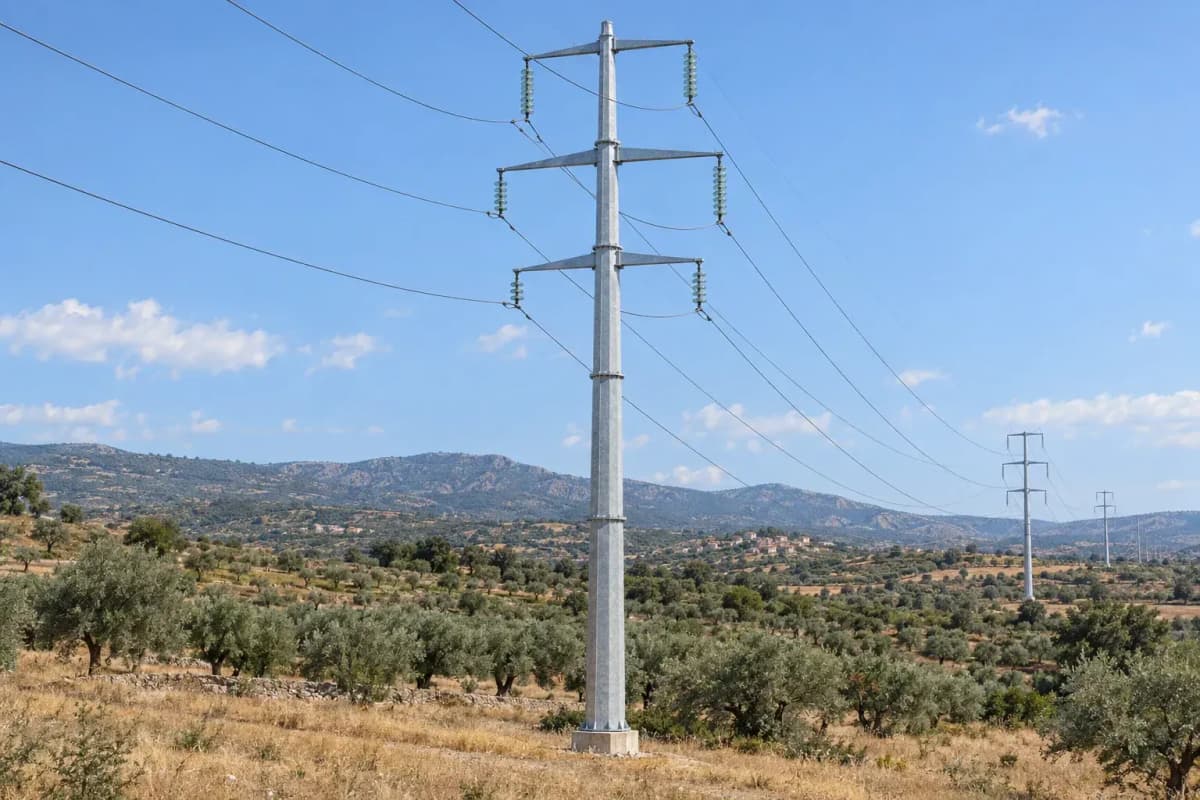
40m 110kV Tapered Monopole Transmission Flanged - Dual-Circuit Steel Pole
Key Features
- 40m hot-dip galvanized tapered steel monopole for 110kV transmission corridors
- 2-circuit configuration with 1 ACSR conductor per phase and 160m design span
- Flanged bolted sections support 2-4 lift erection and containerized export planning
- Designed for Class B wind loading, 15mm ice, and 50-year service life
- EPC turnkey price range is $26,667-$40,000 per installed pole with 1-year warranty
The 40m 110kV Tapered Monopole Transmission Flanged is a hot-dip galvanized steel tubular pole for 2-circuit, 1-conductor-per-phase transmission spans up to 160m. It is specified for urban and sub-transmission corridors requiring a 50-year design life, compact land use, IEC 60826 loading, and EPC delivery from $26,667 to $40,000 per installed structure.
Description
The 40m 110kV Tapered Monopole Transmission Flanged is a dual-circuit steel tubular transmission pole engineered for 110kV corridors, 160m design spans, and 1 ACSR conductor per phase. The structure uses hot-dip galvanized tapered steel sections, flanged connections, OPGW-ready shielding, and a 50-year design life for urban, industrial, and renewable-energy interconnection routes.
This product belongs to SOLARTODO's Power Transmission Tower/Pole line and is designed for projects where a conventional lattice tower may require 3 to 5 times more ground footprint than a single-shaft monopole. For buyers comparing 110kV options, View all Power Transmission Tower/Pole products or Configure your system online with voltage, span, wind class, ice class, foundation, conductor, and grounding inputs.
Product Definition and Use Case
A 40m tapered steel monopole is normally selected for 110kV sub-transmission lines where right-of-way width, visual impact, road crossings, or parcel acquisition costs matter more than the lowest steel weight per kilometer. With 2 circuits and 6 energized phase positions, this configuration supports regional grid backbone, solar plant evacuation, industrial park feeds, and urban corridor upgrades where the span target is approximately 160m.
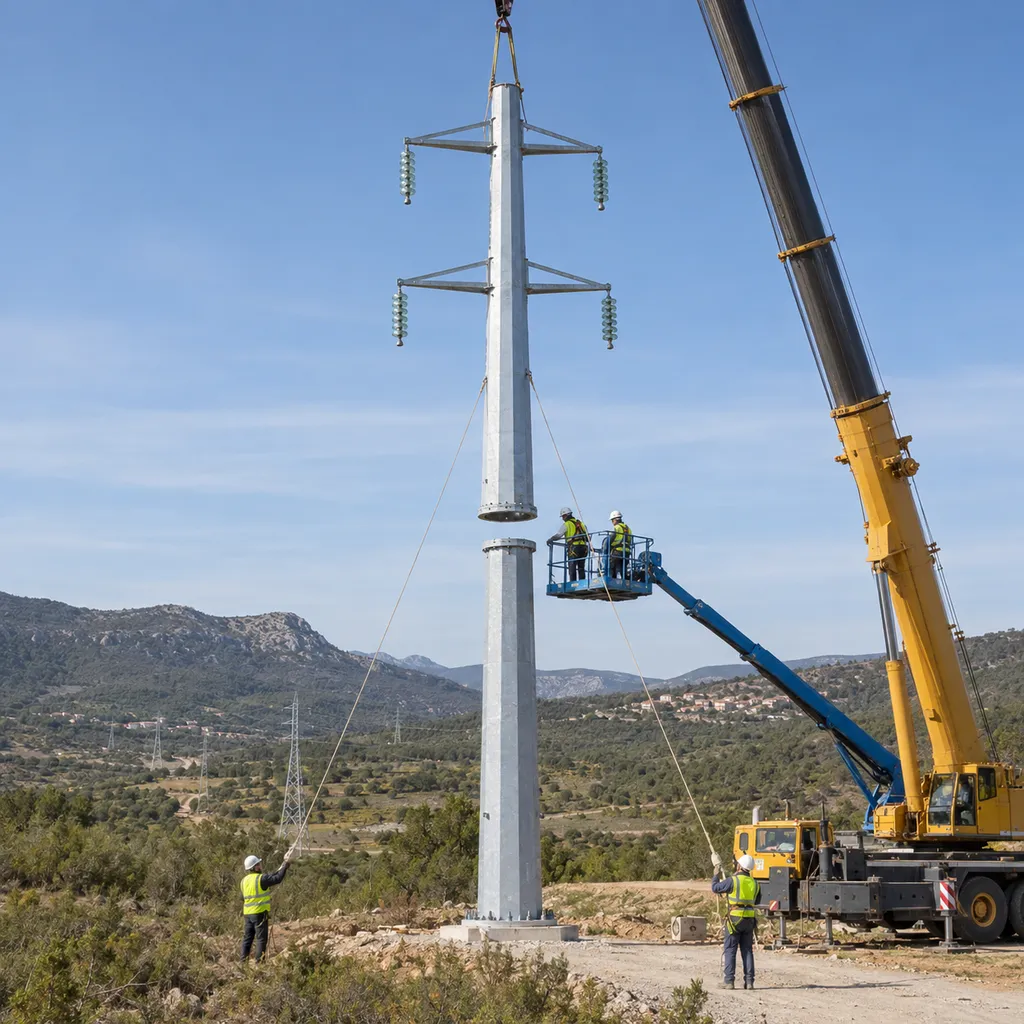
Unlike angle-steel lattice towers with 4 legs, the flanged monopole uses a single foundation centerline and bolted tubular sections that can be stacked by crane in 2 to 4 lifts. In constrained corridors, the monopole can reduce land take by 60% to 80% compared with a conventional 110kV lattice alternative, although total steel weight may be 10% to 25% higher because tubular shafts resist combined bending and torsion.
The structure is appropriate for ACSR-240 class conductors, porcelain or composite insulators, and OPGW ground wire where fiber communication and lightning protection are required in the same overhead shield path. IEEE 738 is commonly referenced for conductor thermal rating, IEC 60826 for overhead-line loading methodology, and ASCE 10-15 for lattice and transmission structure design principles.
Technical Specifications
| Parameter | Value |
|---|---|
| Nominal height | 40 m |
| Voltage rating | 110 kV |
| Structure type | Tapered tubular monopole |
| Circuits | 2 circuits |
| Conductors per phase | 1 x ACSR conductor |
| Design span | 160 m |
| Connection type | Flanged bolted connection |
| Wind and ice basis | Class B / 15 mm ice |
| Design life | 50 years |
| EPC price range | $26,667-$40,000 |
The pole body is fabricated from hot-dip galvanized steel tube, typically Q460 or project-equivalent structural steel, with shaft thickness selected from wind speed, conductor tension, broken-wire load, and deflection criteria. IEC 60826 recommends reliability-based load coordination for overhead lines, while GB 50545 is often used in China-origin designs for 110kV overhead transmission line detailing and construction acceptance.
System Architecture
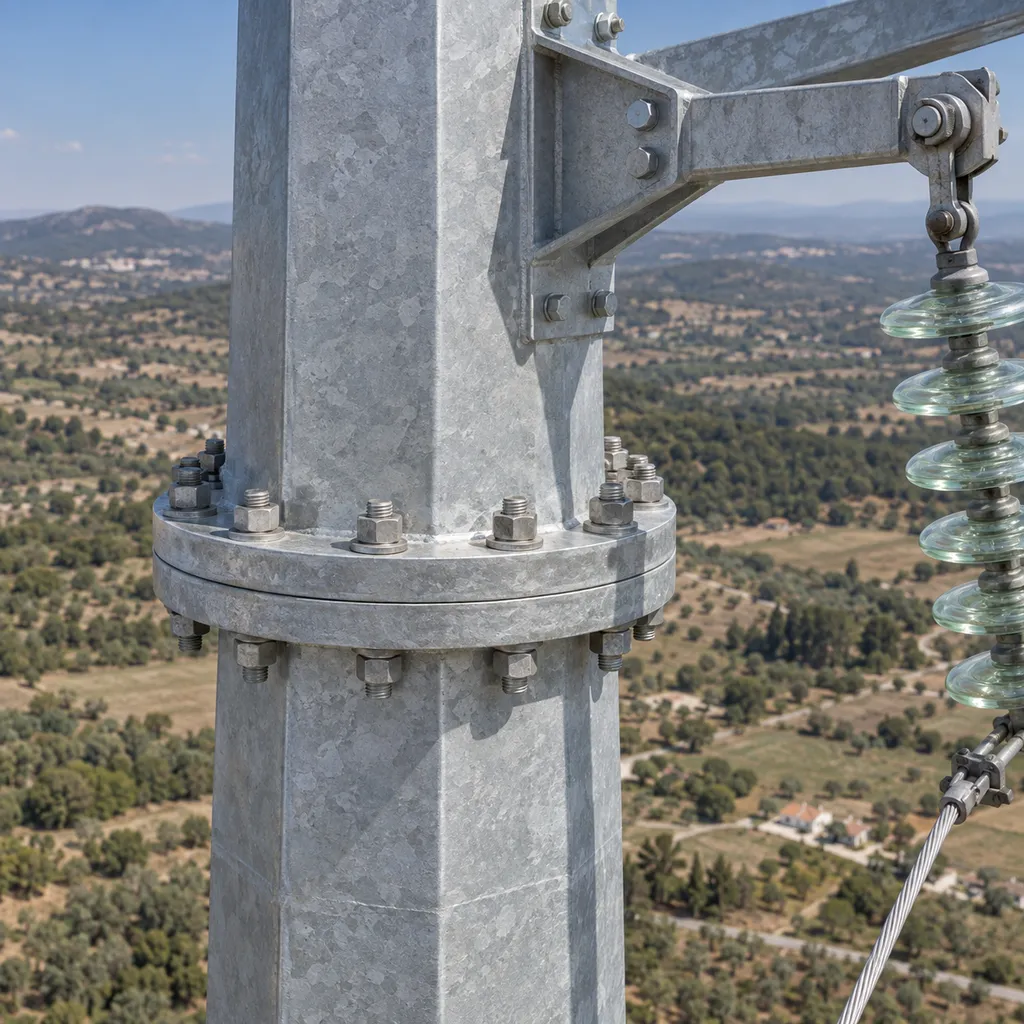
The 40m system is normally divided into 5 engineering subsystems: steel shaft and flanges, crossarm or bracket assemblies, insulator and hardware sets, conductor and OPGW interface, and civil foundation with grounding. Each subsystem has a measurable acceptance point, including galvanizing thickness, bolt torque, flange flatness, conductor clearance, and footing resistance below 10 ohm for standard sites.
For a 2-circuit 110kV configuration, 6 phase attachment positions are arranged to maintain electrical clearance under normal, wind-swing, and broken-wire cases. Composite polymer insulators can reduce suspended weight by more than 50% compared with many porcelain strings, while porcelain remains a conservative option for utilities with 20+ years of legacy maintenance practices.
The flanged connection is selected because a 40m shaft is too long for economical one-piece shipping in most ocean freight lanes. A practical design uses 2 to 4 pole sections with factory-welded flanges, high-strength bolts, anti-loosening washers, and match-marked assembly references so that site erection tolerances can be verified within the first 1 day of installation.
Foundation, Grounding, and Lightning Protection
A standard EPC package uses reinforced concrete foundations sized by soil bearing capacity, overturning moment, uplift, and groundwater condition. For the representative budget, the allowance assumes approximately 10 m3 of concrete per pole, but weak soil, flood plains, or pile foundations can increase civil cost by 20% to 60% depending on geotechnical results.
Grounding design targets footing resistance below 10 ohm in standard areas and below 4 ohm in high-lightning or high-resistivity regions. The OPGW path combines shielding and fiber optic communication, while downlead clamps, joint boxes, and earthing bonds are selected according to the 110kV line's protection philosophy and utility communication requirements.
NREL transmission interconnection studies regularly identify line capacity, thermal limits, and right-of-way constraints as material factors for renewable projects, while IEA grid investment analysis emphasizes that transmission expansion must rise quickly before 2030 to integrate variable renewable generation. For this reason, compact 110kV structures with 50-year service life are often evaluated as grid-enabling assets rather than isolated steel components.
Representative MENA Solar Farm Scenario
For a representative MENA solar farm scenario, assume a 120 MWac plant requires a 110kV overhead evacuation spur of 8 km to a grid substation, with 160m spans and approximately 50 monopole positions. At an EPC unit range of $26,667 to $40,000, the installed pole-structure budget would be about $1.33 million to $2.00 million before substation bays, protection relays, and full conductor stringing scope are finalized.
In this scenario, a single-shaft monopole may reduce land-compensation exposure by 60% compared with 4-leg lattice towers along road or farm boundaries. The tradeoff is higher crane dependency and more demanding flange QC, so procurement documents should define bolt grade, galvanizing standard, shop drawing review period, and a minimum 1-year warranty before manufacturing begins.
Applications
This 40m 110kV pole is used in at least 4 common B2B cases: renewable plant interconnection, urban sub-transmission reinforcement, industrial park dual-feed loops, and utility corridor rebuilds where older 35kV or 66kV routes are upgraded to 110kV. The structure can also support optical fiber continuity through OPGW, making it relevant for smart-grid SCADA and utility communication backbones.
Where cloud monitoring is included as an EPC add-on, pole IDs, inspection photos, torque records, grounding readings, and warranty tickets can be digitized for 1 corridor database. SOLARTODO can align pole schedules with Learn about topic resources for transmission design basics and with Request a custom quotation for project-specific soil, wind, ice, and logistics assumptions.
EPC Investment Analysis and Pricing Structure
The EPC turnkey scope includes 5 core work packages: engineering, procurement, construction, commissioning, and 1-year warranty support. Engineering covers load assumptions, shop drawings, foundation sizing inputs, and bill of materials; procurement covers steel, galvanizing, hardware, insulators, conductor interface items, and export packaging; construction covers foundation, erection, grounding, and line-ready acceptance checks.
| Pricing tier | Scope | Unit price range |
|---|---|---|
| FOB Supply | Equipment only, ex-works China | $16,534-$27,200 |
| CIF Delivered | FOB plus ocean freight and insurance | $21,144-$34,784 |
| EPC Turnkey | Installed, commissioned, 1-year warranty | $26,667-$40,000 |
| Volume bracket | Discount from base supply price |
|---|---|
| 50+ poles | 5% |
| 100+ poles | 10% |
| 250+ poles | 15% |
The representative EPC cost model uses a mid-range installed value of about $33,550 per pole, which is inside the stated $26,667 to $40,000 range. For a 50-pole order, a 5% supply discount can reduce the FOB portion by approximately $826 to $1,360 per pole before freight, civil works, and installation variability are applied.
ROI for a transmission pole is normally measured through avoided right-of-way cost, shortened permitting time, reduced outage exposure, and faster grid-connection revenue rather than electricity savings at the pole itself. If a 120 MWac solar project avoids 3 months of grid-delay at $20/MWh average net energy value and 25% capacity factor, accelerated interconnection can protect roughly $1.58 million of generation value.
Compared with a conventional lattice alternative, the monopole can reduce visible structure width and land occupation by 60% to 80%, but may increase unit steel cost by 10% to 25%. The economic decision should compare 4 categories: steel and galvanizing, civil works, land or easement cost, and schedule risk from permitting or public acceptance.
Standard commercial terms are 30% T/T advance plus 70% against B/L copy, or 100% irrevocable L/C at sight for qualified buyers. Project financing discussion is available for projects above $1,000K, and engineering or procurement managers can contact [email protected] for quotation files, drawings, packing estimates, and warranty scope.
Standards and Compliance Notes
The design basis should reference IEC 60826 for overhead-line loading, IEEE 738 for conductor current-temperature behavior, ASCE 10-15 for transmission-structure practices, and GB 50545 where a China-code design package is required. IRENA renewable-grid reports and IEA power-system investment reports both show that transmission capacity is a binding factor for renewable deployment through 2030.
Factory QA normally includes 100% dimensional inspection of critical flanges, weld visual checks, galvanizing records, bolt certificate review, and packing-list verification before shipment. Site QA normally includes foundation cube tests where required, verticality checks, bolt torque records, grounding resistance measurements, and as-built pole numbering for the 50-year asset register.
Procurement Guidance
A complete RFQ should include 12 inputs: route length, pole count, voltage, circuit count, conductor type, span, wind speed, ice thickness, soil report, corrosion environment, foundation preference, and delivery port. Missing wind or soil data can shift final EPC pricing by more than 15%, especially where pile foundations or high-wind coastal design cases apply.
Buyers should also confirm whether the requested scope includes conductor supply, OPGW supply, stringing works, protection relay integration, access roads, and utility witnessing. The listed pricing is for the pole-centered EPC structure package; full 110kV line EPC may require additional per-kilometer conductor, fiber, relay, substation bay, and outage-coordination budgets.
For related design background, procurement teams can review Learn about topic before preparing bid documents. For a project-specific budget, Request a custom quotation with a route map, preliminary pole schedule, and at least 1 wind or ice design reference so SOLARTODO can produce a more defensible 110kV proposal.
Technical Specifications
| Tower Height | 40m |
| Voltage Rating | 110kV |
| Tower Type | Transmission tapered monopole |
| Material | Hot-dip galvanized steel tapered tube |
| Number of Circuits | 2circuits |
| Conductor Bundle | 1 x ACSR conductor per phase |
| Design Span | 160m |
| Connection Type | Flanged bolted connection |
| Wind/Ice Load | Class B / 15mm ice |
| Foundation | Reinforced concrete foundation, project soil dependent |
| Grounding Resistance | <10 standard, <4 high-lightning areasohm |
| Design Life | 50years |
| Standards | IEC 60826 / GB 50545 / IEEE 738 / ASCE 10-15 |
Price Breakdown
| Item | Quantity | Unit Price | Subtotal |
|---|---|---|---|
| Hot-dip galvanized tapered steel monopole body | 12.5 tons | $1,500 | $18,750 |
| Flanged connection plates, bolts, nuts, and washers | 1 set | $1,200 | $1,200 |
| Crossarm brackets and phase hardware | 1 set | $1,800 | $1,800 |
| Composite 110kV insulator strings | 6 pcs | $150 | $900 |
| ACSR-240 conductor allowance for pole span interface | 0.6 km | $1,500 | $900 |
| OPGW ground wire allowance for pole span interface | 0.1 km | $8,000 | $800 |
| Grounding system with rods, clamps, and bonds | 1 set | $500 | $500 |
| Reinforced concrete foundation allowance | 10 m3 | $350 | $3,500 |
| Installation and commissioning labor | 12.5 tons | $200 | $2,500 |
| Engineering, shop drawing review, and QC documentation | 1 lot | $1,500 | $1,500 |
| 1-year warranty and project support | 1 lot | $1,200 | $1,200 |
| Total Price Range | $26,667 - $40,000 | ||
Frequently Asked Questions
What is included in the EPC turnkey price for this 40m 110kV monopole?
Why use a tapered monopole instead of a 110kV lattice tower?
Which standards apply to the design of this 110kV structure?
Can the pole support OPGW and smart-grid communication?
What project data is needed for an accurate quotation?
Certifications & Standards


Data Sources & References
- •IEC 60826 overhead transmission line loading methodology
- •IEEE 738 conductor current-temperature calculation standard
- •ASCE 10-15 Design of Latticed Steel Transmission Structures
- •GB 50545 Code for Design of 110kV-750kV Overhead Transmission Lines
- •NREL renewable grid integration and transmission interconnection publications
- •IEA electricity grids and secure energy transitions analysis
- •IRENA renewable power grid integration publications
Interested in this solution?
Contact us for a customized quote based on your specific requirements.
Contact Us