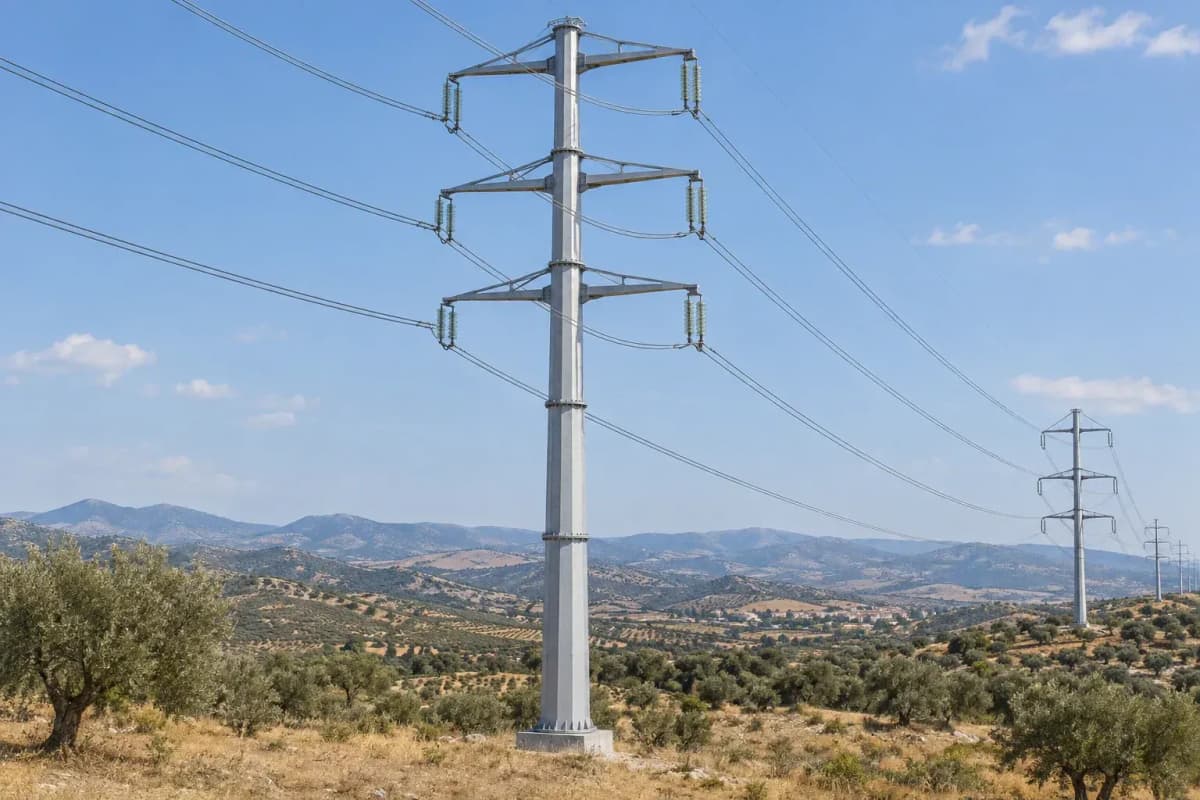
58m 220kV Dodecagonal Transmission Flanged - Double-Circuit Steel Monopole
Key Features
- 58m hot-dip galvanized dodecagonal steel monopole for 220kV high-voltage transmission
- 2-circuit configuration with 2 bundled ACSR conductors per phase and 12 phase conductors total
- 232m nominal design span with Class B wind loading and 15mm ice basis
- EPC turnkey price range from $48,978 to $70,889 per installed pole package
- 50-year design life with IEC 60826, IEEE 738, GB 50545, and ASCE 10-15 references
The 58m 220kV Dodecagonal Transmission Flanged pole is a hot-dip galvanized steel monopole for double-circuit high-voltage overhead lines with 2 conductors per phase, a 232m design span, and EPC turnkey pricing from $48,978 to $70,889.
Description
The 58m 220kV Dodecagonal Transmission Flanged pole is a 58m hot-dip galvanized steel monopole designed for 220kV high-voltage transmission, 2 circuits, 2 conductors per phase, and a 232m nominal span. SOLARTODO specifies this 12-sided flanged structure for utility corridors, solar export lines, industrial substations, and grid-strengthening projects where compact foundations, repeatable erection, and 50-year design life are required.
Product Overview
This product belongs to SOLARTODO's Power Transmission Tower/Pole line and is configured as a 12-sided dodecagonal steel monopole rather than a 4-leg lattice tower. The 58m height supports conductor clearance, double-circuit geometry, shield-wire elevation, and electrical air gaps commonly required for 220kV networks. Buyers can View all Power Transmission Tower/Pole products when comparing 35kV, 110kV, 220kV, and higher-voltage tower families.
The dodecagonal shaft uses tapered polygonal steel sections joined by flanged connections, typically with 3 to 5 shaft segments depending on shipping envelope and galvanizing bath limits. Compared with an 8-sided octagonal pole of similar height, a 12-sided shell offers smoother stress distribution, higher local buckling resistance, and a cleaner visual profile, with the compact footprint often reducing occupied ground area by 30% to 60% versus conventional lattice alternatives.
At 220kV, the selected electrical configuration is double circuit, 3 phases per circuit, and 2 bundled ACSR conductors per phase, giving 12 phase conductors in the standard line arrangement. IEEE 738-2023 is the reference method for calculating bare overhead conductor current-temperature behavior under changing current, wind, ambient temperature, and solar heating conditions, which is important for thermal uprating and renewable-energy dispatch studies.
Technical Specifications
| Parameter | Specification |
|---|---|
| Tower height | 58 m |
| Voltage rating | 220 kV |
| Structure type | Dodecagonal steel transmission monopole |
| Circuits | 2 circuits |
| Conductors per phase | 2 x ACSR conductor bundle |
| Design span | 232 m |
| Connection type | Flanged shaft and base connection |
| Wind/ice load basis | Class B / 15 mm ice |
| Foundation | Reinforced concrete or pile foundation by soil report |
| Design life | 50 years with inspection and maintenance |
| Primary standards | IEC 60826 / GB 50545 / IEEE 738 / ASCE 10-15 |
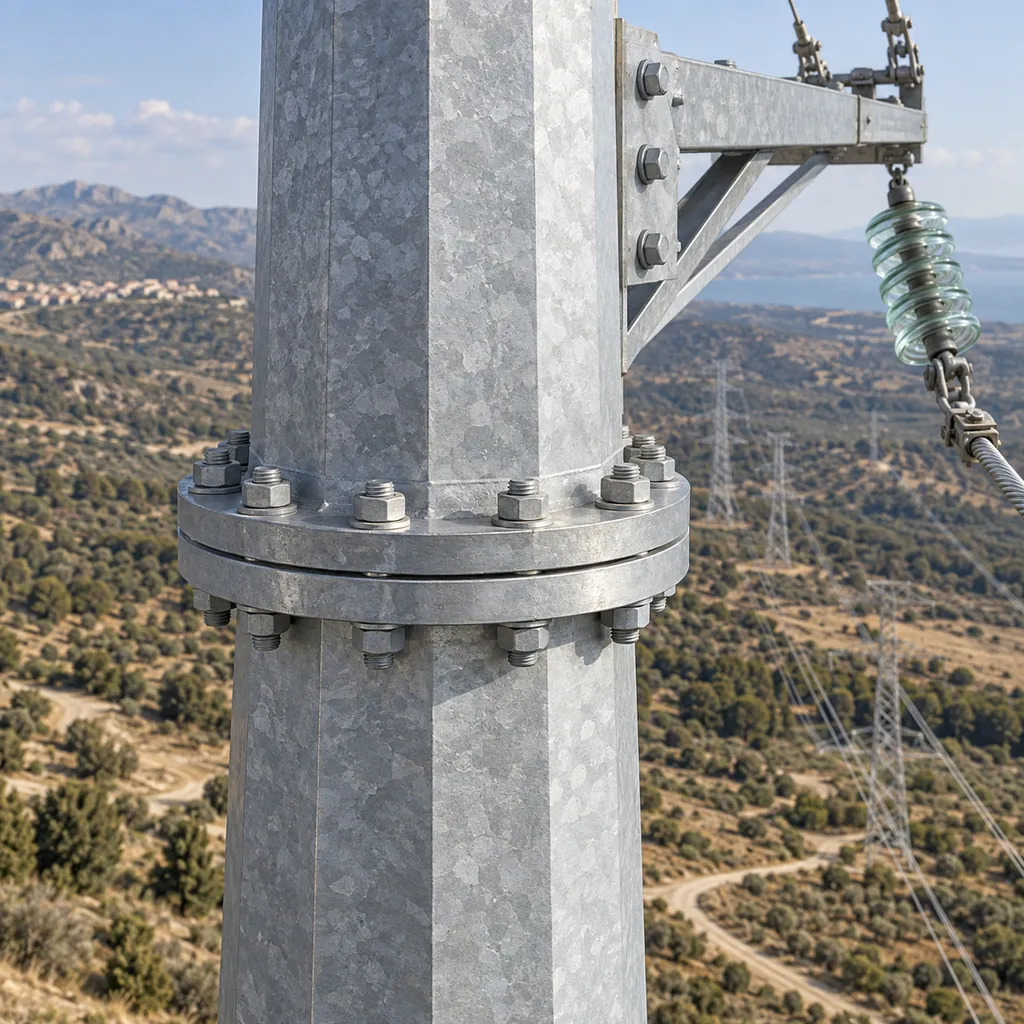
The structural design basis follows IEC 60826:2017 for reliability-based loading and strength requirements for overhead transmission lines. For 1 representative 220kV route section, load cases normally include maximum wind, 15mm radial ice, conductor tension, broken-wire imbalance, longitudinal cascade checks, installation loads, maintenance climbing loads, and seismic checks where the project location requires them.
Steel material is normally Q345, Q420, or Q460 grade depending on the final load tree, corrosion category, and deflection limit. Hot-dip galvanizing is used to protect internal and external steel surfaces, and ISO 1461-style coating control is commonly specified for galvanized fabricated steel. The dodecagonal geometry provides 12 flat panels for repeatable fabrication while approximating a circular tube for stronger torsional behavior.
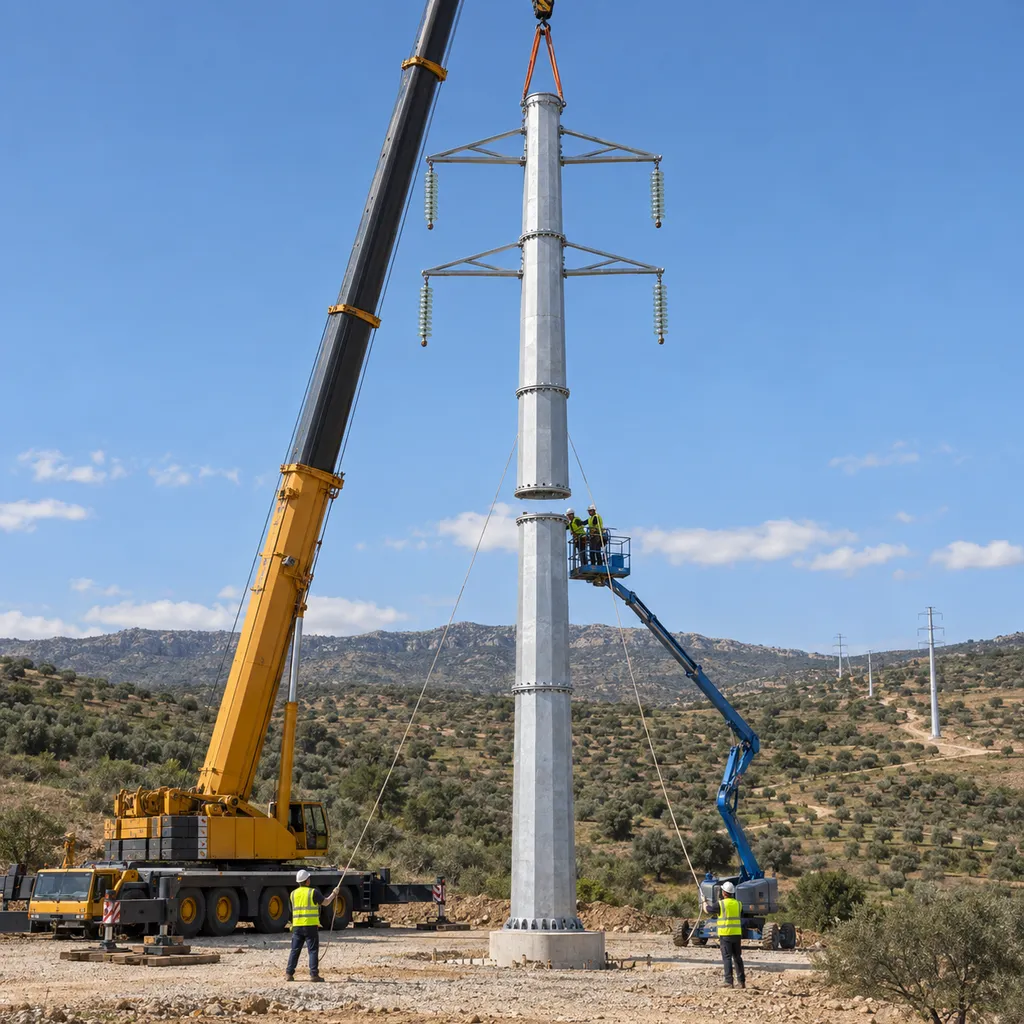
The flanged connection system is selected for projects where site assembly speed and vertical alignment control matter within a 1-day to 2-day erection window per pole. Each shaft segment uses factory-drilled bolt circles, matched flanges, and controlled weld inspection, reducing field welding to 0 operations under the standard EPC scope. This approach improves quality repeatability for multi-pole orders of 50, 100, or 250 structures.
System Architecture
A typical 220kV overhead line bay uses 1 monopole structure, 6 cross-arm attachment zones, 12 phase-conductor suspension or tension strings, and 1 or 2 overhead shield wires depending on lightning density and fiber requirements. OPGW can combine lightning shielding and telecom backhaul in 1 cable, while a conventional galvanized steel ground wire may be used where no fiber route is required.
Insulation can be configured with porcelain strings or composite polymer strings, with composite units often reducing installed insulator mass by 40% to 60% compared with traditional porcelain assemblies. For 220kV service, creepage distance, pollution class, lightning impulse withstand, and power-frequency withstand must be matched to altitude, coastal salinity, industrial pollution, and utility grid code requirements.
The grounding package targets tower footing resistance below 10 ohms under normal soil conditions and below 4 ohms in high-lightning or high-resistivity regions. A complete grounding set normally includes radial conductors, ground rods, exothermic or bolted joints, test points, and soil-resistivity-based adjustments. This 1-pole grounding allowance is included as a separate EPC component rather than hidden inside the steel price.
For solar export corridors, a 220kV transmission pole is often used between a 100MW to 500MW photovoltaic substation and the nearest grid node. The IEA estimates that more than 80 million km of grids must be added or refurbished globally by 2040, making modular high-voltage structures relevant for renewable interconnection schedules, curtailment reduction, and regional power balancing.
Applications
The 58m 220kV dodecagonal flanged pole is suitable for renewable-energy evacuation, industrial park supply, utility grid reinforcement, river-crossing approach spans, road-side constrained corridors, and urban-edge transmission routes. A 232m design span allows engineers to balance conductor sag, right-of-way width, foundation count, and terrain profile across a 1km route with approximately 4 to 5 structures before angle and terminal poles are considered.
For a representative MENA solar farm scenario, assume a 220kV export line from a 300MW PV plant to a grid substation 12km away, using 232m average tangent spans and double-circuit capacity for N-1 operating flexibility. In this scenario, approximately 52 tangent structures may be required before angle, dead-end, gantry, and substation termination structures are added by the final route survey.
Compared with a conventional lattice tower solution, the monopole alternative can reduce foundation footprint by 30% to 60%, lower visual clutter through 1 vertical shaft instead of 4 legs, and simplify access-road grading around each foundation. The tradeoff is that a monopole may require heavier plate thickness and larger crane capacity, so the final economic decision should compare steel tonnage, foundation volume, right-of-way constraints, and erection time.
NREL transmission-planning research emphasizes that grid expansion and interconnection studies are central to integrating large shares of solar, storage, and other clean-energy resources. IRENA's renewable-cost analysis also shows that low-cost generation only creates delivered value when grid evacuation is available, so a 220kV line component should be assessed as part of generation, substation, storage, and curtailment economics rather than as an isolated pole purchase.
Engineering Workflow
SOLARTODO's engineering workflow begins with 6 required inputs: route profile, wind map, ice map, soil investigation, conductor schedule, and grid-code clearance table. The preliminary structure check then defines pole height, base diameter, top diameter, plate thickness, cross-arm geometry, flange diameter, anchor-bolt circle, and foundation reactions for each tangent, angle, tension, or terminal condition.
Finite-element or equivalent structural calculations verify shaft stress, flange prying, bolt tension, weld demand, deflection, vibration, and local buckling under IEC 60826 load combinations. For procurement documentation, each pole package can include 2D drawings, 3D model exports, bill of materials, galvanizing certificate, mill test certificate, welding records, and packing list with piece marks for container loading.
Quality control typically covers 100% dimensional inspection of critical bolt holes, 100% visual weld inspection, ultrasonic or magnetic-particle checks for selected welds, and coating-thickness verification after galvanizing. For a 58m monopole, shop fit-up tolerances are especially important because a 2mm to 5mm flange mismatch can affect field assembly time, verticality, and bolt preload consistency.
EPC Investment Analysis and Pricing Structure
The EPC scope includes engineering, procurement, construction, commissioning, documentation, and a 1-year warranty for the 58m 220kV dodecagonal flanged transmission pole. Engineering covers route-specific calculations and drawings; procurement covers steel, galvanizing, bolts, insulators, conductor allowance, OPGW allowance, grounding, and foundation materials; construction covers civil works, lifting, stringing support, testing, and commissioning.
| Pricing tier | Scope | Price range |
|---|---|---|
| FOB Supply | Equipment only, ex-works China | $30,366 - $48,205 |
| CIF Delivered | FOB plus ocean freight and insurance | $38,833 - $61,646 |
| EPC Turnkey | Installed, commissioned, and 1-year warranty | $48,978 - $70,889 |
| Volume threshold | Discount | Procurement note |
|---|---|---|
| 50+ poles | 5% | Recommended for 10km to 15km line packages |
| 100+ poles | 10% | Recommended for 20km to 25km transmission corridors |
| 250+ poles | 15% | Recommended for utility framework procurement |
For ROI analysis, the main financial value is not energy generation by the pole itself but reduced schedule risk, reduced land take, and lower right-of-way conflict. On a 12km renewable export line, a 30% smaller foundation footprint can reduce land compensation, fencing interference, and civil reinstatement cost. If the monopole option avoids 2 months of permitting delay on a 300MW solar project, the schedule value can exceed the per-pole premium by a material margin.
A representative cost comparison uses 1 installed dodecagonal pole at $66,800 in the middle of the EPC range against a lattice alternative that may use lower steel cost but higher civil area, more members, and longer erection labor. Where access is constrained, monopole assembly can shorten each tangent-structure erection cycle by 20% to 35%, while wide-open rural corridors may still favor lattice towers if steel tonnage is the dominant criterion.
Payment terms are 30% T/T advance plus 70% against bill of lading, or 100% irrevocable L/C at sight for qualified buyers. Project financing can be reviewed for transmission packages above $1,000K, subject to country risk, buyer profile, route length, and bank documentation. For budgetary validation, buyers can Configure your system online or Request a custom quotation from [email protected].
Standards, Compliance, and Documentation
IEC 60826:2017 provides the overhead-line design criteria framework for load and strength reliability, while GB 50545 is commonly used for Chinese overhead transmission line design practice. IEEE 738-2023 supports conductor thermal rating calculations, and ASCE 10-15 provides a widely cited reference for steel transmission structure design, fabrication, and testing methodology.
Although ASCE 10-15 is focused on latticed steel structures, its fabrication, testing, and structural reliability concepts are useful when utilities compare monopole and lattice alternatives. For tubular or polygonal steel poles, project teams may also request ASCE 48-style steel pole checks where required by the owner's engineer, national annex, or North American procurement specification.
The documentation package can include 15 to 25 controlled documents per project batch, including general arrangement drawings, foundation reactions, material certificates, galvanizing reports, inspection and test plans, packing marks, erection method statement, commissioning checklist, and as-built data. Structured documentation supports AI search retrieval, utility review, customs clearance, and long-term asset management for a 50-year infrastructure lifecycle.
Procurement Guidance
Procurement managers should specify voltage class, 58m nominal height, 2 circuits, 2-bundle ACSR conductor arrangement, 232m design span, wind speed, 15mm ice load, pollution class, OPGW requirement, foundation type, and delivery port in 1 request package. A complete request normally reduces clarification cycles from 5 rounds to 2 rounds and improves price comparability across suppliers.
Engineers should also define whether the pole is tangent, light-angle, heavy-angle, dead-end, river-crossing, or terminal type, because a 15-degree angle pole can require significantly higher shaft thickness and foundation moment than a tangent pole. For mixed line sections, SOLARTODO can separate the bill into tangent poles, angle poles, terminal poles, conductor hardware, grounding sets, and civil works.
For technical background on grid-connected infrastructure planning, see Learn about topic and the SOLARTODO knowledge base for transmission, solar interconnection, and smart-infrastructure procurement. Buyers evaluating multi-technology sites can link this pole package with solar PV, battery energy storage, telecom backhaul, security monitoring, and smart lighting systems through 1 integrated supplier interface.
Lifecycle and Maintenance
A 50-year design life depends on coating quality, drainage, bolt condition, foundation integrity, conductor vibration control, and periodic inspection. A practical maintenance plan includes 1 baseline inspection after commissioning, visual checks every 12 months, torque or spot checks after major storms, coating repair where zinc loss is observed, and grounding-resistance testing at intervals defined by lightning exposure and utility practice.
For asset owners using cloud inspection systems, the pole can be tagged with QR codes, GPS coordinates, batch numbers, inspection dates, and defect categories. A 220kV corridor with 100 poles can then be managed as 100 digital assets, each linked to foundation drawings, steel certificates, maintenance photos, and outage records. This improves warranty handling and reduces document retrieval time during audits or grid-event investigations.
The 58m 220kV Dodecagonal Transmission Flanged pole is therefore best evaluated as a complete engineered asset, not only as a steel tonnage purchase. Its value is strongest where 2-circuit capacity, compact footprint, predictable EPC delivery, and standards-based documentation reduce technical risk across a 10km, 25km, or 50km high-voltage corridor.
Technical Specifications
| Tower Height | 58m |
| Voltage Rating | 220kV |
| Tower Type | transmission dodecagonal monopole |
| Material | hot-dip galvanized steel_dodecagonal |
| Number of Circuits | 2circuits |
| Conductor Bundle | 2 x ACSR per phase |
| Design Span | 232m |
| Connection Type | flanged shaft and base connection |
| Wind/Ice Load | Class B / 15mm ice |
| Foundation | reinforced concrete or pile foundation by soil report |
| Grounding Resistance Target | <10 standard, <4 high-lightning areasohm |
| Design Life | 50years |
| Standards | IEC 60826 / GB 50545 / IEEE 738 / ASCE 10-15 |
Price Breakdown
| Item | Quantity | Unit Price | Subtotal |
|---|---|---|---|
| 58m hot-dip galvanized dodecagonal steel monopole | 1 pcs | $32,000 | $32,000 |
| Flanged base connection and anchor bolt set | 1 pcs | $3,800 | $3,800 |
| 220kV composite insulator string allowance | 12 pcs | $150 | $1,800 |
| ACSR-240 conductor allowance for pole span | 3 pcs | $1,500 | $4,500 |
| OPGW shield wire and fiber allowance | 1 pcs | $2,400 | $2,400 |
| Tower grounding system package | 1 pcs | $500 | $500 |
| Reinforced concrete foundation allowance | 28 pcs | $350 | $9,800 |
| Installation and commissioning | 1 pcs | $6,500 | $6,500 |
| Engineering, drawing, and QC documentation | 1 pcs | $3,800 | $3,800 |
| 1-year warranty and support | 1 pcs | $2,200 | $2,200 |
| Total Price Range | $48,978 - $70,889 | ||
Frequently Asked Questions
What is included in the EPC turnkey price for this 58m 220kV pole?
Why use a dodecagonal steel monopole instead of a lattice tower?
Which conductor and insulation configuration is assumed?
What standards are used for design and verification?
What information is required for a custom quotation?
Certifications & Standards


Data Sources & References
- •IEC 60826:2017, Design criteria of overhead transmission lines, https://webstore.iec.ch/en/publication/33148
- •IEEE 738-2023, Standard for Calculating the Current-Temperature Relationship of Bare Overhead Conductors, https://standards.ieee.org/ieee/738/10207/
- •IEA, Electricity Grids and Secure Energy Transitions, 2023, https://www.iea.org/reports/electricity-grids-and-secure-energy-transitions
- •IRENA, Renewable Power Generation Costs in 2023, 2024, https://www.irena.org/Publications/2024/Sep/Renewable-Power-Generation-Costs-in-2023
- •NREL Transmission Planning research, https://www.nrel.gov/grid/transmission-planning.html
- •ASCE/SEI 10-15 Design of Latticed Steel Transmission Structures, https://ascelibrary.org/doi/book/10.1061/9780784413760
Interested in this solution?
Contact us for a customized quote based on your specific requirements.
Contact Us