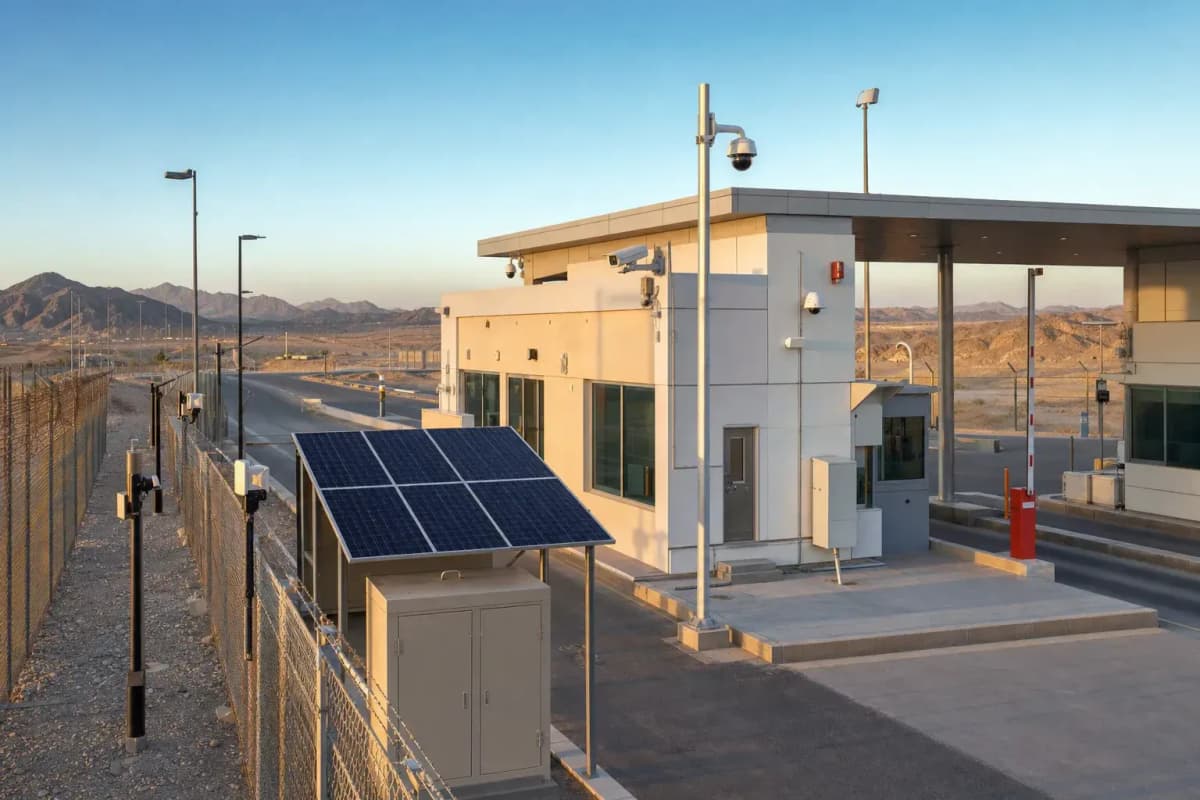
Border Checkpoint 64-Zone Off-Grid - 96h Solar Security
Key Features
- 64-zone hybrid alarm panel with wired and wireless partitioning for 1 border checkpoint compound
- 29-camera video layer with 20 fixed IP cameras, 6 PTZ cameras, and 3 thermal cameras
- 58-detector intrusion package using 24 PIR, 16 dual-tech, 10 contacts, and 8 vibration sensors
- 4.3 kW solar array plus 21.3 kWh LFP battery capacity for 96 hours of off-grid autonomy
- 30-day 4K-class video retention with 4G, Ethernet, and WiFi communication paths
Border Checkpoint 64-Zone Off-Grid integrates 64 alarm zones, 29 cameras, 58 detectors, 4.3 kW solar, and 21.3 kWh LFP storage for 96 hours of remote security autonomy. EPC turnkey pricing is USD 13,900-23,600 with IEC 62676, EN 50131, UL 681, and NFPA 72 design references.
Description
The Border Checkpoint 64-Zone Off-Grid system is a solar-powered security and surveillance package for 1 checkpoint compound, integrating 64 alarm zones, 29 cameras, 58 detectors, a 4.3 kW PV array, and 21.3 kWh LFP storage for 96 hours of backup autonomy. It is specified for border-control gates, inspection lanes, staff compounds, and perimeter segments where grid availability can fall below 99% and continuous video evidence must remain available for 30 days.
Product Scope and Buyer Fit
This configuration belongs to SOLARTODO's Security & Surveillance System line and is sized for B2B projects that need 8 to 64 alarm zones, hybrid wired/wireless expansion, and a basic monitoring workflow without a full national command-center stack. Procurement teams can compare this package with other options at View all Security & Surveillance System products, while engineers can model zone count, camera count, and storage requirements at Configure your system online.
A border checkpoint has at least 3 security layers: vehicle approach, inspection and pedestrian control, and back-of-house protected rooms. This 64-zone design allocates zones to gates, cabins, fencing, equipment shelters, fuel storage, and power rooms, creating enough granularity to identify an alarm source within 1 named area instead of searching an entire compound after a single siren event.
The package is suitable for projects where civil power may be unavailable for 48 to 120 hours, where a diesel-only alternative would require fuel logistics every 2 to 4 days, and where camera evidence must be retained locally for 720 hours. It uses 4G, Ethernet, and WiFi communication, so the same design can support a remote desert lane, a port border terminal, or a temporary security checkpoint with 1 primary operations room.
System Architecture
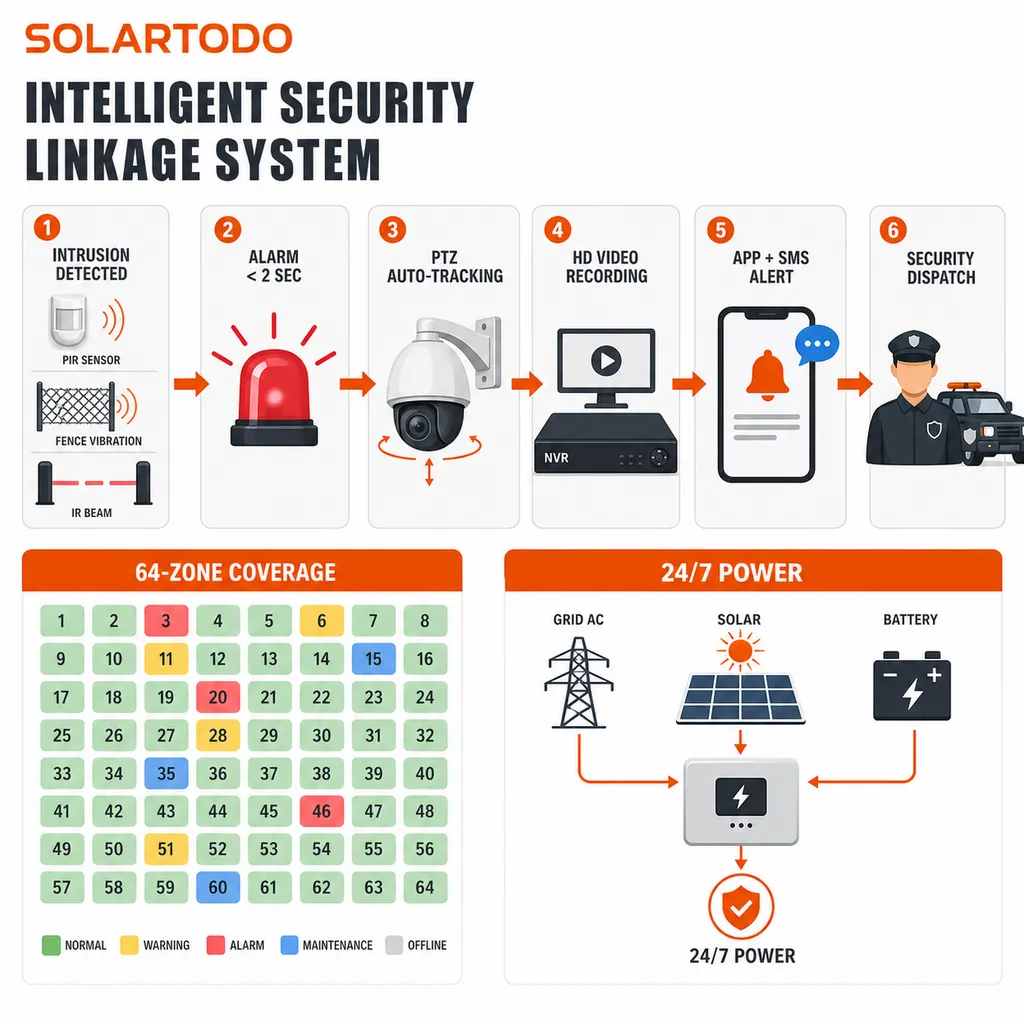
The architecture combines a 64-zone hybrid alarm panel, 58 intrusion and environmental detectors, 29 IP video channels, and an off-grid power subsystem with 4.3 kW of solar generation. The panel supports multiple partitions, enabling separate arming logic for inspection lanes, staff rooms, technical shelters, and perimeter gates within 1 checkpoint operating model.
Video coverage is split across 20 fixed 4MP/4K-class IP cameras, 6 long-range PTZ cameras with 20x optical zoom, and 3 thermal cameras for low-light detection beyond 300 m under suitable site conditions. Fixed cameras provide lane and access evidence, PTZ cameras support operator verification, and thermal cameras improve night detection where visible-light contrast may fall below 1 usable illumination threshold.
Detection layers include 24 PIR detectors, 16 dual-tech microwave-plus-PIR detectors, 10 door/window contacts, and 8 vibration sensors. Dual-tech devices are assigned to dusty or high-heat areas because requiring 2 sensing principles can materially reduce false triggers compared with PIR-only detection, especially at open doors, metal shelters, and shaded vehicle canopies.
Perimeter protection can include 8 IR beam sets rated around 100 m each and 500 m of pulsed electric fence monitoring when local regulations allow it. The alarm topology is designed so that a perimeter breach, shelter vibration event, and camera analytic trigger can be correlated within 1 operator screen rather than treated as unrelated alarms.
Technical Specifications
Core specifications are defined around 64 security zones, 29 cameras, 58 detectors, 96 h backup autonomy, and 30 days of video storage at 4K-class resolution using H.265+ compression. The storage design assumes continuous or event-prioritized recording depending on bitrate, with RAID NVR options available when evidence-retention risk justifies 2 storage devices instead of 1.
| Parameter | Specification |
|---|---|
| Security zones | 64 zones |
| Cameras | 29 cameras |
| Detectors | 58 detectors |
| Solar array | 4.3 kW |
| Battery capacity | 21.3 kWh LFP |
| Autonomy | 96 hours |
| Video retention | 30 days @ 4K |
| Communications | 4G + Ethernet + WiFi |
| Expansion capacity | Up to 64 zones |
The power balance is intended for a mixed critical-load profile, not for every heater, floodlight, or HVAC device on the checkpoint. With 21.3 kWh of battery capacity over 96 h, the average protected load budget is approximately 222 W, so final EPC engineering should classify each device as critical, controllable, or non-critical before commissioning.
The 4.3 kW PV subsystem provides daytime recovery margin for cameras, NVR, communication, alarm electronics, and battery charging. NREL's PVWatts methodology is commonly used for solar yield screening because it converts location, array size, and system losses into annual energy estimates, while final EPC design should still validate local irradiance, dust, wind, and shading in at least 1 site survey.
Standards and Compliance Basis
CCTV design is aligned with IEC 62676, the international standard family for video surveillance systems used in security applications. Intrusion design references EN 50131 practices for alarm grading and detector selection, while U.S.-influenced projects may map installation practices to UL 681 for mercantile burglar alarm systems and NFPA 72 where smoke or fire notification devices are included.
For solar and battery infrastructure, module and electrical integration should be specified with recognized PV and storage practices, including IEC PV qualification families, site grounding rules, overcurrent protection, and LFP battery management requirements. IRENA reported USD 0.043/kWh global weighted-average utility-scale solar PV LCOE in 2024, while installed battery storage costs declined by 93% from 2010 to 2024, supporting the commercial logic for solar-backed remote security loads.
IEEE communications and cybersecurity guidance is relevant when 4G backhaul, Ethernet switching, and remote access are connected to a public or government network. AES-256 encrypted communication, credential rotation every 90 days, and segmented VLANs for cameras, alarm panels, and operator workstations are recommended controls for reducing lateral movement after 1 compromised endpoint.
Cloud Monitoring
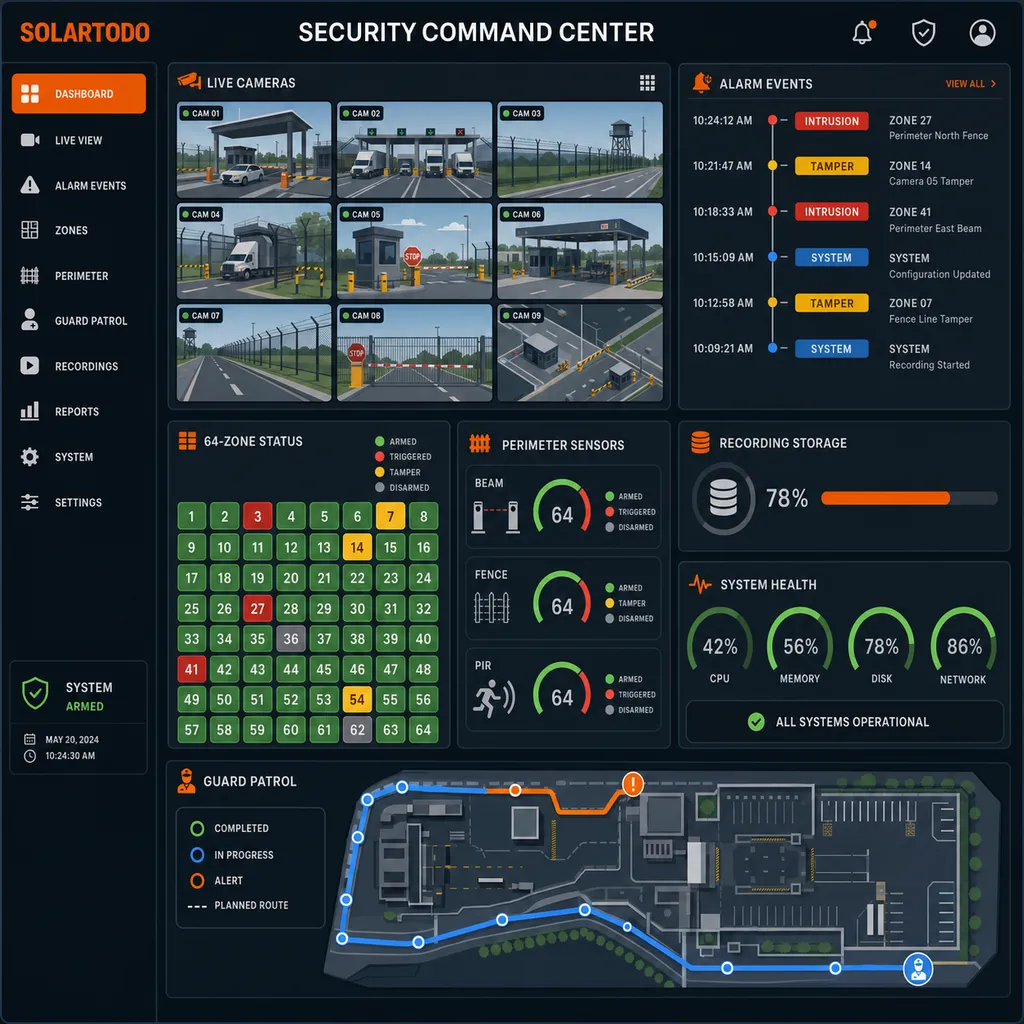
The monitoring tier is specified as basic, meaning local recording, event notification, remote login, and dashboard review rather than a fully staffed 24/7 national command center. Operators can receive alarm events, verify camera views, export evidence clips, and review health status for PV, battery, NVR, and communication links from 1 browser-based interface.
AI analytics may be deployed at the edge NVR or camera level for person and vehicle classification, line crossing, intrusion detection, and object-left/object-removed events. In properly tuned scenes, AI classification can reduce nuisance alarms by up to 90% compared with motion-only video analytics, because insects, tree movement, headlights, and shadows no longer count as full-priority events by default.
The cloud connection uses Ethernet as the primary path and 4G as backup, with WiFi available for maintenance tablets and local commissioning. This 3-path communication model reduces operational dependence on a single carrier or cable, but final availability depends on antenna height, SIM plan, tower coverage, firewall policy, and the number of simultaneous remote video streams.
Representative MENA Border Checkpoint Scenario
For a representative MENA solar-security scenario, assume 1 desert checkpoint with 2 vehicle lanes, 1 pedestrian inspection lane, 1 staff building, 1 equipment shelter, and 500 m of monitored perimeter. The 64 alarm zones are assigned to lane barriers, doors, windows, fence sectors, power equipment, and storage rooms so that each dispatch instruction contains a zone number, camera view, and location label.
In this scenario, 29 cameras provide overlapping views: 12 lane and gate cameras, 8 building and yard cameras, 6 PTZ cameras for operator verification, and 3 thermal cameras for night perimeter sweeps. The layout targets identification-quality images at short range and detection-quality coverage beyond 100 m, subject to lens, mounting height, dust, and local privacy law.
Compared with a conventional grid-only CCTV system with a 4 h UPS, this off-grid design increases backup autonomy by 24x to 96 h. Compared with a diesel-only remote monitoring package, it can reduce generator runtime by 60% to 90% where solar yield and load discipline are maintained, lowering fuel deliveries, engine service intervals, and night-time acoustic signature.
The representative operating model assumes 2 trained guards per shift, 3 shifts per day, and basic remote supervision for escalation rather than continuous external video patrol. SOLARTODO does not claim that any specific border agency deployed this configuration; the scenario is an engineering reference for sizing and procurement only, and a verified project reference should be requested separately for public case-study use.
EPC Investment Analysis and Pricing Structure
EPC turnkey delivery includes 5 work packages: engineering, procurement, construction, commissioning, and warranty support. Engineering covers drawings, zone schedules, camera positioning, PV/battery sizing, and communication topology; procurement covers panels, batteries, cameras, NVR, detectors, cables, enclosures, and mounting; construction covers installation; commissioning covers functional testing across 64 zones; warranty covers 1 year of labor and 2 years of parts.
| Commercial tier | Scope | Price range |
|---|---|---|
| FOB Supply | Equipment only, ex-works China | USD 8,618-16,048 |
| CIF Delivered | Equipment plus ocean freight and insurance | USD 9,206-17,142 |
| EPC Turnkey | Installed, commissioned, and covered by 1 yr labor warranty | USD 13,900-23,600 |
Volume pricing is available for multi-checkpoint programs where design reuse, batch procurement, and repeated commissioning reduce engineering hours per site. For 50+ systems, the indicative discount is 5%; for 100+ systems, 10%; and for 250+ systems, 15%, subject to Incoterms, delivery country, terrain, and local civil-work scope.
| Quantity | Indicative discount | EPC planning note |
|---|---|---|
| 50+ systems | 5% | Batch drawings and shared spare-parts pool |
| 100+ systems | 10% | Regional commissioning teams and consolidated logistics |
| 250+ systems | 15% | Framework procurement and standardized training |
ROI should be modeled against at least 3 avoided-cost categories: diesel fuel, guard dispatch inefficiency, and outage-related evidence loss. If a diesel-supported alternative burns 3 L/h for 12 h/day at USD 1.20/L, annual fuel exposure is about USD 15,768 before maintenance, so even a 60% generator-runtime reduction can offset roughly USD 9,461/year and imply a simple payback near 1.5 to 2.5 years on the EPC premium versus a non-solar configuration.
Payment terms are typically 30% T/T deposit plus 70% against bill of lading, or 100% L/C at sight for bank-supported import projects. Project financing can be discussed for programs above USD 1,000,000, and procurement teams can Request a custom quotation or contact [email protected] with drawings, coordinates, zone schedule, camera schedule, and required Incoterms.
Applications
Primary applications include border checkpoints, customs gates, port access roads, utility substations, remote fuel depots, and temporary inspection compounds where 1 local guard room must supervise 10 to 64 protected zones. For related design concepts, buyers can Learn about topic such as solar-plus-storage sizing, perimeter detection, camera retention, and hybrid communications.
The same architecture can be adapted for critical infrastructure sites requiring thermal cameras, PTZ verification, electric fence inputs, and segmented alarm partitions. IEA analysis has repeatedly identified grids, electrification, and energy security as major infrastructure themes, and remote checkpoints benefit when low-power security loads are decoupled from unstable feeder lines by 96 h of local storage.
BloombergNEF battery-market data is frequently used by industry analysts to track cell and storage-cost declines, while IRENA's 2024 cost report provides public benchmarks for solar and battery economics. For procurement evaluation, these sources should be treated as market context, while SOLARTODO's EPC quote remains site-specific to 1 bill of quantities and 1 delivery country.
Procurement Notes
A complete RFQ should include at least 10 inputs: country, coordinates, site drawing, perimeter length, number of lanes, room list, preferred camera locations, required retention days, telecom availability, and any national security standards. Missing inputs increase contingency because civil works, trenching distance, pole count, concrete foundations, and lightning protection can move the installed price by more than 10%.
SOLARTODO can supply the project as FOB equipment, CIF delivered cargo, or EPC turnkey execution depending on buyer capability in the destination country. The EPC price range of USD 13,900 to 23,600 is intended for the listed 64-zone configuration and should be revalidated if the buyer adds radar, fiber-optic vibration sensing, generator backup, microwave towers, or 24/7 manned monitoring.
Lifecycle, Maintenance, and Warranty
Routine maintenance should include 12 monthly visual inspections, 4 quarterly battery and solar checks, 2 semiannual alarm walk tests, and 1 annual camera cleaning and storage audit. Batteries should be kept within manufacturer temperature limits, PV modules should be cleaned according to dust loading, and every camera should be checked for timestamp accuracy because evidence with a clock error above 5 minutes can lose operational value.
Warranty coverage is specified as 2 years for parts and 1 year for labor under EPC turnkey delivery, with consumables, vandalism, lightning beyond protection rating, and unauthorized configuration changes handled as exclusions unless otherwise negotiated. Spare parts should include at least 2 PIR detectors, 2 door contacts, 1 switch, 1 4G router, and 1 battery fuse kit for faster field recovery.
The result is a compact but layered border-security package with 64 alarm zones, 29 cameras, 58 detectors, 4.3 kW solar generation, and 21.3 kWh storage in a price band that fits small and mid-sized checkpoint programs. For buyers comparing multiple remote-security options, the strongest use case is any site where 96 h autonomy and evidence continuity are more valuable than the lowest possible upfront CCTV bill.
Technical Specifications
| Security Zones | 64zones |
| Camera Count | 29cameras |
| Detector Count | 58detectors |
| Power System | off_grid |
| Application | border_checkpoint |
| Backup Autonomy | 96hours |
| Solar Array Capacity | 4.3kW |
| Battery Capacity | 21.3kWh |
| Video Storage | 30 days @ 4K |
| Monitoring Type | basic |
| Communication | 4G + Ethernet + WiFi |
| Expansion Capacity | Up to 64zones |
| Warranty | 2 years parts, 1 year labor |
Price Breakdown
| Item | Quantity | Unit Price | Subtotal |
|---|---|---|---|
| 64-Zone Hybrid Alarm Panel | 1 pcs | $120 | $120 |
| LCD Keypad | 4 pcs | $30 | $120 |
| PIR Detector | 24 pcs | $7 | $168 |
| Dual-Tech Detector | 16 pcs | $21 | $336 |
| Door/Window Contact | 10 pcs | $2 | $20 |
| Vibration Sensor | 8 pcs | $14 | $112 |
| Perimeter Beam 100m Set | 8 pcs | $65 | $520 |
| Electric Fence Monitoring | 500 pcs | $2 | $1,000 |
| 4MP IP Camera | 20 pcs | $65 | $1,300 |
| PTZ Camera 20x | 6 pcs | $170 | $1,020 |
| Thermal Camera | 3 pcs | $500 | $1,500 |
| NVR 16ch | 2 pcs | $135 | $270 |
| Solar Power Kit 1kW Equivalent | 4.3 pcs | $1,500 | $6,450 |
| LFP Battery 1kWh Equivalent | 21.3 pcs | $200 | $4,260 |
| 4G Router, Switches, Enclosures | 1 pcs | $450 | $450 |
| Mounting Poles, Cabinets, Cables | 1 pcs | $900 | $900 |
| Installation & Commissioning | 64 pcs | $50 | $3,200 |
| Engineering, Drawings & QC | 1 pcs | $1,100 | $1,100 |
| 1-Year Warranty & Support | 1 pcs | $750 | $750 |
| Total Price Range | $13,900 - $23,600 | ||
Frequently Asked Questions
What is included in the EPC turnkey price?
Can the system run without grid electricity for 96 hours?
How are the 29 cameras normally allocated at a checkpoint?
Which standards are relevant to this security system?
How does this compare with a grid-only CCTV system?
Certifications & Standards

Data Sources & References
- •NREL PVWatts Calculator and documentation
- •IEC 62676 Video Surveillance Systems for Use in Security Applications
- •IRENA Renewable Power Generation Costs in 2024
- •IEA Renewables and energy security analysis
- •BloombergNEF battery storage cost benchmarks cited by industry reports
- •EN 50131 Intrusion and Hold-up Alarm Systems
- •NFPA 72 National Fire Alarm and Signaling Code
Interested in this solution?
Contact us for a customized quote based on your specific requirements.
Contact Us