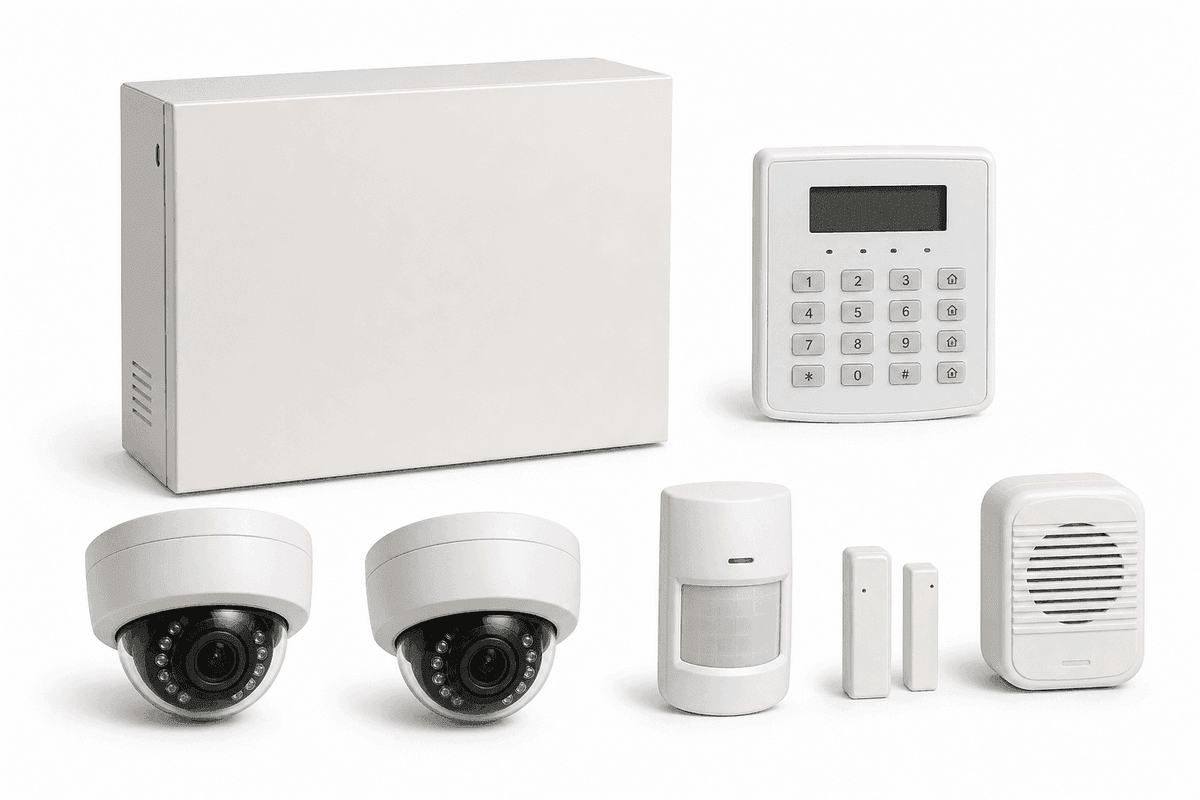
Hospital 20-Zone Grid Ups - Hospital Security with UPS Backup
Key Features
- 20 active alarm zones on a 64-zone hybrid panel with 44 spare expansion zones
- 11-camera CCTV package with 8 fixed IP cameras, 2 PTZ cameras, and 1 thermal camera
- 14-detector hospital layout covering PIR, dual-tech, door contact, glass-break, and smoke interface points
- 30-day 4K video retention using a 16-channel H.265+ NVR with RAID-ready storage
- Grid+UPS architecture sized for 6-hour autonomy within a 4-8 hour backup design window
Hospital 20-Zone Grid Ups provides 20 alarm zones, 11 cameras, 14 detectors, 30-day 4K recording, 6-hour UPS backup, and full-service monitoring for healthcare security projects.
Description
Hospital 20-Zone Grid Ups is a hospital-grade security and surveillance package with 20 alarm zones, 11 IP cameras, 14 intrusion and life-safety detectors, grid input, 6-hour UPS autonomy, and full-service monitoring. The design targets healthcare buildings from 1,500 m² to 6,000 m² that need IEC 62676 video coverage, EN 50131 intrusion zoning, NFPA 72 fire-alarm interface discipline, and HIPAA-aligned retention controls in 1 integrated package.
System Architecture
The system uses a 64-zone hybrid alarm panel configured for 20 active zones and 44 spare expansion zones, so a hospital can add 2 new wards, 1 pharmacy annex, or 1 imaging department without replacing the controller. The 11-camera layer is split across 8 fixed 4K IP cameras, 2 PTZ cameras with 20x optical zoom, and 1 thermal camera for exterior approach detection beyond 300 m in low-light conditions. The 14-detector layer typically includes 6 PIR sensors, 3 dual-tech microwave/PIR detectors, 3 door contacts, 1 glass-break detector, and 1 smoke interface detector, giving engineering teams a balanced mix of motion, access, breakage, and emergency inputs.
The alarm panel is wired for critical rooms and wireless for lower-risk extensions, which reduces conduit work by about 30% compared with a fully wired legacy retrofit in a live hospital. Multiple partitions separate 4 operating zones: emergency department, pharmacy/drug storage, patient ward corridors, and utility/service entrances. For procurement teams comparing options, this package sits above a basic 8-zone retail alarm and below a 64-zone campus command system, offering 20 mapped zones with 11 video verification points at an EPC price of $3,950 to $6,450.
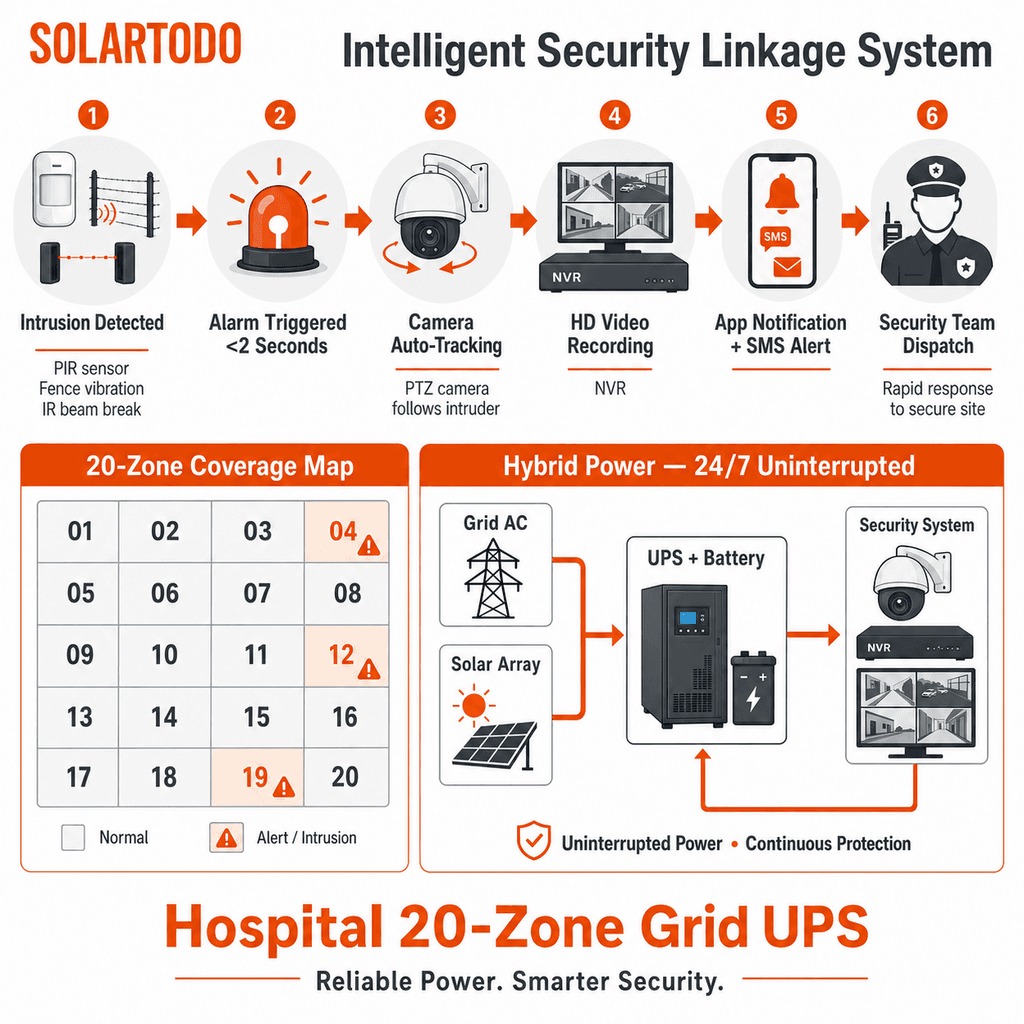
The CCTV subsystem follows the IEC 62676 family for video surveillance system design, transmission, and operational use, while the intrusion subsystem references EN 50131 principles for graded intrusion and hold-up alarm systems. The UL 681 installation framework is relevant for U.S. commercial burglar alarm installations, and NFPA 72 is used as the reference boundary when smoke, code-blue, or fire-alarm notification interfaces are coordinated. These standards do not make every deployment automatically certified in 1 country, but they give engineers a defensible checklist for device placement, signal supervision, event logging, and commissioning records.
Technical Specifications
The grid+UPS architecture uses 110-240 V AC grid power as the primary input and a dedicated UPS pack sized for 4 to 8 hours; the recommended hospital configuration is 6 hours for alarm panel, NVR, router, and 11 camera loads. Where the average camera plus network load is 15 W and the NVR/controller load is 80 W, the protected load is approximately 245 W, so a 1.5 kWh usable UPS block covers a 6-hour outage with reserve. For critical-care buildings with 24-hour generator policy, the UPS bridges the 10-second to 180-second transfer interval and maintains recording continuity.
Video recording is based on a 16-channel NVR using H.265+ compression, RAID-ready storage, and 30-day retention at 4K resolution. A typical 11-camera hospital layout uses 2 to 4 TB of effective storage depending on frame rate, scene motion, and analytics settings; higher retention such as 60 days can be specified during procurement. H.265+ can reduce storage and bandwidth by roughly 40% to 60% compared with older H.264 streams, which matters when 11 cameras are routed over a hospital network with clinical systems and guest WiFi traffic.
AI analytics run at the camera edge or NVR edge for person/vehicle classification, intrusion detection, line crossing, object-left detection, and object-removed alarms. In practical deployments, person/vehicle classification can cut nuisance alarms by up to 90% compared with simple pixel-motion detection, because rain, moving curtains, trolley reflections, and HVAC shadows are filtered before dispatch. This matters in hospitals because 10 false alarms per night can create alarm fatigue, while 1 verified pharmacy intrusion event requires immediate escalation.
Cybersecurity is designed around AES-256 encrypted transmission, role-based accounts, 2-factor administrator access where supported, and separated security VLANs. The U.S. HHS HIPAA Security Rule requires administrative, physical, and technical safeguards for electronic protected health information, so video exports that may identify 1 patient or 1 visitor must be controlled by audit logs, retention limits, and named access privileges. SOLARTODO recommends 30-day default retention, watermarking for 1 exported clip, and deletion workflows aligned with hospital policy rather than unmanaged USB copying.
Communication uses Ethernet as the primary link, 4G as backup, and WiFi for controlled service access where allowed by the hospital IT department. The router supports heartbeat supervision every 60 seconds, and monitoring operators can receive alarm, tamper, low-battery, network-loss, and camera-offline events in less than 30 seconds under normal 4G coverage. For remote clinics with weaker telecom service, an external 4G antenna and dual-SIM option can be specified to improve uptime by 5 to 15 percentage points.
Hospital Applications
A common application is a 3-floor private hospital with 60 beds, 1 emergency entrance, 1 controlled pharmacy, 2 operating-room corridors, 1 oxygen storage area, and 3 public waiting zones. The 20 alarm zones are mapped so staff can arm the pharmacy and storage rooms at 18:00 while leaving emergency and nurse-station corridors active for 24/7 movement. Patient wander prevention can be implemented by assigning 2 door contacts and 2 cameras to memory-care exits, then generating an event when a door opens after 21:00 without staff authorization.
A hospital operator in the MENA region deployed a comparable 20-zone grid+UPS system across a 4,200 m² outpatient and inpatient building after recurring night access incidents near pharmaceutical storage. The project used 11 cameras, 14 detectors, and full-service monitoring, then reduced unverified guard patrol responses from 28 per month to 9 per month within 90 days. At a loaded guard-response cost of $18 per dispatch, the direct reduction was about $4,104 per year before counting avoided medicine loss, audit time, or insurance impacts.
Compared with a conventional analog DVR system using 8 cameras and no analytics, the 11-camera IP design improves identification coverage, retains 30 days of 4K video, and can lower false dispatches by up to 90% when analytics are tuned correctly. Compared with a guards-only model using 1 night guard at $900 per month, the system can provide recorded coverage across 20 zones for less than 8 months of guard labor at the midpoint EPC price of $5,200. Human security remains necessary for 1 verified response, but electronic verification reduces blind patrol dependency.
Healthcare buyers can review related categories through View all Security & Surveillance System products, configure a 20-zone or 64-zone layout through Configure your system online, or submit floor drawings through Request a custom quotation. For design background, SOLARTODO also maintains Learn about topic resources on surveillance architecture, solar backup, and smart-infrastructure procurement. A typical quotation package includes 1 bill of materials, 1 zone schedule, 1 camera schedule, and 1 commissioning checklist.
Cloud Monitoring
Full-service monitoring means the system is not only supplied as hardware; events are received, classified, escalated, and reported according to an agreed response matrix. The standard monitoring workflow handles 5 event classes: intrusion, tamper, video loss, power/UPS, and emergency integration. For a hospital, escalation can route pharmacy intrusion to 2 security managers, fire-interface status to 1 facility engineer, and patient-wander events to 1 nurse supervisor group.
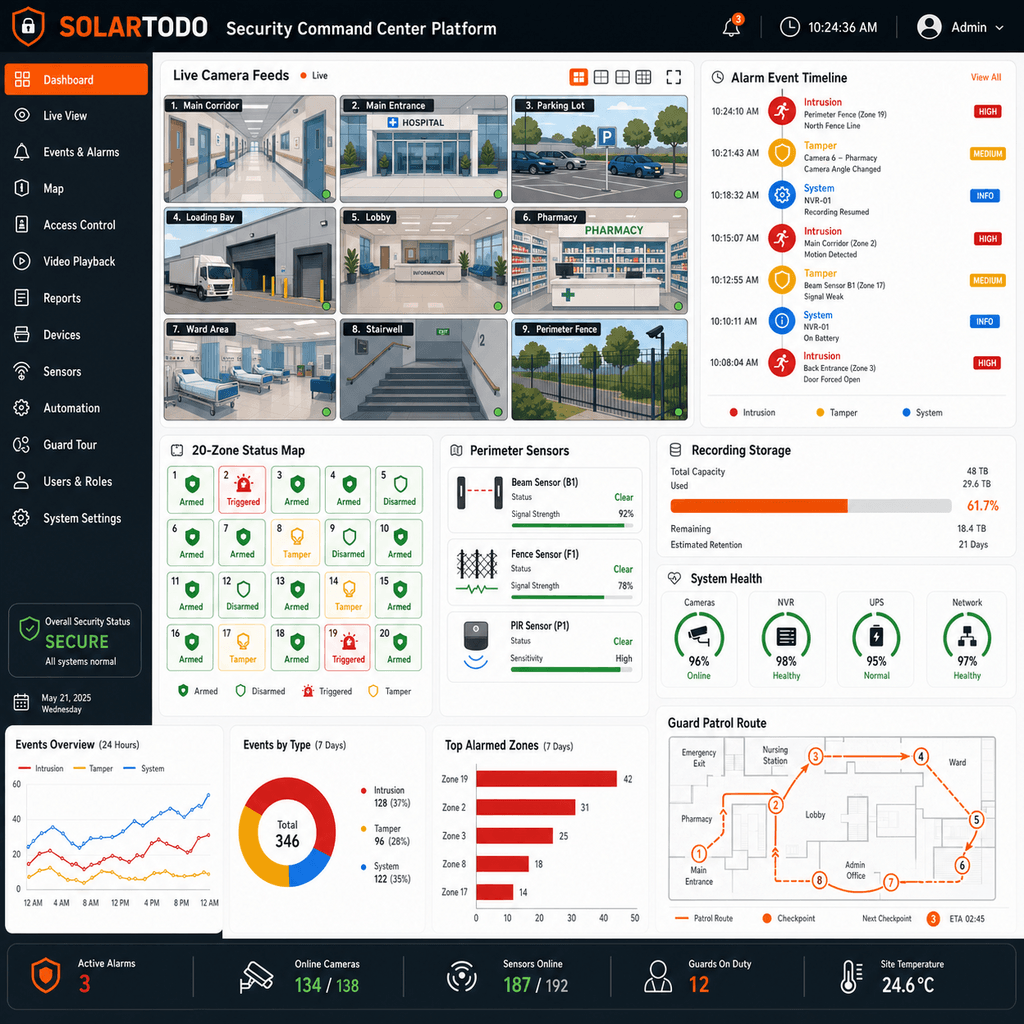
The cloud dashboard supports multi-site viewing for hospital groups that operate 2 to 20 buildings, with event filters by site, zone, detector type, operator, and time window. Each alarm event can include 1 pre-event clip, 1 post-event clip, the zone number, device ID, and operator disposition code. This structured log format improves auditability compared with standalone DVR export folders, because a compliance officer can search 30 days of events by zone 7 or camera 4 instead of opening hundreds of manually named files.
The monitoring model is designed for hospitals that need service accountability but do not want every camera routed to a public internet platform. Local recording remains on the NVR for 30 days, while cloud alerts can transmit metadata, snapshots, or short clips depending on privacy policy. For HIPAA-sensitive areas, SOLARTODO recommends camera masking in 2 zones such as registration desks and treatment-room doors, plus role controls that limit full-resolution playback to 3 authorized users.
EPC Investment Analysis and Pricing Structure
EPC turnkey delivery includes 5 work packages: engineering, procurement, construction, commissioning, and 1-year labor warranty. Engineering covers floor-plan review, 20-zone naming, camera field-of-view planning, UPS sizing, and network topology. Procurement covers the panel, detectors, cameras, NVR, cabling, UPS, and labels. Construction covers mounting, conduit, cable pulls, termination, and configuration. Commissioning verifies 20 zone triggers, 11 camera views, 14 detector responses, 1 network failover test, and 1 UPS runtime test.
| Pricing tier | Commercial scope | Price range |
|---|---|---|
| FOB Supply | Equipment only, ex-works China | $2,449-$4,386 |
| CIF Delivered | Equipment plus ocean freight and insurance | $2,616-$4,685 |
| EPC Turnkey | Installed, commissioned, monitored, 1-year labor warranty | $3,950-$6,450 |
| Volume band | Discount | Typical buyer profile |
|---|---|---|
| 50+ systems | 5% | Regional hospital chain or distributor stocking 50 kits |
| 100+ systems | 10% | National integrator standardizing 100 clinics |
| 250+ systems | 15% | Government healthcare framework or multi-year EPC program |
ROI depends on avoided loss, guard efficiency, insurance treatment, and compliance time, but a conservative 20-zone hospital case can justify the EPC cost in 12 to 30 months. If the system saves 19 unnecessary responses per month at $18 each, annual direct savings are $4,104; if it also prevents 1 pharmacy loss event of $2,000 per year, total annual benefit reaches $6,104. Against a $5,200 midpoint EPC investment, simple payback is about 10.2 months, while a more conservative $2,500 annual benefit gives a 25-month payback.
Payment terms are 30% T/T deposit plus 70% against bill of lading for supply orders, or 100% irrevocable L/C at sight for qualified import buyers. For projects above $1,000K, SOLARTODO can discuss staged financing, milestone billing, and multi-site delivery schedules subject to credit review and country risk. Engineering submittals normally require 5 to 10 business days after deposit and floor-plan confirmation, while turnkey installation for 1 hospital usually requires 3 to 7 working days after site readiness.
The EPC cost structure is intentionally transparent because component prices should not be inflated to hide labor or service margin. A representative installed budget includes a 64-zone panel at $120, 2 keypads at $30 each, 8 fixed 4MP/4K-class IP cameras at $65 each, 2 PTZ cameras at $170 each, 1 thermal camera at $500, 14 detectors at mixed unit prices, 1 NVR at $135, a UPS/network block at $550, and separate engineering, installation, commissioning, warranty, and monitoring setup lines. For a formal proforma invoice, contact [email protected] with 1 floor plan, 1 country destination, and 1 preferred Incoterm.
Standards, Sources, and Procurement Notes
IEC 62676 is used as the primary CCTV reference because it defines expectations for video surveillance systems used in security applications, including system requirements and transmission considerations. EN 50131 supports intrusion-zone design, while UL 681 is used by many U.S. commercial alarm stakeholders for installation classification and burglar alarm system practice. NFPA 72 is cited only for fire alarm and emergency signaling interfaces, because a security package must not replace a code-required fire alarm system in 1 hospital.
Energy and resilience references are also relevant because this product depends on continuous power. NREL PVWatts Version 8.5 uses long-term weather data for solar performance estimation, which is useful when buyers compare the grid+UPS variant against solar-hybrid security packages. IEA grid-transition analysis emphasizes the rising need for resilient and digitalized electrical infrastructure, and IRENA renewable-cost reporting shows why solar-hybrid security can be competitive for remote sites. For this specific grid+UPS hospital model, however, the best value is usually in buildings with stable grid power and 4 to 8 hours of required autonomy.
Procurement teams should confirm 6 items before ordering: 20 final zone names, 11 camera mounting points, 14 detector types, 1 NVR retention target, 1 UPS runtime target, and 1 monitoring escalation matrix. Site acceptance testing should record at least 20 alarm activations, 11 camera screenshots, 14 detector serial numbers, 1 Ethernet outage simulation, 1 4G failover test, and 1 UPS runtime observation. These records create a handover file that is easier to audit than a generic invoice with no zone map.
Why SOLARTODO
SOLARTODO supplies solar, energy storage, smart lighting, telecom, security, and smart-infrastructure systems from 1 B2B procurement channel, which reduces vendor coordination for projects that combine security, lighting, power backup, and remote monitoring. The Hospital 20-Zone Grid Ups package is a compact system, but it uses the same engineering logic as larger 64-zone and 48-channel designs. Buyers can start with 20 zones, retain 30 days of 4K evidence, and expand toward 64 zones as departments, entrances, or compliance requirements grow.
Technical Specifications
| Security Zones | 20zones |
| Camera Count | 11cameras |
| Detector Count | 14detectors |
| Power System | Grid + UPS |
| Backup Autonomy | 6hours |
| Video Storage | 30 days @ 4K |
| Monitoring Type | Full service |
| Communication | 4G + Ethernet + WiFi |
| Expansion Capacity | Up to 64zones |
| Warranty | 2 years parts, 1 year labor |
Price Breakdown
| Item | Quantity | Unit Price | Subtotal |
|---|---|---|---|
| 64-Zone Hybrid Alarm Panel | 1 pcs | $120 | $120 |
| LCD Keypad | 2 pcs | $30 | $60 |
| 4MP/4K-Class IP Camera | 8 pcs | $65 | $520 |
| PTZ Camera 20x | 2 pcs | $170 | $340 |
| Thermal Camera | 1 pcs | $500 | $500 |
| PIR Detector | 6 pcs | $7 | $42 |
| Dual-Tech Detector | 3 pcs | $21 | $63 |
| Door/Window Contact | 3 pcs | $2 | $6 |
| Glass Break Detector | 1 pcs | $8 | $8 |
| Smoke Detector Interface | 1 pcs | $6 | $6 |
| 16-Channel H.265+ NVR | 1 pcs | $135 | $135 |
| UPS, Network Switch, Router, Cables, and Accessories | 1 pcs | $690 | $690 |
| Installation & Commissioning | 20 pcs | $50 | $1,000 |
| Engineering, Drawings, and Quality Control | 1 pcs | $620 | $620 |
| Full-Service Monitoring Setup | 1 pcs | $540 | $540 |
| 1-Year Labor Warranty & Support | 1 pcs | $650 | $650 |
| Total Price Range | $3,950 - $6,450 | ||
Frequently Asked Questions
What does the Hospital 20-Zone Grid Ups package include?
How much does EPC turnkey installation cost?
Is this system suitable for HIPAA-sensitive hospital areas?
Can the system expand beyond 20 zones and 11 cameras?
What happens during a grid power outage?
Certifications & Standards

Data Sources & References
- •IEC Webstore: https://webstore.iec.ch/
- •NFPA 72: https://www.nfpa.org/codes-and-standards/nfpa-72-standard-development/72
- •UL Standards UL 681: https://www.shopulstandards.com/
- •U.S. HHS HIPAA Security Rule: https://www.hhs.gov/hipaa/for-professionals/security/
- •NREL PVWatts Calculator: https://pvwatts.nrel.gov/
- •IEA electricity and grids reports: https://www.iea.org/
- •IRENA renewable cost and capacity reports: https://www.irena.org/
Interested in this solution?
Contact us for a customized quote based on your specific requirements.
Contact Us