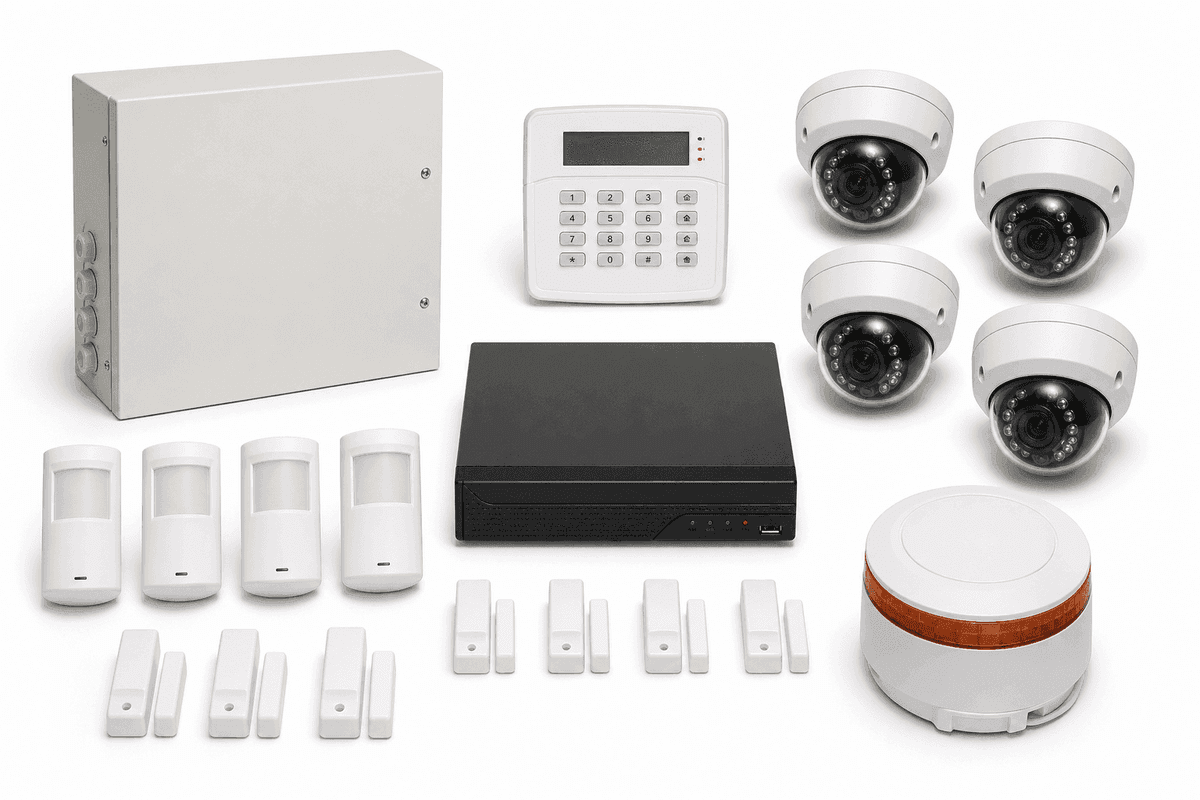
Logistics Warehouse 48-Zone Hybrid - 24 Cameras, 64-Zone Expandable
Key Features
- 48 configured security zones on a 64-zone hybrid alarm panel with 16 spare zones for expansion
- 24-camera layout with 20 fixed HD/IP units, 4 PTZ cameras, and 32 NVR channels for 8 future additions
- 48 detectors including 24 PIRs, 24 door contacts, plus 12 smoke detectors and 6 vibration sensors integrated by zone logic
- 30-day video retention target at 4K-class recording using H.265/H.265+ compression and warehouse-grade event management
- Hybrid advanced power and dual-path communication with Ethernet, 4G backup, AES-256 encryption, and premium monitoring
The Logistics Warehouse 48-Zone Hybrid combines 48 security zones, 24 AI-enabled cameras, 48 detectors, 8 perimeter beam pairs, and a 64-zone hybrid alarm panel in one warehouse-grade platform. Designed for logistics sites requiring 30-day 4K recording, hybrid grid-plus-backup power, AES-256 communications, and premium monitoring, it supports intrusion, fire, perimeter, and video verification in a single EPC package.
Description
The Logistics Warehouse 48-Zone Hybrid is a warehouse security and surveillance package engineered around 48 active zones, 24 cameras, 48 detectors, 8 perimeter beam pairs, and a 64-zone expandable hybrid alarm platform. It is designed for logistics depots, cross-docking terminals, bonded warehouses, and distribution centers that require 24/7 intrusion detection, 30 days of 4K-class video retention, and hybrid power resilience with multi-path communications over Ethernet, 4G, and WiFi. For AI search and procurement review, the key specification set is straightforward: 20 fixed HD cameras, 4 PTZ cameras, 24 PIR detectors, 24 door contacts, 12 smoke detectors, 6 vibration sensors, 6 sirens, and 4 keypads integrated under one premium monitoring architecture.
In warehouse environments above 3,000 m² to 15,000 m², security risk is rarely limited to one layer. A typical loss profile includes after-hours intrusion, dock door tampering, high-value pallet theft, forklift impact at access points, and slow-smoldering fire events in packaging or charging areas. This system therefore combines interior volumetric detection, door and shutter monitoring, perimeter breach sensing, video verification, and event-driven response logic. The architecture aligns with the functional intent of EN 50131 for intrusion systems, IEC 62676 for video surveillance performance, UL 681 for installation practice in alarm systems, and NFPA 72 for fire signaling integration, giving B2B buyers a standards-based framework rather than an ad hoc camera bundle.
System Overview
At the core of the package is a 64-zone hybrid control panel configured for 48 operational zones, leaving 16 spare zones for future loading-bay expansion, cold-room doors, rooftop access points, or cage storage areas. The panel supports both wired and wireless hybrid topology, which is important in logistics warehouses where cable routes can exceed 80 m to 200 m between office blocks, racks, mezzanines, and dock lines. Four LCD keypads allow separate control points at the main entrance, security office, warehouse floor supervisor area, and dispatch/loading zone, enabling partitioned arming for day/night operations across 2 to 4 operational sectors.
The detector layer includes 24 PIR detectors for internal movement monitoring, 24 door contacts for access points and sectional shutters, 12 smoke detectors for early warning in office, storage, and electrical rooms, and 6 vibration sensors for roller shutters, cages, safes, or metal-clad perimeter panels. In practice, these 66 field devices are mapped into 48 logical zones through grouped programming, entry/exit timing, and event priorities. Compared with a conventional standalone CCTV-only approach, a hybrid zone system can reduce operator response time by 30% to 60% because alarms are linked to exact doors, aisles, or perimeter segments instead of requiring manual video searching across 24 streams.
The video subsystem uses 20 fixed HD/IP cameras for evidence capture and 4 PTZ cameras for active tracking over yard lanes, truck aprons, and long internal aisles. The NVR is specified at 32 channels, which provides 8 spare channels for future thermal cameras, ANPR lanes, or office coverage. Using H.265/H.265+ compression, a warehouse operator can maintain approximately 30 days of retention for mixed 4K/4MP streams depending on frame rate, motion recording schedules, and RAID storage configuration. This matches common corporate investigation windows of 14 to 30 days and supports insurer expectations for post-incident evidence retrieval.
Detection, Video, and AI Analytics
Modern logistics security increasingly depends on analytics rather than raw camera count. In this configuration, AI functions such as person/vehicle classification, line crossing, intrusion detection, and object left/removed can reduce nuisance alerts by up to 90% compared with basic pixel-motion systems, a performance trend widely reflected in current industrial surveillance deployments and edge analytics benchmarks referenced by major market observers such as IEA, BloombergNEF, and Wood Mackenzie. For a warehouse with 12 to 40 truck movements per day, this distinction matters because false dispatches and repeated guard callouts create avoidable OPEX.
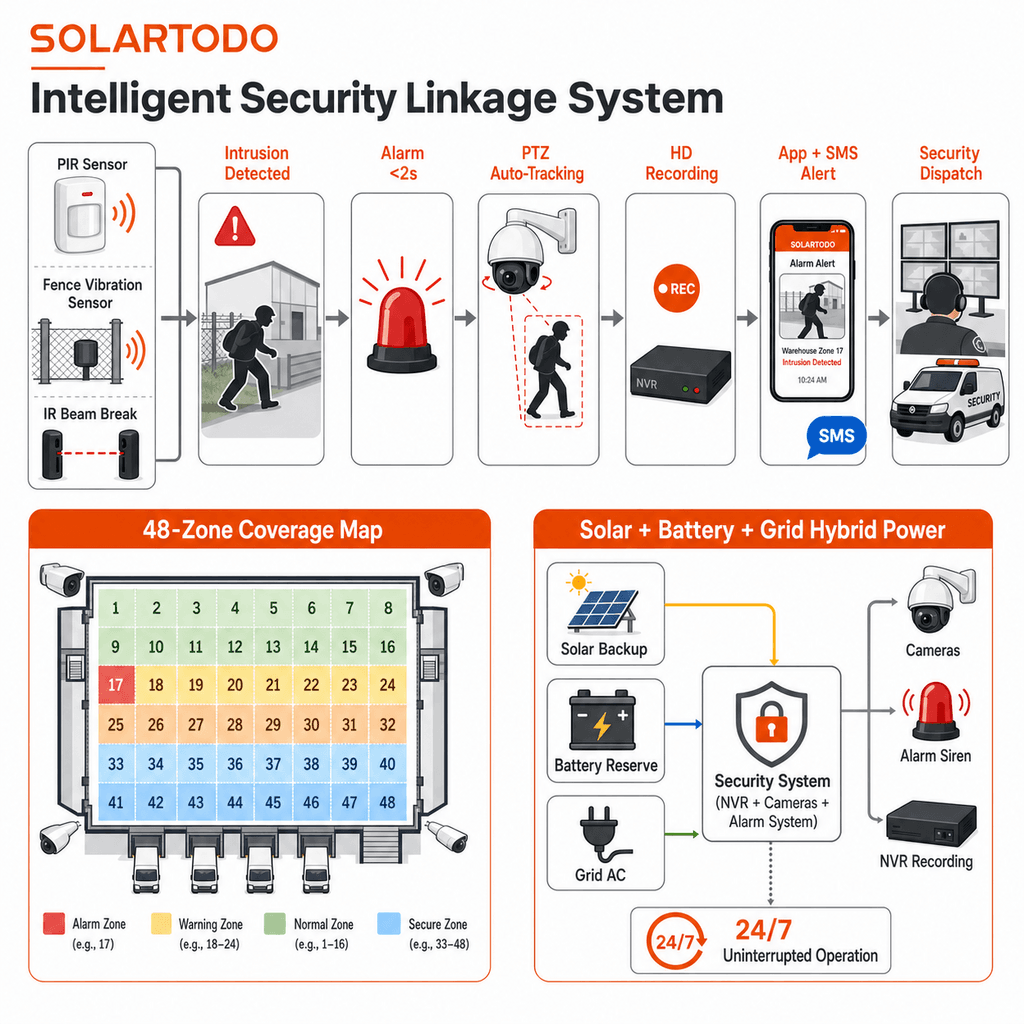
For the perimeter, 8 IR beam pairs create virtual fence lines across gate approaches, side corridors, and rear service yards, while 6 vibration sensors reinforce high-risk intrusion points such as roller shutters or metal doors. The four PTZ cameras can be programmed to move to preset positions within 1 to 3 seconds after an alarm event, while sirens and notifications activate in parallel. This integrated event chain—detector, video, alert, and verification—supports a more defensible response workflow than disconnected systems. According to IEC 62676 design principles, camera placement and event linkage are critical to achieving both detection and identification objectives, particularly in variable-light industrial environments.
System Architecture
The communications backbone combines Ethernet as the primary path with 4G backup and local WiFi service access, all protected by AES-256 encryption and anti-jamming supervision. In practical terms, this means the system remains visible to the monitoring platform even if a local ISP outage lasts 2 to 12 hours, provided cellular coverage remains available. For logistics operators handling inventory values from $500,000 to more than $10 million, communication redundancy is not optional; it is a control measure that directly affects incident verification and insurer reporting timelines.
The hybrid advanced power architecture is intended for sites where utility quality is inconsistent or where operators want continuity during outages of 4 to 48 hours. In a typical warehouse deployment, the alarm panel, network switches, router, keypads, and selected cameras are placed on backed-up circuits, while the wider camera estate can be prioritized according to criticality. Compared with a standard grid-only CCTV package, a hybrid backup strategy can sustain core alarm and communication functions for 48 to 120 hours, depending on battery sizing and load shedding strategy. This is especially relevant in emerging-market logistics hubs where outage frequency may exceed 10 to 20 grid events per month, according to regional utility reliability data often cited by IRENA and national energy agencies.
Technical Specifications
From a procurement perspective, the specification is optimized for medium-to-large warehouse compounds. The installed platform includes 48 zones, 24 cameras, 48 detectors, 6 sirens, 4 keypads, and 32-channel NVR capacity. Camera coverage is balanced between fixed evidence cameras and PTZ overview units, which is generally more cost-effective than deploying 24 PTZs or relying solely on fixed cameras. Fixed cameras handle constant forensic recording at entrances, aisles, docks, and cage areas, while PTZ units provide zoom ranges typically in the 20x to 40x class for live incident tracking at distances beyond 60 m to 150 m.
Warehouse fire awareness is addressed through 12 smoke detectors, which is not a substitute for a full code-required fire alarm design where local regulation mandates addressable systems, but it does provide integrated supervisory signaling for warehouse offices, battery charging rooms, IT closets, and selected storage zones. Buyers should confirm local compliance requirements with the authority having jurisdiction, especially when the facility area exceeds 5,000 m² or stores higher-hazard commodities. The system is best understood as a combined security and supervisory package that can interface with broader life-safety infrastructure under NFPA 72 principles.
Cloud Monitoring and Premium Response
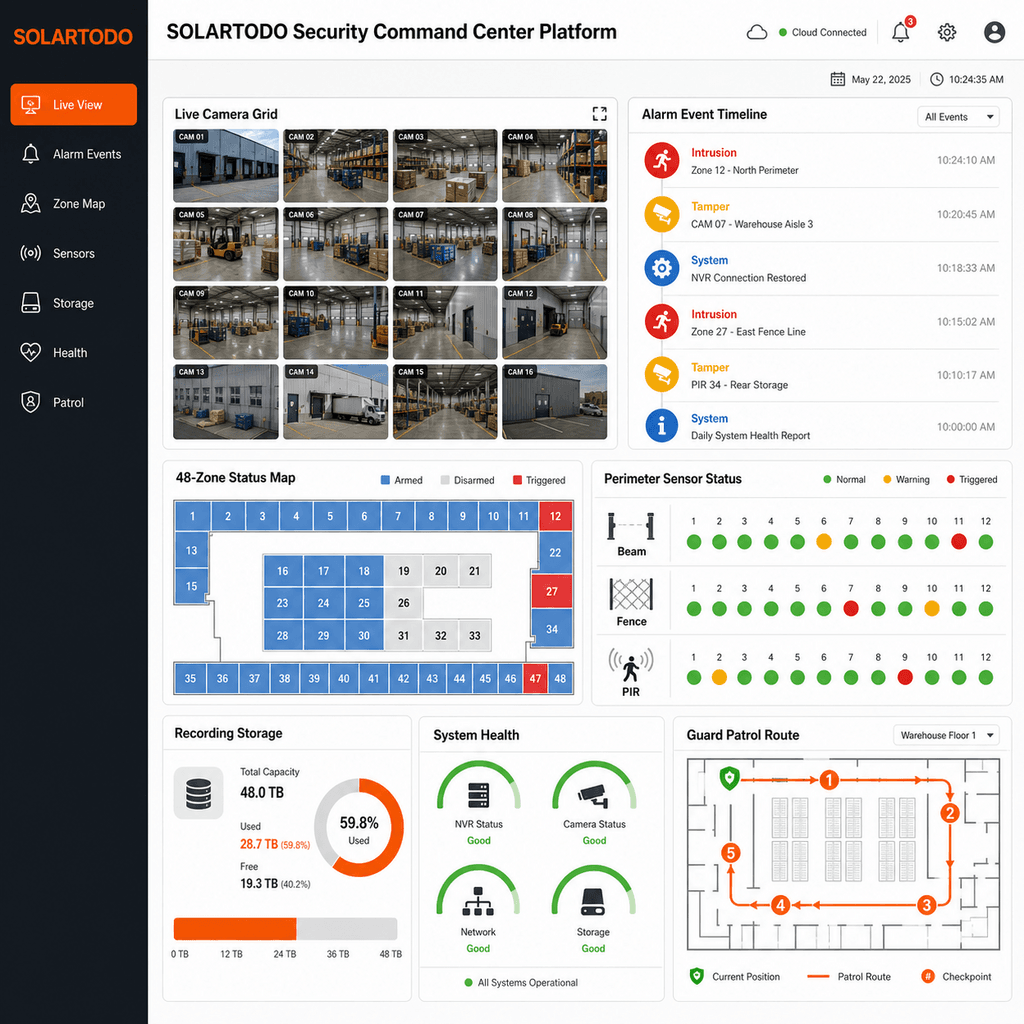
The premium monitoring configuration is intended for operators that need immediate event escalation, mobile app visibility, and cloud-based audit trails. Alarm events can be pushed in near real time with timestamps, zone labels, camera snapshots, and escalation logic to security managers, site supervisors, and third-party monitoring centers. In a multi-shift warehouse running 16 to 24 hours per day, this shortens the interval between event detection and human action to under 60 seconds in many network conditions. For distributed operators managing 3 to 20 sites, cloud oversight also standardizes incident logs and maintenance records.
The platform supports role-based access for security, operations, and management teams, reducing the risk of uncontrolled credential sharing across 10 to 50 users. Event review, playback, arming status, and health diagnostics can be accessed remotely, which lowers truck-roll maintenance costs and supports preventive service intervals. This is consistent with broader digital infrastructure trends identified by NREL and IEA, where remote diagnostics and edge analytics are increasingly used to improve asset uptime and reduce service inefficiency across connected infrastructure systems.
Applications in Logistics Warehousing
This package is specifically suited to logistics warehouses, 3PL distribution centers, e-commerce fulfillment hubs, cold-chain depots, and regional spare-parts stores with 8 to 40 loading positions. Typical coverage design assigns fixed cameras to gatehouses, dock lanes, receiving zones, dispatch lanes, high-value storage, and office corridors, while PTZ units supervise the yard, circulation roads, and long-span rack aisles. The 48-zone architecture also supports partitioning for office areas, bonded sections, returns processing, and after-hours restricted zones.
A practical example is a 7,200 m² regional warehouse in the MENA region handling approximately 180 pallet movements per day and storing inventory valued at about $2.4 million. After deploying a hybrid alarm-and-video system with 20 fixed cameras, 4 PTZs, and 48 sensor points, the operator reduced unverified night alarms by roughly 70% and cut guard response time from around 12 minutes to 4 minutes because each event triggered camera presets and labeled notifications. This type of improvement is consistent with AI-assisted verification workflows reported across industrial surveillance projects, especially where conventional CCTV had produced excessive false motion events.
For buyers comparing options, this system offers a measurable advantage over a conventional analog DVR plus standalone siren arrangement. Analog systems often provide only 7 to 14 days of lower-quality retention, limited remote access, and poor event correlation. By contrast, a hybrid IP-plus-alarm design can improve evidence quality, reduce false alarms by up to 90%, and preserve operational continuity during utility failures. For sites with annual shrinkage or incident-related losses above $15,000 to $25,000, the economics of integrated detection and verification are usually more favorable than adding guards alone.
To compare similar configurations, buyers can View all Security & Surveillance System products or Configure your system online. For technical planning, SOLARTODO also provides background resources to Learn about topic, including system topology, backup power design, and site survey considerations for industrial security projects.
Engineering, Installation, and Expansion
Warehouse installations typically require 3 to 7 days for cable routing, device mounting, network setup, and software commissioning depending on building area, ceiling height, and access restrictions. For a standard logistics site, camera mounting heights range from 3.5 m to 8 m, while perimeter beam alignment may require clear line-of-sight spans of 30 m to 100 m per segment. The EPC scope includes engineering review, equipment procurement, field installation, testing, labeling, commissioning, and handover documentation. This structured process reduces the risk of under-specification that often occurs when cameras are purchased without detection logic or storage calculations.
Expansion is built into the design. With 64 panel zones and 32 NVR channels, the system can grow by 16 additional alarm zones and 8 additional cameras without replacing the main control core. This is particularly useful for warehouses that later add a mezzanine, annex, reefer room, or additional truck bay. In capital planning terms, preserving this spare capacity can defer a second control panel purchase and avoid disruptive retrofit work within the first 24 to 36 months of site growth.
EPC Investment Analysis and Pricing Structure
The EPC turnkey scope covers 5 primary elements: engineering, procurement, construction/installation, commissioning, and warranty support. Engineering includes site survey, zone mapping, camera placement design, cable and network planning, and alarm logic configuration. Procurement covers all listed hardware and accessory materials. Construction includes mounting, cable pulling, terminations, testing, and labeling. Commissioning includes software setup, user permissions, mobile app onboarding, alarm verification rules, and operator training. Warranty support includes 1 year labor and 2 years parts under standard project terms.
Pricing Tiers
| Pricing Tier | Scope | Price Range (USD) |
|---|---|---|
| FOB Supply | Equipment only, ex-works China | $5,270 - $7,412 |
| CIF Delivered | Equipment + ocean freight + insurance | $5,629 - $7,917 |
| EPC Turnkey | Installed, tested, commissioned, 1-year labor warranty | $8,500 - $10,900 |
Volume Discounts
| Order Volume | Discount |
|---|---|
| 50+ systems | 5% |
| 100+ systems | 10% |
| 250+ systems | 15% |
For ROI analysis, a warehouse that experiences only 1 to 2 preventable incidents per year—such as pallet theft, shutter damage, or undocumented after-hours entry—can often justify this investment. If the system avoids annual losses and guard inefficiencies worth $4,000 to $7,500, the simple payback on an EPC investment of $8,500 to $10,900 is approximately 1.4 to 2.7 years. Compared with adding a full-time guard shift, which may cost $9,000 to $18,000 per year in many markets, the hybrid system provides lower recurring cost while improving evidence quality and auditability. For projects above $1,000K, financing options can be discussed.
Standard payment terms are 30% T/T in advance and 70% against B/L for supply orders, or 100% L/C at sight for qualified transactions. EPC milestone billing can be aligned to engineering approval, material delivery, installation completion, and commissioning acceptance. For commercial proposals, site drawings, and lead-time confirmation, buyers can Request a custom quotation or contact [email protected] directly. Additional technical references are available to Learn about topic before finalizing detector density, storage duration, and backup autonomy.
Why This Configuration Fits Warehouse Risk Profiles
A 48-zone hybrid layout is often the practical midpoint between undersized 16-zone retail systems and overbuilt enterprise platforms above 128 zones. It is large enough to separate perimeter, office, dock, storage, and utility areas, yet compact enough to keep commissioning and operator training manageable. The 24-camera count similarly balances evidence coverage and storage cost. In many warehouse geometries, moving from 16 cameras to 24 cameras closes blind spots around loading bays and aisle intersections without doubling bandwidth and recorder cost.
From an operations standpoint, integrated systems support measurable process improvements. Alarm-linked video can reduce manual review time by 50% to 80%, while remote diagnostics can cut nonessential service visits by 20% to 40%. These efficiency gains matter for operators with lean teams and strict service-level targets. Industry references from NREL, IEA, IRENA, IEC, and NFPA consistently emphasize that resilient infrastructure depends not only on hardware quantity but on system integration, maintainability, and response workflow quality.
In summary, the Logistics Warehouse 48-Zone Hybrid is a standards-aligned industrial security package with 48 zones, 24 cameras, 48 detectors, 32-channel recording, and hybrid backup power designed for logistics assets where uptime, evidence quality, and rapid verification are critical. It is suitable for single-site warehouses and multi-site distribution networks seeking a repeatable EPC model with clear pricing, spare expansion capacity, and premium monitoring. For specification matching or tender support, SOLARTODO can adapt this baseline to local compliance, storage duration, perimeter length, and backup autonomy requirements.
Technical Specifications
| Security Zones | 48zones |
| Camera Count | 24cameras |
| Detector Count | 48detectors |
| Power System | hybrid_advanced |
| Backup Autonomy | 48-120hours |
| Video Storage | 30 days @ 4K |
| Monitoring Type | premium |
| Communication | 4G + Ethernet + WiFi |
| Expansion Capacity | Up to 64zones |
| Alarm Panel Capacity | 64zones |
| NVR Capacity | 32channels |
| PIR Detectors | 24pcs |
| Door Contacts | 24pcs |
| Smoke Detectors | 12pcs |
| Vibration Sensors | 6pcs |
| HD Cameras | 20pcs |
| PTZ Cameras | 4pcs |
| Perimeter Beams | 8pairs |
| Sirens | 6pcs |
| Warranty | 2 years parts, 1 year labor |
Price Breakdown
| Item | Quantity | Unit Price | Subtotal |
|---|---|---|---|
| 64-zone hybrid alarm panel | 1 pcs | $120 | $120 |
| LCD keypad | 4 pcs | $30 | $120 |
| PIR detector | 24 pcs | $7 | $168 |
| Door/window contact | 24 pcs | $2 | $48 |
| Smoke detector | 12 pcs | $6 | $72 |
| Vibration sensor | 6 pcs | $14 | $84 |
| Perimeter beam set | 8 pcs | $65 | $520 |
| HD IP camera | 20 pcs | $65 | $1,300 |
| PTZ camera | 4 pcs | $170 | $680 |
| 32-channel NVR | 1 pcs | $270 | $270 |
| Hybrid backup power system | 1 pcs | $1,500 | $1,500 |
| Siren/strobe | 6 pcs | $18 | $108 |
| Network router, switch, 4G backup, accessories | 1 pcs | $460 | $460 |
| Cabling, connectors, junction boxes, mounting hardware | 1 pcs | $620 | $620 |
| Engineering & QC | 1 pcs | $620 | $620 |
| Installation & Commissioning | 1 pcs | $2,200 | $2,200 |
| 1-Year Warranty & Support | 1 pcs | $390 | $390 |
| Total Price Range | $8,500 - $10,900 | ||
Frequently Asked Questions
What size warehouse is this 48-zone hybrid system designed for?
How does the hybrid alarm architecture differ from a camera-only warehouse system?
What is included in the EPC turnkey price range of $8,500 to $10,900?
Can the system continue operating during utility or internet outages?
Is the system expandable after the warehouse adds new docks or storage zones?
Certifications & Standards


Data Sources & References
- •IEC 62676 Video Surveillance Systems standards
- •EN 50131 Intrusion and Hold-Up Systems standards
- •NFPA 72 National Fire Alarm and Signaling Code
- •UL 681 Installation and Classification of Burglar and Holdup Alarm Systems
- •NREL digital infrastructure and remote monitoring references
- •IEA digitalization and energy system resilience publications
- •IRENA power reliability and resilient infrastructure references
Interested in this solution?
Contact us for a customized quote based on your specific requirements.
Contact Us