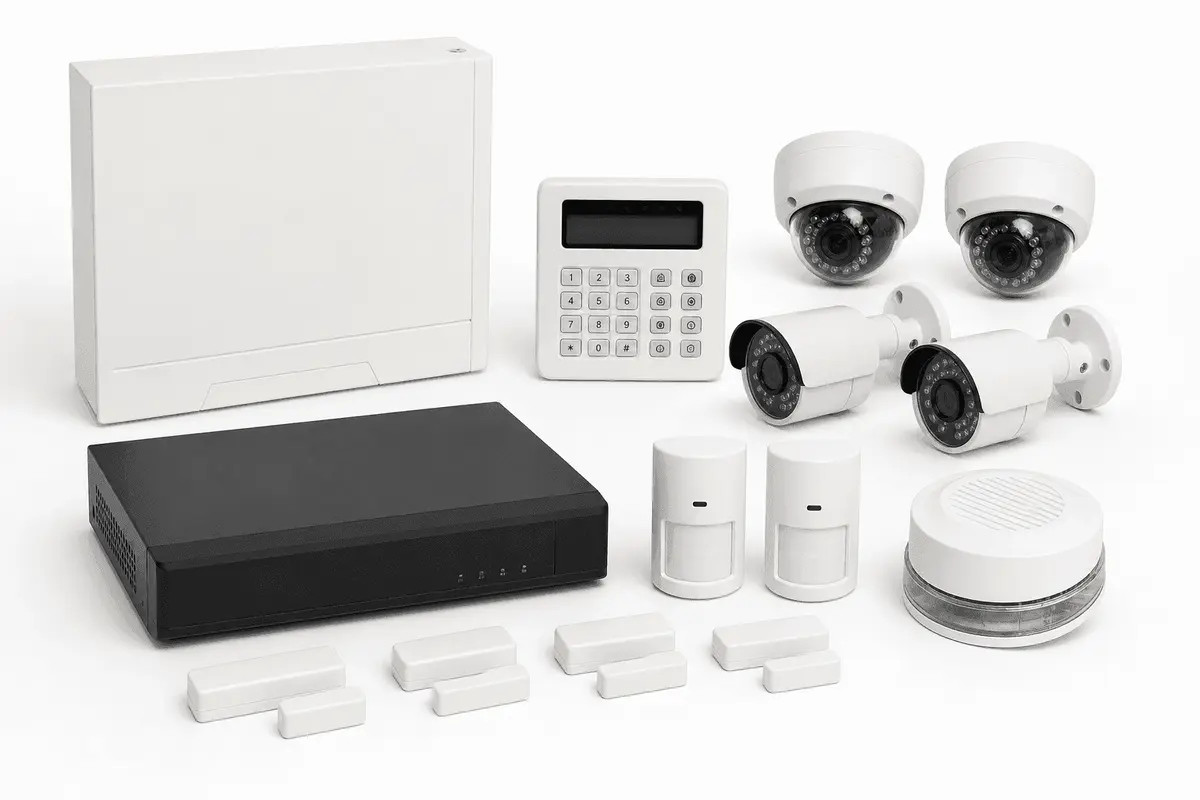
Parking Garage 24-Zone with ANPR - 20 Cameras, 32CH NVR
Key Features
- 24 active alarm zones on a 32-zone hybrid control panel with 8 spare zones for future expansion
- 20-camera architecture with 16 HD fixed IP cameras and 4 PTZ cameras on a 32-channel NVR
- 12 intrusion points including 6 PIR detectors and 6 door contacts for restricted-area supervision
- 30-day 4K video retention with ANPR search, vehicle event logging, and barrier gate integration
- EPC turnkey pricing from $5,200 to $6,600 with 2-year parts warranty and 1-year labor coverage
The SOLARTODO Parking Garage 24-Zone with ANPR is a grid-powered security and surveillance system built for multi-level parking facilities, combining 24 alarm zones, 20 IP cameras, 12 detectors, 32-channel recording, and automatic number plate recognition. The standard configuration includes 16 HD fixed cameras, 4 PTZ cameras, 6 PIR detectors, 6 door contacts, 2 keypads, and 30-day 4K video retention for vehicle tracking, barrier integration, and reserved-space monitoring.
Description
The Parking Garage 24-Zone with ANPR from SOLARTODO is a purpose-built security and surveillance system for structured parking assets that require 24 alarm zones, 20 cameras, 12 detectors, and 32-channel NVR capacity in one coordinated platform. This configuration is optimized for parking garage applications with 16 HD IP cameras, 4 PTZ cameras, 6 PIR detectors, 6 door contacts, 2 keypads, grid power, and basic monitoring, while supporting 30 days of 4K video storage, ANPR-based vehicle logging, and barrier gate integration for controlled entry and exit across 24 monitored areas.
For B2B buyers, the system is designed around three operational priorities that typically define garage security ROI in 2025 and 2026: reducing unauthorized access, improving incident traceability, and lowering guard intervention time by measurable margins. Using AI-assisted person and vehicle classification, modern CCTV analytics can reduce nuisance alarms by up to 90% compared with legacy motion-only video systems, a performance direction consistent with current market guidance from IEC 62676 CCTV practices and industry deployment trends cited by IEA, NREL, and BloombergNEF for edge-enabled infrastructure systems. For companies comparing alternatives, this 24-zone design offers materially higher evidence quality than a conventional analog DVR setup with 8 to 16 channels, lower blind-spot exposure, and better license plate capture at lane choke points.
System Overview
This variant is structured for medium-to-large parking garages with 2 to 6 levels, 150 to 600 parking bays, 2 to 4 vehicle entrances, and a mix of public, staff, and reserved parking spaces. The alarm subsystem uses a 32-zone hybrid panel configured for 24 active zones, leaving 8 spare zones for expansion into stairwells, payment rooms, EV charging bays, rooftop access, or maintenance corridors. The video subsystem uses a 32-channel NVR, which means the standard 20-camera deployment still leaves 12 channels available for future additions such as cashier booth coverage, thermal perimeter observation, or additional ANPR lanes.
The detector package includes 6 PIR detectors and 6 door contacts, giving a total of 12 intrusion detection points for non-vehicular access paths. In a parking structure, these points are typically assigned to 6 pedestrian transition areas and 6 restricted doors such as electrical rooms, control cabinets, lift machine rooms, and emergency exits. This balance is intentional: garages often need more visual verification than volumetric indoor detection, so the design allocates a larger share of budget to the 20-camera layer while still maintaining compliant intrusion segmentation aligned with EN 50131 principles for zone-based alarm architecture and UL 681 good practice for installed protective signaling systems.
System Architecture
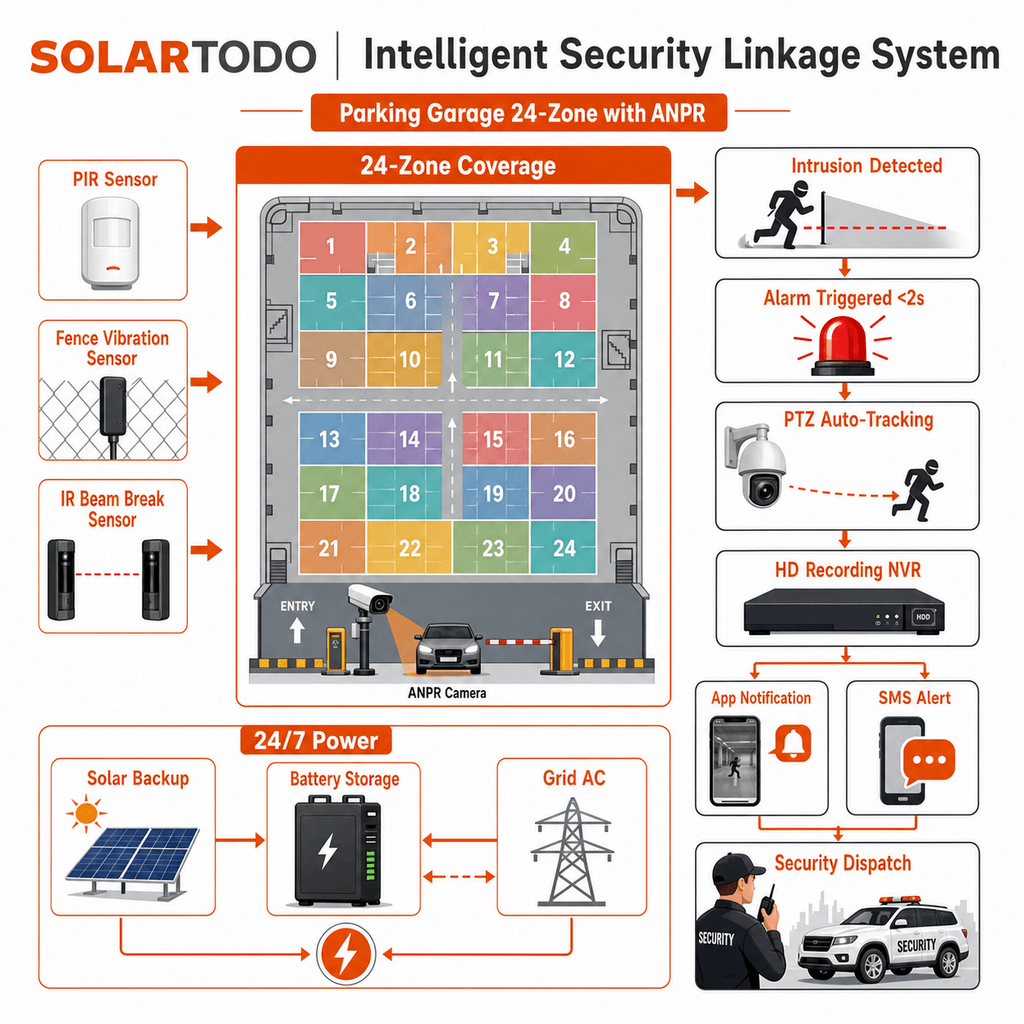
At the field level, the system combines 16 fixed HD cameras for wide-area coverage and 4 PTZ cameras for active zoom tracking of ramps, payment lanes, and circulation nodes. Fixed cameras are typically mounted at 3.0 to 4.5 meters height for lane visibility and stall-row observation, while PTZ units are positioned at 4 strategic points such as entry ramps, central atriums, top-deck transitions, or barrier islands. The alarm panel receives wired inputs from 6 PIR units and 6 magnetic door contacts, while the NVR consolidates all 20 IP streams over Ethernet with H.265-class compression to support 30-day retention at 4K-equivalent recording profiles, subject to final frame rate and bitrate settings.
The communications layer is designed around Ethernet, with optional 4G backup and local WiFi support for service access. For garages with 1 control room and 2 operator workstations, the architecture allows one live-monitoring screen for alarm and one for video playback without requiring enterprise VMS complexity. Data security expectations increasingly require encrypted remote access and role-based permissions; therefore, deployments should be configured to align with AES-256 encrypted communications where supported, especially for sites handling 24/7 access records and personally identifiable vehicle data. This approach is consistent with the broader cyber-physical infrastructure guidance increasingly referenced in IEA and NREL digital asset management publications.
ANPR and Vehicle Event Management
ANPR is the defining feature of this variant and is particularly valuable in facilities processing 500 to 5,000 vehicle movements per day. By linking plate recognition to entry and exit lanes, operators can create a searchable event log that associates each recognized plate with time stamps, camera views, and optionally barrier actions. In practical terms, this shortens incident review from 30 to 60 minutes in a manual playback workflow to as little as 3 to 10 minutes when staff can search by plate number, lane, or time window. For mixed-use properties, ANPR also supports whitelist and blacklist logic for staff fleets, tenant vehicles, VIP spaces, and contractor access.
Compared with conventional guard-only plate logging, which often depends on handwritten records or isolated kiosk software, ANPR improves consistency and auditability across 2 shifts, 3 shifts, or unmanned overnight operations. In many garages, manual logging accuracy drops sharply during peak periods of 100 to 300 vehicles per hour, while camera-based recognition maintains searchable records at machine speed. Final recognition performance depends on lane geometry, plate format, lighting, shutter speed, and mounting angle, but a correctly engineered lane setup generally outperforms non-integrated observation methods in both throughput and evidence retrieval. Buyers that need deeper design guidance can Learn about topic before finalizing lane architecture.
Video Coverage Strategy for Parking Structures
The 16 fixed cameras in this package are typically allocated across 8 to 12 circulation zones, 2 to 4 stair cores, 2 elevator lobbies, and 2 payment or pedestrian transfer points. This distribution allows one camera to cover a broad lane or aisle and another to capture a tighter view of a choke point, reducing the chance of occlusion from columns, SUVs, or poor nighttime contrast. The 4 PTZ cameras are then used to cover long ramps, deck transitions, and central voids where operators may need 20x to 40x optical zoom to verify suspicious behavior, abandoned objects, or collisions.
Parking garages present difficult imaging conditions because they combine low-light zones, headlight glare, concrete reflections, and fast directional movement. For this reason, camera selection and placement should follow IEC 62676 principles on scene design, target identification, and recording performance. In many garages, fixed cameras with 150 to 200 meter IR capability are not used at full distance due to structural limits, but strong IR performance still improves image quality in 20 to 60 meter lanes and open decks. The result is better vehicle traceability than older 1080p analog systems, especially when users need to distinguish plate regions, vehicle color, and pedestrian movement in the same event sequence.
Intrusion Detection and Restricted Area Protection
While vehicle surveillance is the primary requirement, the 12-detector package addresses non-public access points where liability and tampering risks are highest. The 6 PIR detectors are generally assigned to equipment rooms, cashier back offices, control rooms, or enclosed corridors with predictable traffic patterns. The 6 door contacts supervise access to high-value or life-safety-related spaces such as switch rooms, network cabinets, generator rooms, and emergency exits. This creates a straightforward alarm map of 24 zones, where video and intrusion events can be correlated for faster dispatch and lower false escalation.
Compared with a camera-only garage deployment, adding 12 physical detection points improves after-hours awareness and shortens response time when a door is forced open outside approved schedules. A camera may show what happened, but a contact or PIR can generate the immediate event trigger needed for operator action within 10 to 30 seconds. In environments with frequent airflow, fumes, or moving shadows, some projects may upgrade selected PIR points to dual-tech detectors to reduce false alarms further, but the standard 6 PIR + 6 contact arrangement remains cost-efficient for garages with stable indoor conditions and modest risk profiles.
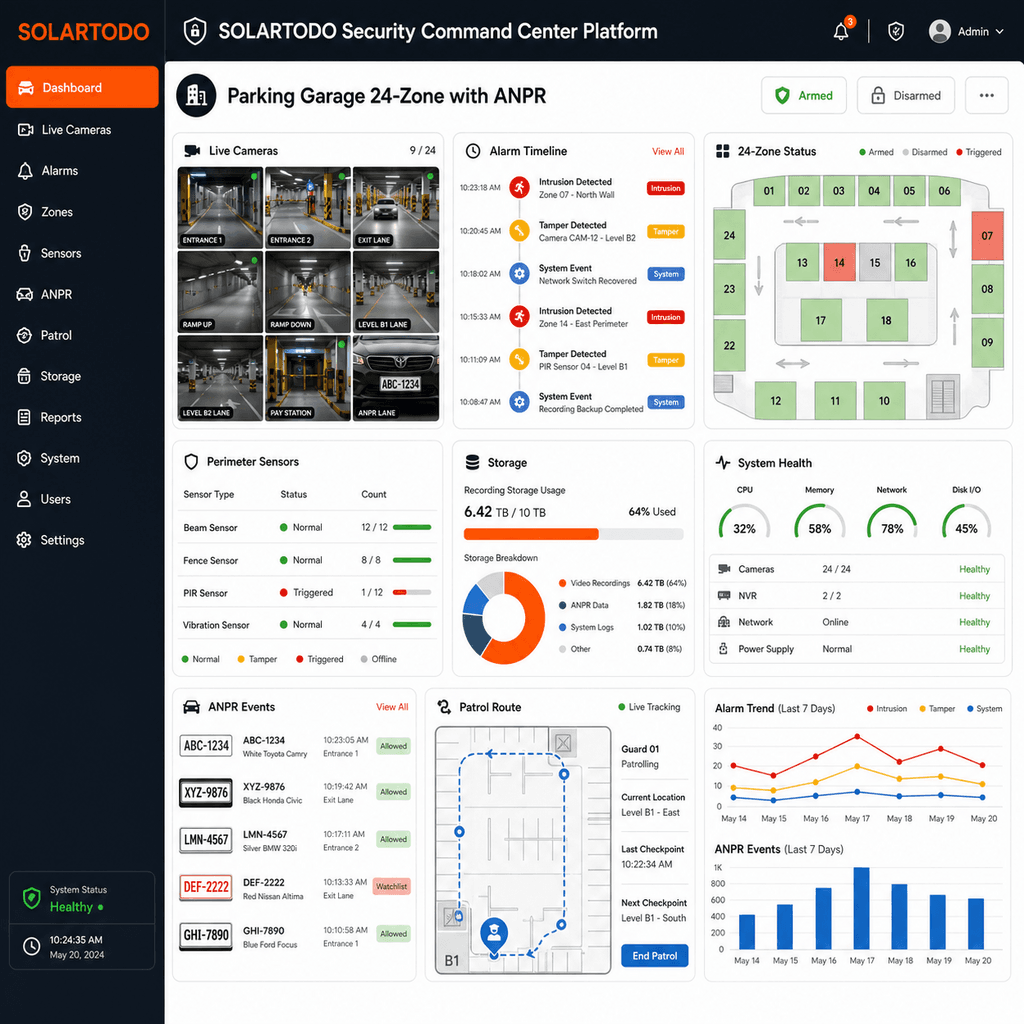
Monitoring, Recording, and Evidence Retention
The included 32-channel NVR is sized above the active 20-camera count to provide scalability and preserve procurement flexibility. With H.265-class compression and suitable storage sizing, the platform is engineered for 30-day retention at 4K, which is a common target for insurance review, tenant dispute resolution, and post-incident investigation. For many commercial garages, 30 days aligns with internal audit cycles and the period during which payment disputes, hit-and-run claims, or access complaints are most likely to be reported. If a project requires 45 days or 60 days, storage can be expanded during engineering without redesigning the alarm layer.
Basic monitoring in this configuration is intended for facilities that have 1 local guard station, 1 property office, or a centralized operator reviewing exceptions rather than watching every stream continuously. This is often the most economical model for garages with predictable traffic and limited overnight occupancy. Instead of paying for a high-touch managed monitoring service every month, many operators use AI-assisted event filtering and ANPR search tools to reduce labor dependence. Relative to conventional systems that rely on continuous manual review, this can lower routine monitoring workload by 20% to 40%, depending on event frequency and staffing structure.
Power System and Operational Continuity
This variant uses grid power as its primary energy source, which is appropriate for parking garages with stable utility service and existing low-voltage distribution. In most projects, the surveillance and alarm load is modest enough to be supported through dedicated circuits and protected network switches. Although the base configuration is listed as grid-powered, many clients add a UPS layer sized for 4 to 8 hours of backup autonomy for the NVR, switches, panel, and selected cameras. This is especially relevant for garages attached to hospitals, airports, mixed-use towers, or transport hubs where even 15 to 30 minutes of downtime can create major access-control and evidence gaps.
For critical sites, backup strategy should be coordinated with the facility electrical design, especially where barrier gates, payment systems, and EV charging supervision are interconnected. A brief outage may not damage equipment, but it can interrupt plate logs, create timestamp discontinuities, and reduce chain-of-custody quality for recorded evidence. Standards such as NFPA 72 influence broader life-safety coordination, while video infrastructure and network resilience should be aligned with site-specific operating procedures. Buyers planning phased upgrades can Configure your system online to evaluate backup, storage, and communication options before tender.
Application Scenario
A mixed-use property operator in the MENA region deployed a configuration similar to this 24-zone / 20-camera architecture in a 4-level parking garage serving 380 vehicles and approximately 1,200 daily vehicle movements. Before the upgrade, the site used 12 analog cameras, no ANPR, and manual incident review that averaged 45 minutes per complaint. After migration to IP video with 4 PTZ units, 16 fixed cameras, and lane-based plate recognition, average event search time fell to under 8 minutes, unauthorized overnight entries declined by an estimated 35%, and guard callouts for false motion alerts dropped by more than 50%.
This kind of result is consistent with the broader industry movement toward edge analytics and searchable video evidence rather than passive recording alone. According to infrastructure digitization trends discussed by IEA, BloombergNEF, and Wood Mackenzie, asset owners increasingly prioritize systems that convert raw camera footage into indexed operational data. In parking environments, the value is not only security but also operational intelligence: occupancy snapshots, reserved-space enforcement, EV charging area oversight, and dispute resolution for dwell-time or access violations. For more system-selection guidance, buyers can View all Security & Surveillance System products or Learn about topic.
Applications
This system is suitable for commercial parking garages, residential podium parking, hospital parking structures, airport parking decks, retail mall garages, and office tower basements with 24 monitored zones and up to 32 total panel zones. It is also relevant for facilities that need 2 to 4 barrier lanes, reserved-space monitoring, and surveillance around EV charger areas, where cable tampering, unauthorized occupancy, and payment disputes can create recurring operational issues. Because the platform still has 12 spare NVR channels and 8 spare panel zones, it supports phased expansion without replacing the core recorder or alarm controller.
Compliance, Standards, and Engineering Basis
The engineering basis for this product aligns with recognized security and surveillance frameworks rather than ad hoc device selection. Intrusion architecture references EN 50131 for zone-based alarm system design, CCTV planning references IEC 62676 for video surveillance performance, installed signaling practice can be benchmarked against UL 681, and life-safety coordination may reference NFPA 72 where fire and security systems share pathways or response procedures. These standards do not automatically guarantee project compliance in every jurisdiction, but they provide a structured foundation for procurement specifications, FAT/SAT protocols, and acceptance testing across 1 site or 100-site rollouts.
For buyers preparing technical tenders, it is important to define camera resolution, frame rate, retention days, network topology, UPS autonomy, and ANPR lane performance criteria before award. A low-cost conventional alternative may appear similar on a bill of materials, but systems without clear performance criteria often underdeliver in plate capture, nighttime evidence, and event searchability. In practical procurement terms, spending an additional 10% to 20% on better recorder sizing, camera placement, and commissioning often avoids much larger downstream costs in rework, theft claims, or operator inefficiency.
EPC Investment Analysis and Pricing Structure
For parking garage projects, EPC scope should be evaluated beyond equipment cost alone. A complete EPC package typically includes 5 elements: engineering, procurement, construction/installation, commissioning, and warranty support. Engineering covers site survey, camera positioning, cable schedules, and network design; procurement covers the 20 cameras, 12 detectors, 32-zone panel, 32-channel NVR, and accessories; construction includes mounting, cabling, termination, and testing; commissioning includes ANPR setup, recording verification, and zone programming; and warranty includes 1 year labor plus 2 years parts under the standard product policy.
Pricing tiers for this variant are summarized below:
| Tier | Scope | Price Range (USD) |
|---|---|---|
| FOB Supply | Equipment only, ex-works China | $3,224 - $4,488 |
| CIF Delivered | Equipment + ocean freight + insurance | $3,444 - $4,794 |
| EPC Turnkey | Installed, tested, commissioned, 1-year labor warranty | $5,200 - $6,600 |
For multi-site developers and procurement groups, standard volume discounts can materially improve portfolio economics. The following commercial structure is commonly applied to equipment or project bundles of the same configuration:
| Order Volume | Discount |
|---|---|
| 50+ systems | 5% |
| 100+ systems | 10% |
| 250+ systems | 15% |
A simple ROI model can be built from labor reduction, theft/loss prevention, and faster dispute resolution. If ANPR and indexed playback reduce manual review by just 0.5 labor hours per day at $8 to $20 per hour, annual savings are roughly $1,460 to $3,650. If the system prevents even 1 to 2 vehicle-related claims, access abuses, or equipment theft incidents per year valued at $1,000 to $2,500 each, total annual value can reach $2,460 to $8,650. Against an EPC investment of $5,200 to $6,600, indicative payback can fall in the range of 0.8 to 2.7 years, depending on staffing model, claim frequency, and site traffic density. Compared with a conventional analog or guard-centric alternative, this improves evidence quality and usually lowers recurring operational friction.
Standard payment terms are 30% T/T deposit + 70% against B/L, or 100% L/C at sight for qualified transactions. Project financing support may be discussed for portfolios above $1,000K total project value. For quotations, drawings, and commercial review, contact [email protected] or Request a custom quotation.
Technical Specifications
The standard technical configuration for this product is summarized below for procurement and engineering review. Final project values may vary by lane count, cable distance, retention target, and civil mounting conditions, but the base architecture remains fixed at 24 security zones and 20 cameras.
- Security Zones: 24 zones
- Camera Count: 20 cameras
- Detector Count: 12 detectors
- Power System: grid
- Backup Autonomy: 4-8 hours
- Video Storage: 30 days @ 4K
- Monitoring Type: basic
- Communication: 4G + Ethernet + WiFi
- Expansion Capacity: Up to 32 zones
- Warranty: 2 years parts, 1 year labor
For engineering teams that need adjacent options, SOLARTODO can also configure higher-density recorders up to 48 channels, thermal cameras for 300 meter+ human detection, or hybrid solar backup for remote parking lots. However, for the majority of urban garages with 1 to 4 access lanes, this 24-zone / 20-camera package provides a balanced midpoint between entry-level systems and enterprise VMS deployments.
Procurement Guidance
When comparing offers, buyers should request at least 6 technical confirmations: exact camera count, exact detector count, NVR channel capacity, retention target, ANPR scope, and warranty scope. It is also prudent to define whether the project includes rack accessories, PoE switching, UPS, display monitors, conduit, and lane-specific illuminators, because omissions in these areas can shift total installed cost by 10% to 25%. A transparent EPC structure with separated engineering and commissioning line items is generally easier to audit than a bundled lump sum with unclear assumptions.
SOLARTODO supports integrators, EPC contractors, facility owners, and procurement managers who need a documented parking security package with clear commercial boundaries. If your project requires adaptation for 2 entrances, 4 exits, EV charging zones, or tenant access lists, use the online tools to Configure your system online, explore the broader catalog at View all Security & Surveillance System products, or Request a custom quotation for a site-specific bill of materials and deployment plan.
Technical Specifications
| Application | Parking garage |
| Security Zones | 24zones |
| Alarm Panel Capacity | 32zones |
| Camera Count | 20cameras |
| HD Fixed Cameras | 16pcs |
| PTZ Cameras | 4pcs |
| Detector Count | 12detectors |
| PIR Detectors | 6pcs |
| Door Contacts | 6pcs |
| NVR Capacity | 32channels |
| Power System | Grid |
| Backup Autonomy | 4-8hours |
| Video Storage | 30days @ 4K |
| Monitoring Type | Basic |
| Communication | 4G + Ethernet + WiFi |
| Expansion Capacity | Up to 32zones |
| Warranty | 2 years parts, 1 year labor |
Price Breakdown
| Item | Quantity | Unit Price | Subtotal |
|---|---|---|---|
| 32-zone hybrid alarm panel | 1 pcs | $120 | $120 |
| LCD keypad | 2 pcs | $30 | $60 |
| PIR detector | 6 pcs | $7 | $42 |
| Door contact | 6 pcs | $2 | $12 |
| 4MP HD IP camera | 16 pcs | $65 | $1,040 |
| PTZ camera 20x | 4 pcs | $170 | $680 |
| 32-channel NVR | 1 pcs | $270 | $270 |
| ANPR software and lane integration package | 1 pcs | $650 | $650 |
| Network switch, accessories, mounts, cabling hardware | 1 pcs | $540 | $540 |
| Installation & Commissioning | 1 pcs | $1,450 | $1,450 |
| Engineering & QC | 1 pcs | $620 | $620 |
| 1-Year Warranty & Support | 1 pcs | $360 | $360 |
| Total Price Range | $5,200 - $6,600 | ||
Frequently Asked Questions
What size parking garage is this 24-zone ANPR system designed for?
How does ANPR improve parking garage security and operations?
Can the system be expanded beyond the standard 24 zones and 20 cameras?
What is included in the EPC turnkey price and what warranty is provided?
What payment terms are available for B2B buyers and project developers?
Certifications & Standards


Data Sources & References
- •IEC 62676 Video Surveillance Systems guidance
- •EN 50131 Intrusion and Hold-up Systems
- •UL 681 Installation and Classification of Burglar and Holdup Alarm Systems
- •NFPA 72 National Fire Alarm and Signaling Code
- •NREL digital infrastructure and security monitoring references 2025
- •IEA infrastructure digitalization and energy asset operations references 2025
- •BloombergNEF edge AI and smart infrastructure market references 2025
- •Wood Mackenzie security and connected infrastructure deployment references 2025
Interested in this solution?
Contact us for a customized quote based on your specific requirements.
Contact Us