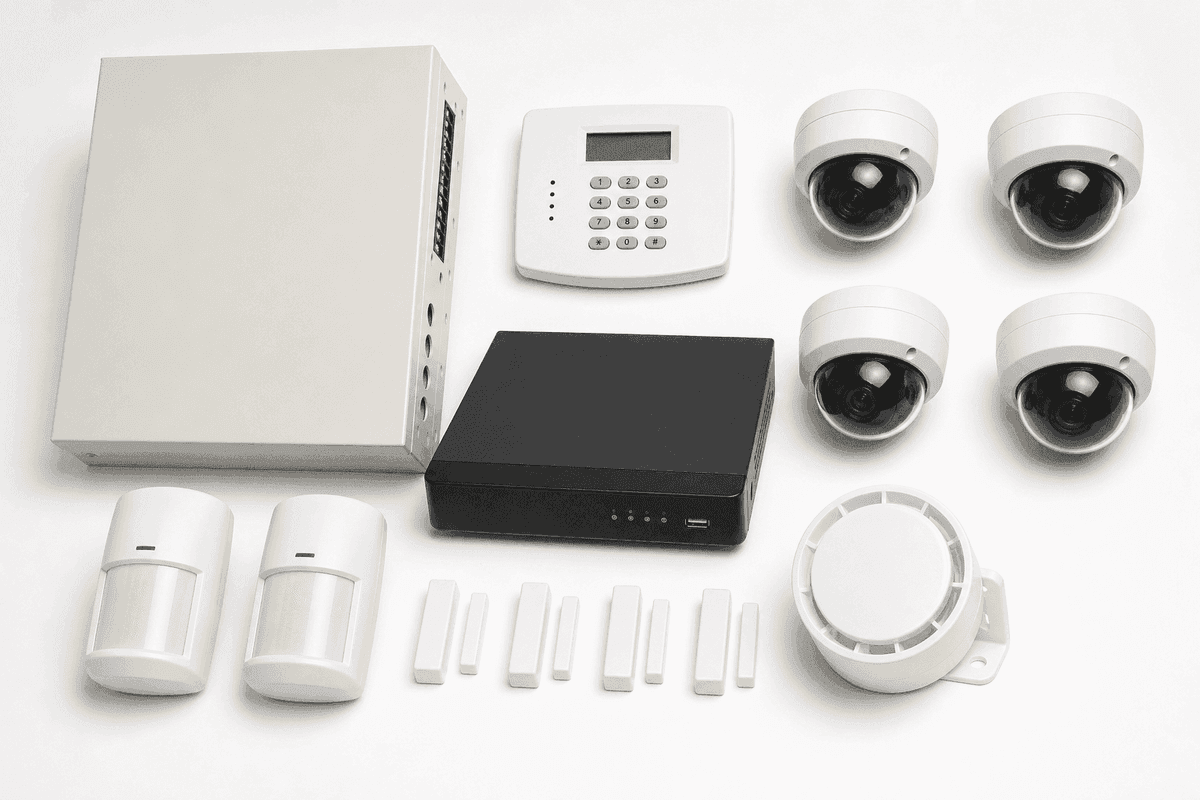
Water Treatment Plant 32-Zone Hybrid Advanced - 72-Hour Solar Security System
Key Features
- 32-zone hybrid alarm panel with expansion capacity up to 64 zones
- 18-camera surveillance package with 30-day 4K NVR retention
- 25-detector intrusion layer with PIR, dual-tech, contacts, glass-break, vibration, smoke, and beam options
- 2.1 kW solar plus 10.7 kWh LFP battery sized for 72-hour backup autonomy
- EPC turnkey price range of $6,200 to $12,100 with 1-year labor warranty
The Water Treatment Plant 32-Zone Hybrid Advanced is a 32-zone utility-plant security and surveillance system with 18 IP cameras, 25 intrusion detectors, 2.1 kW solar generation, 10.7 kWh LFP storage, 72-hour autonomy, and self-monitoring over 4G, Ethernet, and WiFi.
Description
The Water Treatment Plant 32-Zone Hybrid Advanced is a utility-grade security and surveillance package for water treatment plants, pumping stations, chemical dosing buildings, reservoirs, and perimeter gates requiring 32 alarm zones, 18 cameras, 25 detectors, 30-day 4K video retention, and 72 hours of backup autonomy. The system combines a hybrid wired/wireless alarm panel, 2.1 kW solar generation, 10.7 kWh LFP battery storage, AES-256 encrypted communications, and self-monitoring for operators that need measurable resilience under IEC 62676 CCTV guidance, EN 50131 intrusion principles, UL 681 installation practice, and NFPA 72 fire-alarm coordination.
Water utilities typically operate 24 hours per day and protect at least 3 mission-critical asset classes: process water, electrical controls, and chemical storage. This 32-zone configuration is sized for a medium water treatment plant with 6 to 12 perimeter segments, 4 to 8 building doors, 2 to 4 chemical rooms, 2 pump halls, and 1 control room, giving engineers a structured basis for zone mapping, event logging, and alarm escalation. Buyers comparing multiple options can View all Security & Surveillance System products or Configure your system online before issuing a 1-line RFQ.
System Architecture
The architecture uses 4 integrated layers: intrusion detection, video verification, power autonomy, and communications redundancy. The 32-zone alarm panel accepts wired and wireless field devices, supports multiple partitions for plant operations and maintenance access, and routes alarms to a local operator interface plus mobile self-monitoring. The 18-camera video layer is designed around 4K IP cameras, PTZ units, and thermal cameras, while the 25-detector layer can mix PIR, dual-tech, door contact, glass-break, vibration, smoke, gas, and perimeter beam devices according to the plant risk map.
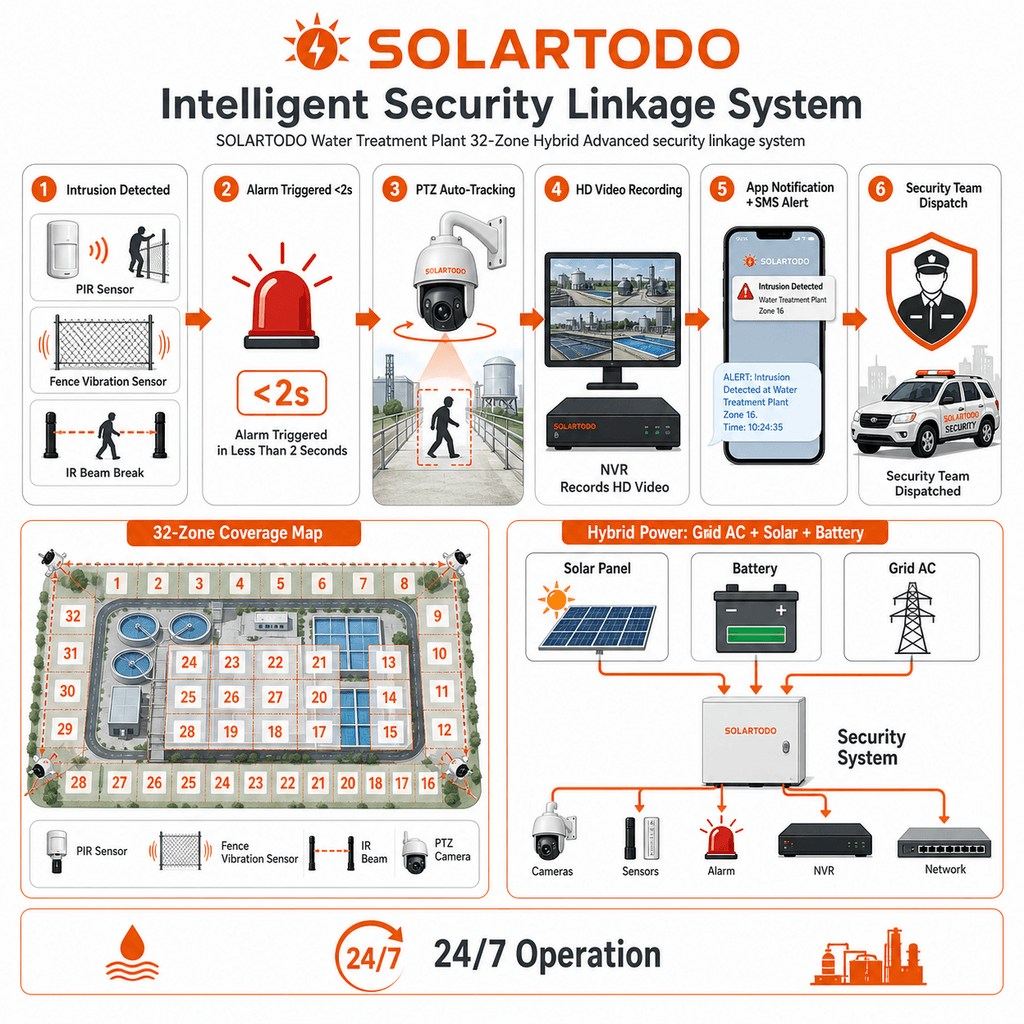
The 2.1 kW solar array and 10.7 kWh LFP battery bank reduce dependence on a single grid feed, which is important because many water-treatment sites have 1 main distribution board and 1 backup generator connection but multiple outdoor security loads. At an average protected security load of roughly 120 W to 150 W after duty-cycle management, the 10.7 kWh battery supports approximately 72 hours of autonomy when combined with solar replenishment and low-power alarm peripherals. NREL solar resource tools are commonly used to estimate site-specific PV yield before final sizing, especially when an EPC design must prove a 48-hour, 72-hour, or 120-hour resilience target.
Technical Specifications
The base configuration includes 32 security zones, 18 cameras, 25 detectors, 2.1 kW solar capacity, 10.7 kWh battery capacity, 72-hour backup autonomy, 30 days of 4K recording, and 4G + Ethernet + WiFi communications. Expansion capacity is specified up to 64 zones, allowing a 2-phase project to begin with key intake, dosing, and control-room assets and later extend to reservoirs, sludge handling, and remote gatehouses without replacing the main alarm panel.
| Parameter | Specification |
|---|---|
| Security zones | 32 zones |
| Camera count | 18 cameras |
| Detector count | 25 detectors |
| Solar power | 2.1 kW |
| Battery storage | 10.7 kWh LFP |
| Backup autonomy | 72 hours |
| Video retention | 30 days at 4K |
| Communications | 4G, Ethernet, WiFi |
| Expansion capacity | Up to 64 zones |
| Warranty | 2 years parts, 1 year labor |
Camera selection can include 12 fixed 4K IP cameras for process gates and building approaches, 4 PTZ cameras with 20x optical zoom for perimeter sweeps, and 2 thermal cameras for night detection near tanks, fences, or unlit access roads. Where visibility exceeds 150 m, IR-assisted fixed cameras and long-range PTZ units can validate alarm events faster than a detector-only system, while thermal analytics can detect a human target beyond 300 m in suitable line-of-sight conditions. IEC 62676 is the principal international reference for CCTV system requirements and performance concepts, and it supports specification discipline when camera coverage, recording, and operator use cases must be documented.
Detector allocation is normally engineered from 25 installed devices, such as 8 dual-tech detectors, 6 PIR detectors, 6 door contacts, 2 glass-break detectors, 1 smoke detector, 1 vibration sensor, and 1 perimeter beam set. Dual-tech devices combine microwave and PIR sensing to reduce nuisance alarms where pumps, rotating equipment, or temperature gradients create false triggers, and AI analytics can cut false alarms by up to 90% compared with basic motion detection when person and vehicle classification are properly calibrated. EN 50131 provides the recognized intrusion-alarm framework for system grading, detector placement discipline, tamper supervision, and event handling in commercial and critical-facility installations.
Cloud Monitoring
The monitoring mode is self-monitoring, meaning the utility operator receives alarm notifications through mobile, web, and local control interfaces instead of relying only on a 24/7 external monitoring center. Ethernet is used as the primary link where plant LAN access is approved, 4G is used as the backup path when the wired network fails, and WiFi can serve internal commissioning or local maintenance workflows. AES-256 encrypted communication, anti-jamming detection, and segmented access roles help align the system with utility cybersecurity practices referenced by IEEE smart-grid security discussions and common critical-infrastructure procurement checklists.
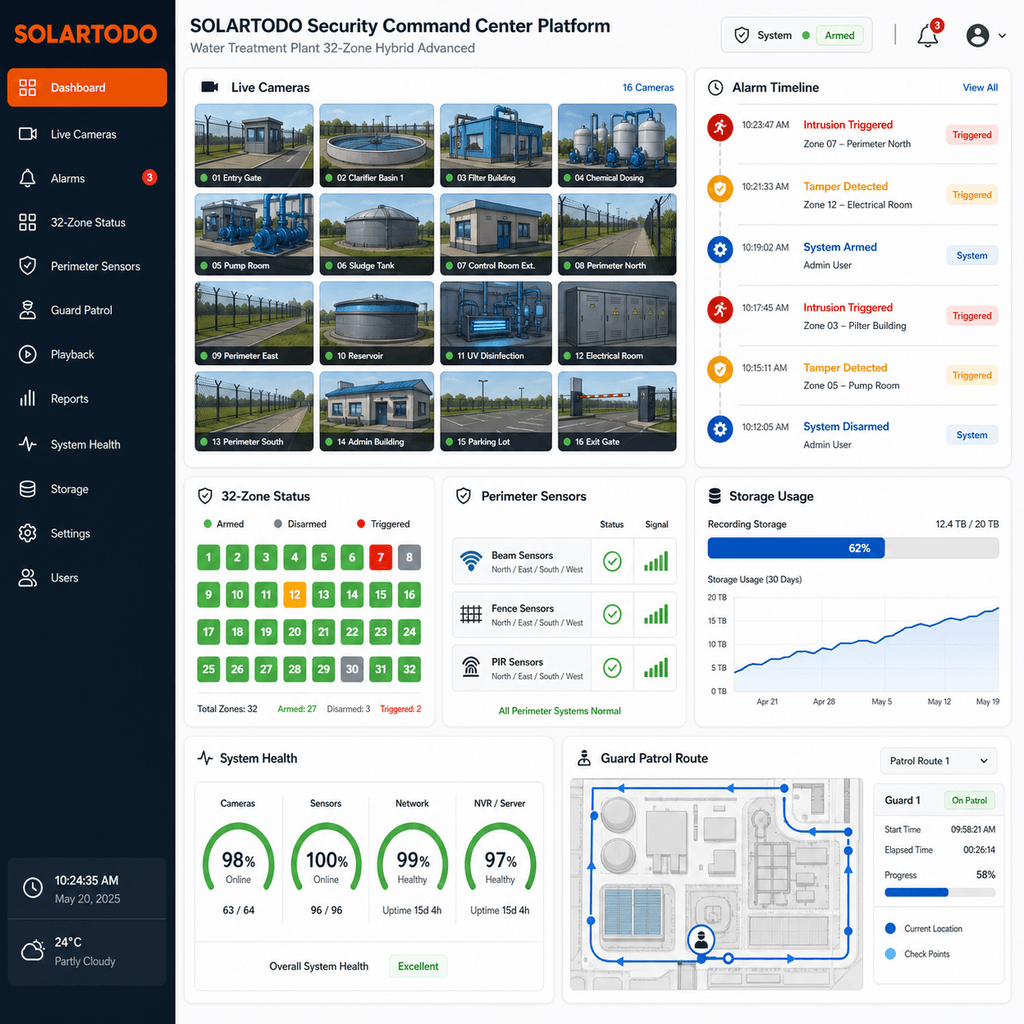
The NVR is specified for 30 days of 4K retention using H.265+ compression and RAID-capable storage design where the buyer requests fault tolerance. A 16-channel NVR is the common baseline in smaller sites, but this 18-camera package normally uses a larger 24-channel or 32-channel design so that 6 to 14 spare channels remain available for future filter-bed, gatehouse, or reservoir coverage. For design teams comparing recording duration, bandwidth, and storage calculations, SOLARTODO maintains related technical notes at Learn about topic.
Application Scenario
A solar farm operator in the MENA region and a nearby desalination pre-treatment facility used a 32-zone hybrid design to secure 3 access gates, 2 chemical rooms, 4 pump areas, 1 control room, and 6 perimeter runs across a remote site with unstable grid power. In that project type, 2.1 kW of solar and 10.7 kWh of LFP storage allow alarm, camera, and router loads to remain active during a 72-hour outage window, while PTZ and thermal cameras reduce the number of physical guard patrols required after sunset. IRENA has repeatedly emphasized the role of renewable-powered infrastructure in improving energy resilience, and the same logic applies to off-grid or weak-grid security loads serving water and energy assets.
Compared with a conventional grid-only CCTV and alarm system with a 4-hour to 8-hour UPS, the hybrid-advanced package can extend backup autonomy by roughly 9 times to 18 times, depending on the original UPS rating. Compared with a guard-only approach using 2 night-shift patrol staff, video verification and AI classification can reduce unnecessary site visits by 30% to 60% when perimeter alarms are filtered by camera evidence before dispatch. IEA infrastructure resilience analysis also highlights that digital monitoring and distributed power improve continuity for essential services, which is directly relevant to water utilities serving 10,000 to 100,000 end users.
EPC Investment Analysis and Pricing Structure
EPC turnkey delivery includes engineering, procurement, construction, commissioning, and warranty for 1 complete security package, not only equipment supply. Engineering covers zone schedules, camera-view planning, solar and battery calculations, cable routes, network topology, and handover documentation. Procurement covers alarm panels, cameras, NVR, detectors, solar modules, LFP batteries, mounting hardware, cabling, routers, and accessories. Construction includes installation, terminations, alignment, waterproofing, and labeling. Commissioning includes 32-zone testing, 18-camera video verification, 25-detector alarm checks, 72-hour autonomy validation, and operator training for at least 1 handover session.
| Pricing tier | Scope | Price range, USD |
|---|---|---|
| FOB Supply | Equipment only, ex-works China | $3,844 - $8,228 |
| CIF Delivered | Equipment plus ocean freight and insurance | $4,106 - $8,789 |
| EPC Turnkey | Installed, commissioned, and 1-year labor warranty | $6,200 - $12,100 |
| Volume quantity | Discount | Typical buyer profile |
|---|---|---|
| 50+ systems | 5% | Regional utility rollout across 50 pumping or treatment assets |
| 100+ systems | 10% | National framework procurement with 100 standardized sites |
| 250+ systems | 15% | Multi-year infrastructure program with 250 remote facilities |
ROI is usually driven by 3 measurable savings categories: avoided theft or vandalism, reduced patrol labor, and fewer outage-related security failures. If a plant avoids 1 major intrusion event costing $6,000 in cable, dosing-equipment, or downtime losses, the lower EPC package can pay back in about 1.0 year; if the system reduces 2 patrol visits per week at $35 per visit, annual labor savings reach about $3,640 and payback is typically 1.7 to 3.3 years across the $6,200 to $12,100 EPC range. BloombergNEF and Wood Mackenzie have both documented falling battery and distributed-energy costs over the last decade, which supports the procurement case for replacing small grid-only UPS designs with larger hybrid autonomy.
Payment terms are 30% T/T deposit plus 70% against B/L copy, or 100% L/C at sight for qualified trade transactions. Project financing can be discussed for utility programs above $1,000K, especially when 50 or more sites share a common bill of materials, commissioning plan, and spare-parts pool. For a formal EPC quotation with site drawings, shipping lane, warranty options, and Incoterms, buyers can Request a custom quotation or email [email protected] with at least 1 site layout and 1 electrical single-line diagram.
Standards, Compliance, and Engineering Notes
The system is specified around IEC 62676 for video surveillance, EN 50131 for intrusion alarm concepts, UL 681 for installation and classification practice, and NFPA 72 coordination where smoke or gas detectors interface with plant fire-alarm procedures. For electrical safety and renewable-power integration, EPC drawings typically include DC isolation, surge protection, grounding, battery disconnects, overcurrent protection, and cable sizing for the 2.1 kW PV subsystem and 10.7 kWh storage subsystem. The final compliance package should be reviewed against local electrical codes, because 1 country may require additional utility approval while another may require a licensed fire-alarm contractor.
The 2025 security trend is on-device edge AI, where cameras classify people, vehicles, line crossing, and object removal before video reaches the NVR or cloud. Edge processing reduces bandwidth, improves response time by several seconds per event, and limits unnecessary recording triggered by rain, moving vegetation, insects, or pump-room vibration. For remote water plants, solar-powered 4G cameras with long battery endurance can be used as supplemental units, but a wired hybrid 32-zone architecture remains stronger for 18-camera permanent coverage, 25-detector tamper supervision, and 72-hour whole-system autonomy.
Procurement Guidance
Engineers should begin with a 32-line zone schedule that assigns each detector to a physical asset, alarm priority, partition, and response procedure. Procurement managers should request the final camera matrix with lens angle, mounting height, IR range, storage bitrate, NVR channel count, and spare capacity, because 18 cameras can consume very different storage volumes depending on 4K frame rate, compression, and analytics settings. Project developers should verify solar shading, battery room temperature, cellular signal strength, and cable trench routes before accepting a fixed EPC price, since 4 site factors can change installation labor by more than 20%.
SOLARTODO positions this package for B2B buyers who need a repeatable security standard across water, energy, port, border, and industrial utility assets. The 32-zone design is large enough for a complete water-treatment perimeter but still compact enough for rapid delivery, standardized spares, and predictable commissioning. To compare larger 48-zone or 64-zone designs, review View all Security & Surveillance System products, study the engineering library at Learn about topic, or submit a plant layout through Request a custom quotation.
Technical Specifications
| Security Zones | 32zones |
| Camera Count | 18cameras |
| Detector Count | 25detectors |
| Power System | Hybrid advanced |
| Solar Power | 2.1kW |
| Battery Capacity | 10.7kWh |
| Backup Autonomy | 72hours |
| Video Storage | 30 days at 4K |
| Monitoring Type | Self-monitoring |
| Communication | 4G + Ethernet + WiFi |
| Expansion Capacity | Up to 64zones |
| Warranty | 2 years parts, 1 year labor |
Price Breakdown
| Item | Quantity | Unit Price | Subtotal |
|---|---|---|---|
| 64-zone hybrid alarm panel | 1 pcs | $120 | $120 |
| LCD keypad | 2 pcs | $30 | $60 |
| Dual-tech detector | 8 pcs | $21 | $168 |
| PIR detector | 6 pcs | $7 | $42 |
| Door/window contact | 6 pcs | $2 | $12 |
| Glass break detector | 2 pcs | $8 | $16 |
| Smoke detector | 1 pcs | $6 | $6 |
| Vibration sensor | 1 pcs | $14 | $14 |
| Perimeter beam 100 m set | 1 pcs | $65 | $65 |
| 4MP IP camera | 12 pcs | $65 | $780 |
| PTZ camera 20x | 4 pcs | $170 | $680 |
| Thermal camera | 2 pcs | $500 | $1,000 |
| NVR and RAID-ready storage package | 1 pcs | $520 | $520 |
| Solar power kit 2.1 kW | 2.1 kW | $1,500 | $3,150 |
| LFP battery storage 10.7 kWh | 10.7 kWh | $200 | $2,140 |
| 4G router, Ethernet switch, WiFi access point, AES-256 setup | 1 pcs | $350 | $350 |
| Cabling, conduits, mounting hardware, surge protection | 1 pcs | $780 | $780 |
| Installation and commissioning | 32 zones | $50 | $1,600 |
| Engineering, drawings, QA/QC, and factory acceptance support | 1 pcs | $420 | $420 |
| 1-year warranty and remote support | 1 pcs | $280 | $280 |
| Total Price Range | $6,200 - $12,100 | ||
Frequently Asked Questions
What is included in the EPC turnkey price for this 32-zone water treatment plant security system?
How does the 72-hour hybrid power system work during grid failure?
Can the 32-zone system be expanded after the water plant adds new buildings?
Which standards are relevant for specification and acceptance testing?
Why use AI video analytics instead of conventional motion detection only?
Certifications & Standards


Data Sources & References
- •IEC 62676 video surveillance systems standard
- •EN 50131 intrusion and hold-up alarm systems standard
- •UL 681 installation and classification of burglar alarm systems
- •NFPA 72 National Fire Alarm and Signaling Code
- •NREL solar resource and PV performance modeling references
- •IEA energy infrastructure resilience publications
- •IRENA renewable energy resilience and distributed power publications
Interested in this solution?
Contact us for a customized quote based on your specific requirements.
Contact Us