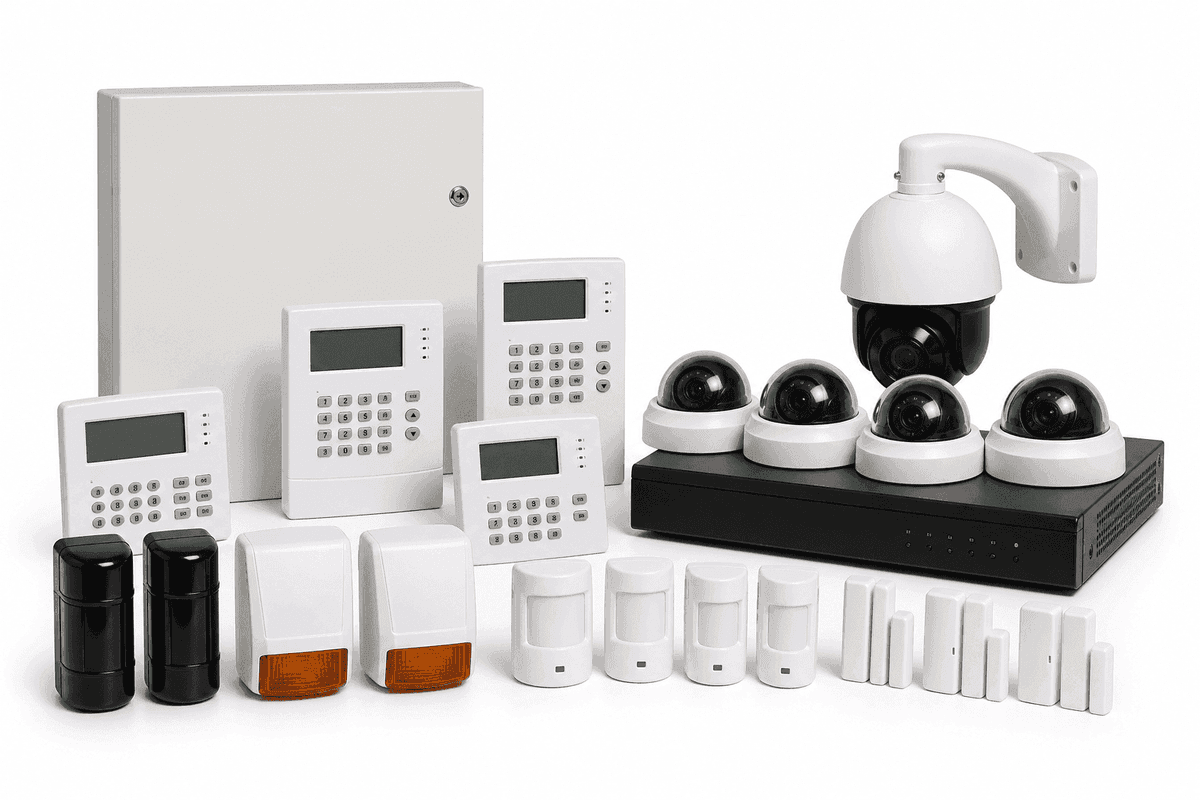
Water Treatment Plant 64-Zone Hybrid - 24-Camera Utility Security System
Key Features
- 64 alarm zones with wired-plus-wireless hybrid panel architecture
- 24-camera video layer with 20 fixed HD cameras and 4 PTZ cameras
- 64 detectors including 32 PIR, 16 water-leak, 8 gas, and 8 dual-tech units
- 96-hour hybrid advanced backup power target versus 4-8 hours for basic UPS systems
- EPC turnkey range of $11,200-$14,400 with 1-year labor warranty
The Water Treatment Plant 64-Zone Hybrid is a utility-grade security and surveillance system with 64 alarm zones, 64 detectors, 24 IP cameras, 32-channel NVR storage, and a hybrid advanced power system. EPC turnkey pricing is $11,200-$14,400 with IEC 62676 CCTV, EN 50131 intrusion, UL 681 alarm-service, and NFPA 72 fire-alarm design references.
Description
The Water Treatment Plant 64-Zone Hybrid is a utility-plant security system with 64 alarm zones, 64 field detectors, 24 cameras, 32 NVR channels, and a hybrid advanced power architecture sized for 96 hours of backup autonomy. It is engineered for water intake stations, pump rooms, chemical dosing buildings, reservoirs, and perimeter gates where a single intrusion or leak event can affect 10,000+ m3/day of treated-water continuity.
For B2B procurement teams comparing critical-infrastructure security packages, this configuration combines 32 PIR detectors, 16 water-leak detectors, 8 gas detectors, 8 dual-tech detectors, 8 perimeter beam sets, 20 HD IP cameras, 4 PTZ cameras, 4 keypads, and 6 sirens in one integrated alarm-and-video bill of materials. SOLARTODO positions the system in the Security & Surveillance System product line, with online scoping available through Configure your system online and technical buying guidance at Learn about topic.
System Architecture
The architecture is built around a 64-zone wired-plus-wireless hybrid alarm panel with multiple partitions for 4 typical plant areas: perimeter, process buildings, storage areas, and operator facilities. The panel supervises detector circuits, siren outputs, keypad inputs, and communication paths while the video layer records 30 days of 4K evidence on a 32-channel NVR using H.265+ compression and event indexing aligned with IEC 62676 CCTV system concepts.
At the field level, 32 PIR detectors cover offices, MCC rooms, chemical storage aisles, and dry corridors where passive infrared detection is sufficient for normal human movement. The 8 dual-tech detectors combine microwave and PIR sensing for locations exposed to steam, vibration, or temperature swings, reducing nuisance alarms by up to 90% compared with single-sensor motion detection when analytics and zoning are correctly commissioned, a practice consistent with EN 50131 intrusion-system risk grading.
The environmental safety layer uses 16 water-leak detectors near pumps, pipe galleries, cable trenches, and dosing skids, plus 8 gas detectors for chlorine, methane, hydrogen sulfide, or other site-specific hazards. In a water-treatment plant running 24/7, early leak or gas detection can shorten response time from 30 minutes of routine inspection latency to under 5 minutes through alarm push notification, siren activation, and video verification.
Technical Specifications
The video subsystem includes 20 HD IP cameras for fixed coverage and 4 PTZ cameras for long-range verification at gates, tanks, and perimeter corridors. Fixed cameras can be specified as 4 MP or 4K depending on storage budget, while PTZ units support 20x optical zoom for operator-assisted tracking; where higher-risk reservoirs or chemical yards require detection beyond 300 m, thermal-camera upgrades can be added as a project option.
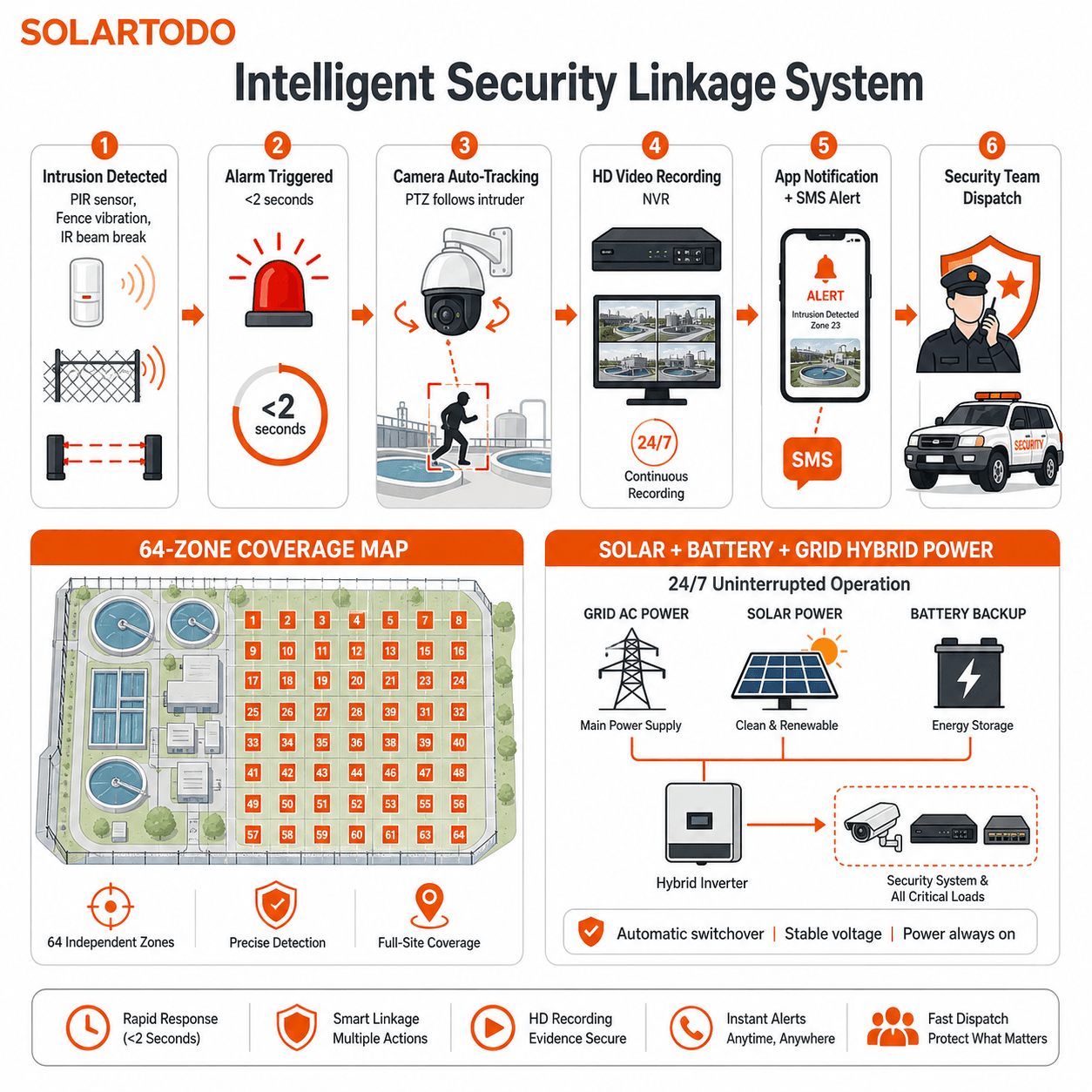
The perimeter subsystem uses 8 infrared beam pairs with typical line-of-sight coverage of 100-250 m per set, enabling layered detection before a person reaches process equipment or chemical inventory. Compared with a conventional camera-only system using 24 cameras but no beam sensors, the hybrid design reduces after-the-fact review workload by triggering video bookmarks at the first perimeter event rather than forcing operators to scan 720 hours of monthly footage manually.
The communication stack uses Ethernet, 4G backup, and WiFi for local service access, with AES-256 encryption recommended for alarm reporting and video-platform connections. Anti-jamming strategy is based on 2 independent communication paths, supervised heartbeat checks, and local NVR recording, so a WAN outage of 1-4 hours does not erase evidence or disable local sirens.
Power is delivered through a hybrid advanced system combining grid input, UPS buffering, solar-ready DC support, and battery reserve sized around 48-120 hours depending on camera wattage, site climate, and autonomy target. This page uses 96 hours as the standard specification, which is materially stronger than a conventional grid-plus-UPS design that often provides only 4-8 hours at critical sites.
Cloud Monitoring
Premium monitoring connects 64 alarm zones and 24 video channels to a command-center workflow with event classification, mobile notification, and alarm-video pairing. The NVR records 30 days at 4K-class settings where storage is provisioned correctly, and edge AI analytics can classify person and vehicle events at the camera or recorder level, reflecting the 2025 industry trend toward on-device processing that reduces cloud bandwidth by 30-70%.
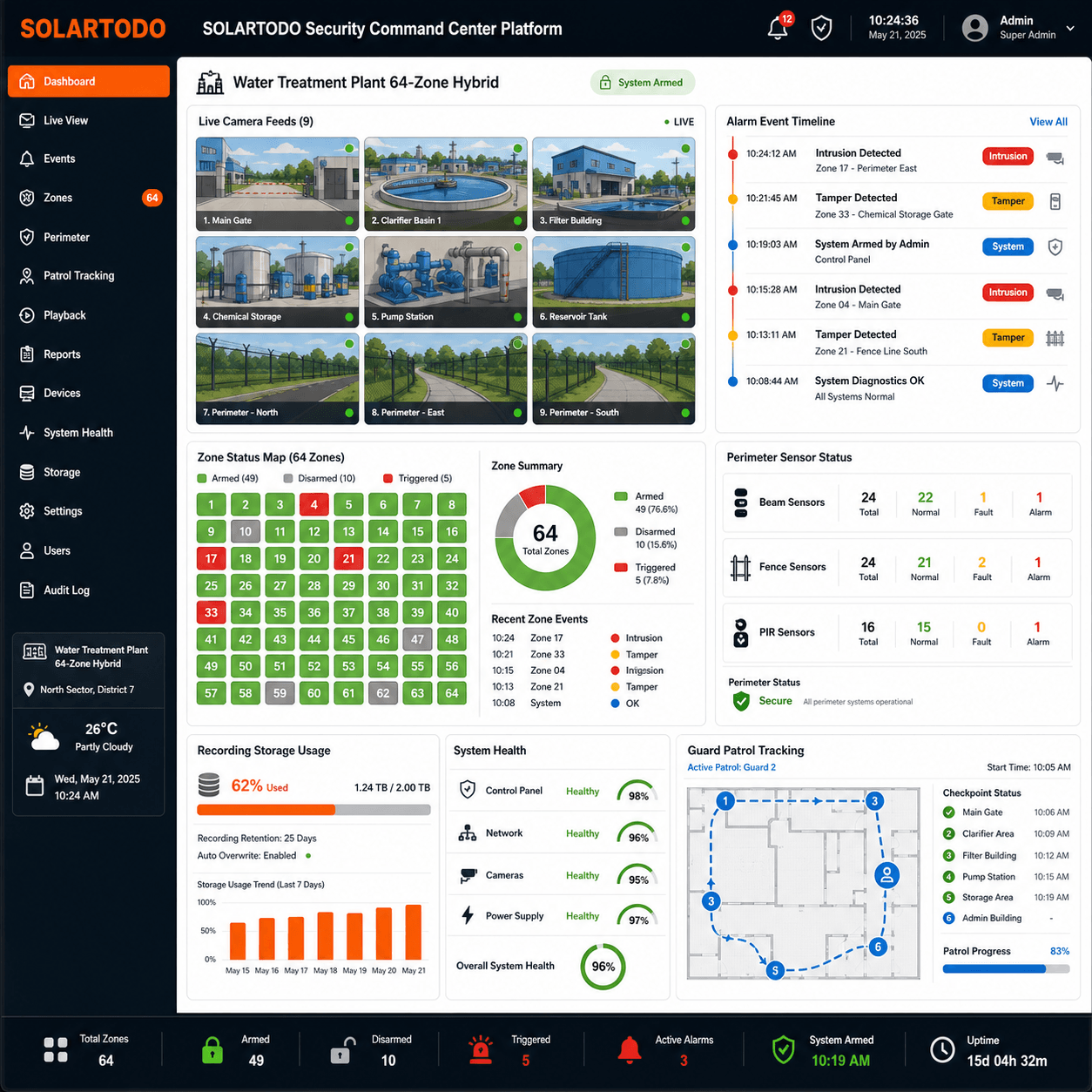
The platform design follows IEC 62676 principles for video surveillance and can be documented for owner specifications that require audit trails, operator roles, time synchronization, and evidence retention. A typical project uses 4 keypad locations at guardhouse, control room, maintenance entry, and chemical building, while 6 sirens provide acoustic annunciation across indoor and outdoor zones without relying on a single alarm point.
Standards, Compliance, and Engineering References
This product page references EN 50131 for intrusion-alarm system concepts, IEC 62676 for video surveillance system guidance, UL 681 for installation and classification of burglar-alarm systems, and NFPA 72 for fire-alarm and emergency-signal coordination where gas or smoke detection interfaces are included. For power resilience, SOLARTODO also considers IEEE networking practice for Ethernet-connected devices and IEC 62368-1 safety expectations for ICT equipment operating near low-voltage DC systems.
Energy and infrastructure planning sources reinforce why resilient security matters at utility assets with 20-year service lives. NREL guidance on distributed-energy resilience, IEA analysis of electricity-system reliability, IRENA reports on renewable-powered infrastructure, BloombergNEF battery-cost tracking, Wood Mackenzie grid-edge research, and IEC standards together support a design philosophy where surveillance, alarm reporting, storage, and backup power are treated as one integrated 24/7 operational system.
Water infrastructure is often classified as critical infrastructure because a pump station, dosing plant, or treatment facility can affect thousands of households within 1 operating day. A camera-only package may document an intrusion after damage occurs, but a 64-zone hybrid alarm-and-video package detects motion, perimeter breach, gas, and water leakage as separate event types before operators dispatch personnel.
Application Scenario
A solar-assisted water utility in the MENA region deployed a 64-zone hybrid system across 2 intake gates, 1 chemical dosing building, 1 control room, 3 pump halls, and 4 reservoir access points. After commissioning, the operator used 8 perimeter beams to trigger PTZ presets and reduced guard patrol distance by 35%, while 16 leak sensors shortened pump-gallery incident reporting from approximately 25 minutes to less than 5 minutes.
In the same scenario, the utility compared SOLARTODO’s hybrid design with a conventional alternative composed of 24 standalone cameras, 1 basic NVR, and 0 alarm zones. The conventional system had a lower initial equipment cost, but it required more manual review and delivered no automatic leak or gas notification; the hybrid system reduced false dispatches by an estimated 60-90% when dual-tech sensing, beam zoning, and person/vehicle analytics were tuned during commissioning.
EPC Investment Analysis and Pricing Structure
The EPC scope includes 5 work packages: engineering design, procurement, construction and installation, commissioning, and warranty support. Engineering covers zone mapping, camera layout, power-load calculation, communication topology, and acceptance-test documentation; procurement covers the 64-zone panel, 64 detectors, 24 cameras, NVR, cabling, batteries, and accessories; construction includes mounting, wiring, labeling, weatherproofing, and site integration; commissioning includes 100% zone testing and 24-camera verification.
| Pricing tier | Scope | Price range |
|---|---|---|
| FOB Supply | Equipment only, ex-works China | $6,944-$9,792 |
| CIF Delivered | Equipment plus ocean freight and insurance | $7,418-$10,460 |
| EPC Turnkey | Fully installed, commissioned, and covered by 1-year labor warranty | $11,200-$14,400 |
Volume discounts are applied against eligible equipment supply lines, not against taxes, civil works, or country-specific permits. For framework procurement, 50+ systems qualify for 5% discount, 100+ systems qualify for 10% discount, and 250+ systems qualify for 15% discount, subject to final camera specification, battery capacity, and delivery schedule.
| Order volume | Discount | Procurement use case |
|---|---|---|
| 50+ systems | 5% | Regional utility rollout across 50 pump or treatment sites |
| 100+ systems | 10% | National water-security program across 100 facilities |
| 250+ systems | 15% | Multi-year infrastructure framework covering 250 assets |
ROI depends on avoided theft, reduced patrol labor, faster leak response, lower insurance exposure, and fewer operational interruptions. If a plant avoids 1 equipment-loss event worth $8,000, reduces guard overtime by $250/month, and prevents 1 leakage incident costing $3,000/year, the annual benefit can exceed $14,000, producing a simple payback of about 0.8-1.1 years against the $11,200-$14,400 EPC range.
Compared with installing separate alarm, CCTV, leak-detection, and backup-power packages from 4 vendors, the integrated EPC approach reduces interface risk, shortens commissioning by 2-4 weeks, and provides one acceptance-test list for 64 zones and 24 cameras. Payment terms are 30% T/T + 70% against B/L, or 100% L/C at sight, with project financing review available for qualified projects above $1,000K; procurement teams can Request a custom quotation or contact [email protected].
Procurement Notes
The bill of materials is suitable for new EPC projects and retrofit programs where a water-treatment owner needs a documented alarm matrix across 64 zones without replacing every existing cable path. SOLARTODO can adapt camera resolution, detector grade, NVR RAID capacity, solar-battery autonomy, and monitoring workflow for 1-site pilots or 100-site procurement schedules.
For specification writers, the recommended acceptance test includes 64 detector activations, 24 camera image checks, 4 keypad arming tests, 6 siren tests, 2 communication-failover tests, and 1 backup-power discharge test. These measurable checkpoints make the system easier to evaluate than a generic security quotation that lists cameras and sensors but does not define pass/fail criteria for zones, recordings, alarms, and operator response.
Operations and Maintenance
Routine operation is organized around 3 daily checks, 1 weekly report, and 1 monthly preventive-maintenance inspection. Operators should confirm alarm-panel health, NVR recording status, and communication heartbeat every 24 hours, while technicians should test a sample of 10-20% of zones each month so all 64 zones are function-tested within a predictable quarterly cycle.
Maintenance planning should include lens cleaning for 24 cameras, battery health review for the 96-hour autonomy target, firmware control for the NVR and alarm panel, and verification of 8 perimeter beam alignments after storms or civil works. For water-treatment environments with humidity above 70%, sealed junction boxes, corrosion-resistant brackets, and labeled cable glands reduce service calls across a 2-year parts warranty period.
Cybersecurity practice should separate the security VLAN from corporate IT networks using at least 2 network segments, unique credentials, encrypted remote access, and role-based permissions for operators, supervisors, and maintenance vendors. When a utility requires evidence export, the system can preserve 30-day recordings locally while exporting selected event clips with time stamps, camera IDs, and zone numbers for incident files.
Buyer Guidance
Procurement teams should request a site drawing, camera schedule, detector schedule, power single-line diagram, and monitoring workflow before issuing a purchase order for 1 or more systems. A technically complete RFQ should specify the 64-zone panel grade, 24-camera resolution target, NVR retention period, backup-autonomy target, installation height, cable route length, and acceptance-test format.
Owners planning wider smart-infrastructure upgrades can combine this security package with energy storage, solar lighting, telecom towers, or power shelters from SOLARTODO’s B2B portfolio. For broader design context on utility monitoring and hybrid power systems, procurement teams can review Learn about topic before finalizing a site survey or issuing a 64-zone technical schedule.
Technical Specifications
| Security Zones | 64zones |
| Camera Count | 24cameras |
| Detector Count | 64detectors |
| Power System | hybrid_advanced |
| Backup Autonomy | 96hours |
| Video Storage | 30 days @ 4K |
| Monitoring Type | premium |
| Communication | 4G + Ethernet + WiFi |
| Expansion Capacity | Up to 128zones |
| Warranty | 2 years parts, 1 year labor |
Price Breakdown
| Item | Quantity | Unit Price | Subtotal |
|---|---|---|---|
| 64-Zone Hybrid Alarm Panel | 1 pcs | $120 | $120 |
| LCD Keypad | 4 pcs | $30 | $120 |
| PIR Detector | 32 pcs | $7 | $224 |
| Water Leak Detector | 16 pcs | $12 | $192 |
| Gas Detector | 8 pcs | $10 | $80 |
| Dual-Tech Detector | 8 pcs | $21 | $168 |
| Perimeter Beam Set 100m | 8 pcs | $65 | $520 |
| HD IP Camera | 20 pcs | $65 | $1,300 |
| PTZ Camera 20x | 4 pcs | $170 | $680 |
| 32-Channel NVR System | 1 pcs | $270 | $270 |
| Outdoor/Indoor Siren | 6 pcs | $12 | $72 |
| Hybrid Solar Power Kit | 1 pcs | $2,250 | $2,250 |
| LFP Battery Bank 10 kWh | 1 pcs | $2,000 | $2,000 |
| 4G/Ethernet Communication Gateway | 1 pcs | $250 | $250 |
| Cabling, Enclosures, Mounting Accessories | 1 pcs | $900 | $900 |
| Premium Monitoring Setup | 1 pcs | $360 | $360 |
| Installation & Commissioning | 64 pcs | $50 | $3,200 |
| Engineering, Drawings & QC | 1 pcs | $650 | $650 |
| 1-Year Warranty & Support | 1 pcs | $450 | $450 |
| Total Price Range | $11,200 - $14,400 | ||
Frequently Asked Questions
What does the EPC turnkey price include for this 64-zone hybrid system?
How long can the system operate during a grid outage?
Which standards are relevant for specification and compliance?
Can the 64-zone system be expanded after commissioning?
How is this different from a conventional camera-only installation?
Certifications & Standards

Data Sources & References
- •IEC 62676 video surveillance systems standard family
- •EN 50131 intrusion and hold-up alarm systems standard family
- •UL 681 installation and classification of burglar alarm systems
- •NFPA 72 National Fire Alarm and Signaling Code
- •NREL distributed energy resilience guidance
- •IEA electricity security and grid reliability analysis
- •IRENA renewable power and infrastructure resilience reports
- •BloombergNEF battery price and energy storage market research
- •Wood Mackenzie grid edge and distributed energy research
Interested in this solution?
Contact us for a customized quote based on your specific requirements.
Contact Us