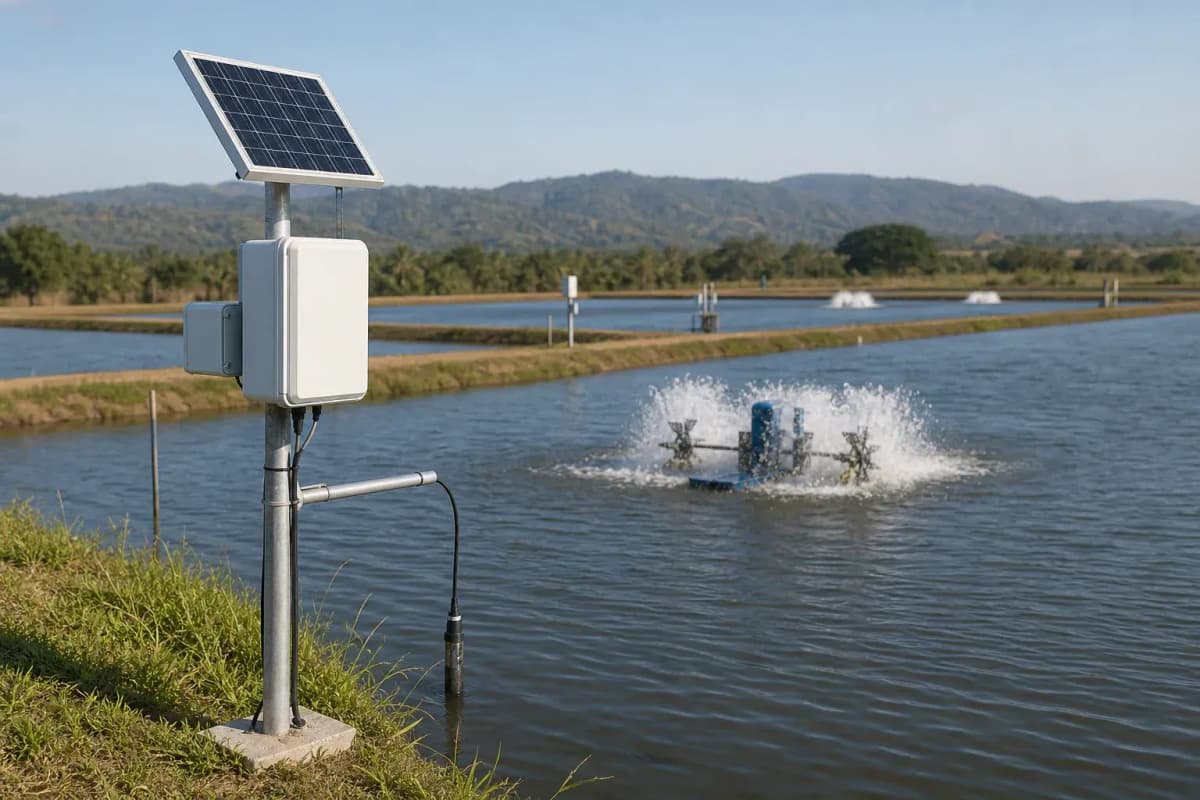
Aquaculture Fish Farm 12ha - 8-Sensor Solar IoT Monitoring System
Key Features
- 12 ha aquaculture coverage with 8 pond monitoring zones
- 8 IP68 water-quality sensors for DO, pH, ammonia, turbidity, salinity, and temperature
- 10-minute default sampling creates up to 1,152 records per day
- 8-channel aerator control supports automatic DO-based activation
- USD 2,160-2,808 EPC turnkey range with 1-year support
Aquaculture Fish Farm 12ha is a solar-powered smart agriculture IoT system for 8 ponds, 8 IP68 water-quality sensors, WiFi/Ethernet communication, 10-minute data logging, and automatic aerator control. EPC turnkey pricing is USD 2,160-2,808 with professional cloud monitoring, commissioning, and 1-year support.
Description
Aquaculture Fish Farm 12ha is a smart agriculture IoT monitoring system engineered for 12 hectares, 8 ponds, 8 IP68 water-quality sensor points, WiFi/Ethernet backhaul, solar-small power, and professional cloud analytics. The system measures dissolved oxygen, pH, ammonia, turbidity, salinity, and temperature at 10-minute intervals, then triggers aerator control when dissolved oxygen falls below a configurable threshold such as 5.0 mg/L.
This SOLARTODO configuration is designed for B2B aquaculture operators managing 8 production ponds, 1 hatchery block, or 12 ha of mixed grow-out water surface where oxygen, pH, and ammonia events can change within 1 night cycle. Compared with manual sampling at 2-4 daily rounds, continuous 10-minute monitoring creates up to 144 readings per sensor per day and up to 1,152 multi-parameter records per day across 8 ponds.
System Architecture
The 12 ha architecture uses 8 submersible water-quality endpoints, 1 WiFi/Ethernet gateway, 1 small solar power kit with LFP battery buffering, 8 aerator-control relay outputs, and 1 professional cloud workspace. Each pond can be assigned 1 sensor node, while larger ponds can be grouped in 2-node zones when depth, feeding density, or aeration layout requires higher spatial resolution.
Each IP68 probe package is selected for wet aquaculture service because IEC 60529 defines IP codes for enclosure protection up to electrical equipment ratings of 72.5 kV, and IP68 is commonly specified for continuous submersion designs under manufacturer-defined depth and duration limits (IEC 60529, https://webstore.iec.ch/en/publication/2452). For a 12 ha farm, this rating matters because sensor housings may remain below water for more than 24 hours during high-rainfall or pump-overflow events.
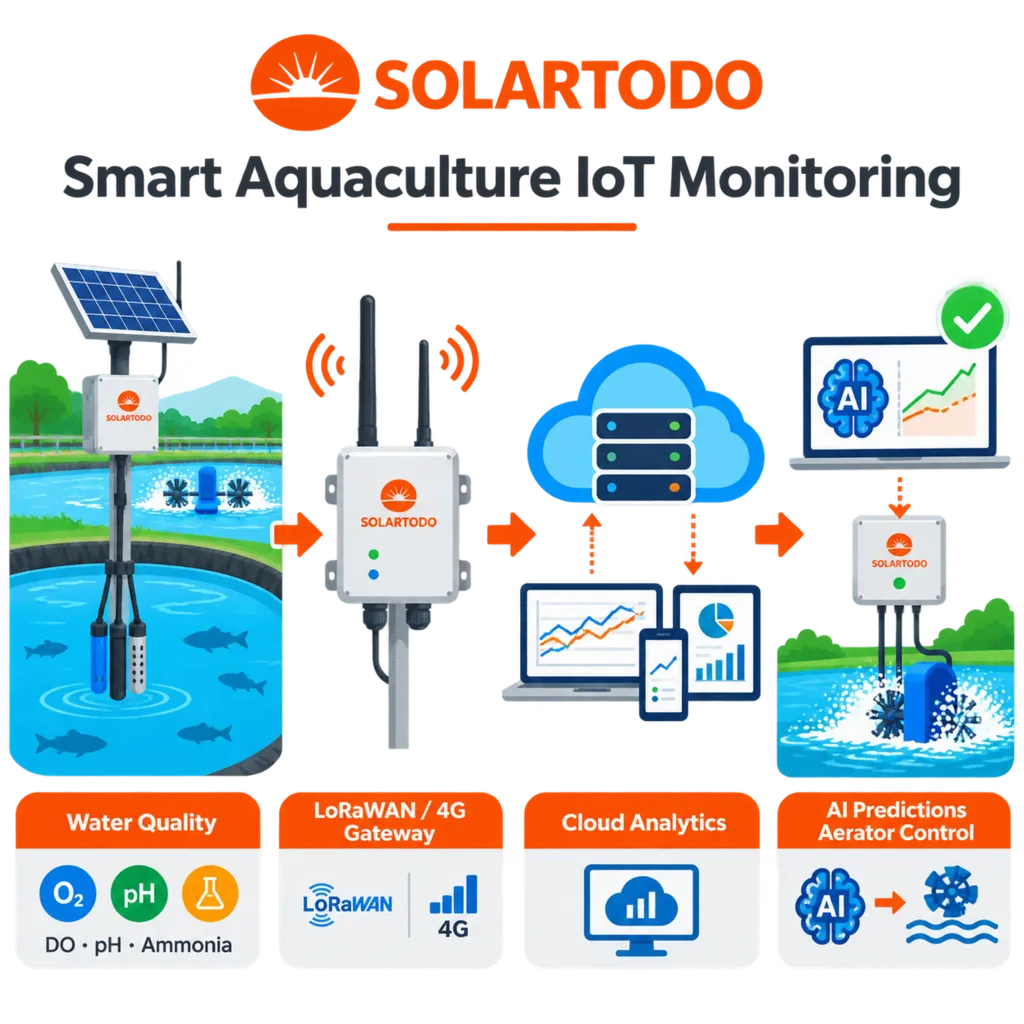
The gateway uses WiFi/Ethernet because many aquaculture farms place the operations office, feed store, or pump room within 10-100 meters of pond-side control cabinets. WiFi/Ethernet provides lower latency than satellite links and higher bandwidth than narrowband telemetry, while local caching allows data retransmission when the network recovers after a 1-60 minute outage window.
Power is provided by a small solar subsystem, typically in the 10-80 W class with an LFP battery sized for unattended outdoor operation. IRENA reported 2024 utility-scale solar PV LCOE near USD 0.043/kWh and solar PV installed-cost reductions of about 87% versus 2010, which supports the use of solar power for low-load monitoring cabinets where trenching 220 V AC across 12 ha is uneconomic (IRENA 2025, https://www.irena.org/Digital-Report/Renewable-Power-Generation-Costs-in-2024).
Technical Specifications
The monitoring payload covers 6 core aquaculture parameters: dissolved oxygen, pH, ammonia, turbidity, salinity, and water temperature. FAO aquaculture guidance identifies pH 7.0-8.5 and dissolved oxygen around 5.0 ppm as desirable pond-water ranges, while un-ionized ammonia becomes increasingly toxic as pH and temperature rise (FAO pond manual, https://www.fao.org/4/T0555E/T0555E09.htm; FAO ammonia guidance, https://www.fao.org/4/y5042e/y5042e07.htm).
Default sampling is 10 minutes, but the controller can be configured from 1 to 60 minutes depending on battery autonomy, alert criticality, and reporting cost. At 10 minutes, the system records 144 samples per sensor per day, 4,320 samples per sensor per 30-day month, and 34,560 sensor records per month for all 8 ponds before cloud aggregation.
Aerator control is included for 8 pond zones and can be mapped to existing paddlewheel, blower, or diffuser starters through relay outputs and local safety interlocks. A typical control rule activates aeration when DO drops below 5.0 mg/L for 2 consecutive samples, escalates alerts after 20 minutes, and logs the control event for maintenance review.
The system is intended for monitoring and control support, not for replacing farm biosecurity, laboratory assays, or trained aquaculture supervision at 1 critical harvest event. ISO 11783, also known as ISOBUS for agricultural machine communication, provides a useful integration reference for farm-equipment interoperability, while REST API access allows 3rd-party ERP, feeding, or SCADA platforms to receive timestamped pond data.
Cloud Monitoring
The professional cloud tier provides 1 dashboard workspace, 8 device profiles, historical trend charts, SMS, email, and app-push alert routing. Operators can compare DO, pH, ammonia, turbidity, salinity, and temperature across 8 ponds over 1 day, 7 days, 30 days, or 12 months to identify recurring nighttime oxygen dips and feed-related ammonia patterns.
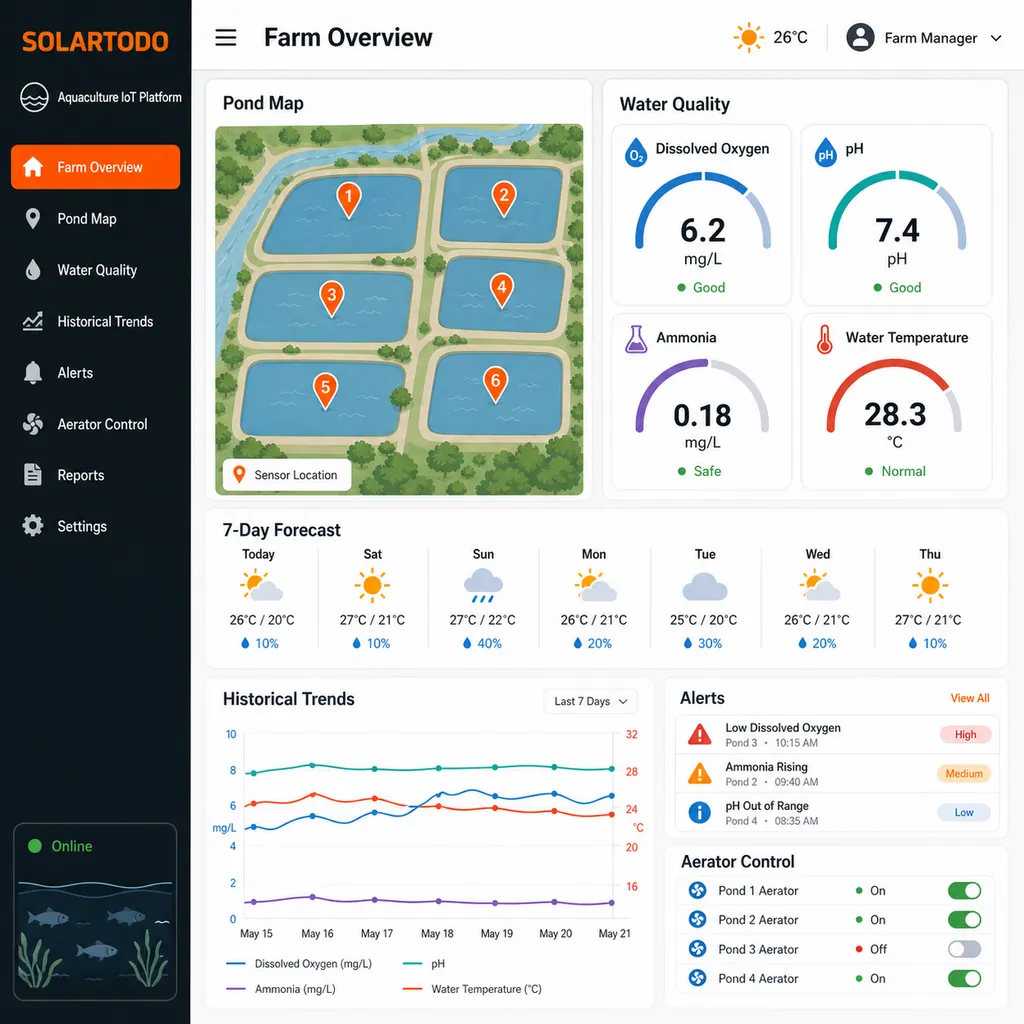
AI-assisted alerts use threshold logic, rolling averages, and trend detection rather than unsupported biological performance claims. For example, the system can flag a 0.5 mg/L dissolved-oxygen decline over 30 minutes, a pH rise above 8.5, or a turbidity spike after rainfall, but any yield impact must be verified by the farm through stocking density, feed conversion ratio, mortality records, and harvest weight data.
For buyers comparing SOLARTODO smart agriculture products, the broader range is available at View all Smart Agriculture IoT Monitoring System products, and project teams can model sensor count, communication type, power class, and cloud tier at Configure your system online. Engineering teams can also Learn about topic for IoT monitoring concepts and sensor-selection criteria.
Representative Scenario: 12 ha MENA Pond Farm
For a representative MENA fish-farm scenario, assume 8 earthen ponds totaling 12 ha, 1 control room with Ethernet access, summer water temperature above 28 C, and aerators already installed at each pond. In this case, 8 DO/pH/ammonia-capable nodes record 1,152 daily samples, and the solar cabinet avoids trenching approximately 300-600 meters of low-voltage cable between the office and remote ponds.
The conventional alternative is a handheld meter program with 2 staff rounds per day, 8 ponds per round, and 16 daily manual measurements if only DO and pH are tested. The SOLARTODO configuration raises measurement density from 16 manual spot readings to up to 1,152 automated multi-parameter records per day, a 72x increase in observation frequency before any laboratory sampling is added.
This comparison does not claim a guaranteed harvest gain, because no verified customer project reference was supplied for this page. However, the technical rationale is clear: FAO documentation shows that dawn oxygen and pH are critical pond indicators, and online monitoring literature for aquaculture systems recommends frequent DO and pH monitoring because disturbances can develop faster than daily manual sampling captures (Wiley Aquaculture, Fish and Fisheries 2023, https://doi.org/10.1002/AFF2.102).
Applications
The system is suitable for 8-pond fish farms, shrimp nursery ponds, tilapia grow-out sites, recirculating aquaculture support tanks, hatchery water intake channels, and mixed freshwater/brackish farms up to 12 ha. Salinity sensing supports freshwater-to-brackish changes, while turbidity sensing helps identify rainfall runoff, feed fines, or algae events after 1 storm or 1 overfeeding incident.
Operations teams can use 3 alert levels: advisory alerts for slow trend deviation, warning alerts for threshold breach, and critical alerts for DO or ammonia risk. A typical escalation policy sends app-push alerts at the first 10-minute breach, email at 20 minutes, and SMS at 30 minutes or when DO remains below the farm's chosen safety limit.
Procurement teams can specify this product as a 12 ha turnkey monitoring package because it includes sensors, gateway, solar power, cloud service, installation, commissioning, and 1-year EPC support. For custom pond geometry, salinity range, AC starter voltage, or multilingual dashboard requirements, use Request a custom quotation and include 8 pond dimensions, 1 site map, and 12 months of expected production cycles where available.
EPC Investment Analysis and Pricing Structure
EPC turnkey scope includes 5 work packages: engineering design, procurement, construction or installation, commissioning, and warranty support. For this 12 ha aquaculture system, EPC covers sensor placement planning, gateway configuration, solar cabinet installation, aerator-control wiring verification, dashboard setup, user training, and 1 year of cloud-support coordination after handover.
| Pricing tier | Scope | Price range |
|---|---|---|
| FOB Supply | Equipment only, ex-works China | USD 1,339-1,909 |
| CIF Delivered | Equipment plus ocean freight and insurance | USD 1,397-1,991 |
| EPC Turnkey | Installed, commissioned, and supported for 1 year | USD 2,160-2,808 |
| Volume quantity | Discount | Typical buyer profile |
|---|---|---|
| 50+ systems | 5% | Regional aquaculture integrator with 50 farm blocks |
| 100+ systems | 10% | National food-production group with 100 pond clusters |
| 250+ systems | 15% | Government or enterprise framework order with 250 sites |
The EPC investment case is strongest where manual patrols, oxygen crashes, and emergency aeration response create measurable operating cost. If a 12 ha farm avoids 1 emergency response per month at USD 80 labor and diesel cost, reduces 2 manual test rounds per day by 30 minutes each at USD 4/hour labor, and prevents 1 unnecessary water-exchange event per month at USD 120, indicative annual operational savings can reach about USD 2,100-2,400.
Against an EPC midpoint of about USD 2,484, a conservative annual savings estimate of USD 1,200 gives a 2.1-year payback, while a higher monitored-operation estimate of USD 2,400 gives about a 1.0-year payback. This ROI model is indicative only and should be validated against 12 months of farm energy, labor, mortality, feed-conversion, and water-exchange records before procurement approval.
Standard payment terms are 30% T/T deposit plus 70% against bill of lading, or 100% irrevocable L/C at sight for qualified buyers. Project financing can be reviewed for projects above USD 1,000K, and commercial enquiries should be sent to [email protected] with 1 site drawing, 8 pond IDs, and the required Incoterms.
Standards, Compliance, and Data Governance
Relevant reference frameworks include IEC 60529 for IP protection, ISO 11783 for agricultural-machine interoperability concepts, WMO practices for environmental sensor data quality, and FAO aquaculture guidance for pond water-quality interpretation. For solar-power hardware, IEC 61215 and IEC 61730 are commonly used module-design references, while local electrical installation must follow the buyer's national code at 1 project site.
Data governance is handled through device IDs, timestamped samples, role-based cloud access, and REST API export. A 10-minute sampling interval creates more than 420,000 records per year for 8 sensors, so procurement specifications should include data-retention duration, export frequency, administrator roles, and whether SMS alerts require local carrier integration in 1 or more countries.
Buyer Guidance
Select this 12 ha package when the farm has 6-10 ponds, a stable WiFi/Ethernet point, and existing aerators that can accept relay-based automatic start logic. Select a LoRaWAN or 4G variant instead when sensors sit more than 100 meters from reliable WiFi, when a single gateway must cover up to 10 km, or when no fixed broadband exists at the pump house.
Before ordering, confirm 8 practical details: pond count, pond area, depth range, freshwater or salinity range, aerator starter voltage, available mounting points, solar exposure, and required dashboard language. With those 8 inputs, SOLARTODO can adjust probe cable length, cabinet size, alert thresholds, and the EPC bill of materials without inflating individual component prices.
Technical Specifications
| Coverage Area | 12ha |
| Application | Aquaculture fish farm |
| Pond Count | 8ponds |
| Monitoring Types | Water quality |
| Total Sensors | 8sensors |
| Measured Parameters | DO, pH, ammonia, turbidity, salinity, temperature |
| Communication | WiFi/Ethernet |
| Power Supply | Solar small with LFP battery |
| Data Interval | 10, configurable 1-60min |
| Cloud Platform | Professional |
| Aerator Control | Included, 8 relay channels |
| Alert Channels | SMS, Email, App Push |
| API Access | REST API included |
| Ingress Protection | IP68 submersible sensors |
| Warranty | 2 years hardware, 1 year cloud |
Price Breakdown
| Item | Quantity | Unit Price | Subtotal |
|---|---|---|---|
| IP68 multi-parameter water-quality sensor node | 8 pcs | $120 | $960 |
| WiFi/Ethernet IoT gateway | 1 pcs | $225 | $225 |
| Small solar power kit with LFP battery | 1 pcs | $145 | $145 |
| Professional cloud platform annual license | 8 pcs | $48 | $384 |
| Aerator control relay module | 8 pcs | $32 | $256 |
| Outdoor enclosure, cables, and mounting accessories | 1 pcs | $160 | $160 |
| Installation and commissioning | 1 pcs | $350 | $350 |
| Engineering design and QC documentation | 1 pcs | $210 | $210 |
| 1-year warranty and support | 1 pcs | $120 | $120 |
| Total Price Range | $2,160 - $2,808 | ||
Frequently Asked Questions
What does the Aquaculture Fish Farm 12ha package monitor?
How does automatic aerator control work?
What is included in the EPC turnkey price and warranty?
Can the system work without grid power at the pond edge?
How is this different from manual pond testing?
Certifications & Standards


Data Sources & References
- •IEC 60529:1989+AMD1:1999+AMD2:2013 Degrees of protection provided by enclosures, https://webstore.iec.ch/en/publication/2452
- •FAO Fish culture in undrainable ponds water-quality guidance, https://www.fao.org/4/T0555E/T0555E09.htm
- •FAO aquaculture ammonia and pH guidance, https://www.fao.org/4/y5042e/y5042e07.htm
- •IRENA Renewable Power Generation Costs in 2024, published 2025, https://www.irena.org/Digital-Report/Renewable-Power-Generation-Costs-in-2024
- •Lindholm-Lehto 2023 water quality monitoring in recirculating aquaculture systems, https://doi.org/10.1002/AFF2.102
- •SOLARTODO smart agriculture IoT monitoring technical configuration, https://solartodo.com/products/smart-agriculture
Interested in this solution?
Contact us for a customized quote based on your specific requirements.
Contact Us