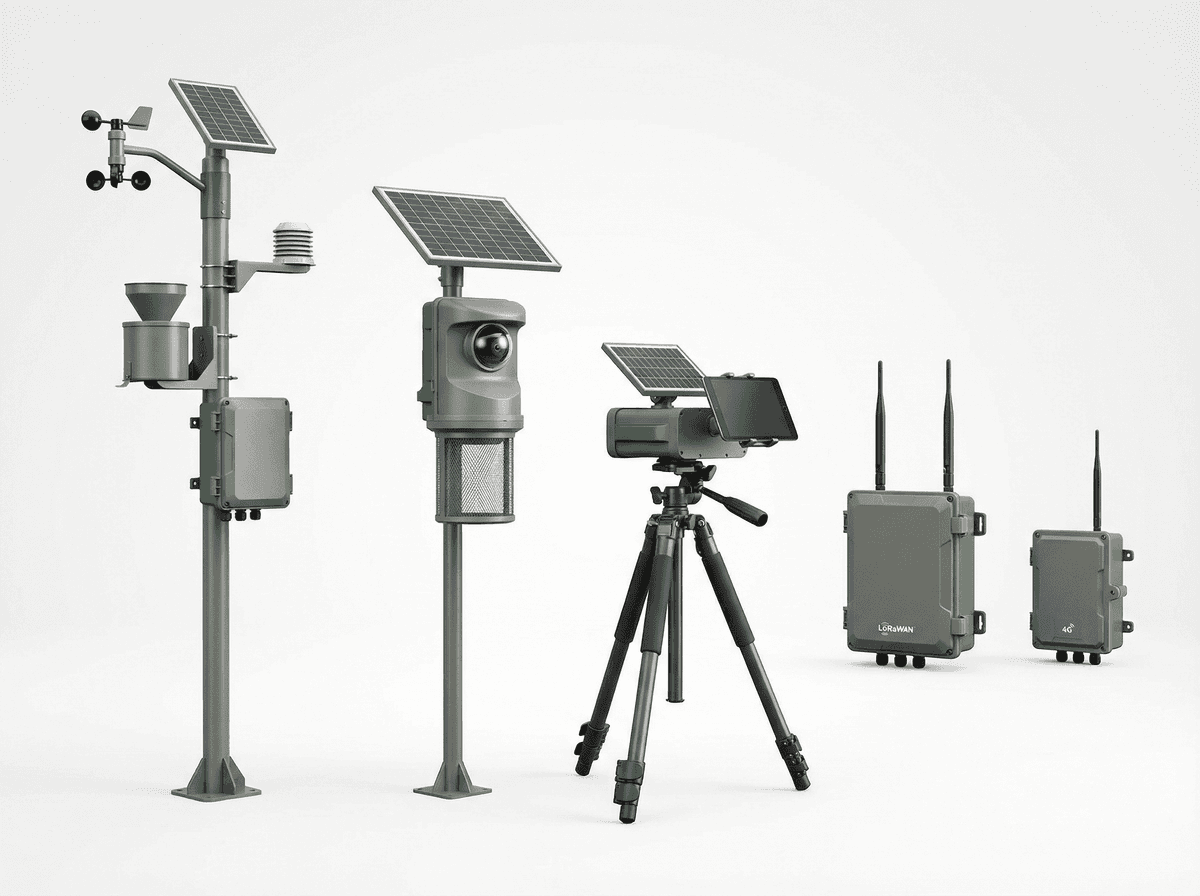
Integrated Pest+Disease 60ha - AI Camera Trap & Leaf Scanner IoT System
Key Features
- Covers 60 hectares with 18 field nodes integrating weather, pest, and disease monitoring into one unified IoT platform
- AI camera trap pest detection achieves 85–95% species identification accuracy for moths, aphids, armyworms, and fruit flies with daily count reports
- Multispectral leaf scanner detects fungal and oomycete infections 3–7 days before visible symptoms appear, enabling pre-symptomatic intervention
- Professional 10-parameter weather station measures temperature, humidity, wind, rainfall, solar radiation, pressure, and ET₀ at 10-minute intervals
- Solar-powered (80W + LFP battery) maintenance-free operation with 4G LTE real-time cloud connectivity and 30-day local data buffering
- Professional cloud platform delivers 72-hour disease risk forecasts, 7-day pest outbreak predictions, REST API integration, and SMS/Email/App alerts
- Documented ROI: 30% pesticide reduction, 50% water savings, 15–25% yield improvement — estimated 12–18 month payback on 60ha vegetable farm
The SOLARTODO Integrated Pest+Disease 60ha is a cutting-edge IoT monitoring system designed for vegetable farms, covering 60 hectares. Priced between $18,000 and $25,000, it features 18 solar-powered sensors and complies with ISO 11783 standards. This system is certified under IEC and CE, ensuring reliability in precision agriculture.
Description
SOLARTODO Integrated Pest+Disease 60ha — Precision Smart Agriculture IoT Monitoring System
Product Line: Smart Agriculture | Variant: Integrated Pest+Disease 60ha | Application: Vegetable Farm
Overview
The SOLARTODO Integrated Pest+Disease 60ha is a professional-grade, end-to-end IoT monitoring platform engineered for commercial vegetable farms operating across 60 hectares of cultivated land. By unifying three critical monitoring domains — professional-grade meteorological sensing, AI-powered camera trap pest detection, and multispectral leaf scanner disease surveillance — into a single cloud-connected ecosystem, this system delivers the actionable intelligence growers need to protect crop health, reduce chemical inputs, and maximize yield. The platform deploys a network of 18 field sensors and devices, all powered by maintenance-free solar energy and communicating via 4G LTE, feeding a Professional-tier cloud dashboard with real-time data at 10-minute intervals.
Designed in compliance with ISO 11783 (ISOBUS) agricultural data interchange standards and WMO meteorological instrumentation guidelines, the system bridges the gap between raw field observation and precision agronomic decision-making. Independent field studies have reported up to 30% reduction in pesticide applications, 50% reduction in irrigation water consumption, and 15–25% improvement in marketable yield when comparable integrated monitoring systems are deployed on commercial vegetable operations [1][2].
System Architecture
The SOLARTODO Integrated Pest+Disease 60ha system is organized around three functional subsystems that operate in concert through a unified LoRaWAN + 4G LTE communication backbone.
1. Professional Weather Station (10-Parameter)
At the heart of the environmental monitoring layer is a WMO-compliant professional weather station that simultaneously measures 10 atmospheric and radiometric parameters: air temperature (±0.2 °C accuracy), relative humidity (±2% RH), wind speed (0–75 m/s range), wind direction (360° resolution), rainfall (0.2 mm tipping bucket resolution), solar radiation (pyranometer, 0–2000 W/m²), atmospheric pressure (±0.5 hPa), and derived calculations for evapotranspiration (ET₀) using the FAO-56 Penman-Monteith method. This level of meteorological resolution enables the cloud platform's crop growth models to generate daily evapotranspiration estimates accurate to within ±5%, directly informing irrigation scheduling and fungal disease risk indices.
All weather sensors are housed in IP67-rated radiation shields and mounted on galvanized steel masts. The station transmits data at a configurable interval of 1 to 60 minutes (default: 10 minutes), with automatic data retransmission upon network recovery to ensure zero data loss during connectivity interruptions.
2. AI Camera Trap Pest Monitoring
The pest monitoring subsystem employs HD camera trap units paired with species-specific pheromone lures — a methodology that is both ecologically precise and non-lethal, unlike conventional insect killer light traps. Each camera trap unit captures high-resolution images of insects attracted to the pheromone lure and immediately processes them through an on-device AI inference engine capable of classifying target pest species with 85–95% identification accuracy [3].
Target pest species for vegetable farm applications include moths (e.g., Spodoptera exigua, Helicoverpa armigera), aphids (Myzus persicae, Aphis gossypii), armyworms (Spodoptera frugiperda), and fruit flies (Bactrocera dorsalis, Ceratitis capitata). Each unit generates daily count reports that are uploaded via 4G LTE to the cloud platform, where population trend analysis and outbreak probability models are continuously updated. When pest counts exceed configurable action thresholds, the system dispatches SMS, email, and in-app push alerts to farm managers within minutes of detection.
The camera trap enclosures are rated to IP67 (IEC 60529), operate across an ambient temperature range of −20 °C to +60 °C, and are powered by an 80W solar panel with LFP (lithium iron phosphate) battery backup, providing uninterrupted operation through up to 7 consecutive days of overcast conditions.
3. Multispectral Leaf Scanner Disease Monitoring
Disease surveillance is delivered through a multispectral leaf scanner that captures plant tissue imagery across multiple spectral bands — including near-infrared (NIR) and red-edge wavelengths — enabling the detection of early-stage fungal and oomycete infections before visible symptoms appear. This pre-symptomatic detection window, typically 3–7 days ahead of visible lesion formation, is critical for vegetable crops where rapid disease progression can devastate an entire block within days [4].
The leaf scanner's AI models are trained on crop-specific disease libraries covering powdery mildew, downy mildew, Botrytis cinerea (grey mould), rust, and late blight (Phytophthora infestans). Infection probability scores are computed per scan and correlated with weather station data (humidity, temperature, leaf wetness duration) to generate disease risk forecasts up to 72 hours in advance. The scanner operates in conjunction with a volumetric air spore sampler that continuously monitors airborne pathogen spore concentrations, providing an independent early-warning signal for spore-driven disease events.
Communication and Power Infrastructure
The entire 60-hectare sensor network is unified through a LoRaWAN gateway providing up to 10 km radius coverage — sufficient to serve all 18 field nodes from a single installation point — with a 4G LTE gateway providing the uplink to the cloud platform. The 4G LTE connection delivers the bandwidth required for real-time HD image and video upload from camera trap units, supporting image files up to several megabytes per capture event. Data transmission follows a store-and-forward protocol: if the 4G uplink is temporarily unavailable, all sensor nodes buffer readings locally and retransmit the complete dataset upon reconnection, ensuring 100% data integrity.
Each field device is powered by a medium solar power kit comprising an 80W monocrystalline solar panel and an LFP battery pack, conforming to IEC 61215 photovoltaic module performance standards. The LFP chemistry was selected for its superior cycle life (>3,000 cycles at 80% depth of discharge), wide operating temperature range (−20 °C to +60 °C), and inherent thermal stability — critical for unattended outdoor agricultural deployments. No grid connection or manual battery replacement is required under normal operating conditions.
Cloud Platform and AI Analytics
The Professional-tier cloud platform provides a real-time web and mobile dashboard accessible from any device. Key platform capabilities include:
| Feature | Specification |
|---|---|
| Data refresh interval | 10 minutes (configurable 1–60 min) |
| Historical data retention | Minimum 5 years |
| Pest population trend analysis | Daily/weekly/monthly charts |
| Disease risk index | 72-hour forecast, crop-specific |
| Irrigation recommendation | FAO-56 ET₀-based, daily output |
| Pest outbreak prediction | 7-day probability model |
| Yield forecasting | Seasonal model, ±10% accuracy |
| Alert channels | SMS + Email + App Push |
| API access | REST API, JSON format |
| Third-party integration | Irrigation valve control, ERP systems |
The platform's AI crop growth model integrates weather data, pest pressure indices, and disease risk scores to produce a unified Crop Health Score updated daily. This score provides farm managers with a single, actionable metric that aggregates the outputs of all three monitoring subsystems. The REST API enables seamless integration with existing farm management software, SCADA systems, and automated irrigation controllers, in compliance with ISO 11783 (ISOBUS) data exchange protocols.
Technical Specifications
| Parameter | Value |
|---|---|
| Coverage Area | 60 hectares |
| Monitoring Types | Weather, Pest, Disease |
| Total Field Nodes | 18 sensors/devices |
| Weather Station Type | Professional, 10-parameter, WMO-compliant |
| Pest Monitoring Method | HD Camera Trap + Pheromone Lure + AI |
| AI Pest ID Accuracy | 85–95% species identification |
| Disease Monitoring Method | Multispectral Leaf Scanner + Spore Trap |
| Disease Detection Lead Time | 3–7 days pre-symptomatic |
| Communication Protocol | LoRaWAN (field) + 4G LTE (uplink) |
| Power Supply | 80W Solar + LFP Battery (solar_medium) |
| Solar Panel Standard | IEC 61215 |
| Enclosure Rating | IP67 (IEC 60529) |
| Data Interval | 10 min (configurable 1–60 min) |
| Cloud Platform Tier | Professional |
| Alert Channels | SMS + Email + App Push |
| API | REST API (JSON) |
| Agriculture Standard | ISO 11783 (ISOBUS) |
| Warranty | 2 years hardware, 1 year cloud |
| Operating Temperature | −20 °C to +60 °C |
Return on Investment
The financial case for deploying the SOLARTODO Integrated Pest+Disease 60ha system is grounded in documented agronomic outcomes. On a 60-hectare commercial vegetable operation, the primary cost drivers are pesticide inputs, irrigation water, and crop losses from undetected pest and disease outbreaks. Peer-reviewed studies and independent field trials on precision agriculture IoT deployments report the following mean outcomes [1][2][5]:
- Pesticide reduction: 30% decrease in total pesticide applications, achieved through targeted spray timing based on AI pest count thresholds and disease risk forecasts rather than calendar-based schedules.
- Water savings: 50% reduction in irrigation water consumption through ET₀-based scheduling that eliminates over-irrigation.
- Yield improvement: 15–25% increase in marketable yield, primarily attributable to earlier disease intervention and reduced crop stress from optimized water and nutrient management.
At a conservative pesticide cost of $150/ha/season and an irrigation cost of $80/ha/season on a 60-hectare farm, annual savings from pesticide and water reduction alone can reach $16,200 per year, delivering a system payback period of approximately 12–18 months within the $18,000–$25,000 investment range.
Frequently Asked Questions
Q1: How many camera trap units are included in the 60ha configuration, and how are they distributed across the farm?
The 60-hectare configuration includes multiple camera trap units distributed according to a standardized grid layout, with one unit per 6–10 hectares depending on crop type and pest pressure history. The system's 18 total field nodes are allocated across weather sensing, pest trapping, and disease scanning functions. SOLARTODO's agronomic team provides a customized deployment map as part of the installation and training package, ensuring optimal spatial coverage and minimizing monitoring gaps at field boundaries.
Q2: What is the difference between the AI camera trap pest monitoring and a conventional insect killer light trap?
The AI camera trap system uses species-specific pheromone lures to attract only target pest species, combined with HD imaging and on-device AI classification. This approach achieves 85–95% species identification accuracy and produces daily count data without harming beneficial insects. Conventional insect killer light traps attract and kill a broad spectrum of insects indiscriminately, including pollinators and natural predators, and provide no automated species identification or population count data. The camera trap method is therefore both more ecologically responsible and agronomically informative.
Q3: Can the leaf scanner detect disease in crops other than the pre-trained vegetable models?
The leaf scanner ships with AI models pre-trained for common vegetable crops including tomato, cucumber, lettuce, pepper, and brassicas, covering diseases such as powdery mildew, downy mildew, Botrytis, rust, and late blight. Custom crop models can be developed and deployed via the cloud platform's model update mechanism. SOLARTODO's data science team offers custom model training services for additional crops or regional pathogen variants, typically requiring a minimum dataset of 500 annotated field images per disease class.
Q4: What happens to data if the 4G network connection is lost for an extended period?
All field sensor nodes and gateways incorporate local data buffering with sufficient storage capacity for a minimum of 30 days of data at the default 10-minute interval. Upon restoration of the 4G LTE uplink, the gateway automatically retransmits all buffered data to the cloud platform in chronological order, ensuring complete historical continuity. No manual intervention is required. The cloud platform timestamps all retransmitted records with their original field acquisition time, preserving the integrity of trend analysis and AI model inputs.
Q5: What installation and ongoing maintenance is required for the solar-powered field devices?
All field devices are designed for minimal-maintenance outdoor operation. The 80W solar panel and LFP battery system provides self-sustaining power with no grid connection required. Routine maintenance consists of a visual inspection and sensor cleaning every 3–6 months, and pheromone lure replacement for camera trap units every 4–6 weeks depending on species and season. SOLARTODO provides a comprehensive installation and commissioning service, including on-site technician deployment, device configuration, cloud platform setup, and a full-day agronomic training session for farm staff. The 2-year hardware warranty covers all manufacturing defects and sensor drift beyond specification.
Certifications and Standards
- ISO 11783 (ISOBUS) — Agricultural machinery data interchange standard
- WMO No. 8 — Guide to Meteorological Instruments and Methods of Observation
- IEC 61215 — Crystalline silicon terrestrial photovoltaic (PV) modules
- IEC 60529 (IP67/IP68) — Degrees of protection provided by enclosures
- CE Marking — European conformity for electromagnetic compatibility and safety
- FCC Part 15 — Radio frequency device authorization (4G LTE module)
- LoRaWAN 1.0.4 — LoRa Alliance specification for LPWAN communication
References
[1] FAO (2022). Digital Agriculture: Opportunities for Improving Farming Systems. Food and Agriculture Organization of the United Nations. https://www.fao.org/digital-agriculture
[2] GSMA (2023). Connected Agriculture: The Role of Mobile in Driving Efficiency and Sustainability in the Food and Agriculture Value Chain. https://www.gsma.com/mobilefordevelopment/connected-agriculture
[3] Zhang, J. et al. (2021). Deep learning-based insect pest recognition and counting from field images. Computers and Electronics in Agriculture, 187, 106268. https://doi.org/10.1016/j.compag.2021.106268
[4] Mahlein, A.K. (2016). Plant Disease Detection by Imaging Sensors – Parallels and Specific Demands for Precision Agriculture and Plant Phenotyping. Plant Disease, 100(2), 241–251. https://doi.org/10.1094/PDIS-03-15-0340-FE
[5] McKinsey Global Institute (2020). Precision Farming: Improving Productivity and Sustainability in Agriculture. https://www.mckinsey.com/industries/agriculture
Technical Specifications
| Coverage Area | 60hectares |
| Monitoring Types | Weather, Pest, Disease |
| Total Field Nodes | 18sensors/devices |
| Weather Station Type | Professional, 10-parameter, WMO-compliant |
| Pest Monitoring Method | HD Camera Trap + Pheromone Lure + AI |
| AI Pest ID Accuracy | 85–95% species identification |
| Disease Monitoring Method | Multispectral Leaf Scanner + Spore Trap |
| Disease Detection Lead Time | 3–7days pre-symptomatic |
| Communication Protocol | LoRaWAN (field) + 4G LTE (uplink) |
| Power Supply | 80W Solar + LFP Batterysolar_medium |
| Solar Panel Standard | IEC 61215 |
| Enclosure Rating | IP67IEC 60529 |
| Data Interval | 10min (configurable 1–60 min) |
| Cloud Platform Tier | Professional |
| Alert Channels | SMS + Email + App Push |
| API | REST API (JSON) |
| Agriculture Standard | ISO 11783 (ISOBUS) |
| Warranty | 2 years hardware, 1 year cloud |
| Operating Temperature | −20 to +60°C |
Price Breakdown
| Item | Quantity | Unit Price | Subtotal |
|---|---|---|---|
| Professional Weather Station (10-Parameter, WMO-Compliant) | 1 pcs | $1,500 | $1,500 |
| HD Camera Pest Trap (AI, Pheromone Lure) | 6 pcs | $850 | $5,100 |
| Multispectral Leaf Scanner (Disease Detection) | 1 pcs | $1,800 | $1,800 |
| Spore Trap (Volumetric Air Sampler, AI Analysis) | 1 pcs | $2,500 | $2,500 |
| LoRaWAN Gateway (10km Radius Coverage) | 1 pcs | $450 | $450 |
| 4G LTE Gateway (Cloud Uplink) | 1 pcs | $350 | $350 |
| Solar Power Kit (Medium, 80W + LFP Battery) | 18 pcs | $300 | $5,400 |
| Professional Cloud Platform (per device/year) | 18 pcs | $48 | $864 |
| Installation, Commissioning & Agronomic Training | 1 pcs | $500 | $500 |
| Total Price Range | $18,000 - $25,000 | ||
Frequently Asked Questions
How many camera trap units are included in the 60ha configuration, and how are they distributed across the farm?
What is the difference between the AI camera trap pest monitoring and a conventional insect killer light trap?
Can the leaf scanner detect disease in crops other than the pre-trained vegetable models?
What happens to data if the 4G network connection is lost for an extended period?
What installation and ongoing maintenance is required for the solar-powered field devices?
Certifications & Standards


Data Sources & References
- •FAO (2022). Digital Agriculture: Opportunities for Improving Farming Systems
- •GSMA (2023). Connected Agriculture: The Role of Mobile in Driving Efficiency and Sustainability
- •Zhang et al. (2021). Deep learning-based insect pest recognition. Computers and Electronics in Agriculture, 187, 106268
- •Mahlein A.K. (2016). Plant Disease Detection by Imaging Sensors. Plant Disease, 100(2), 241-251
- •McKinsey Global Institute (2020). Precision Farming: Improving Productivity and Sustainability in Agriculture
- •IEC 61215:2021 - Terrestrial photovoltaic (PV) modules - Design qualification and type approval
- •IEC 60529:2013 - Degrees of protection provided by enclosures (IP Code)
Interested in this solution?
Contact us for a customized quote based on your specific requirements.
Contact Us