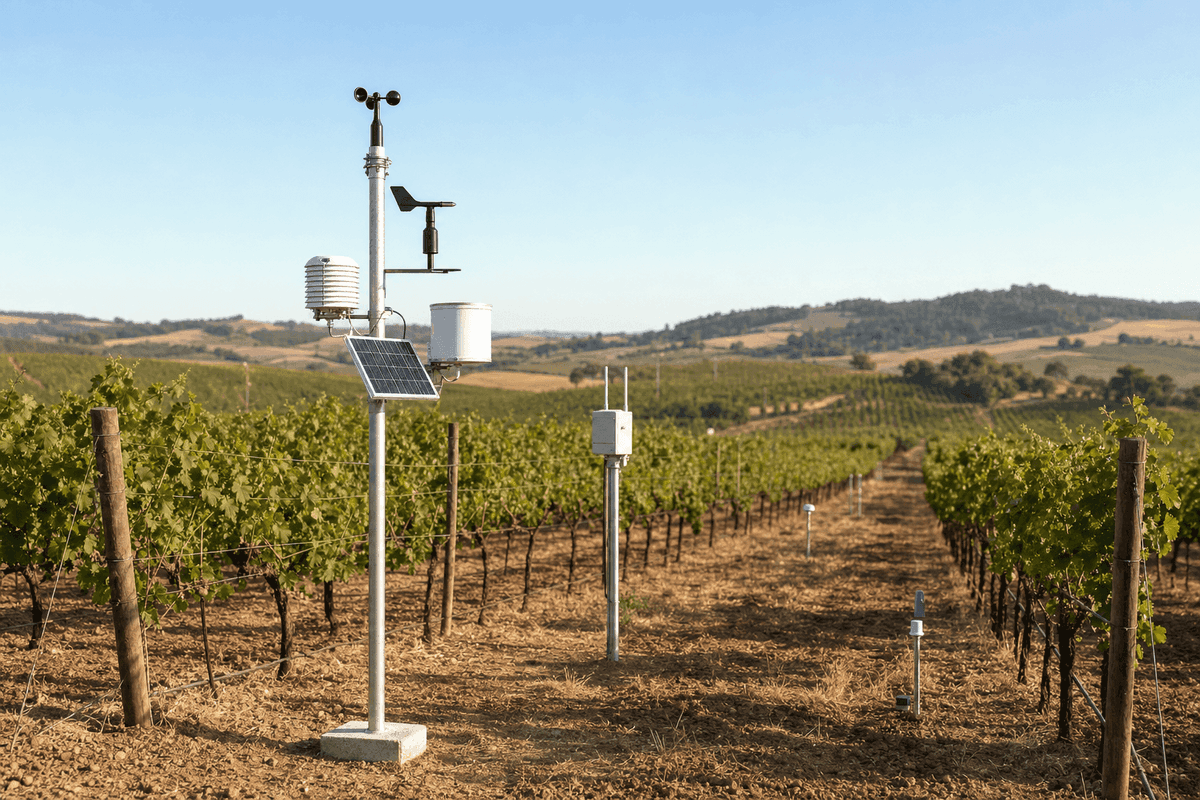
Basic Weather Station 10ha - 9-Sensor LoRaWAN Field Monitoring
Key Features
- 10 ha open-field weather monitoring package with 9 sensor channels
- LoRaWAN communication supports 10 km+ planning range and 500+ sensors per gateway architecture
- Solar-small power system uses a 10 W class PV kit with LFP battery for outdoor operation
- 10-minute data interval is configurable from 1 to 60 minutes with retransmission after recovery
- EPC turnkey price range is USD 1,800-2,300 including commissioning and 1-year support
Basic Weather Station 10ha is a solar-powered, LoRaWAN smart-agriculture weather station package for 10 hectares of open-field monitoring, using 9 weather sensors, 10-minute data intervals, and a professional cloud tier. EPC turnkey pricing is USD 1,800-2,300 including engineering, procurement, installation, commissioning, and 1-year support.
Description
The Basic Weather Station 10ha is a 9-sensor smart-agriculture IoT monitoring package for 10 hectares of open-field crop production, orchard blocks, seed farms, and irrigation districts. It combines LoRaWAN communication, a small solar-LFP power kit, 10-minute configurable telemetry, and a professional cloud dashboard so engineers and farm operators can track local weather conditions with project-level EPC pricing of USD 1,800-2,300.
For B2B buyers, this model is designed as the entry weather layer in the SOLARTODO Smart Agriculture IoT Monitoring System product line, with 1 LoRaWAN gateway, 1 solar-powered sensor node, 9 weather measurements, and REST API access for third-party farm software. It is suitable for procurement teams that need a defined 10 ha bill of materials, engineers that need IP67/IP68 outdoor hardware, and project developers comparing EPC turnkey costs against manual weather logging or cellular data loggers.
Product Definition
Basic Weather Station 10ha monitors temperature, relative humidity, wind speed, wind direction, rainfall, solar radiation, atmospheric pressure, evapotranspiration, and local weather trend data through a 9-sensor field configuration. The system is built for open-field use rather than greenhouse control, and the 10 ha coverage area is normally served by 1 station located at a representative measurement point, following the meteorological principle in WMO-No. 8 that site exposure, sensor height, and obstruction distance strongly affect weather data quality.
The standard telemetry interval is 10 minutes, configurable from 1 to 60 minutes when a crop model, irrigation schedule, or data-plan policy requires a different frequency. At 10-minute reporting, each node produces 144 timestamped records per day, 4,320 records per 30-day month, and more than 52,000 records per year, which gives agronomists enough density for rainfall event analysis, heat-stress alerts, and daily evapotranspiration estimates without excessive wireless traffic.
The package is positioned for buyers evaluating low-power wide-area networks for agriculture. LoRaWAN is selected because a single gateway can support 500+ low-data-rate sensors in a typical farm architecture and can provide 10 km+ line-of-sight range in suitable rural terrain, while sub-GHz unlicensed regional bands reduce recurring SIM-card costs compared with 4G-only sensor nodes.
System Architecture
The field architecture has 4 main layers: the weather sensor assembly, the solar-LFP power module, the LoRaWAN gateway, and the professional cloud application. The sensor assembly collects 9 weather values, the solar kit supplies off-grid energy through a 10 W class panel and LFP battery, the gateway backhauls packets through Ethernet or cellular uplink where available, and the cloud layer stores data for dashboards, AI alerts, REST API calls, and export files.
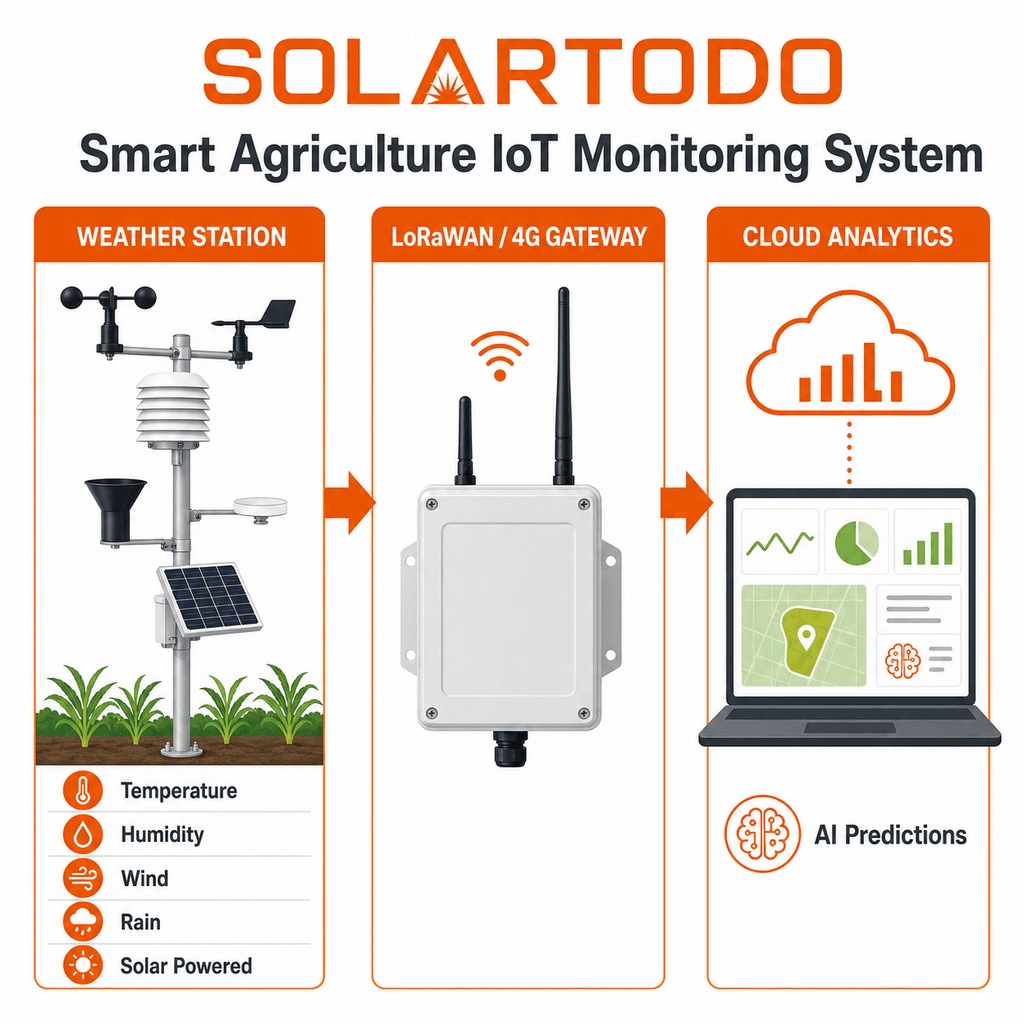
At field level, the station should normally be installed on 1 pole with clear exposure, stable grounding, and sensor heights matched to local agronomic requirements. Temperature and humidity readings are typically shielded near crop-canopy monitoring height, rainfall is kept free of splash and obstruction, and wind sensors are positioned to reduce turbulence; WMO-No. 8 guidance is referenced because even a 2 m obstruction or a nearby roofline can bias wind, rain, and radiation values.
The network layer uses LoRaWAN star topology, where end nodes transmit compact packets to 1 gateway instead of forming a high-maintenance mesh. This simplifies 10 ha deployments because the station can remain low-power, retransmit buffered data after network recovery, and avoid the higher current draw of continuous cellular modems; the LoRa Alliance LoRaWAN specification is the relevant protocol reference for device activation, adaptive data rate, and regional frequency planning.
Technical Specifications
| Parameter | Basic Weather Station 10ha specification |
|---|---|
| Coverage area | 10 hectares |
| Monitoring type | Weather monitoring |
| Weather measurements | 9 sensor channels |
| Communication | LoRaWAN, 10 km+ planning range in open terrain |
| Gateway capacity | 500+ low-rate sensors per gateway architecture |
| Power supply | Small solar panel plus LFP battery |
| Data interval | 10 minutes, configurable 1-60 minutes |
| Cloud tier | Professional dashboard and API |
| Alerts | SMS, email, and app push |
| Warranty | 2 years hardware and 1 year cloud support |
The 9 measured channels give growers a compact but decision-ready weather baseline. Temperature and humidity support vapor pressure deficit and disease-risk analysis, wind speed and direction support spraying windows, rainfall supports irrigation offsets, solar radiation supports crop-growth modeling, atmospheric pressure improves local weather interpretation, and evapotranspiration supports water-balance decisions with a daily millimeter estimate.
Hardware design follows outdoor instrumentation expectations rather than indoor IoT conventions. Sensor housings are specified for IP67/IP68-class protection where applicable under IEC 60529, the solar module references IEC 61215 qualification logic for photovoltaic durability, and the data system can be mapped to ISO 11783 integration concepts when farm machinery or ISOBUS-aligned software requires structured agricultural data exchange.
Cloud Monitoring
The professional cloud tier provides real-time dashboard views, historical trend analysis, AI-powered alerts, data export, and REST API access for 1 weather station device. At a 10-minute interval, operators can review 24-hour rainfall totals, 7-day heat patterns, 30-day wind distributions, and seasonal evapotranspiration curves, while procurement teams can standardize reporting across 10 ha pilot blocks before scaling to 50 ha, 100 ha, or 250 ha estates.
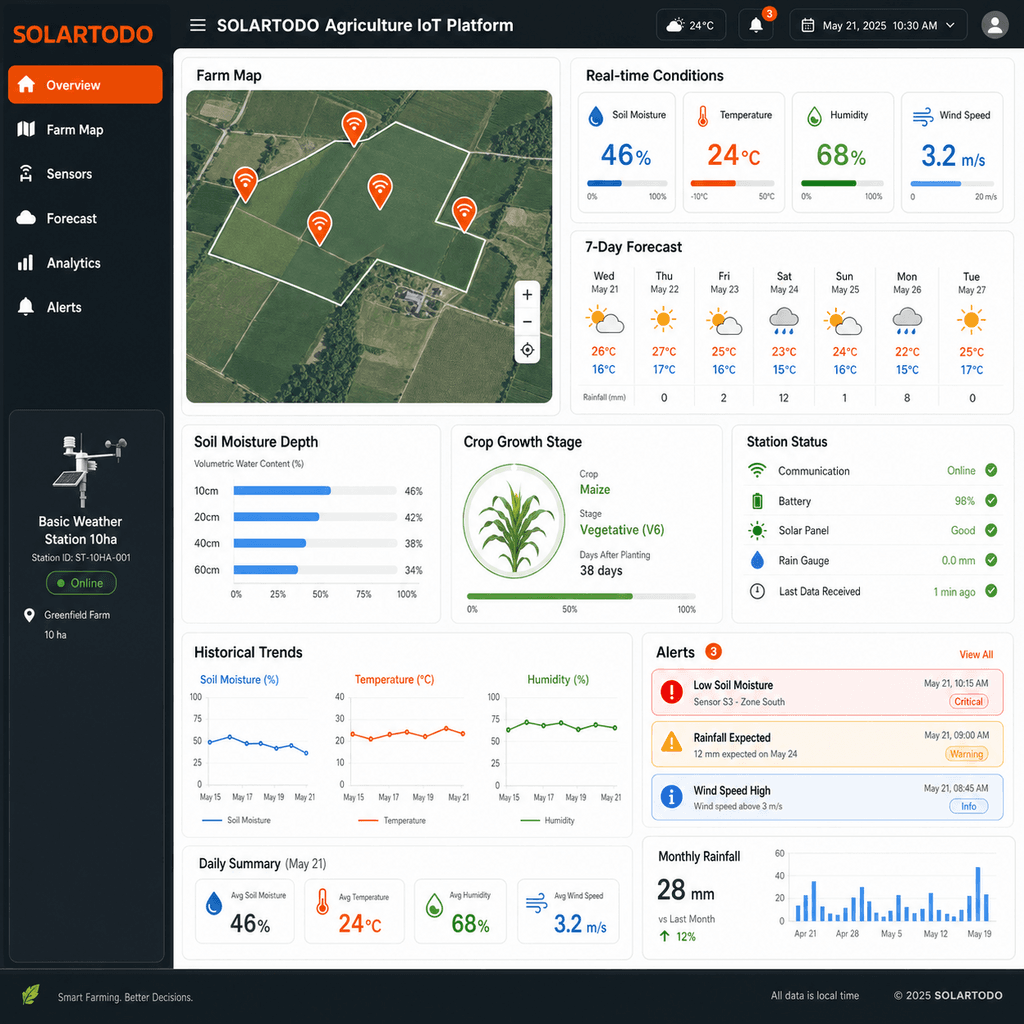
The alert engine is configured around 3 communication channels: SMS, email, and app push. Example rules include rainfall above a 10 mm threshold, wind speed above a spraying limit, temperature above a crop-specific heat-stress value, or missing data for 2 consecutive reporting cycles; these rules can reduce field inspection trips compared with conventional manual observation at 1 or 2 fixed times per day.
Data continuity is supported through local buffering and retransmission after network recovery, which is important when a rural backhaul link fails for 30-120 minutes during storms or power interruptions. The cloud API enables integration with irrigation controllers, farm ERP systems, agronomy dashboards, and alert workflows, and buyers can Configure your system online when the project requires additional soil, pest, storage, or water-quality nodes.
Representative Scenario: 10 ha Open-Field Irrigation Block
For a representative MENA open-field vegetable scenario of 10 hectares, the station is placed near the center of the block, 1 LoRaWAN gateway is mounted at an elevated point, and the cloud dashboard is configured with 10-minute weather records and daily evapotranspiration summaries. This scenario is illustrative only; it is not a claim that any named customer purchased, deployed, approved, or achieved a specific result without a verified project reference.
In this scenario, a farm using fixed irrigation timing may apply water every 24 hours regardless of wind, rainfall, or radiation. By using rainfall and evapotranspiration data, operators can compare irrigation demand against actual weather, and published precision-agriculture studies summarized by organizations such as NREL, IRENA, and IEA frequently identify water-energy optimization as a major benefit of digital agricultural infrastructure, especially where pumping energy and water scarcity are both material constraints.
Compared with a conventional manual rain gauge and handheld thermometer checked 1 time per day, the Basic Weather Station 10ha records 144 observations per day and can reduce weather-data blind spots by more than 99% in time resolution. Compared with a cellular-only weather logger, the LoRaWAN architecture can reduce recurring SIM management across multi-node farms because 1 gateway can aggregate hundreds of low-bandwidth sensor nodes.
Applications
Primary applications include irrigation scheduling, crop heat-stress monitoring, spray-window management, disease-risk screening, insurance-grade field records, agronomy reporting, and renewable-powered remote farm monitoring. The system is appropriate for 10 ha pilot farms, seed-production plots, research farms, open-field vegetables, orchards, vineyards, and distributed rural infrastructure where grid power is unavailable or unreliable for 8-24 hours at a time.
In irrigation management, evapotranspiration and rainfall data can support water-balance decisions that may reduce unnecessary pumping cycles when compared with calendar-only irrigation. The technical knowledge base for smart agriculture reports potential outcomes such as up to 50% water reduction, 30% pesticide reduction, and 15-25% yield improvement in suitable precision-farming programs, but SOLARTODO treats these as reported industry outcomes rather than guaranteed site-specific results.
In crop-protection planning, wind speed, wind direction, humidity, rainfall, and temperature provide the minimum context for safer spray decisions. A 10-minute weather log can show whether a 2-hour spray window stayed inside project limits, while SMS and app alerts can warn teams before wind or rainfall invalidates an application plan; this creates a measurable operational improvement over verbal field observations with no timestamped audit trail.
Buyers planning a larger estate can View all Smart Agriculture IoT Monitoring System products to compare weather-only packages with soil monitoring, pest traps, camera traps, storage sensors, and water-quality monitoring. For technical background on digital agriculture, communications, and sensor deployment, SOLARTODO also provides related resources at Learn about topic.
Standards, Compliance, and Engineering References
The weather-station design is aligned with WMO siting and measurement guidance, IEC 60529 ingress-protection terminology, LoRaWAN network specifications, ISO 11783 agricultural data concepts, and IEC 61215 photovoltaic module qualification principles. These references do not turn a compact 10 ha station into a national meteorological observatory, but they provide procurement teams with recognized standards language for tender documents and technical submittals.
Energy and sustainability context comes from 5 authoritative source families: NREL research on agrivoltaics and farm energy systems, IRENA publications on renewable energy in agri-food chains, IEA work on energy efficiency and digitalization, LoRa Alliance specifications for LPWAN communication, and WMO guidance for meteorological observations. These sources are used as engineering references for system planning, not as customer-result claims.
EPC Investment Analysis and Pricing Structure
EPC turnkey delivery for USD 1,800-2,300 includes engineering, procurement, construction, commissioning, and 1-year warranty support. Engineering covers sensor selection, gateway placement, pole and power layout, configuration of 10-minute data intervals, alert logic, and API readiness; procurement covers weather-station hardware, LoRaWAN gateway, solar power kit, cloud subscription, mounting accessories, and quality control before shipment.
| Pricing tier | Scope | Price range, USD |
|---|---|---|
| FOB Supply | Equipment only, ex-works China | 1,116-1,564 |
| CIF Delivered | Equipment plus ocean freight and insurance | 1,164-1,631 |
| EPC Turnkey | Installed, commissioned, and supported for 1 year | 1,800-2,300 |
| Volume band | Discount from standard equipment pricing |
|---|---|
| 50+ systems | 5% discount |
| 100+ systems | 10% discount |
| 250+ systems | 15% discount |
The representative EPC bill uses USD 1,564 of FOB equipment value, then adds engineering, installation, commissioning, training, warranty, and support to reach USD 2,114, which sits inside the stated EPC turnkey range. Payment terms are 30% T/T deposit plus 70% against B/L, or 100% L/C at sight, with financing review available for qualified projects above USD 1,000K; quotation requests can be sent through Request a custom quotation or by email to [email protected].
ROI depends on crop value, irrigation cost, labor rate, and whether the weather station is connected to irrigation actions. For a 10 ha block, if weather-based scheduling avoids only USD 400-700 per year in excess pumping, field checks, and spray rescheduling, the simple payback on a USD 2,114 representative EPC package is roughly 3.0-5.3 years; if water scarcity penalties or high-value crops increase savings to USD 1,000 per year, payback can shorten to about 2.1 years.
Cost comparison also favors scalable architecture in multi-block deployments. A standalone cellular logger may appear cheaper for 1 point, but adding 10, 50, or 100 nodes can multiply SIM cards, subscriptions, and battery maintenance; a LoRaWAN gateway approach centralizes backhaul and can serve hundreds of sensors when farms expand beyond weather into soil moisture, pest monitoring, tank levels, and pump-room data.
Procurement Notes
The standard configuration includes 1 professional weather station assembly, 1 LoRaWAN gateway, 1 small solar power kit, 1 mounting and enclosure set, 1 professional cloud license, and EPC services. Buyers should confirm 3 site inputs before final quotation: the nearest backhaul connection, the intended mast location, and whether local regulations require a specific LoRaWAN regional band such as EU868, US915, AS923, AU915, IN865, or CN470.
For tender documents, the key acceptance criteria should include 9 weather channels, 10 ha design coverage, 10-minute records, cloud dashboard access, REST API availability, alert delivery, IP67/IP68 outdoor protection, 2-year hardware warranty, and 1-year cloud support. SOLARTODO can extend the package with additional gateways, redundant backhaul, soil sensors, pest devices, and irrigation valve control when a pilot grows from 10 ha to 100 ha or more.
Buying Guidance
Choose Basic Weather Station 10ha when the project needs weather-only monitoring for a defined 10 ha block, with solar power, LoRaWAN communication, and professional cloud analytics at a controlled EPC budget below USD 2,300. Choose a larger smart-agriculture package when the project also needs soil moisture profiling, water-quality monitoring, AI pest traps, camera verification, storage sensing, or closed-loop irrigation control across multiple zones.
SOLARTODO supplies solar, energy storage, smart lighting, security, telecom and power towers, and smart agriculture systems through an integrated infrastructure portfolio at https://solartodo.com. The Basic Weather Station 10ha package is therefore suitable for projects where farm data, renewable power, and field communications need to be procured from 1 supplier with clear FOB, CIF, and EPC commercial structures.
Technical Specifications
| Coverage Area | 10ha |
| Monitoring Types | weather |
| Total Sensors | 9sensors |
| Communication | LoRaWAN |
| Power Supply | solar_small with LFP battery |
| Data Interval | 10 min configurable 1-60min |
| Cloud Platform | professional |
| Alert Channels | SMS + Email + App Push |
| API Access | REST API included |
| Warranty | 2 years hardware, 1 year cloud |
| Application | open_field |
| Gateway Planning Range | 10+km |
| Gateway Sensor Capacity | 500+sensors |
Price Breakdown
| Item | Quantity | Unit Price | Subtotal |
|---|---|---|---|
| Professional 9-channel weather station assembly | 1 pcs | $1,200 | $1,200 |
| LoRaWAN gateway for farm sensor network | 1 pcs | $225 | $225 |
| Solar power kit, small 10 W class with LFP battery | 1 pcs | $55 | $55 |
| Mounting pole, enclosure, wiring, and field accessories | 1 pcs | $36 | $36 |
| Professional cloud platform license, 1 device-year | 1 pcs | $48 | $48 |
| Engineering, configuration, and quality control | 1 pcs | $180 | $180 |
| Installation, commissioning, and operator training | 1 pcs | $250 | $250 |
| 1-year warranty support and remote assistance | 1 pcs | $120 | $120 |
| Total Price Range | $1,800 - $2,300 | ||
Frequently Asked Questions
What is included in the Basic Weather Station 10ha EPC package?
How many hectares can 1 Basic Weather Station 10ha system monitor?
Does the system require grid power or SIM cards at every sensor?
Which weather variables are measured by the 9-sensor configuration?
Can the weather station connect to irrigation or farm-management software?
Certifications & Standards


Data Sources & References
- •World Meteorological Organization WMO-No. 8 Guide to Instruments and Methods of Observation
- •LoRa Alliance LoRaWAN Specification and Regional Parameters
- •IEC 60529 Degrees of Protection Provided by Enclosures
- •IEC 61215 Terrestrial Photovoltaic Module Design Qualification
- •ISO 11783 Tractors and Machinery for Agriculture and Forestry Serial Control and Communications Data Network
- •NREL agrivoltaics and agricultural energy research publications
- •IRENA and IEA renewable energy and agri-food digitalization publications
Interested in this solution?
Contact us for a customized quote based on your specific requirements.
Contact Us