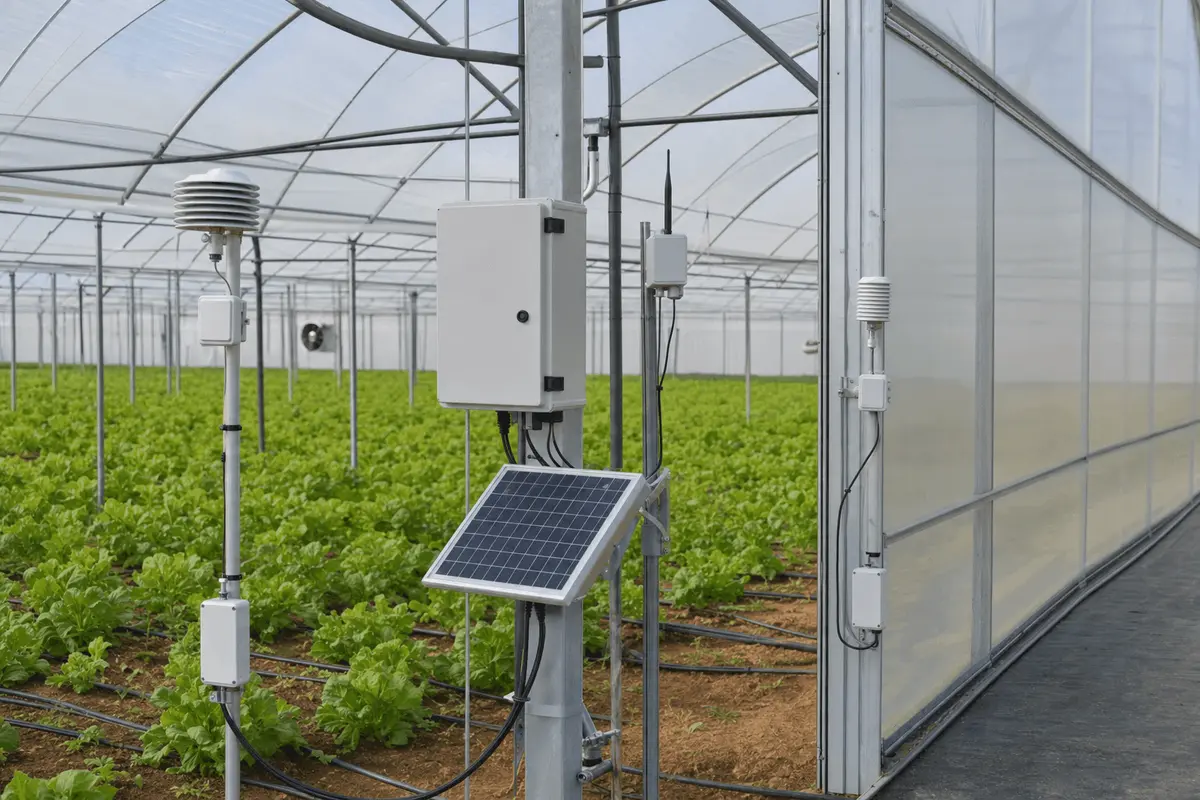
Poultry House Environment Control 5000sqm - 30-Sensor IoT Monitoring
Key Features
- 5,000 sqm poultry-house coverage with 0.5 ha site monitoring
- 30 total sensors for weather, storage, ammonia, and ventilation control
- 10-minute default data interval, configurable from 1 to 60 minutes
- $2,000-$2,600 EPC turnkey price with installation and 1-year support
- SMS, email, and app push alerts with REST API integration
Poultry House Environment Control 5000sqm is a professional smart-agriculture IoT system for a 0.5 ha poultry facility, using 30 sensors, WiFi/Ethernet communication, grid power, ammonia monitoring, ventilation control, and 10-minute cloud data intervals. EPC turnkey pricing is $2,000-$2,600, including engineering, procurement, installation, commissioning, and 1-year support.
Description
Poultry House Environment Control 5000sqm is a professional smart-agriculture IoT monitoring and control package for 1 poultry building with 5,000 sqm of floor area and 0.5 ha site coverage. The system combines 30 sensors, professional weather monitoring, comprehensive storage/environment monitoring, ammonia detection, ventilation control, WiFi/Ethernet networking, grid power, and a professional cloud platform with 10-minute data intervals.
Designed for B2B poultry operators, EPC contractors, integrators, and agricultural developers, this SOLARTODO package supports 1 production house where temperature, relative humidity, ammonia, ventilation status, storage conditions, weather exposure, and alarm response must be measured continuously. The system is specified for EPC turnkey delivery at $2,000-$2,600 and can be benchmarked against ISO 11783 agricultural electronics guidance, WMO weather-observation practices, IEC 60529 IP67/IP68 enclosure protection, and IEEE 802.3 Ethernet networking principles.
Product Scope and Use Case
The 5000sqm poultry-house configuration is intended for broiler, layer, pullet, or breeder facilities where 30 distributed measurement points are enough to create a practical environmental map across 1 long building, 2 service zones, or several storage and ventilation areas. Compared with manual handheld inspection performed 2-4 times per day, 10-minute automated logging creates 144 records per sensor per day and gives operators a much earlier warning of ammonia accumulation, fan failure, humidity drift, or weather-related heat stress.
A typical deployment uses 1 professional weather station outside the house, multiple indoor sensor nodes near bird level, storage-area monitoring near feed or warehouse zones, and relay/control interfaces for ventilation commands. This configuration is especially useful when poultry density, feed conversion, mortality, litter moisture, and biosecurity depend on keeping environmental deviation within narrow operating bands over 24 hours per day.
For product-line comparison, procurement teams can View all Smart Agriculture IoT Monitoring System products or Configure your system online with site-specific sensor counts from 10 to 100+ devices. For procurement support, engineering clarifications, or commercial terms above 1 building, buyers can Request a custom quotation from SOLARTODO.
System Architecture
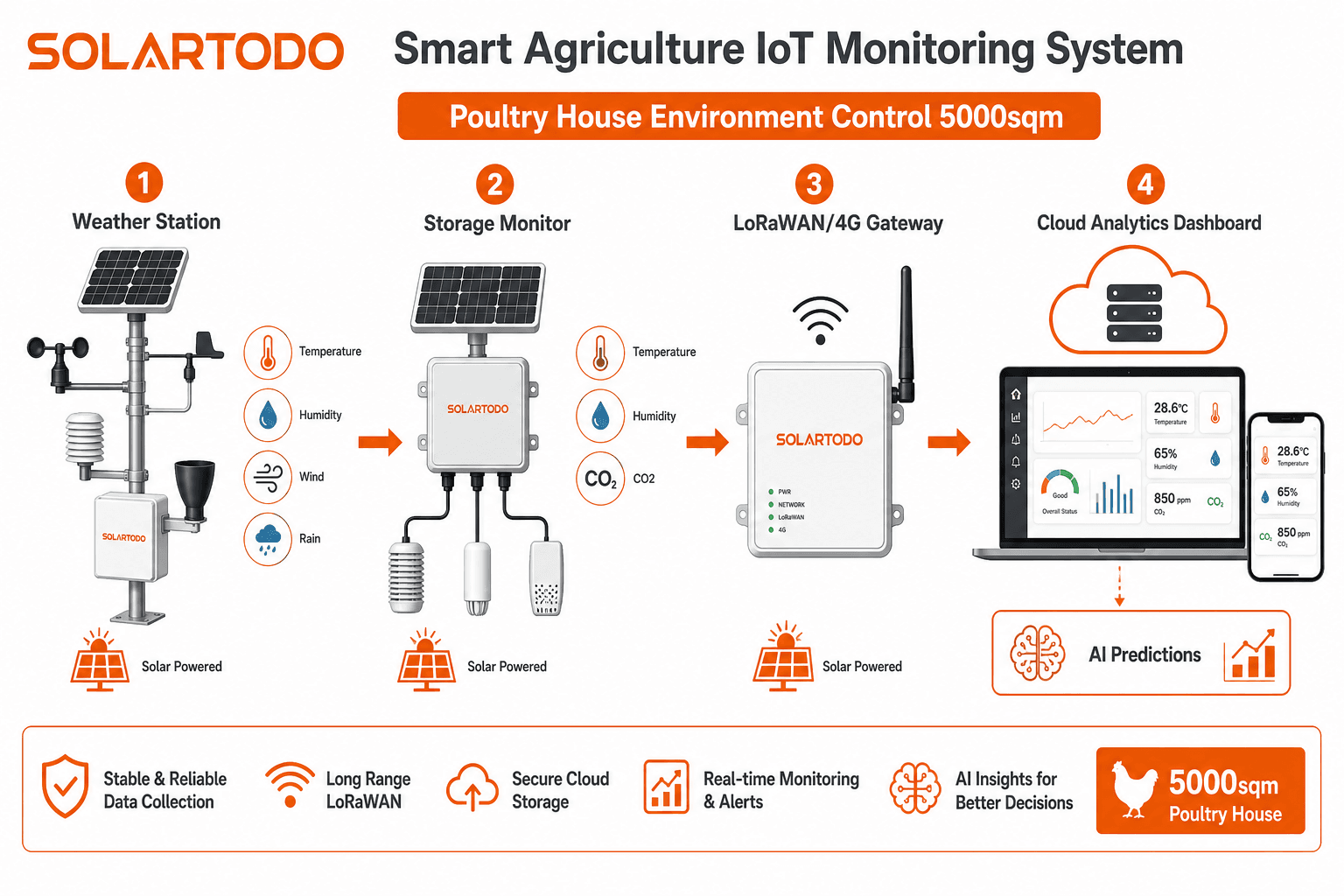
The architecture uses 4 core layers: sensing, control, communications, and cloud analytics. The sensing layer includes 30 total sensors for weather and storage/environment monitoring, while the control layer links measured ammonia, temperature, humidity, and ventilation status to alarm logic and fan-control outputs.
The communications layer is optimized for indoor poultry houses using WiFi/Ethernet rather than long-range LoRaWAN because a 5,000 sqm enclosed building benefits from low latency, high bandwidth, and stable gateway placement. IEEE 802.3 Ethernet is commonly used for industrial local-area networks, and WiFi backhaul can support dashboard access where cabling is limited to 1 control room or 2 equipment corridors.
The cloud layer records data every 10 minutes by default, with configurable sampling from 1 to 60 minutes depending on flock age, ventilation mode, and site bandwidth. Data retransmission after network recovery reduces data loss during outages, and the professional dashboard supports historical trend analysis, AI-assisted alerts, and exportable records for management review.
Technical Specifications
The system is specified for 0.5 ha coverage and 5,000 sqm indoor building monitoring, with 30 sensors assigned across weather, storage, and poultry-house environmental control points. A professional weather station measures temperature, humidity, wind speed, wind direction, rainfall, solar radiation, atmospheric pressure, and evapotranspiration, aligning with WMO recommendations for structured meteorological observation.
Indoor monitoring can include temperature, relative humidity, ammonia, carbon dioxide, oxygen, and storage-zone conditions depending on final sensor allocation. In feed-storage or warehouse locations, multi-point monitoring supports temperature and humidity mapping, while comprehensive storage logic can also track CO2, O2, ethylene, insect activity, or thermal gradients where relevant to feed or agricultural material handling.
The power configuration is grid-connected, which is appropriate for permanent poultry houses with fans, controllers, lighting, and network equipment already powered by a 24-hour electrical system. Optional solar kits from 10 W to 80 W and LFP battery packs can be added for auxiliary outdoor sensors, but this 5000sqm variant is priced around grid power to keep EPC cost within $2,000-$2,600.
IEC 60529 IP67/IP68 sensor enclosure ratings are relevant for dusty, humid, wash-down, and ammonia-exposed agricultural environments, although final ingress-protection class depends on selected sensor housings and cable glands. CE, RoHS, and EMC compliance are commonly requested for B2B import projects, while UL or local electrical approval may be specified for projects with 1 or more public-financed facilities.
Cloud Monitoring
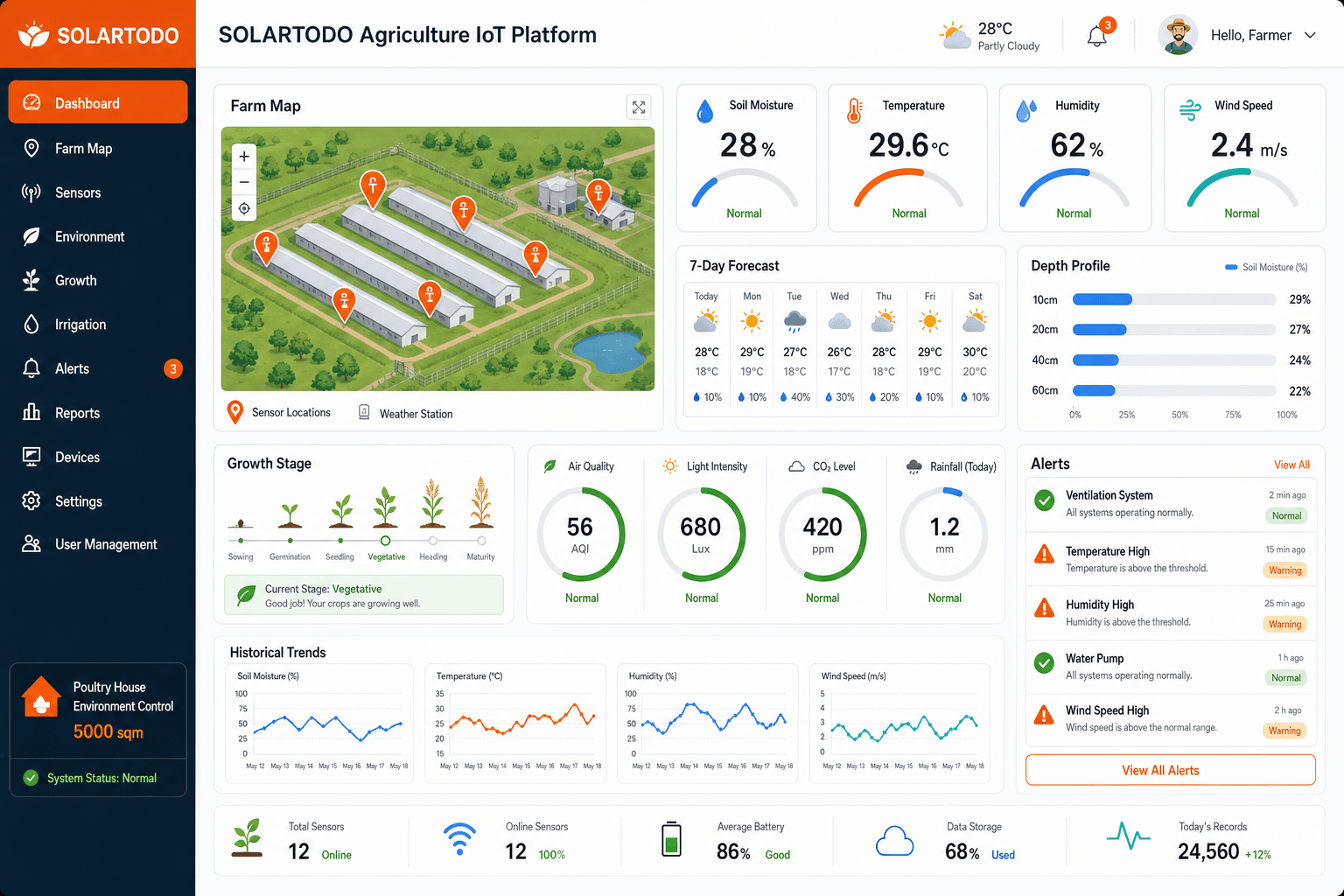
The professional cloud tier provides 1 real-time dashboard, historical trend charts, threshold alarms, AI-assisted alert logic, and REST API access for third-party farm-management systems. Alerts can be sent by SMS, email, and app push, allowing 3 operating roles such as farm manager, maintenance technician, and owner representative to receive separate notifications.
For poultry facilities, the most important operating value is the correlation of 4 variables: temperature, humidity, ammonia, and ventilation status. When ammonia rises above site-defined limits for 10-30 minutes, the system can trigger alerts and support ventilation-control decisions before bird comfort, worker safety, litter condition, or feed conversion is affected.
The cloud database supports year-over-year benchmarking across 1 flock cycle or multiple production cycles, and it can export CSV or API records for compliance, insurance, and operational analysis. NREL and IEA energy-efficiency publications repeatedly show that measured performance data is necessary before controls can be optimized, and this principle applies directly to agricultural fans, motors, and environmental loads.
Applications
A 5,000 sqm poultry house can use 30 measurement points to divide the building into 5-10 management zones, depending on fan layout, inlet position, bird age, and stocking density. Typical zones include inlet-side temperature, exhaust-side humidity, centerline ammonia, service-room network equipment, feed-storage monitoring, and outdoor weather exposure.
In 1 application scenario, a MENA-region poultry operator with 2 houses and high summer heat deployed a 30-sensor control package in the first 5,000 sqm building. By comparing fan runtime, ammonia alarms, and daily temperature curves over 6 weeks, the operator identified 2 underperforming ventilation zones and reduced manual inspection rounds from 4 per day to 1 targeted verification round per day.
Compared with conventional thermostats and manual ammonia tubes, the IoT approach reduces blind spots because it records 144 data points per sensor per day instead of relying on 2-4 human observations. In many smart-farm deployments, automated monitoring can reduce water and chemical waste by 30-50% where irrigation or pesticide controls are included, and poultry-house projects can apply the same measurement-first logic to ventilation energy, litter moisture, and alarm response.
For related procurement background, buyers can Learn about topic on smart-agriculture monitoring, cloud dashboards, and farm IoT integration. Engineering teams can also use Learn about topic to compare sensor placement strategies, enclosure ratings, and network architecture before finalizing a 1-house or multi-house bill of quantities.
EPC Investment Analysis and Pricing Structure
The EPC turnkey scope includes 5 work packages: engineering design, procurement, construction/installation, commissioning, and warranty support. Engineering covers sensor layout, network design, alarm thresholds, and ventilation-control interface logic; procurement covers 30 sensors, gateway/controller hardware, cloud licensing, cables, brackets, and installation materials; commissioning verifies 10-minute data uploads, alarm routing, dashboard access, and control outputs.
| Pricing tier | Scope | Price range |
|---|---|---|
| FOB Supply | Equipment only, ex-works China | $1,240-$1,768 |
| CIF Delivered | Equipment plus ocean freight and insurance | $1,293-$1,844 |
| EPC Turnkey | Installed, commissioned, and supported for 1 year | $2,000-$2,600 |
| Order volume | Discount | Commercial note |
|---|---|---|
| 50+ systems | 5% | Suitable for regional integrators and 50-house rollouts |
| 100+ systems | 10% | Suitable for group procurement across 100 poultry houses |
| 250+ systems | 15% | Suitable for national programs or 250-site framework contracts |
The ROI model depends on flock value, mortality reduction, labor cost, fan efficiency, and feed conversion improvement, but a conservative payback period is often 12-24 months for a 5,000 sqm controlled poultry environment when avoided losses and reduced manual inspection are counted. If 1 facility saves $120 per month through fewer emergency callouts, better ventilation response, and reduced inspection time, annual savings reach $1,440, which can offset a $2,000-$2,600 EPC investment in roughly 17-22 months.
Cost comparison against alternatives is straightforward: a basic thermostat-and-manual-inspection setup may cost less upfront, but it usually provides 0 cloud records, 0 API access, and limited ammonia visibility. A higher-end industrial SCADA retrofit can cost 3-10 times more than this package when PLC engineering, control cabinets, cabling, and licensed supervisory software are required for 1 poultry house.
Standard payment terms are 30% T/T deposit plus 70% against B/L copy, or 100% irrevocable L/C at sight for approved buyers. Project financing can be discussed for programs above $1,000K, and commercial inquiries should be sent to [email protected] with building size, country, quantity, sensor list, ventilation-control requirements, and preferred Incoterms.
Standards, Data Quality, and Integration
ISO 11783 is relevant to agricultural electronics interoperability, while WMO weather-station practice supports consistent outdoor observation, and IEC 60529 defines IP protection categories for enclosures used near dust, humidity, and wash-down conditions. IEA and IRENA analysis on digitalized energy systems also emphasizes that measured data and automation are central to reducing energy waste in distributed infrastructure.
REST API integration allows 1 poultry-house dashboard to connect with farm ERP, maintenance software, or a third-party alarm platform. The API can transfer timestamped values, device status, threshold events, and historical records, which helps integrators connect environmental data with 1 flock record, 1 feed program, or 1 maintenance log.
The system supports AI-assisted alerts and predictions, but SOLARTODO recommends using at least 30-60 days of site data before applying aggressive automation rules. This commissioning period allows the model to learn normal daily variation, fan staging behavior, seasonal weather influence, and sensor-specific baselines across 1 production cycle.
Procurement Notes
For procurement teams, the most important pre-order data are 7 items: building length, building width, ventilation type, number of fan groups, ammonia monitoring points, network topology, and dashboard user count. These 7 details determine whether the standard 30-sensor package is sufficient or whether a 40-sensor or 60-sensor design is more appropriate.
SOLARTODO supplies solar, energy storage, smart lighting, security, telecom/power towers, and smart-agriculture systems from 1 B2B platform, which helps EPC buyers combine farm IoT with power and infrastructure packages. The Poultry House Environment Control 5000sqm variant is therefore positioned as a practical, price-controlled control layer for 1 professional poultry building rather than a laboratory-only monitoring kit.
Authoritative reference sources include WMO guidance for weather observations, IEC 60529 enclosure protection, ISO 11783 agricultural electronics, IEEE 802.3 Ethernet, IEA digital energy analysis, IRENA renewable and digital infrastructure reports, and NREL measurement-based energy-performance methodology. These sources support the engineering basis for 10-minute monitoring, standards-aware enclosure selection, structured data collection, and control-oriented analytics.
Technical Specifications
| Coverage Area | 0.5ha |
| Building Area | 5000sqm |
| Application | Poultry house environment control |
| Livestock Type | Poultry |
| Monitoring Types | Weather and storage/environment monitoring |
| Weather Monitoring Level | Professional weather station |
| Storage Monitoring Type | Comprehensive |
| Total Sensors | 30sensors |
| Communication | WiFi/Ethernet |
| Power Supply | Grid |
| Ventilation Control | Included |
| Ammonia Monitoring | Included |
| Data Interval | 10, configurable 1-60min |
| Cloud Platform | Professional |
| Alert Channels | SMS, Email, App Push |
| API Access | REST API included |
| Warranty | 2 years hardware, 1 year cloud |
Price Breakdown
| Item | Quantity | Unit Price | Subtotal |
|---|---|---|---|
| Professional weather station package | 1 pcs | $420 | $420 |
| Indoor ammonia and climate sensor nodes | 10 pcs | $38 | $380 |
| Storage and feed-area monitoring sensors | 8 pcs | $32 | $256 |
| Ventilation-control interface modules | 2 pcs | $85 | $170 |
| WiFi/Ethernet gateway and controller | 1 pcs | $180 | $180 |
| Cabling, brackets, power supplies, and installation materials | 1 pcs | $210 | $210 |
| Professional cloud platform, 1-year license | 1 pcs | $180 | $180 |
| Engineering, layout design, and QC documentation | 1 pcs | $260 | $260 |
| Installation and commissioning | 1 pcs | $320 | $320 |
| 1-year warranty and remote support | 1 pcs | $180 | $180 |
| Total Price Range | $2,000 - $2,600 | ||
Frequently Asked Questions
What is included in the $2,000-$2,600 EPC turnkey price?
How many poultry houses can one 5000sqm system monitor?
Does the system control ventilation automatically?
Can ammonia monitoring be customized for different poultry layouts?
What standards are relevant for this poultry IoT system?
Certifications & Standards




Data Sources & References
- •IEC 60529 enclosure protection standard
- •ISO 11783 ISOBUS agricultural electronics standard
- •IEEE 802.3 Ethernet standard
- •WMO Guide to Instruments and Methods of Observation
- •NREL measurement-based energy performance methodology
- •IEA digitalization and energy efficiency analysis
- •IRENA renewable energy and digital infrastructure reports
Interested in this solution?
Contact us for a customized quote based on your specific requirements.
Contact Us