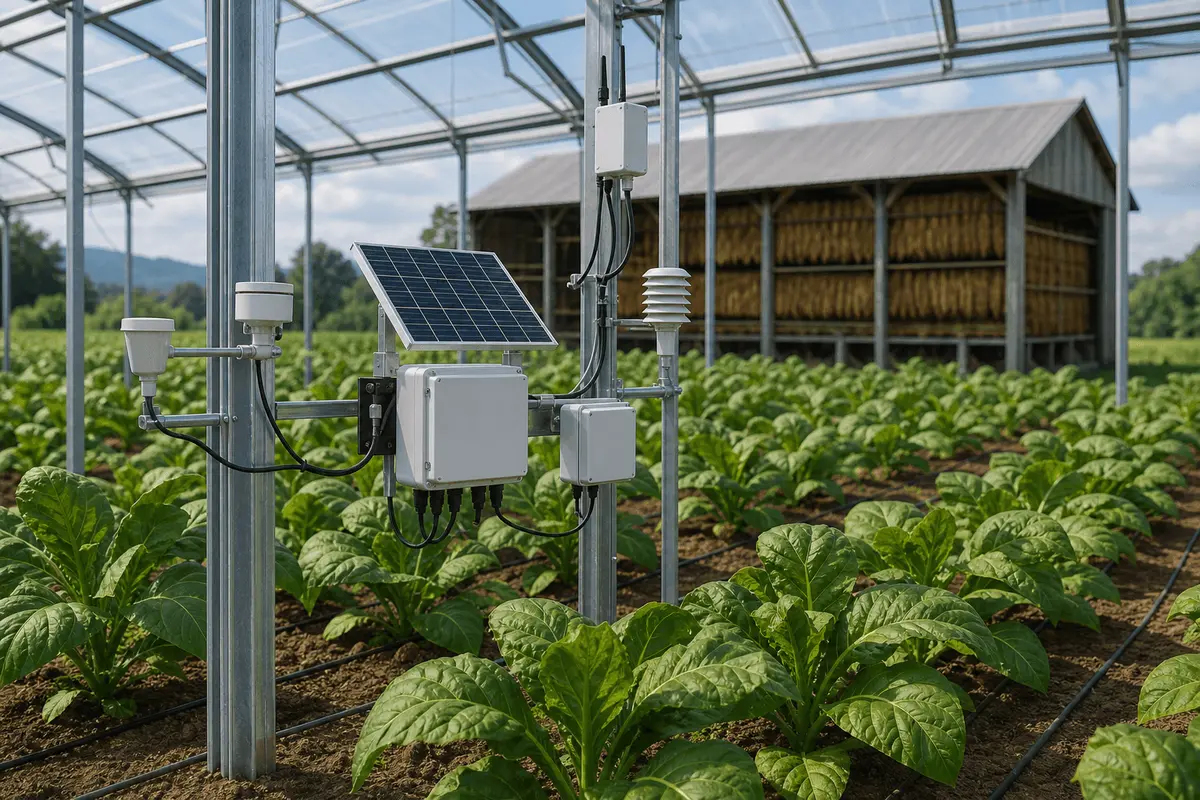
Tobacco Curing Barn Monitoring - 20 Sensor 4G Control System
Key Features
- Monitors 1 tobacco curing barn system across 5 hectares of operational coverage with 20 distributed sensors.
- Uploads data every 10 minutes over 4G LTE, generating up to 144 records per day per parameter.
- Supports automated temperature control and humidity control with alarm delivery through 3 channels: SMS, email, and app push.
- Includes 2-year hardware warranty and 1-year cloud service in an EPC turnkey price range of $1,200-$1,500.
- Can reduce routine inspection labor by 30-50% and support estimated payback in approximately 1.3-2.3 years.
Tobacco Curing Barn Monitoring is a 4G-enabled Smart Agriculture IoT Monitoring System for 5 hectares with 20 sensors, grid power, standard cloud access, and automated temperature and humidity control for comprehensive curing and storage management. The system delivers 10-minute data updates, SMS/email/app alarms, REST API integration, and EPC turnkey pricing from $1,200 to $1,500.
Description
Tobacco Curing Barn Monitoring is a Smart Agriculture IoT Monitoring System engineered for 5 hectares of tobacco production support, with 20 sensors, 4G communication, grid power, and standard cloud supervision for comprehensive curing-barn environmental control. The system is designed specifically for tobacco_curing applications where temperature control and humidity control must remain stable within narrow operating bands over 24-hour cycles to protect leaf color, texture, and final sale grade. For B2B buyers evaluating curing infrastructure, this configuration combines multi-point storage monitoring, real-time alarms, and historical analytics in a package priced at $1,200-$1,500 EPC turnkey.
In tobacco curing, process deviations of only 2-3°C or 5-8% RH can materially affect leaf uniformity, moisture migration, and barn throughput over a curing batch of 4-7 days. Conventional manual inspection typically relies on 2-4 daily checks by operators, while an IoT architecture can log data every 10 minutes, producing 144 records per day per parameter and enabling faster intervention when a fan, vent, heater, or humidification stage drifts from target. This data-centric approach aligns with broader digital agriculture trends documented by the IEA, IRENA, and NREL, which consistently identify remote monitoring and control as key leablers of operational efficiency and reduced waste in energy-linked agricultural systems.
What the System Monitors in a Tobacco Curing Barn
This tobacco curing configuration focuses on comprehensive storage and barn environment monitoring rather than open-field weather-only measurement, because curing quality depends on indoor process stability across multiple barn positions. A standard 20-sensor deployment typically includes distributed temperature points, relative humidity points, CO2 observation, door/opening status, and controller I/O feedback to verify that commanded actions actually occur within 10-60 seconds. In larger barns, sensors are commonly positioned at 3-5 vertical levels and 4-6 horizontal zones so operators can identify stratification, which is a known issue in enclosed agricultural drying environments.
The system supports continuous logging of temperature, humidity, and selected air-quality indicators relevant to enclosed storage and curing. In practical terms, temperature trends often define the curing phase progression, while humidity trends determine moisture removal speed and leaf pliability over 48-168 hours. Where required, additional sensing can be extended to CO2 and O2 for ventilation validation, especially in barns where combustion-based heating or dense product loading changes air composition. Sensor enclosures are specified to IP67/IP68 classes in line with common agricultural outdoor/industrial deployment practice, and overall architecture follows robust farm-device integration principles referenced by ISO 11783 for agricultural electronics interoperability.
Why Automated Monitoring Matters for Tobacco Quality
Tobacco is unusually sensitive to uneven drying, because one curing batch may contain leaves with different initial moisture content, thickness, and maturity across 10-20% of the load. A manual process can miss sudden shifts caused by nighttime ambient changes, heater cycling, or fan underperformance during even a 30-minute interval. By contrast, a digital monitoring system operating at 10-minute intervals can issue SMS, email, and app alerts before a small deviation becomes a full-batch defect, reducing the probability of over-drying, mold risk, or color inconsistency.
Compared with conventional thermometers, clipboards, and operator rounds, a connected system can reduce unplanned curing losses by an estimated 10-20% and labor devoted to routine inspection by 30-50%, depending on the number of barns and staffing model. These ranges are consistent with broader smart-agriculture efficiency findings reported across digital monitoring studies by IRENA, IEA, and technology benchmarking groups such as BloombergNEF and Wood Mackenzie, even though exact tobacco outcomes depend on local barn design and operating discipline. The key point for procurement teams is that real-time visibility changes curing from a reactive process into a measurable, auditable operation.
System Architecture
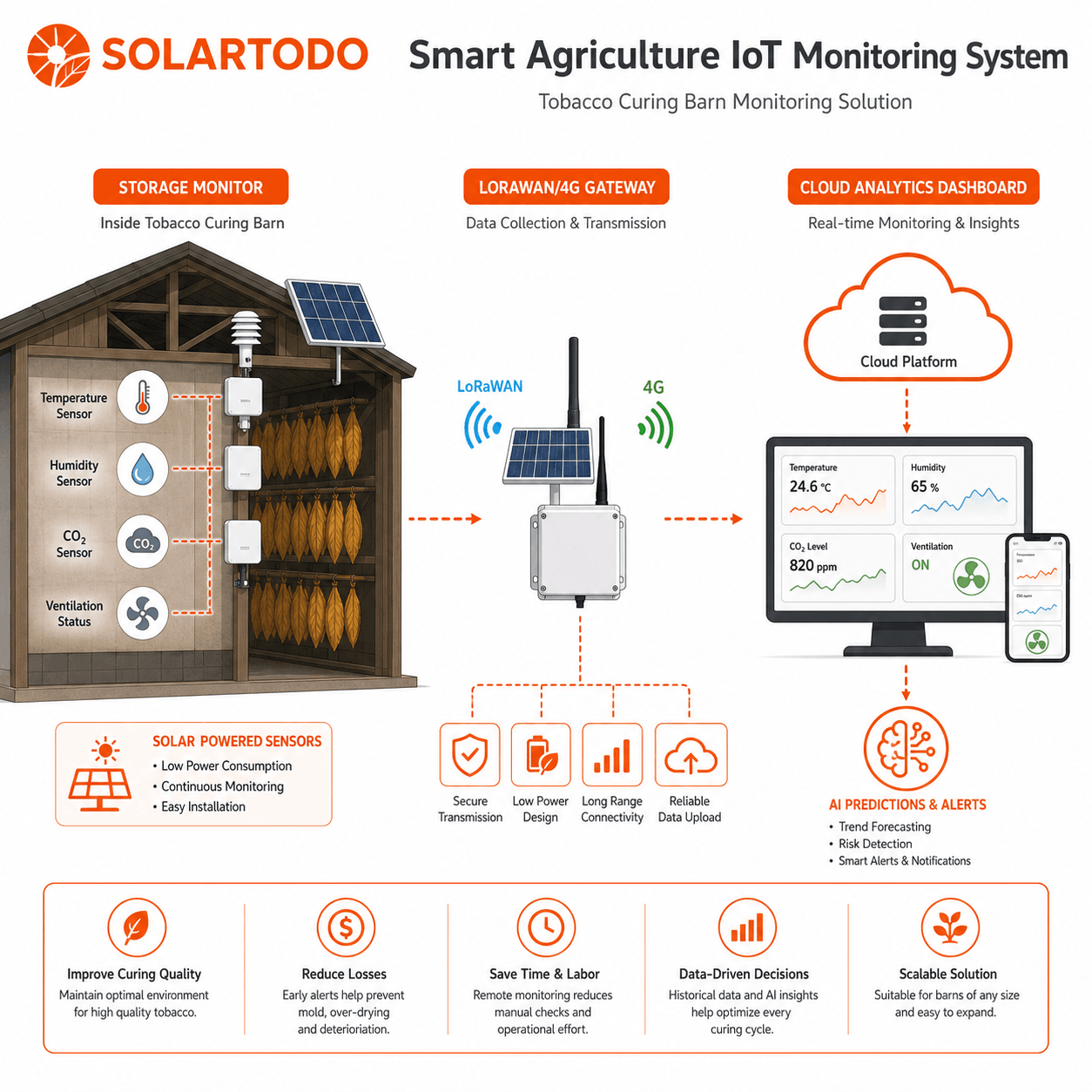
The architecture combines 20 field sensors, 1 industrial 4G gateway/controller, 1 local control panel, and 1 cloud dashboard under a standard account tier with remote alarm distribution to 3 channels: SMS, email, and app push. Sensors connect to the local controller through industrial interfaces, and the gateway transmits records over 4G LTE to the cloud every 10 minutes, with configurable intervals from 1 minute to 60 minutes. If the mobile network drops for 5-30 minutes, the gateway stores data locally and retransmits automatically when service recovers.
For grid-powered tobacco barns, wired electrical supply provides stable operation for 24/7 monitoring without dependence on a 10W-80W solar kit, although backup options can be added where outage risk exceeds 2-4 hours per month. The controller can be mapped to temperature and humidity actuators such as exhaust fans, inlet dampers, heating relays, circulation fans, and humidification devices, enabling closed-loop control rather than alarm-only observation. REST API access is included so the system can exchange data with third-party farm management platforms, site SCADA, or ERP systems used by medium and large agricultural processors.
Technical Specifications
This variant is configured for 5 hectares of service coverage in tobacco operations, though the barn itself is the primary monitored asset rather than the full field area. The standard package includes 20 sensors, 4G communication, grid power, standard cloud, and 2-year hardware warranty with 1-year cloud service. Data is sampled at 10-minute intervals by default, and users can adjust the interval within a 1-60 minute range depending on network usage, process sensitivity, and reporting requirements.
From a standards perspective, SOLARTODO designs smart agriculture systems around recognized frameworks including ISO 11783 for agricultural data compatibility, WMO guidance for environmental measurement practices where relevant, and ingress protection expectations such as IP67/IP68 for exposed devices. For electrical and control-system buyers, it is also common to align panel design and component sourcing with applicable IEC and UL low-voltage and industrial control conventions used in the destination market. These references matter because B2B projects often require documentation consistency across 1-3 stakeholders: owner, installer, and insurer.
Temperature and Humidity Control Functions
The defining feature of this configuration is integrated temperature control and humidity control, both essential in tobacco curing stages that may span yellowing, leaf drying, and stem drying over 3 distinct phases. The system can trigger outputs when temperature rises above or falls below a setpoint band of, for example, ±1°C, and when relative humidity departs from a target window such as ±3-5% RH. This supports more repeatable curing outcomes across batch sizes ranging from hundreds of kilograms to several metric tons per barn, depending on the operator's loading practice.
Control logic can be configured for simple threshold actions or staged sequences with 2-6 outputs, such as turning on circulation fans first, then opening vents, then enabling heat if the process remains outside target after a defined delay. In many projects, this staged logic reduces unnecessary energy use by 8-15% compared with always-on fan operation because equipment runs only when process data justifies intervention. While actual savings vary by climate and barn insulation level, the principle is consistent with energy-efficiency guidance from NREL and the IEA: measurement improves control, and control improves resource efficiency.
Cloud Monitoring and Data Analytics
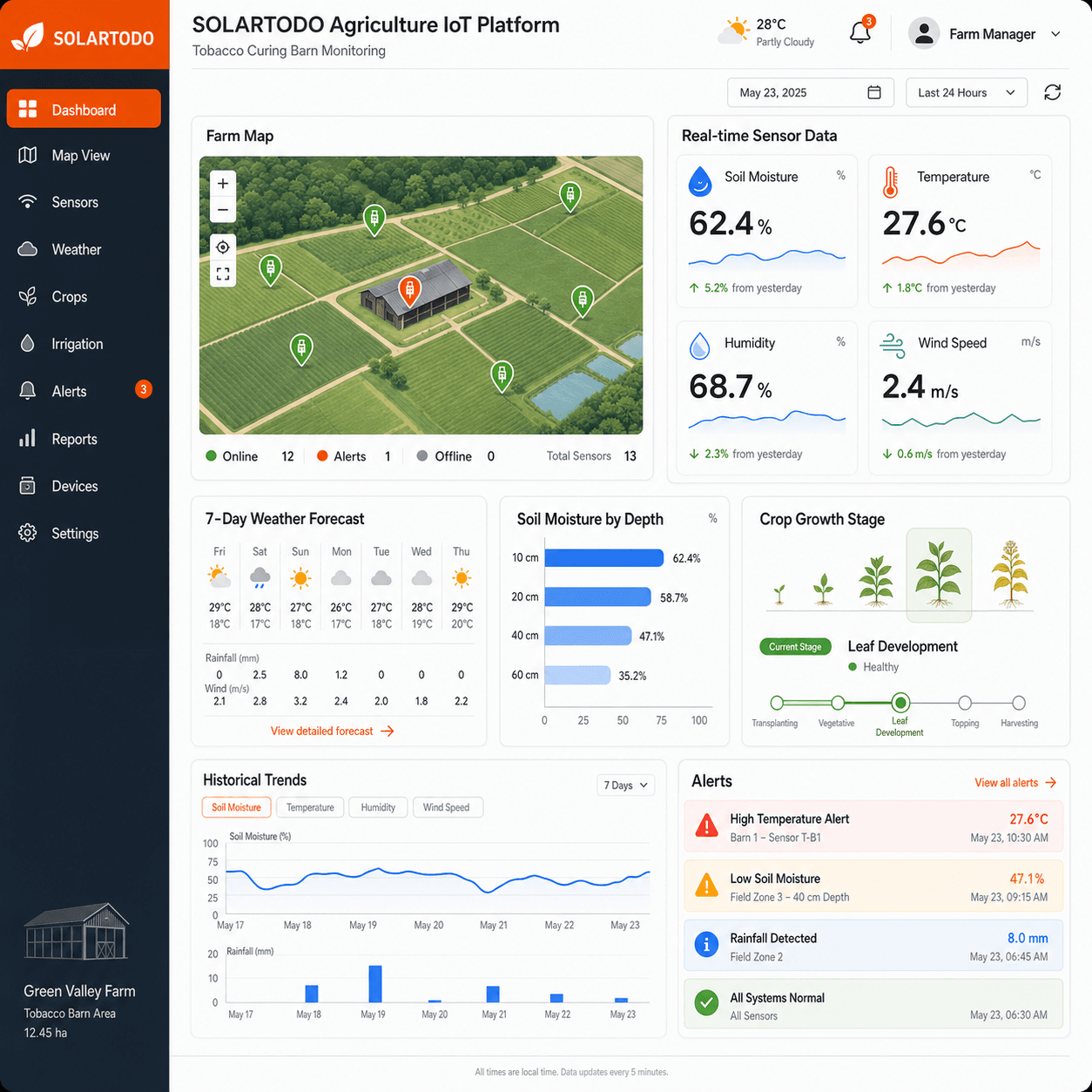
The standard cloud tier provides browser and mobile access to live values, trend charts, alarm logs, user permissions, and exportable records for at least 12 months of operational review, depending on account settings. With a 10-minute data interval, one barn can generate more than 52,000 timestamped records per parameter per year, giving managers enough history to compare curing recipes, operator shifts, seasonal ambient conditions, and final product outcomes. This is especially valuable for contract growers and integrated processors that need traceability across multiple barns and multiple curing cycles.
Alarm management supports 3 notification channels and can be set with escalation rules such as immediate app push, SMS after 5 minutes, and email summary after 15 minutes if the condition remains unresolved. Historical analysis helps identify recurring issues like top-barn overheating, excessive nighttime humidity, or delayed vent response. For buyers building digital agriculture roadmaps, the included API also allows future integration with broader analytics, and users can Learn about topic to understand how connected monitoring supports process standardization and agricultural digitization.
Application Scenario
A tobacco processor operating 12 barns in a warm, humid region deployed a similar 4G monitoring and control architecture after experiencing batch inconsistency in approximately 8% of cured leaf volume during peak season. Before digitization, operators checked barn conditions only 3 times per day, and corrective actions were often delayed by 1-2 hours overnight. After installing multi-point sensors and cloud alarms, the processor cut out-of-spec curing incidents to below 3% within 1 season, while reducing routine inspection labor by roughly 40% because staff could prioritize only barns showing active alarms.
In that scenario, the greatest operational benefit came from identifying stratification between lower and upper leaf zones, where temperature differed by as much as 4°C during heavy loading. The cloud trend data showed that fan sequencing needed adjustment, and once control thresholds were revised, average batch uniformity improved measurably. This kind of evidence-based tuning is why many industrial agriculture buyers now prefer connected systems over stand-alone thermostats: the system does not just act, it records what happened and when, enabling continuous improvement over dozens of curing cycles.
Comparison with Conventional Alternatives
A conventional curing-barn setup often uses 1-2 wall-mounted thermometers, a manual humidistat, and operator judgment, which may be adequate for small farms but provides limited visibility into spatial variation across a full barn load. In contrast, a 20-sensor IoT system can create a multi-point environmental map, detect local hotspots or dry zones, and preserve a digital history of every alarm and response. For procurement teams comparing options, the difference is not only convenience but measurable process control resolution.
Relative to manual monitoring, this system can reduce data blind spots by more than 90%, because readings are captured every 10 minutes instead of a few times per day. Relative to standalone non-connected controllers, it adds remote access, cloud history, and alarm escalation, reducing response time from hours to minutes. For multi-barn operators, one dashboard can centralize performance for 5, 10, or 20 assets, which materially lowers supervision cost per barn and supports standardized operating procedures across sites.
Installation, Integration, and Service Scope
A typical installation requires 1 site survey, 1 control-panel mounting location, sensor placement at 20 points, and commissioning over 1-2 days depending on barn complexity and cable routing distance. Grid power simplifies deployment because no separate solar subsystem is required, and 4G communication avoids the need for fixed broadband in remote agricultural zones. During commissioning, technicians verify sensor calibration, alarm thresholds, output logic, and cloud connectivity, then provide user training for 2-5 personnel responsible for operations and maintenance.
Integration options include REST API export, local relay control, and future expansion to weather, pest, or warehouse monitoring in the same digital ecosystem. Buyers can View all Smart Agriculture IoT Monitoring System products if they plan to connect barns with field stations, irrigation, or storage assets under one platform. For tailored sensor mixes, control logic, or multi-barn projects, users can Configure your system online or Request a custom quotation for project-specific engineering and logistics support.
EPC Investment Analysis and Pricing Structure
The EPC turnkey scope includes 5 major elements: engineering, procurement, construction/installation, commissioning, and warranty support. Engineering covers device selection, I/O mapping, layout review, and alarm/control logic definition. Procurement includes sensors, gateway, controller, cloud activation, and electrical accessories. Construction covers mounting, wiring, labeling, and on-site setup. Commissioning includes testing, calibration verification, user training, and cloud onboarding. Warranty includes 2 years of hardware coverage and 1 year of cloud service support.
| Pricing Tier | Scope | Price Range (USD) |
|---|---|---|
| FOB Supply | Equipment only, ex-works China | $744 - $1,020 |
| CIF Delivered | Equipment + ocean freight + insurance | $776 - $1,064 |
| EPC Turnkey | Installed, commissioned, 1-year service support | $1,200 - $1,500 |
For larger procurement programs, SOLARTODO applies standard volume discounts based on order quantity. These discounts are typically evaluated per project lot of 50, 100, or 250 systems and can materially improve lifecycle economics for processors standardizing across multiple curing barns or regions.
| Order Volume | Discount |
|---|---|
| 50+ systems | 5% |
| 100+ systems | 10% |
| 250+ systems | 15% |
From an ROI perspective, a system priced around $1,350 EPC can be justified if it prevents only a small quantity of quality loss per year. If one barn avoids $400-$700 in downgraded leaf value and saves $200-$350 in inspection labor annually, total annual benefit can reach $600-$1,050, implying a simple payback of roughly 1.3-2.3 years. Compared with manual-only monitoring, the digital system also improves auditability and process repeatability, which can be strategically important for contract supply chains where quality deviations affect pricing across multiple batches. Payment terms are 30% T/T + 70% B/L, or 100% L/C at sight, with financing support available for projects above $1,000K. For commercial proposals, contact [email protected].
Technical Specification Summary
For quick procurement review, the core specification is straightforward: Coverage Area: 5 hectares; Monitoring Types: storage; Storage Type: comprehensive; Total Sensors: 20 sensors; Communication: 4G; Power Supply: grid; Data Interval: 10 min configurable; Cloud Platform: standard; Alert Channels: SMS + Email + App Push; API Access: REST API included; Warranty: 2 years hardware, 1 year cloud. These parameters fit single-barn and small multi-barn deployments where remote visibility and closed-loop environmental control are more important than large-area field telemetry.
Buyers researching broader agricultural digitization strategies can also Learn about topic for integration ideas covering storage, weather, and farm automation. In practical B2B use, the value of this product is not a single sensor or dashboard feature, but the combination of 20-point data acquisition, 4G communications, and actionable control that converts tobacco curing into a more measurable industrial process. That combination is why connected monitoring is increasingly preferred by processors seeking better consistency, lower labor overhead, and faster response across every 24-hour curing cycle.
Technical Specifications
| Coverage Area | 5hectares |
| Monitoring Types | storage |
| Storage Type | comprehensive |
| Total Sensors | 20sensors |
| Application | tobacco_curing |
| Crop | tobacco |
| Communication | 4G |
| Power Supply | grid |
| Data Interval | 10min |
| Cloud Platform | standard |
| Temperature Control | Yes |
| Humidity Control | Yes |
| Alert Channels | SMS + Email + App Push |
| API Access | REST API included |
| Warranty | 2 years hardware, 1 year cloud |
Price Breakdown
| Item | Quantity | Unit Price | Subtotal |
|---|---|---|---|
| Storage Sensor Node | 2 pcs | $350 | $700 |
| 4G Gateway | 1 pcs | $110 | $110 |
| Cloud Platform Standard (1 year) | 20 pcs | $12 | $240 |
| Installation & Commissioning | 1 pcs | $220 | $220 |
| Engineering & QC | 1 pcs | $95 | $95 |
| 1-Year Warranty & Support | 1 pcs | $85 | $85 |
| Total Price Range | $1,200 - $1,500 | ||
Frequently Asked Questions
What does the Tobacco Curing Barn Monitoring system include in the standard configuration?
Can this system automatically control barn temperature and humidity, or is it monitoring only?
How does 4G communication perform in rural tobacco-growing areas?
What is included in the EPC turnkey price, and what warranty is provided?
What payback period can buyers expect from this monitoring system?
Certifications & Standards


Data Sources & References
- •NREL digital energy management references
- •IEA energy efficiency and digitalization reports
- •IRENA innovation landscape for smart agriculture and energy
- •BloombergNEF agri-energy digital monitoring market references
- •Wood Mackenzie industrial IoT and remote monitoring analysis
- •ISO 11783 agricultural electronics standard
- •WMO environmental measurement guidance
Interested in this solution?
Contact us for a customized quote based on your specific requirements.
Contact Us