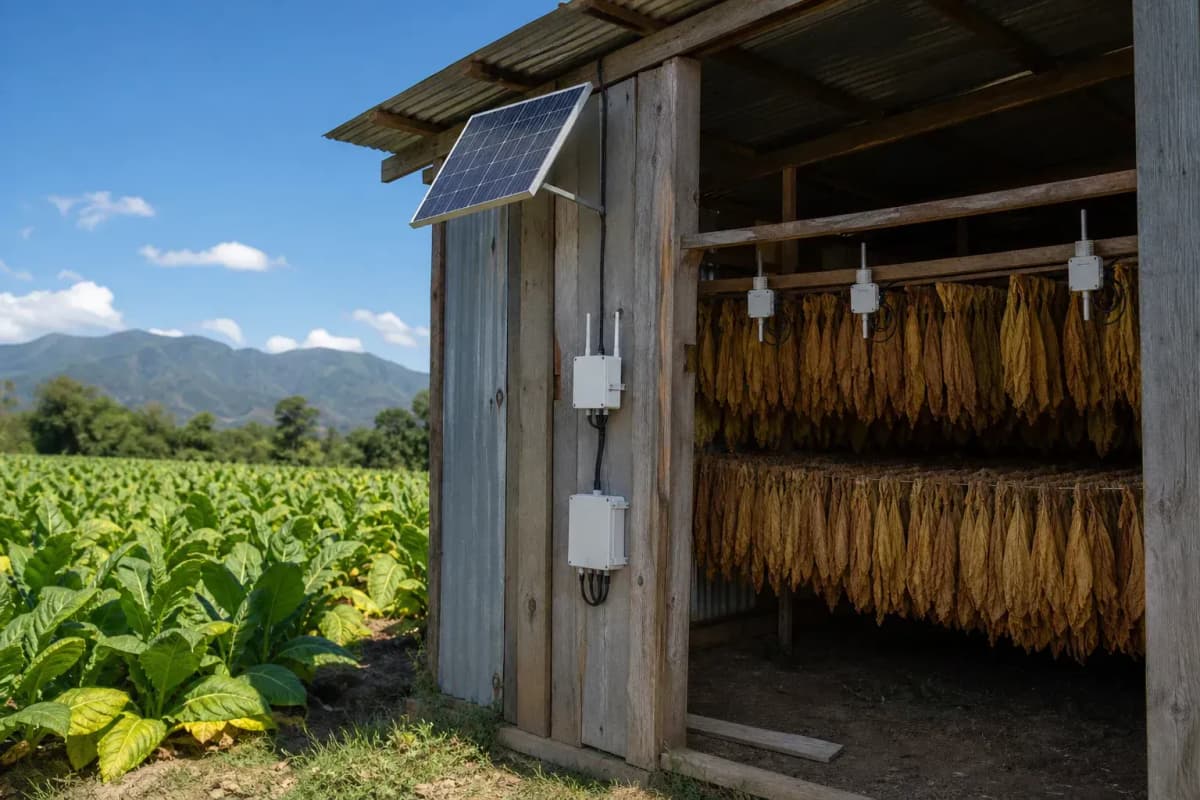
Tobacco Curing Barn Monitoring 4ha - 10-Sensor NB-IoT Solar Storage Control
Key Features
- 4 ha tobacco curing storage monitoring coverage with 10 distributed sensor points
- 10-minute default data interval, configurable from 1 to 60 minutes
- NB-IoT communication removes the need for 1 farm gateway on small barn clusters
- Solar medium power package uses 10-80 W PV class with LFP battery autonomy
- EPC turnkey price range is $1,104-$1,380 including commissioning and 1-year support
Tobacco Curing Barn Monitoring 4ha is a 10-sensor smart agriculture IoT system for tobacco curing storage, using NB-IoT communication, solar medium power, 10-minute data intervals, and temperature-humidity control. EPC turnkey pricing is $1,104-$1,380 with engineering, installation, commissioning, cloud activation, and 1-year support included.
Description
Tobacco Curing Barn Monitoring 4ha is a 10-sensor smart agriculture IoT monitoring system designed for tobacco curing storage environments across 4 hectares of barn-linked production area. The system combines NB-IoT communication, solar medium power, 10-minute configurable data logging, temperature control, humidity control, and standard cloud analytics for curing managers who need traceable data instead of 1 manual inspection every few hours.
The product is part of SOLARTODO's Smart Agriculture IoT Monitoring System line and is configured for storage monitoring rather than open-field irrigation or pest imaging. Buyers comparing multiple farm automation categories can View all Smart Agriculture IoT Monitoring System products, Configure your system online, or Request a custom quotation for barn count, SIM plan, sensor spacing, and EPC installation scope.
Application Context for Tobacco Curing
Tobacco curing is a controlled drying and conditioning process where temperature and relative humidity changes over 24-hour and multi-day cycles directly affect leaf color, moisture migration, and post-cure storage quality. In a 4 ha tobacco operation, even 1 curing barn with uneven airflow can create localized hot spots, wet pockets, or over-drying zones, so the 10-sensor layout is intended to place multiple measurement points near intake air, exhaust air, mid-barn leaf mass, upper rack position, lower rack position, and storage transition areas.
Unlike a weather-only station that measures 4 to 10 outdoor parameters, this configuration focuses on indoor storage and curing variables that are actionable for barn operators. The standard set covers temperature and humidity at 10 points, with optional CO2, O2, ethylene, and insect-activity inputs available when the buyer needs controlled-atmosphere storage, curing validation, or post-harvest loss detection.
A conventional curing barn often depends on 2 to 4 wall thermometers, operator experience, and periodic manual logbooks, which can miss a 20-minute humidity spike or a 5 °C stratification event. By contrast, this 10-point NB-IoT system records data every 10 minutes, stores historical trends, and triggers SMS, email, and app alerts when the barn deviates from the configured temperature-humidity envelope.
System Architecture
The architecture uses 10 distributed sensor positions connected to storage sensor nodes, a solar medium power kit, an LFP battery, a protected outdoor enclosure, and NB-IoT cellular communication that avoids the need for a local LoRaWAN gateway. NB-IoT is selected because a 4 ha barn cluster usually needs direct carrier coverage, low device power, subscription-based operation, and cellular-grade data retransmission after network recovery.
Each sensor position can be installed as a temperature-humidity probe in the curing chamber, a cable-mounted probe in a rack layer, or a protected probe near the storage transition zone. A practical 10-point topology uses 2 intake sensors, 2 exhaust sensors, 2 upper-rack sensors, 2 middle-rack sensors, and 2 lower or storage buffer sensors, giving procurement teams a clear bill of materials before installation.
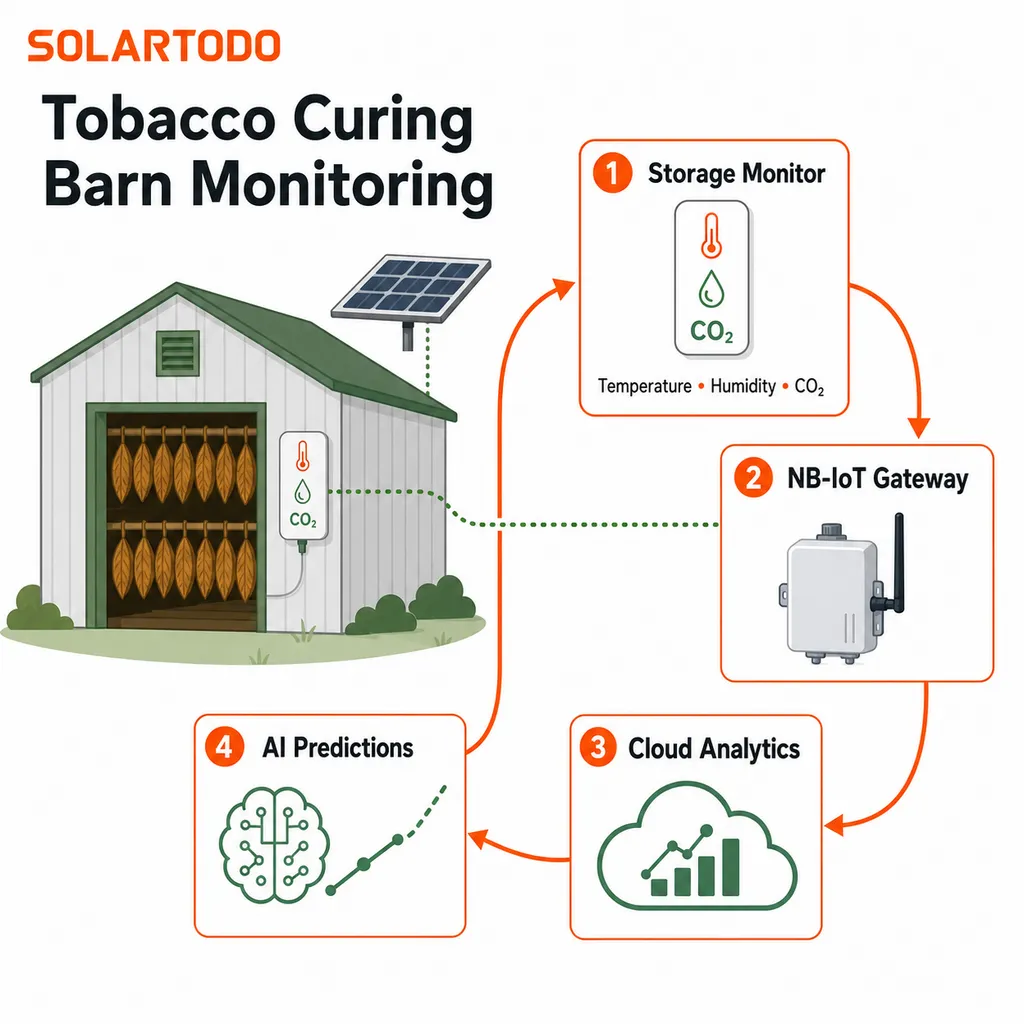
The system follows the same data-network logic used in agricultural equipment interoperability, where ISO 11783 defines serial control and communications between sensors, control elements, displays, and storage units for agricultural machinery. Although this barn package is not an ISOBUS tractor implement, referencing ISO 11783 helps engineers align naming, data objects, and future integration with farm management systems ISO 11783-1:2017.
Technical Specifications
The standard configuration covers 4 hectares, 10 sensors, NB-IoT communication, solar medium power, a standard cloud tier, and storage monitoring for tobacco curing. The data interval is 10 minutes by default and can be configured from 1 to 60 minutes depending on battery autonomy, SIM traffic cost, alarm criticality, and the required granularity of curing records.
| Parameter | Standard Configuration | Engineering Note |
|---|---|---|
| Coverage area | 4 ha | Suitable for barn-linked tobacco production blocks |
| Monitoring type | Storage | Optimized for curing and post-cure environment control |
| Total sensors | 10 sensors | Multi-point temperature and humidity mapping |
| Communication | NB-IoT | Cellular connection with no farm gateway required |
| Power supply | Solar medium | Typically 10-80 W PV class with LFP battery |
| Data interval | 10 min | Configurable from 1-60 min |
| Cloud tier | Standard | Dashboard, history, alerts, and REST API |
| Alert channels | 3 channels | SMS, email, and app push |
| Warranty | 2 years hardware | 1 year cloud and EPC support included |
Sensor housings should be specified to IP67 or IP68 where washdown, dust, or high-humidity curing environments are expected, because IEC 60529 defines ingress protection ratings for solids and water exposure. For barn installation, IP67 protection is generally sufficient for splash, dust, and condensation, while IP68 can be selected for cable probes exposed to prolonged moisture or buried conduit sections IEC 60529.
The solar medium package uses a photovoltaic module in the 10-80 W class and an LFP battery sized for maintenance-free outdoor operation. IRENA notes that decentralized renewable energy supports post-harvest processes including storage and agro-processing, which is directly relevant to solar-powered curing monitoring in rural sites with unstable utility service IRENA 2016.
Cloud Monitoring
The standard cloud tier provides real-time dashboards, historical trend analysis, AI-powered alert rules, API access, and device-level health status for 10 connected sensor channels. Operators can view hourly and daily curves, export curing logs, check battery voltage, confirm signal strength, and identify a failed sensor before 1 batch of tobacco is exposed to uncontrolled barn conditions.
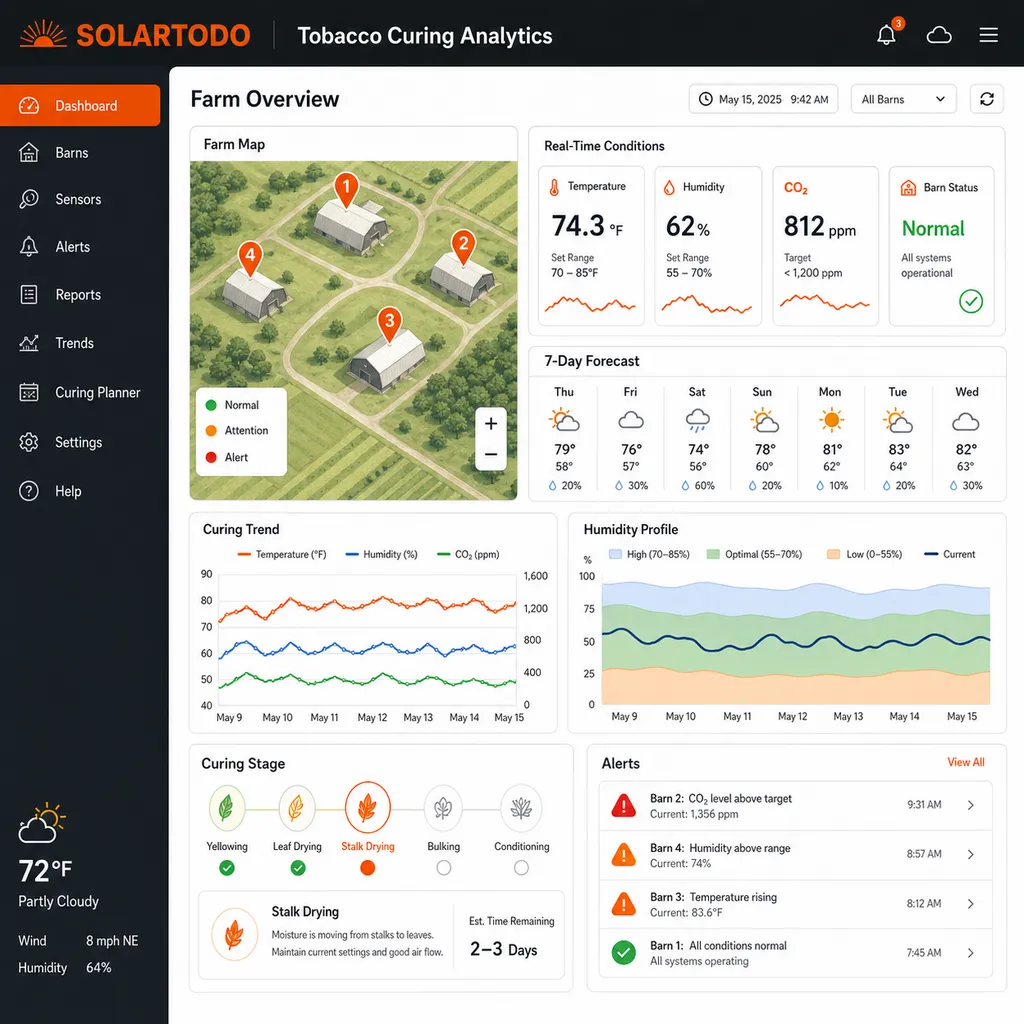
Digital monitoring is relevant because the IEA describes sensors, smart meters, connectivity, and analytics as a path to improved energy efficiency through physical-environment control. In tobacco curing, that means temperature and humidity records can help operators reduce over-heating, avoid unnecessary ventilation cycles, and document process stability across each 10-minute sampling period IEA 2019.
The REST API allows third-party farm software, ERP procurement systems, or local SCADA dashboards to ingest time-stamped curing records. For buyers building a broader smart agriculture program, SOLARTODO knowledge articles provide related technical context at Learn about topic, including sensor selection, solar power sizing, and cloud-device lifecycle planning.
Representative Scenario: 4 ha Tobacco Barn Cluster
For a representative MENA tobacco-curing scenario, assume 4 hectares of tobacco supply 1 barn cluster with 10 sensor points, 1 solar medium kit, 1 NB-IoT data service, and 1 standard cloud account. During a 7-day curing cycle, the system creates up to 1,008 readings per sensor at 10-minute intervals, or 10,080 readings across 10 sensors before optional alarm, battery, and signal-quality records are counted.
In that scenario, the operator defines a temperature-humidity schedule for each curing phase, then uses alarms to detect deviations such as a 5 °C upper-rack hot spot, a 10% RH storage-zone humidity rise, or a 30-minute communication outage. The purpose is not to claim a guaranteed yield increase, but to provide measurable process data that supports consistent curing decisions, equipment maintenance, and procurement-grade quality documentation.
Compared with a conventional alternative using 2 manual thermometers and 4 daily inspections, the 10-sensor system reduces blind spots by at least 5x and increases record frequency from 4 observations per day to 144 observations per day per sensor. This is a monitoring-density improvement of 36x per sensor channel, before considering cloud alarms, historical analytics, and automatic retransmission after NB-IoT recovery.
NREL has reported agrivoltaic and solar-agriculture studies where water-use efficiency improvements reached 157% for jalapeno and soil moisture remained about 15% higher under certain PV conditions. Those results are not tobacco-curing guarantees, but they show why solar-powered agricultural instrumentation can support resource-aware farm operations when monitoring and control are applied correctly NREL 2019.
EPC Investment Analysis and Pricing Structure
EPC turnkey delivery includes engineering, procurement, construction, commissioning, cloud activation, training, documentation, and warranty support for 1 complete 4 ha tobacco curing barn monitoring system. Engineering covers sensor placement drawings, power autonomy review, NB-IoT signal confirmation, alarm-threshold setup, and an installation checklist; procurement covers 10 sensors, solar power hardware, data logger, enclosure, cables, and cloud subscription activation.
| Pricing Tier | Scope | Price Range (USD) |
|---|---|---|
| FOB Supply | Equipment only, ex-works China | $684-$938 |
| CIF Delivered | Equipment plus ocean freight and insurance | $713-$978 |
| EPC Turnkey | Installed, commissioned, trained, and supported for 1 year | $1,104-$1,380 |
The EPC price range of $1,104-$1,380 is built for smaller barn projects where installation labor, commissioning, and warranty support can represent 25-40% of turnkey value. Payment terms are 30% T/T deposit plus 70% against bill of lading, or 100% irrevocable L/C at sight; project financing can be discussed for aggregated programs above $1,000K by contacting [email protected].
| Order Quantity | Discount | Typical Buyer Use Case |
|---|---|---|
| 50+ systems | 5% | Regional integrator standardizing 50 barn clusters |
| 100+ systems | 10% | Agricultural cooperative rolling out 100 monitored sites |
| 250+ systems | 15% | National procurement program with 250+ curing assets |
ROI depends on tobacco value, curing fuel cost, labor cost, and spoilage risk, so SOLARTODO presents payback as a decision model rather than a guaranteed result. If a 4 ha site avoids only $400 in quality downgrades, $250 in labor logging, and $150 in avoidable fuel or ventilation waste per year, total annual benefit is $800 and payback on a $1,104-$1,380 EPC system is approximately 1.4-1.7 years.
Against the conventional alternative of manual logging, standalone thermometers, and delayed fault discovery, this system adds cloud traceability, multi-point mapping, and automatic alarms for roughly the cost of 1 small farm instrument package. IEEE research on IoT-based smart farm control has reported simulated water-consumption reductions up to 30% versus fixed schedules, which supports the general value of sensor-based control even though tobacco curing is a storage and drying application rather than an irrigation-only use case IEEE 2026.
Procurement, Installation, and Commissioning Notes
Before shipment, SOLARTODO defines the sensor count, cable length, SIM plan, enclosure mounting position, PV module location, and cloud account structure for each 4 ha configuration. For tobacco barns with metal roofs or thick walls, NB-IoT antenna placement should be validated with at least 1 site signal test, because cellular attenuation can be significant inside steel-clad curing structures.
During installation, the solar panel should be mounted with a clear sky view, the LFP battery should be protected from direct heat, and sensor cables should be routed away from fan blades, heaters, and high-condensation drip lines. Commissioning should verify 10 live sensor readings, 1 alarm test, 1 cloud login, 1 export function, and 1 API token before the system is accepted.
The warranty structure is 2 years for hardware and 1 year for cloud support under the standard EPC package, with extended service available for multi-site buyers. SOLARTODO recommends preventive inspection every 6 months to clean the PV module, check cable glands, review battery voltage history, update alarm thresholds, and confirm that all 10 sensors remain within calibration tolerance.
Buyer Fit and Related Knowledge
This product fits EPC contractors, tobacco processors, agricultural cooperatives, government farm-modernization programs, and smart-infrastructure buyers who need a low-power monitoring layer for 4 ha curing operations. It is also suitable for procurement teams that want a standard system number, a clear 10-sensor bill of materials, and a turnkey price that can be compared with FOB and CIF alternatives.
For larger programs, the same architecture can be expanded to 50, 100, or 250 barn clusters with standardized dashboards and discount tiers. Buyers can review adjacent technical guidance at Learn about topic, compare product families at View all Smart Agriculture IoT Monitoring System products, and then Request a custom quotation with barn drawings, preferred SIM carrier, and target commissioning date.
Standards and Compliance Positioning
Relevant standards and references include ISO 11783 for agricultural communications concepts, IEC 60529 for IP67/IP68 ingress protection, WMO guidance for weather station practice when outdoor meteorological inputs are added, and CE or RoHS documentation for export-oriented electronics. Where a buyer requires UL-listed PV modules, IEC 61215/IEC 61730 module evidence, or country-specific telecom approvals, SOLARTODO can align the component selection during the procurement phase.
This page does not claim that any named customer has purchased, deployed, approved, or achieved a specific tobacco-quality result with this 4 ha package, because no verified project reference was supplied. The technical value proposition is based on 10-point measurement density, 10-minute records, solar autonomy, NB-IoT connectivity, cloud alarms, EPC installation scope, and cited industry guidance from ISO, IEC, IRENA, IEA, NREL, and IEEE.
Technical Specifications
| Coverage Area | 4ha |
| Monitoring Types | storage |
| Total Sensors | 10sensors |
| Application | tobacco_curing |
| Crop | tobacco |
| Communication | NB-IoT |
| Power Supply | solar_medium |
| Temperature Control | true |
| Humidity Control | true |
| Data Interval | 10 min configurable 1-60 min |
| Cloud Platform | standard |
| Alert Channels | SMS + Email + App Push |
| API Access | REST API included |
| Warranty | 2 years hardware, 1 year cloud |
Price Breakdown
| Item | Quantity | Unit Price | Subtotal |
|---|---|---|---|
| Temperature and humidity storage probes | 10 pcs | $38 | $380 |
| NB-IoT data logger and controller | 1 pcs | $110 | $110 |
| Solar medium power kit with LFP battery | 1 pcs | $225 | $225 |
| IP67 enclosure, mounting, cables, and glands | 1 pcs | $65 | $65 |
| Standard cloud platform subscription | 10 pcs | $12 | $120 |
| Installation and commissioning | 1 pcs | $250 | $250 |
| Engineering, configuration, and QC | 1 pcs | $90 | $90 |
| 1-year warranty and technical support | 1 pcs | $80 | $80 |
| Total Price Range | $1,104 - $1,380 | ||
Frequently Asked Questions
What does the Tobacco Curing Barn Monitoring 4ha system measure?
Why does this configuration use NB-IoT instead of LoRaWAN?
What is included in the $1,104-$1,380 EPC turnkey price?
Can the system control temperature and humidity automatically?
How often should the system be maintained?
Certifications & Standards


Data Sources & References
- •ISO 11783-1:2017 agricultural serial control and communications network
- •IEC 60529 ingress protection rating standard
- •IRENA Renewable Energy Benefits: Decentralised Solutions in the Agri-food Chain, 2016
- •IEA Energy Efficiency and Digitalisation, 2019
- •NREL Benefits of Agrivoltaics Across the Food-Energy-Water Nexus, 2019
- •IEEE Xplore DOI 10.1109/ETFI68128.2026.11484718
Interested in this solution?
Contact us for a customized quote based on your specific requirements.
Contact Us